 Скачать презентацию Experience of new fuel assembly operation and perspectives
9d497b6829b9f6d42f70d9999810f831.ppt
- Количество слайдов: 17



Experience of new fuel assembly operation and perspectives of fuel cycle development for NPP with VVER Author: Мokhov V. А. International scientific and technical conference “Nuclear engineering safety, efficiency and economy” Moscow, May 26 -27, 2010
New fuel assemblies – TVS (2 М) Short background of the new fuel development for VEER-1000 The new Russian fuel is an aggregate of design and technological upgradings performed beginning with the end of the 90 -ies and appearing in the form of TVS-2 (2 M) and TVSA fuel assemblies (FA), on the basis of which universal fuel cycles were developed but whose designs are essentially different. This presentation concerns TVS-2 (2 М) which became a prototype for the new design of AES-2006 fuel assemblies. This fuel was developed not simultaneously with the reactor unit design but independently, with the adaptation to the conditions of power units already under operation, with the aim of reducing the fuel constituent of the operational costs and reserving the VVER fuel market for the Russian Supplier 2
New fuel assemblies – TVS-2 (2 М) Relevant operational objectives • NPP unit power increase • Introduction of 18 -month fuel cycles • Operational properties improvement Capacity factor increase • Reduction of natural uranium specific consumption Fuel assembly design features • Fuel loading increase • Increase of the fuel initial enrichment to 5% • Modernisations and justifications for reliability growth during handling and operation 3
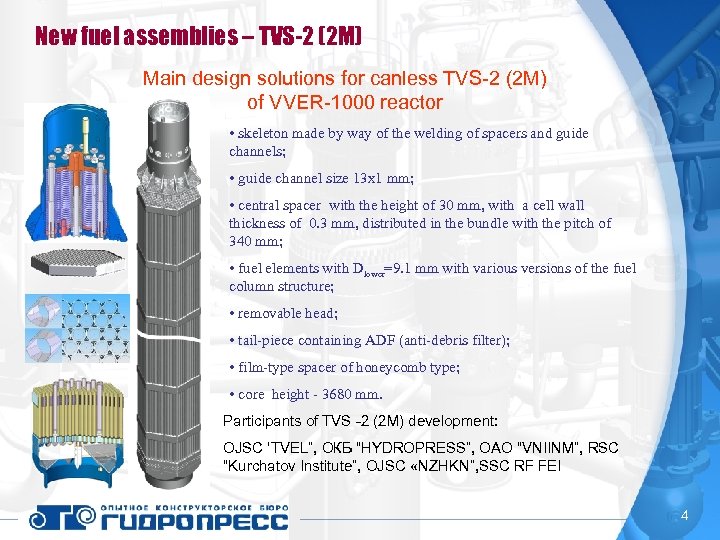
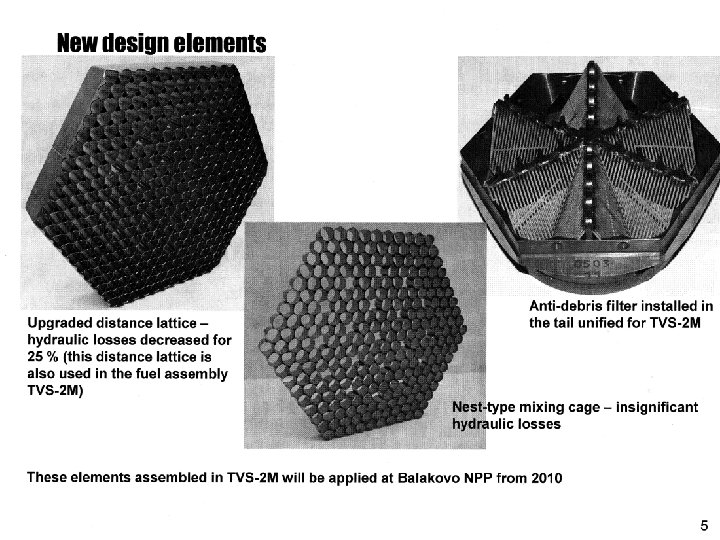
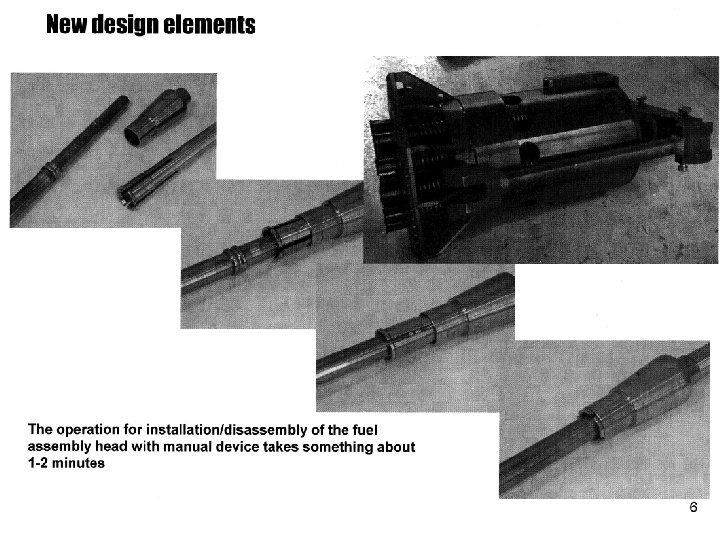
New fuel assemblies – TVS-2 (2 М) Main design solutions for canless TVS-2 (2 М) of VVER-1000 reactor • skeleton made by way of the welding of spacers and guide channels; • guide channel size 13 х1 mm; • central spacer with the height of 30 mm, with a cell wall thickness of 0. 3 mm, distributed in the bundle with the pitch of 340 mm; • fuel elements with Dlower=9. 1 mm with various versions of the fuel column structure; • removable head; • tail-piece containing ADF (anti-debris filter); • film-type spacer of honeycomb type; • core height - 3680 mm. Participants of TVS -2 (2 М) development: OJSC ‘TVEL”, ОКБ “HYDROPRESS”, ОАО “VNIINM”, RSC “Kurchatov Institute”, OJSC «NZHKN”, SSC RF FEI 4
5
6
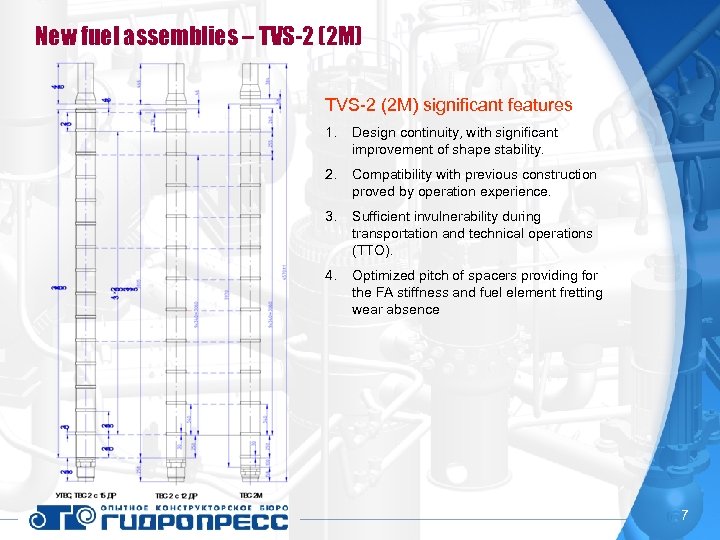
New fuel assemblies – TVS-2 (2 М) TVS-2 (2 M) significant features 1. Design continuity, with significant improvement of shape stability. 2. Compatibility with previous construction proved by operation experience. 3. Sufficient invulnerability during transportation and technical operations (ТТО). 4. Optimized pitch of spacers providing for the FA stiffness and fuel element fretting wear absence 7
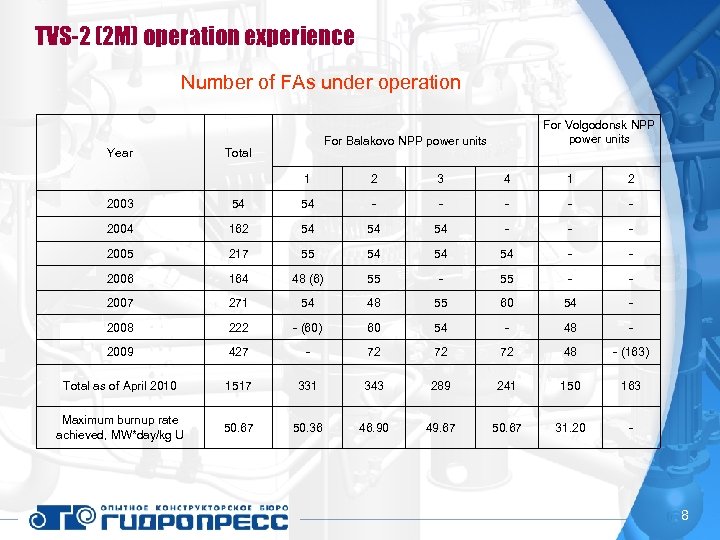
TVS-2 (2 M) operation experience Number of FAs under operation Year For Volgodonsk NPP power units For Balakovo NPP power units Total 1 2 3 4 1 2 2003 54 54 - - - 2004 162 54 54 54 - - - 2005 217 55 54 54 54 - - 2006 164 48 (6) 55 - - 2007 271 54 48 55 60 54 - 2008 222 - (60) 60 54 - 48 - 2009 427 - 72 72 72 48 - (163) Total as of April 2010 1517 331 343 289 241 150 163 Maximum burnup rate achieved, MW*day/kg U 50. 67 50. 36 46. 90 49. 67 50. 67 31. 20 - 8
TVS-2 (2 M) operation experience General indicators • Time of CPS control element drop – less than 2. 5 s. • CPS control element movement effort – less than 6 kgf Characteristic • Efforts for FA withdrawal from – installation in the core – within the design limits (± 75 kgf) of “fresh” core • Reliability achieved – 1. 6· 10 -6 • Capacity factor achieved – 90% (with accompanying reliable equipment operation) • Currently, there are no leaky fuel elements at power units with TVS-2 (2 М) • Integral indicator of TVS-2 (2 M) deformation absence – logical summary growth of fuel assemblies for ~ 1. 5 mm per cycle 9
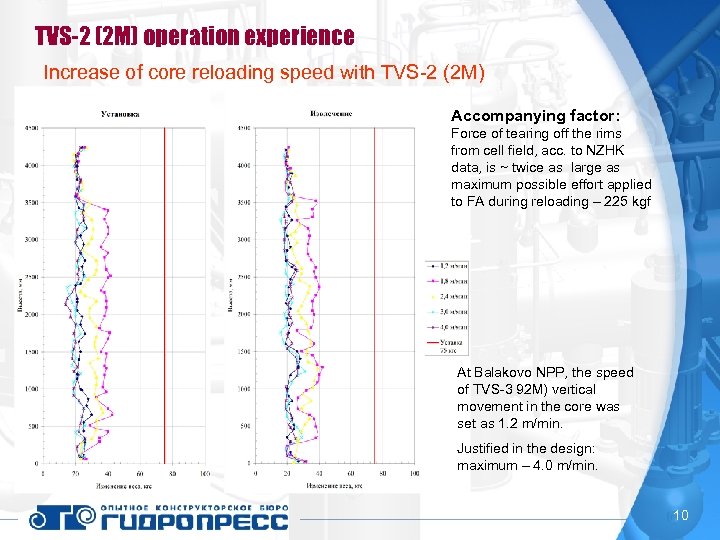
TVS-2 (2 M) operation experience Increase of core reloading speed with TVS-2 (2 М) Accompanying factor: Force of tearing off the rims from cell field, acc. to NZHK data, is ~ twice as large as maximum possible effort applied to FA during reloading – 225 kgf At Balakovo NPP, the speed of TVS-3 92 M) vertical movement in the core was set as 1. 2 m/min. Justified in the design: maximum – 4. 0 m/min. 10
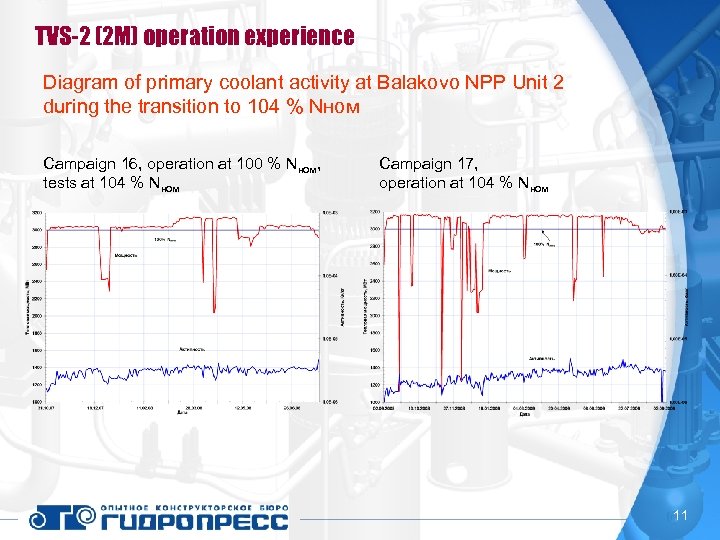
TVS-2 (2 M) operation experience Diagram of primary coolant activity at Balakovo NPP Unit 2 during the transition to 104 % Nном Campaign 16, operation at 100 % Nном, tests at 104 % Nном Campaign 17, operation at 104 % Nном 11
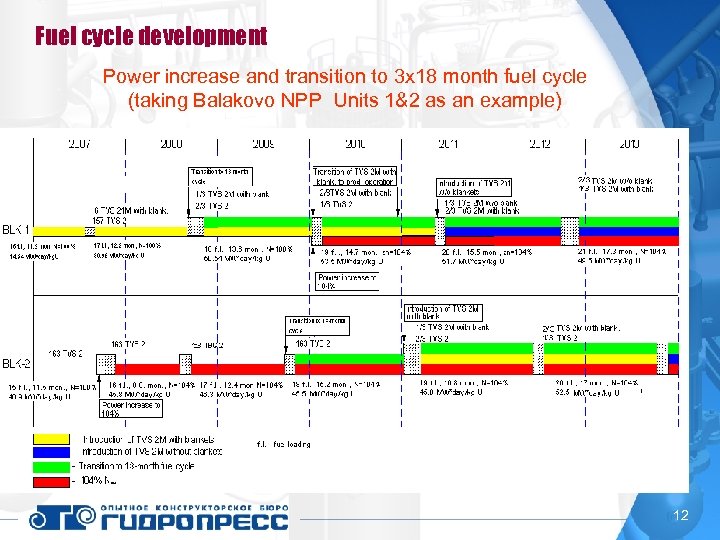
Fuel cycle development Power increase and transition to 3 х18 month fuel cycle (taking Balakovo NPP Units 1&2 as an example) 12
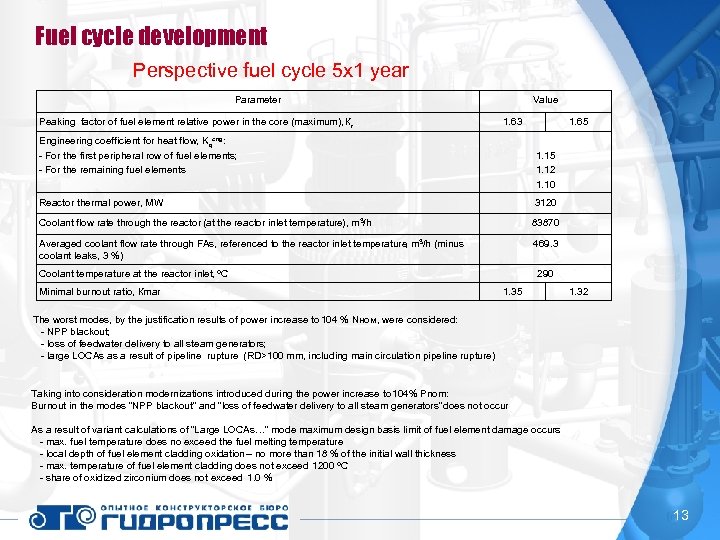
Fuel cycle development Perspective fuel cycle 5 х1 year Parameter Peaking factor of fuel element relative power in the core (maximum), Кr Value 1. 63 Engineering coefficient for heat flow, Kqeng: - For the first peripheral row of fuel elements; - For the remaining fuel elements 1. 65 1. 12 1. 10 Reactor thermal power, MW 3120 Coolant flow rate through the reactor (at the reactor inlet temperature), m 3/h 83870 Averaged coolant flow rate through FAs, referenced to the reactor inlet temperature m 3/h (minus , coolant leaks, 3 %) 469. 3 Coolant temperature at the reactor inlet, С Minimal burnout ratio, Кmar 290 1. 35 1. 32 The worst modes, by the justification results of power increase to 104 % Nном, were considered: - NPP blackout; - loss of feedwater delivery to all steam generators; - large LOCAs as a result of pipeline rupture (RD>100 mm, including main circulation pipeline rupture) Taking into consideration modernizations introduced during the power increase to 104% Pnom: Burnout in the modes “NPP blackout” and “loss of feedwater delivery to all steam generators” does not occur As a result of variant calculations of “Large LOCAs…” mode maximum design basis limit of fuel element damage occurs : - max. fuel temperature does no exceed the fuel melting temperature - local depth of fuel element cladding oxidation – no more than 18 % of the initial wall thickness - max. temperature of fuel element cladding does not exceed 1200 С - share of oxidized zirconium does not exceed 1. 0 % 13
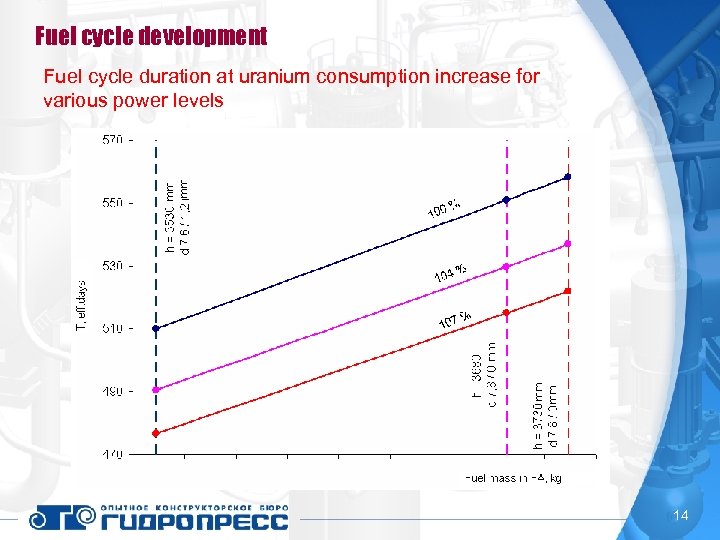
Fuel cycle development Fuel cycle duration at uranium consumption increase for various power levels 14
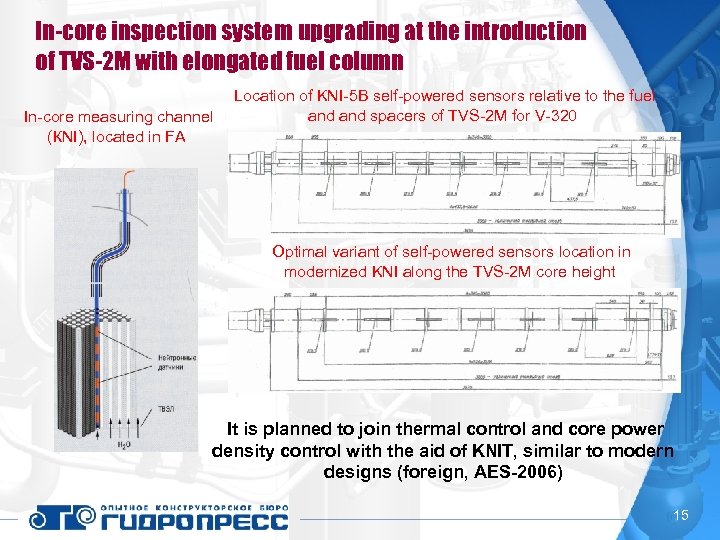
In-core inspection system upgrading at the introduction of TVS-2 M with elongated fuel column In-core measuring channel (КNI), located in FA Location of KNI-5 B self-powered sensors relative to the fuel and spacers of TVS-2 М for V-320 Optimal variant of self-powered sensors location in modernized KNI along the TVS-2 M core height It is planned to join thermal control and core power density control with the aid of KNIT, similar to modern designs (foreign, AES-2006) 15
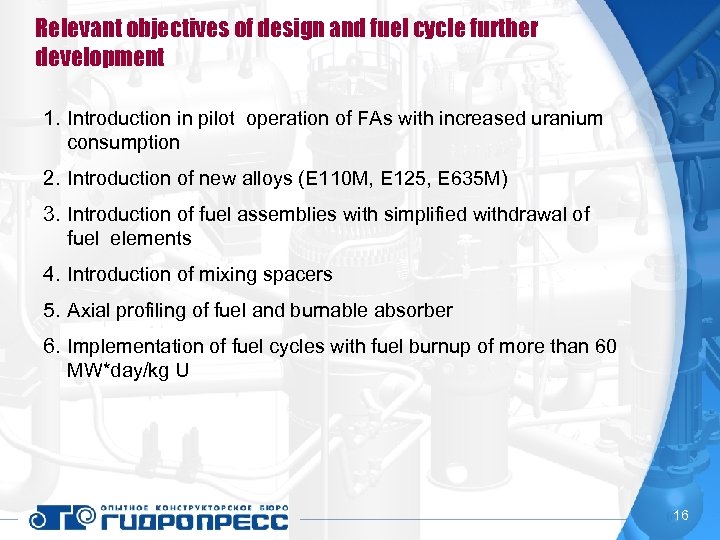
Relevant objectives of design and fuel cycle further development 1. Introduction in pilot operation of FAs with increased uranium consumption 2. Introduction of new alloys (E 110 М, E 125, E 635 М) 3. Introduction of fuel assemblies with simplified withdrawal of fuel elements 4. Introduction of mixing spacers 5. Axial profiling of fuel and burnable absorber 6. Implementation of fuel cycles with fuel burnup of more than 60 MW*day/kg U 16

Conclusion Basic design of TVS-2 (2 М) has a problem-free operational experience and is a reliable basis for further upgradings Thank you! 17
Скачать презентацию Experience of new fuel assembly operation and perspectives
9d497b6829b9f6d42f70d9999810f831.ppt