


 Скачать презентацию Expectations and individual differences in cognitive and affective
acd46cc03f29d760d615bced7b578ea6.ppt
- Количество слайдов: 94
 Expectations and individual differences in cognitive and affective control Collaborators Columbia Kevin Ochsner Ed Smith Martin Lindquist Emily Stern Joy Hirsch MBBH Brain Group Jim Rilling Jonathan Cohen Bob Rose Ed Smith Steve Kosslyn University of Michigan Richie Davidson Christian Waugh Margaret Kemmeny Barb Fredrickson Steve Taylor Israel Liberzon Ken Casey Doug Noll Tom Nichols Jon-Kar Zubieta
 One who has control over the mind is tranquil in heat and cold, in pleasure and pain, and in honor and dishonor. – Bhagavad Gita
 If you are distressed by anything external, the pain is not due to the thing itself, but to your estimate of it; and this you have the power to revoke at any moment – Marcus Aurelius
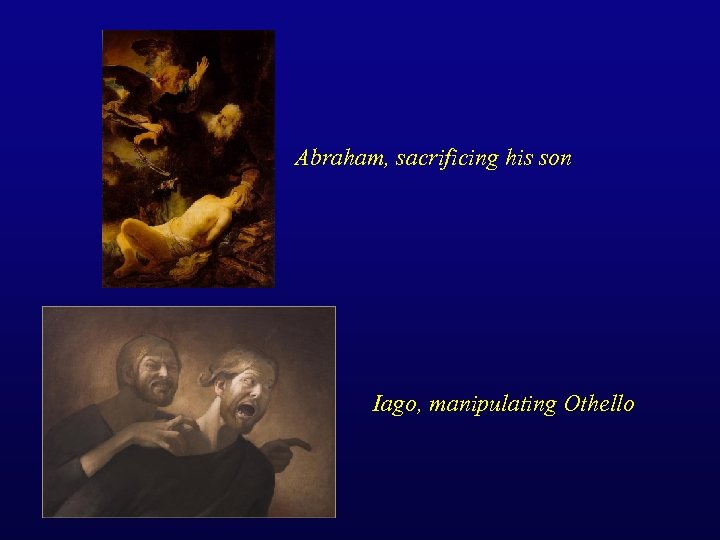 Abraham, sacrificing his son Iago, manipulating Othello
 Structure • What is control? – Define terms: goals, expectations, and control – Control theory and principles of self-regulation • Brain mechanisms of expectancy – Expectations in the control of attention – Expectations in the control of pain – Expectations in the control of emotion
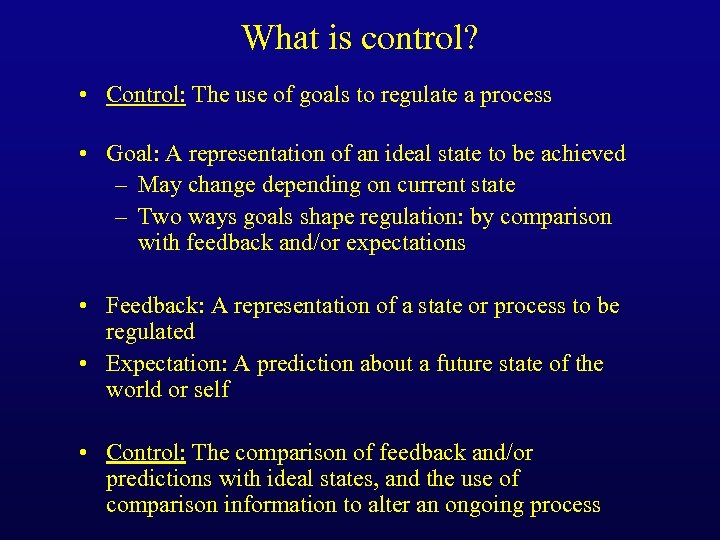 What is control? • Control: The use of goals to regulate a process • Goal: A representation of an ideal state to be achieved – May change depending on current state – Two ways goals shape regulation: by comparison with feedback and/or expectations • Feedback: A representation of a state or process to be regulated • Expectation: A prediction about a future state of the world or self • Control: The comparison of feedback and/or predictions with ideal states, and the use of comparison information to alter an ongoing process
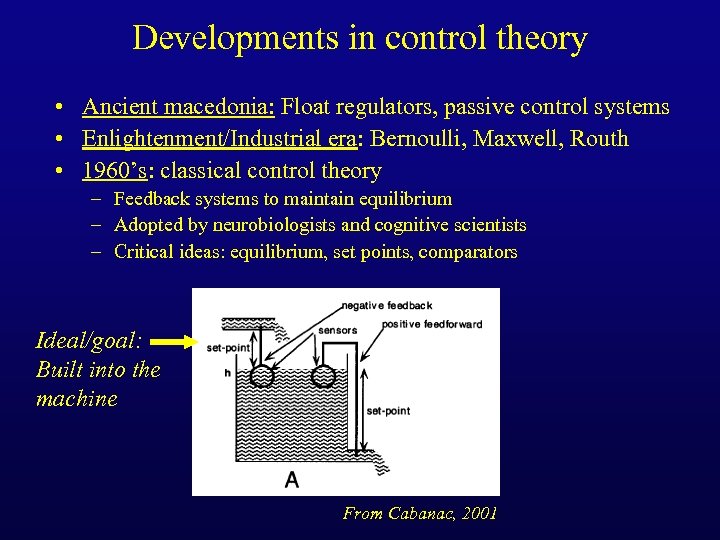 Developments in control theory • Ancient macedonia: Float regulators, passive control systems • Enlightenment/Industrial era: Bernoulli, Maxwell, Routh • 1960’s: classical control theory – Feedback systems to maintain equilibrium – Adopted by neurobiologists and cognitive scientists – Critical ideas: equilibrium, set points, comparators Ideal/goal: Built into the machine From Cabanac, 2001
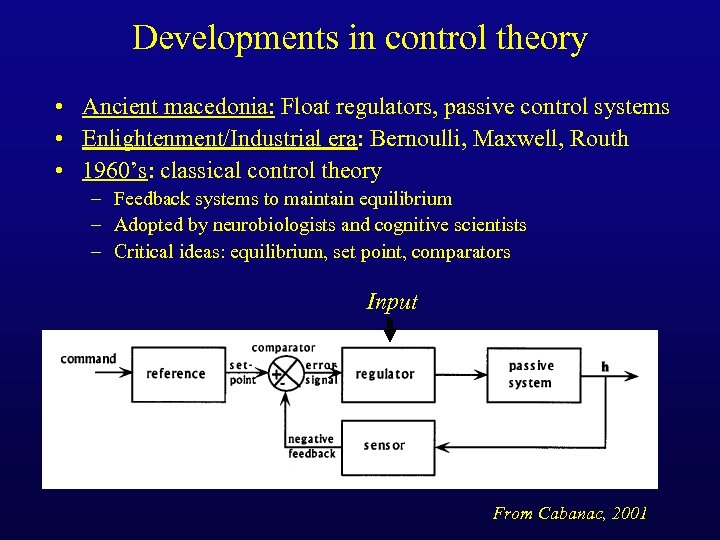 Developments in control theory • Ancient macedonia: Float regulators, passive control systems • Enlightenment/Industrial era: Bernoulli, Maxwell, Routh • 1960’s: classical control theory – Feedback systems to maintain equilibrium – Adopted by neurobiologists and cognitive scientists – Critical ideas: equilibrium, set point, comparators Input From Cabanac, 2001
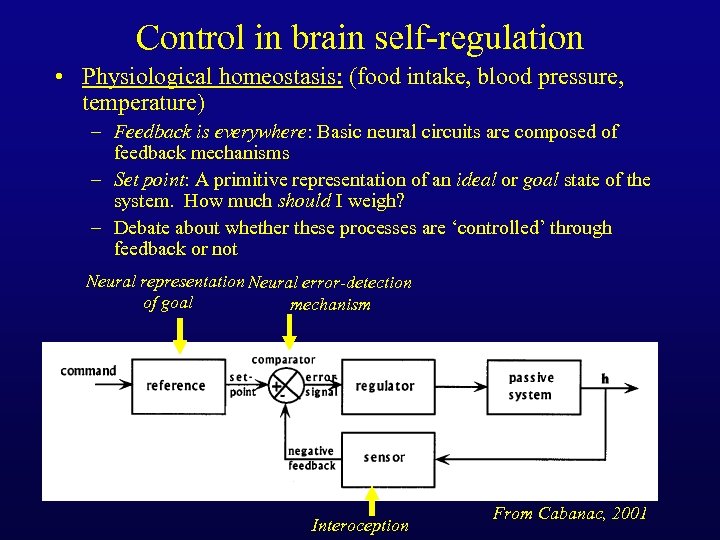 Control in brain self-regulation • Physiological homeostasis: (food intake, blood pressure, temperature) – Feedback is everywhere: Basic neural circuits are composed of feedback mechanisms – Set point: A primitive representation of an ideal or goal state of the system. How much should I weigh? – Debate about whether these processes are ‘controlled’ through feedback or not Neural representation Neural error-detection of goal mechanism Interoception From Cabanac, 2001
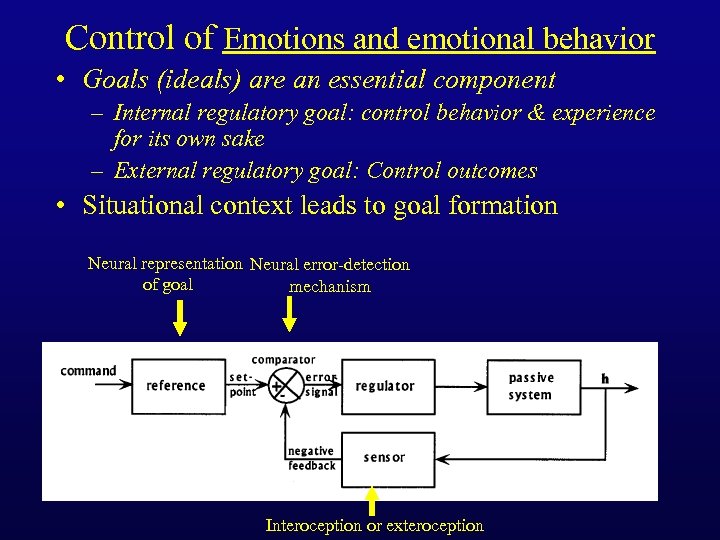 Control of Emotions and emotional behavior • Goals (ideals) are an essential component – Internal regulatory goal: control behavior & experience for its own sake – External regulatory goal: Control outcomes • Situational context leads to goal formation Neural representation Neural error-detection of goal mechanism Interoception or exteroception
 Developments in control theory • Ancient macedonia: Float regulators, passive control systems • Enlightenment/Industrial era: Bernoulli, Maxwell, Routh • 1960’s: classical control theory – Feedback systems to maintain equilibrium – Adopted by neurobiologists and cognitive scientists – Critical ideas: equilibrium, set point, comparators • Modern control theory – Adaptive control: control settings adjust to optimize performance (Analogue to strategy) – Neural networks – Borrows concepts from neurobiology – Focus on reactive control; Expectations largely absent
 Structure • What is control? – Define terms: goals, expectations, and control – Control theory and principles of self-regulation • Brain mechanisms of expectancy – Expectations in the control of attention – Expectations in the control of pain – Expectations in the control of emotion
 Control of attention • Cognitive science/neuroscience – Use tasks that tap basic information processing – Highly controlled tasks – Identify mechanisms for voluntarily focusing attention and selecting responses – Assumed to generalize: ‘free will’ or ‘cognitive flexibility’
 Control of attention • Instructions: If the center letter you are about to see is an H, raise one index finger. If the center letter is an S, raise two fingers.
 Control of attention HHH
 Control of attention SSS
 Control of attention SHS
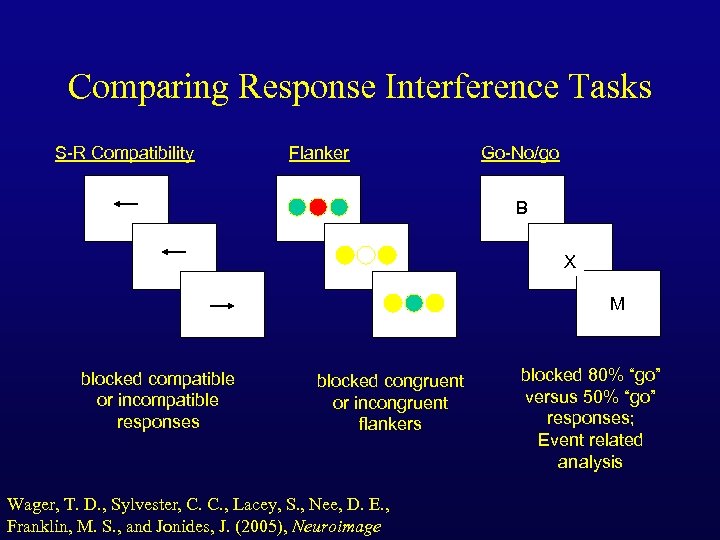 Comparing Response Interference Tasks S-R Compatibility Flanker Go-No/go B X M blocked compatible or incompatible responses blocked congruent or incongruent flankers Wager, T. D. , Sylvester, C. C. , Lacey, S. , Nee, D. E. , Franklin, M. S. , and Jonides, J. (2005), Neuroimage blocked 80% “go” versus 50% “go” responses; Event related analysis
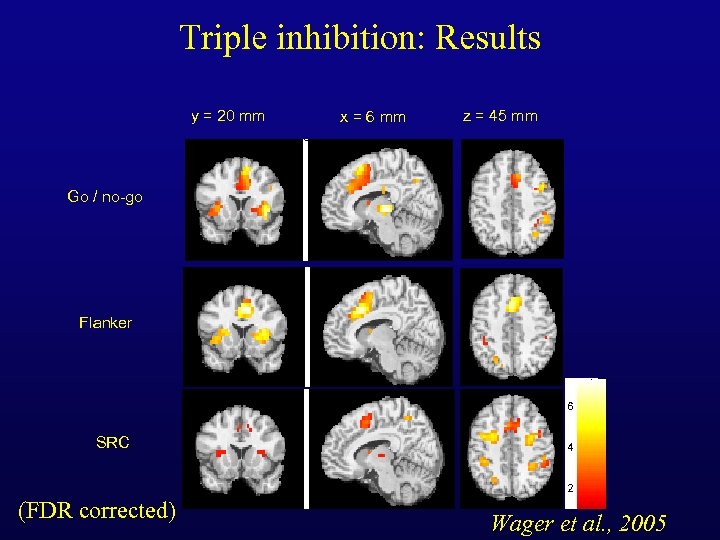 Triple inhibition: Results y = 20 mm x = 6 mm z = 45 mm Go / no-go Flanker SRC (FDR corrected) Wager et al. , 2005
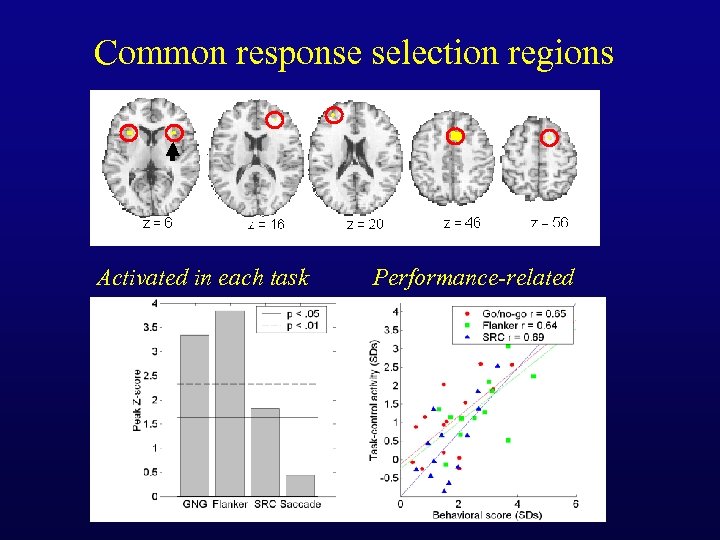 Common response selection regions Activated in each task Performance-related
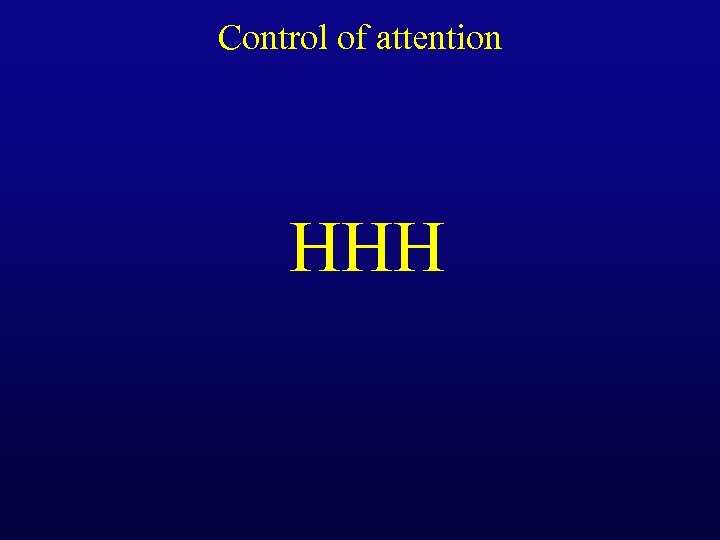
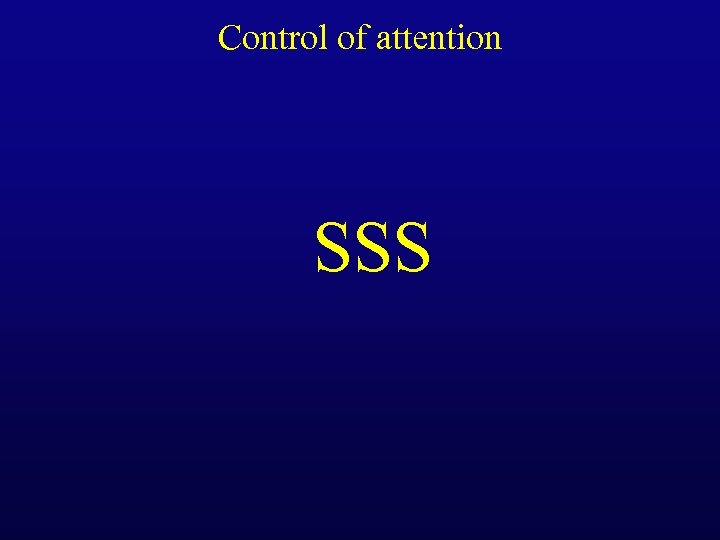
 Control of attention • How did you perform the task? – Instruction: “Respond to the center item” – Goal: make a correct response – Generate expectation: Important information in center, irrelevant information peripheral. – Maintain expectation: activity in brain must be maintained to interact with later stimulus processing – Bias perceptual mechanisms: Subgoal: enhance perception of center, block periphery – Expectancy generation = establishing a task set – This expectation of relevance, and the subsequent shaping of perception, is ‘attention’
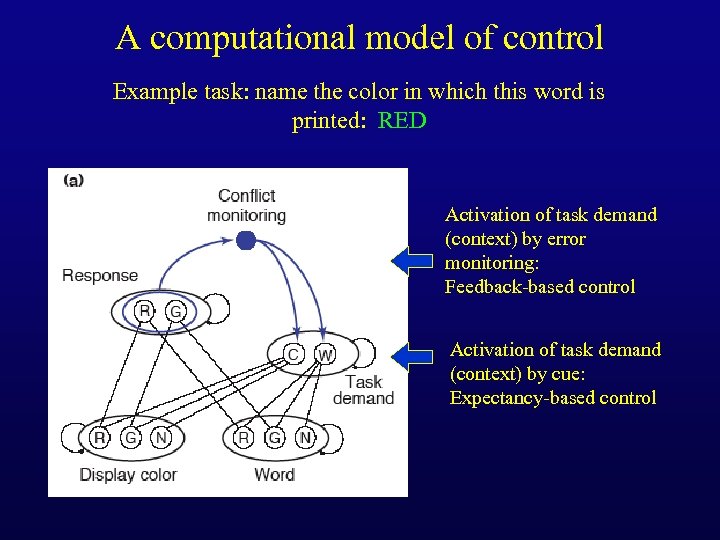 A computational model of control Example task: name the color in which this word is printed: RED Activation of task demand (context) by error monitoring: Feedback-based control Activation of task demand (context) by cue: Expectancy-based control
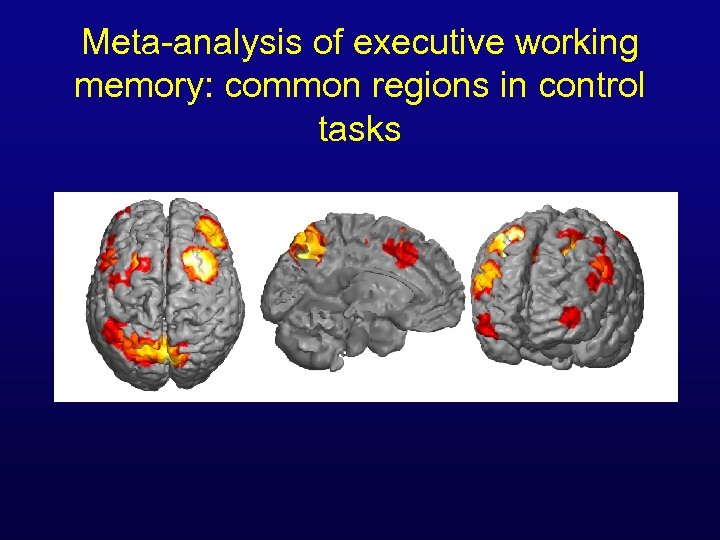 Meta-analysis of executive working memory: common regions in control tasks
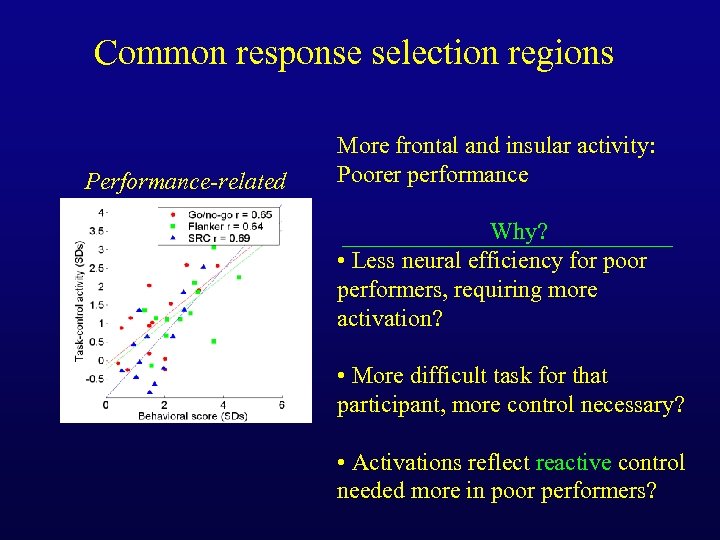 Common response selection regions Performance-related More frontal and insular activity: Poorer performance Why? • Less neural efficiency for poor performers, requiring more activation? • More difficult task for that participant, more control necessary? • Activations reflect reactive control needed more in poor performers?
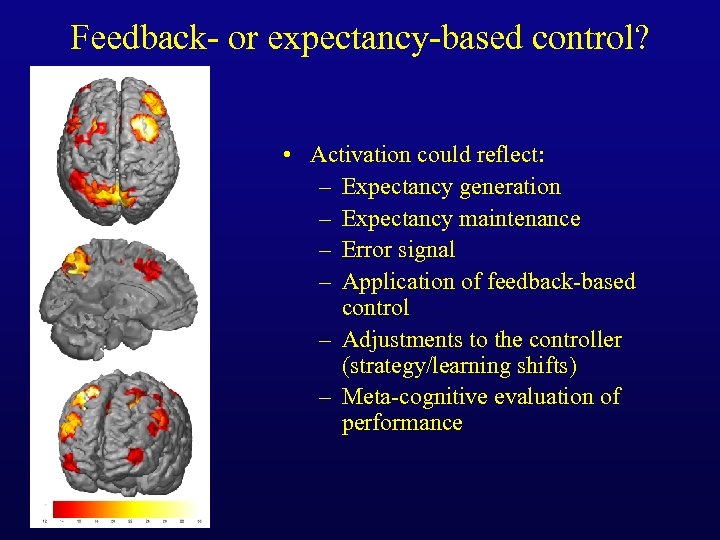 Feedback- or expectancy-based control? • Activation could reflect: – Expectancy generation – Expectancy maintenance – Error signal – Application of feedback-based control – Adjustments to the controller (strategy/learning shifts) – Meta-cognitive evaluation of performance
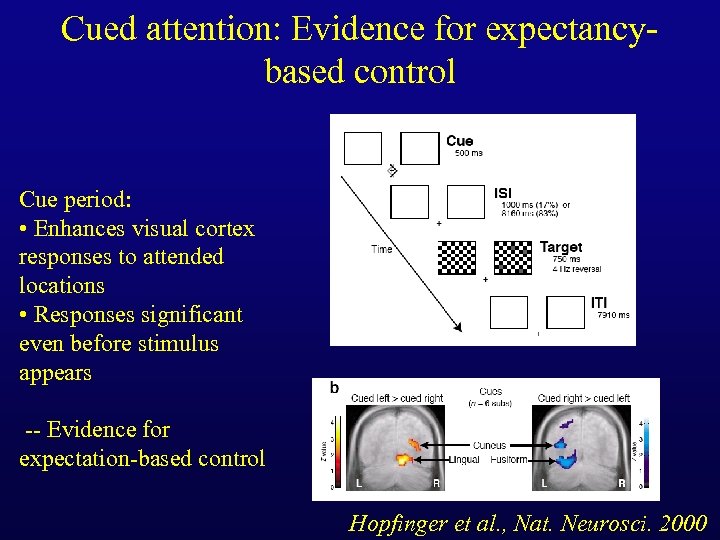 Cued attention: Evidence for expectancybased control Cue period: • Enhances visual cortex responses to attended locations • Responses significant even before stimulus appears -- Evidence for expectation-based control Hopfinger et al. , Nat. Neurosci. 2000
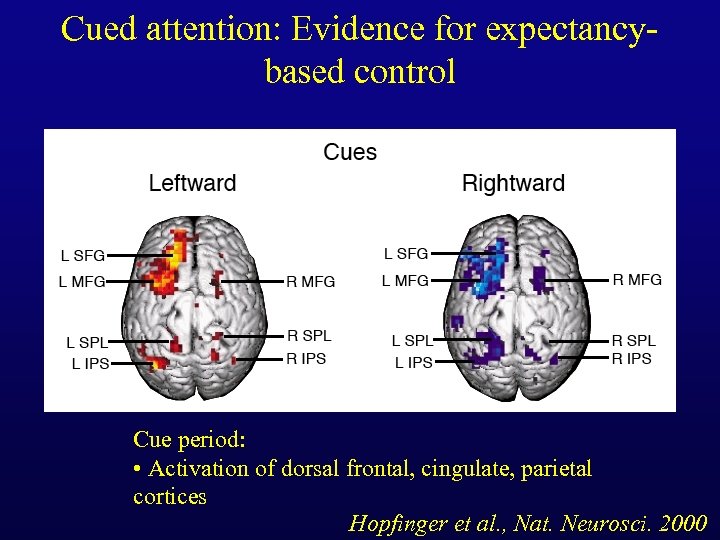 Cued attention: Evidence for expectancybased control Cue period: • Activation of dorsal frontal, cingulate, parietal cortices Hopfinger et al. , Nat. Neurosci. 2000
 Feedback- or expectancy-based control? • Activation likely to reflect: – Expectancy generation – Expectancy maintenance • But is frontal activity due to a general alerting response, or to specific task preparation?
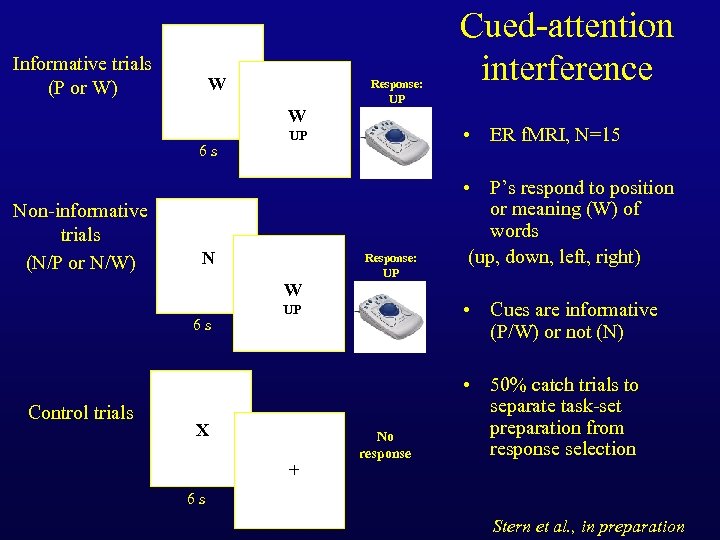 Informative trials (P or W) W Response: UP W 6 s Non-informative trials (N/P or N/W) • ER f. MRI, N=15 UP N Response: UP W 6 s X + • P’s respond to position or meaning (W) of words (up, down, left, right) • Cues are informative (P/W) or not (N) UP 2200 ms Control trials Cued-attention interference No response • 50% catch trials to separate task-set preparation from response selection 6 s Stern et al. , in preparation
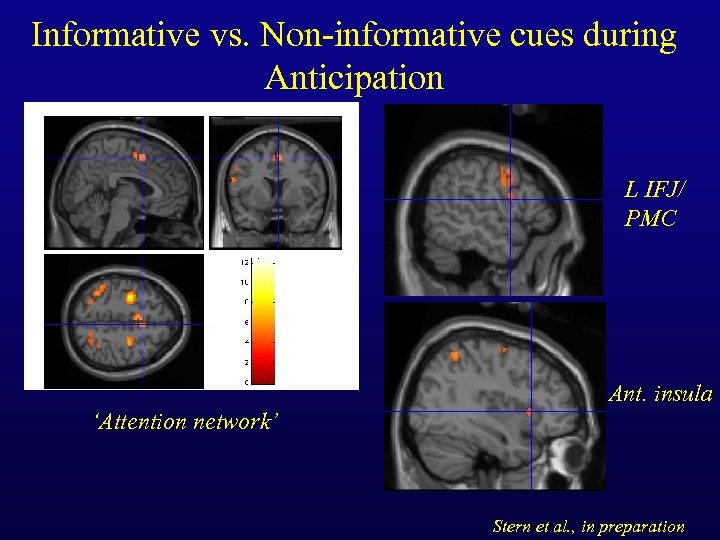 Informative vs. Non-informative cues during Anticipation L IFJ/ PMC Ant. insula ‘Attention network’ Stern et al. , in preparation
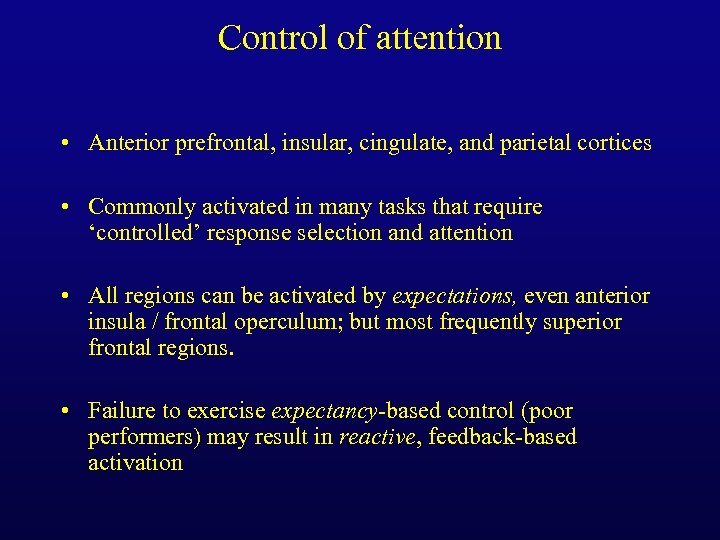 Control of attention • Anterior prefrontal, insular, cingulate, and parietal cortices • Commonly activated in many tasks that require ‘controlled’ response selection and attention • All regions can be activated by expectations, even anterior insula / frontal operculum; but most frequently superior frontal regions. • Failure to exercise expectancy-based control (poor performers) may result in reactive, feedback-based activation
 Structure • What is control? – Define terms: goals, expectations, and control – Control theory and principles of self-regulation • Brain mechanisms of expectancy – Expectations in the control of attention – Expectations in the control of pain – Expectations in the control of emotion
 Control of pain • Does ‘cognitive control’ over attention generalize to other domains, like pain and emotion? • Does affective information activate the ‘attention network, ’ and is this information linked to affective regulation? • Strategy: Manipulate expectancies about pain, examine neural correlates of expectancies and their impact on pain processing
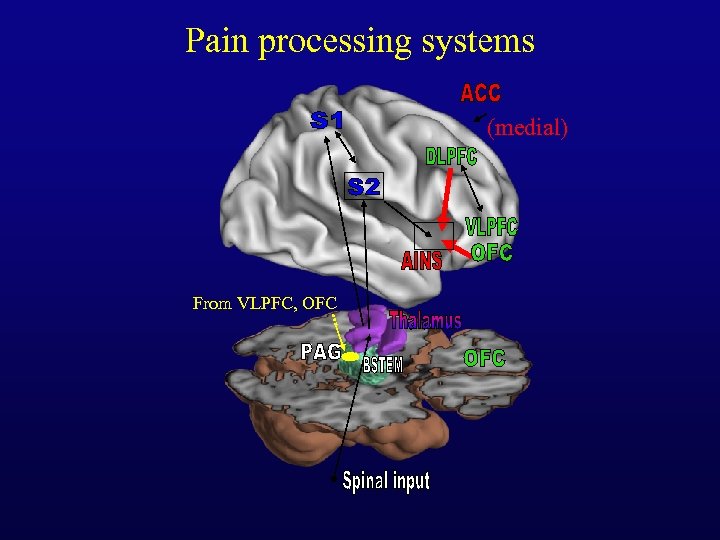 Pain processing systems (medial) From VLPFC, OFC
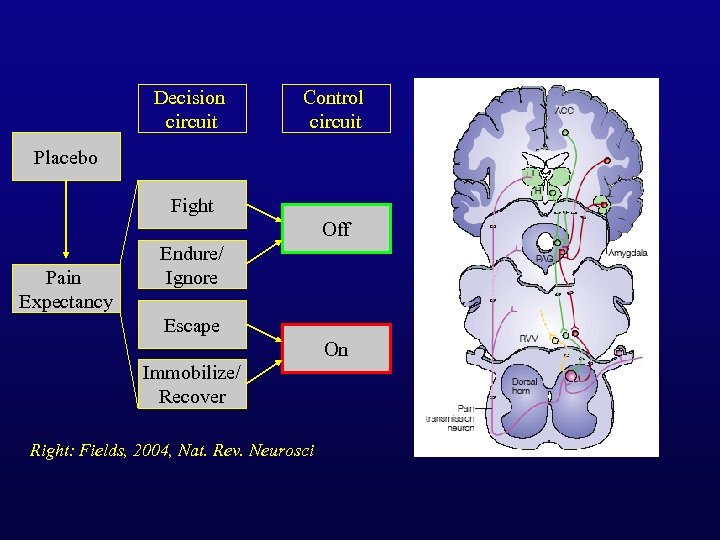 Decision circuit Control circuit Placebo Fight Off Pain Expectancy Endure/ Ignore Escape On Immobilize/ Recover Right: Fields, 2004, Nat. Rev. Neurosci
 What is the placebo effect? • Placebo effect: Improvement of signs or symptoms caused by administration of a treatment with no intrinsic beneficial effects. • In pain, analgesia caused by a sham treatment (e. g. , an injection of saline, an inert ointment) • Placebo treatment is a manipulation of expectancy and appraisal of meaning. – A tool for studying meaning generation, mechanisms of belief, and brain-body interactions
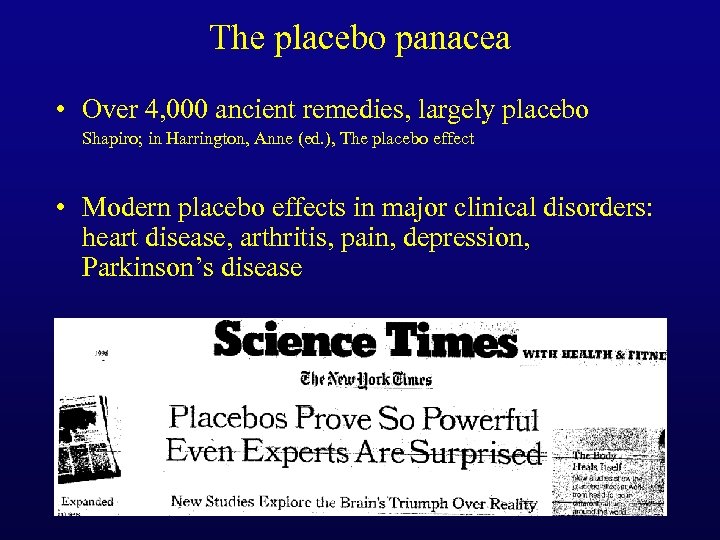 The placebo panacea • Over 4, 000 ancient remedies, largely placebo Shapiro; in Harrington, Anne (ed. ), The placebo effect • Modern placebo effects in major clinical disorders: heart disease, arthritis, pain, depression, Parkinson’s disease
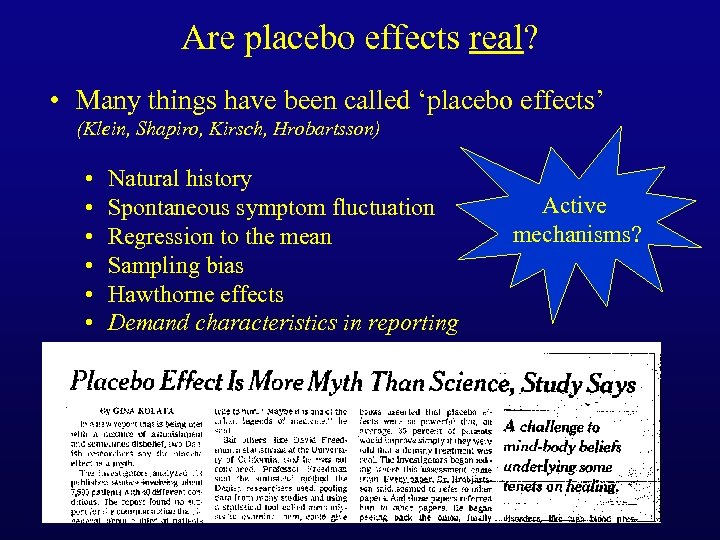 Are placebo effects real? • Many things have been called ‘placebo effects’ (Klein, Shapiro, Kirsch, Hrobartsson) • • • Natural history Spontaneous symptom fluctuation Regression to the mean Sampling bias Hawthorne effects Demand characteristics in reporting Active mechanisms?
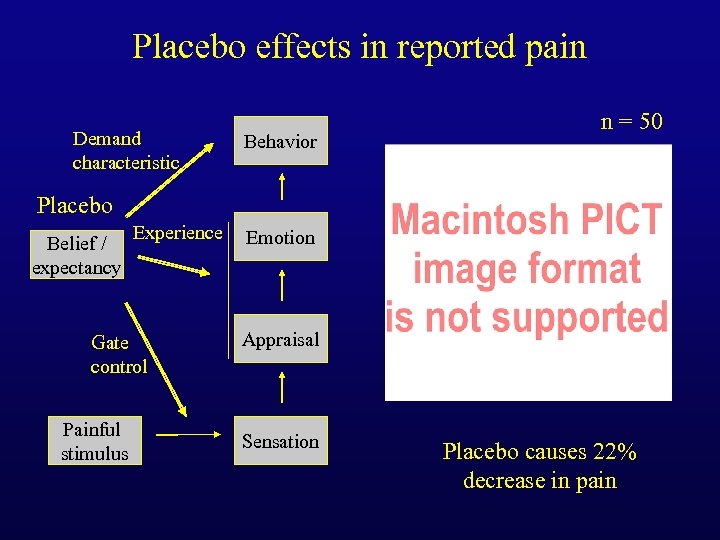 Placebo effects in reported pain Demand characteristic Behavior n = 50 Placebo Belief / expectancy Experience Gate control Painful stimulus Emotion Appraisal Sensation Placebo causes 22% decrease in pain
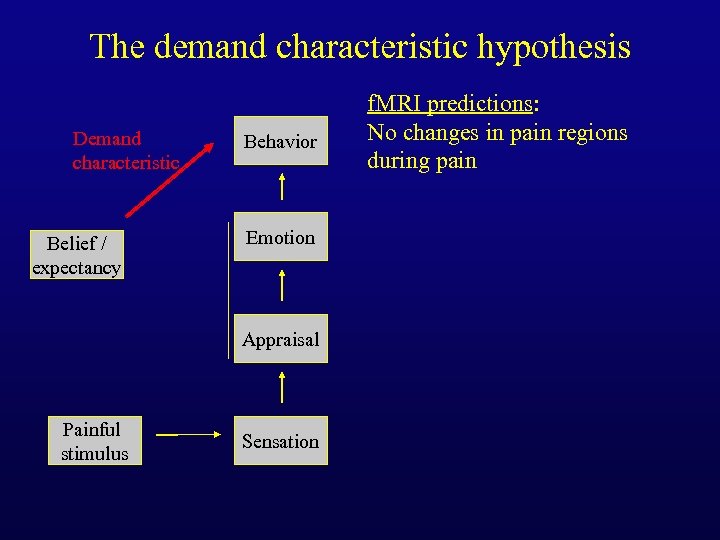 The demand characteristic hypothesis Demand characteristic Belief / expectancy Behavior Emotion Appraisal Painful stimulus Sensation f. MRI predictions: No changes in pain regions during pain
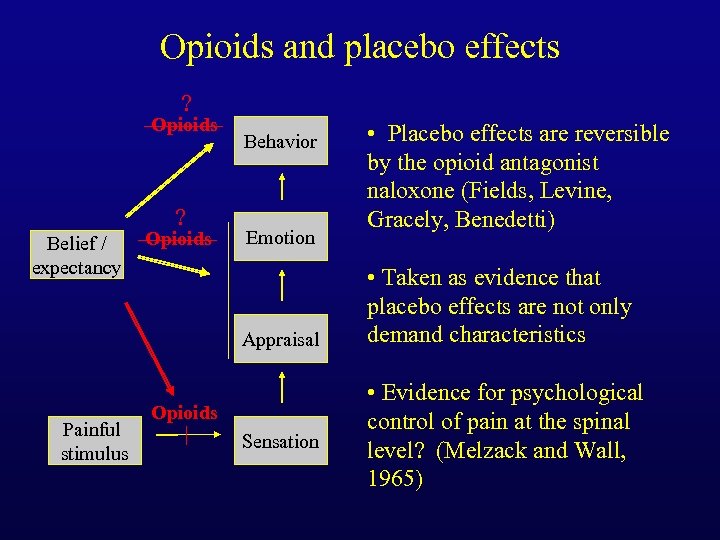 Opioids and placebo effects ? Opioids ? Belief / expectancy Opioids Behavior Emotion Appraisal Painful stimulus Opioids Sensation • Placebo effects are reversible by the opioid antagonist naloxone (Fields, Levine, Gracely, Benedetti) • Taken as evidence that placebo effects are not only demand characteristics • Evidence for psychological control of pain at the spinal level? (Melzack and Wall, 1965)
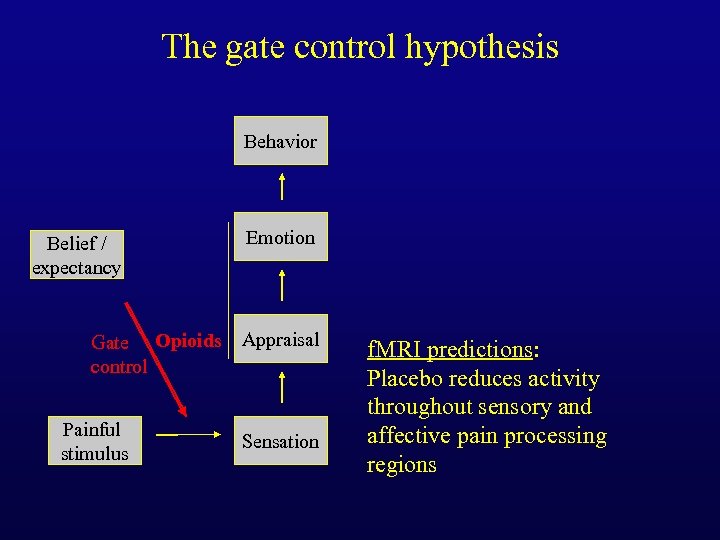 The gate control hypothesis Behavior Belief / expectancy Emotion Gate Opioids Appraisal control Painful stimulus Sensation f. MRI predictions: Placebo reduces activity throughout sensory and affective pain processing regions
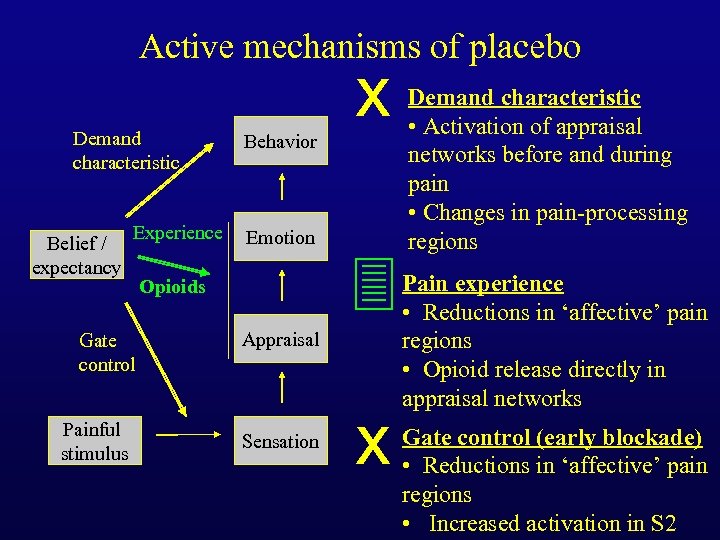
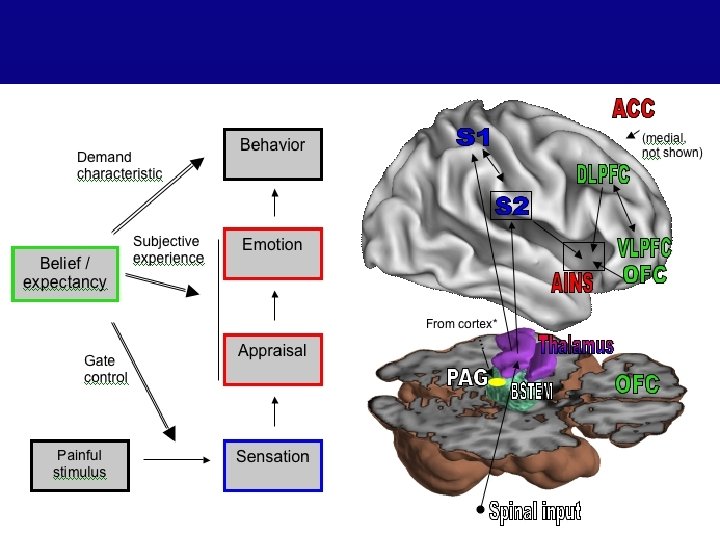
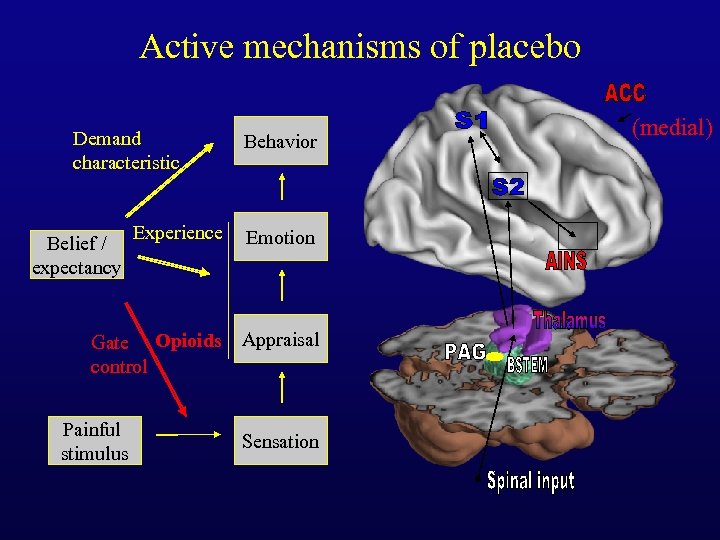 Active mechanisms of placebo Demand characteristic Belief / expectancy Experience Behavior Emotion Gate Opioids Appraisal control Painful stimulus Sensation (medial)
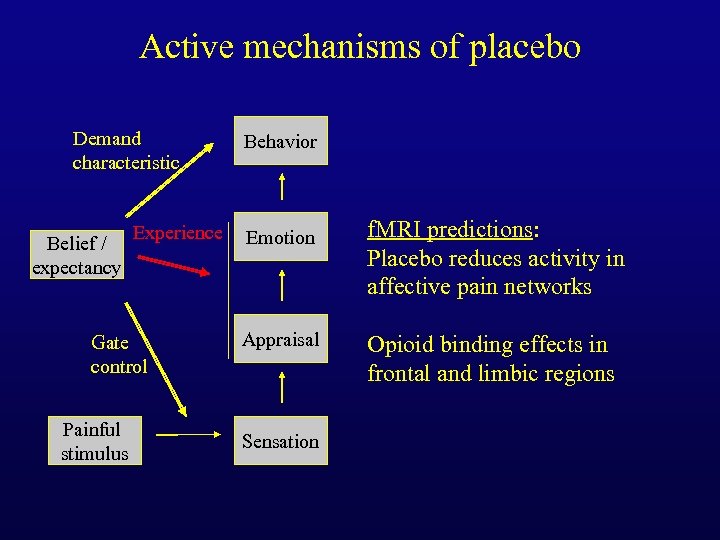 Active mechanisms of placebo Demand characteristic Belief / expectancy Experience Gate control Painful stimulus Behavior Emotion Appraisal Sensation f. MRI predictions: Placebo reduces activity in affective pain networks Opioid binding effects in frontal and limbic regions
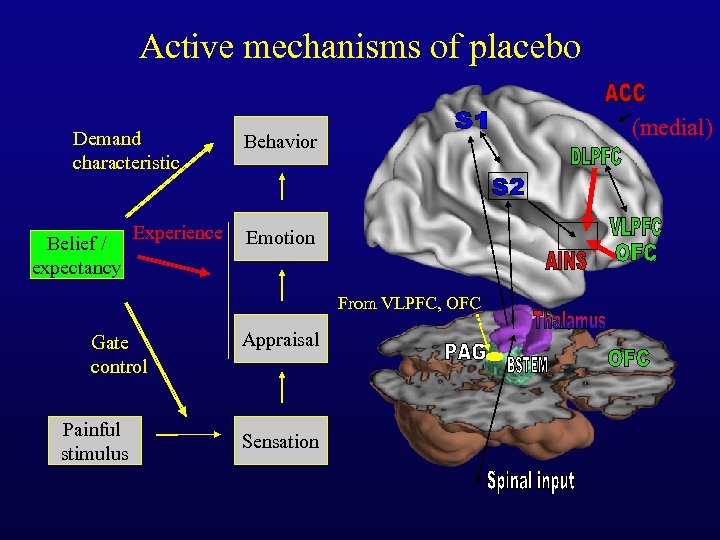 Active mechanisms of placebo Demand characteristic Belief / expectancy Experience (medial) Behavior Emotion From VLPFC, OFC Gate control Painful stimulus Appraisal Sensation
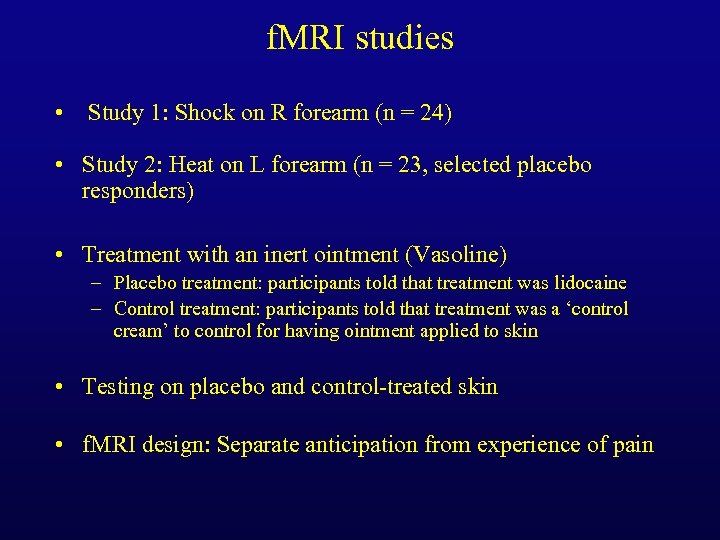 f. MRI studies • Study 1: Shock on R forearm (n = 24) • Study 2: Heat on L forearm (n = 23, selected placebo responders) • Treatment with an inert ointment (Vasoline) – Placebo treatment: participants told that treatment was lidocaine – Control treatment: participants told that treatment was a ‘control cream’ to control for having ointment applied to skin • Testing on placebo and control-treated skin • f. MRI design: Separate anticipation from experience of pain
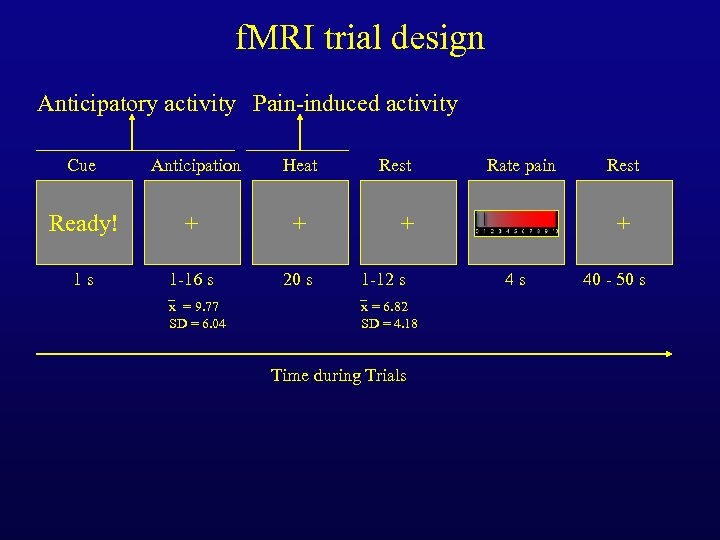 f. MRI trial design Anticipatory activity Pain-induced activity Cue Anticipation Heat Ready! + + 1 s 1 -16 s 20 s x = 9. 77 SD = 6. 04 Rest + 1 -12 s x = 6. 82 SD = 4. 18 Time during Trials Rate pain rating 4 s Rest + 40 - 50 s
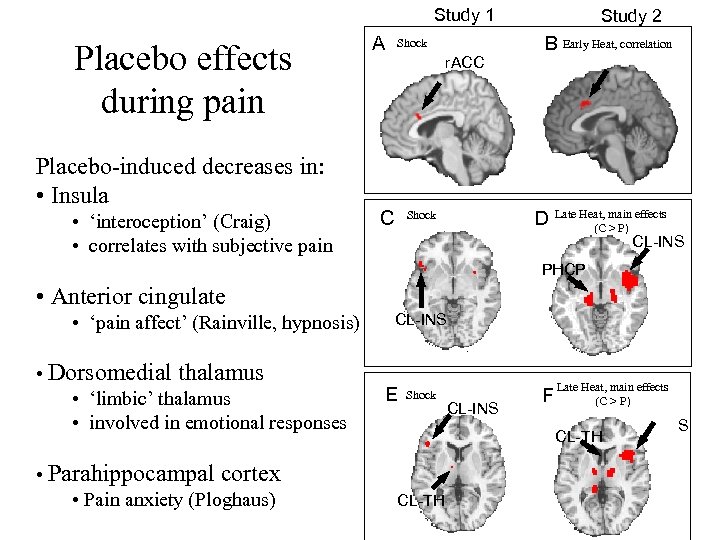 Study 1 Placebo effects during pain Placebo-induced decreases in: • Insula • ‘interoception’ (Craig) • correlates with subjective pain A Shock r. ACC C Study 2 B Early Heat, correlation D Late Heat, main effects (C > P) Shock CL-INS PHCP • Anterior cingulate • ‘pain affect’ (Rainville, hypnosis) • Dorsomedial thalamus • ‘limbic’ thalamus • involved in emotional responses • Parahippocampal cortex • Pain anxiety (Ploghaus) CL-INS E Shock CL-INS F Late Heat, main effects (C > P) CL-TH CL-INS
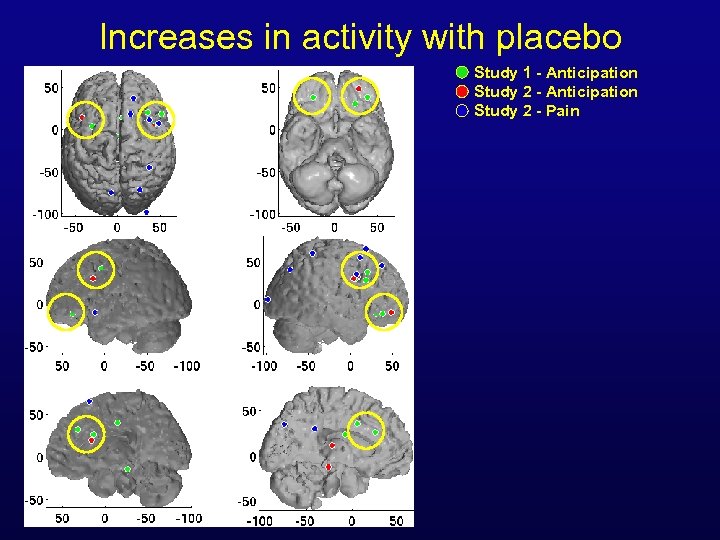
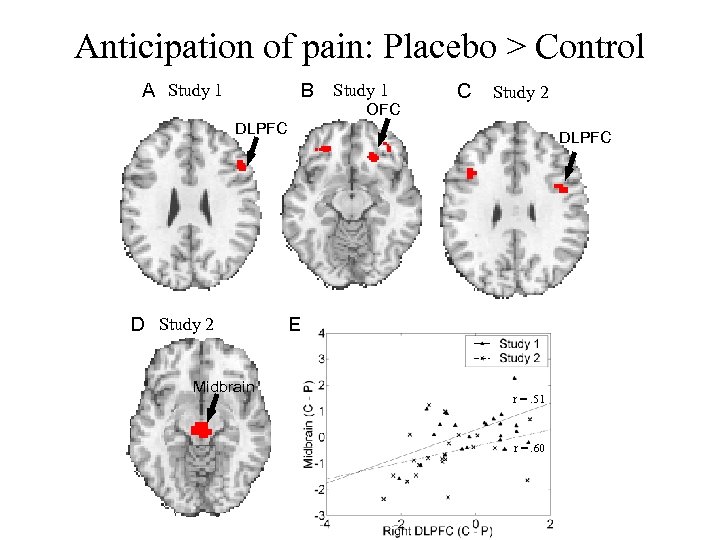 Anticipation of pain: Placebo > Control A Study 1 B Study 1 OFC C Study 2 DLPFC D Study 2 Midbrain DLPFC E r =. 51 r =. 60
![Opioid release correlated with reported placebo in [11 C] Carfentinil PET Direct effects of](https://present5.com/presentation/acd46cc03f29d760d615bced7b578ea6/image-50.jpg "Opioid release correlated with reported placebo in [11 C] Carfentinil PET Direct effects of") Opioid release correlated with reported placebo in [11 C] Carfentinil PET Direct effects of opioids in appraisal
Opioid release correlated with reported placebo in [11 C] Carfentinil PET Direct effects of opioids in appraisal
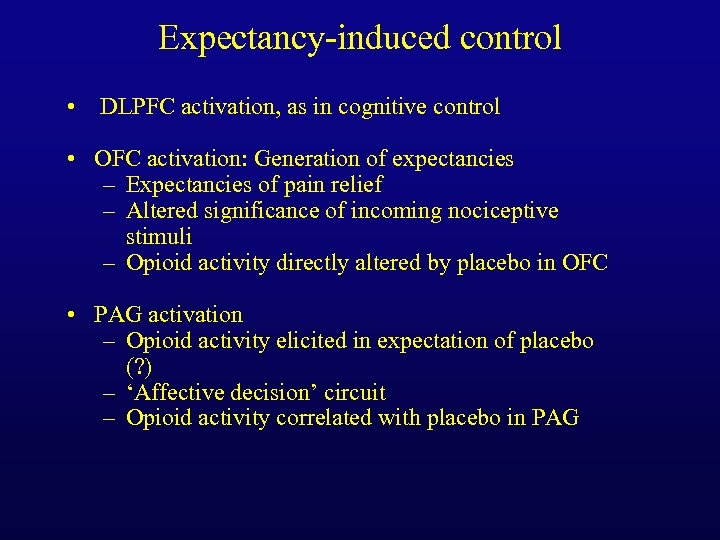 Expectancy-induced control • DLPFC activation, as in cognitive control • OFC activation: Generation of expectancies – Expectancies of pain relief – Altered significance of incoming nociceptive stimuli – Opioid activity directly altered by placebo in OFC • PAG activation – Opioid activity elicited in expectation of placebo (? ) – ‘Affective decision’ circuit – Opioid activity correlated with placebo in PAG
 Structure • What is control? – Define terms: goals, expectations, and control – Control theory and principles of self-regulation • Brain mechanisms of expectancy – Expectations in the control of attention – Expectations in the control of pain – Expectations in the control of emotion
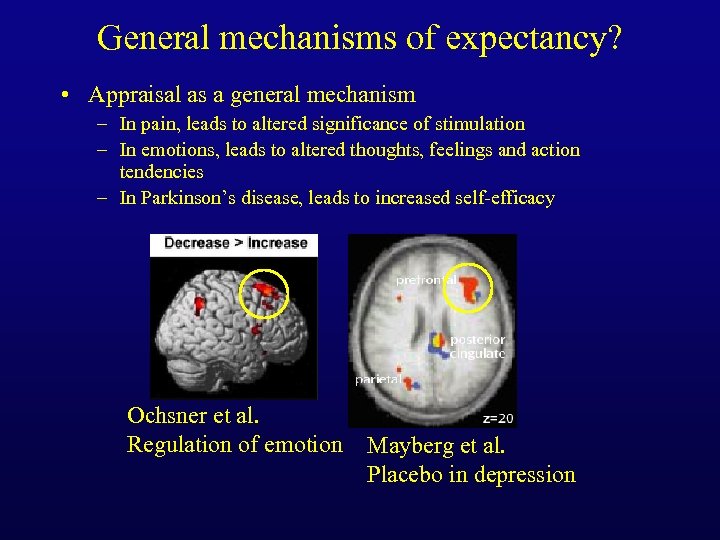 General mechanisms of expectancy? • Appraisal as a general mechanism – In pain, leads to altered significance of stimulation – In emotions, leads to altered thoughts, feelings and action tendencies – In Parkinson’s disease, leads to increased self-efficacy Ochsner et al. Regulation of emotion Mayberg et al. Placebo in depression
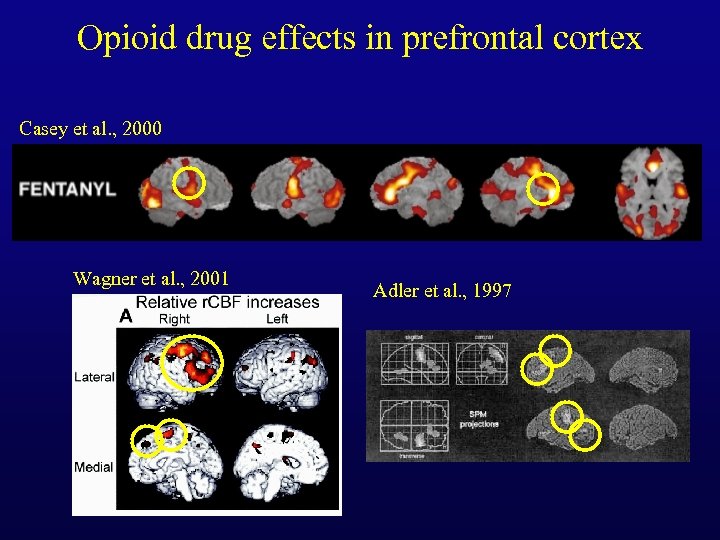
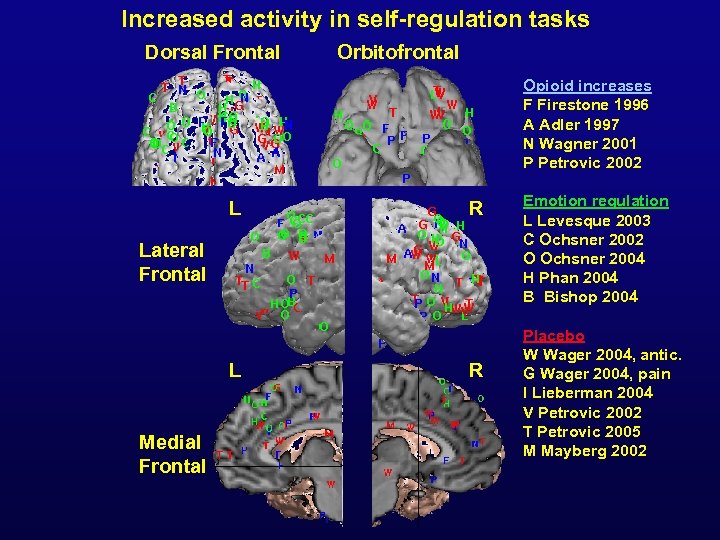 Increased activity in self-regulation tasks Dorsal Frontal Orbitofrontal Opioid increases F Firestone 1996 A Adler 1997 N Wagner 2001 P Petrovic 2002 L R Lateral Frontal L Medial Frontal R Emotion regulation L Levesque 2003 C Ochsner 2002 O Ochsner 2004 H Phan 2004 B Bishop 2004 Placebo W Wager 2004, antic. G Wager 2004, pain I Lieberman 2004 V Petrovic 2002 T Petrovic 2005 M Mayberg 2002
 Expectations and Emotion • How does expectation of an emotional picture influence neural responses? • Do patterns of expectancy distinguish emotionally resilient individuals from nonresilient ones? • Resilience: Ability to deal effectively with life adversity • Sample: 15 resilient and 15 nonresilient individuals picked from extremes of sample on ego resilience scale (e. g. , Block 1989).
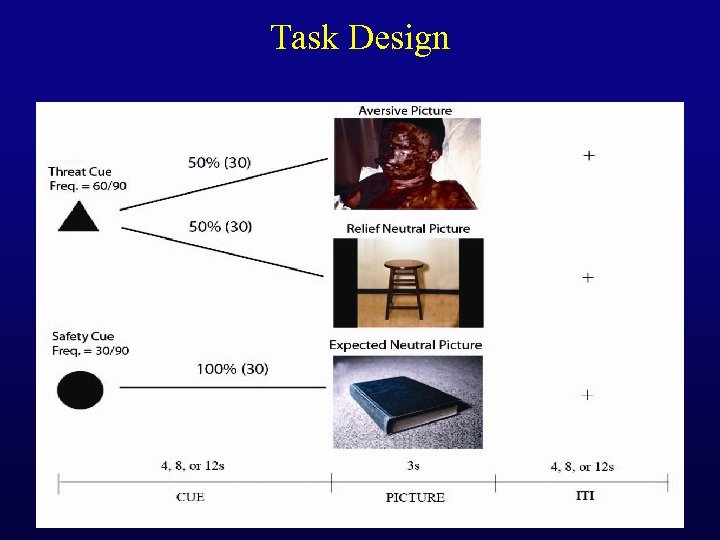 Task Design
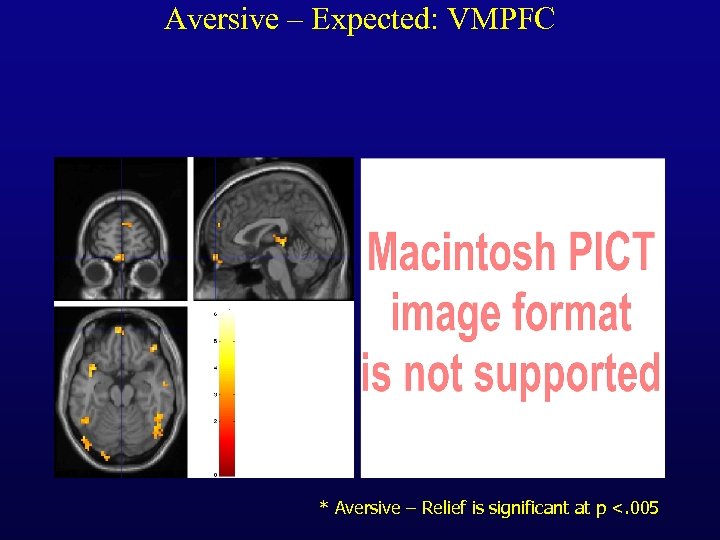 Aversive – Expected: VMPFC * Aversive – Relief is significant at p <. 005
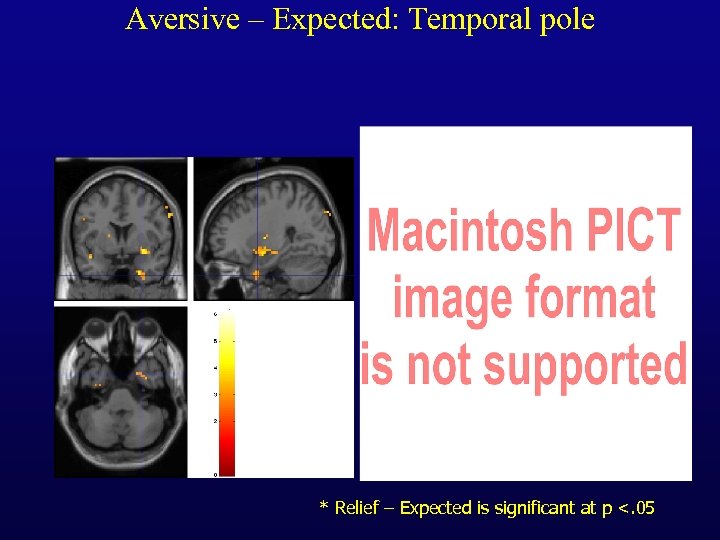 Aversive – Expected: Temporal pole * Relief – Expected is significant at p <. 05
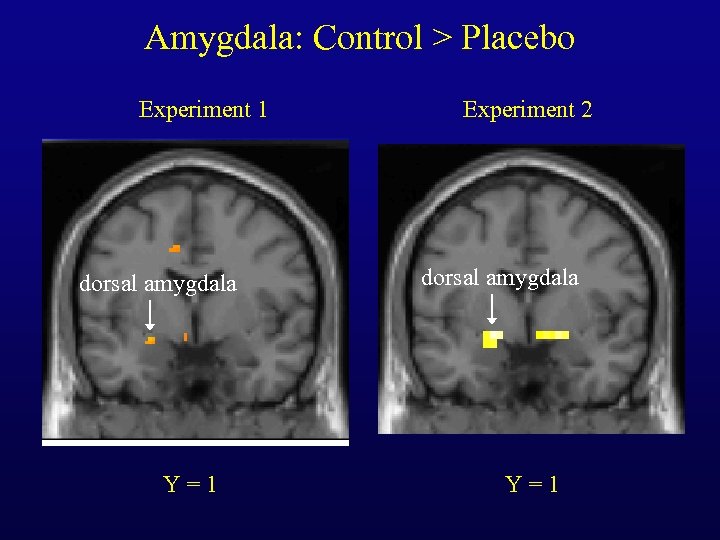
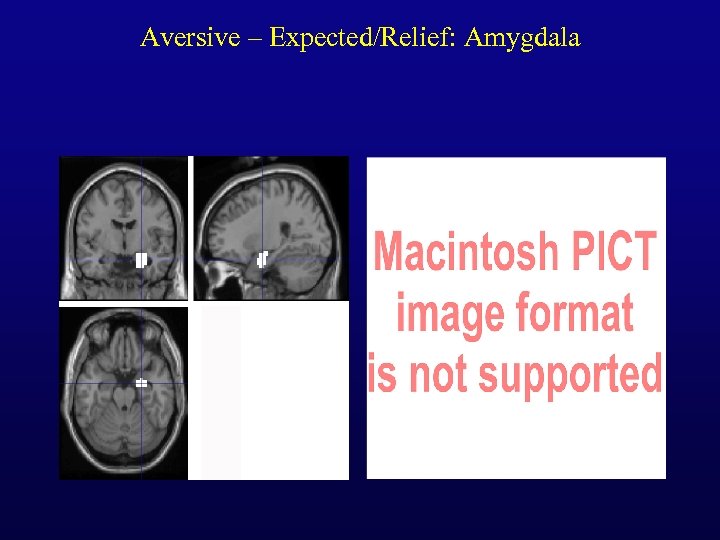 Aversive – Expected/Relief: Amygdala
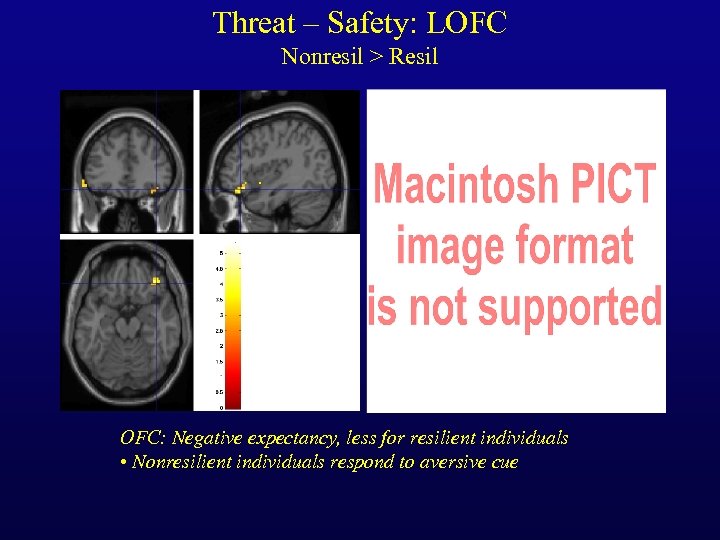 Threat – Safety: LOFC Nonresil > Resil OFC: Negative expectancy, less for resilient individuals • Nonresilient individuals respond to aversive cue
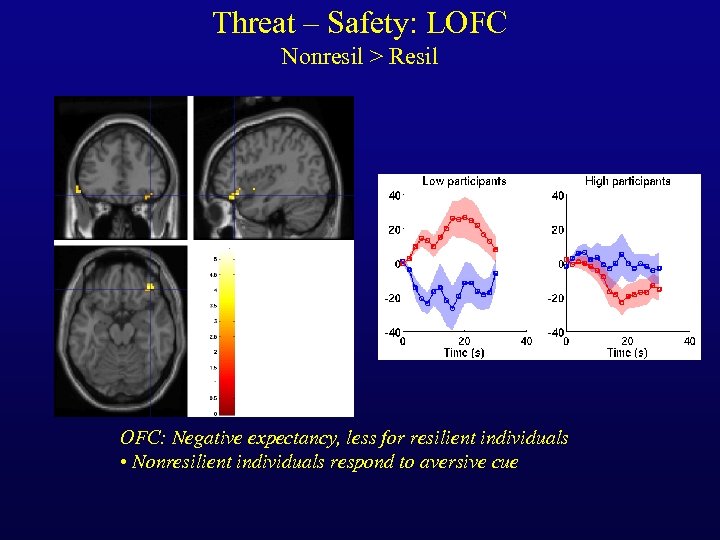 Threat – Safety: LOFC Nonresil > Resil OFC: Negative expectancy, less for resilient individuals • Nonresilient individuals respond to aversive cue
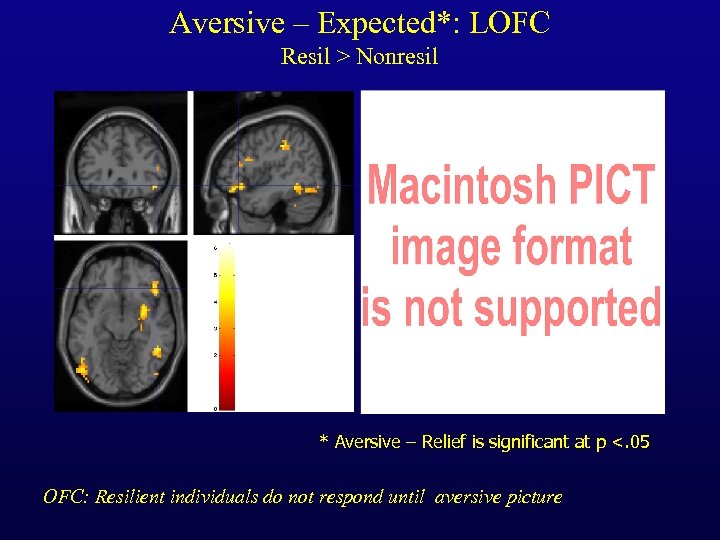 Aversive – Expected*: LOFC Resil > Nonresil * Aversive – Relief is significant at p <. 05 OFC: Resilient individuals do not respond until aversive picture
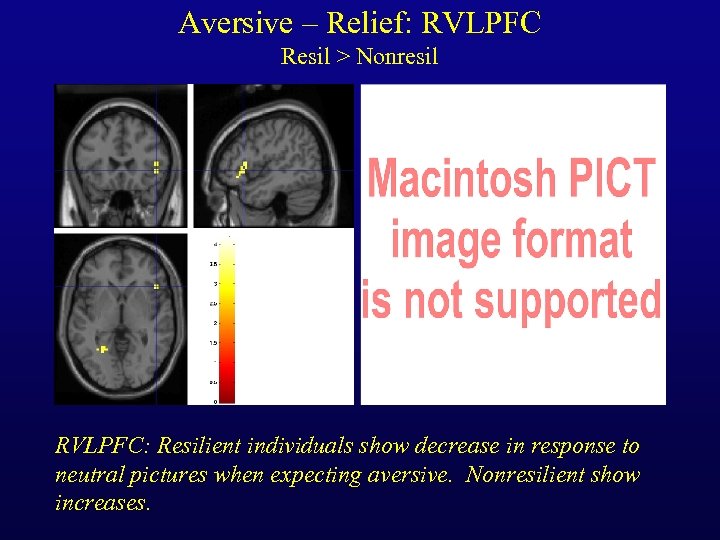 Aversive – Relief: RVLPFC Resil > Nonresil RVLPFC: Resilient individuals show decrease in response to neutral pictures when expecting aversive. Nonresilient show increases.
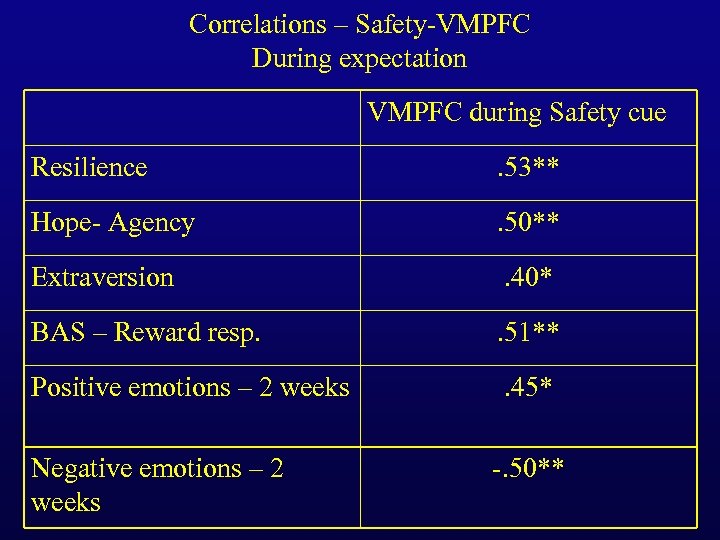 Correlations – Safety-VMPFC During expectation VMPFC during Safety cue Resilience . 53** Hope- Agency . 50** Extraversion . 40* BAS – Reward resp. . 51** Positive emotions – 2 weeks . 45* Negative emotions – 2 weeks -. 50**
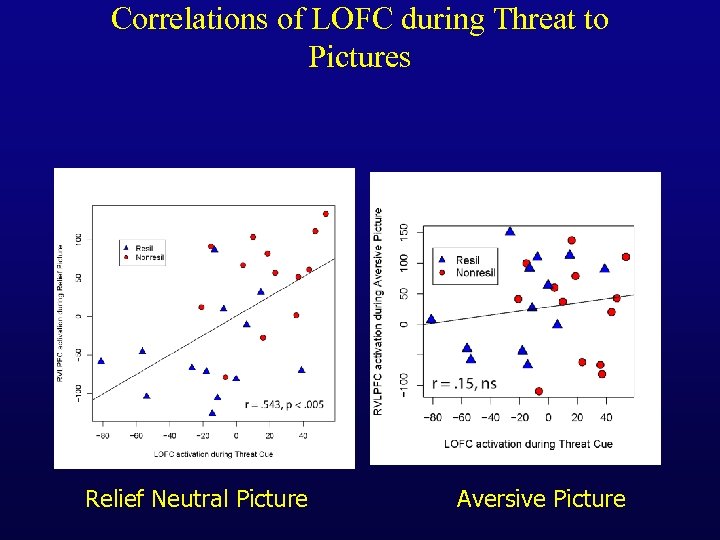 Correlations of LOFC during Threat to Pictures Relief Neutral Picture Aversive Picture
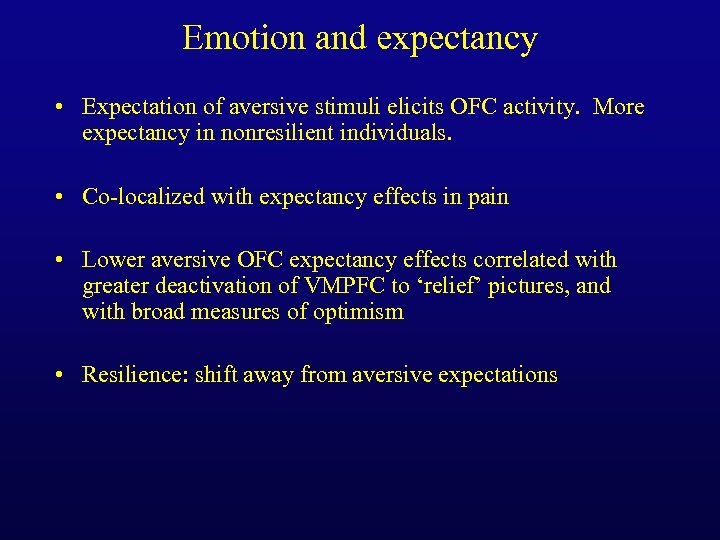 Emotion and expectancy • Expectation of aversive stimuli elicits OFC activity. More expectancy in nonresilient individuals. • Co-localized with expectancy effects in pain • Lower aversive OFC expectancy effects correlated with greater deactivation of VMPFC to ‘relief’ pictures, and with broad measures of optimism • Resilience: shift away from aversive expectations
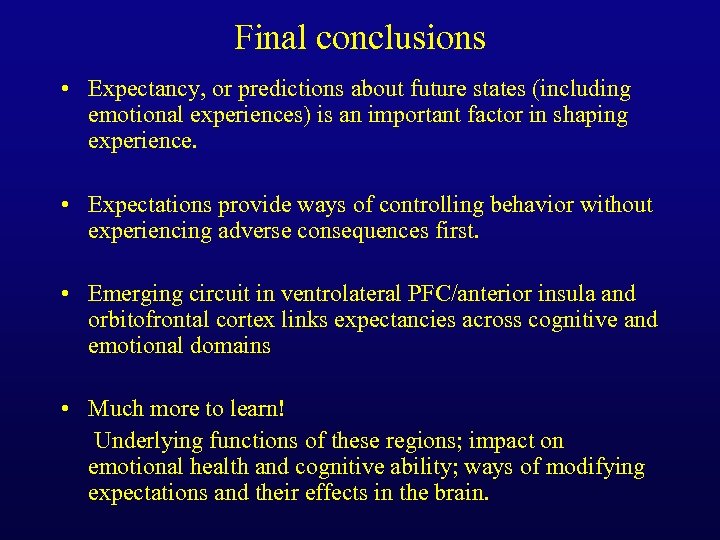 Final conclusions • Expectancy, or predictions about future states (including emotional experiences) is an important factor in shaping experience. • Expectations provide ways of controlling behavior without experiencing adverse consequences first. • Emerging circuit in ventrolateral PFC/anterior insula and orbitofrontal cortex links expectancies across cognitive and emotional domains • Much more to learn! Underlying functions of these regions; impact on emotional health and cognitive ability; ways of modifying expectations and their effects in the brain.
 Thank you!
 Threat cues in the brain
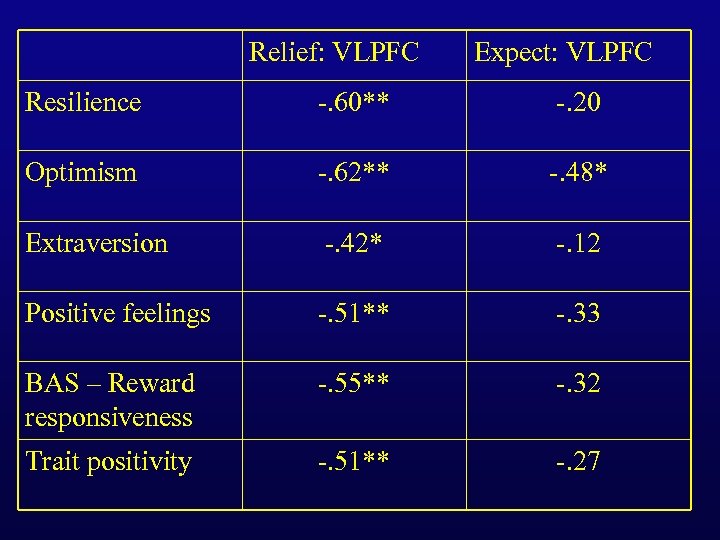 Relief: VLPFC Expect: VLPFC Resilience -. 60** -. 20 Optimism -. 62** -. 48* Extraversion -. 42* -. 12 Positive feelings -. 51** -. 33 BAS – Reward responsiveness -. 55** -. 32 Trait positivity -. 51** -. 27
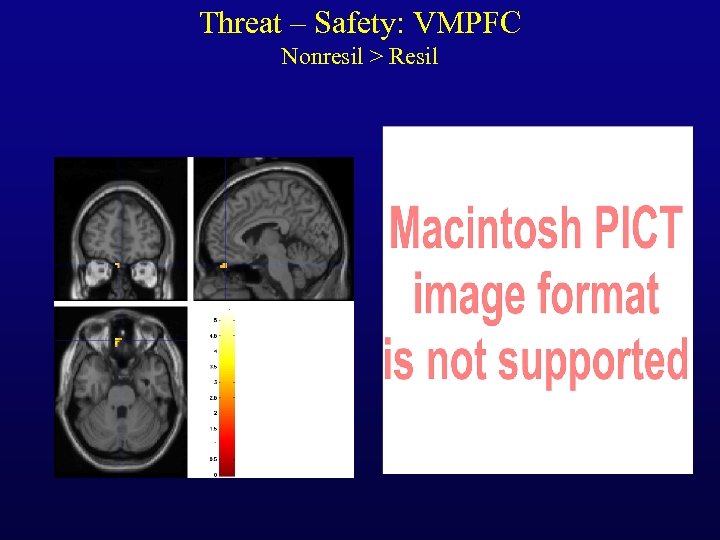 Threat – Safety: VMPFC Nonresil > Resil
 Conclusions • Nonresilient activate more MPFC/LOFC in response to the threat cue • Nonresilient activate more RVLPFC to relief pictures than Resilient • This activation in the LOFC to the threat cue predicts RVLPFC response to the relief neutral pictures • If LOFC -> negative expectations and RVLPFC -> negative labelling, then for NR, their negative expectations drive their negative labelling of a neutral picture. • Resilient people are better able to discriminate negative from neutral events -> may lead to quicker recovery
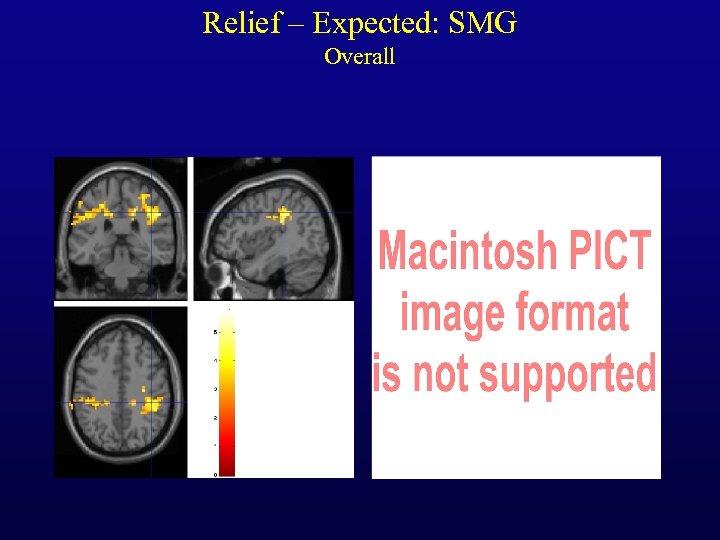 Relief – Expected: SMG Overall
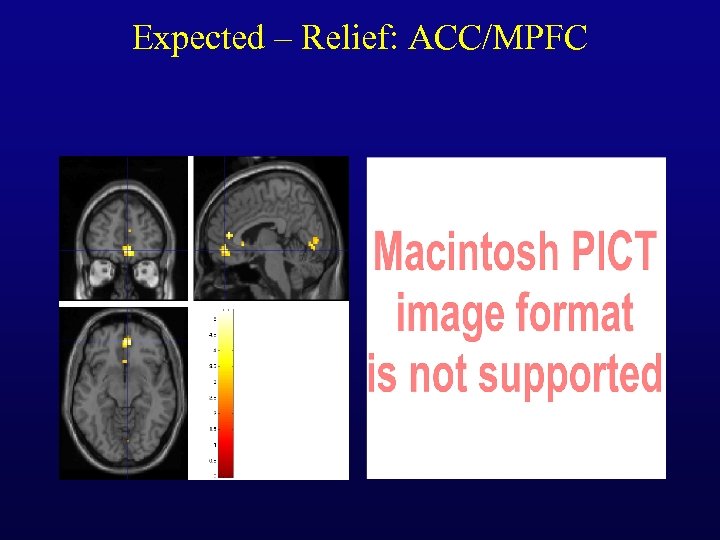 Expected – Relief: ACC/MPFC
 Increases in activity with placebo Study 1 - Anticipation Study 2 - Pain
 Placebo effects in S 2 • Use meta-analysis as a broad ROI • Identify S 2 in individual participants by individual pain response Evidence against early blockade of nociception as a major factor
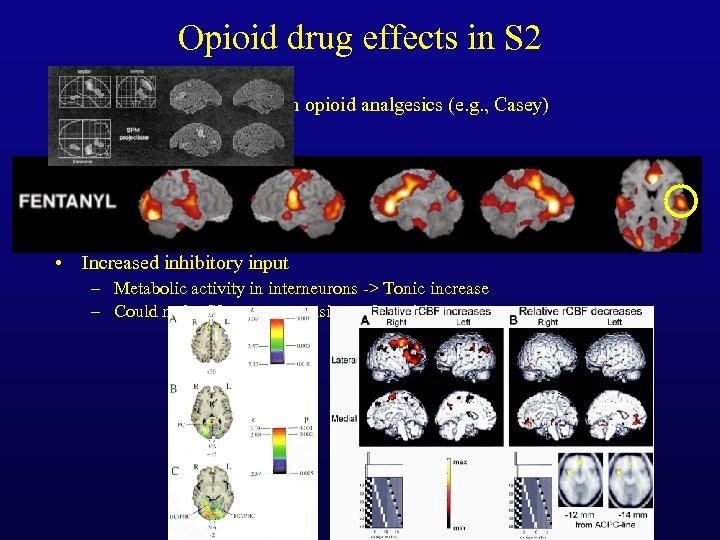
 Opioid drug effects in S 2 • Increases in S 2 with verum opioid analgesics (e. g. , Casey) • Increased inhibitory input – Metabolic activity in interneurons -> Tonic increase – Could make S 2 more responsive to frontal input
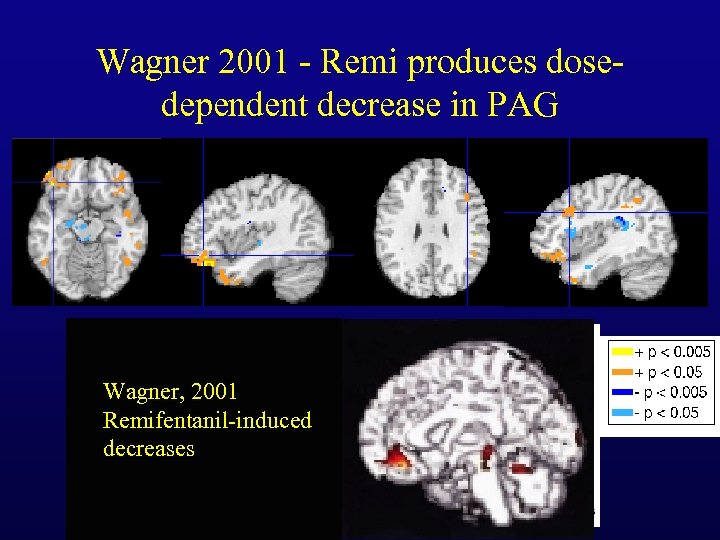
 Opioid drug effects in prefrontal cortex Casey et al. , 2000 Wagner et al. , 2001 Adler et al. , 1997
 Active mechanisms of placebo Demand characteristic Belief / expectancy Experience Gate control Painful stimulus Behavior Emotion Opioids x Appraisal Sensation x Demand characteristic • Activation of appraisal networks before and during pain • Changes in pain-processing regions Pain experience • Reductions in ‘affective’ pain regions • Opioid release directly in appraisal networks Gate control (early blockade) • Reductions in ‘affective’ pain regions • Increased activation in S 2
 Wagner 2001 - Remi produces dosedependent decrease in PAG Wagner, 2001 Remifentanil-induced decreases
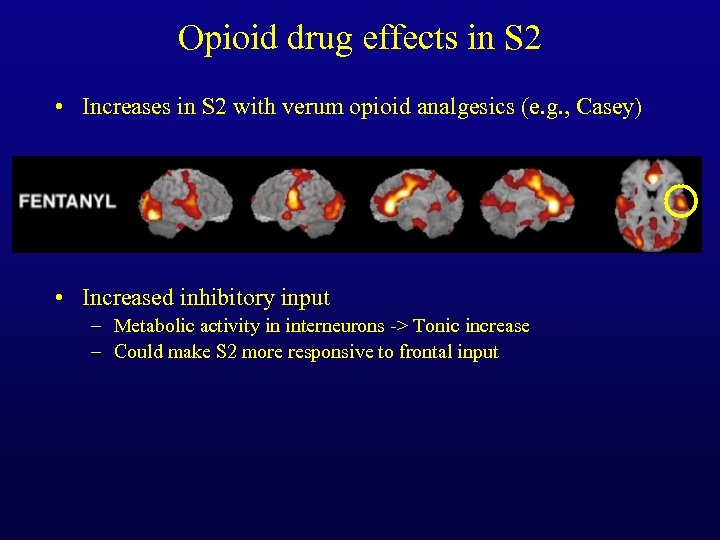
 Opioid drug effects in S 2 • Increases in S 2 with verum opioid analgesics (e. g. , Casey) • Increased inhibitory input – Metabolic activity in interneurons -> Tonic increase – Could make S 2 more responsive to frontal input
 Amygdala: Control > Placebo Experiment 1 dorsal amygdala Y=1 Experiment 2 dorsal amygdala Y=1
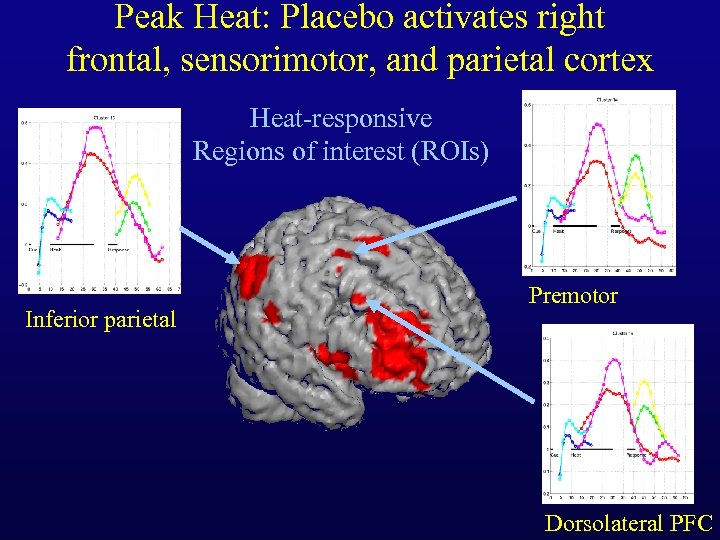 Peak Heat: Placebo activates right frontal, sensorimotor, and parietal cortex Heat-responsive Regions of interest (ROIs) Inferior parietal Premotor Dorsolateral PFC
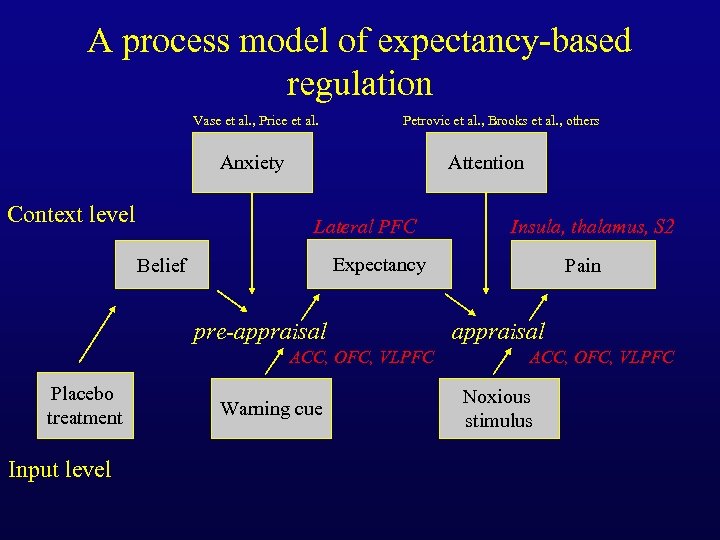 A process model of expectancy-based regulation Vase et al. , Price et al. Petrovic et al. , Brooks et al. , others Anxiety Context level Attention Lateral PFC Expectancy Belief pre-appraisal ACC, OFC, VLPFC Placebo treatment Input level Insula, thalamus, S 2 Warning cue Pain appraisal ACC, OFC, VLPFC Noxious stimulus
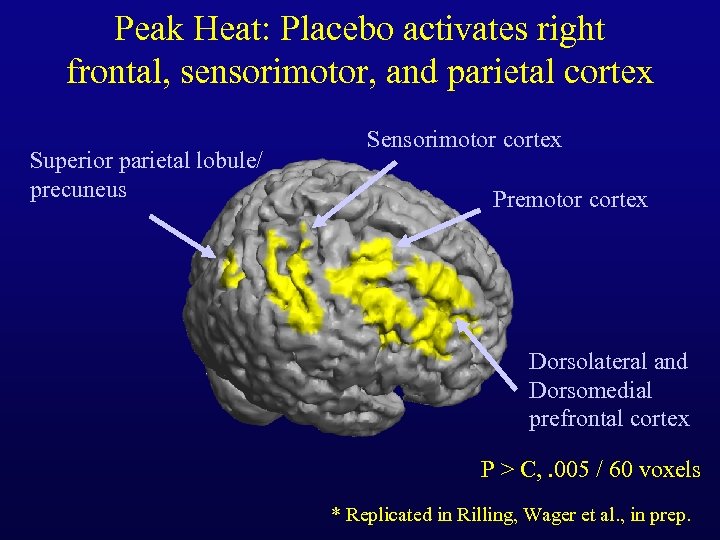 Peak Heat: Placebo activates right frontal, sensorimotor, and parietal cortex Superior parietal lobule/ precuneus Sensorimotor cortex Premotor cortex Dorsolateral and Dorsomedial prefrontal cortex P > C, . 005 / 60 voxels * Replicated in Rilling, Wager et al. , in prep.
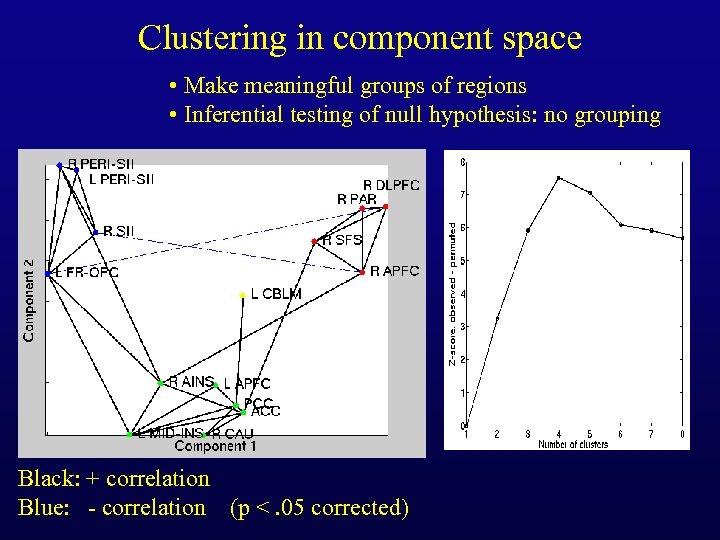 Clustering in component space • Make meaningful groups of regions • Inferential testing of null hypothesis: no grouping Black: + correlation Blue: - correlation (p <. 05 corrected)
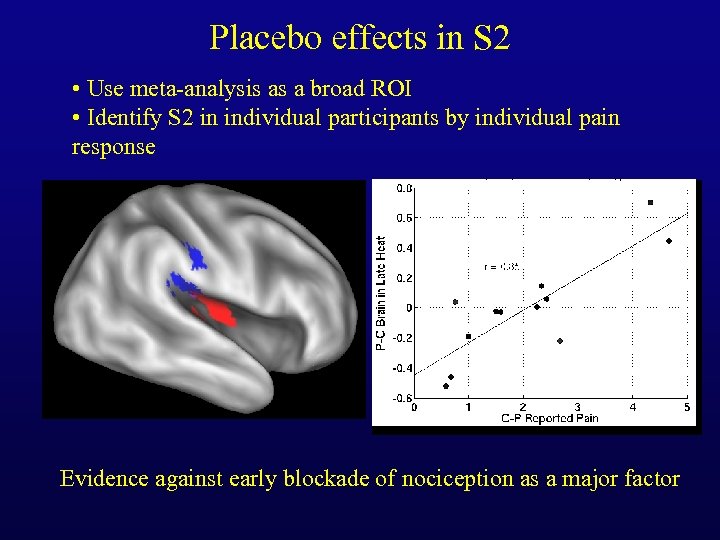
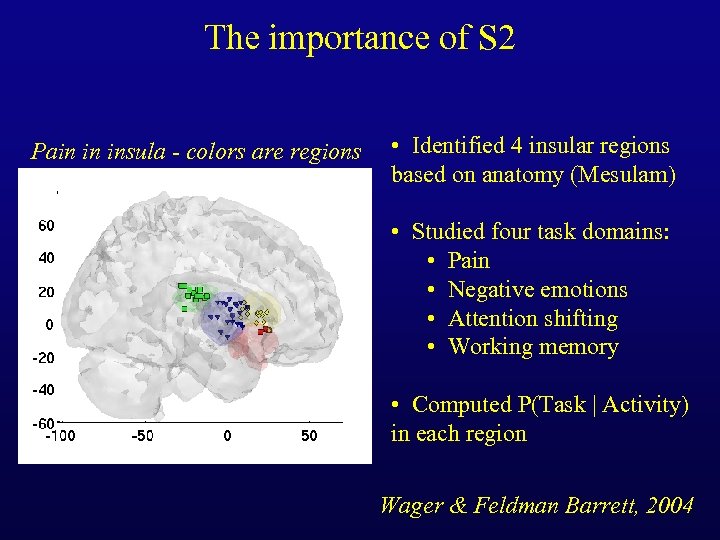 The importance of S 2 Pain in insula - colors are regions • Identified 4 insular regions based on anatomy (Mesulam) • Studied four task domains: • Pain • Negative emotions • Attention shifting • Working memory • Computed P(Task | Activity) in each region Wager & Feldman Barrett, 2004
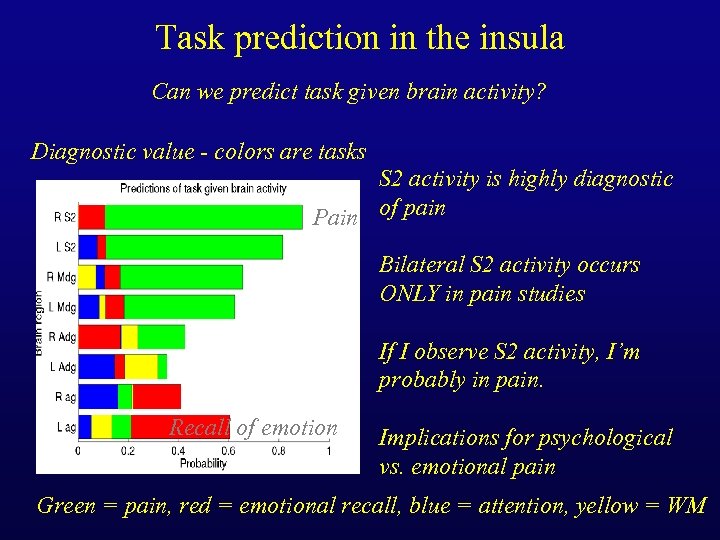 Task prediction in the insula Can we predict task given brain activity? Diagnostic value - colors are tasks S 2 activity is highly diagnostic Pain of pain Bilateral S 2 activity occurs ONLY in pain studies If I observe S 2 activity, I’m probably in pain. Recall of emotion Implications for psychological vs. emotional pain Green = pain, red = emotional recall, blue = attention, yellow = WM
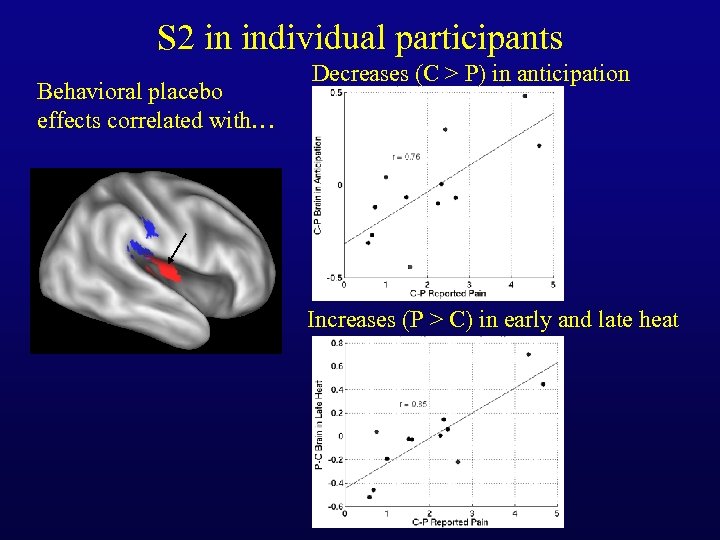 S 2 in individual participants Behavioral placebo effects correlated with… Decreases (C > P) in anticipation Increases (P > C) in early and late heat
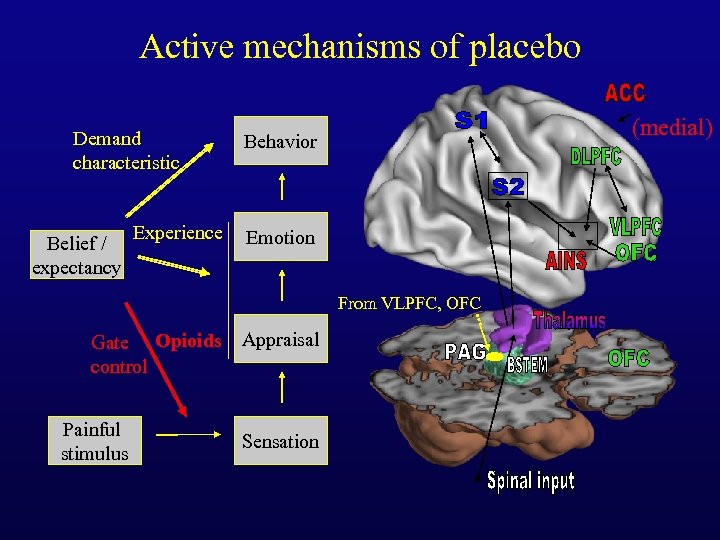 Active mechanisms of placebo Demand characteristic Belief / expectancy Experience (medial) Behavior Emotion From VLPFC, OFC Gate Opioids Appraisal control Painful stimulus Sensation
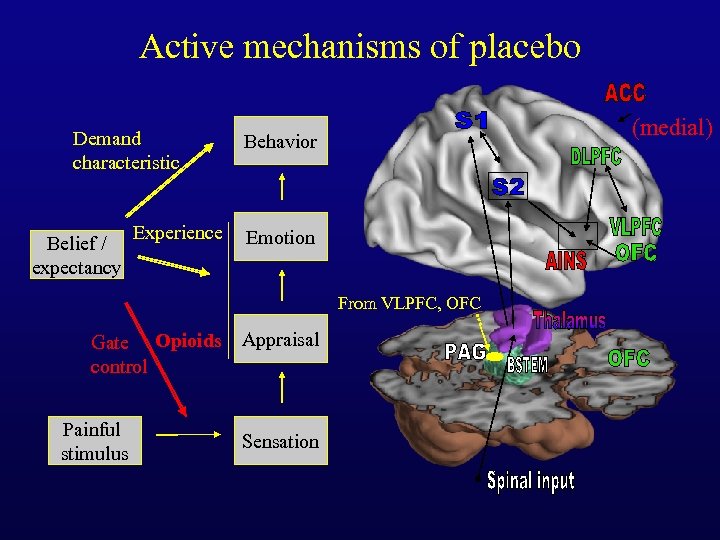 Active mechanisms of placebo Demand characteristic Belief / expectancy Experience (medial) Behavior Emotion From VLPFC, OFC Gate Opioids Appraisal control Painful stimulus Sensation
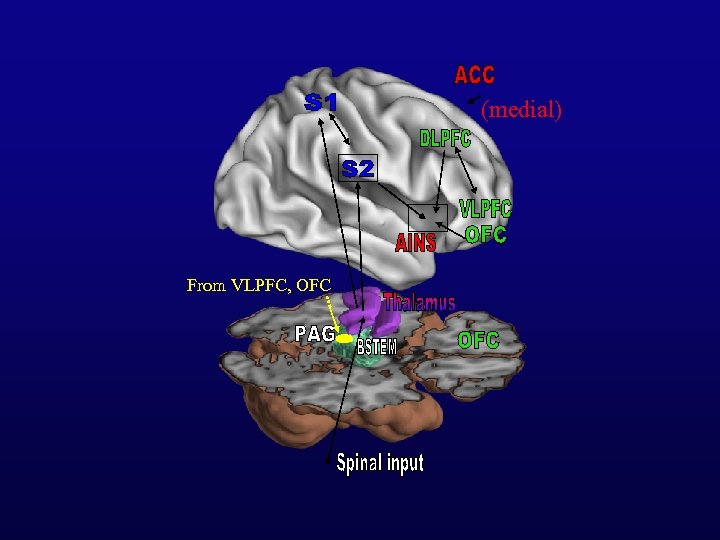 (medial) From VLPFC, OFC
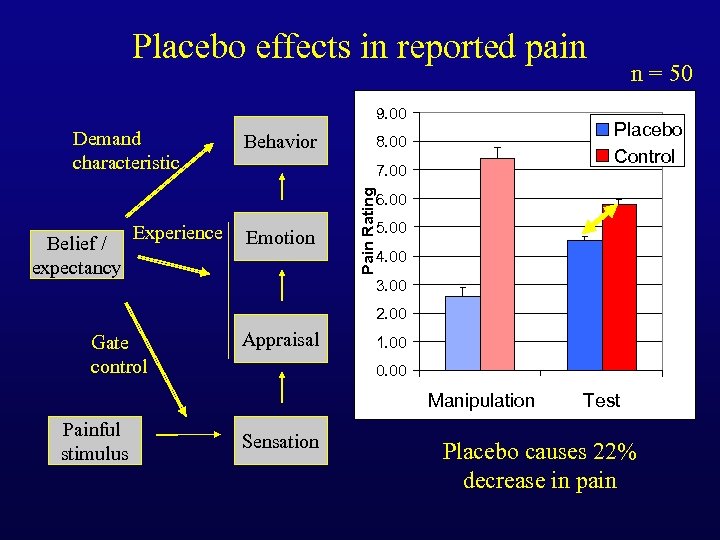 Placebo effects in reported pain 9. 00 Behavior Placebo Control 8. 00 7. 00 Pain Rating Demand characteristic n = 50 6. 00 Belief / expectancy Experience Emotion 5. 00 4. 00 3. 00 2. 00 Gate control Appraisal 1. 00 0. 00 Manipulation Painful stimulus Sensation Test Placebo causes 22% decrease in pain