


 Скачать презентацию EXPECT TO ACHIEVE New roles and thinking on
cddcf4a51145fa60c24e743cb89917bb.ppt
- Количество слайдов: 18
 EXPECT TO ACHIEVE New roles and thinking on staff and student engagement Dr John Peters Head of Academic Practice j. peters@newman. ac. uk
 EXPECT TO ACHIEVE What’s the difference between engagement and partnership?
 EXPECT TO ACHIEVE Key points • • Overview of student engagement Student Partnership Implications for PDP Personal learning Learning for an unknowable future Learning to create a better future Implications for PDP
 EXPECT TO ACHIEVE Types of Student Engagement • Student learning in class – Student-centred, active, challenging & deep learning • Representation and participation institutionally – Governance and quality processes • Identity and belonging – Inclusion, participation, progression & achievement
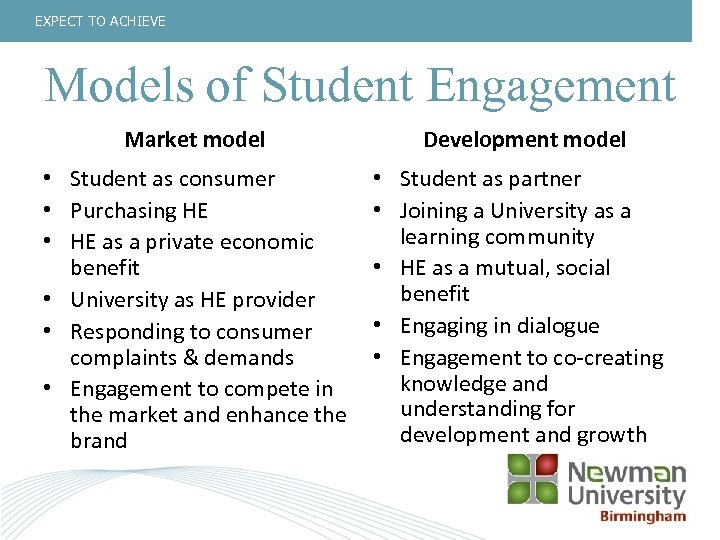 EXPECT TO ACHIEVE Models of Student Engagement Market model Development model • Student as consumer • Purchasing HE • HE as a private economic benefit • University as HE provider • Responding to consumer complaints & demands • Engagement to compete in the market and enhance the brand • Student as partner • Joining a University as a learning community • HE as a mutual, social benefit • Engaging in dialogue • Engagement to co-creating knowledge and understanding for development and growth
 EXPECT TO ACHIEVE Quality Assurance Agency ‘Partnership working is based on the values of: openness; trust and honesty; agreed shared goals and values; and regular communication between the partners. It … recognises that all members in the partnership have legitimate, but different, perceptions and experiences. By working together to a common agreed purpose, steps can be taken that lead to enhancements for all concerned. The terms reflect a mature relationship based on mutual respect between students and staff. ’
 EXPECT TO ACHIEVE National Union of Students • Students as active participants in the learning process • Shaping their course delivery and content • Co-creators of knowledge • Co-producers of learning outcomes • Collaborators and agents of change • Partnership as the goal of student engagement
 EXPECT TO ACHIEVE Examples of partnership 1 • Students as co-researchers (Healey & Jenkins, 2009), • Students as change agents (Dunne & Zandstra, 2011); • ‘Student as producer’ (Neary 2010), • Students as consultants (Cook-Sather, 2010) • Students as co-creators of curricula (Bovill, 2014) • Students as partners (
![EXPECT TO ACHIEVE Examples of partnership 2 • Birmingham City University [academic partners] •](https://present5.com/presentation/cddcf4a51145fa60c24e743cb89917bb/image-9.jpg "EXPECT TO ACHIEVE Examples of partnership 2 • Birmingham City University [academic partners] •") EXPECT TO ACHIEVE Examples of partnership 2 • Birmingham City University [academic partners] • Winchester [fellows] • York St John [researchers] • Canterbury Christchurch [SALTs] • Worcester [AI & academic partners] • Newman [academic, research and community partners]
EXPECT TO ACHIEVE Examples of partnership 2 • Birmingham City University [academic partners] • Winchester [fellows] • York St John [researchers] • Canterbury Christchurch [SALTs] • Worcester [AI & academic partners] • Newman [academic, research and community partners]
 EXPECT TO ACHIEVE What is the role of PDP and PDP practitioners in all this? • • • Strategic engagement Encouraging development Promoting engagement Reaching staff through student engagement Capturing or helping describe engagement Promoting and capturing the learning
 EXPECT TO ACHIEVE Personal learning • ‘Now the project has finished I’d like to share my feelings about what am amazing experience it has been … what I learnt about myself and realizing what I can achieve when I focus and step out of my comfort zone. A brilliant opportunity that I would recommend to any student … Well done Newman ’ • https: //www. youtube. com/watch? feature=pl ayer_embedded&v=f. NJqd 2 EKkz 8
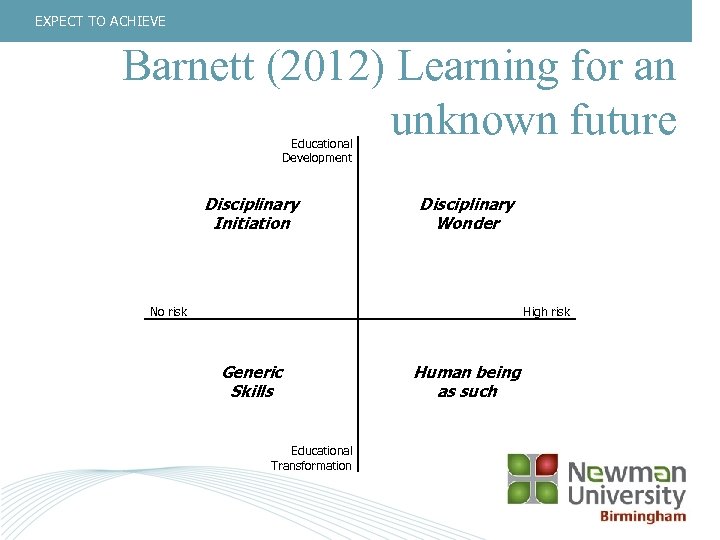 EXPECT TO ACHIEVE Barnett (2012) Learning for an unknown future No risk Educational Development Disciplinary Initiation Generic Skills Educational Transformation Disciplinary Wonder High risk Human being as such
 EXPECT TO ACHIEVE Learning to change the future Education is the most powerful weapon which you can use to change the world Nelson Mandela ‘Education is “the practice of freedom, ” the means by which men and women deal critically with reality and discover how to participate in the transformation of their world. ’ [Richard Shaull, Foreword to Freire (1970) Pedagogy of the oppressed]
 EXPECT TO ACHIEVE The Pedagogy of Hope Through dialogue, the teacher-of-the-students and the students-of-the-teacher cease to exist and a new term emerges: teacher-student with student-teachers. The teacher is no longer merely the-one-who-teaches, but one who is himself taught in dialogue with the students, who in turn while being taught also teach. They become jointly responsible for a process in which all grow. Paulo Freire
 EXPECT TO ACHIEVE The Pedagogy of Partnership • Building from a shared hope - believing in our transformative potential • Establishing a dream of transformation – asking what is the best we can be? • Promoting respectful dialogue - hearing underrepresented voices about our lived experiences & espoused values. • Involving co-investigation & shared reflection, problemposing, curiosity, rational exploration & creativity. • Seeking the co-construction of solutions aimed at a better way of being. • An ongoing, transformative and collaborative process of being and becoming.
 EXPECT TO ACHIEVE So what’s the place for PDP and PDP practitioners in this? Questions & Issues
 EXPECT TO ACHIEVE References 1 • • Ronald Barnett (2012): Learning for an unknown future, Higher Education Research & Development, 31: 1, 65 -77 Bovill, C. (2014). An investigation of co-created curricula within higher education in the UK, Ireland the USA. Innovations in Education and Teaching International, 51(1) 15 -25. Cook-Sather, A. (2010). Students as Learners and Teachers: Taking Responsibility, Transforming Education, and Redefining Accountability. Curriculum Inquiry, 40 (4). Cook-Sather, A. , Bovill, C. , & Felten, P. (2014). Engaging Students as Partners in Teaching and Learning: A Guide for Faculty. San Francisco: Jossey-Bass. Dunne, E. & Zandstra, R. (2011). Students as change agents. New ways of engaging with learning and teaching in higher education. Bristol: ESCalate Higher Education Academy Subject Centre for Education / University of Exeter. Healey, M. & Jenkins, A. (2009). Developing Undergraduate Research and Inquiry. York: Higher Education Academy. Karima Kadi-Hanifi, Ozlem Dagman, John Peters, Elle Snell, Caroline Tutton & Trevor Wright (2014) ‘Engaging students and staff with educational development through appreciative inquiry’, Innovations in Education and Teaching International.
 EXPECT TO ACHIEVE References 2 • National Union of Students, UK (2012): A manifesto for partnership, http: //www. nusconnect. org. uk/resourcehandler/0 a 02 e 2 e 5 -197 e-4 bd 3 b 7 ed-e 8 ceff 3 dc 0 e 4/ [accessed 30/1/2014] • Neary, M. (2010). Student as Producer: A Pedagogy for the Avant-Garde? Learning Exchange, 1, (1). • John Peters (2013) ‘Hearing voices and seeing visions’, Educational Developments 14, 1 • Quality Assurance Agency (2012) UK Quality Code for HE: Part B, Assuring and enhancing academic quality; chapter 5, student engagement. • Paul Trowler and Vicki Trowler (2010) Framework for action: enhancing student engagement at the institutional level (York: The Higher Education Academy) • Vicki Trowler (2010) Student engagement literature review (York: HEA) • Caroline Tutton & Elle Snell (2013) Student researchers as educational developers: our journey, Educational Developments, 14. 1