


 Скачать презентацию Expanding Health Insurance Coverage James R Tallon Jr
24dfdb764aaa701451bbf7a4c9e737c1.ppt
- Количество слайдов: 9
 Expanding Health Insurance Coverage James R. Tallon, Jr. President, United Hospital Fund Bipartisan Congressional Health Policy Conference January 13, 2007
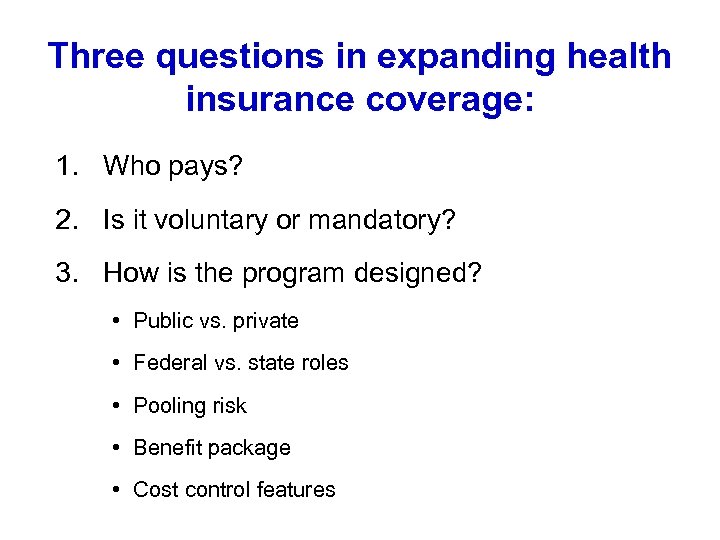 Three questions in expanding health insurance coverage: 1. Who pays? 2. Is it voluntary or mandatory? 3. How is the program designed? • Public vs. private • Federal vs. state roles • Pooling risk • Benefit package • Cost control features
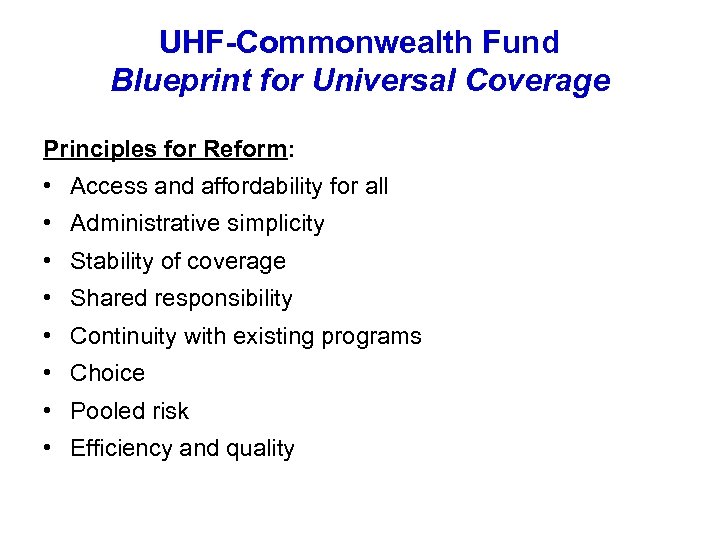 UHF-Commonwealth Fund Blueprint for Universal Coverage Principles for Reform: • Access and affordability for all • Administrative simplicity • Stability of coverage • Shared responsibility • Continuity with existing programs • Choice • Pooled risk • Efficiency and quality
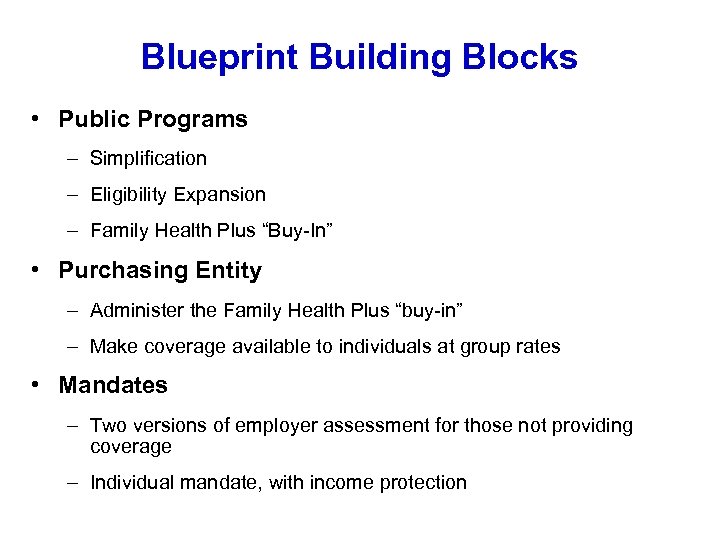 Blueprint Building Blocks • Public Programs – Simplification – Eligibility Expansion – Family Health Plus “Buy-In” • Purchasing Entity – Administer the Family Health Plus “buy-in” – Make coverage available to individuals at group rates • Mandates – Two versions of employer assessment for those not providing coverage – Individual mandate, with income protection
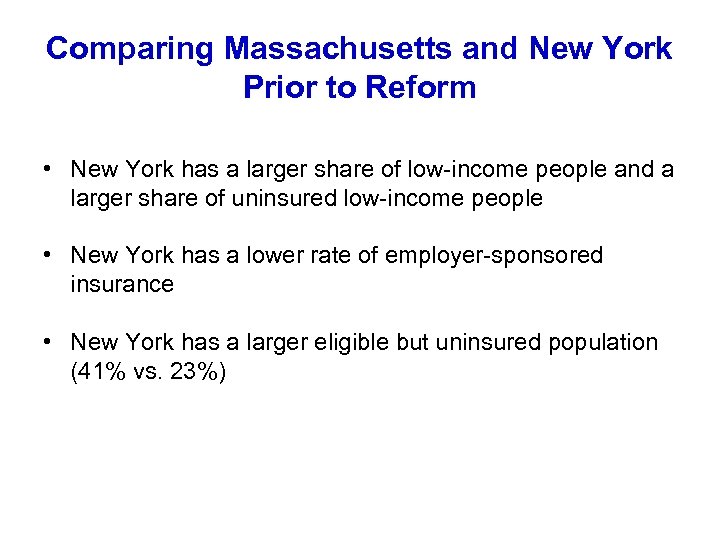 Comparing Massachusetts and New York Prior to Reform • New York has a larger share of low-income people and a larger share of uninsured low-income people • New York has a lower rate of employer-sponsored insurance • New York has a larger eligible but uninsured population (41% vs. 23%)
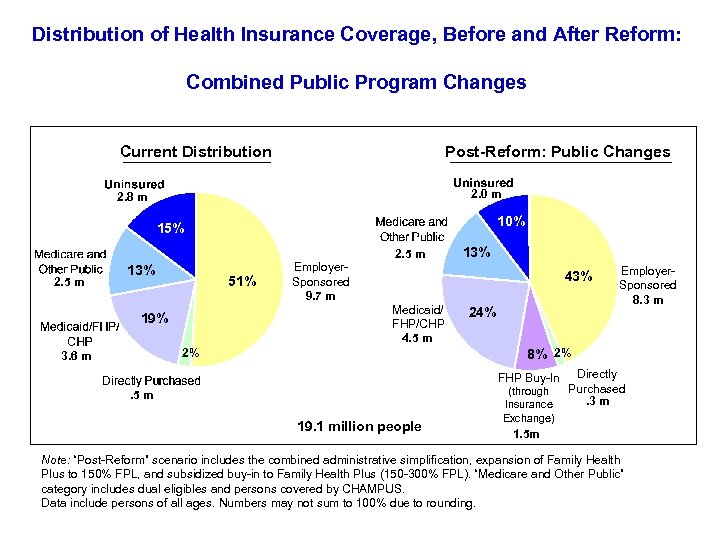 Distribution of Health Insurance Coverage, Before and After Reform: Combined Public Program Changes Current Distribution Post-Reform: Public Changes 2. 0 m 2. 8 m 10% 15% 2. 5 m 13% 51% 43% Medicaid/ FHP/CHP 4. 5 m 19% 2% 3. 6 m 13% Employer. Sponsored 9. 7 m 24% Employer. Sponsored 8. 3 m 8% 2% FHP Buy-In . 5 m 19. 1 million people (through Insurance Exchange) Directly Purchased. 3 m 1. 5 m Note: “Post-Reform” scenario includes the combined administrative simplification, expansion of Family Health Plus to 150% FPL, and subsidized buy-in to Family Health Plus (150 -300% FPL). “Medicare and Other Public” category includes dual eligibles and persons covered by CHAMPUS. Data include persons of all ages. Numbers may not sum to 100% due to rounding.
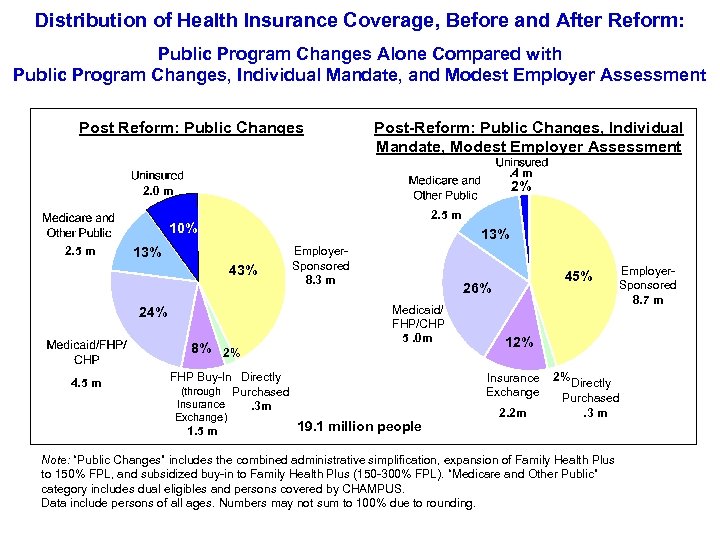 Distribution of Health Insurance Coverage, Before and After Reform: Public Program Changes Alone Compared with Public Program Changes, Individual Mandate, and Modest Employer Assessment Post Reform: Public Changes Post-Reform: Public Changes, Individual Mandate, Modest Employer Assessment. 4 m 2% 2. 0 m 2. 5 m 10% 2. 5 m 13% 43% 24% 8% 2% 4. 5 m Employer. Sponsored 8. 3 m 26% Medicaid/ FHP/CHP 5. 0 m FHP Buy-In Directly (through Purchased Insurance. 3 m Exchange) 1. 5 m 45% 12% Insurance Exchange 19. 1 million people Employer. Sponsored 8. 7 m 2. 2 m 2% Directly Purchased. 3 m Note: “Public Changes” includes the combined administrative simplification, expansion of Family Health Plus to 150% FPL, and subsidized buy-in to Family Health Plus (150 -300% FPL). “Medicare and Other Public” category includes dual eligibles and persons covered by CHAMPUS. Data include persons of all ages. Numbers may not sum to 100% due to rounding.
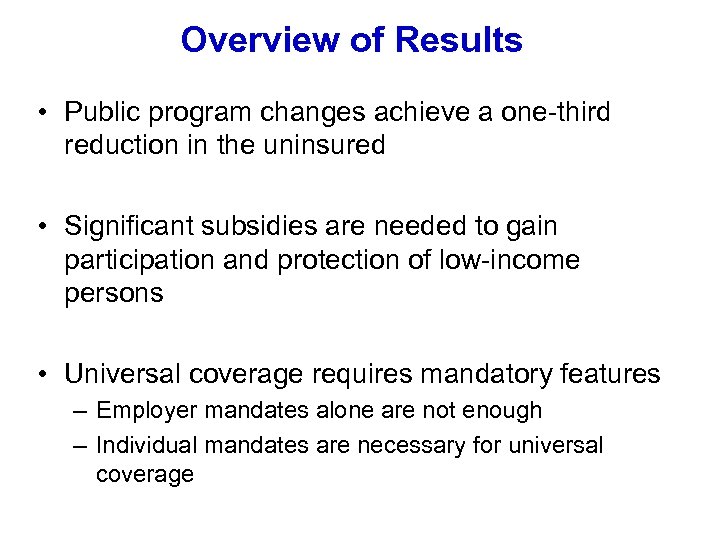 Overview of Results • Public program changes achieve a one-third reduction in the uninsured • Significant subsidies are needed to gain participation and protection of low-income persons • Universal coverage requires mandatory features – Employer mandates alone are not enough – Individual mandates are necessary for universal coverage
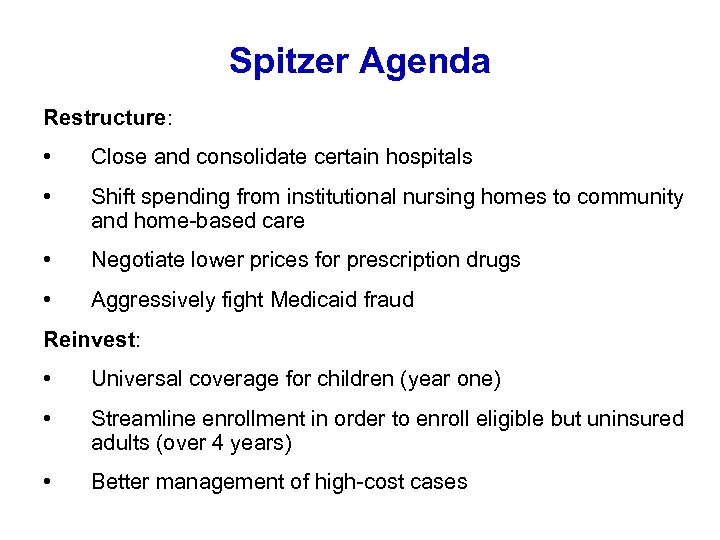 Spitzer Agenda Restructure: • Close and consolidate certain hospitals • Shift spending from institutional nursing homes to community and home-based care • Negotiate lower prices for prescription drugs • Aggressively fight Medicaid fraud Reinvest: • Universal coverage for children (year one) • Streamline enrollment in order to enroll eligible but uninsured adults (over 4 years) • Better management of high-cost cases