


 Скачать презентацию EXP 482 Corporate Financial Policy Clifford W Smith
7829172e57e0411ef772e73f16348da6.ppt
- Количество слайдов: 33
 EXP 482 Corporate Financial Policy Clifford W. Smith, Jr. Winter 2007 - Overhead 4 * Covers readings on course outline through Smith/Warner (1979)
 Bond Contracts Conflicts of Interest v Dividend payouts v Claim dilution v Asset substitution v Underinvestment
 Bond Covenants Restrictions on: v Investment policy v Dividend policy v Financing policy v Required bonding activities
 Bond Covenants v Restrictions on Investment – Direct restrictions on investment of physical assets seldom observed – Restrictions on financial investments – Restrictions on disposition of assets – Security provisions (i. e. mortgage loans) – Asset maintenance – Restrictions on mergers
 Mergers Under what circumstances are bondholders made better off or worse off by a merger?
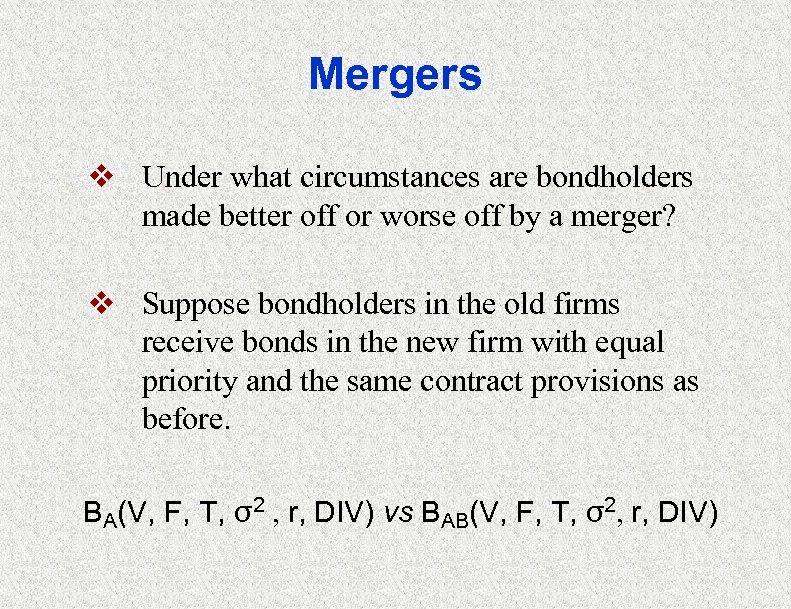 Mergers v Under what circumstances are bondholders made better off or worse off by a merger? v Suppose bondholders in the old firms receive bonds in the new firm with equal priority and the same contract provisions as before. BA(V, F, T, σ2 , r, DIV) vs BAB(V, F, T, σ2, r, DIV)
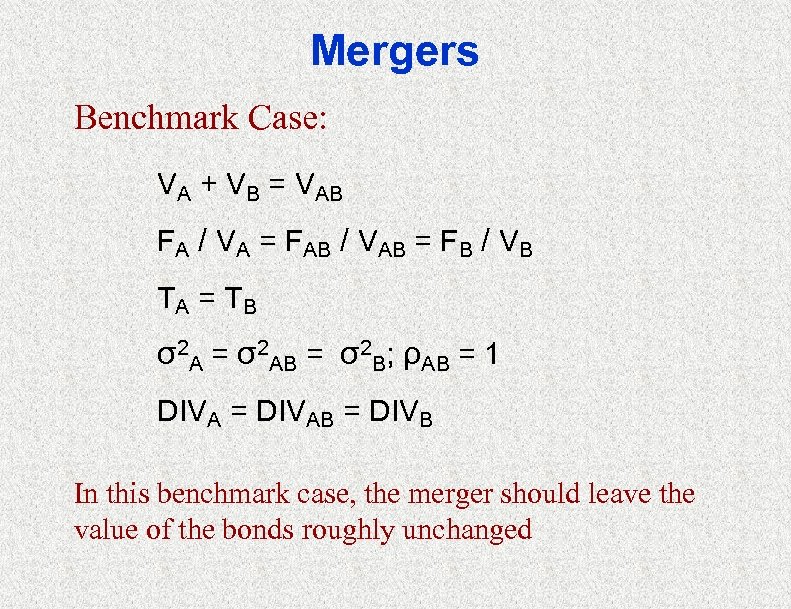 Mergers Benchmark Case: VA + VB = VAB FA / VA = FAB / VAB = FB / VB TA = TB σ2 A = σ2 AB = σ2 B; ρAB = 1 DIVA = DIVAB = DIVB In this benchmark case, the merger should leave the value of the bonds roughly unchanged
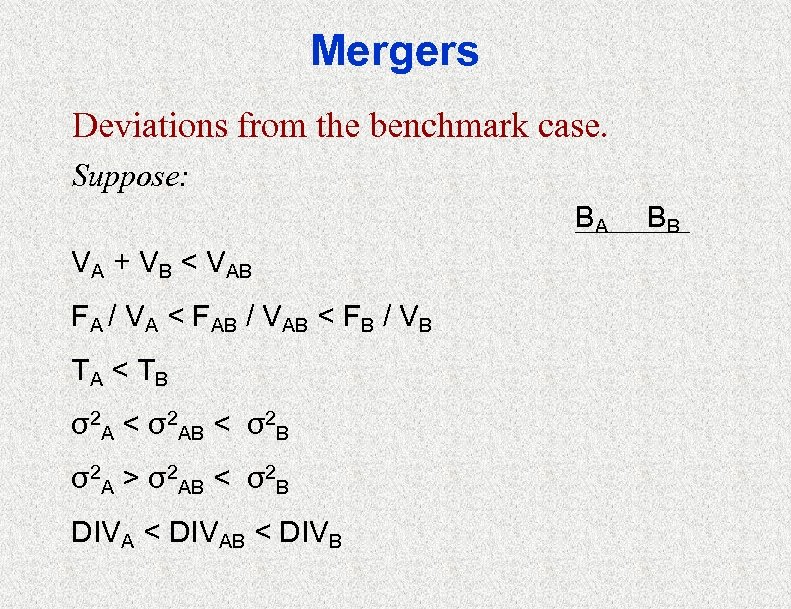 Mergers Deviations from the benchmark case. Suppose: BA VA + VB < VAB FA / VA < FAB / VAB < FB / VB TA < T B σ2 A < σ2 AB < σ2 B σ2 A > σ2 AB < σ2 B DIVA < DIVAB < DIVB BB
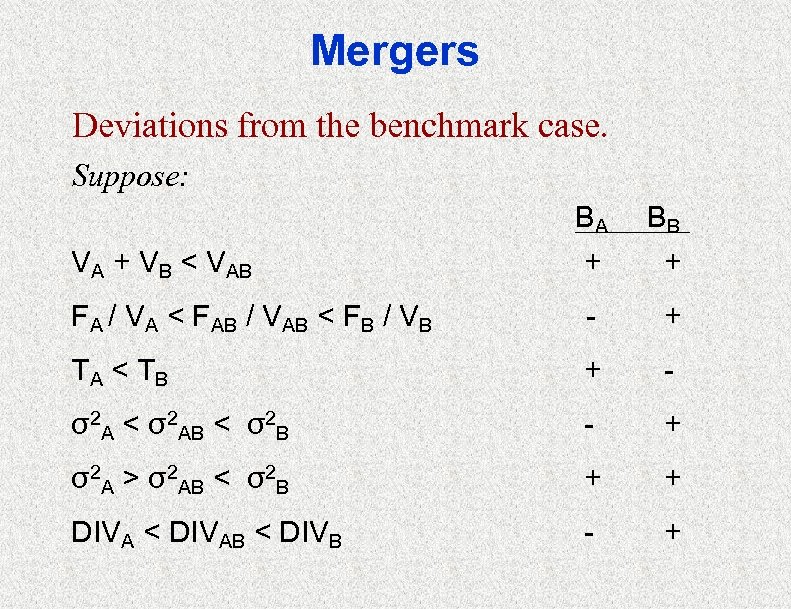 Mergers Deviations from the benchmark case. Suppose: BA + BB + FA / VA < FAB / VAB < FB / VB - + TA < T B + - σ2 A < σ2 AB < σ2 B - + σ2 A > σ2 AB < σ2 B + + DIVA < DIVAB < DIVB - + VA + VB < VAB
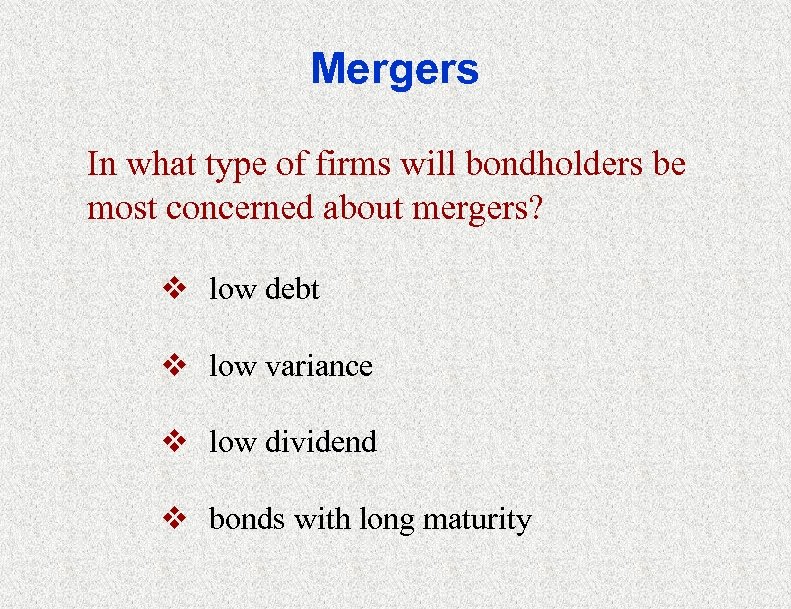 Mergers In what type of firms will bondholders be most concerned about mergers? v low debt v low variance v low dividend v bonds with long maturity
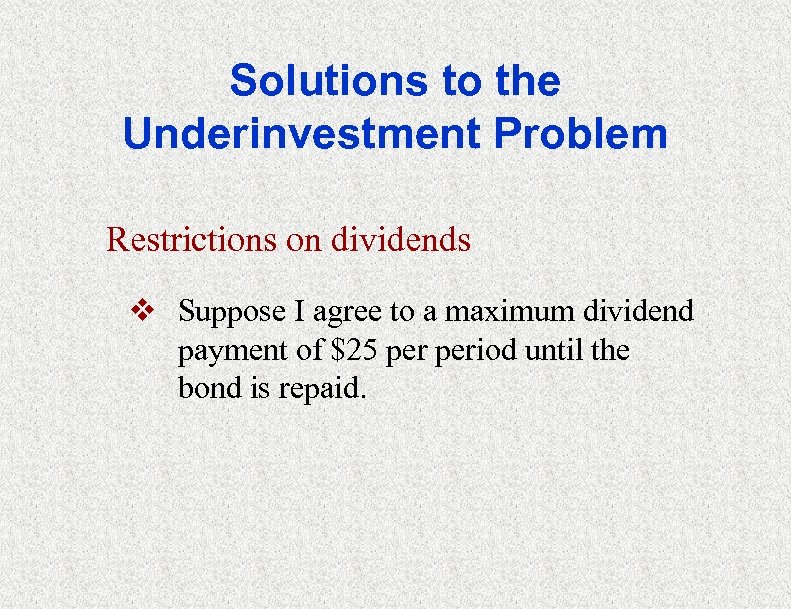 Solutions to the Underinvestment Problem Restrictions on dividends v Suppose I agree to a maximum dividend payment of $25 period until the bond is repaid.
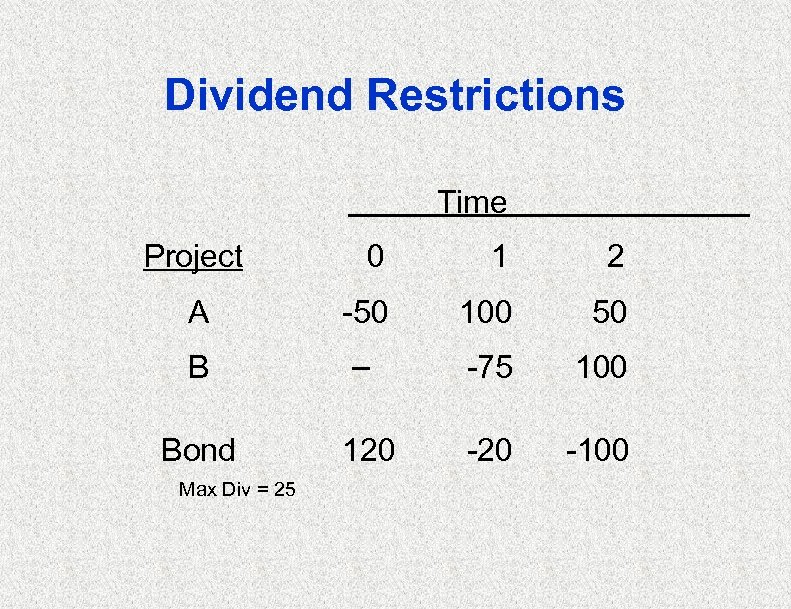 Dividend Restrictions Time Project 0 1 2 A -50 100 50 B – -75 100 Bond 120 -100 Max Div = 25
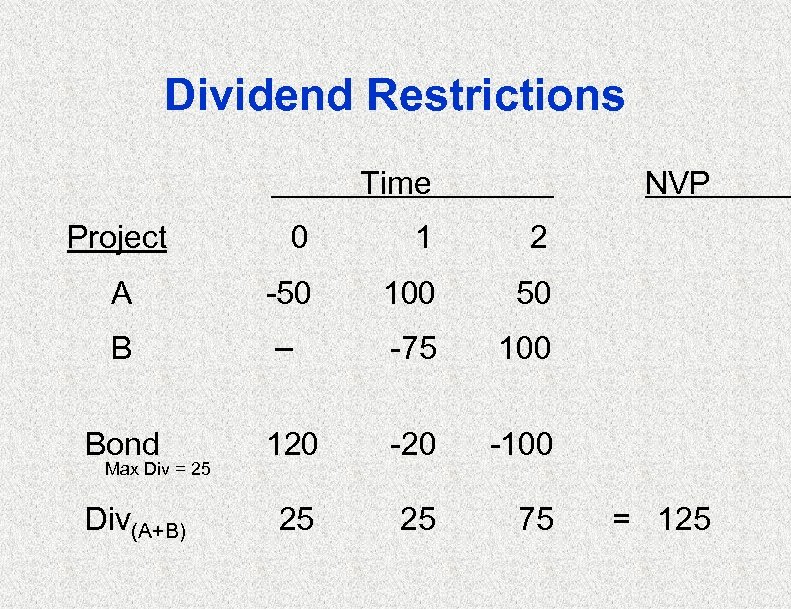 Dividend Restrictions Time Project NVP 0 1 2 A -50 100 50 B – -75 100 Bond 120 -100 25 25 75 Max Div = 25 Div(A+B) = 125
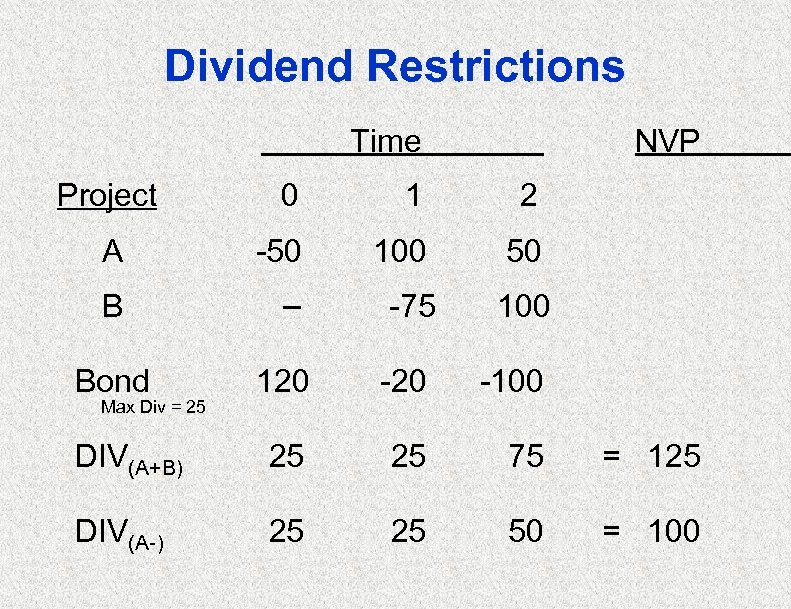 Dividend Restrictions Time Project NVP 0 1 2 A -50 100 50 B – -75 100 Bond 120 -100 DIV(A+B) 25 25 75 = 125 DIV(A-) 25 25 50 = 100 Max Div = 25
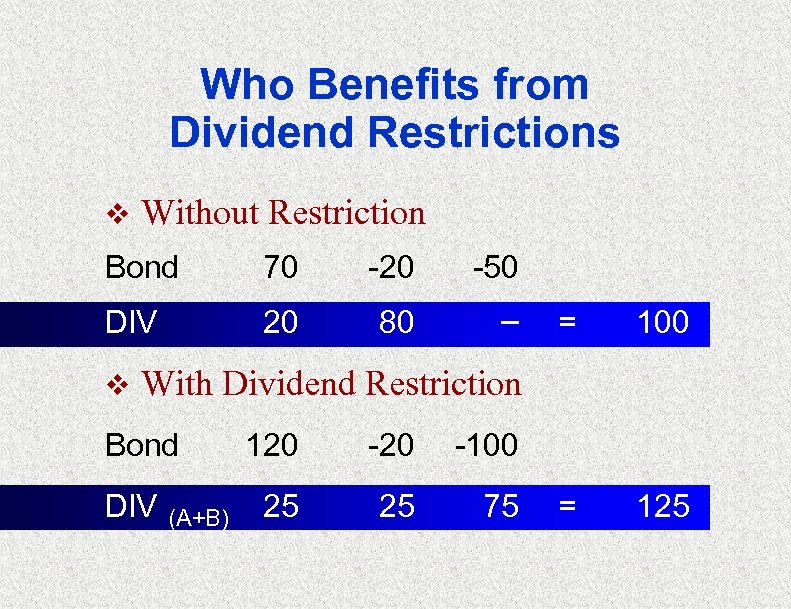 Who Benefits from Dividend Restrictions v Without Restriction Bond 70 -20 -50 DIV 20 80 – v = 100 = 125 With Dividend Restriction Bond DIV (A+B) 120 -100 25 25 75
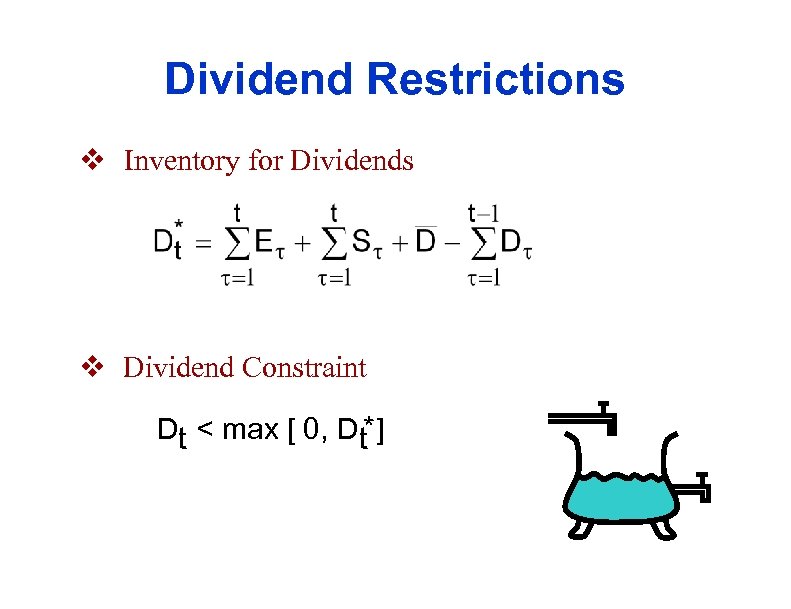
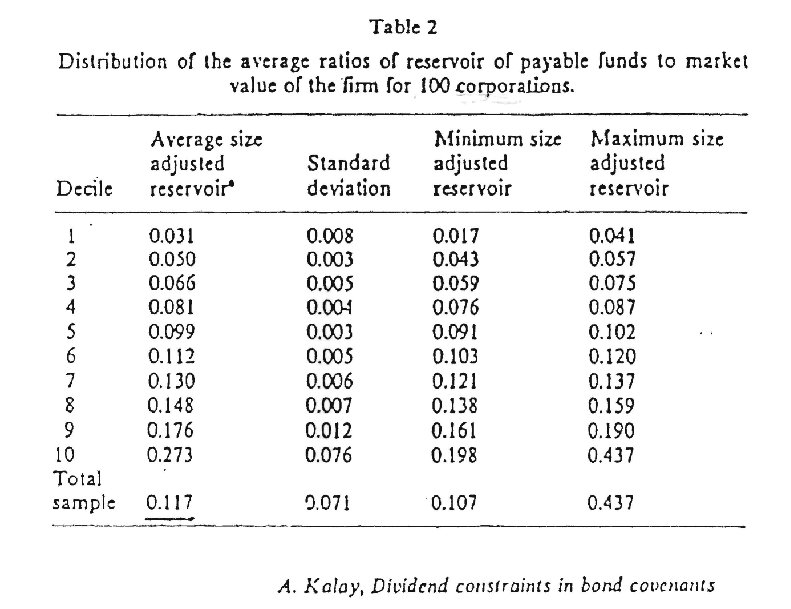
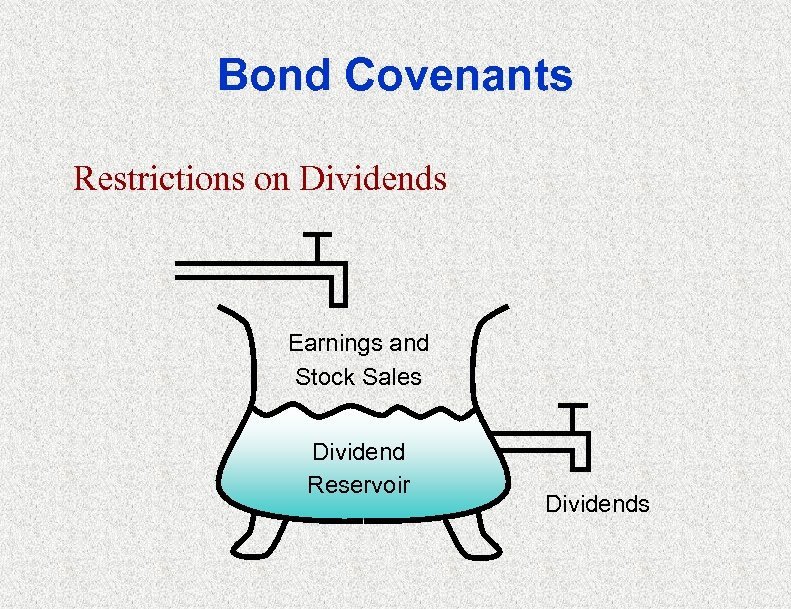 Bond Covenants Restrictions on Dividends Earnings and Stock Sales Dividend Reservoir Dividends
 Dividend Restrictions v Inventory for Dividends v Dividend Constraint Dt < max [ 0, Dt* ]
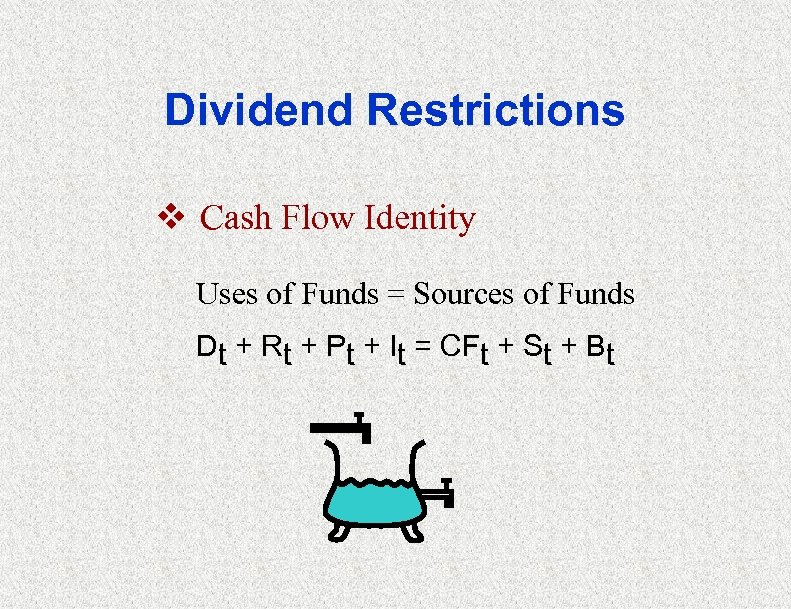 Dividend Restrictions v Cash Flow Identity Uses of Funds = Sources of Funds Dt + Rt + Pt + It = CFt + St + Bt
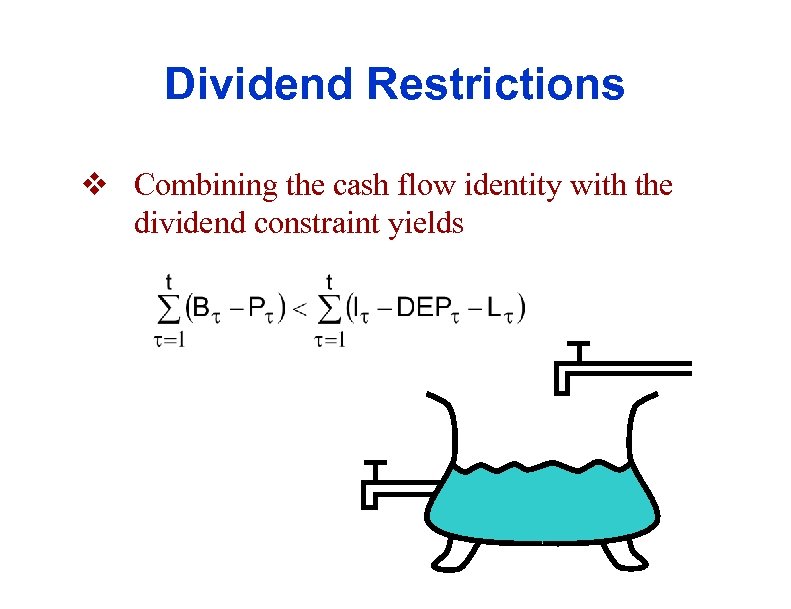
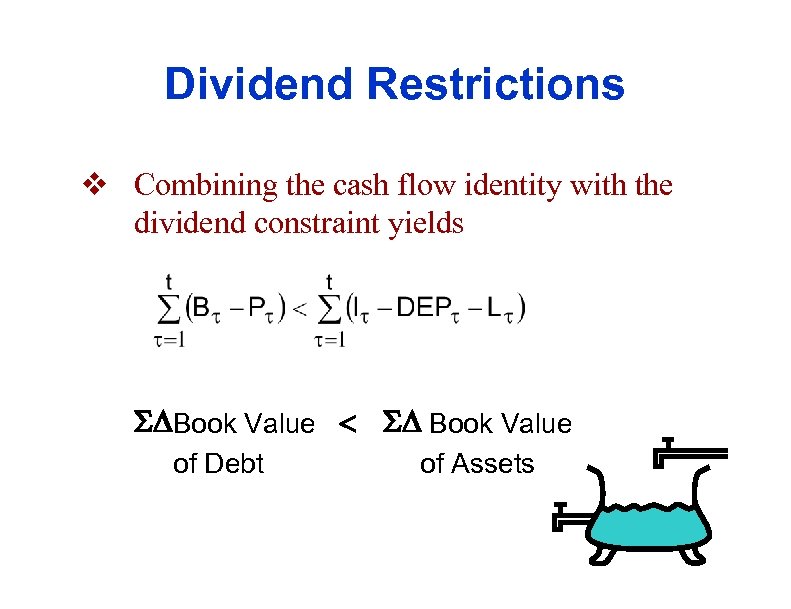
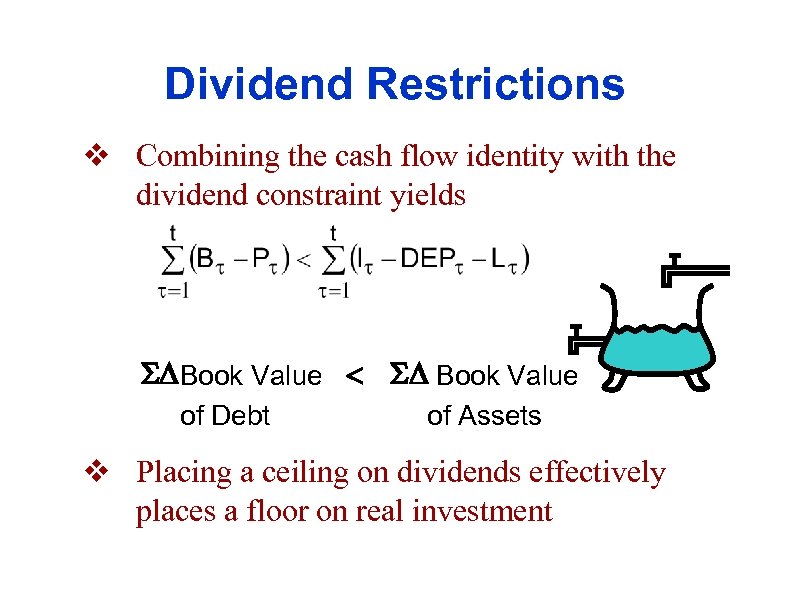
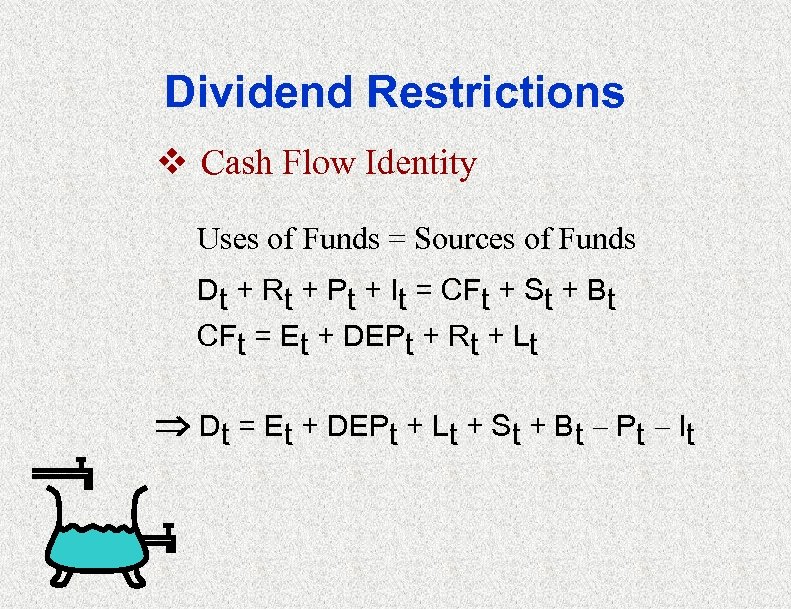 Dividend Restrictions v Cash Flow Identity Uses of Funds = Sources of Funds Dt + Rt + Pt + It = CFt + St + Bt CFt = Et + DEPt + Rt + Lt Þ Dt = Et + DEPt + Lt + St + Bt - Pt - It
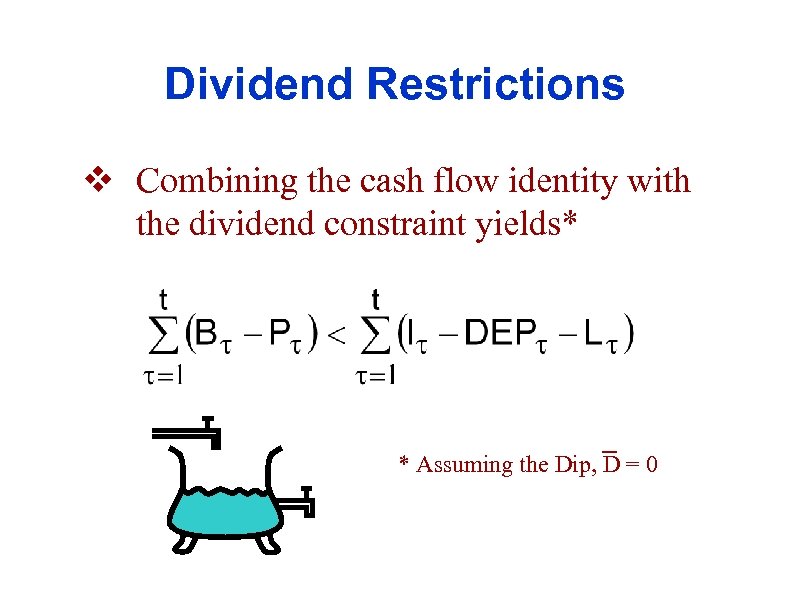 Dividend Restrictions v Combining the cash flow identity with the dividend constraint yields* * Assuming the Dip, D = 0
 Dividend Restrictions v Combining the cash flow identity with the dividend constraint yields
 Dividend Restrictions v Combining the cash flow identity with the dividend constraint yields Book Value of Debt of Assets
 Dividend Restrictions v Combining the cash flow identity with the dividend constraint yields Book Value of Debt of Assets v Placing a ceiling on dividends effectively places a floor on real investment
 Dividend Restrictions v Improve dividend payout problem v Improve claim dilution problem v Improve underinvestment problem v May exacerbate asset substitution problem
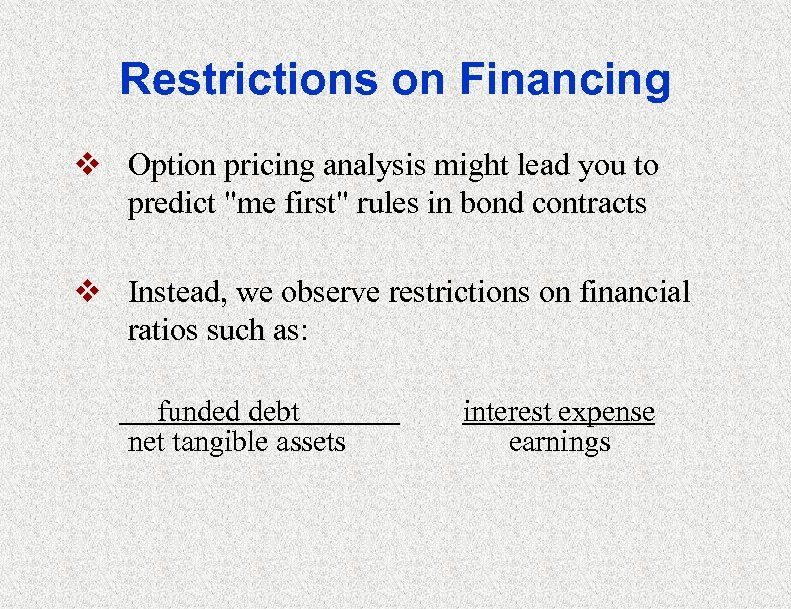 Restrictions on Financing v Option pricing analysis might lead you to predict "me first" rules in bond contracts v Instead, we observe restrictions on financial ratios such as: funded debt net tangible assets interest expense earnings
 Restrictions on Financing Use of balance sheet vs income statement for financing restrictions
 Other Financing Issues v Leasing v Convertible Bonds v Callable Bonds v Sinking Funds
 Solutions to the Underinvestment Problem Sinking fund provisions v A bond with a sinking fund provides for the repayment of some of the principle before expiration
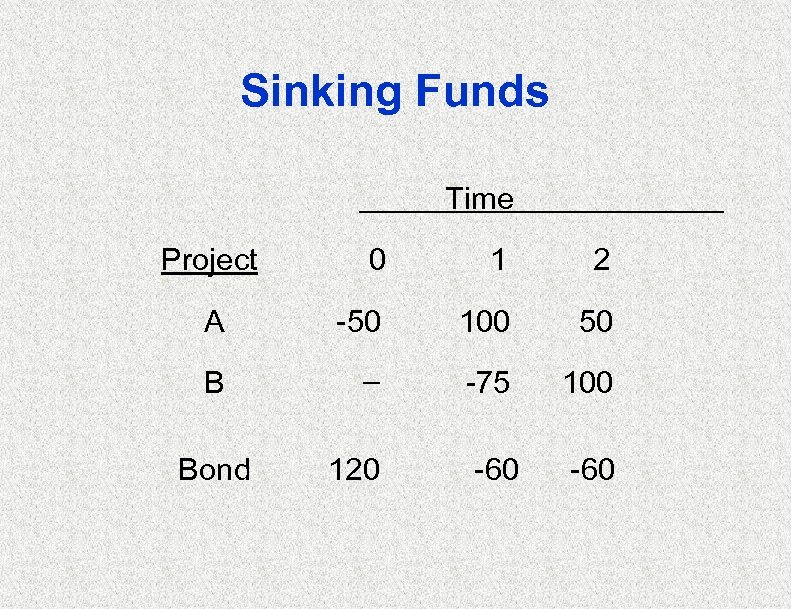 Sinking Funds Time Project 0 1 2 A -50 100 50 B – -75 100 120 -60 Bond
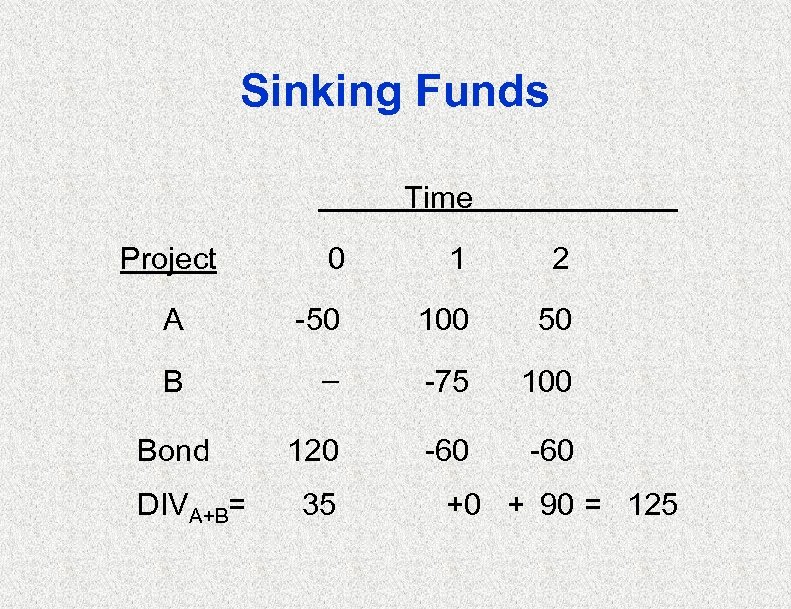 Sinking Funds Time Project 0 1 2 A -50 100 50 B – -75 100 120 -60 Bond DIVA+B= 35 +0 + 90 = 125
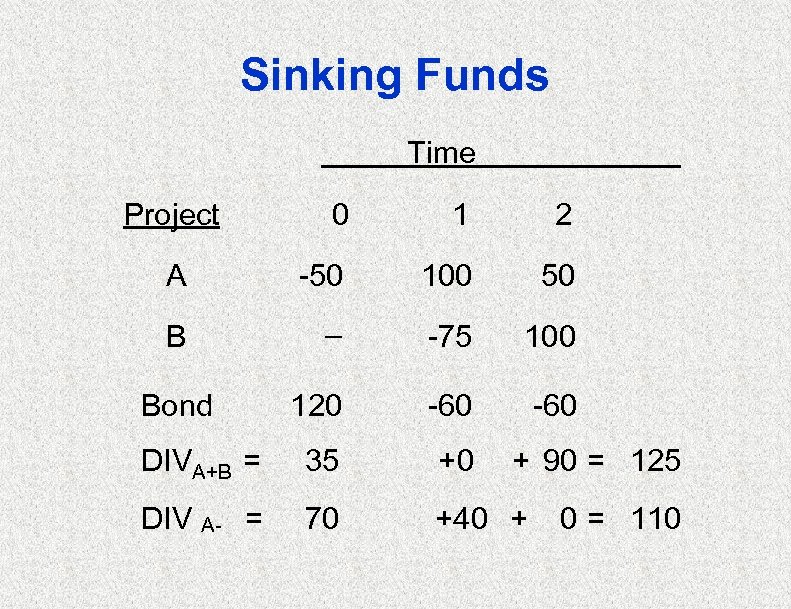 Sinking Funds Time Project 0 1 2 A -50 100 50 B – -75 100 120 -60 DIVA+B = 35 +0 DIV A- = 70 +40 + Bond + 90 = 125 0 = 110
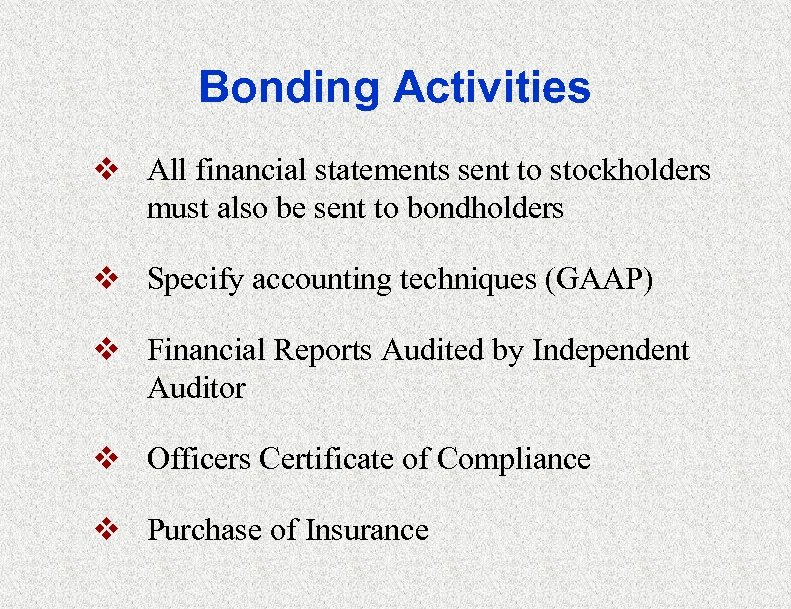 Bonding Activities v All financial statements sent to stockholders must also be sent to bondholders v Specify accounting techniques (GAAP) v Financial Reports Audited by Independent Auditor v Officers Certificate of Compliance v Purchase of Insurance