


 Скачать презентацию Exo-Planet Task Force Exo PTF A Strategy for
4a71b1dd13d54a4fd220b1b83763f523.ppt
- Количество слайдов: 22
 Exo-Planet Task Force (Exo. PTF) A Strategy for the Detection and Characterization of Exoplanets Preliminary Findings Briefing “Do there exist many worlds, or is there but a single world? This is one of the most noble and exalted questions in the study of Nature. ” -Albertus Magnus 1193 -1280
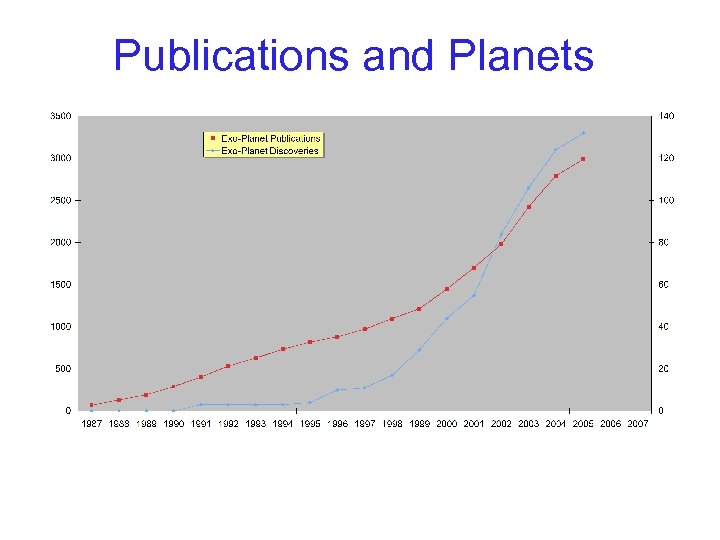 Publications and Planets
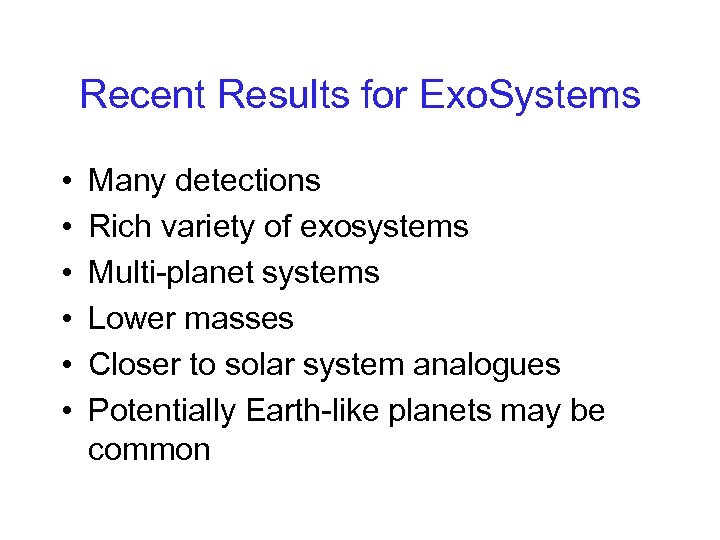 Recent Results for Exo. Systems • • • Many detections Rich variety of exosystems Multi-planet systems Lower masses Closer to solar system analogues Potentially Earth-like planets may be common
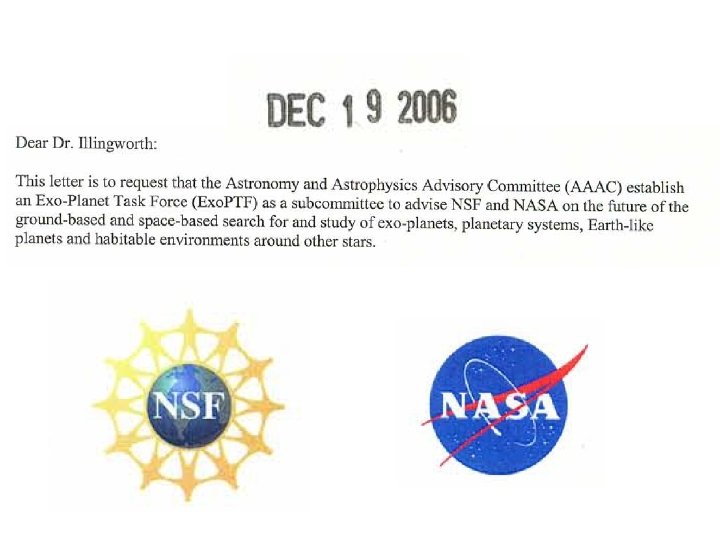
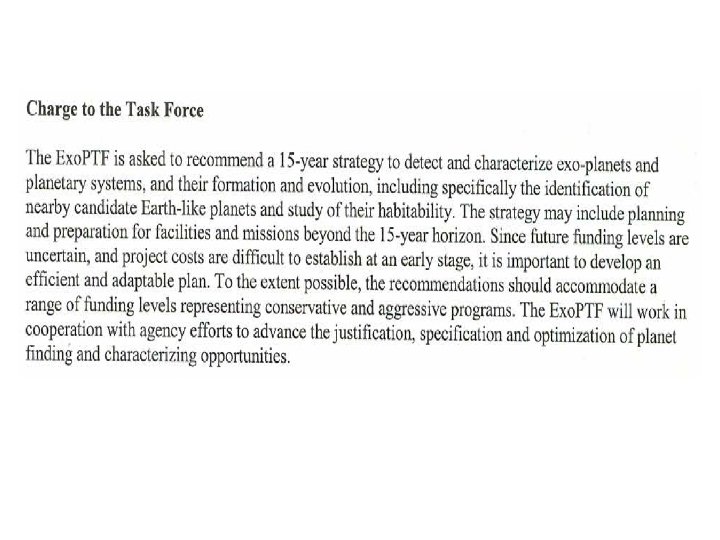
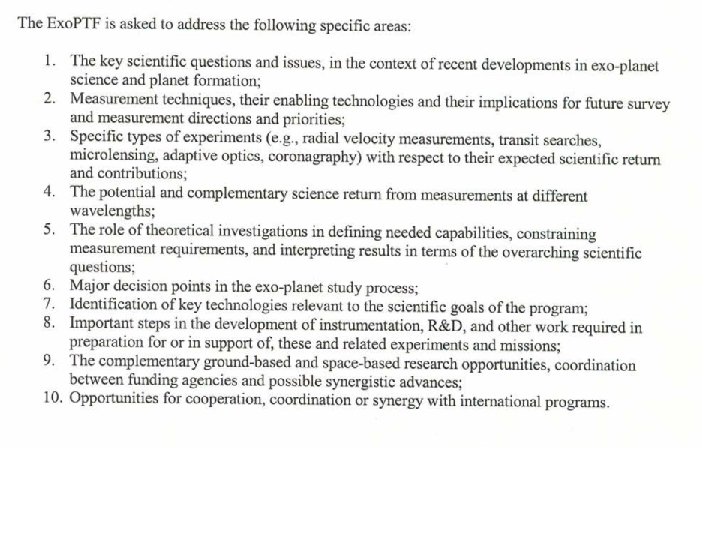
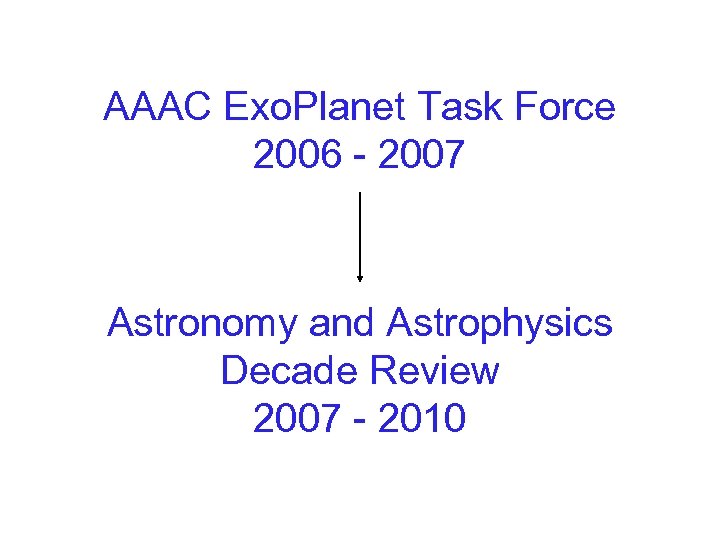 AAAC Exo. Planet Task Force 2006 - 2007 Astronomy and Astrophysics Decade Review 2007 - 2010
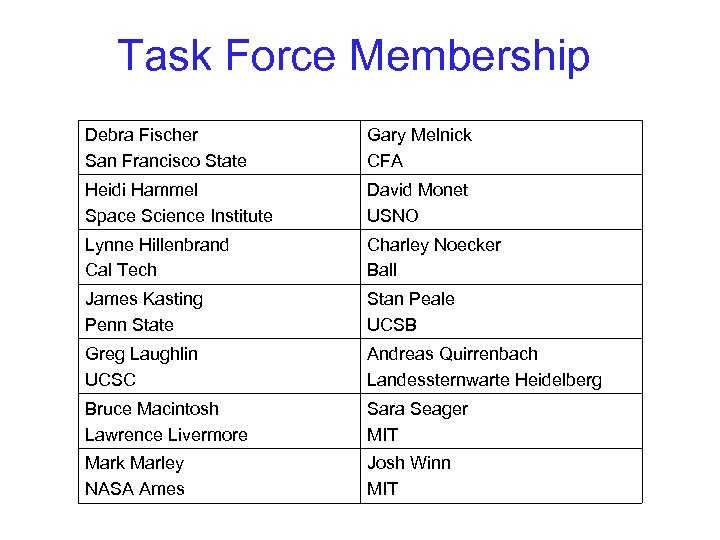 Task Force Membership Debra Fischer San Francisco State Gary Melnick CFA Heidi Hammel Space Science Institute David Monet USNO Lynne Hillenbrand Cal Tech Charley Noecker Ball James Kasting Penn State Stan Peale UCSB Greg Laughlin UCSC Andreas Quirrenbach Landessternwarte Heidelberg Bruce Macintosh Lawrence Livermore Sara Seager MIT Mark Marley NASA Ames Josh Winn MIT
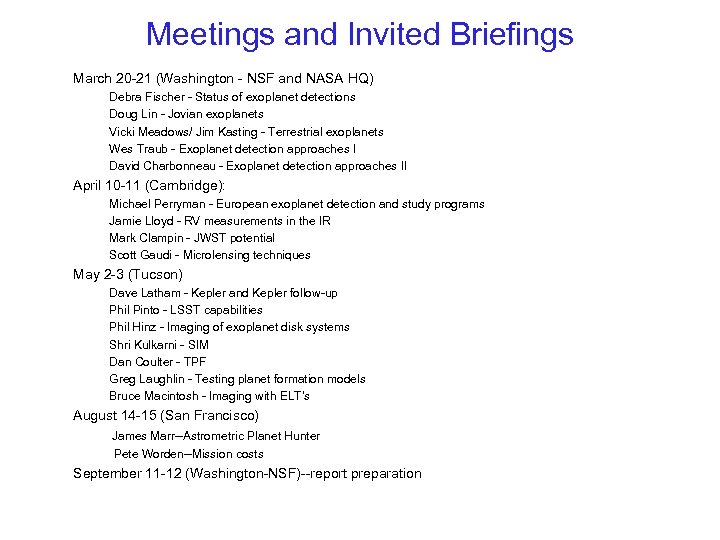 Meetings and Invited Briefings March 20 -21 (Washington - NSF and NASA HQ) Debra Fischer - Status of exoplanet detections Doug Lin - Jovian exoplanets Vicki Meadows/ Jim Kasting - Terrestrial exoplanets Wes Traub - Exoplanet detection approaches I David Charbonneau - Exoplanet detection approaches II April 10 -11 (Cambridge): Michael Perryman - European exoplanet detection and study programs Jamie Lloyd - RV measurements in the IR Mark Clampin - JWST potential Scott Gaudi - Microlensing techniques May 2 -3 (Tucson) Dave Latham - Kepler and Kepler follow-up Phil Pinto - LSST capabilities Phil Hinz - Imaging of exoplanet disk systems Shri Kulkarni - SIM Dan Coulter - TPF Greg Laughlin - Testing planet formation models Bruce Macintosh - Imaging with ELT’s August 14 -15 (San Francisco) James Marr--Astrometric Planet Hunter Pete Worden--Mission costs September 11 -12 (Washington-NSF)--report preparation
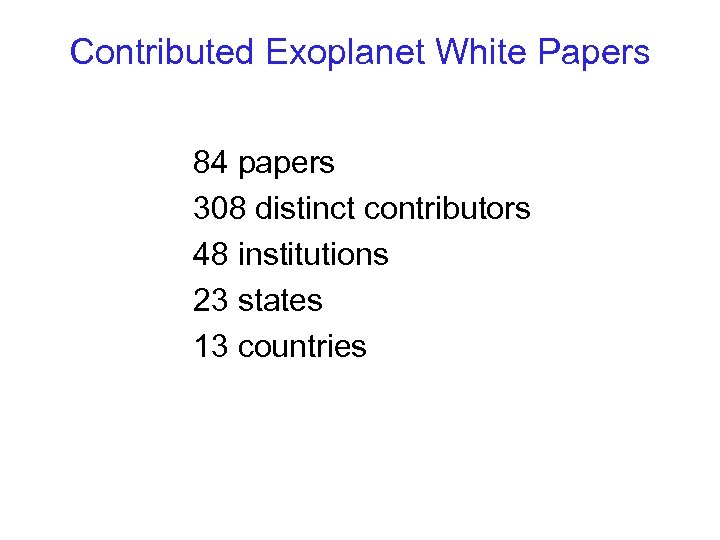 Contributed Exoplanet White Papers 84 papers 308 distinct contributors 48 institutions 23 states 13 countries
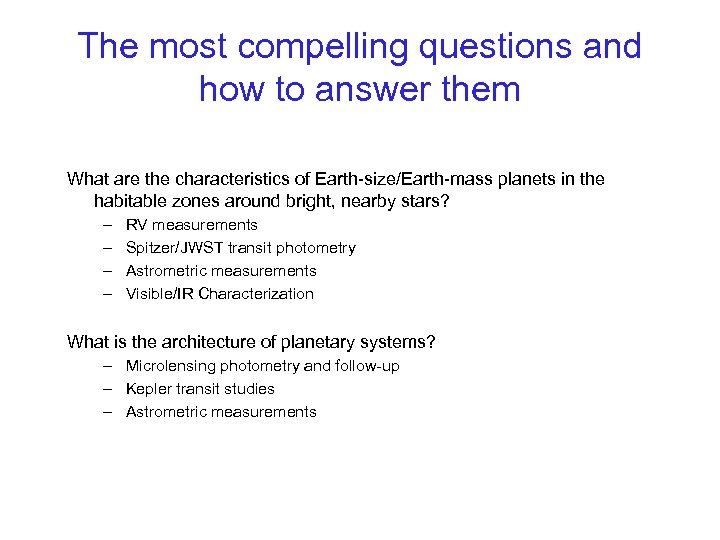 The most compelling questions and how to answer them What are the characteristics of Earth-size/Earth-mass planets in the habitable zones around bright, nearby stars? – – RV measurements Spitzer/JWST transit photometry Astrometric measurements Visible/IR Characterization What is the architecture of planetary systems? – Microlensing photometry and follow-up – Kepler transit studies – Astrometric measurements
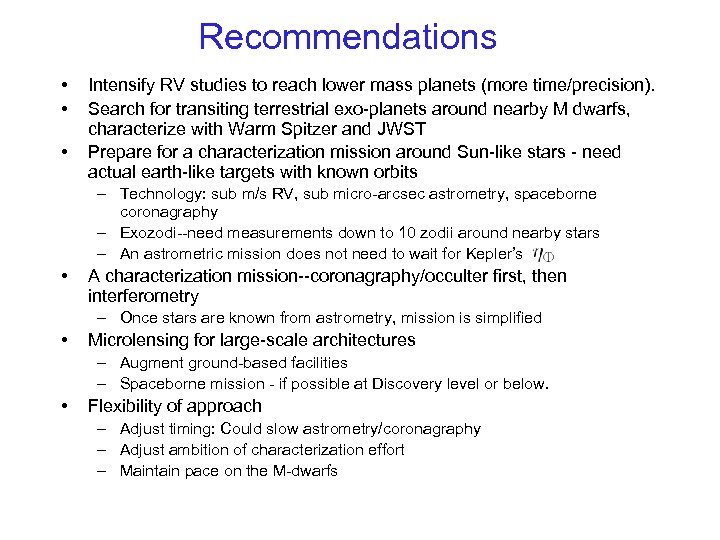 Recommendations • • • Intensify RV studies to reach lower mass planets (more time/precision). Search for transiting terrestrial exo-planets around nearby M dwarfs, characterize with Warm Spitzer and JWST Prepare for a characterization mission around Sun-like stars - need actual earth-like targets with known orbits – Technology: sub m/s RV, sub micro-arcsec astrometry, spaceborne coronagraphy – Exozodi--need measurements down to 10 zodii around nearby stars – An astrometric mission does not need to wait for Kepler’s • A characterization mission--coronagraphy/occulter first, then interferometry – Once stars are known from astrometry, mission is simplified • Microlensing for large-scale architectures – Augment ground-based facilities – Spaceborne mission - if possible at Discovery level or below. • Flexibility of approach – Adjust timing: Could slow astrometry/coronagraphy – Adjust ambition of characterization effort – Maintain pace on the M-dwarfs
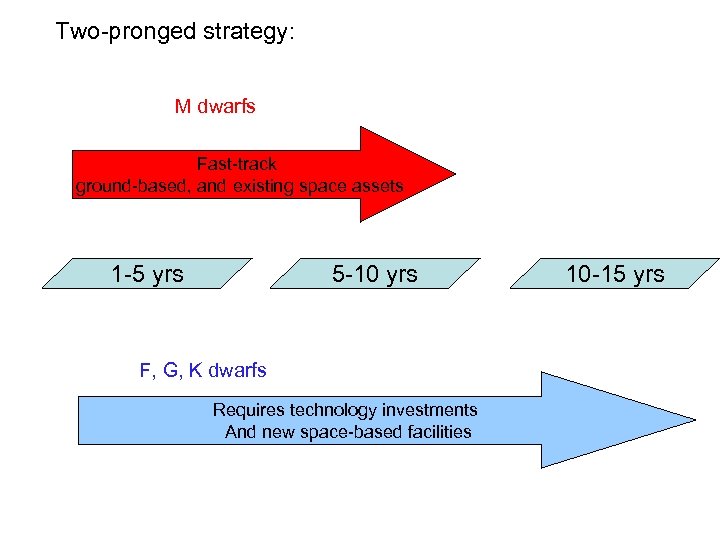 Two-pronged strategy: M dwarfs Fast-track ground-based, and existing space assets 1 -5 yrs 5 -10 yrs F, G, K dwarfs Requires technology investments And new space-based facilities 10 -15 yrs
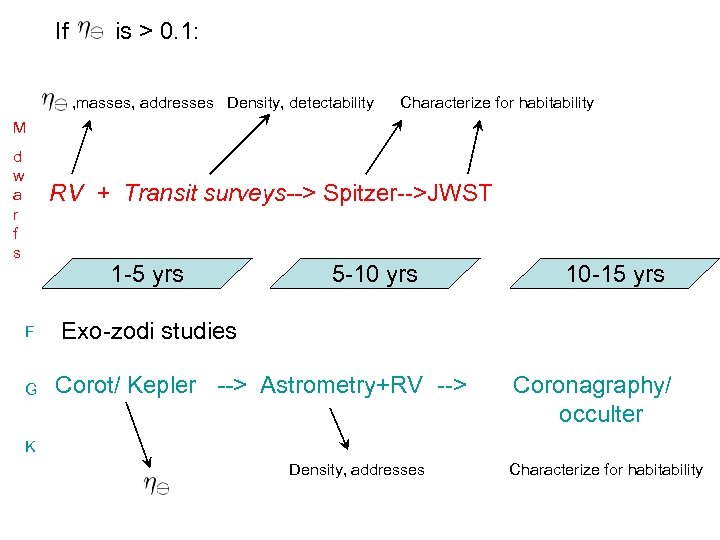 If is > 0. 1: , masses, addresses Density, detectability Characterize for habitability M d w a r f s RV + Transit surveys--> Spitzer-->JWST 1 -5 yrs F G 5 -10 yrs 10 -15 yrs Exo-zodi studies Corot/ Kepler --> Astrometry+RV --> Coronagraphy/ occulter K Density, addresses Characterize for habitability
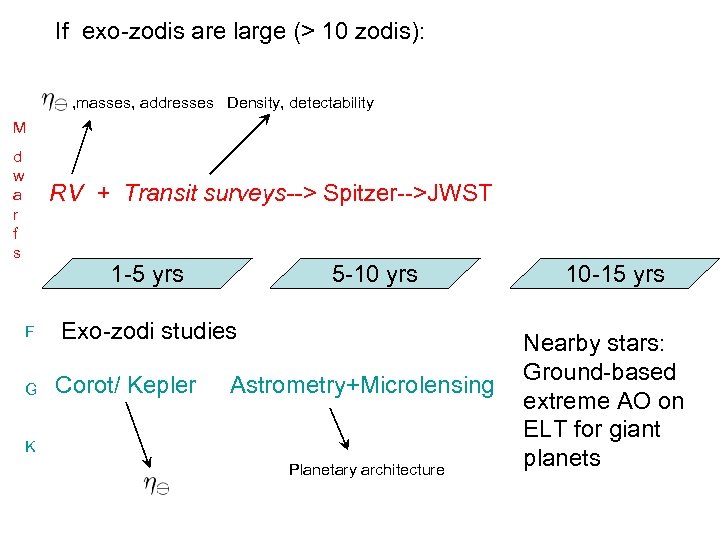 If exo-zodis are large (> 10 zodis): , masses, addresses Density, detectability M d w a r f s RV + Transit surveys--> Spitzer-->JWST 1 -5 yrs F G 5 -10 yrs Exo-zodi studies Corot/ Kepler Astrometry+Microlensing K Planetary architecture 10 -15 yrs Nearby stars: Ground-based extreme AO on ELT for giant planets
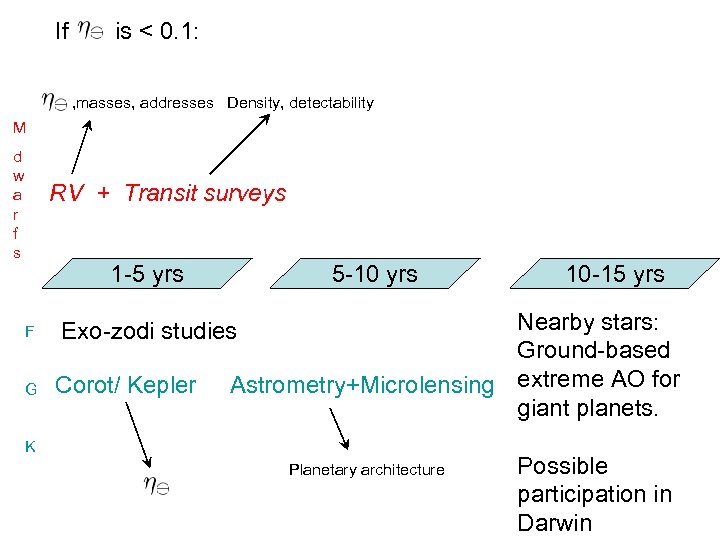 If is < 0. 1: , masses, addresses Density, detectability M d w a r f s RV + Transit surveys 1 -5 yrs F G 5 -10 yrs 10 -15 yrs Nearby stars: Ground-based Astrometry+Microlensing extreme AO for giant planets. Exo-zodi studies Corot/ Kepler K Planetary architecture Possible participation in Darwin
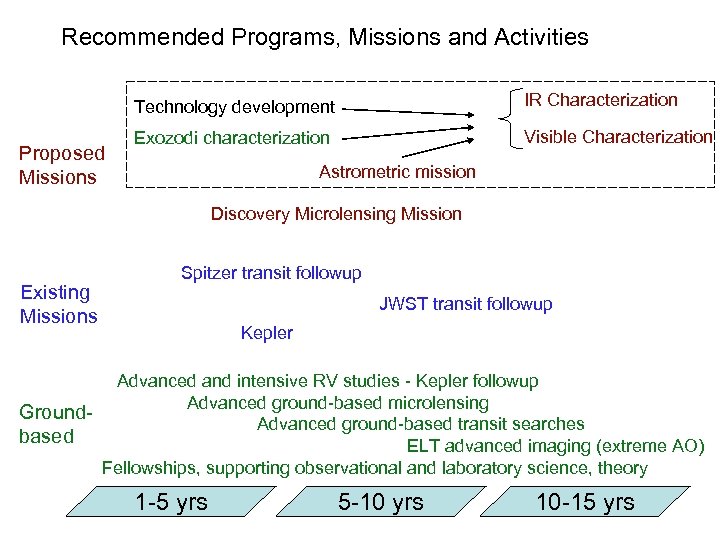 Recommended Programs, Missions and Activities Technology development Proposed Missions IR Characterization Exozodi characterization Visible Characterization Astrometric mission Discovery Microlensing Mission Existing Missions Spitzer transit followup JWST transit followup Kepler Advanced and intensive RV studies - Kepler followup Advanced ground-based microlensing Ground. Advanced ground-based transit searches based ELT advanced imaging (extreme AO) Fellowships, supporting observational and laboratory science, theory 1 -5 yrs 5 -10 yrs 10 -15 yrs
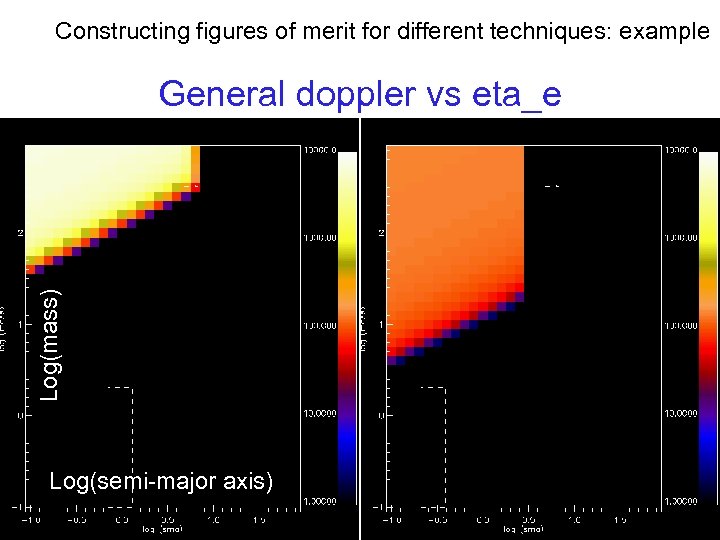 Constructing figures of merit for different techniques: example Log(mass) General doppler vs eta_e Log(semi-major axis)
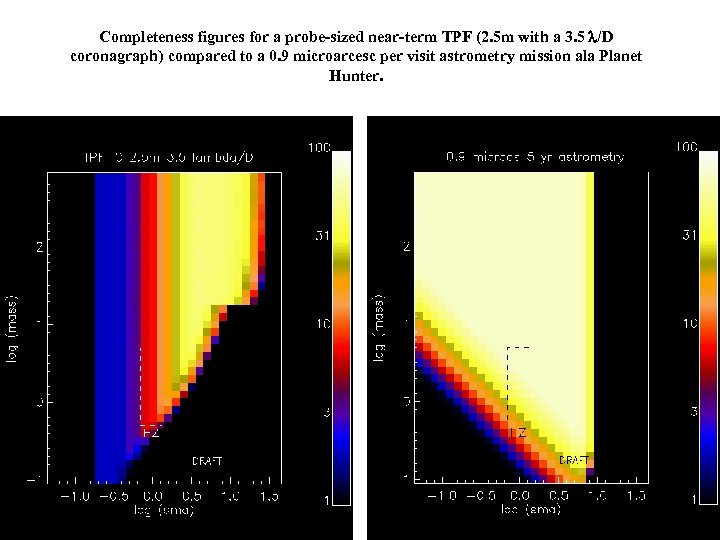 Completeness figures for a probe-sized near-term TPF (2. 5 m with a 3. 5 /D coronagraph) compared to a 0. 9 microarcesc per visit astrometry mission ala Planet Hunter.
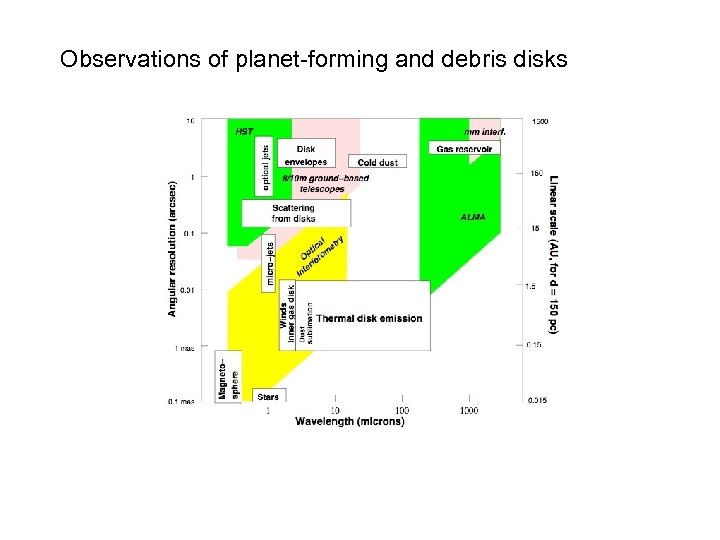 Observations of planet-forming and debris disks
 Structure of the Report • • • • • 1. 2. 3. 4. 5. 6. 7. 8. 9. A. B. C. D. E. F. G. 10. 11. 12. 13. Executive Summary The scientific and philosophical significance of detecting other Earths Goals and Methodologies for detecting and characterizing extrasolar planets Findings of the Exoplanet Task Force Exoplanet detection scenarios from the present to detect/char other Earths Recommendations of the Exoplanet Task Force State of knowledge of extrasolar planets Figures of merit for exoplanet detection/characterization Technique performance projections…(0 -5), (6 -10), (11 -15) years RV Astrometry Transit Microlensing Coronography Interferometry Indirect inference via debris disk properties Laboratory, theory, and technology investments required References Acknowledgments Technical Appendix
 Conclusions 1. The plan addresses the key questions in exoplanet research: Are there habitable planets around other stars? What is the architecture of planetary systems? How do planets fit in to the process of star formation? 2. The plan provides the opportunity for early discoveries and risk reduction; spaceborne coronagraphy is significantly simplified. 3. Plan depends on a balance of ground- and space; existing and future assets 4. Plan is flexible to surprises, failures and new discoveries. 4. Plan is already streamlined in cost but can be stretched out