 Скачать презентацию Exhibit ES-1 Congressional Health Reform Bills as of
d4037bd741aaea570e708ffcac7b50ff.ppt
- Количество слайдов: 28



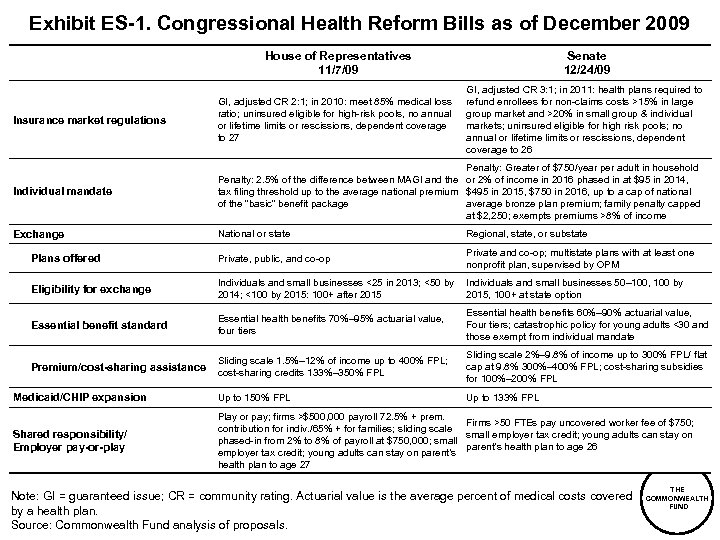
Exhibit ES-1. Congressional Health Reform Bills as of December 2009 House of Representatives 11/7/09 Senate 12/24/09 GI, adjusted CR 3: 1; in 2011: health plans required to refund enrollees for non-claims costs >15% in large group market and >20% in small group & individual markets; uninsured eligible for high risk pools; no annual or lifetime limits or rescissions, dependent coverage to 26 Insurance market regulations GI, adjusted CR 2: 1; in 2010: meet 85% medical loss ratio; uninsured eligible for high-risk pools, no annual or lifetime limits or rescissions, dependent coverage to 27 Individual mandate Penalty: Greater of $750/year per adult in household Penalty: 2. 5% of the difference between MAGI and the or 2% of income in 2016 phased in at $95 in 2014, tax filing threshold up to the average national premium $495 in 2015, $750 in 2016, up to a cap of national of the “basic” benefit package average bronze plan premium; family penalty capped at $2, 250; exempts premiums >8% of income Exchange National or state Regional, state, or substate Plans offered Private, public, and co-op Private and co-op; multistate plans with at least one nonprofit plan, supervised by OPM Eligibility for exchange Individuals and small businesses <25 in 2013; <50 by 2014; <100 by 2015: 100+ after 2015 Individuals and small businesses 50– 100, 100 by 2015, 100+ at state option Essential benefit standard Essential health benefits 70%– 95% actuarial value, four tiers Essential health benefits 60%– 90% actuarial value, Four tiers; catastrophic policy for young adults <30 and those exempt from individual mandate Premium/cost-sharing assistance Sliding scale 1. 5%– 12% of income up to 400% FPL; cost-sharing credits 133%– 350% FPL Sliding scale 2%– 9. 8% of income up to 300% FPL/ flat cap at 9. 8% 300%– 400% FPL; cost-sharing subsidies for 100%– 200% FPL Medicaid/CHIP expansion Up to 150% FPL Up to 133% FPL Shared responsibility/ Employer pay-or-play Play or pay; firms >$500, 000 payroll 72. 5% + prem. Firms >50 FTEs pay uncovered worker fee of $750; contribution for indiv. /65% + for families; sliding scale small employer tax credit; young adults can stay on phased-in from 2% to 8% of payroll at $750, 000; small parent’s health plan to age 26 employer tax credit; young adults can stay on parent’s health plan to age 27 Note: GI = guaranteed issue; CR = community rating. Actuarial value is the average percent of medical costs covered by a health plan. Source: Commonwealth Fund analysis of proposals. THE COMMONWEALTH FUND
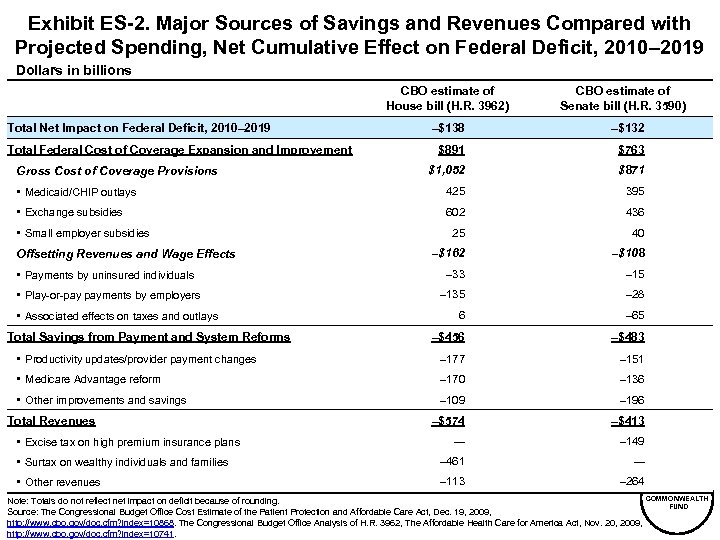
Exhibit ES-2. Major Sources of Savings and Revenues Compared with Projected Spending, Net Cumulative Effect on Federal Deficit, 2010– 2019 Dollars in billions CBO estimate of House bill (H. R. 3962) Total Net Impact on Federal Deficit, 2010– 2019 CBO estimate of Senate bill (H. R. 3590) –$138 –$132 $891 $763 $1, 052 $871 • Medicaid/CHIP outlays 425 395 • Exchange subsidies 602 436 25 40 –$162 –$108 • Payments by uninsured individuals – 33 – 15 • Play-or-pay payments by employers – 135 – 28 6 – 65 –$456 –$483 • Productivity updates/provider payment changes – 177 – 151 • Medicare Advantage reform – 170 – 136 • Other improvements and savings – 109 – 196 –$574 –$413 — – 149 • Surtax on wealthy individuals and families – 461 — • Other revenues – 113 – 264 Total Federal Cost of Coverage Expansion and Improvement Gross Cost of Coverage Provisions • Small employer subsidies Offsetting Revenues and Wage Effects • Associated effects on taxes and outlays Total Savings from Payment and System Reforms Total Revenues • Excise tax on high premium insurance plans Note: Totals do not reflect net impact on deficit because of rounding. Source: The Congressional Budget Office Cost Estimate of the Patient Protection and Affordable Care Act, Dec. 19, 2009, http: //www. cbo. gov/doc. cfm? index=10868. The Congressional Budget Office Analysis of H. R. 3962, The Affordable Health Care for America Act, Nov. 20, 2009, http: //www. cbo. gov/doc. cfm? index=10741. THE COMMONWEALTH FUND
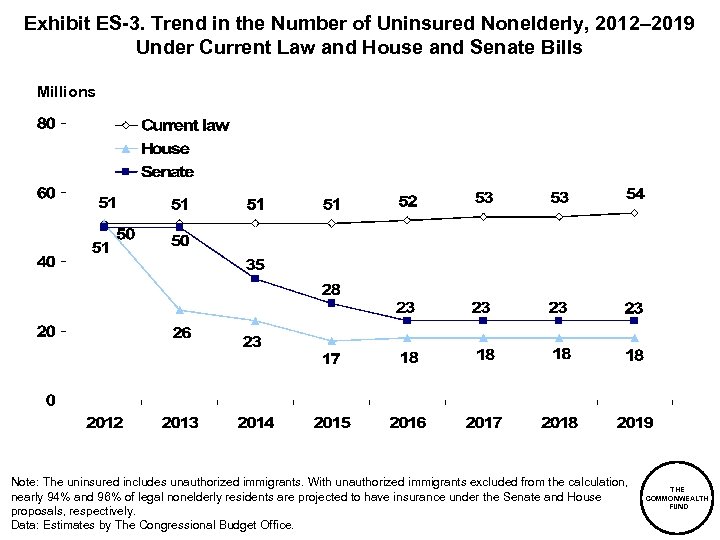
Exhibit ES-3. Trend in the Number of Uninsured Nonelderly, 2012– 2019 Under Current Law and House and Senate Bills Millions Note: The uninsured includes unauthorized immigrants. With unauthorized immigrants excluded from the calculation, nearly 94% and 96% of legal nonelderly residents are projected to have insurance under the Senate and House proposals, respectively. Data: Estimates by The Congressional Budget Office. THE COMMONWEALTH FUND
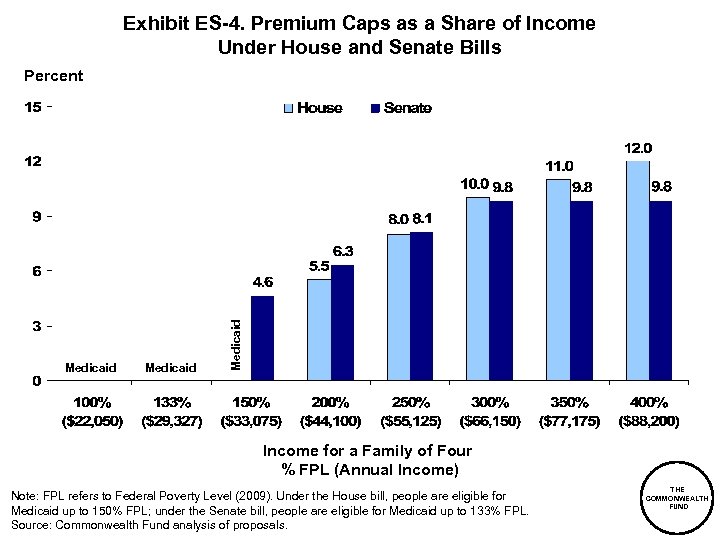
Exhibit ES-4. Premium Caps as a Share of Income Under House and Senate Bills Medicaid Percent Income for a Family of Four % FPL (Annual Income) Note: FPL refers to Federal Poverty Level (2009). Under the House bill, people are eligible for Medicaid up to 150% FPL; under the Senate bill, people are eligible for Medicaid up to 133% FPL. Source: Commonwealth Fund analysis of proposals. THE COMMONWEALTH FUND
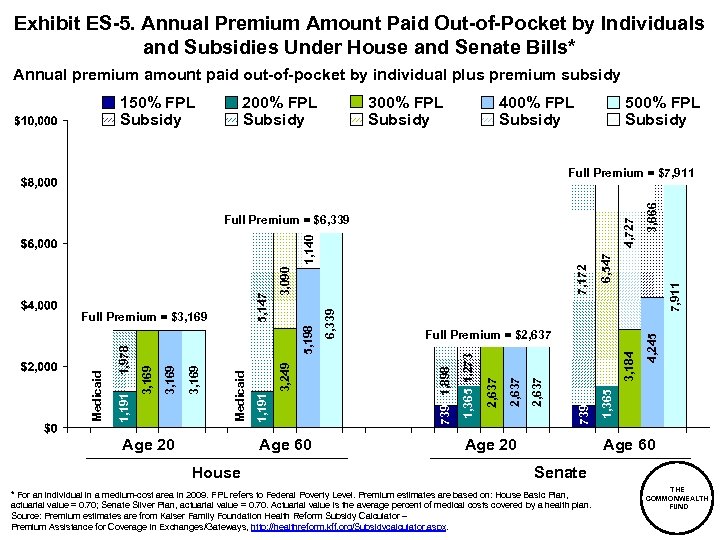
Exhibit ES-5. Annual Premium Amount Paid Out-of-Pocket by Individuals and Subsidies Under House and Senate Bills* Annual premium amount paid out-of-pocket by individual plus premium subsidy 200% FPL Subsidy 150% FPL Subsidy 300% FPL Subsidy 400% FPL Subsidy 500% FPL Subsidy Age 60 House 1, 365 3, 184 Age 20 4, 245 7, 911 6, 547 7, 172 739 2, 637 1, 365 1, 273 6, 339 Full Premium = $2, 637 739 1, 898 3, 249 5, 198 Age 20 1, 191 Medicaid 3, 169 1, 978 1, 191 Medicaid Full Premium = $3, 169 3, 090 5, 147 1, 140 4, 727 Full Premium = $6, 339 3, 666 Full Premium = $7, 911 Age 60 Senate * For an individual in a medium-cost area in 2009. FPL refers to Federal Poverty Level. Premium estimates are based on: House Basic Plan, actuarial value = 0. 70; Senate Silver Plan, actuarial value = 0. 70. Actuarial value is the average percent of medical costs covered by a health plan. Source: Premium estimates are from Kaiser Family Foundation Health Reform Subsidy Calculator – Premium Assistance for Coverage in Exchanges/Gateways, http: //healthreform. kff. org/Subsidycalculator. aspx. THE COMMONWEALTH FUND
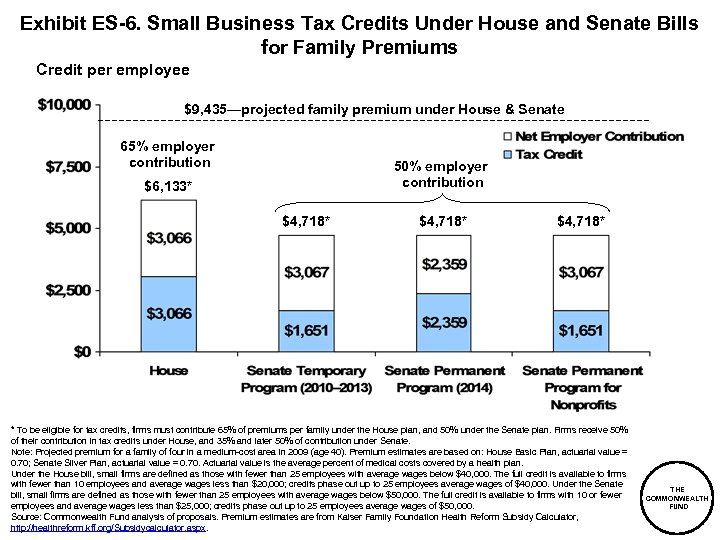
Exhibit ES-6. Small Business Tax Credits Under House and Senate Bills for Family Premiums Credit per employee $9, 435—projected family premium under House & Senate 65% employer contribution 50% employer contribution $6, 133* $4, 718* * To be eligible for tax credits, firms must contribute 65% of premiums per family under the House plan, and 50% under the Senate plan. Firms receive 50% of their contribution in tax credits under House, and 35% and later 50% of contribution under Senate. Note: Projected premium for a family of four in a medium-cost area in 2009 (age 40). Premium estimates are based on: House Basic Plan, actuarial value = 0. 70; Senate Silver Plan, actuarial value = 0. 70. Actuarial value is the average percent of medical costs covered by a health plan. Under the House bill, small firms are defined as those with fewer than 25 employees with average wages below $40, 000. The full credit is available to firms with fewer than 10 employees and average wages less than $20, 000; credits phase out up to 25 employees average wages of $40, 000. Under the Senate bill, small firms are defined as those with fewer than 25 employees with average wages below $50, 000. The full credit is available to firms with 10 or fewer employees and average wages less than $25, 000; credits phase out up to 25 employees average wages of $50, 000. Source: Commonwealth Fund analysis of proposals. Premium estimates are from Kaiser Family Foundation Health Reform Subsidy Calculator, http: //healthreform. kff. org/Subsidycalculator. aspx. THE COMMONWEALTH FUND
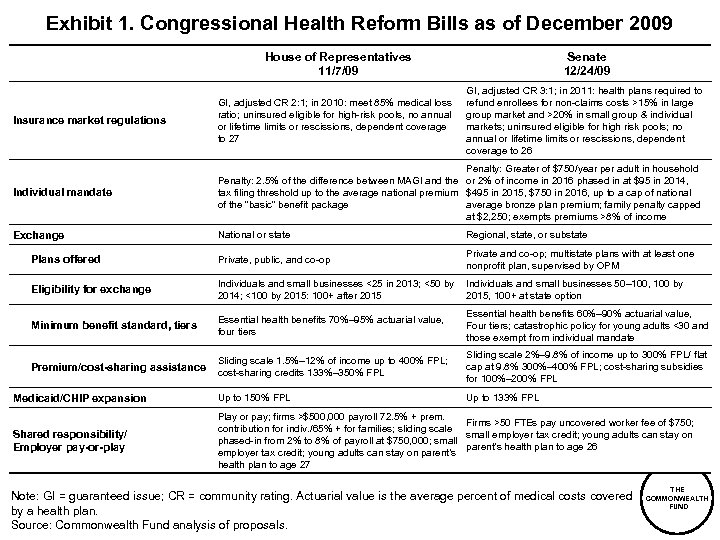
Exhibit 1. Congressional Health Reform Bills as of December 2009 House of Representatives 11/7/09 Senate 12/24/09 GI, adjusted CR 3: 1; in 2011: health plans required to refund enrollees for non-claims costs >15% in large group market and >20% in small group & individual markets; uninsured eligible for high risk pools; no annual or lifetime limits or rescissions, dependent coverage to 26 Insurance market regulations GI, adjusted CR 2: 1; in 2010: meet 85% medical loss ratio; uninsured eligible for high-risk pools, no annual or lifetime limits or rescissions, dependent coverage to 27 Individual mandate Penalty: Greater of $750/year per adult in household Penalty: 2. 5% of the difference between MAGI and the or 2% of income in 2016 phased in at $95 in 2014, tax filing threshold up to the average national premium $495 in 2015, $750 in 2016, up to a cap of national of the “basic” benefit package average bronze plan premium; family penalty capped at $2, 250; exempts premiums >8% of income Exchange National or state Regional, state, or substate Plans offered Private, public, and co-op Private and co-op; multistate plans with at least one nonprofit plan, supervised by OPM Eligibility for exchange Individuals and small businesses <25 in 2013; <50 by 2014; <100 by 2015: 100+ after 2015 Individuals and small businesses 50– 100, 100 by 2015, 100+ at state option Minimum benefit standard, tiers Essential health benefits 70%– 95% actuarial value, four tiers Essential health benefits 60%– 90% actuarial value, Four tiers; catastrophic policy for young adults <30 and those exempt from individual mandate Premium/cost-sharing assistance Sliding scale 1. 5%– 12% of income up to 400% FPL; cost-sharing credits 133%– 350% FPL Sliding scale 2%– 9. 8% of income up to 300% FPL/ flat cap at 9. 8% 300%– 400% FPL; cost-sharing subsidies for 100%– 200% FPL Medicaid/CHIP expansion Up to 150% FPL Up to 133% FPL Shared responsibility/ Employer pay-or-play Play or pay; firms >$500, 000 payroll 72. 5% + prem. Firms >50 FTEs pay uncovered worker fee of $750; contribution for indiv. /65% + for families; sliding scale small employer tax credit; young adults can stay on phased-in from 2% to 8% of payroll at $750, 000; small parent’s health plan to age 26 employer tax credit; young adults can stay on parent’s health plan to age 27 Note: GI = guaranteed issue; CR = community rating. Actuarial value is the average percent of medical costs covered by a health plan. Source: Commonwealth Fund analysis of proposals. THE COMMONWEALTH FUND
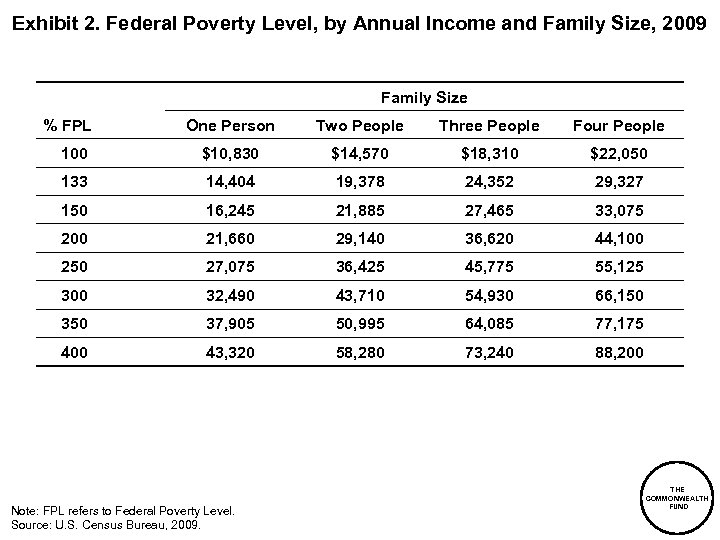
Exhibit 2. Federal Poverty Level, by Annual Income and Family Size, 2009 Family Size % FPL One Person Two People Three People Four People 100 $10, 830 $14, 570 $18, 310 $22, 050 133 14, 404 19, 378 24, 352 29, 327 150 16, 245 21, 885 27, 465 33, 075 200 21, 660 29, 140 36, 620 44, 100 250 27, 075 36, 425 45, 775 55, 125 300 32, 490 43, 710 54, 930 66, 150 37, 905 50, 995 64, 085 77, 175 400 43, 320 58, 280 73, 240 88, 200 Note: FPL refers to Federal Poverty Level. Source: U. S. Census Bureau, 2009. THE COMMONWEALTH FUND
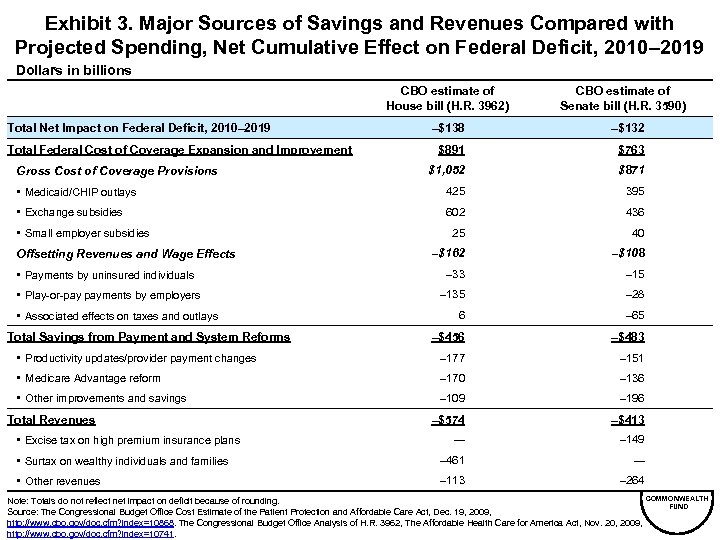
Exhibit 3. Major Sources of Savings and Revenues Compared with Projected Spending, Net Cumulative Effect on Federal Deficit, 2010– 2019 Dollars in billions CBO estimate of House bill (H. R. 3962) Total Net Impact on Federal Deficit, 2010– 2019 CBO estimate of Senate bill (H. R. 3590) –$138 –$132 $891 $763 $1, 052 $871 • Medicaid/CHIP outlays 425 395 • Exchange subsidies 602 436 25 40 –$162 –$108 • Payments by uninsured individuals – 33 – 15 • Play-or-pay payments by employers – 135 – 28 6 – 65 –$456 –$483 • Productivity updates/provider payment changes – 177 – 151 • Medicare Advantage reform – 170 – 136 • Other improvements and savings – 109 – 196 –$574 –$413 — – 149 • Surtax on wealthy individuals and families – 461 — • Other revenues – 113 – 264 Total Federal Cost of Coverage Expansion and Improvement Gross Cost of Coverage Provisions • Small employer subsidies Offsetting Revenues and Wage Effects • Associated effects on taxes and outlays Total Savings from Payment and System Reforms Total Revenues • Excise tax on high premium insurance plans Note: Totals do not reflect net impact on deficit because of rounding. Source: The Congressional Budget Office Cost Estimate of the Patient Protection and Affordable Care Act, Dec. 19, 2009, http: //www. cbo. gov/doc. cfm? index=10868. The Congressional Budget Office Analysis of H. R. 3962, The Affordable Health Care for America Act, Nov. 20, 2009, http: //www. cbo. gov/doc. cfm? index=10741. THE COMMONWEALTH FUND
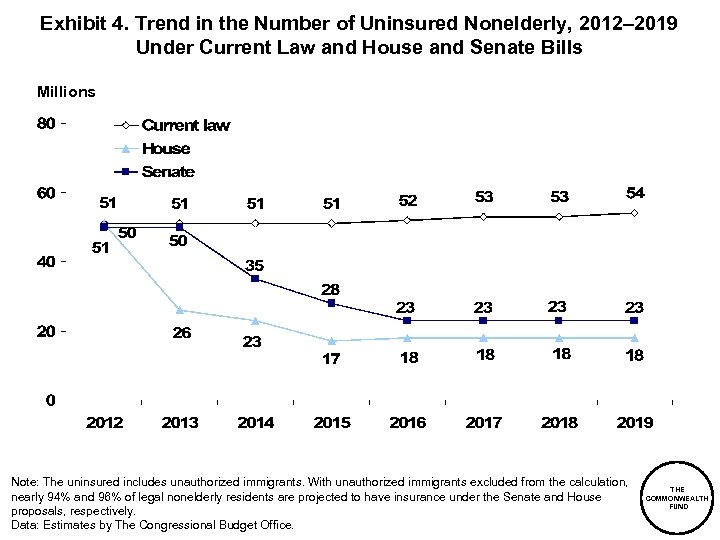
Exhibit 4. Trend in the Number of Uninsured Nonelderly, 2012– 2019 Under Current Law and House and Senate Bills Millions Note: The uninsured includes unauthorized immigrants. With unauthorized immigrants excluded from the calculation, nearly 94% and 96% of legal nonelderly residents are projected to have insurance under the Senate and House proposals, respectively. Data: Estimates by The Congressional Budget Office. THE COMMONWEALTH FUND
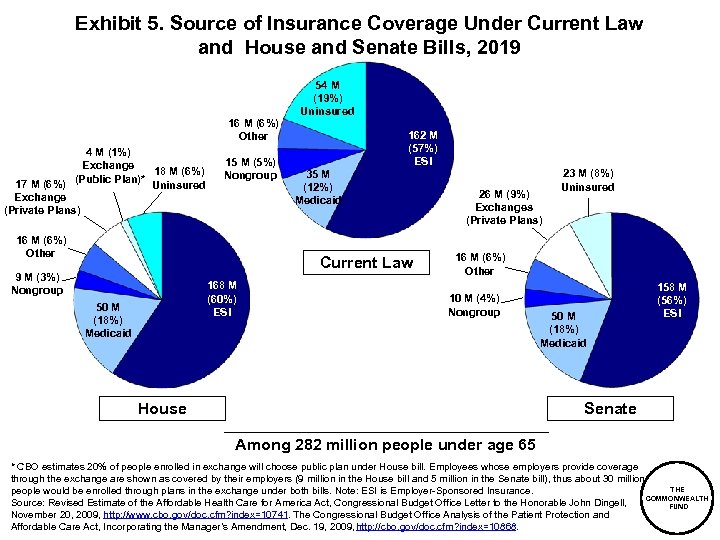
Exhibit 5. Source of Insurance Coverage Under Current Law and House and Senate Bills, 2019 16 M (6%) Other 4 M (1%) Exchange 18 M (6%) 17 M (6%) (Public Plan)* Uninsured Exchange (Private Plans) 15 M (5%) Nongroup 16 M (6%) Other 54 M (19%) Uninsured 162 M (57%) ESI 35 M (12%) Medicaid Current Law 9 M (3%) Nongroup 168 M (60%) ESI 50 M (18%) Medicaid 24 M (9%) Uninsured 26 M (9%) Exchanges (Private Plans) 23 M (8%) Uninsured 16 M (6%) Other 10 M (4%) Nongroup House 50 M (18%) Medicaid 158 M (56%) ESI Senate Among 282 million people under age 65 * CBO estimates 20% of people enrolled in exchange will choose public plan under House bill. Employees whose employers provide coverage through the exchange are shown as covered by their employers (9 million in the House bill and 5 million in the Senate bill), thus about 30 million THE people would be enrolled through plans in the exchange under both bills. Note: ESI is Employer-Sponsored Insurance. COMMONWEALTH Source: Revised Estimate of the Affordable Health Care for America Act, Congressional Budget Office Letter to the Honorable John Dingell, FUND November 20, 2009, http: //www. cbo. gov/doc. cfm? index=10741. The Congressional Budget Office Analysis of the Patient Protection and Affordable Care Act, Incorporating the Manager’s Amendment, Dec. 19, 2009, http: //cbo. gov/doc. cfm? index=10868.
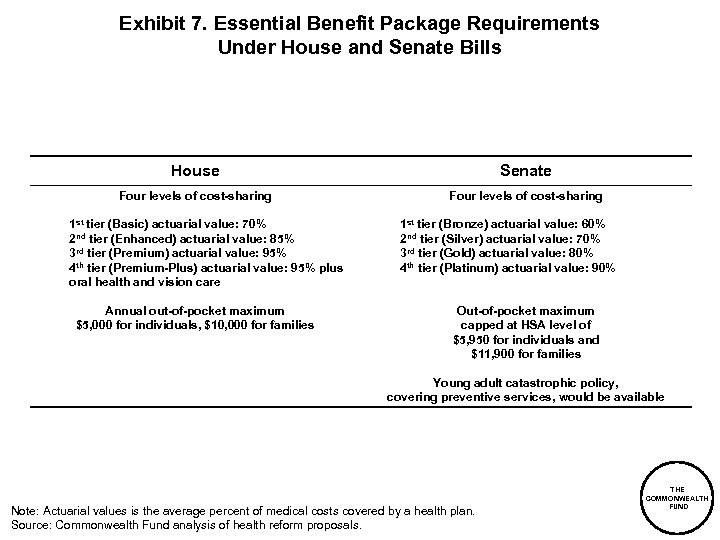
Exhibit 7. Essential Benefit Package Requirements Under House and Senate Bills House Senate Four levels of cost-sharing 1 st tier (Basic) actuarial value: 70% 2 nd tier (Enhanced) actuarial value: 85% 3 rd tier (Premium) actuarial value: 95% 4 th tier (Premium-Plus) actuarial value: 95% plus oral health and vision care Annual out-of-pocket maximum $5, 000 for individuals, $10, 000 for families 1 st tier (Bronze) actuarial value: 60% 2 nd tier (Silver) actuarial value: 70% 3 rd tier (Gold) actuarial value: 80% 4 th tier (Platinum) actuarial value: 90% Out-of-pocket maximum capped at HSA level of $5, 950 for individuals and $11, 900 for families Young adult catastrophic policy, covering preventive services, would be available Note: Actuarial values is the average percent of medical costs covered by a health plan. Source: Commonwealth Fund analysis of health reform proposals. THE COMMONWEALTH FUND
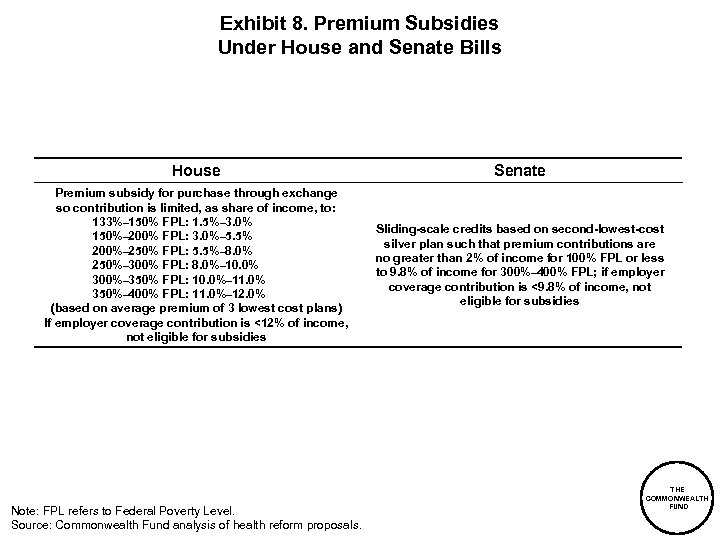
Exhibit 8. Premium Subsidies Under House and Senate Bills House Senate Premium subsidy for purchase through exchange so contribution is limited, as share of income, to: 133%– 150% FPL: 1. 5%– 3. 0% 150%– 200% FPL: 3. 0%– 5. 5% 200%– 250% FPL: 5. 5%– 8. 0% 250%– 300% FPL: 8. 0%– 10. 0% 300%– 350% FPL: 10. 0%– 11. 0% 350%– 400% FPL: 11. 0%– 12. 0% (based on average premium of 3 lowest cost plans) If employer coverage contribution is <12% of income, not eligible for subsidies Sliding-scale credits based on second-lowest-cost silver plan such that premium contributions are no greater than 2% of income for 100% FPL or less to 9. 8% of income for 300%– 400% FPL; if employer coverage contribution is <9. 8% of income, not eligible for subsidies Note: FPL refers to Federal Poverty Level. Source: Commonwealth Fund analysis of health reform proposals. THE COMMONWEALTH FUND
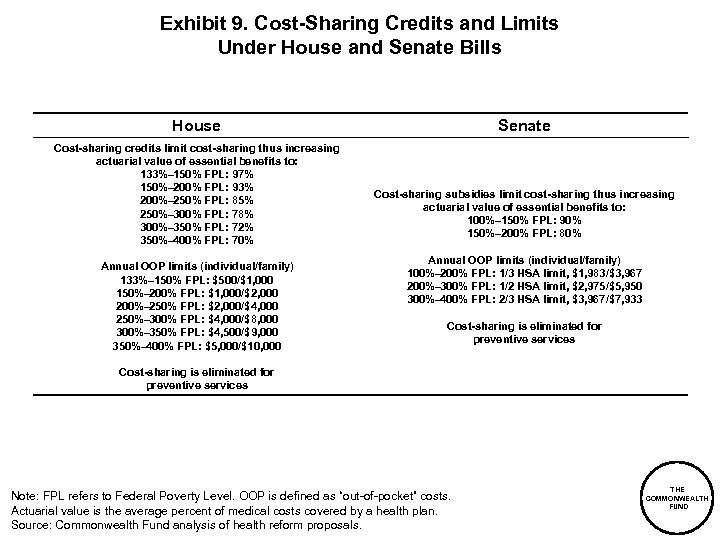
Exhibit 9. Cost-Sharing Credits and Limits Under House and Senate Bills House Cost-sharing credits limit cost-sharing thus increasing actuarial value of essential benefits to: 133%– 150% FPL: 97% 150%– 200% FPL: 93% 200%– 250% FPL: 85% 250%– 300% FPL: 78% 300%– 350% FPL: 72% 350%– 400% FPL: 70% Annual OOP limits (individual/family) 133%– 150% FPL: $500/$1, 000 150%– 200% FPL: $1, 000/$2, 000 200%– 250% FPL: $2, 000/$4, 000 250%– 300% FPL: $4, 000/$8, 000 300%– 350% FPL: $4, 500/$9, 000 350%– 400% FPL: $5, 000/$10, 000 Senate Cost-sharing subsidies limit cost-sharing thus increasing actuarial value of essential benefits to: 100%– 150% FPL: 90% 150%– 200% FPL: 80% Annual OOP limits (individual/family) 100%– 200% FPL: 1/3 HSA limit, $1, 983/$3, 967 200%– 300% FPL: 1/2 HSA limit, $2, 975/$5, 950 300%– 400% FPL: 2/3 HSA limit, $3, 967/$7, 933 Cost-sharing is eliminated for preventive services Note: FPL refers to Federal Poverty Level. OOP is defined as “out-of-pocket” costs. Actuarial value is the average percent of medical costs covered by a health plan. Source: Commonwealth Fund analysis of health reform proposals. THE COMMONWEALTH FUND
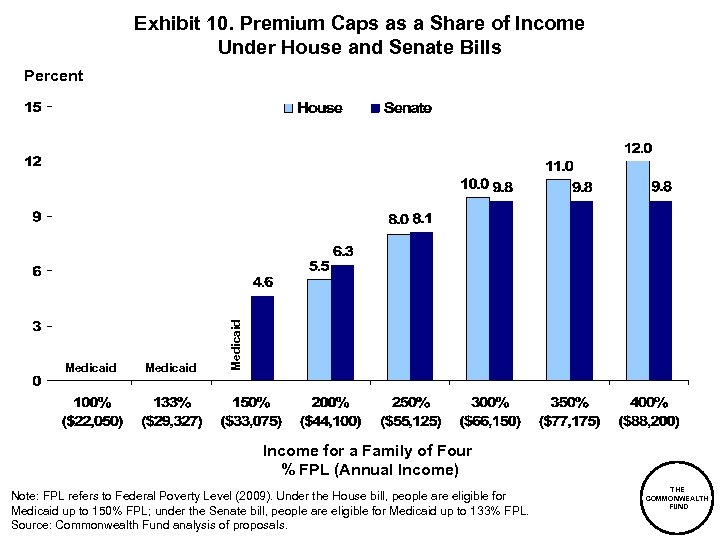
Exhibit 10. Premium Caps as a Share of Income Under House and Senate Bills Medicaid Percent Income for a Family of Four % FPL (Annual Income) Note: FPL refers to Federal Poverty Level (2009). Under the House bill, people are eligible for Medicaid up to 150% FPL; under the Senate bill, people are eligible for Medicaid up to 133% FPL. Source: Commonwealth Fund analysis of proposals. THE COMMONWEALTH FUND
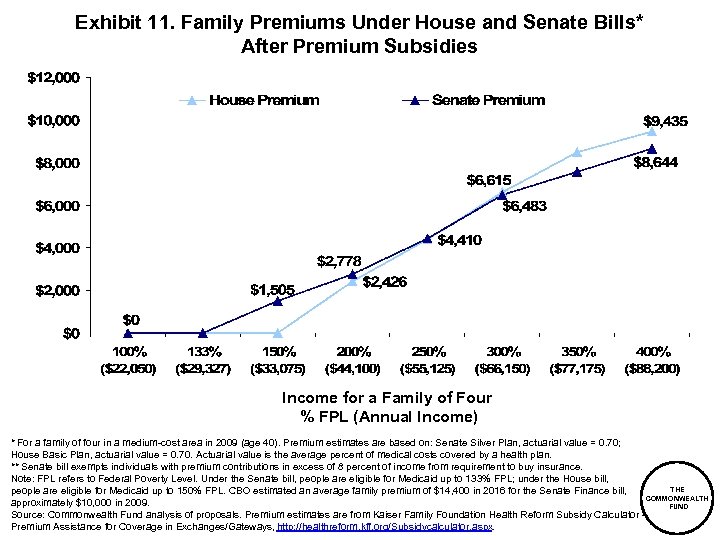
Exhibit 11. Family Premiums Under House and Senate Bills* After Premium Subsidies Income for a Family of Four % FPL (Annual Income) * For a family of four in a medium-cost area in 2009 (age 40). Premium estimates are based on: Senate Silver Plan, actuarial value = 0. 70; House Basic Plan, actuarial value = 0. 70. Actuarial value is the average percent of medical costs covered by a health plan. ** Senate bill exempts individuals with premium contributions in excess of 8 percent of income from requirement to buy insurance. Note: FPL refers to Federal Poverty Level. Under the Senate bill, people are eligible for Medicaid up to 133% FPL; under the House bill, THE people are eligible for Medicaid up to 150% FPL. CBO estimated an average family premium of $14, 400 in 2016 for the Senate Finance bill, COMMONWEALTH approximately $10, 000 in 2009. FUND Source: Commonwealth Fund analysis of proposals. Premium estimates are from Kaiser Family Foundation Health Reform Subsidy Calculator – Premium Assistance for Coverage in Exchanges/Gateways, http: //healthreform. kff. org/Subsidycalculator. aspx.
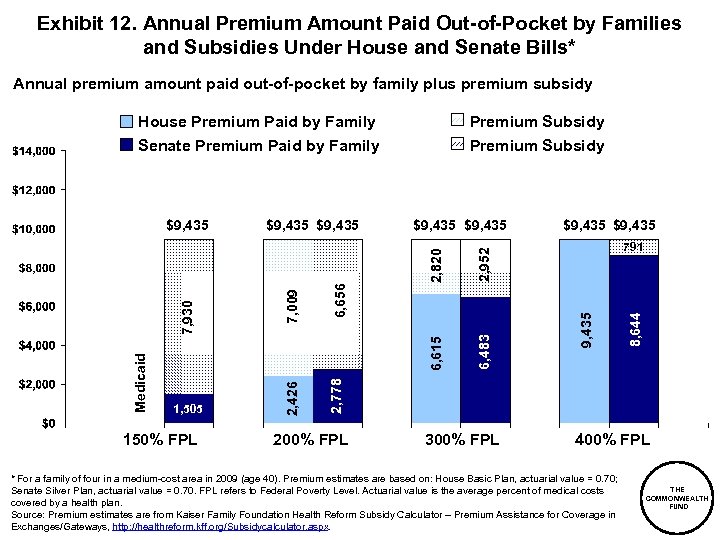
Exhibit 12. Annual Premium Amount Paid Out-of-Pocket by Families and Subsidies Under House and Senate Bills* Annual premium amount paid out-of-pocket by family plus premium subsidy House Premium Paid by Family Senate Premium Paid by Family 150% FPL 791 2, 952 200% FPL 300% FPL 8, 644 9, 435 6, 656 $9, 435 2, 778 6, 483 $9, 435 2, 820 7, 009 1, 505 2, 426 7, 930 Medicaid $9, 435 6, 615 $9, 435 Premium Subsidy 400% FPL * For a family of four in a medium-cost area in 2009 (age 40). Premium estimates are based on: House Basic Plan, actuarial value = 0. 70; Senate Silver Plan, actuarial value = 0. 70. FPL refers to Federal Poverty Level. Actuarial value is the average percent of medical costs covered by a health plan. Source: Premium estimates are from Kaiser Family Foundation Health Reform Subsidy Calculator – Premium Assistance for Coverage in Exchanges/Gateways, http: //healthreform. kff. org/Subsidycalculator. aspx. THE COMMONWEALTH FUND
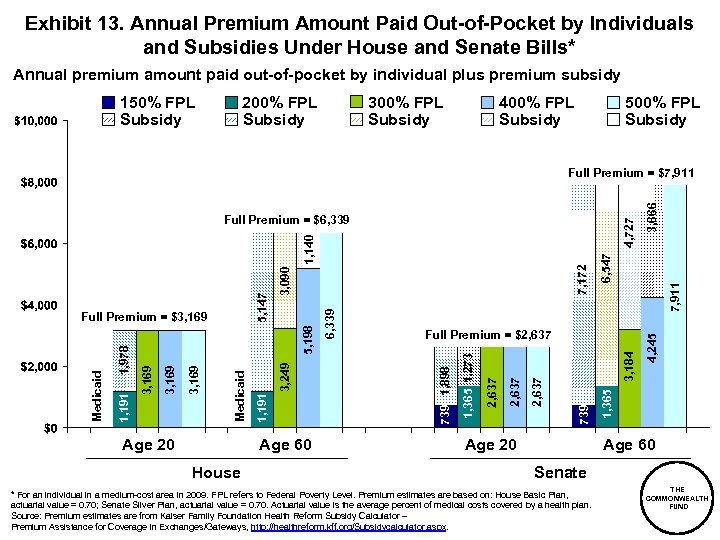
Exhibit 13. Annual Premium Amount Paid Out-of-Pocket by Individuals and Subsidies Under House and Senate Bills* Annual premium amount paid out-of-pocket by individual plus premium subsidy 200% FPL Subsidy 150% FPL Subsidy 300% FPL Subsidy 400% FPL Subsidy 500% FPL Subsidy Age 60 House 1, 365 3, 184 Age 20 4, 245 7, 911 6, 547 7, 172 739 2, 637 1, 365 1, 273 6, 339 Full Premium = $2, 637 739 1, 898 3, 249 5, 198 Age 20 1, 191 Medicaid 3, 169 1, 978 1, 191 Medicaid Full Premium = $3, 169 3, 090 5, 147 1, 140 4, 727 Full Premium = $6, 339 3, 666 Full Premium = $7, 911 Age 60 Senate * For an individual in a medium-cost area in 2009. FPL refers to Federal Poverty Level. Premium estimates are based on: House Basic Plan, actuarial value = 0. 70; Senate Silver Plan, actuarial value = 0. 70. Actuarial value is the average percent of medical costs covered by a health plan. Source: Premium estimates are from Kaiser Family Foundation Health Reform Subsidy Calculator – Premium Assistance for Coverage in Exchanges/Gateways, http: //healthreform. kff. org/Subsidycalculator. aspx. THE COMMONWEALTH FUND
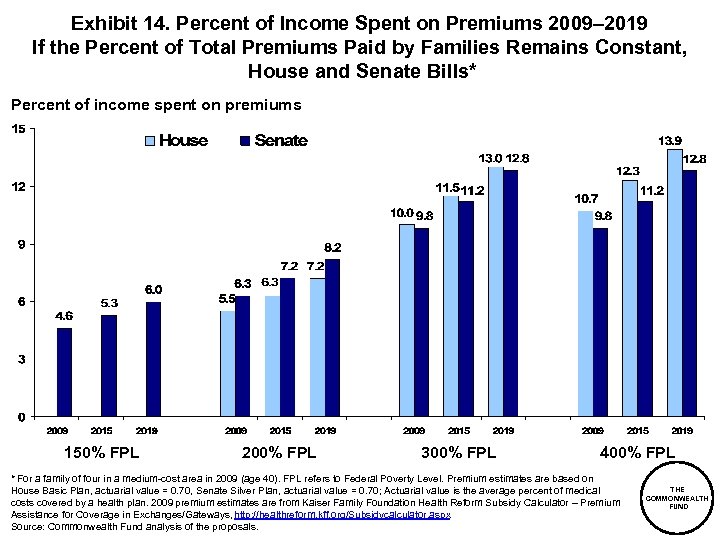
Exhibit 14. Percent of Income Spent on Premiums 2009– 2019 If the Percent of Total Premiums Paid by Families Remains Constant, House and Senate Bills* Percent of income spent on premiums 150% FPL 200% FPL 300% FPL 400% FPL * For a family of four in a medium-cost area in 2009 (age 40). FPL refers to Federal Poverty Level. Premium estimates are based on House Basic Plan, actuarial value = 0. 70, Senate Silver Plan, actuarial value = 0. 70; Actuarial value is the average percent of medical costs covered by a health plan. 2009 premium estimates are from Kaiser Family Foundation Health Reform Subsidy Calculator – Premium Assistance for Coverage in Exchanges/Gateways, http: //healthreform. kff. org/Subsidycalculator. aspx. Source: Commonwealth Fund analysis of the proposals. THE COMMONWEALTH FUND
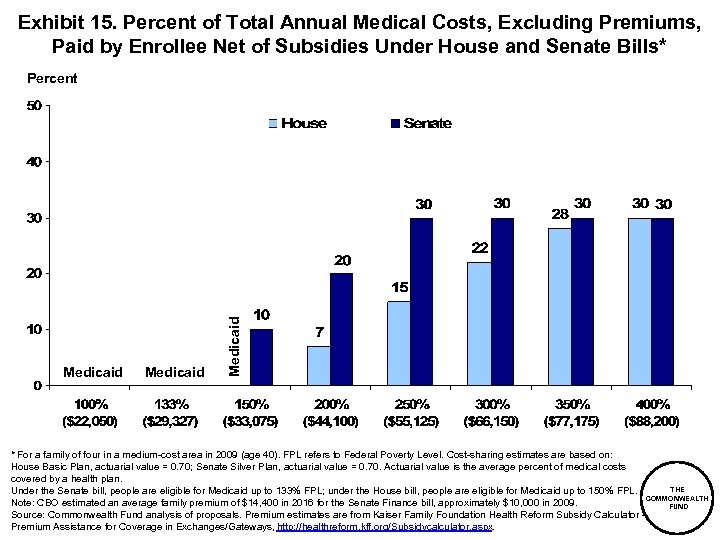
Exhibit 15. Percent of Total Annual Medical Costs, Excluding Premiums, Paid by Enrollee Net of Subsidies Under House and Senate Bills* Medicaid Percent * For a family of four in a medium-cost area in 2009 (age 40). FPL refers to Federal Poverty Level. Cost-sharing estimates are based on: House Basic Plan, actuarial value = 0. 70; Senate Silver Plan, actuarial value = 0. 70. Actuarial value is the average percent of medical costs covered by a health plan. THE Under the Senate bill, people are eligible for Medicaid up to 133% FPL; under the House bill, people are eligible for Medicaid up to 150% FPL. COMMONWEALTH Note: CBO estimated an average family premium of $14, 400 in 2016 for the Senate Finance bill, approximately $10, 000 in 2009. FUND Source: Commonwealth Fund analysis of proposals. Premium estimates are from Kaiser Family Foundation Health Reform Subsidy Calculator – Premium Assistance for Coverage in Exchanges/Gateways, http: //healthreform. kff. org/Subsidycalculator. aspx.
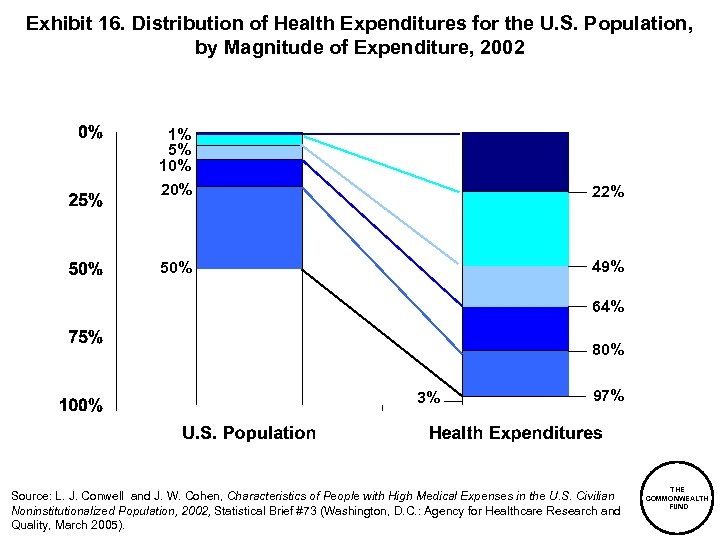
Exhibit 16. Distribution of Health Expenditures for the U. S. Population, by Magnitude of Expenditure, 2002 1% 5% 10% 22% 50% 49% 64% 80% 3% 97% Source: L. J. Conwell and J. W. Cohen, Characteristics of People with High Medical Expenses in the U. S. Civilian Noninstitutionalized Population, 2002, Statistical Brief #73 (Washington, D. C. : Agency for Healthcare Research and Quality, March 2005). THE COMMONWEALTH FUND
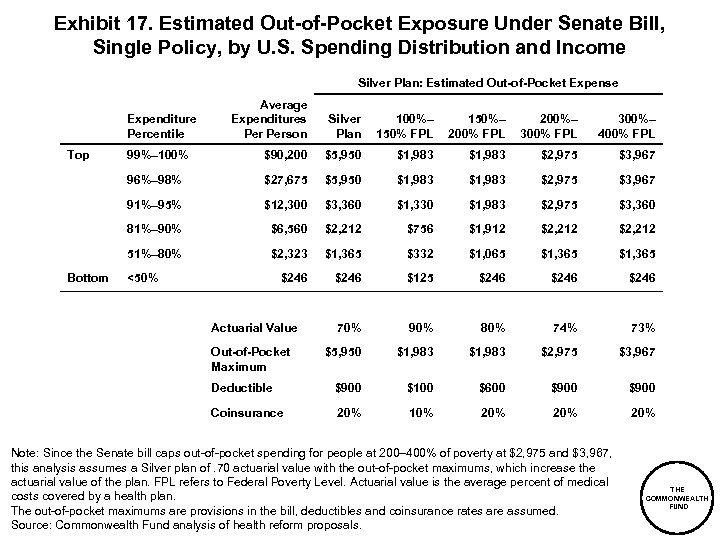
Exhibit 17. Estimated Out-of-Pocket Exposure Under Senate Bill, Single Policy, by U. S. Spending Distribution and Income Silver Plan: Estimated Out-of-Pocket Expense Average Expenditures Person Silver Plan 100%– 150% FPL 150%– 200% FPL 200%– 300% FPL 300%– 400% FPL 99%– 100% $90, 200 $5, 950 $1, 983 $2, 975 $3, 967 96%– 98% $27, 675 $5, 950 $1, 983 $2, 975 $3, 967 91%– 95% $12, 300 $3, 360 $1, 330 $1, 983 $2, 975 $3, 360 81%– 90% $6, 560 $2, 212 $756 $1, 912 $2, 212 51%– 80% $2, 323 $1, 365 $332 $1, 065 $1, 365 $246 $125 $246 70% 90% 80% 74% 73% $5, 950 $1, 983 $2, 975 $3, 967 Deductible $900 $100 $600 $900 Coinsurance 20% 10% 20% 20% Expenditure Percentile Top Bottom <50% Actuarial Value Out-of-Pocket Maximum Note: Since the Senate bill caps out-of-pocket spending for people at 200– 400% of poverty at $2, 975 and $3, 967, this analysis assumes a Silver plan of. 70 actuarial value with the out-of-pocket maximums, which increase the actuarial value of the plan. FPL refers to Federal Poverty Level. Actuarial value is the average percent of medical costs covered by a health plan. The out-of-pocket maximums are provisions in the bill, deductibles and coinsurance rates are assumed. Source: Commonwealth Fund analysis of health reform proposals. THE COMMONWEALTH FUND
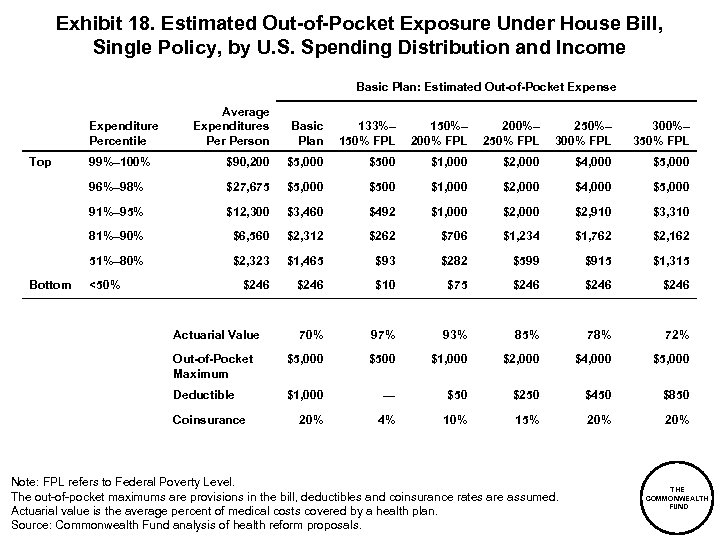
Exhibit 18. Estimated Out-of-Pocket Exposure Under House Bill, Single Policy, by U. S. Spending Distribution and Income Basic Plan: Estimated Out-of-Pocket Expense Average Expenditures Person Basic Plan 133%– 150% FPL 150%– 200% FPL 200%– 250% FPL 250%– 300% FPL 300%– 350% FPL 99%– 100% $90, 200 $5, 000 $500 $1, 000 $2, 000 $4, 000 $5, 000 96%– 98% $27, 675 $5, 000 $500 $1, 000 $2, 000 $4, 000 $5, 000 91%– 95% $12, 300 $3, 460 $492 $1, 000 $2, 910 $3, 310 81%– 90% $6, 560 $2, 312 $262 $706 $1, 234 $1, 762 $2, 162 51%– 80% $2, 323 $1, 465 $93 $282 $599 $915 $1, 315 $246 $10 $75 $246 70% 97% 93% 85% 78% 72% Out-of-Pocket Maximum $5, 000 $500 $1, 000 $2, 000 $4, 000 $5, 000 Deductible $1, 000 — $50 $250 $450 $850 20% 4% 10% 15% 20% Expenditure Percentile Top Bottom <50% Actuarial Value Coinsurance Note: FPL refers to Federal Poverty Level. The out-of-pocket maximums are provisions in the bill, deductibles and coinsurance rates are assumed. Actuarial value is the average percent of medical costs covered by a health plan. Source: Commonwealth Fund analysis of health reform proposals. THE COMMONWEALTH FUND
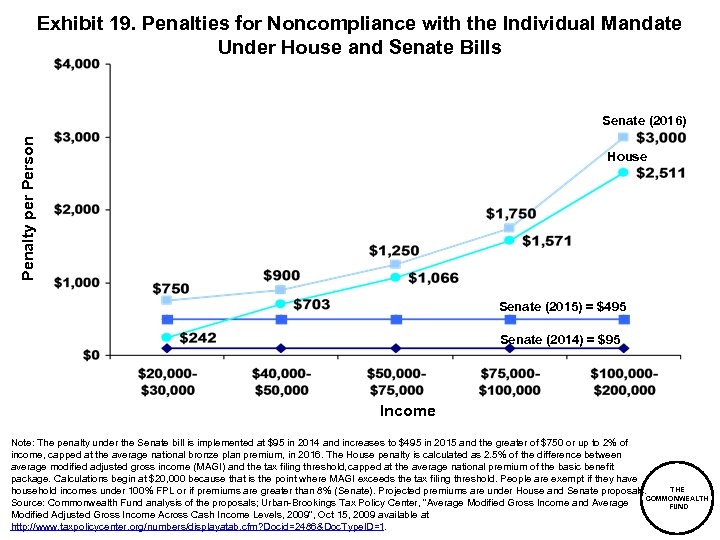
Exhibit 19. Penalties for Noncompliance with the Individual Mandate Under House and Senate Bills Penalty per Person Senate (2016) House Senate (2015) = $495 Senate (2014) = $95 Income Note: The penalty under the Senate bill is implemented at $95 in 2014 and increases to $495 in 2015 and the greater of $750 or up to 2% of income, capped at the average national bronze plan premium, in 2016. The House penalty is calculated as 2. 5% of the difference between average modified adjusted gross income (MAGI) and the tax filing threshold, capped at the average national premium of the basic benefit package. Calculations begin at $20, 000 because that is the point where MAGI exceeds the tax filing threshold. People are exempt if they have THE household incomes under 100% FPL or if premiums are greater than 8% (Senate). Projected premiums are under House and Senate proposals. COMMONWEALTH Source: Commonwealth Fund analysis of the proposals; Urban-Brookings Tax Policy Center, “Average Modified Gross Income and Average FUND Modified Adjusted Gross Income Across Cash Income Levels, 2009”, Oct 15, 2009 available at http: //www. taxpolicycenter. org/numbers/displayatab. cfm? Docid=2486&Doc. Type. ID=1.
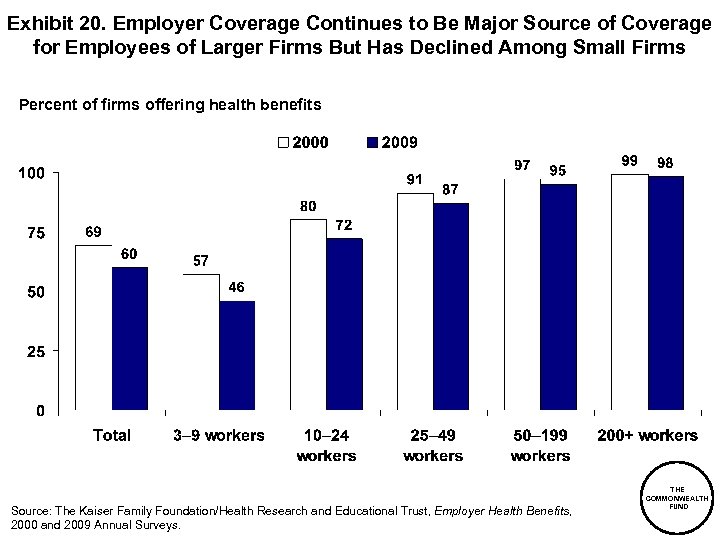
Exhibit 20. Employer Coverage Continues to Be Major Source of Coverage for Employees of Larger Firms But Has Declined Among Small Firms Percent of firms offering health benefits Source: The Kaiser Family Foundation/Health Research and Educational Trust, Employer Health Benefits, 2000 and 2009 Annual Surveys. THE COMMONWEALTH FUND
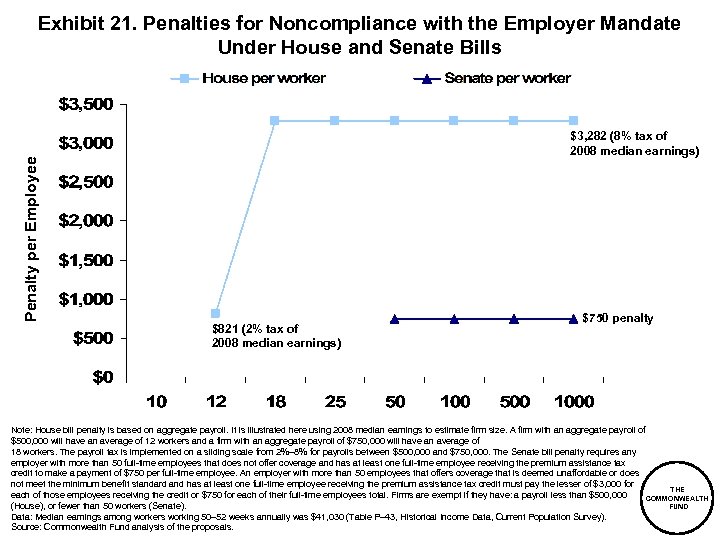
Penalty per Employee Exhibit 21. Penalties for Noncompliance with the Employer Mandate Under House and Senate Bills $3, 282 (8% tax of 2008 median earnings) $821 (2% tax of 2008 median earnings) $750 penalty Note: House bill penalty is based on aggregate payroll. It is illustrated here using 2008 median earnings to estimate firm size. A firm with an aggregate payroll of $500, 000 will have an average of 12 workers and a firm with an aggregate payroll of $750, 000 will have an average of 18 workers. The payroll tax is implemented on a sliding scale from 2%– 8% for payrolls between $500, 000 and $750, 000. The Senate bill penalty requires any employer with more than 50 full-time employees that does not offer coverage and has at least one full-time employee receiving the premium assistance tax credit to make a payment of $750 per full-time employee. An employer with more than 50 employees that offers coverage that is deemed unaffordable or does not meet the minimum benefit standard and has at least one full-time employee receiving the premium assistance tax credit must pay the lesser of $3, 000 for THE each of those employees receiving the credit or $750 for each of their full-time employees total. Firms are exempt if they have: a payroll less than $500, 000 COMMONWEALTH (House), or fewer than 50 workers (Senate). FUND Data: Median earnings among workers working 50– 52 weeks annually was $41, 030 (Table P– 43, Historical Income Data, Current Population Survey). Source: Commonwealth Fund analysis of the proposals.
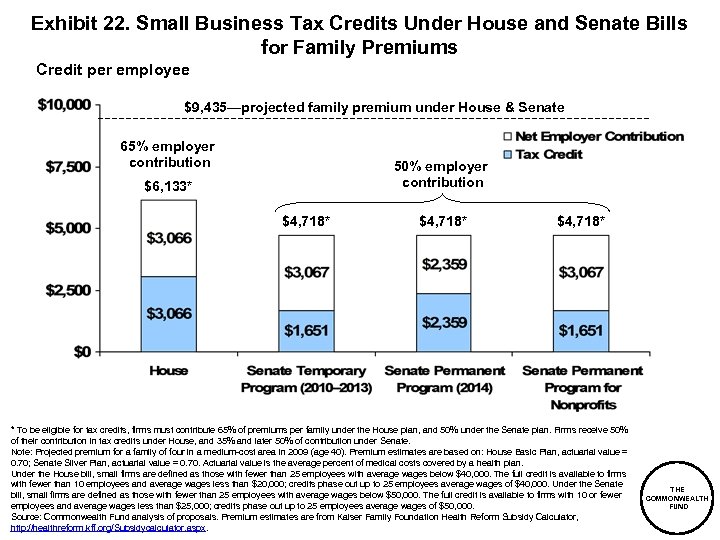
Exhibit 22. Small Business Tax Credits Under House and Senate Bills for Family Premiums Credit per employee $9, 435—projected family premium under House & Senate 65% employer contribution 50% employer contribution $6, 133* $4, 718* * To be eligible for tax credits, firms must contribute 65% of premiums per family under the House plan, and 50% under the Senate plan. Firms receive 50% of their contribution in tax credits under House, and 35% and later 50% of contribution under Senate. Note: Projected premium for a family of four in a medium-cost area in 2009 (age 40). Premium estimates are based on: House Basic Plan, actuarial value = 0. 70; Senate Silver Plan, actuarial value = 0. 70. Actuarial value is the average percent of medical costs covered by a health plan. Under the House bill, small firms are defined as those with fewer than 25 employees with average wages below $40, 000. The full credit is available to firms with fewer than 10 employees and average wages less than $20, 000; credits phase out up to 25 employees average wages of $40, 000. Under the Senate bill, small firms are defined as those with fewer than 25 employees with average wages below $50, 000. The full credit is available to firms with 10 or fewer employees and average wages less than $25, 000; credits phase out up to 25 employees average wages of $50, 000. Source: Commonwealth Fund analysis of proposals. Premium estimates are from Kaiser Family Foundation Health Reform Subsidy Calculator, http: //healthreform. kff. org/Subsidycalculator. aspx. THE COMMONWEALTH FUND
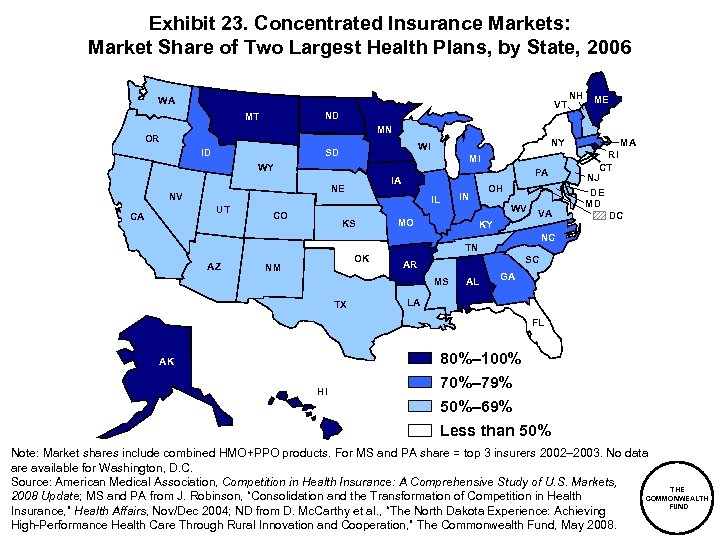
Exhibit 23. Concentrated Insurance Markets: Market Share of Two Largest Health Plans, by State, 2006 WA VT NH ME ND MT MN OR NY WI SD ID MI WY NE NV UT CA AZ CO IL KS OK NM PA IA WV MO KY VA NC TN SC AR MS TX OH IN MA RI CT NJ DE MD DC AL GA LA FL 80%– 100% AK HI 70%– 79% 50%– 69% Less than 50% Note: Market shares include combined HMO+PPO products. For MS and PA share = top 3 insurers 2002– 2003. No data are available for Washington, D. C. Source: American Medical Association, Competition in Health Insurance: A Comprehensive Study of U. S. Markets, THE 2008 Update; MS and PA from J. Robinson, “Consolidation and the Transformation of Competition in Health COMMONWEALTH FUND Insurance, ” Health Affairs, Nov/Dec 2004; ND from D. Mc. Carthy et al. , “The North Dakota Experience: Achieving High-Performance Health Care Through Rural Innovation and Cooperation, ” The Commonwealth Fund, May 2008.
Скачать презентацию Exhibit ES-1 Congressional Health Reform Bills as of
d4037bd741aaea570e708ffcac7b50ff.ppt