


 Скачать презентацию Exercise Prescription Certificate Course Cardiovascular Fitness Roy NGAI
dfc4afab109f2469ff75a578b3599c44.ppt
- Количество слайдов: 36
 Exercise Prescription Certificate Course Cardiovascular Fitness Roy NGAI ( 魏 開 義 ) MPhy. Ed Chairman (1996 -2000) Vice President (2000 -now) H K Physical Fitness Association
 pe S Gi ial c edo -P ft ter me
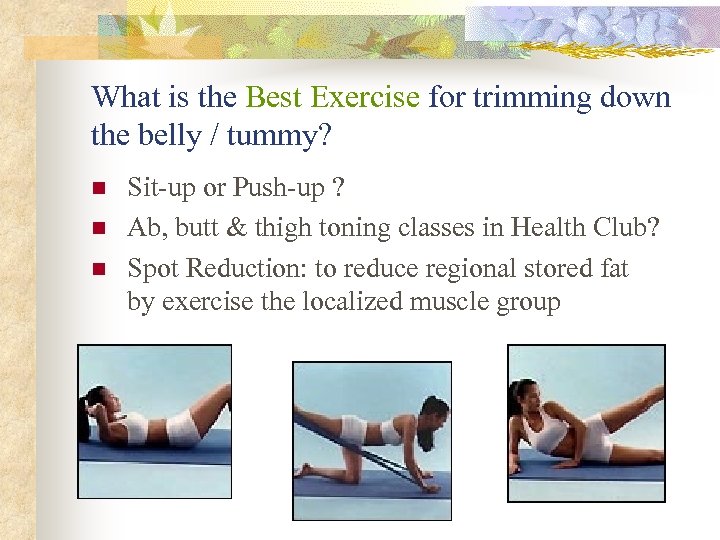 What is the Best Exercise for trimming down the belly / tummy? n n n Sit-up or Push-up ? Ab, butt & thigh toning classes in Health Club? Spot Reduction: to reduce regional stored fat by exercise the localized muscle group
 A Study of Spot Reduction (Gwinup at el, . 1971) n n Examined the muscle and fat mass in the dominant arm and non-dominant arm of high caliber tennis players Result: The muscle mass of the dominant arm was much greater than the non dominant arm, but no differences were found between the skinfold measurements of either forearm.
 What should be avoided when advising the Obese People in Exercise?
 Category of Exercise Prescription n n Endurance exercise – CV Fitness Resistance exercise – Muscular Fitness Stretching exercise – Flexibility Neuromuscular Relaxation exercise – Neuromuscular equilibration
 Exercise Prescription are designed to: n n Enhance physical fitness Promote health by reducing risk factors for chronic disease (high BP, glucose intolerance) Ensure safety during exercise participation Base on individual interests, health needs and clinical status
 n Standards & Guidelines of CR Fitness (by ACSM) Intensity: n n n Duration: n n n 55%/65% - 90% HRmax RPE 3 -6 (or 12 -18) 20 -60 min continuous or intermittent (minimum of 10 min. bouts) Frequency: 3 – 5 d/wk Activity: n n Large muscle group, dynamic activity Preferably cross train on a variety of exercise modes
 Safety Precaution Prior to Vigorous Exercise Participation n n Medical History Physical Activity Readiness Questions (PAR-Q) A Questionnaire for People Aged 15 to 69
 Need Assessment before Ex. Rx (What is your goal? ) n n Optimal Physical Health Fat Loss Cardiovascular Fitness Sports Performance
 Optimal Physical Health The Surgeon General has determined that lack of physical activity is detrimental to your health. It recommends moderate activity: 150 kcal/day or 1000 kcal/wk. n ACSM suggests all adults should engage in 30 min or more moderate physical activity daily. This level of activity corresponds to 200 kcal/day. n Other authorities suggest the least amount of activity for optimal physical health is about 1500 -2000 kcal/wk of light and moderate activities. Additional physical health benefits come with increased intensity and eventually level off at around 3500 kcal/wk n Children and adolescents are recommended to engage in at least 60 min of physical activity on most, preferably all days of the week n
 Fat Loss n The ACSM recommends to target a weekly exercise expenditure of approximately 1000 kcal/wk (e. g. 3 sessions of 300 Calories or 4 sessions of 200 Calories) n Review of the scientific literature suggests moderate intense aerobic activity needs to be performed most days of the week to bring about significant fat loss. n Alternating weight bearing with non-weight bearing exercises every other day may be recommended to minimize the repetitive orthopedic stresses of exercising daily. The combination of aerobic and anaerobic exercise may utilize more fat than either type of exercise alone.
 Cardiovascular Fitness n n n For cardiorespiratory fitness, ACSM recommends intensities between 55/65% to 90% of HRmax or between 40&50% to 85% of Heart Rate Reserve (HHR). ACSM suggests low fit or deconditioned individuals may experience improvements at exercise intensities of only 40 to 49% HRR or 55 to 64% HRmax. Cardiovascular fitness improvement is dependent upon the exercise program (mode, frequency, duration, intensity of exercise), as well as the individual participant (fitness level, age, and health status).
 Sports Performance n n In general, the best exercise for a specific sport is the sport itself. The specific muscles involved, type of muscular contraction, intensity, duration, recovery time, and motor skill must be considered. Specific components of the sport may need to be trained separately. Periodization may be implemented for continued progress and specialization on particular components.
 Intensity for CR Fitness n n n A percentage of the maximum heart rate (HRmax), METs, or maximum oxygen consumption (VO 2 max) can be used to prescribe exercise intensity. Heart rate reserve (HRR) which takes into account the resting heart rate can also used to prescribe exercise intensities Rating of Perceived Exertion (RPE) is an individual's evaluation of fatigue based on a scale from 6 to 20 or 0 to 10. Individuals who take medications that effect heart rate can using RPE
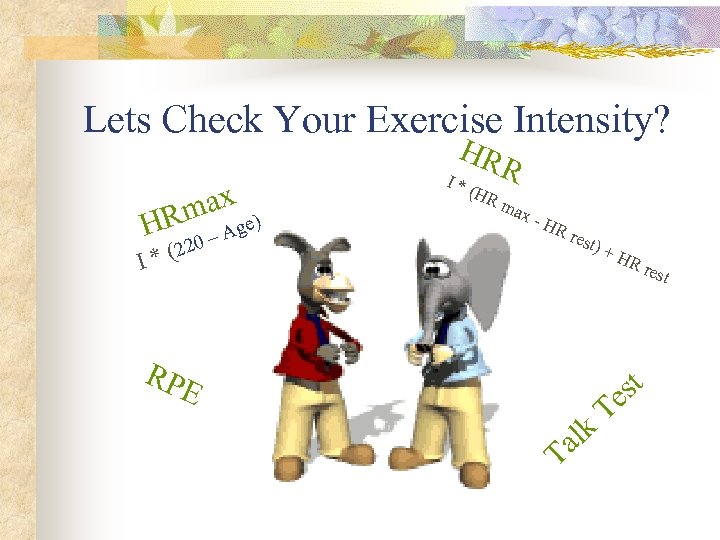 Lets Check Your Exercise Intensity? HR ax Rm H I* (220 I* ) Age – (HR R max -H Rr est) RP E T lk a +H Rr T st e est
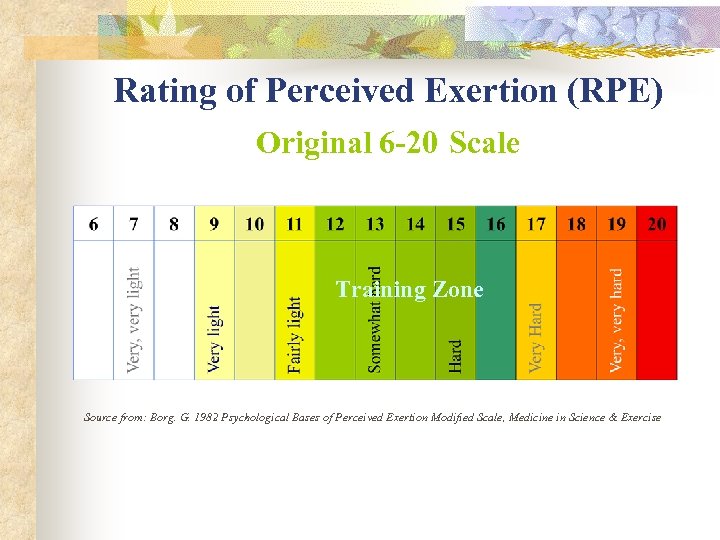 Rating of Perceived Exertion (RPE) Original 6 -20 Scale Training Zone Source from: Borg. G. 1982 Psychological Bases of Perceived Exertion Modified Scale, Medicine in Science & Exercise
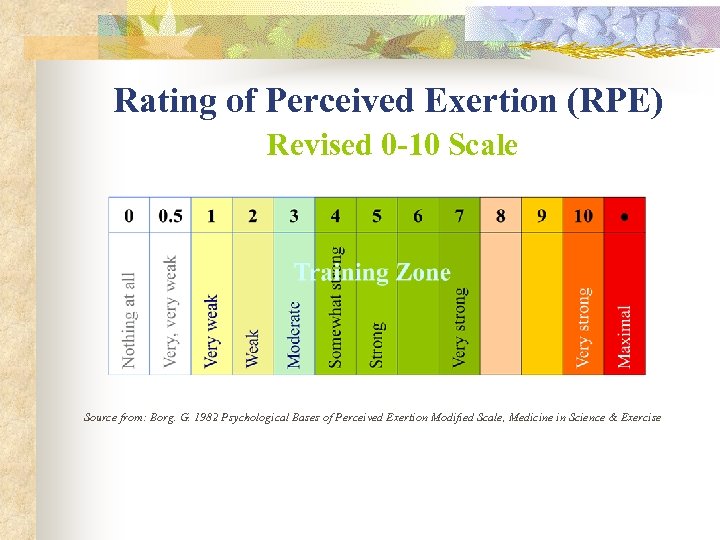 Rating of Perceived Exertion (RPE) Revised 0 -10 Scale Source from: Borg. G. 1982 Psychological Bases of Perceived Exertion Modified Scale, Medicine in Science & Exercise
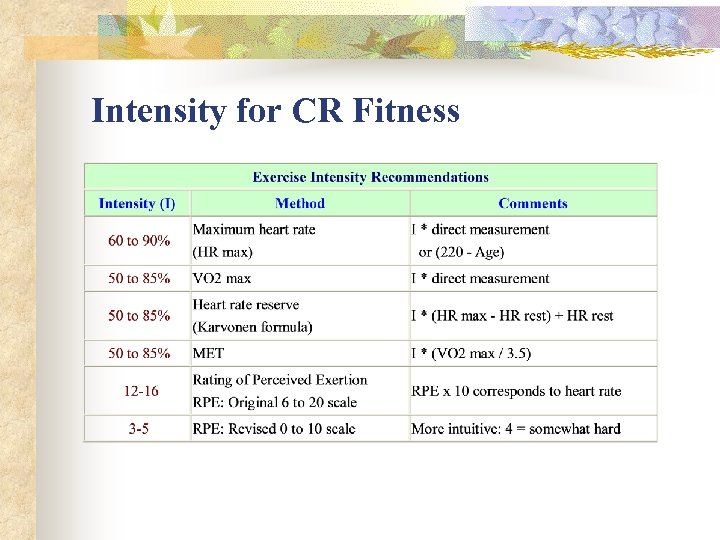 Intensity for CR Fitness
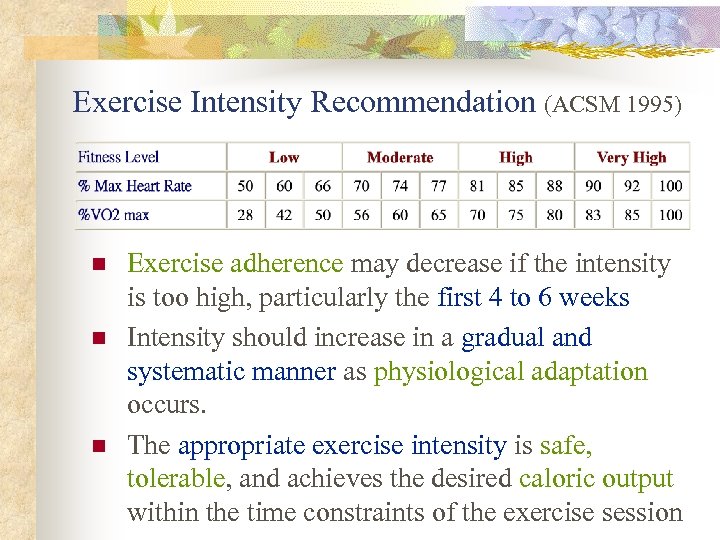 Exercise Intensity Recommendation (ACSM 1995) n n n Exercise adherence may decrease if the intensity is too high, particularly the first 4 to 6 weeks Intensity should increase in a gradual and systematic manner as physiological adaptation occurs. The appropriate exercise intensity is safe, tolerable, and achieves the desired caloric output within the time constraints of the exercise session
 Duration for CR Fitness n n The ACSM recommends 20 to 60 min of continuous aerobic activity. Time constrains of the individual must be considered. Depending upon individual fitness goals, exercise sessions may be of moderate duration (20 to 30 minutes) excluding time spent warming up & cooling down. Initial programs may last 12 to 15 min and progress toward 20 minutes. Severely deconditioned person may need to perform multiple sessions of short duration (~10 min). Duration should increase as adaptation to training occurs without undue fatigue or injury
 Frequency for CR Fitness n n n Scheduling constrains of the individual must be considered. ACSM recommends aerobic activity to be performed 3 to 5 session/wk Individuals beginning an exercise program should perform aerobic exercise 3 day/wk on non-consecutive days. Severely deconditioned individual may need to perform multiple sessions of short duration (~10 mins) Individuals just beginning wt-bearing exercise (eg: jogging, aerobic dance, etc. ) may be advised to wait 48 hrs between bouts to prevent overuse injuries If exercising on consecutive days, alternating between two modes of exercise (eg: walking one day, cycling next day) can be suggested, particularly for overweight or orthopedic injuries persons
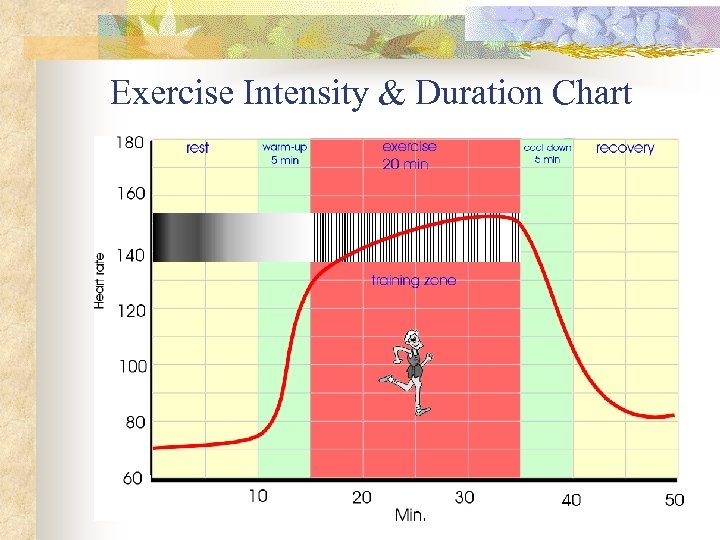 Exercise Intensity & Duration Chart
 Type of Stretching Exercise Two basic classification: Active (unassisted stretching) and Passive (assisted stretching) n n n Static Stretching Ballistic Stretching Dynamic Stretching Proprioceptive Neuromuscular Facilitation (PNF) Stretching Yogic Stretching
 Any Questions
 Let’s Move to Practicum Session

 The End


 Format: n Exercise Intensity monitoring techniques n n n Buddy-up before workout Exercise Grouping: n n n n HR Method RPE Method Talk Test Walk only Brisk Walk – Brisk Walk only Jog – Walk – Jog – B Walk – Jog only Participants may join the session as observers if their condition not fit for the training
 運動須知 Tips for Exercise n Anaerobic (非帶氧運動) 維持或促進純組織 n Aerobic (帶氧運動) 促進熱量消耗, 強化心肺功能 n Low Impact (低衝激運動) n Slow-Long Distance(慢速長距離運動)
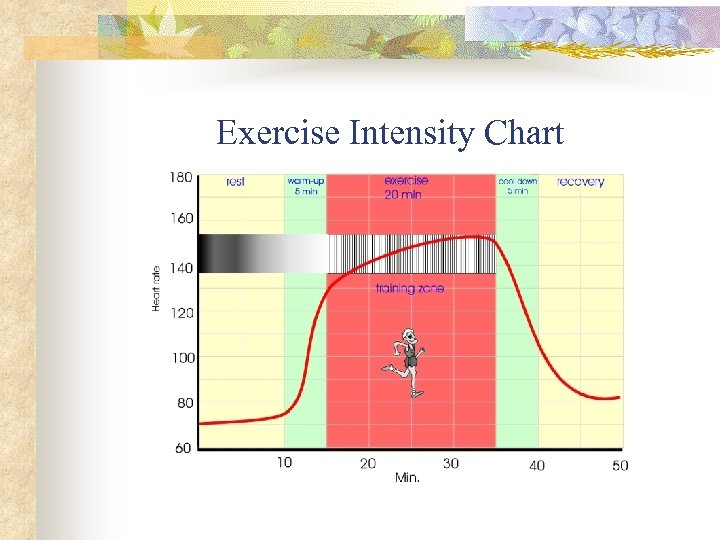 Exercise Intensity Chart
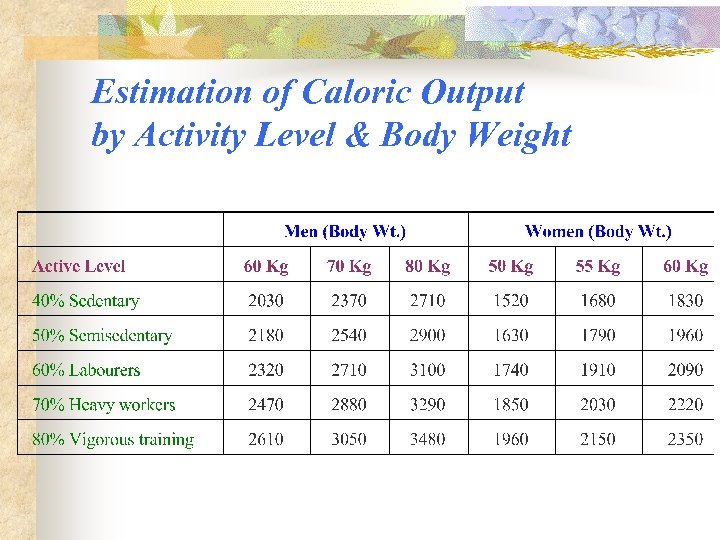 Estimation of Caloric Output by Activity Level & Body Weight
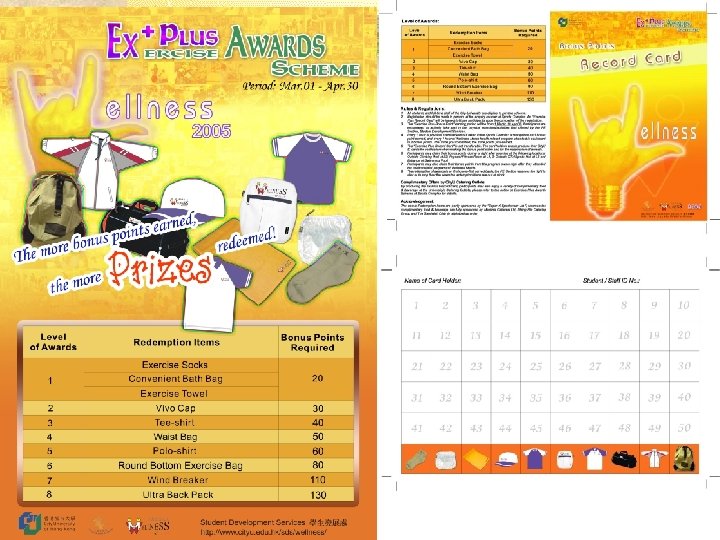 Ex-Plus Awards Scheme
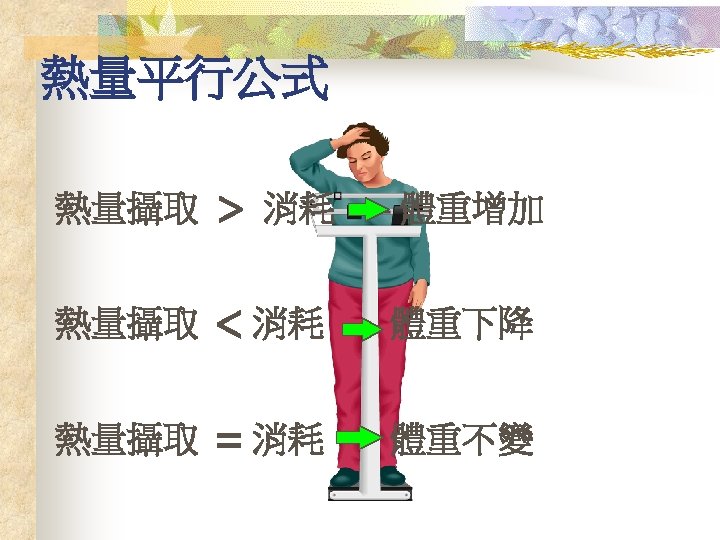 熱量平行公式 熱量攝取 > 消耗 體重增加 熱量攝取 < 消耗 體重下降 熱量攝取 = 消耗 體重不變