


 Скачать презентацию Exercise Medicine a practical guideline on daily
3e789d2cb559ad97584734d375c32710.ppt
- Количество слайдов: 39
 Exercise & Medicine a practical guideline on daily clinical practice with special focus on hypertension, diabetes and ischemic heart disease Dr. Wong Bun Lap Bernard Specialist in Cardiology
 Genius is one percent inspiration, Ninety-nine percent perspiration ~ Thomas Alva Edison 1847 -1931
 Interesting Definitions Exercise (ek’ser-siz) – the performance of physical exertion for improvement of health or the correction of physical deformity. ~Dorland’s Illustrated Medical Dictionary 27 th edition, 1988’
 Interesting Definitions Exercise – Physical activity that is planned, structured, repetitive, and purposeful, usually aimed at a improving or maintaining physical fitness. Physical activities – Any body movement produced by skeletal muscles that results in energy expenditure beyond resting expenditure. ~ Richard C Pasternak, Braunwald’s Heart Disease, A textbook of cardiovascular medicine, 7 th Edition 2005’
 Heart Disease A very common disease 2 nd Killer – 5, 390 deaths in 2003’ (14. 8/day) Public resources demanding – More than 60, 000 hospital admissions per year – Only for ischemic heart diseases • 17, 523 (48/day) admissions & 1, 780 deaths per year ~ Statistical Report 2003/2004, Hospital Authority ~ Census & Statistic Department, Department of Health
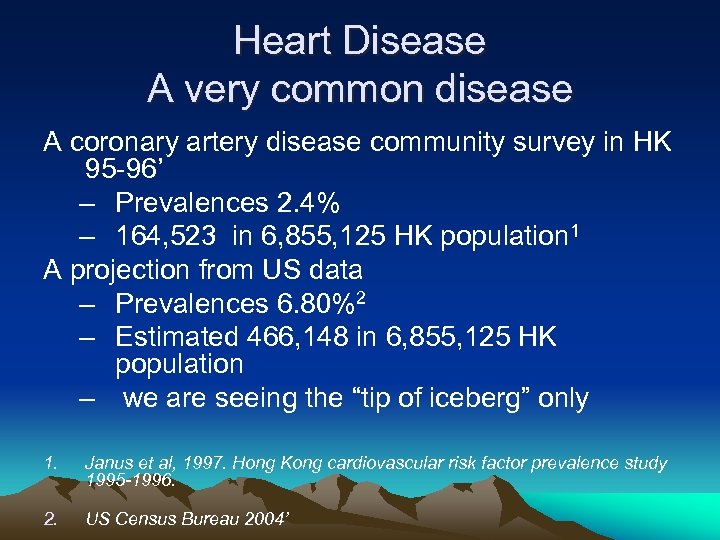 Heart Disease A very common disease A coronary artery disease community survey in HK 95 -96’ – Prevalences 2. 4% – 164, 523 in 6, 855, 125 HK population 1 A projection from US data – Prevalences 6. 80%2 – Estimated 466, 148 in 6, 855, 125 HK population – we are seeing the “tip of iceberg” only 1. Janus et al, 1997. Hong Kong cardiovascular risk factor prevalence study 1995 -1996. 2. US Census Bureau 2004’
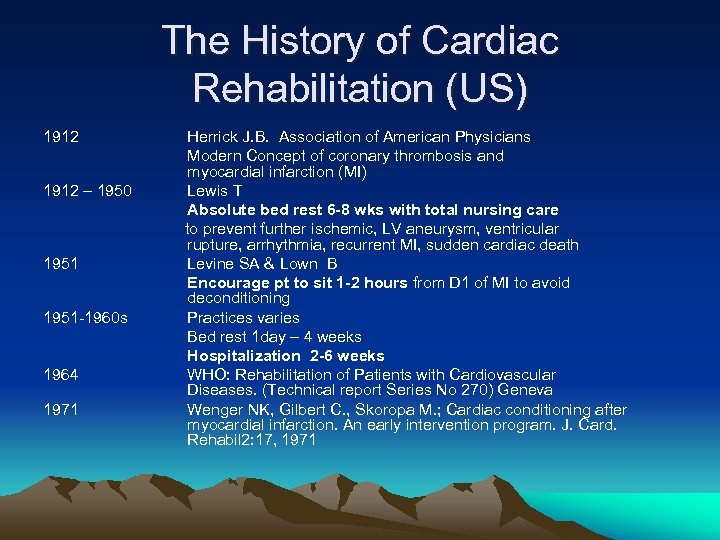 The History of Cardiac Rehabilitation (US) 1912 – 1950 1951 -1960 s 1964 1971 Herrick J. B. Association of American Physicians Modern Concept of coronary thrombosis and myocardial infarction (MI) Lewis T Absolute bed rest 6 -8 wks with total nursing care to prevent further ischemic, LV aneurysm, ventricular rupture, arrhythmia, recurrent MI, sudden cardiac death Levine SA & Lown B Encourage pt to sit 1 -2 hours from D 1 of MI to avoid deconditioning Practices varies Bed rest 1 day – 4 weeks Hospitalization 2 -6 weeks WHO: Rehabilitation of Patients with Cardiovascular Diseases. (Technical report Series No 270) Geneva Wenger NK, Gilbert C. , Skoropa M. ; Cardiac conditioning after myocardial infarction. An early intervention program. J. Card. Rehabil 2: 17, 1971
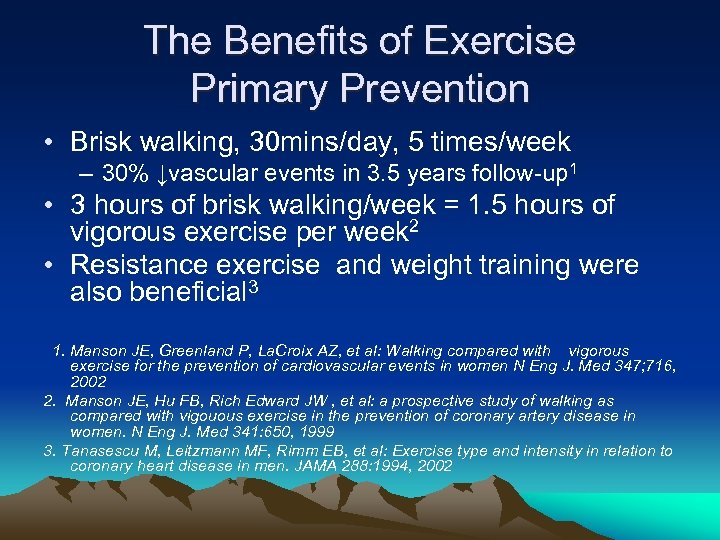 The Benefits of Exercise Primary Prevention • Brisk walking, 30 mins/day, 5 times/week – 30% ↓vascular events in 3. 5 years follow-up 1 • 3 hours of brisk walking/week = 1. 5 hours of vigorous exercise per week 2 • Resistance exercise and weight training were also beneficial 3 1. Manson JE, Greenland P, La. Croix AZ, et al: Walking compared with vigorous exercise for the prevention of cardiovascular events in women N Eng J. Med 347; 716, 2002 2. Manson JE, Hu FB, Rich Edward JW , et al: a prospective study of walking as compared with vigouous exercise in the prevention of coronary artery disease in women. N Eng J. Med 341: 650, 1999 3. Tanasescu M, Leitzmann MF, Rimm EB, et al: Exercise type and intensity in relation to coronary heart disease in men. JAMA 288: 1994, 2002
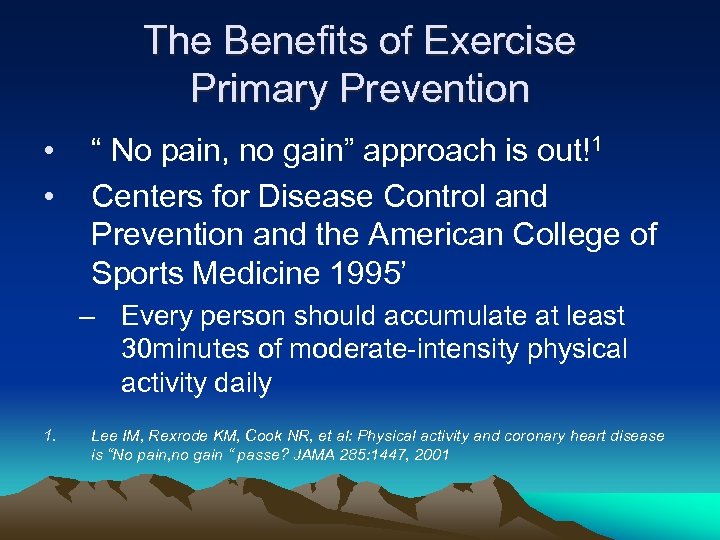 The Benefits of Exercise Primary Prevention • • “ No pain, no gain” approach is out!1 Centers for Disease Control and Prevention and the American College of Sports Medicine 1995’ – Every person should accumulate at least 30 minutes of moderate-intensity physical activity daily 1. Lee IM, Rexrode KM, Cook NR, et al: Physical activity and coronary heart disease is “No pain, no gain “ passe? JAMA 285: 1447, 2001
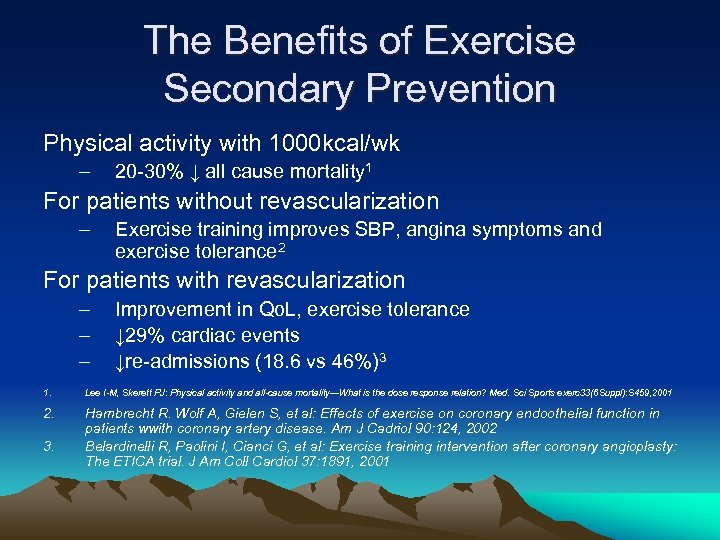 The Benefits of Exercise Secondary Prevention Physical activity with 1000 kcal/wk – 20 -30% ↓ all cause mortality 1 For patients without revascularization – Exercise training improves SBP, angina symptoms and exercise tolerance 2 For patients with revascularization – – – Improvement in Qo. L, exercise tolerance ↓ 29% cardiac events ↓re-admissions (18. 6 vs 46%)3 1. Lee I-M, Skerett PJ: Physical activity and all-cause mortality—What is the dose response relation? Med. Sci Sports exerc 33(6 Suppl): S 459, 2001 2. Hambrecht R. Wolf A, Gielen S, et al: Effects of exercise on coronary endoothelial function in patients wwith coronary artery disease. Am J Cadriol 90: 124, 2002 Belardinelli R, Paolini I, Cianci G, et al: Exercise training intervention after coronary angioplasty: The ETICA trial. J Am Coll Cardiol 37: 1891, 2001 3.
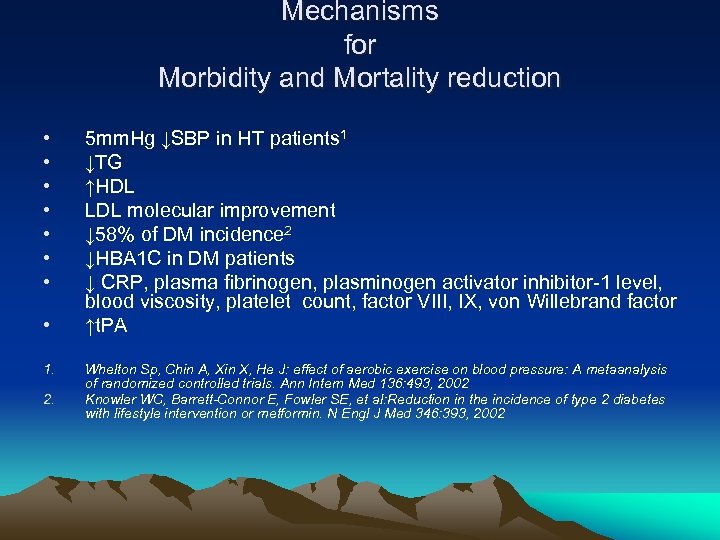 Mechanisms for Morbidity and Mortality reduction • • 1. 2. 5 mm. Hg ↓SBP in HT patients 1 ↓TG ↑HDL LDL molecular improvement ↓ 58% of DM incidence 2 ↓HBA 1 C in DM patients ↓ CRP, plasma fibrinogen, plasminogen activator inhibitor-1 level, blood viscosity, platelet count, factor VIII, IX, von Willebrand factor ↑t. PA Whelton Sp, Chin A, Xin X, He J: effect of aerobic exercise on blood pressure: A metaanalysis of randomized controlled trials. Ann Intern Med 136: 493, 2002 Knowler WC, Barrett-Connor E, Fowler SE, et al: Reduction in the incidence of type 2 diabetes with lifestyle intervention or metformin. N Engl J Med 346: 393, 2002
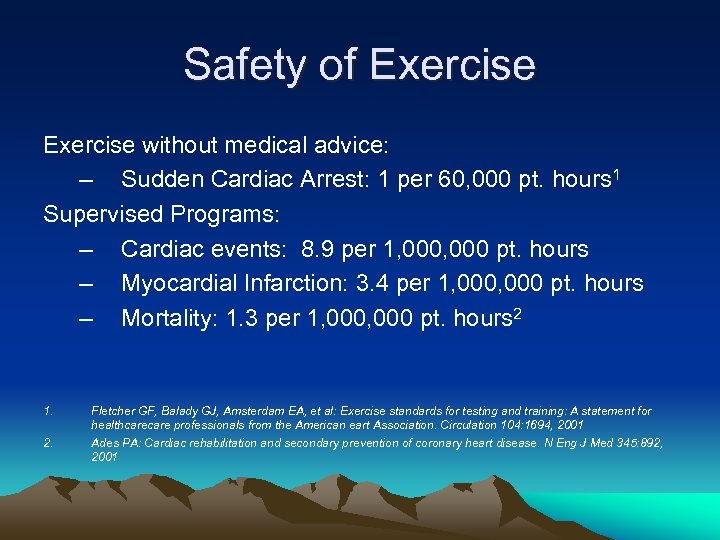 Safety of Exercise without medical advice: – Sudden Cardiac Arrest: 1 per 60, 000 pt. hours 1 Supervised Programs: – Cardiac events: 8. 9 per 1, 000 pt. hours – Myocardial Infarction: 3. 4 per 1, 000 pt. hours – Mortality: 1. 3 per 1, 000 pt. hours 2 1. 2. Fletcher GF, Balady GJ, Amsterdam EA, et al: Exercise standards for testing and training: A statement for healthcare professionals from the American eart Association. Circulation 104: 1694, 2001 Ades PA: Cardiac rehabilitation and secondary prevention of coronary heart disease. N Eng J Med 345: 892, 2001
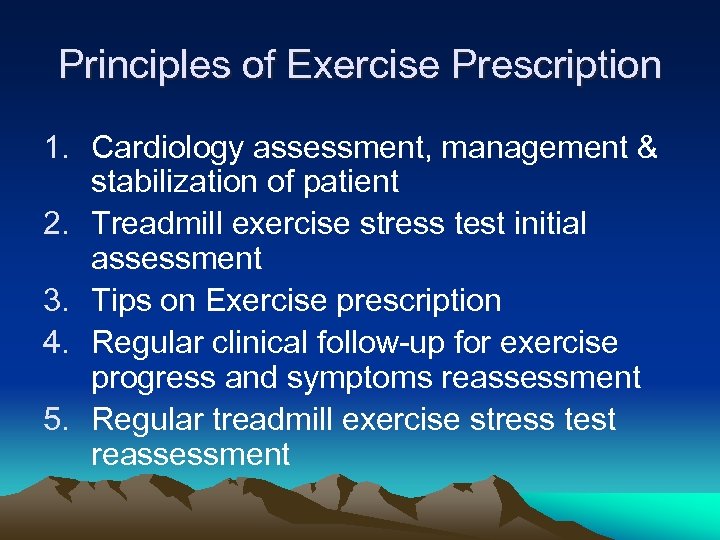 Principles of Exercise Prescription 1. Cardiology assessment, management & stabilization of patient 2. Treadmill exercise stress test initial assessment 3. Tips on Exercise prescription 4. Regular clinical follow-up for exercise progress and symptoms reassessment 5. Regular treadmill exercise stress test reassessment
 Principles of Exercise Prescription 1. Cardiology assessment, management & stabilization of patient – Diagnosis – Management • • Acute Chronic Medical Interventional
 Principles of Exercise Prescription 1. Cardiology assessment, management & stabilization of patient – Stabilization of patient and avoid: • • • • Unstable angina SBP ≥ 180 mm. Hg or DBP ≥ 100 mm. Hg Symptomatic orthostatic BP drop > 20 mm. Hg Critical aortic stenosis Acute systemic illness or fever Uncontrolled arrhythmia Uncompensated CHF 3 rd degree AV Block (complete heart block) Acute pericarditis & myocarditis Recent embolism Thrombophlebitis Resting ST displacement ≥ 2 mm Uncontrolled DM Electrolyte disturbance hypovolemia
 Principles of Exercise Prescription 2. Treadmill exercise stress test initial assessment • Cardiovascular status assessment • • Exercise induced arrhythmia Execise induced ischemia Trend of Blood pressure during exercise Trend of Sa. O 2 during exercise
 Principles of Exercise Prescription 2. • - Treadmill exercise stress test initial assessment Functional capacity assessment Activity of daily living: - Lying quietly Sitting: light activity Walking from house to car/bus Watering plants Taking out trash Walking the dog Household tasks, moderate effort Vacuuming 1. 0 METS 1. 5 METS 2. 5 METS 3. 0 METS 3. 5 METS
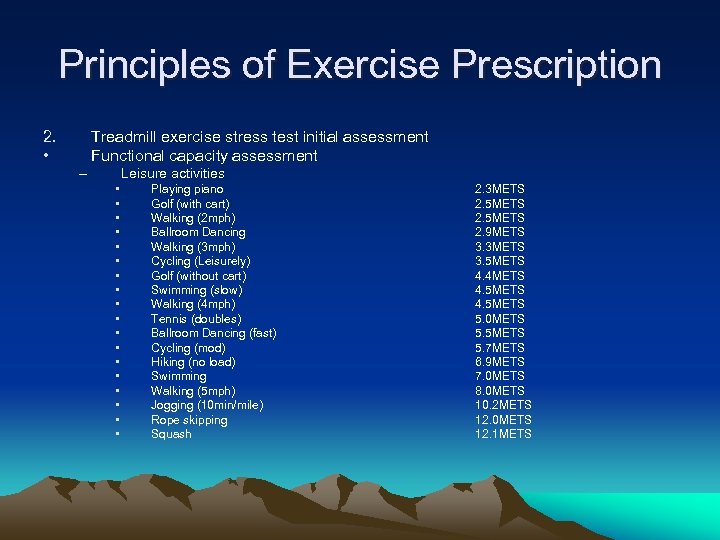 Principles of Exercise Prescription 2. • Treadmill exercise stress test initial assessment Functional capacity assessment – Leisure activities • • • • • Playing piano Golf (with cart) Walking (2 mph) Ballroom Dancing Walking (3 mph) Cycling (Leisurely) Golf (without cart) Swimming (slow) Walking (4 mph) Tennis (doubles) Ballroom Dancing (fast) Cycling (mod) Hiking (no load) Swimming Walking (5 mph) Jogging (10 min/mile) Rope skipping Squash 2. 3 METS 2. 5 METS 2. 9 METS 3. 3 METS 3. 5 METS 4. 4 METS 4. 5 METS 5. 0 METS 5. 5 METS 5. 7 METS 6. 9 METS 7. 0 METS 8. 0 METS 10. 2 METS 12. 0 METS 12. 1 METS
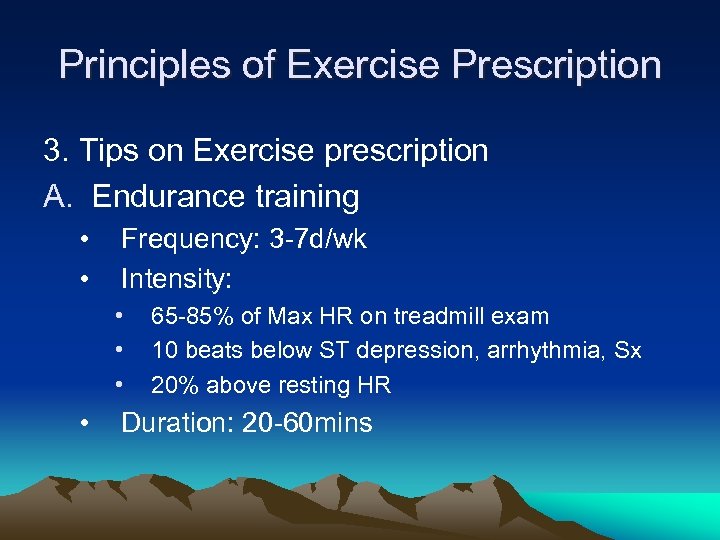 Principles of Exercise Prescription 3. Tips on Exercise prescription A. Endurance training • • Frequency: 3 -7 d/wk Intensity: • • 65 -85% of Max HR on treadmill exam 10 beats below ST depression, arrhythmia, Sx 20% above resting HR Duration: 20 -60 mins
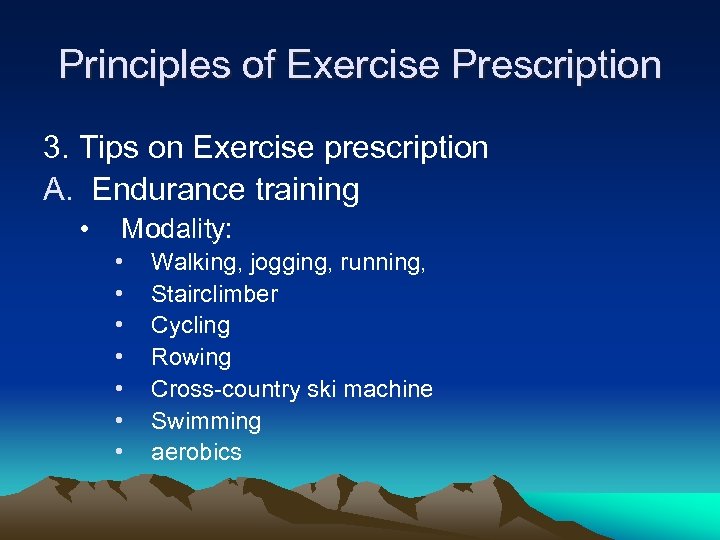 Principles of Exercise Prescription 3. Tips on Exercise prescription A. Endurance training • Modality: • • Walking, jogging, running, Stairclimber Cycling Rowing Cross-country ski machine Swimming aerobics
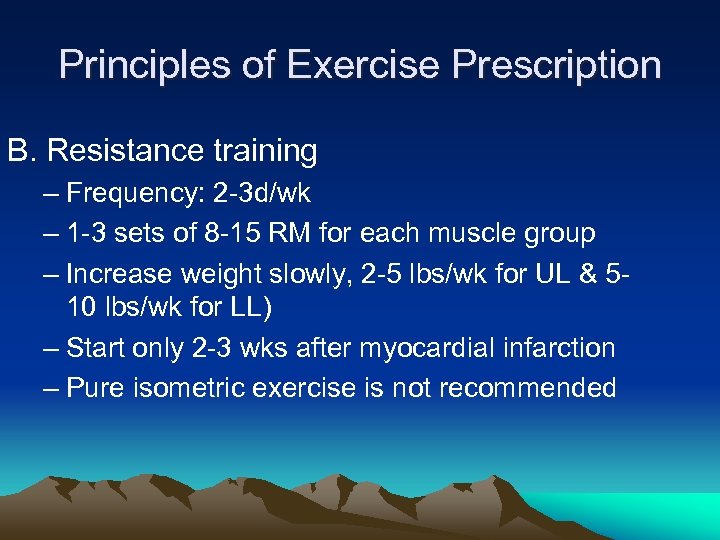 Principles of Exercise Prescription B. Resistance training – Frequency: 2 -3 d/wk – 1 -3 sets of 8 -15 RM for each muscle group – Increase weight slowly, 2 -5 lbs/wk for UL & 510 lbs/wk for LL) – Start only 2 -3 wks after myocardial infarction – Pure isometric exercise is not recommended
 Principles of Exercise Prescription 4. Regular clinical follow-up for exercise progress and symptoms reassessment – To assess the cardiovascular status • Chest pain, dizziness, LOC, palpitation, dypsnoea, appetite, BO/PU, resting BP & P. – To assess the progress of exercise tolerance – Advancing the prescription according to • The improvement in fitness • To increase in steps of 5 – 10% of max. heart rate • To maintain ~ 85% of max. heart rate during the whole exercise session
 Principles of Exercise Prescription 5. Regular treadmill exercise stress test reassessment – Ascess the impact of medical and exercise management – Provide feedback to patient – Plan of future management
 Tips on Hypertensive patients • Avoid pure isometric exercise • Side effect of Anti-HT medications: – Beta-blockers: lethargy – Diuretics: dehydration – ABCD: Post-exertional BP↓ • Control BP first →Exercise Second! • Treadmill is a very good test for BP trend on exertion
 Tips on DM patients Pre- exercise treadmill Stress test was indicated: 1. Age > 40 2. Age > 30 with – – – DM > 10 yrs HT Smoking Hyperlipidemia Retinopathy Nephropathy (microalbuminuria) 3. Coronary Artery Disease 4. CVA 5. Peripheral vascular disease 6. Autonomic neuropathy 7. Renal Failure
 Tips on DM patients Type I DM (IDDM)1 – Aerobic exercise – Low – moderate intensity – 20 -60 mins/day – 4 – 6 days per week
 Tips on DM patients Type II (NIDDM) – Aerobic exercise • Moderate intensity • 150 mins/wk (moderate) • 3 days/wk – Resistance-training exercise • • • Moderate intensity 3 sets of 8 -10 repetitions All major muscle groups Weight cannot be lifted > 8 -10 times 3 days/week
 Tips on DM patients • Postpone exercise if – Hstix > 16. 5 mmol/L – Hstix >13 mmol/L with ketones in urine • Monitor Hstix before, (during) and after exercise • Ideal pre-exercise 6. 7 – 10 mmol/L • Ingest Carbohydrate : Hstix 4. 45. 5 mmol/L 2
 Tips on DM patients • Avoid late evening exercise →nocturnal hypoglycemia • prevent injury – peripheral neuropathy – Lower extremity care – Swimming/cycling/rowing better than walking/jogging • Autonomic neuropathy – Blunted BP/P response – Postural hypotension – Heat stroke
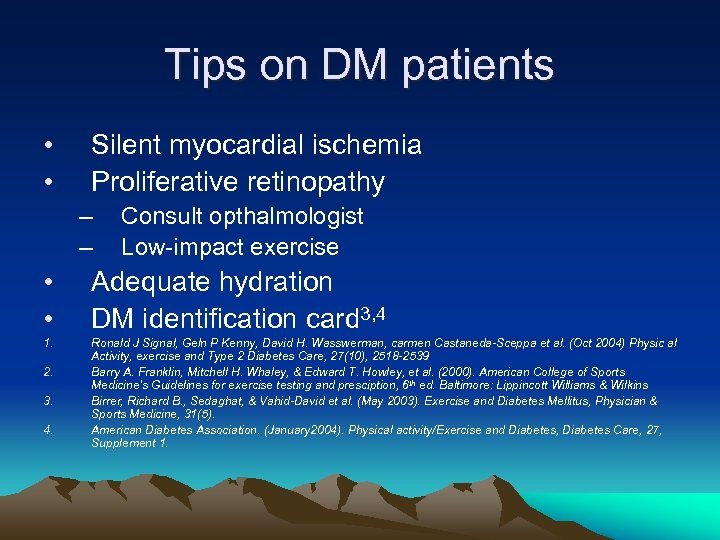 Tips on DM patients • • Silent myocardial ischemia Proliferative retinopathy – – Consult opthalmologist Low-impact exercise • • Adequate hydration DM identification card 3, 4 1. Ronald J Signal, Geln P Kenny, David H. Wasswerman, carmen Castaneda-Sceppa et al. (Oct 2004) Physic al Activity, exercise and Type 2 Diabetes Care, 27(10), 2518 -2539 Barry A. Franklin, Mitchell H. Whaley, & Edward T. Howley, et al. (2000). American College of Sports Medicine’s Guidelines for exercise testing and presciption, 6 th ed. Baltimore: Lippincott Williams & Wilkins Birrer, Richard B. , Sedaghat, & Vahid-David et al. (May 2003). Exercise and Diabetes Mellitus, Physician & Sports Medicine, 31(5). American Diabetes Association. (January 2004). Physical activity/Exercise and Diabetes, Diabetes Care, 27, Supplement 1. 2. 3. 4.
 The greatest mistake physicians make is that they attempt to cure the body without attempting to cure the mind; yet the mind and body are one and should not be treated separately! ~ Plato 427 -347 BC
 In a Nutshell DIY!
 DIY !
DIY !
 DIY !
DIY !
 DIY!
DIY!
 DIY!
DIY!
 DIY!
DIY!
 DIY!
DIY!
 DIY!
DIY!