 Скачать презентацию Executive Force Preservation Board Welcome to the 24
3084d370d37b122d9c6aa5b8b12a6d86.ppt
- Количество слайдов: 82



Executive Force Preservation Board Welcome to the 24 th Executive Force Preservation Board 23 February 2011 Ver 6/22 Feb 11
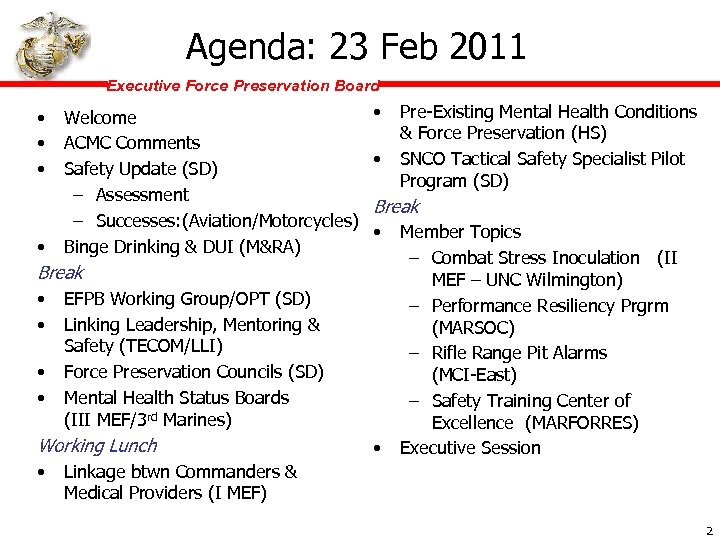
Agenda: 23 Feb 2011 Executive Force Preservation Board • • • Welcome ACMC Comments Safety Update (SD) – Assessment – Successes: (Aviation/Motorcycles) Binge Drinking & DUI (M&RA) • Break • EFPB Working Group/OPT (SD) • Linking Leadership, Mentoring & Safety (TECOM/LLI) • Force Preservation Councils (SD) • Mental Health Status Boards (III MEF/3 rd Marines) Working Lunch • Linkage btwn Commanders & Medical Providers (I MEF) • • Pre-Existing Mental Health Conditions & Force Preservation (HS) SNCO Tactical Safety Specialist Pilot Program (SD) Break • Member Topics – Combat Stress Inoculation (II • MEF – UNC Wilmington) – Performance Resiliency Prgrm (MARSOC) – Rifle Range Pit Alarms (MCI-East) – Safety Training Center of Excellence (MARFORRES) Executive Session 2
Admin Executive Force Preservation Board • • Heads Exits Phones Please silence your Blackberries and cell phones Computers Schedule Lunch Executive Session 3
Executive Force Preservation Board ACMC Comments
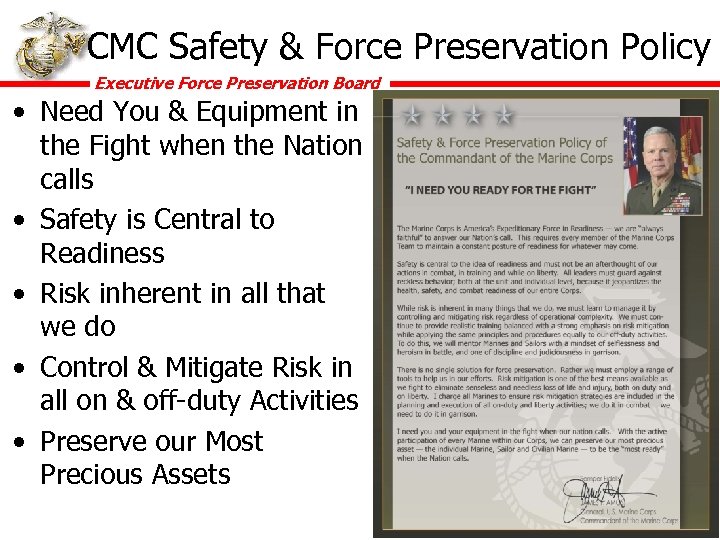
CMC Safety & Force Preservation Policy Executive Force Preservation Board • Need You & Equipment in the Fight when the Nation calls • Safety is Central to Readiness • Risk inherent in all that we do • Control & Mitigate Risk in all on & off-duty Activities • Preserve our Most Precious Assets 5
ACMC Guidance for EFPB Executive Force Preservation Board • Decision-making body. • Prescriptive in nature. • Close the gap between combat and garrison leadership. • Support engaged anticipatory leadership • Codify decisions via message or in updates to orders to reduce mishap fatalities, preserve the force, and improve the effects of Safety and Force Preservation-related programs. 6
Executive Force Preservation Board Safety Division Update Col Paul Fortunato Director, CMC Safety Division
Safety Division Update Executive Force Preservation Board • • Safety Statistics Successes in Safety Assessment of Safety Program Components Discussion 8
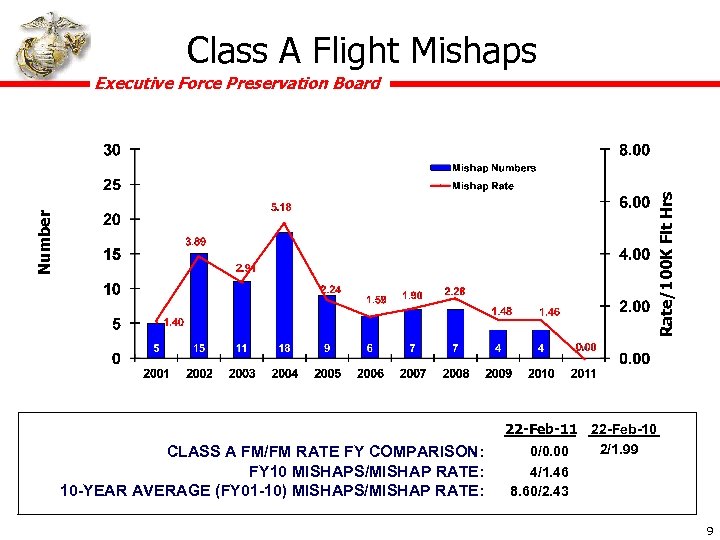
Class A Flight Mishaps Number Rate/100 K Flt Hrs Executive Force Preservation Board CLASS A FM/FM RATE FY COMPARISON: FY 10 MISHAPS/MISHAP RATE: 10 -YEAR AVERAGE (FY 01 -10) MISHAPS/MISHAP RATE: 22 -Feb-11 22 -Feb-10 2/1. 99 0/0. 00 4/1. 46 8. 60/2. 43 9
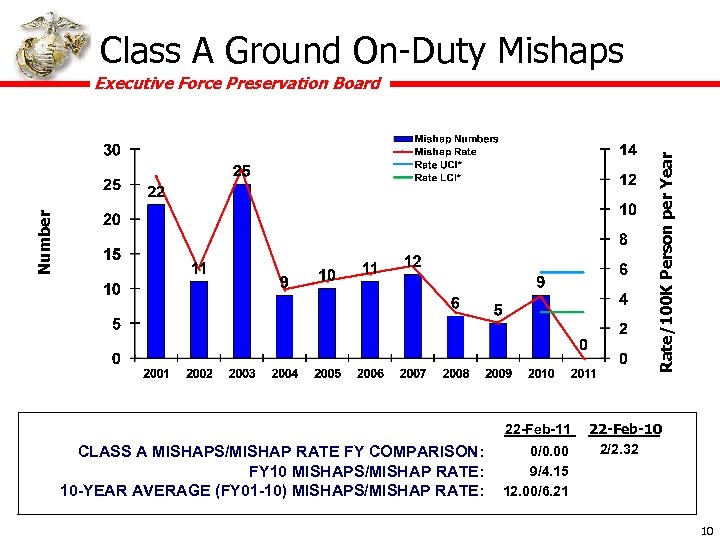
Class A Ground On-Duty Mishaps Number Rate/100 K Person per Year Executive Force Preservation Board 22 -Feb-11 CLASS A MISHAPS/MISHAP RATE FY COMPARISON: FY 10 MISHAPS/MISHAP RATE: 10 -YEAR AVERAGE (FY 01 -10) MISHAPS/MISHAP RATE: 0/0. 00 9/4. 15 12. 00/6. 21 22 -Feb-10 2/2. 32 10
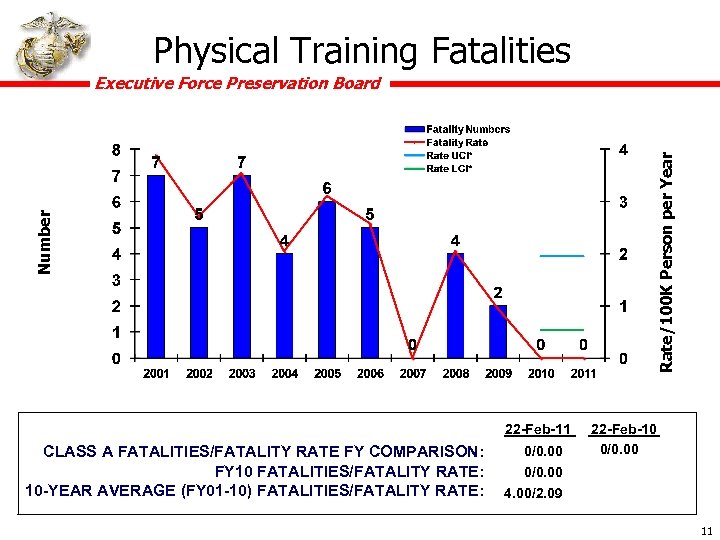
Physical Training Fatalities Number Rate/100 K Person per Year Executive Force Preservation Board 22 -Feb-11 CLASS A FATALITIES/FATALITY RATE FY COMPARISON: FY 10 FATALITIES/FATALITY RATE: 10 -YEAR AVERAGE (FY 01 -10) FATALITIES/FATALITY RATE: 0/0. 00 4. 00/2. 09 22 -Feb-10 0/0. 00 11
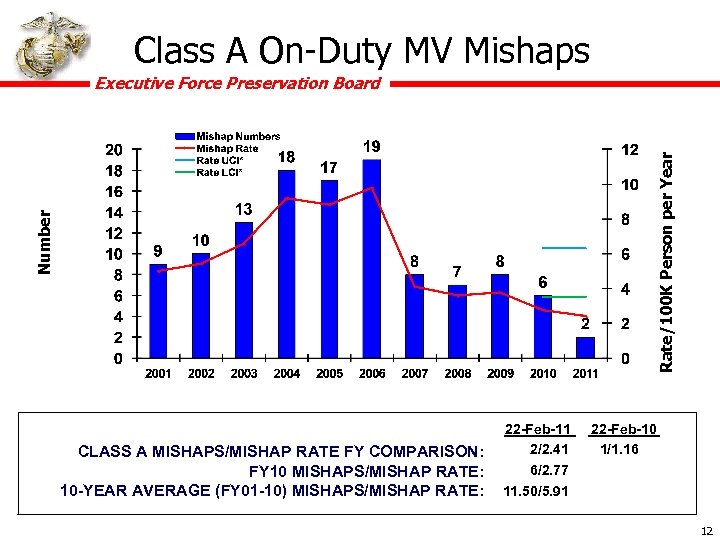
Class A On-Duty MV Mishaps Number Rate/100 K Person per Year Executive Force Preservation Board CLASS A MISHAPS/MISHAP RATE FY COMPARISON: FY 10 MISHAPS/MISHAP RATE: 10 -YEAR AVERAGE (FY 01 -10) MISHAPS/MISHAP RATE: 22 -Feb-11 2/2. 41 22 -Feb-10 1/1. 16 6/2. 77 11. 50/5. 91 12
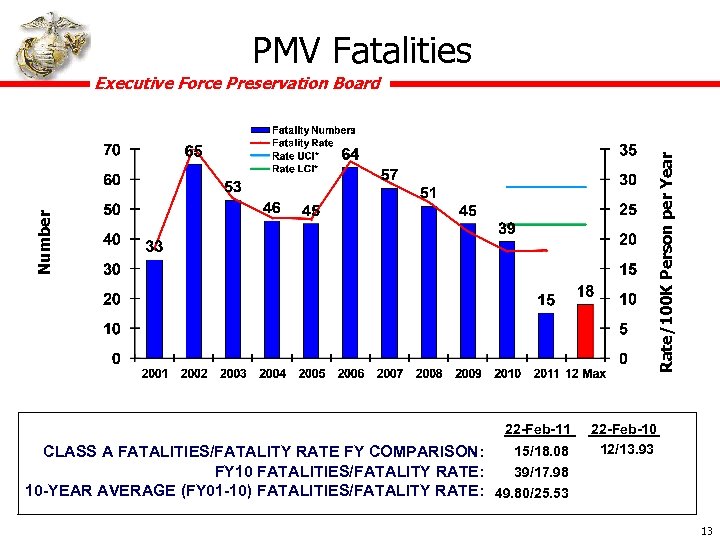
PMV Fatalities Number Rate/100 K Person per Year Executive Force Preservation Board 22 -Feb-11 15/18. 08 CLASS A FATALITIES/FATALITY RATE FY COMPARISON: FY 10 FATALITIES/FATALITY RATE: 39/17. 98 10 -YEAR AVERAGE (FY 01 -10) FATALITIES/FATALITY RATE: 49. 80/25. 53 22 -Feb-10 12/13. 93 13
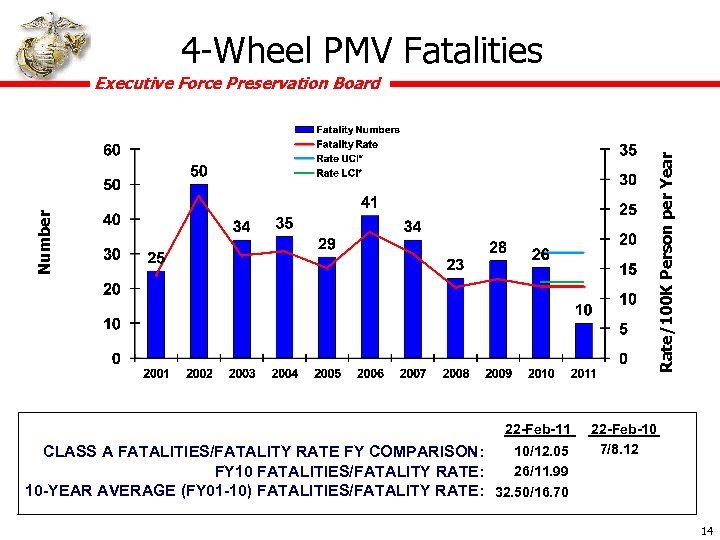
4 -Wheel PMV Fatalities Number Rate/100 K Person per Year Executive Force Preservation Board 22 -Feb-11 10/12. 05 CLASS A FATALITIES/FATALITY RATE FY COMPARISON: 26/11. 99 FY 10 FATALITIES/FATALITY RATE: 10 -YEAR AVERAGE (FY 01 -10) FATALITIES/FATALITY RATE: 32. 50/16. 70 22 -Feb-10 7/8. 12 14
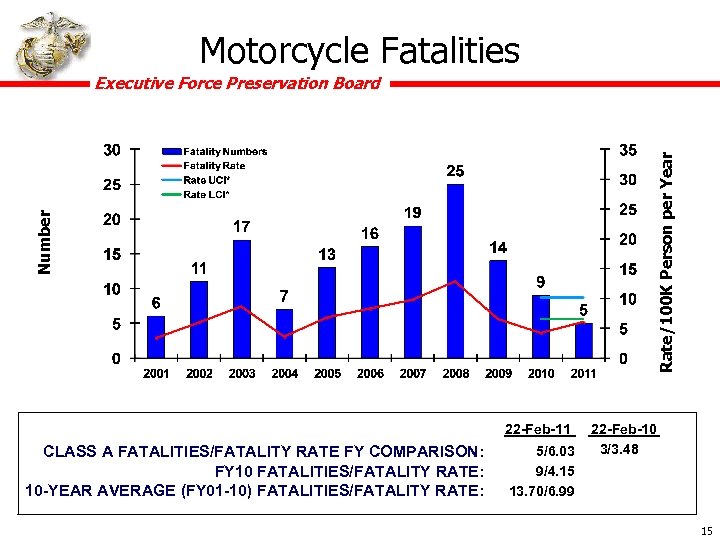
Motorcycle Fatalities Number Rate/100 K Person per Year Executive Force Preservation Board 22 -Feb-11 CLASS A FATALITIES/FATALITY RATE FY COMPARISON: FY 10 FATALITIES/FATALITY RATE: 10 -YEAR AVERAGE (FY 01 -10) FATALITIES/FATALITY RATE: 5/6. 03 9/4. 15 13. 70/6. 99 22 -Feb-10 3/3. 48 15
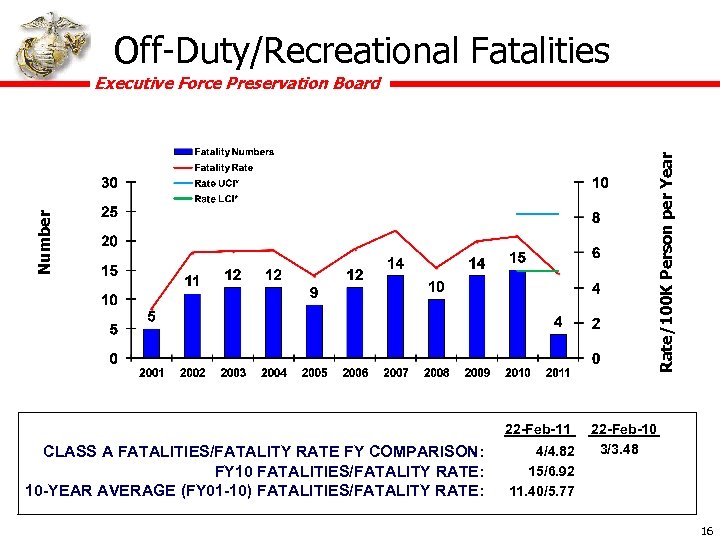
Off-Duty/Recreational Fatalities Number Rate/100 K Person per Year Executive Force Preservation Board 22 -Feb-11 CLASS A FATALITIES/FATALITY RATE FY COMPARISON: FY 10 FATALITIES/FATALITY RATE: 10 -YEAR AVERAGE (FY 01 -10) FATALITIES/FATALITY RATE: 4/4. 82 15/6. 92 11. 40/5. 77 22 -Feb-10 3/3. 48 16
Executive Force Preservation Board Safety Division Assessment
SD Assessment Executive Force Preservation Board • After the 1 st third of the FY, our PMV/Recreational off-duty mishap rates and on-duty Motor Vehicle rates closely match this point last year though we predict rate improvement. • All other categories are better than this point last year. – The other categories include Aviation, Ground, overall On-duty mishaps & fatalities, Military injury rate, and Civilian lost work day case rate. – These categories are more conducive to focused leadership and the on-duty control of personnel and activities – Statistically significant probability for continued improvement and decline in mishap rates. • All categories are well below 10 -year averages. 18
SD Assessment: Operational Safety Executive Force Preservation Board • Class A operational mishaps remain infrequent and most often involve Motor-T equipment – Success in reducing frequency/severity of operational mishaps are due in part to improved vehicles and restraints, wider utilization of risk management concepts, and strict adherence to proven TTPs. – Engaged leadership, training & awareness remain critical key components in mishap reduction. • Aviation Mishaps at historic lows – Began with significant initiatives from the highest levels of Marine Aviation. – Key contributor to this success is the engagement by leaders in all levels of Marine Aviation and adherence to the minimum acceptable standards. 19
SD Assessment: Off-Duty Safety Executive Force Preservation Board • Marine Corps PMV trends are favorable in the longer-term view. Motorcycle fatalities steadily decreased 64% from FY 08 (25) to FY 10 (9). 4 -wheel fatalities have declined 36% overall since FY 06 (41) and remain relatively stable since FY 08 (average 26). • Marine PMV 4 mishap rates show a steady decline from FY 06 to FY 08, hit a plateau from FY 09 to FY 10 and are currently showing a slight up-tick in FY 11. The increase is within the 95% confidence interval, which indicates that FY 11 is statistically no better or worse than the FY 10 rate. • Alcohol use and failure to use seatbelts remain central to the loss of life in 4 -wheel mishaps, with one or both of these factors evident in 32% (16 of 50) traffic deaths from FY 10 to date. • 9 Alcohol-related fatalities FYTD (4 Rec & 5 PMV); signs of tapering off as a factor in traffic deaths but is the singular cause of rec fatalities FYTD. 20
Command Safety Assessments (CSA) Executive Force Preservation Board • Command Safety Assessments (CSA) conducted by SD at MARFORs, MCCDC, MEFs, LOGCOM, TECOM, MCRC and installations since 2008. • Supports OSHA & Do. N requirements for self-evaluation through a Occupational Health and Safety Management System • Positive Trends – Significant process improvement across the Marine Corps – Standardization of written programs & annual internal program management review and associated analysis of trends, hazards and issues • Trends requiring some attention – Safety inspections and assessments of subordinates units are not universally conducted – Reporting and recording of less than fatal mishaps – Safety training of supervisors – Command Safety Councils frequently not established – Safety department C 2 (alignment as special staff) 21
SD Assessment: Reporting Executive Force Preservation Board • 100% Reporting of Class A mishaps, but we have a culture of under-reporting of Bs and Cs. • Navy-Marine Corps Public Health Center data reconciled with Web Enabled Safety System (WESS) data reveals only 10% of reportable injury mishaps are actually reported as mishaps. • Safety Division and Naval Safety Center actions – Streamlining & supporting investigative process – Improving WESS for ease of use – Improving connectivity between WESS & medical reporting systems • For Commanders – Appoint high-quality safety managers – Ensure training and continuity 22
SD Assessment: Investigations Executive Force Preservation Board • Improvements in concurrent Safety & Legal Investigations – Safety Investigation vs. prosecution – Concerns that criminal conduct discovered after SIB convened and effect of SIB on any subsequent criminal prosecution – Dilemma over primacy of Safety Investigation Board (SIB) vs. criminal prosecution • Desire to Leave the Commander options – Safety Investigation Board, WESS Report, Combat Zone Report – Deferring SIB based on Prosecution as possibility or probability? – Identify & fix problems to prevent recurrence • Recent investigations are being conducted as required • Recent improvements in Combat Zone Reporting 23
Executive Force Preservation Board Successes in Safety Aviation Safety Program Motorcycle Safety Program Alcohol-Related Mishaps?
Path to Success in Aviation Safety Executive Force Preservation Board • • • Significant Milestones FY 04: 18 Class A Flight Mishaps – an unsustainable path FY 05: Previous year’s mishap rate cut in half FY 08: No Marine Aviation operational fatalities FY 09: Lowest number of Class A FMs on record FY 10: Matched FY 09’s number with a lower rate. The best record in the history of Marine Aviation How Did We Get Here? • • Not an accident Began with significant initiatives from the highest levels Senior leaders understood and embraced Trickled down to leaders at all levels 25
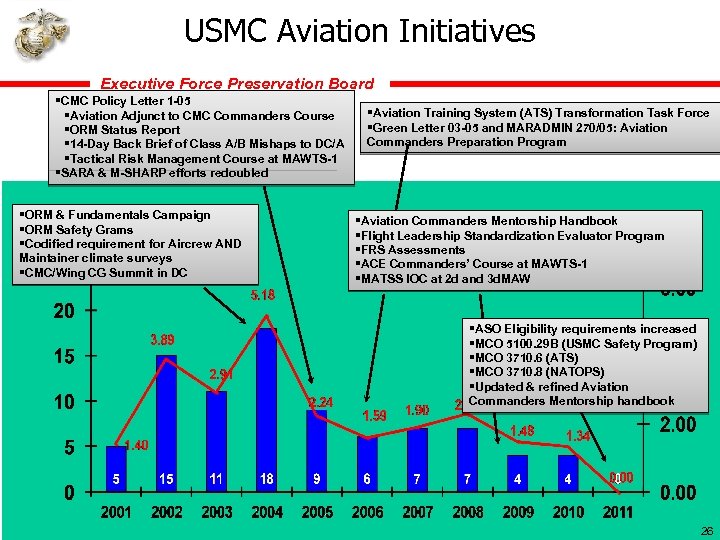
USMC Aviation Initiatives Executive Force Preservation Board §CMC Policy Letter 1 -05 §Aviation Adjunct to CMC Commanders Course §ORM Status Report § 14 -Day Back Brief of Class A/B Mishaps to DC/A §Tactical Risk Management Course at MAWTS-1 §SARA & M-SHARP efforts redoubled §ORM & Fundamentals Campaign §ORM Safety Grams §Codified requirement for Aircrew AND Maintainer climate surveys §CMC/Wing CG Summit in DC §Aviation Training System (ATS) Transformation Task Force §Green Letter 03 -05 and MARADMIN 270/05: Aviation Commanders Preparation Program §Aviation Commanders Mentorship Handbook §Flight Leadership Standardization Evaluator Program §FRS Assessments §ACE Commanders’ Course at MAWTS-1 §MATSS IOC at 2 d and 3 d. MAW §ASO Eligibility requirements increased §MCO 5100. 29 B (USMC Safety Program) §MCO 3710. 6 (ATS) §MCO 3710. 8 (NATOPS) §Updated & refined Aviation Commanders Mentorship handbook 26
Path to Success in Motorcycle Safety Executive Force Preservation Board • • Significant Milestones FY 05 -08: Steady climb in motorcycle mishaps & fatalities FY 05: Mentorship Clubs and California Superbike School FY 08: Worst year in motorcycle safety; 25 fatalities FY 08/09: Motorcycle focus at ESB—training continuum, track days, motorcycle clubs & elimination of the vest FY 09: Semper. Ride; fatalities reduced by 40% FY 10: MCTFS codes; further mishap reductions • • How Did We Get Here? Not by accident but with significant, directed initiatives Training, Awareness and Engaged Leadership Embraced riders Provided effective, appealing & sustainable training • • 27
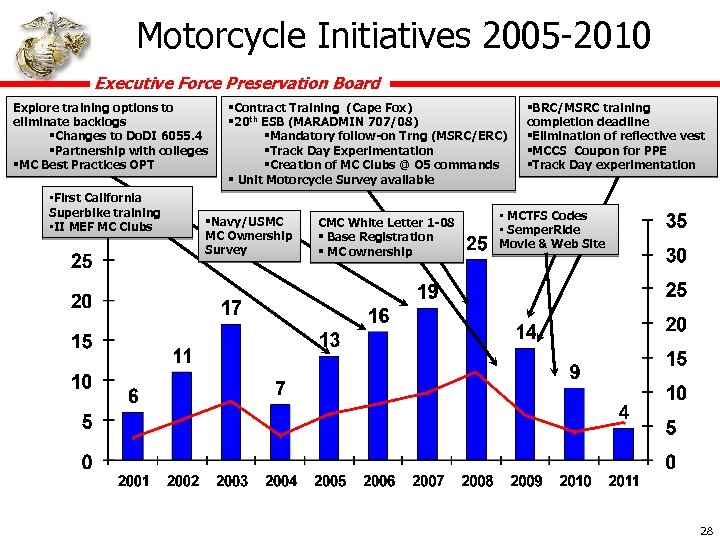
Motorcycle Initiatives 2005 -2010 Executive Force Preservation Board Explore training options to eliminate backlogs §Changes to Do. DI 6055. 4 §Partnership with colleges §MC Best Practices OPT • First California Superbike training • II MEF MC Clubs §Contract Training (Cape Fox) § 20 th ESB (MARADMIN 707/08) §Mandatory follow-on Trng (MSRC/ERC) §Track Day Experimentation §Creation of MC Clubs @ O 5 commands § Unit Motorcycle Survey available §Navy/USMC MC Ownership Survey CMC White Letter 1 -08 § Base Registration § MC ownership §BRC/MSRC training completion deadline §Elimination of reflective vest §MCCS Coupon for PPE §Track Day experimentation • MCTFS Codes • Semper. Ride Movie & Web Site 28
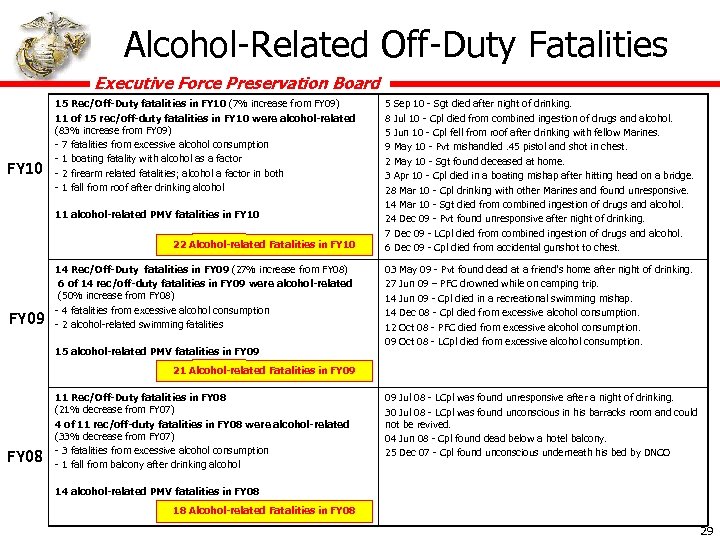
Alcohol-Related Off-Duty Fatalities Executive Force Preservation Board FY 10 15 Rec/Off-Duty fatalities in FY 10 (7% increase from FY 09) 11 of 15 rec/off-duty fatalities in FY 10 were alcohol-related (83% increase from FY 09) - 7 fatalities from excessive alcohol consumption - 1 boating fatality with alcohol as a factor - 2 firearm related fatalities; alcohol a factor in both - 1 fall from roof after drinking alcohol 11 alcohol-related PMV fatalities in FY 10 22 Alcohol-related Fatalities in FY 10 FY 09 14 Rec/Off-Duty fatalities in FY 09 (27% increase from FY 08) 6 of 14 rec/off-duty fatalities in FY 09 were alcohol-related (50% increase from FY 08) - 4 fatalities from excessive alcohol consumption - 2 alcohol-related swimming fatalities 15 alcohol-related PMV fatalities in FY 09 5 Sep 10 - Sgt died after night of drinking. 8 Jul 10 - Cpl died from combined ingestion of drugs and alcohol. 5 Jun 10 - Cpl fell from roof after drinking with fellow Marines. 9 May 10 - Pvt mishandled. 45 pistol and shot in chest. 2 May 10 - Sgt found deceased at home. 3 Apr 10 - Cpl died in a boating mishap after hitting head on a bridge. 28 Mar 10 - Cpl drinking with other Marines and found unresponsive. 14 Mar 10 - Sgt died from combined ingestion of drugs and alcohol. 24 Dec 09 - Pvt found unresponsive after night of drinking. 7 Dec 09 - LCpl died from combined ingestion of drugs and alcohol. 6 Dec 09 - Cpl died from accidental gunshot to chest. 03 27 14 14 12 09 May 09 - Pvt found dead at a friend's home after night of drinking. Jun 09 – PFC drowned while on camping trip. Jun 09 - Cpl died in a recreational swimming mishap. Dec 08 - Cpl died from excessive alcohol consumption. Oct 08 - PFC died from excessive alcohol consumption. Oct 08 - LCpl died from excessive alcohol consumption. 21 Alcohol-related Fatalities in FY 09 FY 08 11 Rec/Off-Duty fatalities in FY 08 (21% decrease from FY 07) 4 of 11 rec/off-duty fatalities in FY 08 were alcohol-related (33% decrease from FY 07) - 3 fatalities from excessive alcohol consumption - 1 fall from balcony after drinking alcohol 09 Jul 08 - LCpl was found unresponsive after a night of drinking. 30 Jul 08 - LCpl was found unconscious in his barracks room and could not be revived. 04 Jun 08 - Cpl found dead below a hotel balcony. 25 Dec 07 - Cpl found unconscious underneath his bed by DNCO 14 alcohol-related PMV fatalities in FY 08 18 Alcohol-related Fatalities in FY 08 29
Executive Force Preservation Board Discussion 30
Executive Force Preservation Board Binge Drinking and DUIs: Alcohol Effects on Force Preservation Ronnie Edwards M&RA (Behavioral Health)
Executive Force Preservation Board Break
Executive Force Preservation Board EFPB Working Group & OPT Col Paul Fortunato Director, Safety Division
Working Group & OPT Executive Force Preservation Board • Stakeholders from EFPB Membership met in Jan – MEFs, MARFORs, MCIs – MCRC, TECOM, HS, M&RA • Discussed previous EFPB taskers for viable COAs and EFPB discussion & decision – – Linkages between leadership, mentoring & safety Force Preservation (Human Factors) Councils Linkage between Commanders and Medical Providers SNCO Tactical Safety Specialists 34
Executive Force Preservation Board Marine Corps Leadership Development Program Linkage between Leadership, Mentoring & Safety Lt. Col Shawn Mansfield Lejeune Leadership Institute/TECOM
Executive Force Preservation Board Force Preservation Councils Col Paul Fortunato Director, Safety Division
Force Preservation Councils Executive Force Preservation Board • • Background in Aviation Units Tasker from 23 rd EFPB MEF Beta Tests and Experimentation OPT Assumptions, COAs and Recommendation 37
Aviation Human Factors Reviews Executive Force Preservation Board • Long-standing requirement in the Naval Aviation Safety Program • Squadron commanders required to monitor aircrews’ – Performance – Motivation and attitude – Physical and psychological condition • Process identifies deficiencies & potential causes to develop mitigation strategies prior to an incident or mishap • Some units have expanded review to all personnel 38
Aviation Human Factors Reviews Executive Force Preservation Board • Human Factors Council (HFC) – Meets monthly or more frequently as required – Discusses performance shortfalls and life stressors – Attempt to identify potential causes and mitigations • Human Factors Boards (HFB) – Meets only when required to address specific issue – Board presents commander with a specific plan to mitigate the identified deficiencies • Limitations – Solely for Commanding Officer’s use – Results shall not be used for disciplinary or admin action – All information and records must be protected 39
23 rd EFPB Tasker Executive Force Preservation Board • 23 rd EFPB tasked II MEF to establish a framework for the establishment and conduct of Force Preservation Boards (FPB) down to company level • Encouraged EFPB members to experiment with framework that II MEF provided • Provide results of experimentation to the 24 th EFPB 40
Framework from 23 rd EFPB Tasker Executive Force Preservation Board • Concentrate on risk factors: – – – Low leader to led ratio Alcohol & drug abuse Psychotropic medication prescriptions Legal and disciplinary issues Antiterrorism / force protection considerations • Use board to bring holders of the “dots” together for a team solution • Unit constitute core board and then bring in those needed to “connect the dots” 41
II MEF Beta Test Executive Force Preservation Board • Gain holistic view of Marine/Sailor to ID at risk personnel, provide timely resources & monitor progress – Commands given latitude to tailor program for best fit – Initial board focus on each Marine/Sailor to identify and categorize those at risk – Subsequent boards will look at previously identified personnel, newly identified at risk personnel, and incoming personnel • Beta Test limited to O-3 command level – Meet monthly, may convene more frequently as req. – FPB composition and conduct dependent on unit 42
I MEF Beta Test Executive Force Preservation Board • Use of a clear formalized process to elevate atrisk Marines to the command by using leadership/Mentoring Program coupled with advice from key staff and senior leaders. • Uses existing Mentorship Program • Combines human factors issues into one composite picture of each Marine 43
I MEF Beta Test Executive Force Preservation Board • Boards established at platoon through battalion levels using mentoring program – Meet monthly, may convene more frequently as required – Begin at platoon level with mentor sessions, elevate cases needing extra attention to next level • Provide individual recommendations tailored to mitigate identified problems and successfully reintegrate individual 44
Other Experimentation Executive Force Preservation Board • Units that have experimented with or implemented some form of Force Preservation Council – – – – – II MEF (Div and MLG @ company level) I MEF 3 d Marines MCRC MCI-E MCI-W MARSOC TECOM MCB Quantico 45
OPT on Force Preservation Councils Executive Force Preservation Board • Considered process that focuses on engaged, small unit leadership, identifies at-risk Marines, supports anticipatory leadership, and ensures elevation of those issues requiring senior leader attention and resources. • Considered fleet experimentation • Discussed COAs and way-ahead for implementing Force Preservation Councils Marine Corps-wide • Considered collaborative communications between entities at Command level (Medical, Chaplain, SACO, Legal, SAPR, etc. ) 46
OPT Assumptions Executive Force Preservation Board • This is a leadership, not a safety program • FPC must work in concert with a Marine Corps Leadership/Mentorship Program • Current leadership program needs to be updated • Not a replacement for current program – Aviation Human Factors Councils & Boards – Mentoring Program • Must execute with available resources (Fiscal & SME) • Will work differently – in MARFORRES, MCRC, etc. – in ground units than in aviation units 47
Force Preservation Council COAs Executive Force Preservation Board 1. Revise Marine Corps existing Leadership Programs, and incorporate FPC structure into revised leadership program 2. Require Force Preservation Council (FPC) at 0 -5 level commands 3. Provide recommended FPC structure, allow commanders option to execute 4. Continued experimentation to develop best practices across the Marine Corps 48
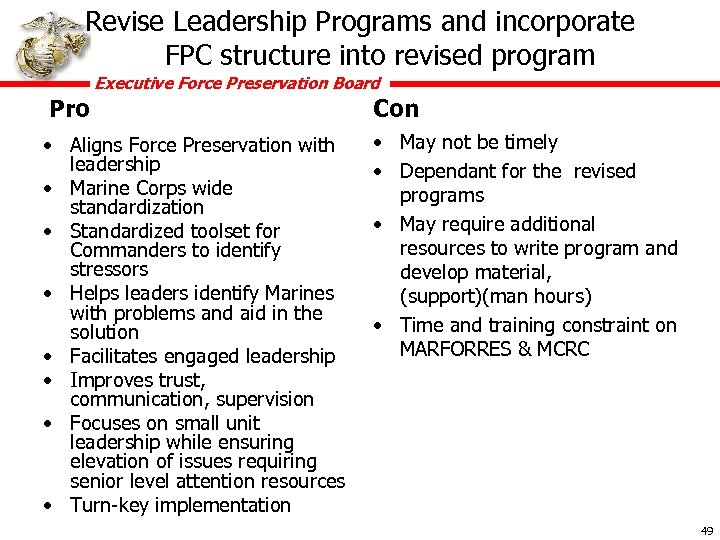
Revise Leadership Programs and incorporate FPC structure into revised program Executive Force Preservation Board Pro Con • Aligns Force Preservation with leadership • Marine Corps wide standardization • Standardized toolset for Commanders to identify stressors • Helps leaders identify Marines with problems and aid in the solution • Facilitates engaged leadership • Improves trust, communication, supervision • Focuses on small unit leadership while ensuring elevation of issues requiring senior level attention resources • Turn-key implementation • May not be timely • Dependant for the revised programs • May require additional resources to write program and develop material, (support)(man hours) • Time and training constraint on MARFORRES & MCRC 49
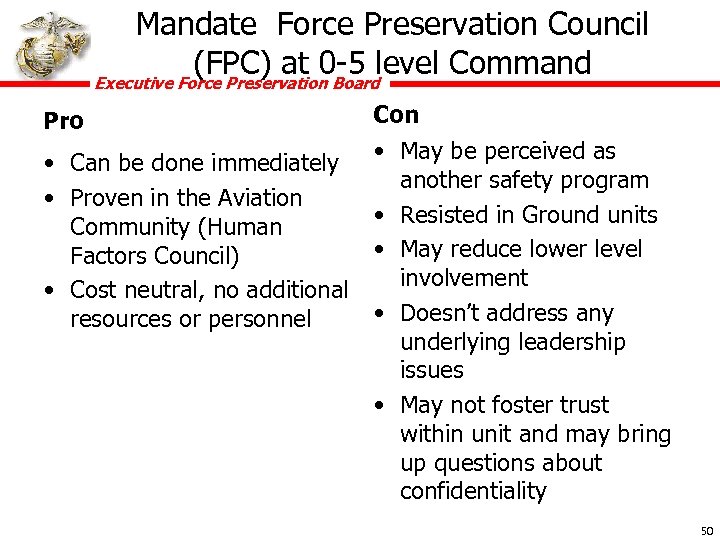
Mandate Force Preservation Council (FPC) at 0 -5 level Command Executive Force Preservation Board Pro Con • Can be done immediately • Proven in the Aviation Community (Human Factors Council) • Cost neutral, no additional resources or personnel • May be perceived as another safety program • Resisted in Ground units • May reduce lower level involvement • Doesn’t address any underlying leadership issues • May not foster trust within unit and may bring up questions about confidentiality 50
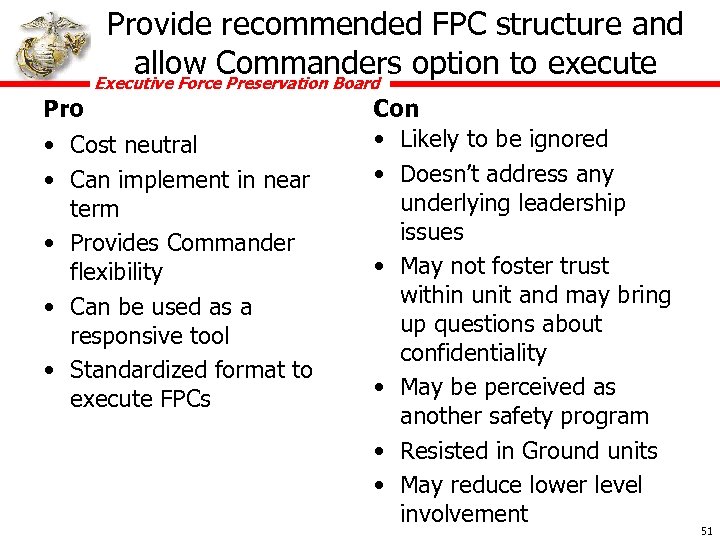
Provide recommended FPC structure and allow Commanders option to execute Executive Force Preservation Board Pro • Cost neutral • Can implement in near term • Provides Commander flexibility • Can be used as a responsive tool • Standardized format to execute FPCs Con • Likely to be ignored • Doesn’t address any underlying leadership issues • May not foster trust within unit and may bring up questions about confidentiality • May be perceived as another safety program • Resisted in Ground units • May reduce lower level involvement 51
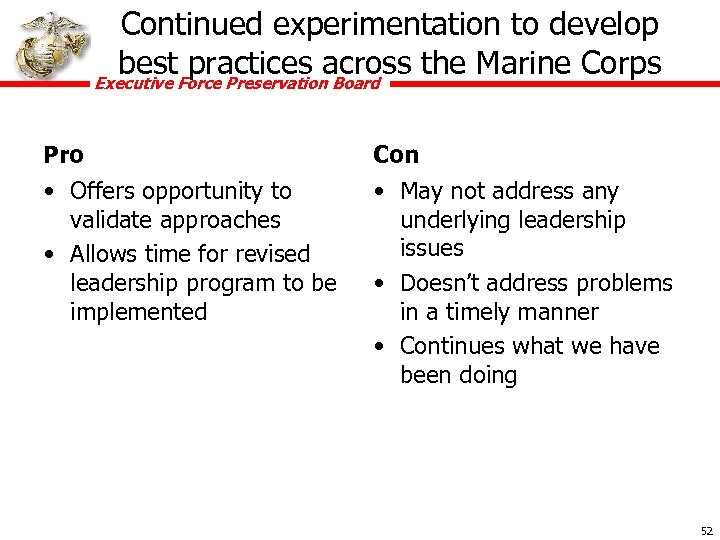
Continued experimentation to develop best. Force Preservationacross the Marine Corps practices Board Executive Pro Con • Offers opportunity to validate approaches • Allows time for revised leadership program to be implemented • May not address any underlying leadership issues • Doesn’t address problems in a timely manner • Continues what we have been doing 52
Recommendation Executive Force Preservation Board • No unanimous agreement on a recommended way-ahead for Marine Corps-wide implementation of FPCs by the OPT • OPT agreed that any FPC implementation must fit in as part of the overall leadership and mentorship programs. • Consensus of COA prioritization by OPT 1. Revise Marine Corps existing Leadership Programs, and incorporate FPC structure into revised leadership program 2. Require Force Preservation Council (FPC) at 0 -5 level commands 3. Continued experimentation to develop best practices across the Marine Corps 4. Provide recommended FPC structure, allow commanders option to execute 53
Executive Force Preservation Board Force Preservation Council Discussion 54
Executive Force Preservation Board Mental Health Status Boards Col Chip Bierman CO, 3 rd Marines
Executive Force Preservation Board Linkage between Commanders and Medical Providers Col Brett Barkey Inspector, I MEF
Executive Force Preservation Board Pre-Existing Mental Health Conditions and Force Preservation RDML Mike Anderson The Medical Officer to the Marine Corps (Health Services)
Executive Force Preservation Board SNCO Tactical Safety Specialist (TSS) Pilot Program Mr. Mike Miller Safety Division
Background Executive Force Preservation Board • 2009 - Executive Safety Board approved civilian TSS structure/funding at select O-5/6 commands. – MROC Decision Memorandum, 02 -2010 approved 162 new billets to be phased in during FY 10 -13. – 54 civilian TSS billets approved/funded during FY 11 – SNCO TSS Pilot (additional duty) at 15 ground battalions (5 per MEF) 59
MROC Decisions Executive Force Preservation Board • MROC of 07 Oct 09 (Come Back Brief) – Gain efficiencies and avoid new civilian structure – “Crawl, walk, run” approach – Additional Duty Unit Safety Managers • Select senior SNCOs with Safety skills inherent to MOS/billet • Attend 15 weeks of Safety & Occupational Health Training – Joint Safety Services Safety Course – Ft Rucker, AL – 200 hours of on-line course prerequisites – Pilot test the project and report results to ESB/EFPB 60
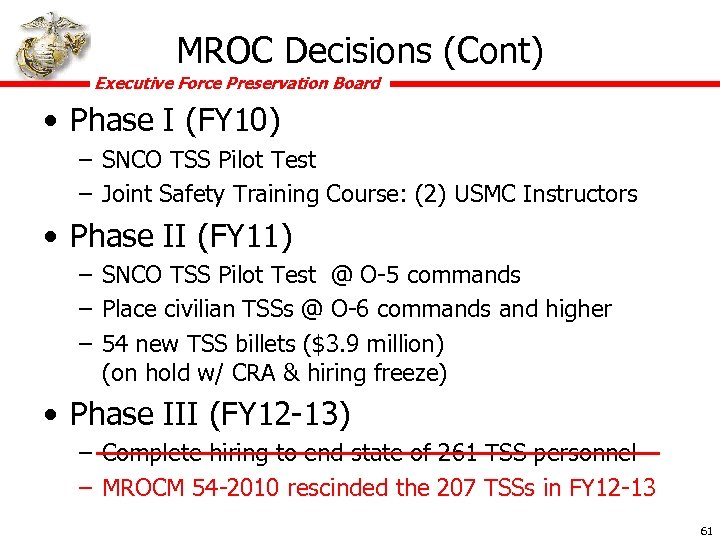
MROC Decisions (Cont) Executive Force Preservation Board • Phase I (FY 10) – SNCO TSS Pilot Test – Joint Safety Training Course: (2) USMC Instructors • Phase II (FY 11) – SNCO TSS Pilot Test @ O-5 commands – Place civilian TSSs @ O-6 commands and higher – 54 new TSS billets ($3. 9 million) (on hold w/ CRA & hiring freeze) • Phase III (FY 12 -13) – Complete hiring to end state of 261 TSS personnel – MROCM 54 -2010 rescinded the 207 TSSs in FY 12 -13 61
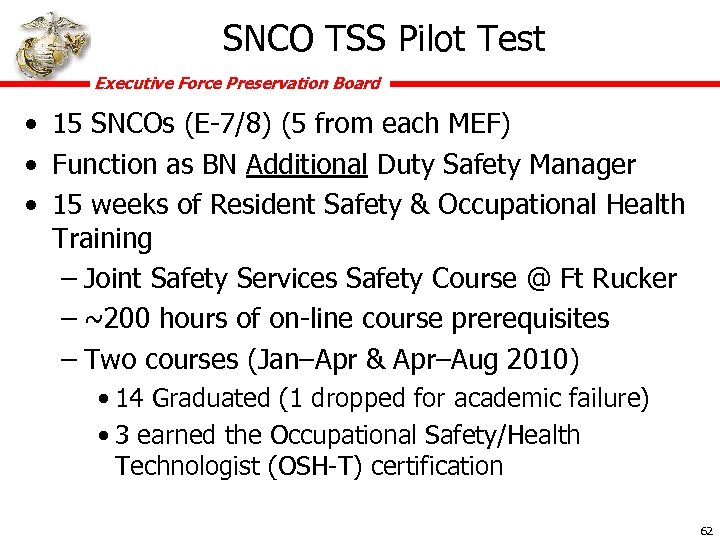
SNCO TSS Pilot Test Executive Force Preservation Board • 15 SNCOs (E-7/8) (5 from each MEF) • Function as BN Additional Duty Safety Manager • 15 weeks of Resident Safety & Occupational Health Training – Joint Safety Services Safety Course @ Ft Rucker – ~200 hours of on-line course prerequisites – Two courses (Jan–Apr & Apr–Aug 2010) • 14 Graduated (1 dropped for academic failure) • 3 earned the Occupational Safety/Health Technologist (OSH-T) certification 62
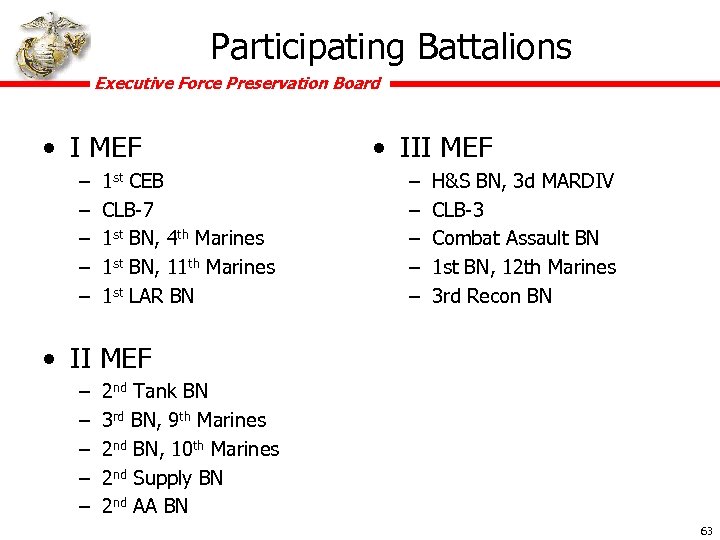
Participating Battalions Executive Force Preservation Board • I MEF – – – 1 st CEB CLB-7 1 st BN, 4 th Marines 1 st BN, 11 th Marines 1 st LAR BN • III MEF – – – H&S BN, 3 d MARDIV CLB-3 Combat Assault BN 1 st BN, 12 th Marines 3 rd Recon BN • II MEF – – – 2 nd Tank BN 3 rd BN, 9 th Marines 2 nd BN, 10 th Marines 2 nd Supply BN 2 nd AA BN 63
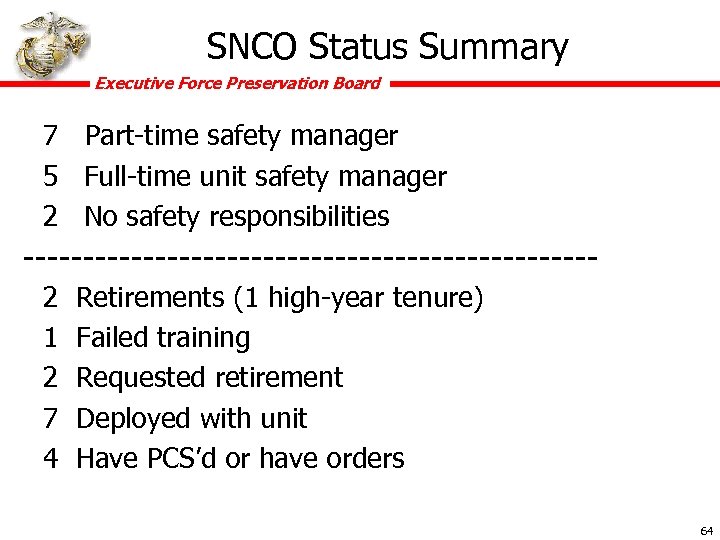
SNCO Status Summary Executive Force Preservation Board 7 Part-time safety manager 5 Full-time unit safety manager 2 No safety responsibilities 2 1 2 7 4 Retirements (1 high-year tenure) Failed training Requested retirement Deployed with unit Have PCS’d or have orders 64
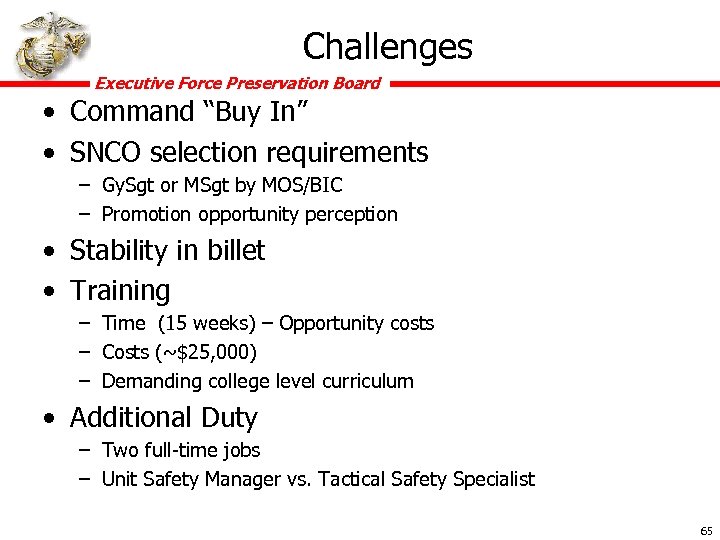
Challenges Executive Force Preservation Board • Command “Buy In” • SNCO selection requirements – Gy. Sgt or MSgt by MOS/BIC – Promotion opportunity perception • Stability in billet • Training – Time (15 weeks) – Opportunity costs – Costs (~$25, 000) – Demanding college level curriculum • Additional Duty – Two full-time jobs – Unit Safety Manager vs. Tactical Safety Specialist 65
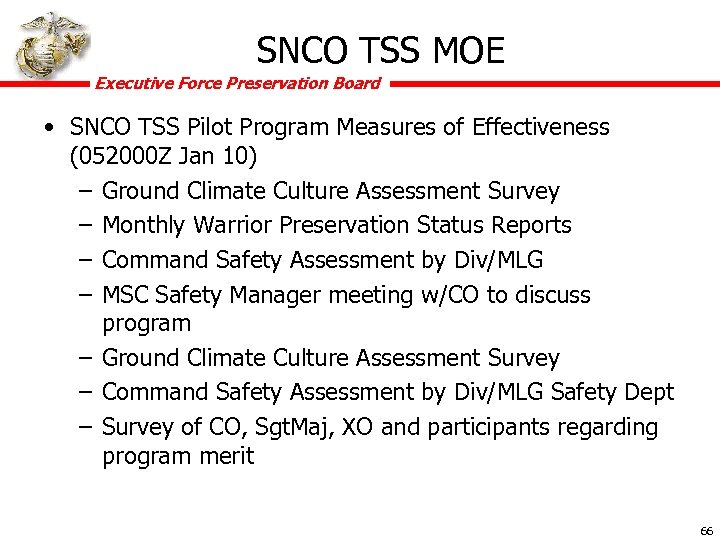
SNCO TSS MOE Executive Force Preservation Board • SNCO TSS Pilot Program Measures of Effectiveness (052000 Z Jan 10) – Ground Climate Culture Assessment Survey – Monthly Warrior Preservation Status Reports – Command Safety Assessment by Div/MLG – MSC Safety Manager meeting w/CO to discuss program – Ground Climate Culture Assessment Survey – Command Safety Assessment by Div/MLG Safety Dept – Survey of CO, Sgt. Maj, XO and participants regarding program merit 66
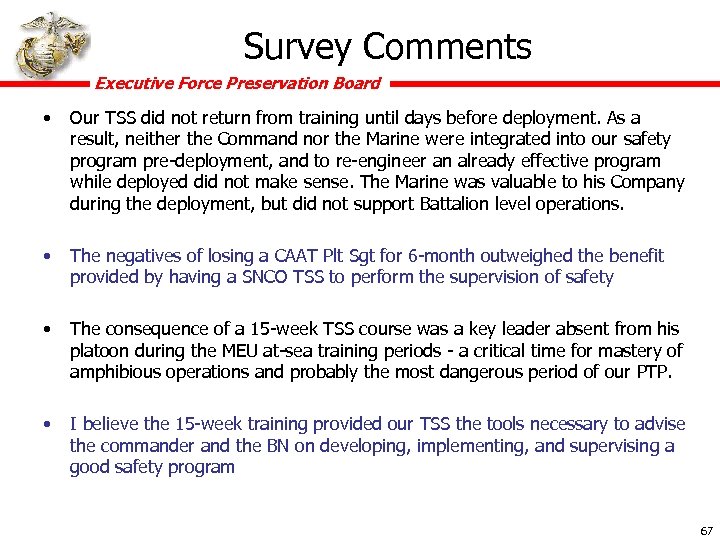
Survey Comments Executive Force Preservation Board • Our TSS did not return from training until days before deployment. As a result, neither the Command nor the Marine were integrated into our safety program pre-deployment, and to re-engineer an already effective program while deployed did not make sense. The Marine was valuable to his Company during the deployment, but did not support Battalion level operations. • The negatives of losing a CAAT Plt Sgt for 6 -month outweighed the benefit provided by having a SNCO TSS to perform the supervision of safety • The consequence of a 15 -week TSS course was a key leader absent from his platoon during the MEU at-sea training periods - a critical time for mastery of amphibious operations and probably the most dangerous period of our PTP. • I believe the 15 -week training provided our TSS the tools necessary to advise the commander and the BN on developing, implementing, and supervising a good safety program 67
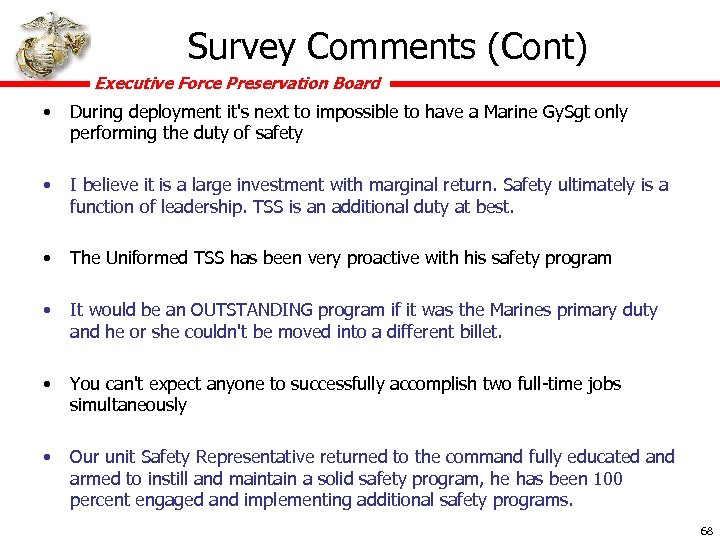
Survey Comments (Cont) Executive Force Preservation Board • During deployment it's next to impossible to have a Marine Gy. Sgt only performing the duty of safety • I believe it is a large investment with marginal return. Safety ultimately is a function of leadership. TSS is an additional duty at best. • The Uniformed TSS has been very proactive with his safety program • It would be an OUTSTANDING program if it was the Marines primary duty and he or she couldn't be moved into a different billet. • You can't expect anyone to successfully accomplish two full-time jobs simultaneously • Our unit Safety Representative returned to the command fully educated and armed to instill and maintain a solid safety program, he has been 100 percent engaged and implementing additional safety programs. 68
Way Ahead Executive Force Preservation Board • SNCO TSS Pilot Program has not been effective • Proposed Courses of Action – COA 1 Assign Additional Duty - Unit Safety Managers with improved Ground Safety for Marines instruction – COA 2 Continue with assignment of Collateral Duty (NCO/Company Grade) Unit Safety Managers – COA 3 Execute SNCO TSS Program as currently designed
COA 1 Executive Force Preservation Board Assign Additional Duty - Unit Safety Managers with improved Ground Safety for Marines instruction Pro • Higher level safety knowledge than 10 -day Ground Safety for Marines Course provides • Potential for increased command attention • Possible improved stability of billet Con • Manpower Management • ~ 6 -weeks away from unit • Insufficient school seat capacity • Curricula undeveloped and funding unidentified 70
COA 2 Executive Force Preservation Board Continue with assignment of Collateral Duty (NCO/Company Grade) Unit Safety Managers (Status Quo) Pro • 2 -weeks away from unit • Curriculum developed & funded by TECOM • Established program with sufficient school seat capacity Con • High turnover rate • Lacks mishap investigation training • Lower safety skills • Instability of billet • Often lacks command support 71
COA 3 Executive Force Preservation Board Execute SNCO TSS Pilot Program as tested Pro • Targets specific MOS/billets resulting in staff credibility and knowledge of unit METLs Con • Costs ~$25 K per student • 15 -weeks away from unit for train up • Competes with primary duty • Training capacity limited to ~50 students per year • Not required to employ as unit “safety specialist” 72
Recommendations Executive Force Preservation Board • Discontinue SNCO TSS Pilot Program • Select COA 1 (Assign Additional Duty - Unit Safety Managers with improved instruction) • Hire the civilian TSS billets authorized during 2011 for duty at O-6 commands IOT provide support to O-5 commands • Continue to provide the Joint Services Safety and Occupational Health Course on a “as available” basis to active duty and civilian Marines
Executive Force Preservation Board TSS Pilot Program Questions and Discussion 74
Executive Force Preservation Board Break
Executive Force Preservation Board Member Issues
Executive Force Preservation Board Performance Resiliency Program Maj. Gen Paul Lefebvre MARSOC
Executive Force Preservation Board Combat Stress Inoculation II MEF/Marine Forces Command NC State
Executive Force Preservation Board Rifle Range Pit Alarms MCI-East
Executive Force Preservation Board Safety Training Center of Excellence MARFORRES
Executive Force Preservation Board Executive Session
 Скачать презентацию Executive Force Preservation Board Welcome to the 24
3084d370d37b122d9c6aa5b8b12a6d86.ppt