


 Скачать презентацию Executive development in German Ministries Using the Federal
1de216ebd04abb417e5c9914dc470418.ppt
- Количество слайдов: 16
 Executive development in German Ministries Using the Federal Ministry of Labour and Social Affairs (BMAS) as an example Joint HRWG/ IPSG meeting 15 th and 16 th of October 2012 Grand Resort Hotel, Limassol Doreen Molnár Federal Ministry of Labour and Social Affairs Personnel Development
 Agenda • Executive development – why? • Executive development – where is it headed for? • Executive development – with which content? • Executive development – on what basis? • Executive development – where: centralized or decentralized? • Executive development – how? • Pillars of executive development in the Federal Ministry of Labour and Social Affairs • Conclusion
 Executive development – why? • Permanent challenges: - citizens expect policy reforms to be implemented effectively - employees expect attractive working conditions • Notion of leadership has changed: - competent execution of ministerial tasks - employee motivation and involvement • Efficiency of public administrations is determined by the engagement and competence of their employees Leadership is essential for the success of the organisation as a whole need to further intensify ongoing training of top and junior public managers Basis: the modernization and further training agreement of October 2007 between the Federal Government and the unions Requirement to commit to lifelong learning and continuous training.
 Executive development – why? German federal administration will confront challenges in the coming years: • budget consolidation and personnel reduction by ca. 10, 000 posts by 2014; • growing density and complexity of tasks; • increasing Europeanization and internationalisation; • demographic change with an ageing and more diverse workforce; • changing values and expectations towards employers (work-life balance, reconciliation of family/care responsibilities and work, mobile work); • childcare or elder care leave arrangements for employees; • more competition for skilled employees and junior personnel; • communication without boundaries and digitisation • . . .
 Executive development – where is it headed for? Future-oriented administration needs managers who: • • • contribute to strategic policy development; manage public authorities/organisational units; focus on objectives and results; confront the problems of demographic change; prevent health problems such as burn-out or psychosomatic illness; reconcile work & private life; support processes of change; react to the concerns of citizens/companies: competent, prompt and reliable; work in a process-oriented and networked manner; facilitate cooperation across organisations and institutions; work in national and international networks; use comprehensive information and knowledge management. executive development must focus on strengthening all-round skills.
 Executive development – with which content? What skills and abilities are essential for managers at the higher and highest levels of interface between administration and policy-making? • Leadership and management skills: determine employees' job satisfaction, willingness to perform, motivation • Provide meaning: be able to provide a clear sense of direction • must be aware of the global context and be able to adopt a holistic view • networkers and team builders: bring together the best people, inspire them to work toward a common goal and engage their team by a cooperative style of leadership • high level of social intelligence and social competence: self-reflection, self-responsibility desire to make things happen, willingness of change • political expertise and determination • have fun and enjoy their work.
 Executive development – on what basis? …is based on job profiles and leadership principles: • Job profiles for public managers: - were prepared by an expert group of several ministries (2006) - relate to different leadership functions in ministries (director-general, director and head of division) - are derived from strategic goals and typical leadership situations - include standardised tasks (for all ministries) - specify the required skills and abilities - basis for recruitment, executive development, performance evaluation. • Leadership principles: - are the expression of a shared understanding of leadership - BMAS: Principles of Leadership and Cooperation - were developed by staff, branch and top public managers (2008) - applicable across DGs and hierarchical levels.
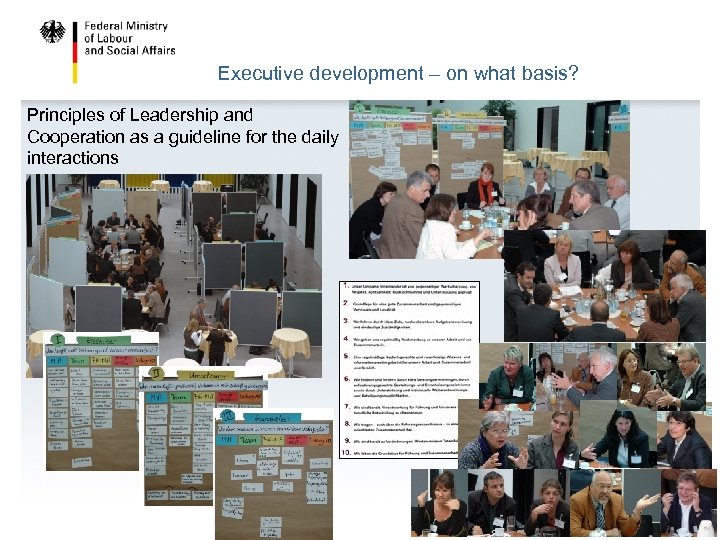 Executive development – on what basis? Principles of Leadership and Cooperation as a guideline for the daily interactions
 Executive development – where: centralised or decentralised? In Germany, executive development: • is the responsibility of each Ministry due to the Autonomy of all federal Ministries • is organised in a decentralised way. • a central element of personnel development • considers different knowledge basis and experience of executives • distinguishes between junior executives, executives with longer management experience and top public managers • strengths executives' professional skills, leadership competence, strategic management skills. BMAS: concept for Human Resources and Organisational Development • areas of action include leadership and cooperation • executive development: central element of this action field
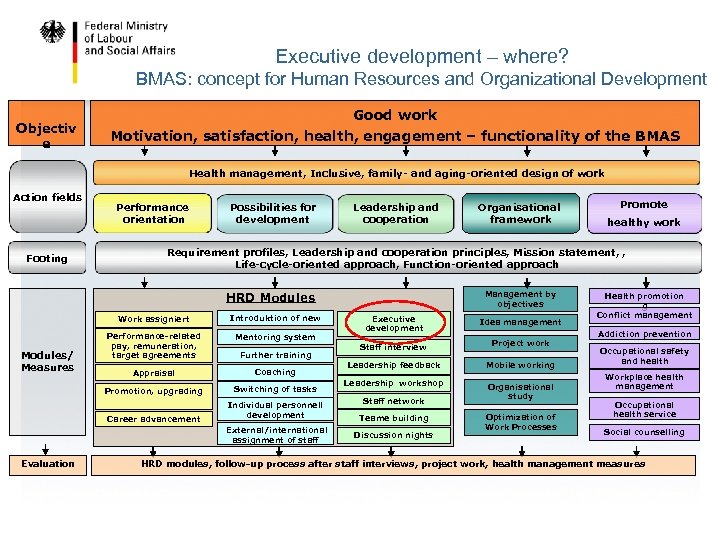 Executive development – where? BMAS: concept for Human Resources and Organizational Development Objectiv e Good work Motivation, satisfaction, health, engagement – functionality of the BMAS Health management, Inclusive, family- and aging-oriented design of work Action fields Footing Performance orientation Possibilities for development Leadership and cooperation Work assigniert Introduktion of new Performance-related pay, remuneration, target agreements Mentoring system Appraisal Further training Coaching Promotion, upgrading Switching of tasks Career advancement Individual personnell development External/international assignment of staff Evaluation Promote healthy work Requirement profiles, Leadership and cooperation principles, Mission statement, , Life-cycle-oriented approach, Function-oriented approach Management by objectives HRD Modules/ Measures Organisational framework Executive development Idea management Staff interview Project work Leadership feedback Mobile working Leadership workshop Organisational study Staff network Teame building Discussion nights Optimization of Work Processes Health promotion g Conflict management Addiction prevention Occupational safety and health Workplace health management Occupational health service Social counselling HRD modules, follow-up process after staff interviews, project work, health management measures
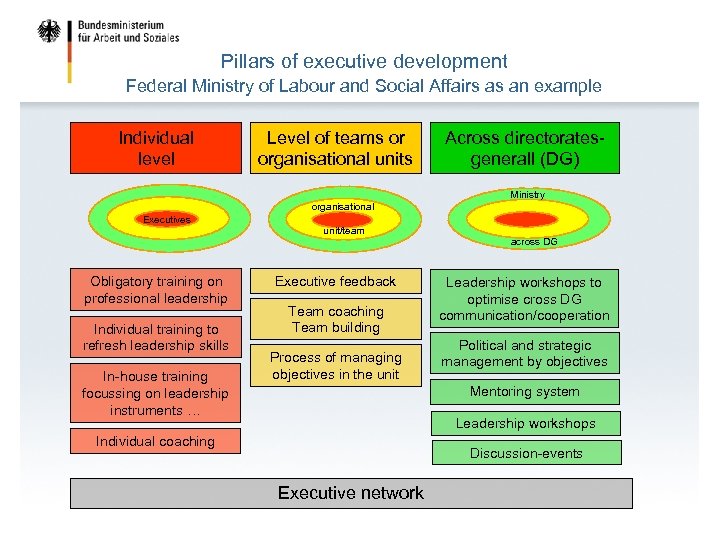 Pillars of executive development Federal Ministry of Labour and Social Affairs as an example Individual level Level of teams or organisational units Across directoratesgenerall (DG) Ministry organisational Executives Obligatory training on professional leadership Individual training to refresh leadership skills In-house training focussing on leadership instruments … unit/team Executive feedback Team coaching Team building Process of managing objectives in the unit across DG Leadership workshops to optimise cross DG communication/cooperation Political and strategic management by objectives Mentoring system Leadership workshops Individual coaching Discussion-events Executive network
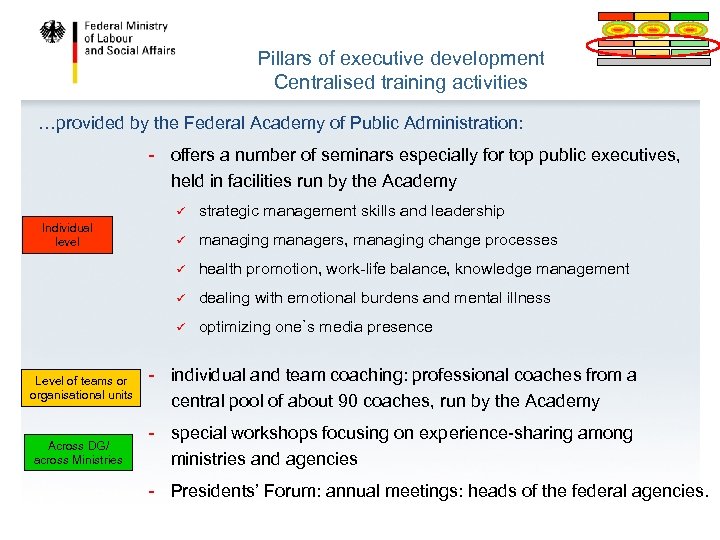 Pillars of executive development Centralised training activities …provided by the Federal Academy of Public Administration: - offers a number of seminars especially for top public executives, held in facilities run by the Academy ü health promotion, work-life balance, knowledge management dealing with emotional burdens and mental illness ü Across DG/ across Ministries managing managers, managing change processes ü Level of teams or organisational units ü ü Individual level strategic management skills and leadership optimizing one`s media presence - individual and team coaching: professional coaches from a central pool of about 90 coaches, run by the Academy - special workshops focusing on experience-sharing among ministries and agencies - Presidents’ Forum: annual meetings: heads of the federal agencies.
 Pillars of executive development Decentralised training activities …are gaining increasing importance: - in-house training are organised by the Ministries themselves § Across DG/ Level of Ministry address aspects of particular importance to the respective DG/organisation § promote exchange and networking among the executives § Individual level encourage collective learning, contributing to organisational development. - in-house training - taking in account the specific needs of a ministry - are developed and conducted by: § the Federal Academy or private training providers - at team level and across DGs: • • Level of teams or organisational units Across DG/ Ministry using of services and support of private providers includes support/moderation to: ü facilitate the process of management by objectives, ü conduct executive feedback, ü deal with specific leadership topics, ü facilitate leadership workshops to optimise cross DG communication/cooperation.
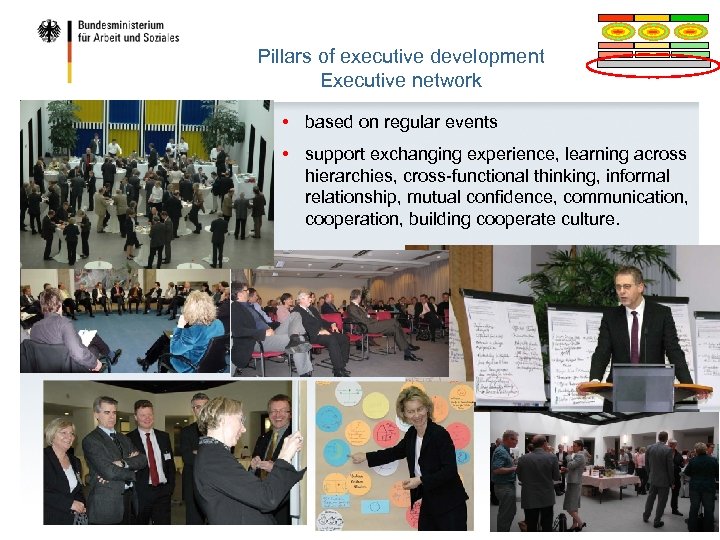 Pillars of executive development Executive network • based on regular events • support exchanging experience, learning across hierarchies, cross-functional thinking, informal relationship, mutual confidence, communication, cooperation, building cooperate culture.
 Executive development - Conclusion • continuous training for all executives including state secretaries Leadership must be learned! Pillars on executive development • measures on individual level - • develop the individual skills and competencies executives need to deal with daily tasks and challenges of leadership measures on group and organizational level and executive network: - enlarge the scope of collective learning processes - reinforce organizational culture of trusting, efficient cooperation and cooperative leadership process is more sustainable, it seeks out, tests and consolidates approaches for change, for upgrading executives’ own abilities and for keeping long-term friction losses to a minimum Good leadership and cooperation cannot be prescribed, they are the outcome of a development process.
 For further questions …concerning the Federal Ministry of Labour and Social Affairs: www. bmas. de …concerning executive development in German Ministries: Doreen Molnár Federal Ministry of Labour and Social Affairs Za 1 - Personnel Development Wilhelmstraße 49, D-10117 Berlin, Germany Telephone: 0049 3018 527 3671 E-Mail: doreen. molnar@bmas. bund. de - 16 -