 Скачать презентацию Executive Branch Unit 4 Part II Executive Branch
2f8b2c934ad34923a0212f9b79252d40.ppt
- Количество слайдов: 49



Executive Branch Unit 4, Part II: Executive Branch 35 -45%
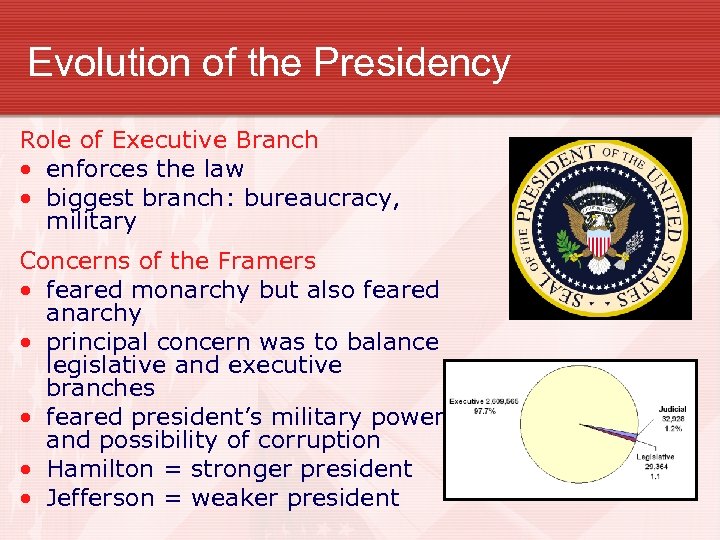
Evolution of the Presidency Role of Executive Branch • enforces the law • biggest branch: bureaucracy, military Concerns of the Framers • feared monarchy but also feared anarchy • principal concern was to balance legislative and executive branches • feared president’s military powers and possibility of corruption • Hamilton = stronger president • Jefferson = weaker president
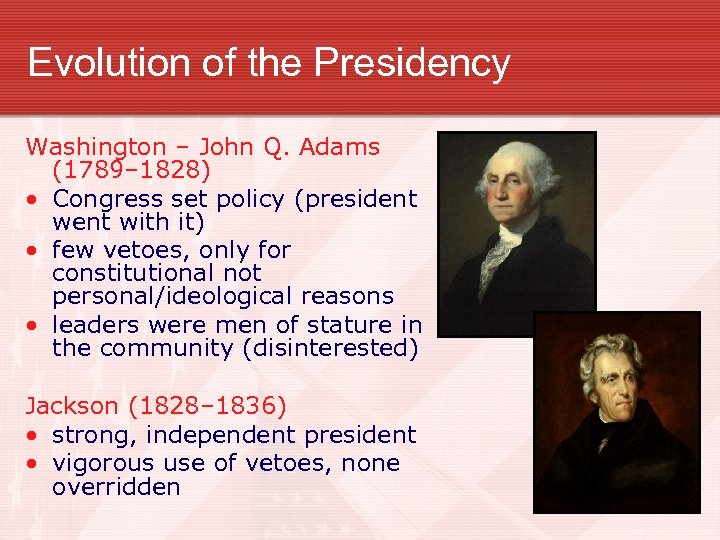
Evolution of the Presidency Washington – John Q. Adams (1789– 1828) • Congress set policy (president with it) • few vetoes, only for constitutional not personal/ideological reasons • leaders were men of stature in the community (disinterested) Jackson (1828– 1836) • strong, independent president • vigorous use of vetoes, none overridden
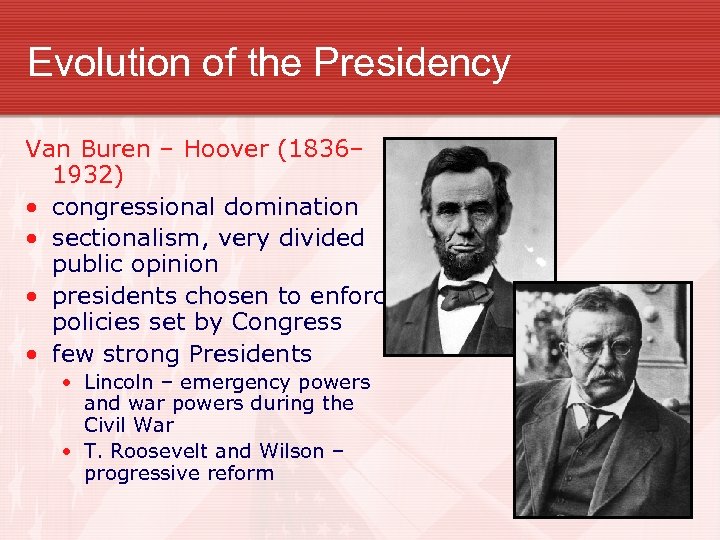
Evolution of the Presidency Van Buren – Hoover (1836– 1932) • congressional domination • sectionalism, very divided public opinion • presidents chosen to enforce policies set by Congress • few strong Presidents • Lincoln – emergency powers and war powers during the Civil War • T. Roosevelt and Wilson – progressive reform
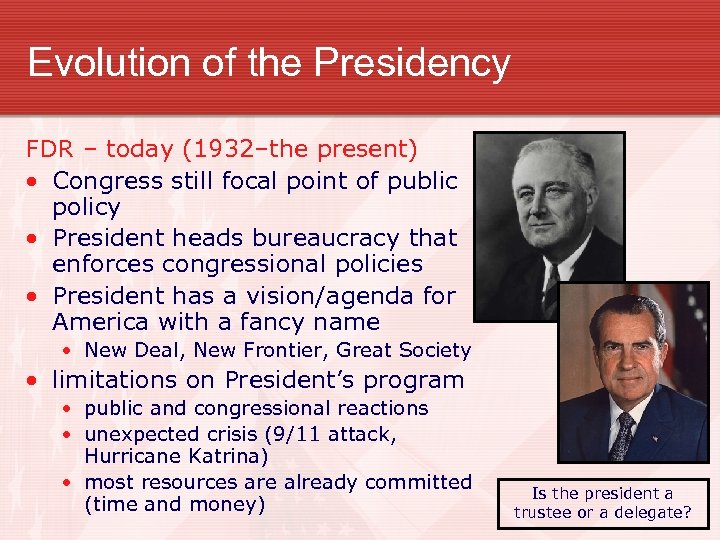
Evolution of the Presidency FDR – today (1932–the present) • Congress still focal point of public policy • President heads bureaucracy that enforces congressional policies • President has a vision/agenda for America with a fancy name • New Deal, New Frontier, Great Society • limitations on President’s program • public and congressional reactions • unexpected crisis (9/11 attack, Hurricane Katrina) • most resources are already committed (time and money) Is the president a trustee or a delegate?
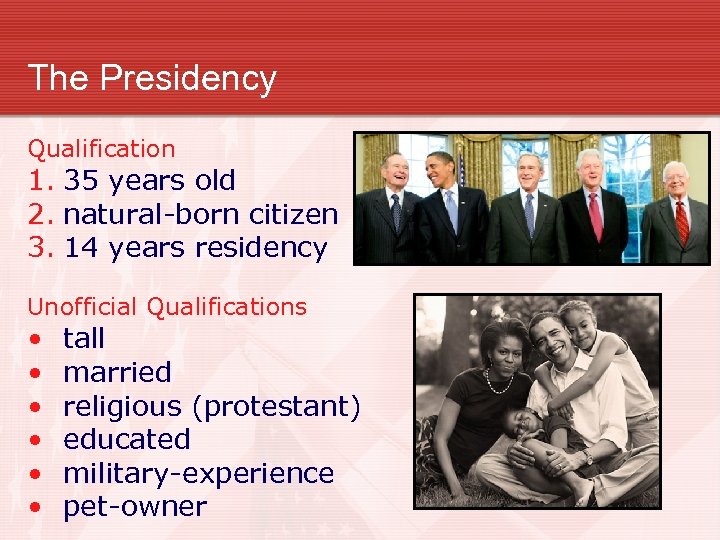
The Presidency Qualification 1. 35 years old 2. natural-born citizen 3. 14 years residency Unofficial Qualifications • • • tall married religious (protestant) educated military-experience pet-owner
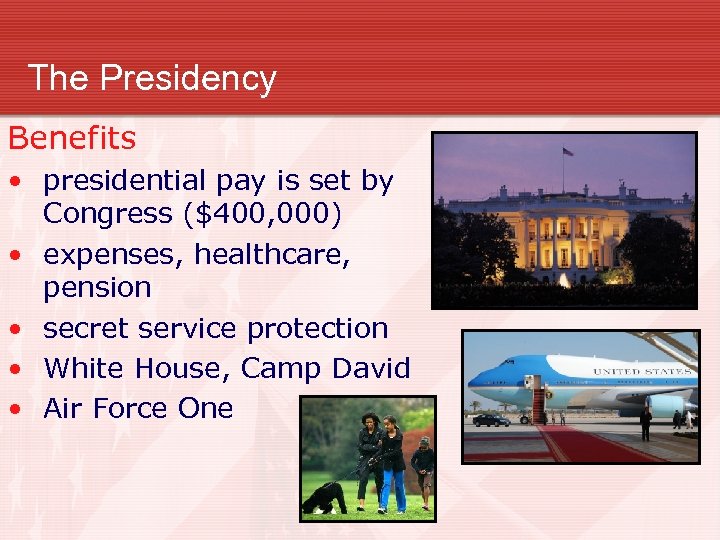
The Presidency Benefits • presidential pay is set by Congress ($400, 000) • expenses, healthcare, pension • secret service protection • White House, Camp David • Air Force One
The Presidency Term of Office • 4 years picked as compromise – not too long or too short • Washington established two-term tradition
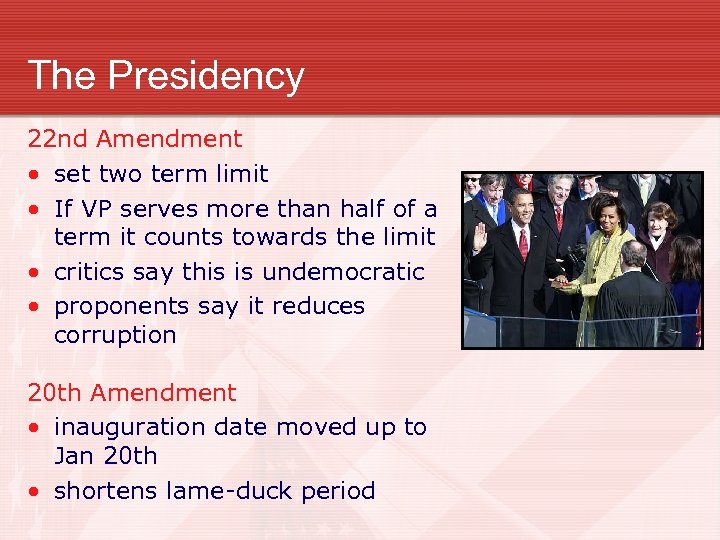
The Presidency 22 nd Amendment • set two term limit • If VP serves more than half of a term it counts towards the limit • critics say this is undemocratic • proponents say it reduces corruption 20 th Amendment • inauguration date moved up to Jan 20 th • shortens lame-duck period
The Presidency Presidential Duties • failure in one area potentially means failure as president • • chief of state chief executive chief administrator chief legislator chief diplomat commander in chief citizen party chief • in general, Democrats stronger in domestic policy and Republicans in foreign policy
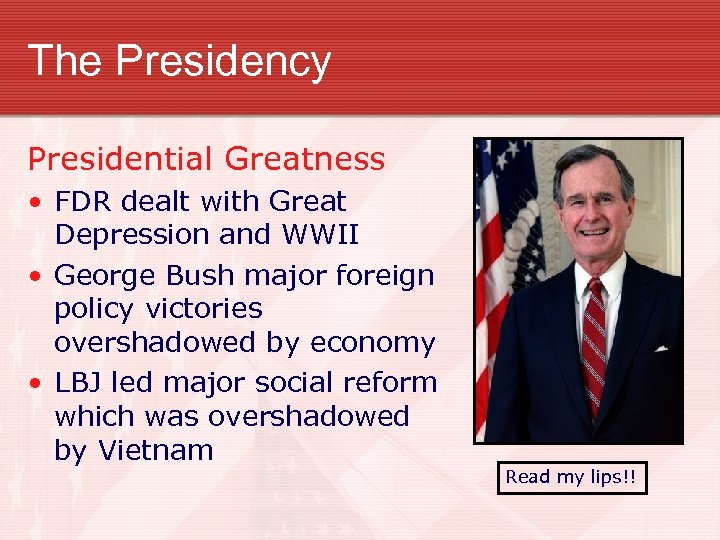
The Presidency Presidential Greatness • FDR dealt with Great Depression and WWII • George Bush major foreign policy victories overshadowed by economy • LBJ led major social reform which was overshadowed by Vietnam Read my lips!!
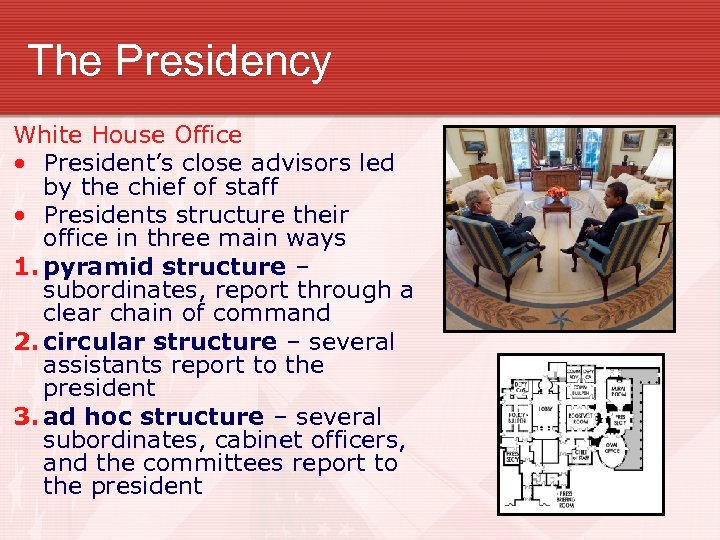
The Presidency White House Office • President’s close advisors led by the chief of staff • Presidents structure their office in three main ways 1. pyramid structure – subordinates, report through a clear chain of command 2. circular structure – several assistants report to the president 3. ad hoc structure – several subordinates, cabinet officers, and the committees report to the president
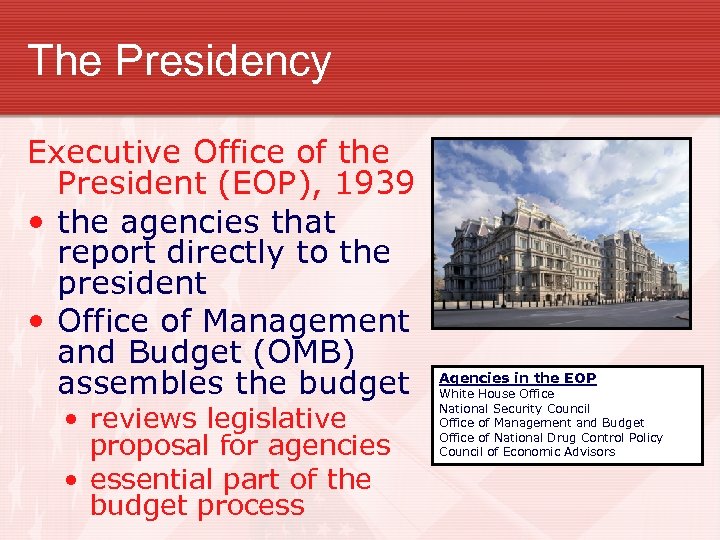
The Presidency Executive Office of the President (EOP), 1939 • the agencies that report directly to the president • Office of Management and Budget (OMB) assembles the budget • reviews legislative proposal for agencies • essential part of the budget process Agencies in the EOP White House Office National Security Council Office of Management and Budget Office of National Drug Control Policy Council of Economic Advisors
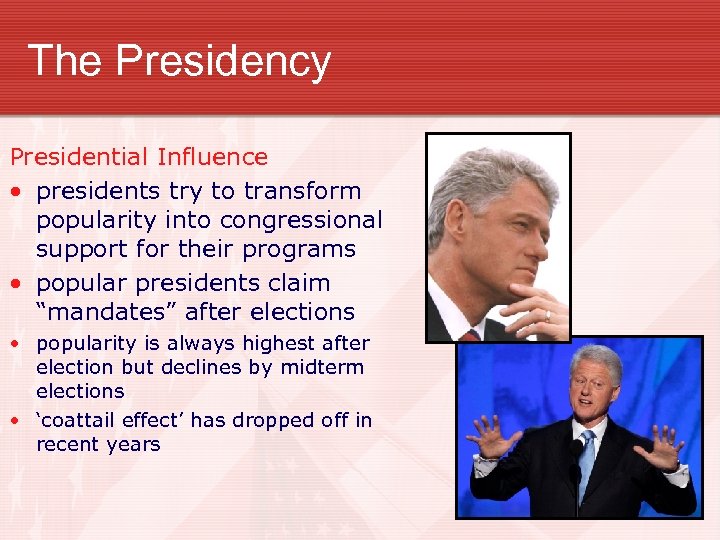
The Presidency Presidential Influence • presidents try to transform popularity into congressional support for their programs • popular presidents claim “mandates” after elections • popularity is always highest after election but declines by midterm elections • ‘coattail effect’ has dropped off in recent years
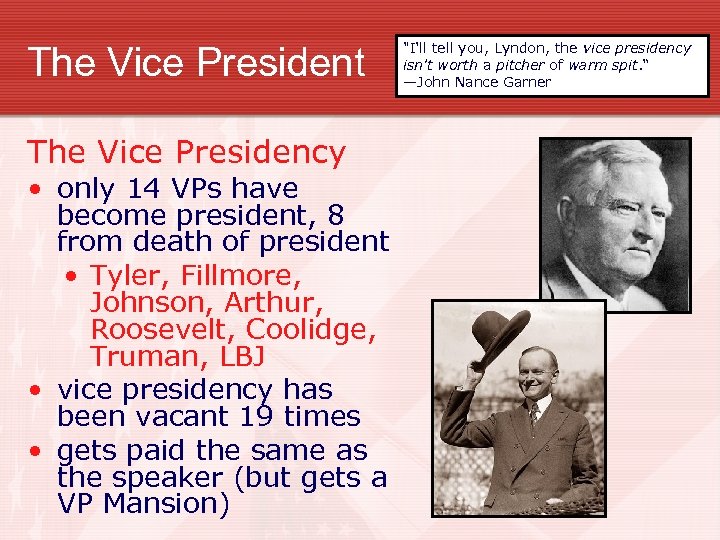
The Vice President The Vice Presidency • only 14 VPs have become president, 8 from death of president • Tyler, Fillmore, Johnson, Arthur, Roosevelt, Coolidge, Truman, LBJ • vice presidency has been vacant 19 times • gets paid the same as the speaker (but gets a VP Mansion) "I'll tell you, Lyndon, the vice presidency isn't worth a pitcher of warm spit. “ —John Nance Garner
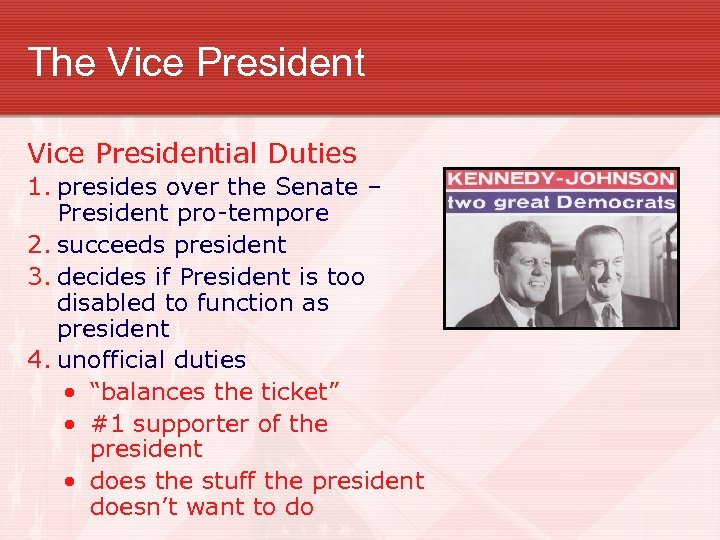
The Vice Presidential Duties 1. presides over the Senate – President pro-tempore 2. succeeds president 3. decides if President is too disabled to function as president 4. unofficial duties • “balances the ticket” • #1 supporter of the president • does the stuff the president doesn’t want to do
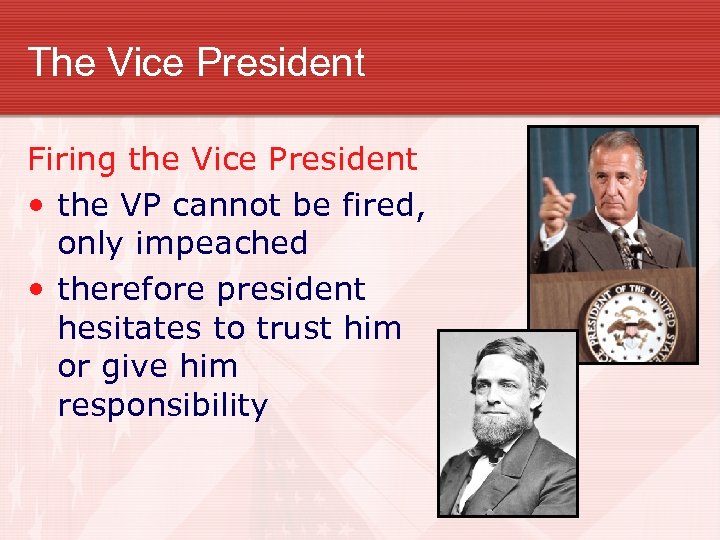
The Vice President Firing the Vice President • the VP cannot be fired, only impeached • therefore president hesitates to trust him or give him responsibility
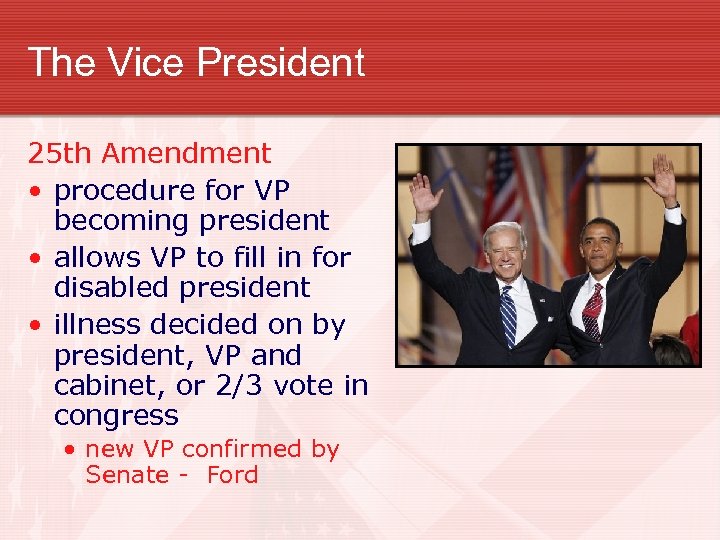
The Vice President 25 th Amendment • procedure for VP becoming president • allows VP to fill in for disabled president • illness decided on by president, VP and cabinet, or 2/3 vote in congress • new VP confirmed by Senate - Ford
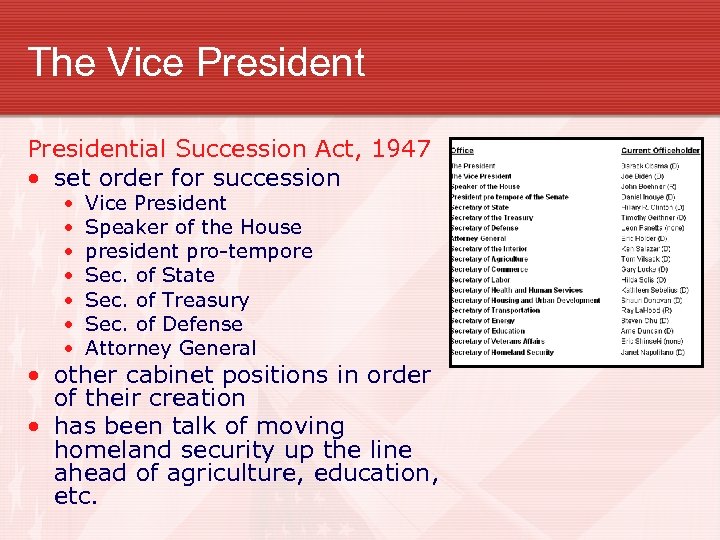
The Vice Presidential Succession Act, 1947 • set order for succession • • Vice President Speaker of the House president pro-tempore Sec. of State Sec. of Treasury Sec. of Defense Attorney General • other cabinet positions in order of their creation • has been talk of moving homeland security up the line ahead of agriculture, education, etc.
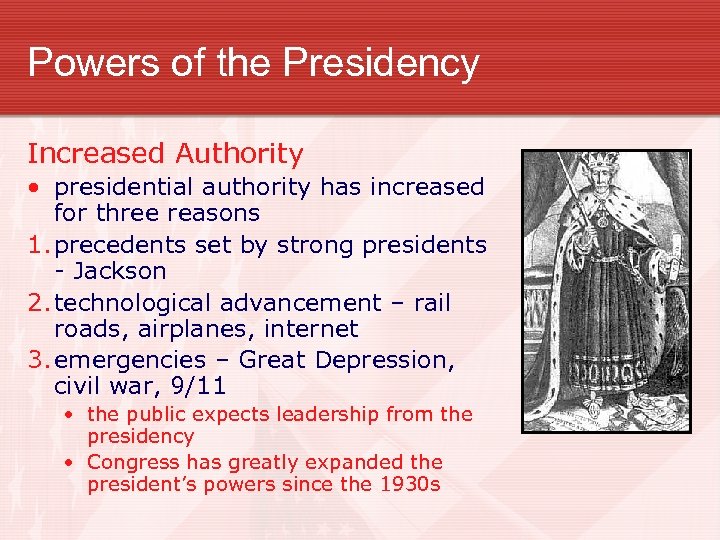
Powers of the Presidency Increased Authority • presidential authority has increased for three reasons 1. precedents set by strong presidents - Jackson 2. technological advancement – rail roads, airplanes, internet 3. emergencies – Great Depression, civil war, 9/11 • the public expects leadership from the presidency • Congress has greatly expanded the president’s powers since the 1930 s
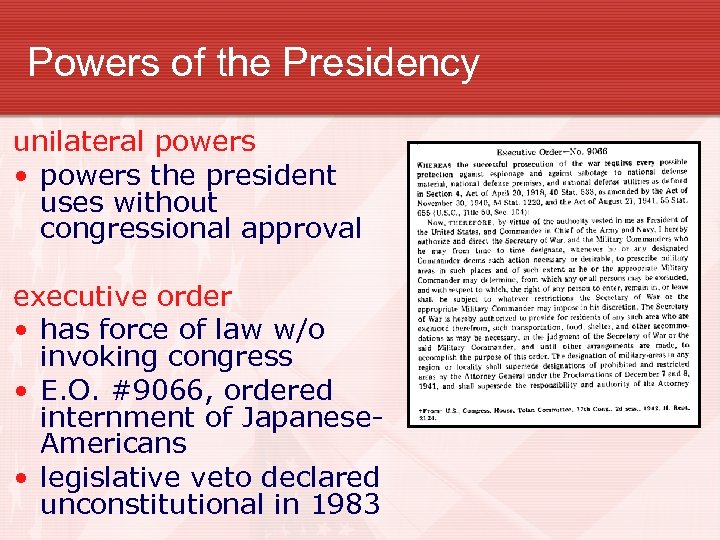
Powers of the Presidency unilateral powers • powers the president uses without congressional approval executive order • has force of law w/o invoking congress • E. O. #9066, ordered internment of Japanese. Americans • legislative veto declared unconstitutional in 1983
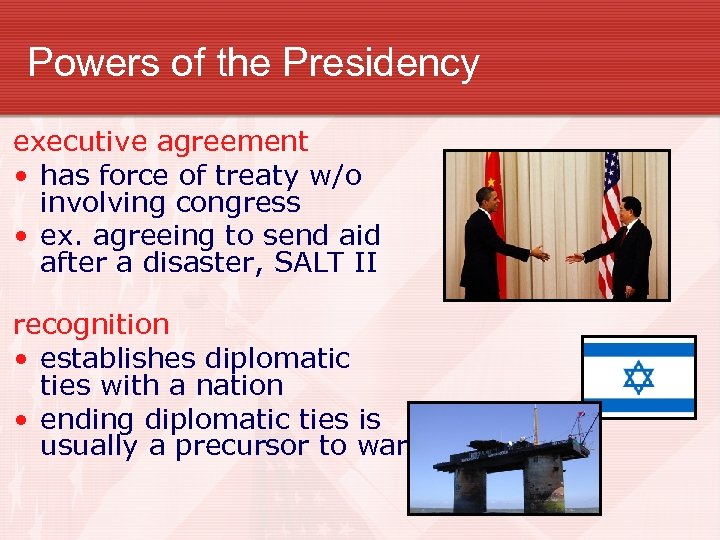
Powers of the Presidency executive agreement • has force of treaty w/o involving congress • ex. agreeing to send aid after a disaster, SALT II recognition • establishes diplomatic ties with a nation • ending diplomatic ties is usually a precursor to war
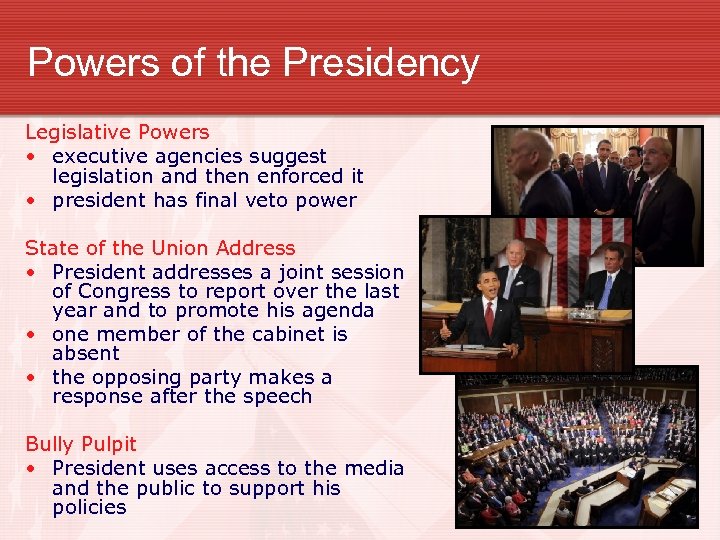
Powers of the Presidency Legislative Powers • executive agencies suggest legislation and then enforced it • president has final veto power State of the Union Address • President addresses a joint session of Congress to report over the last year and to promote his agenda • one member of the cabinet is absent • the opposing party makes a response after the speech Bully Pulpit • President uses access to the media and the public to support his policies
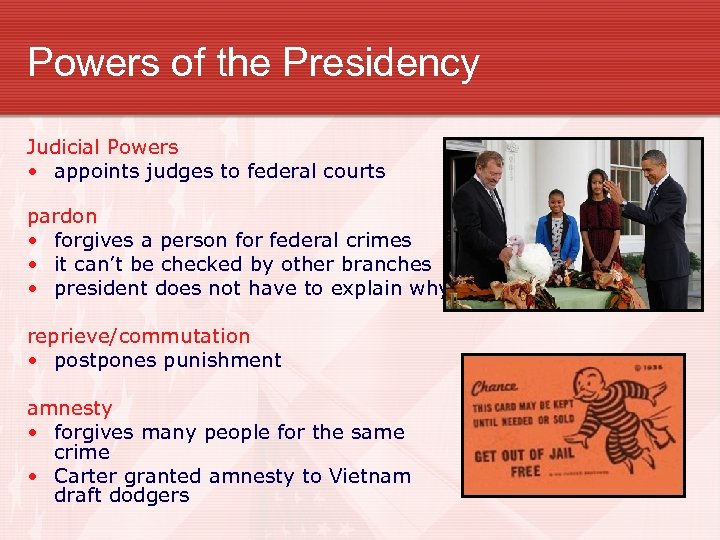
Powers of the Presidency Judicial Powers • appoints judges to federal courts pardon • forgives a person for federal crimes • it can’t be checked by other branches • president does not have to explain why reprieve/commutation • postpones punishment amnesty • forgives many people for the same crime • Carter granted amnesty to Vietnam draft dodgers
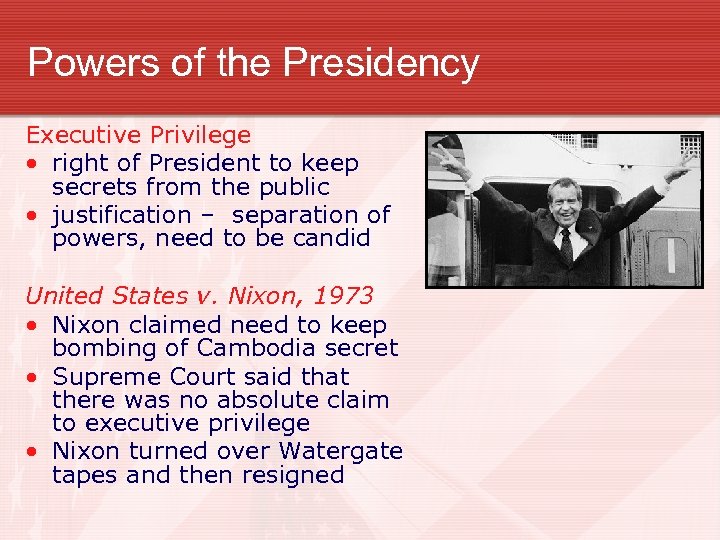
Powers of the Presidency Executive Privilege • right of President to keep secrets from the public • justification – separation of powers, need to be candid United States v. Nixon, 1973 • Nixon claimed need to keep bombing of Cambodia secret • Supreme Court said that there was no absolute claim to executive privilege • Nixon turned over Watergate tapes and then resigned
Short History of Bureaucracy in America 1861– 1901: laissez faire • patronage (spoils system) encouraged party loyalty and turnover • states’ rights made national policy difficult • the Civil War created demand for more federal oversight • industrialization required more regulation of interstate commerce • corruption within the system was evident
Short History of Bureaucracy in America 1920 s-1960 s: government activism • with income tax, came more bureaucracy • huge increase in the number of government employees • public supported more social programs and a larger military
Short History of Bureaucracy in America 1970 s-present • modest increase in number of government employees • more social programs and a larger military • more government contracts with private businesses • more discretionary authority • the ability to choose courses of action and to make policies not set out in the statutory law • subsidies • grant-in-aid programs to state and local groups • creating and enforcing regulations
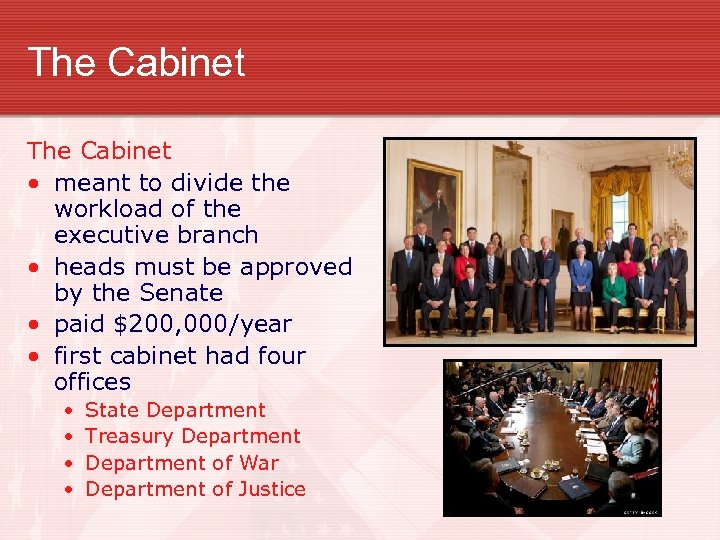
The Cabinet • meant to divide the workload of the executive branch • heads must be approved by the Senate • paid $200, 000/year • first cabinet had four offices • • State Department Treasury Department of War Department of Justice
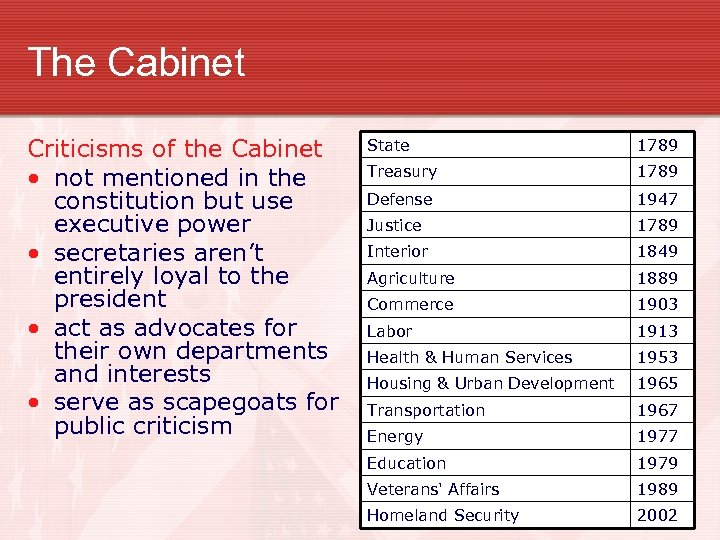
The Cabinet Criticisms of the Cabinet • not mentioned in the constitution but use executive power • secretaries aren’t entirely loyal to the president • act as advocates for their own departments and interests • serve as scapegoats for public criticism State 1789 Treasury 1789 Defense 1947 Justice 1789 Interior 1849 Agriculture 1889 Commerce 1903 Labor 1913 Health & Human Services 1953 Housing & Urban Development 1965 Transportation 1967 Energy 1977 Education 1979 Veterans' Affairs 1989 Homeland Security 2002
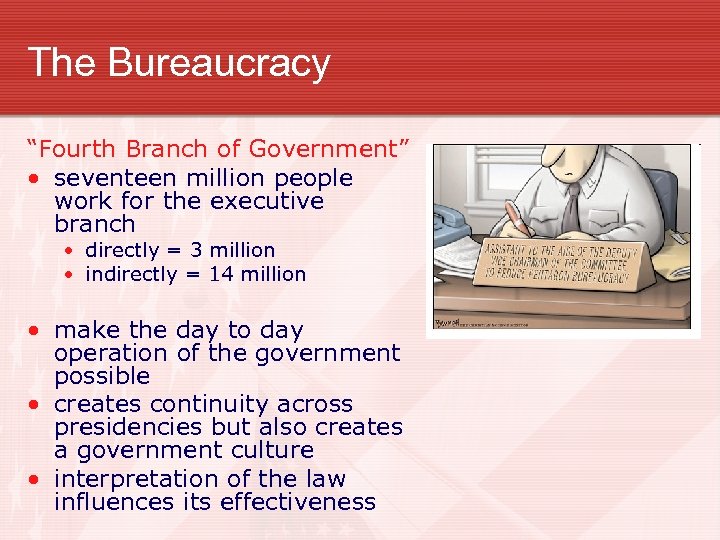
The Bureaucracy “Fourth Branch of Government” • seventeen million people work for the executive branch • directly = 3 million • indirectly = 14 million • make the day to day operation of the government possible • creates continuity across presidencies but also creates a government culture • interpretation of the law influences its effectiveness
The Bureaucracy Social Class, Education, Ideology • appointees match ideology of the president • rank and file represent society • somewhat more liberal/conservative • activist agencies more liberal – EPA, FDA, FTC • traditional agencies more conservative – commerce, Treasury, Agric • much stronger opinions about role of government • much more likely to vote
The Bureaucracy Unique Aspects of American Bureaucracy 1. political oversight is shared by the executive and legislative branches • Presidential Oversight • appoints leaders who must be approved by the Senate • agencies are part of the executive branch • Congressional Oversight • creates and authorizes agencies • appropriates money for programs • congressional investigation into officials and practices 2. fragmented government: federal agencies have to work with states and local government 3. adversarial political culture increases scrutiny
The Bureaucracy Executive Agencies • nearly 150 organizations lack cabinet status but work for the president • heads can be removed only “for cause” and serve a fixed term • may “retire” from public work and then work for the groups that they previously regulated • rivalries exist between agency heads and white house staff • provisional v. political appointees • President knows few appointees personally • however, most have previous federal experience
The Bureaucracy Independent Executive Agencies • lack cabinet-level status • quasi–legislative • fill in gaps and writing rules • quasi-judicial powers • rule enforcement and punish violators • • • EPA NASA Social Security Administration Federal Election Commission Office of Personnel Management
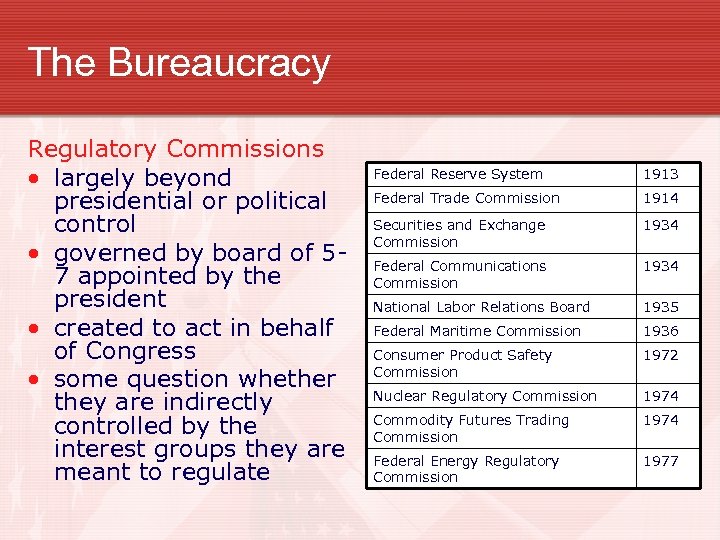
The Bureaucracy Regulatory Commissions • largely beyond presidential or political control • governed by board of 57 appointed by the president • created to act in behalf of Congress • some question whether they are indirectly controlled by the interest groups they are meant to regulate Federal Reserve System 1913 Federal Trade Commission 1914 Securities and Exchange Commission 1934 Federal Communications Commission 1934 National Labor Relations Board 1935 Federal Maritime Commission 1936 Consumer Product Safety Commission 1972 Nuclear Regulatory Commission 1974 Commodity Futures Trading Commission 1974 Federal Energy Regulatory Commission 1977
The Bureaucracy Government Corporations • operate as businesses • stock is owned by the government • • FDIC Postal Service TVA Amtrak
Criticisms of the Bureaucracy 1. Red Tape • complex, conflicting rules that slowdown completion of a project • FAFSA forms or building permits 2. Conflict • agencies work against each other (EPA v. navy) 3. Duplication • two or more agencies seem to do the same thing • Intelligence gathering before 9/11
Criticisms of the Bureaucracy 4. Imperialism • • tendency of agencies to grow in size and influence iron triangle effect – the stronger the agency gets the stronger the committee gets that oversees it 5. Waste • spending more money than is necessary to buy a product or service
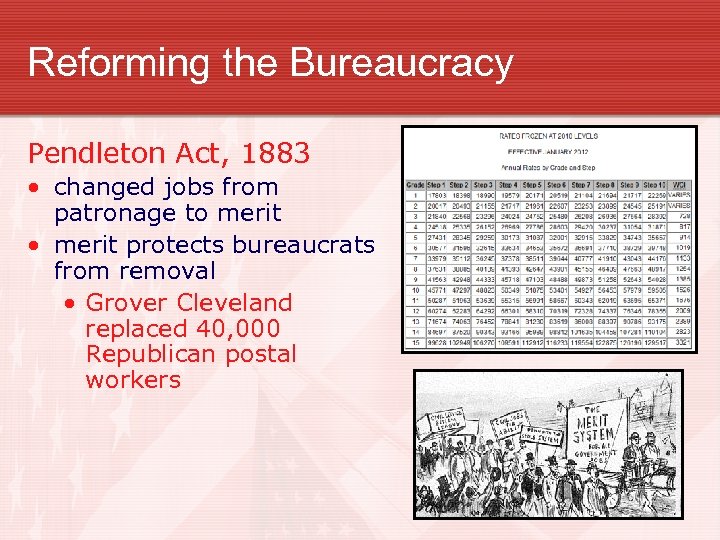
Reforming the Bureaucracy Pendleton Act, 1883 • changed jobs from patronage to merit • merit protects bureaucrats from removal • Grover Cleveland replaced 40, 000 Republican postal workers
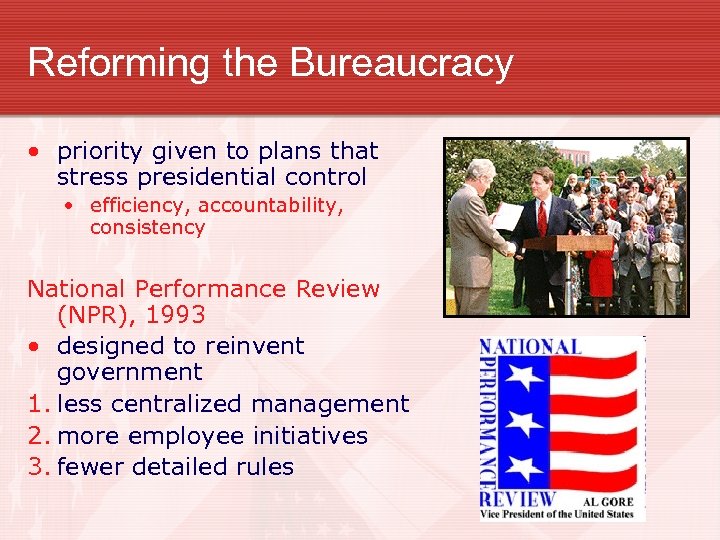
Reforming the Bureaucracy • priority given to plans that stress presidential control • efficiency, accountability, consistency National Performance Review (NPR), 1993 • designed to reinvent government 1. less centralized management 2. more employee initiatives 3. fewer detailed rules
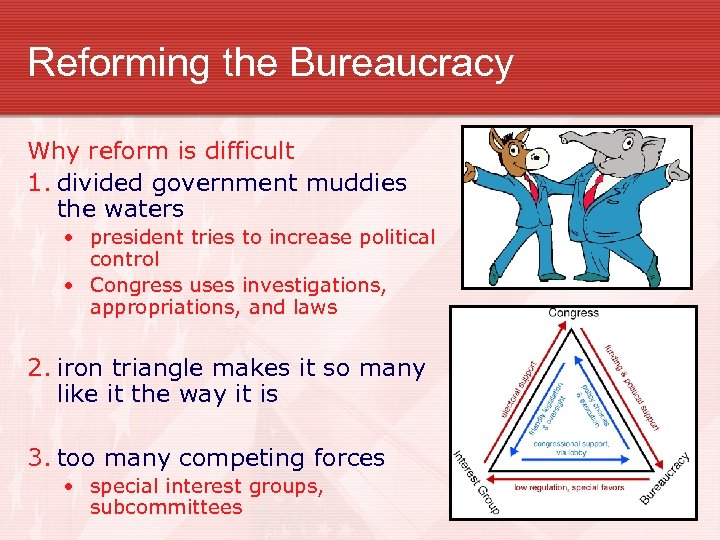
Reforming the Bureaucracy Why reform is difficult 1. divided government muddies the waters • president tries to increase political control • Congress uses investigations, appropriations, and laws 2. iron triangle makes it so many like it the way it is 3. too many competing forces • special interest groups, subcommittees
Recruitment and Retention Competitive Service • jobs based on written exam given by the OPM • only about 54% hired this way • down from 86% in 1952 1. one test can’t meet needs of all the agencies 2. professional needs outweigh test scores 3. pressure to diversify their personnel
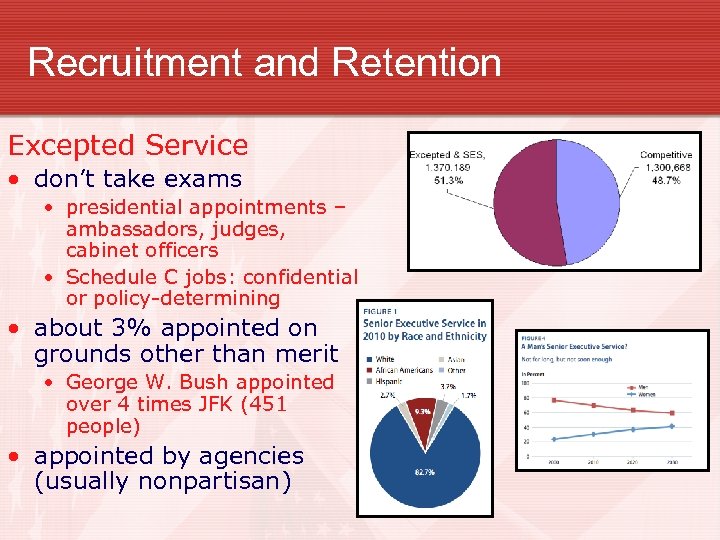
Recruitment and Retention Excepted Service • don’t take exams • presidential appointments – ambassadors, judges, cabinet officers • Schedule C jobs: confidential or policy-determining • about 3% appointed on grounds other than merit • George W. Bush appointed over 4 times JFK (451 people) • appointed by agencies (usually nonpartisan)
Recruitment and Retention Name-Request (buddy system) • job description tailored to fit the person • shortens search for personnel but makes close-knit groups
Recruitment and Retention Firing a Bureaucrat • almost impossible, informal discipline much easier than firing • makes workers more powerful than their bosses • 0. 1% of Federal workers get fired
Recruitment and Retention Civil Rights Reform Act, 1978 • created the senior Executive Service (SES) • in between appointees and rank and file workers • better pay but easier for president to fire bureaucrats
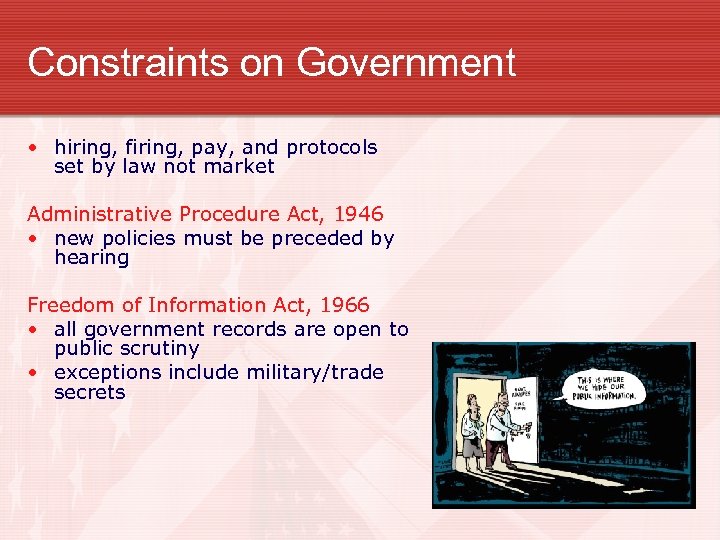
Constraints on Government • hiring, firing, pay, and protocols set by law not market Administrative Procedure Act, 1946 • new policies must be preceded by hearing Freedom of Information Act, 1966 • all government records are open to public scrutiny • exceptions include military/trade secrets
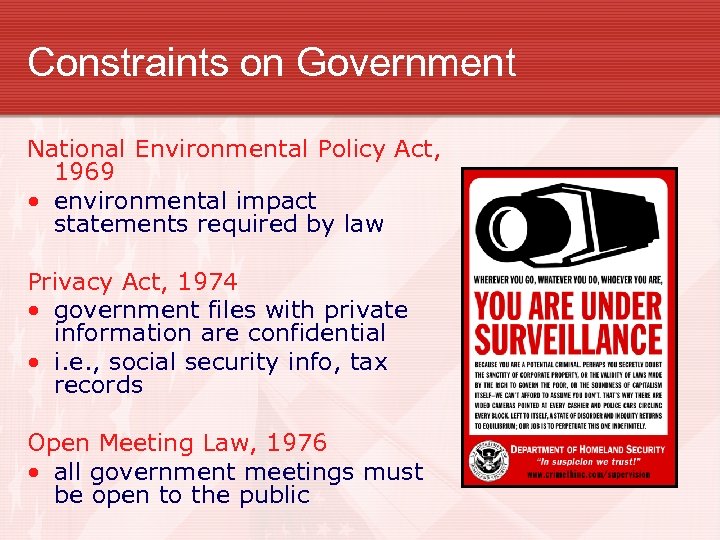
Constraints on Government National Environmental Policy Act, 1969 • environmental impact statements required by law Privacy Act, 1974 • government files with private information are confidential • i. e. , social security info, tax records Open Meeting Law, 1976 • all government meetings must be open to the public
Скачать презентацию Executive Branch Unit 4 Part II Executive Branch
2f8b2c934ad34923a0212f9b79252d40.ppt