


 Скачать презентацию Exchange Rate Systems Past Present and Future
bbcbac1d9813aa3f6511d5ac4a90958a.ppt
- Количество слайдов: 32
 Exchange Rate Systems Past, Present, and Future
 The Evolution of Money The evolution of the international financial structure is really more about the evolution of domestic monetary systems n “Money” is any commodity which satisfies the following: n n Medium of Exchange Store of Value Unit of Account
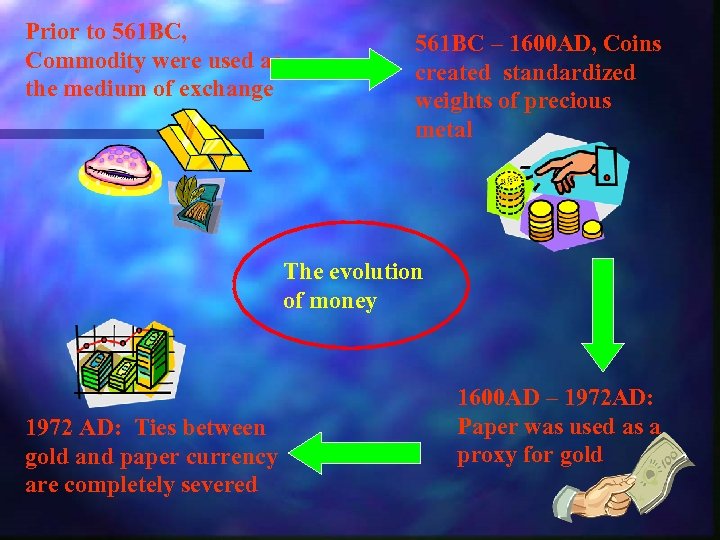 Prior to 561 BC, Commodity were used as the medium of exchange 561 BC – 1600 AD, Coins created standardized weights of precious metal The evolution of money 1972 AD: Ties between gold and paper currency are completely severed 1600 AD – 1972 AD: Paper was used as a proxy for gold
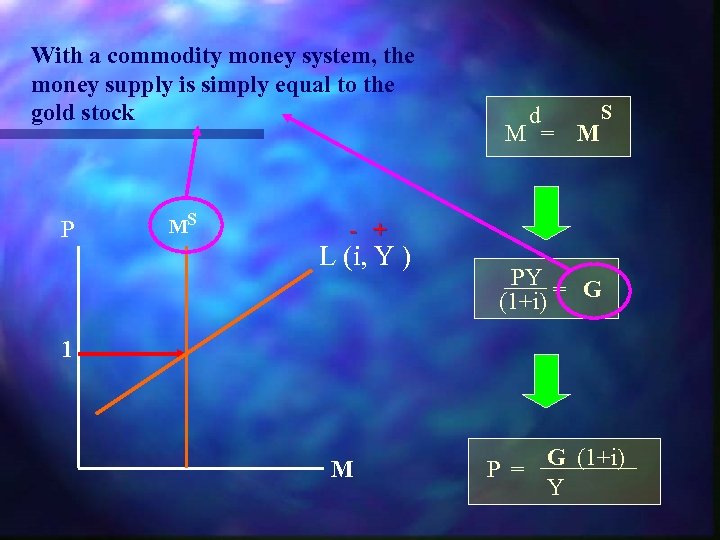 With a commodity money system, the money supply is simply equal to the gold stock P MS d M = M S - + L (i, Y ) PY = G (1+i) 1 M P = G (1+i) Y
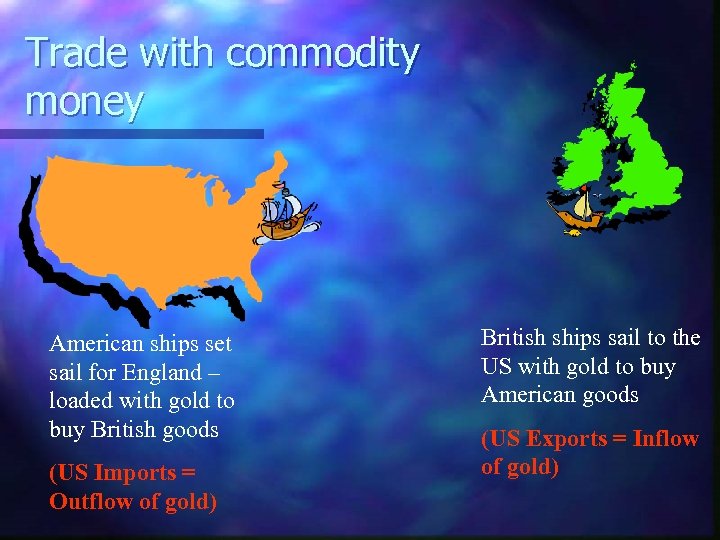 Trade with commodity money American ships set sail for England – loaded with gold to buy British goods (US Imports = Outflow of gold) British ships sail to the US with gold to buy American goods (US Exports = Inflow of gold)
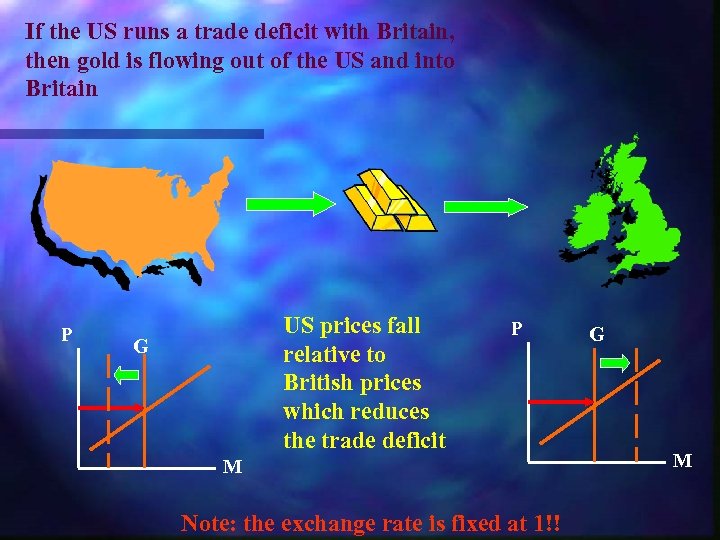 If the US runs a trade deficit with Britain, then gold is flowing out of the US and into Britain P US prices fall relative to British prices which reduces the trade deficit G P M Note: the exchange rate is fixed at 1!! G M
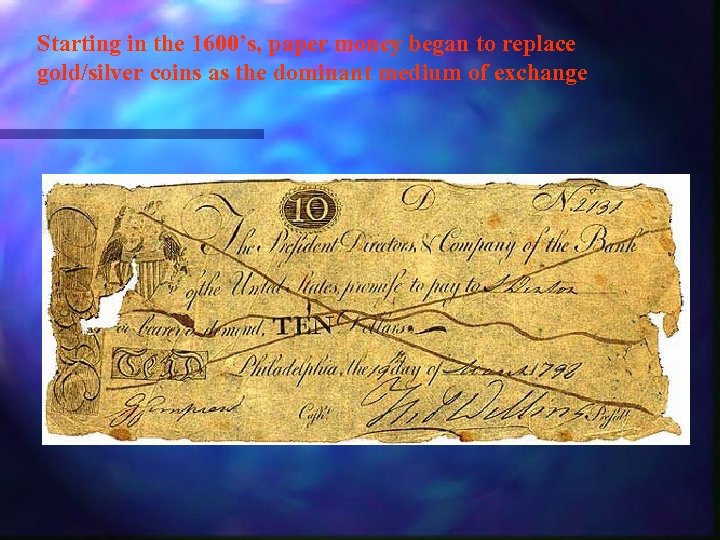 Starting in the 1600’s, paper money began to replace gold/silver coins as the dominant medium of exchange
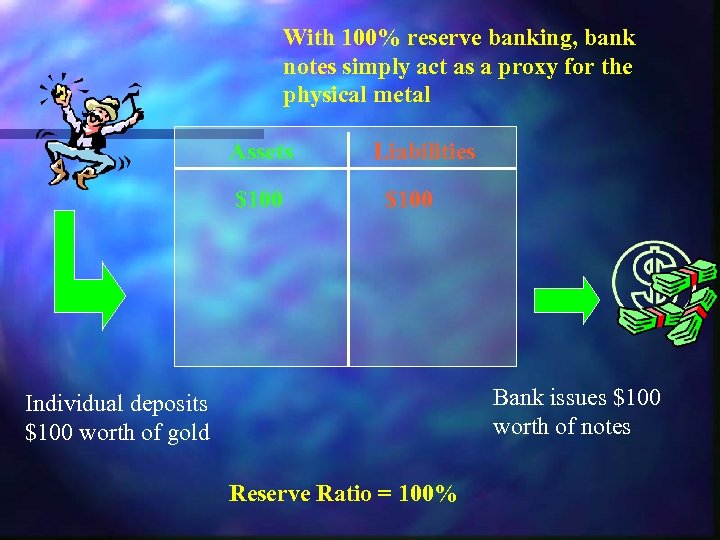 With 100% reserve banking, bank notes simply act as a proxy for the physical metal Assets $100 Liabilities $100 Bank issues $100 worth of notes Individual deposits $100 worth of gold Reserve Ratio = 100%
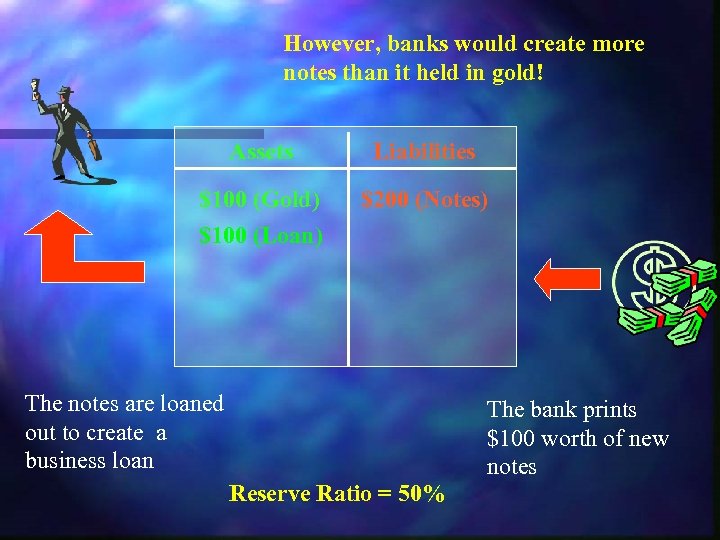 However, banks would create more notes than it held in gold! Assets Liabilities $100 (Gold) $100 (Loan) $200 (Notes) The notes are loaned out to create a business loan Reserve Ratio = 50% The bank prints $100 worth of new notes
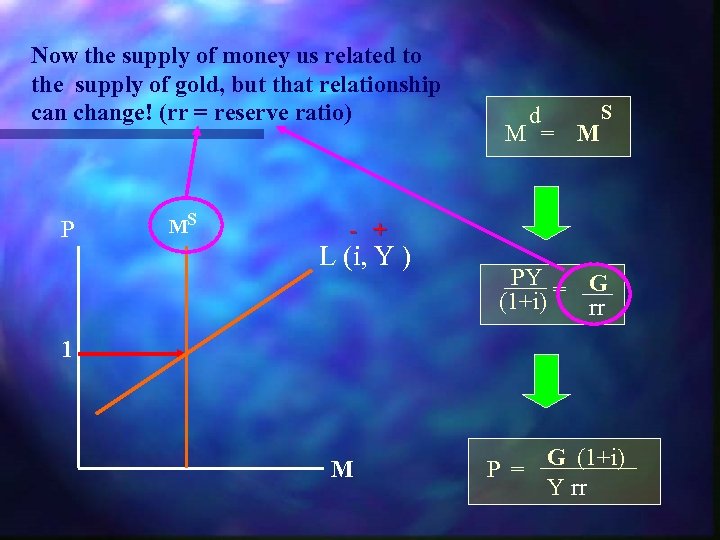 Now the supply of money us related to the supply of gold, but that relationship can change! (rr = reserve ratio) P MS d M = M S - + L (i, Y ) PY = G (1+i) rr 1 M P = G (1+i) Y rr
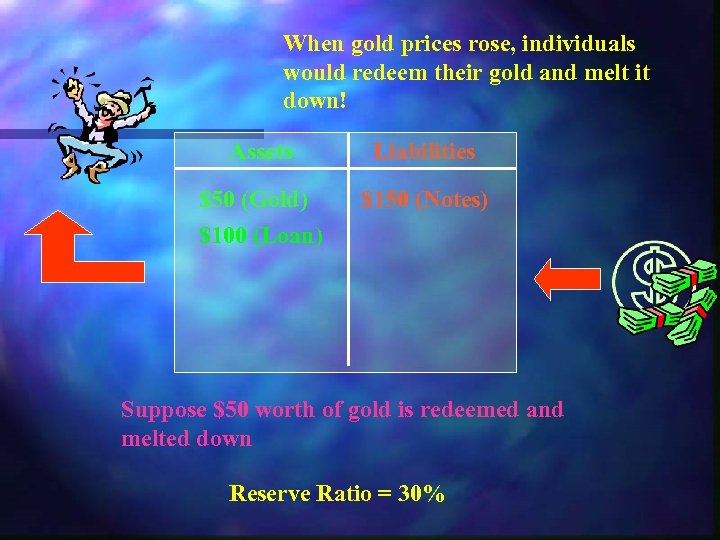 When gold prices rose, individuals would redeem their gold and melt it down! Assets Liabilities $50 (Gold) $100 (Loan) $150 (Notes) Suppose $50 worth of gold is redeemed and melted down Reserve Ratio = 30%
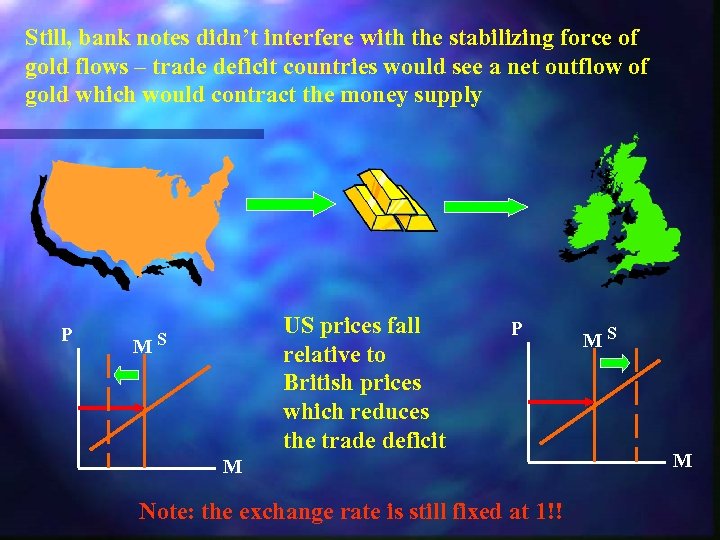 Still, bank notes didn’t interfere with the stabilizing force of gold flows – trade deficit countries would see a net outflow of gold which would contract the money supply P US prices fall relative to British prices which reduces the trade deficit MS P M Note: the exchange rate is still fixed at 1!! MS M
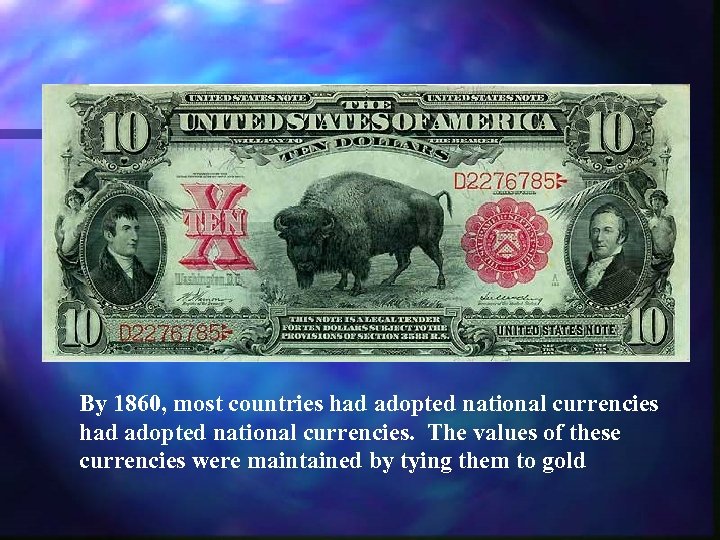 By 1860, most countries had adopted national currencies. The values of these currencies were maintained by tying them to gold
 The Gold Standard (1860 -1945) n The Gold Standard had three basic rules: In each country, currency was convertible into gold on demand at a fixed, pre-specified rate ($20. 67 = 1 oz) n Each country allowed for coinage of gold at a mint n No restrictions on imports/exports of gold n
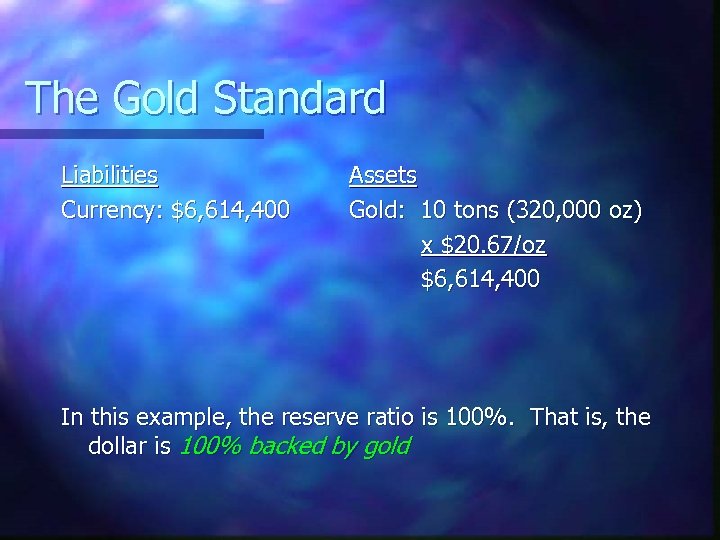 The Gold Standard Liabilities Currency: $6, 614, 400 Assets Gold: 10 tons (320, 000 oz) x $20. 67/oz $6, 614, 400 In this example, the reserve ratio is 100%. That is, the dollar is 100% backed by gold
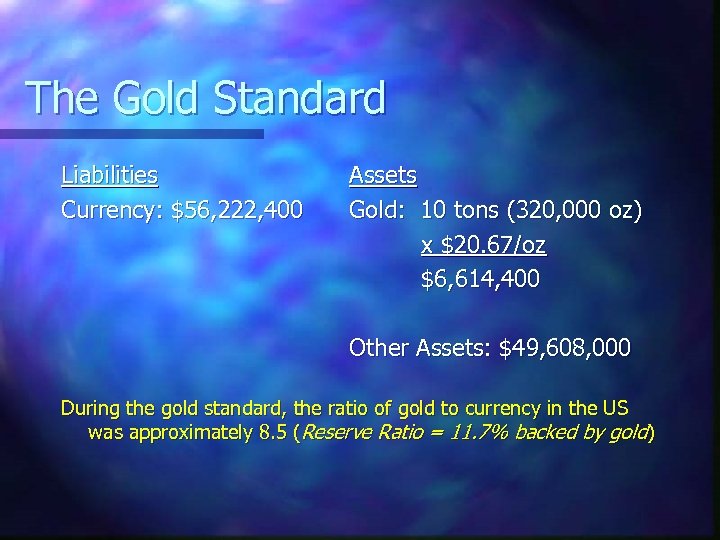 The Gold Standard Liabilities Currency: $56, 222, 400 Assets Gold: 10 tons (320, 000 oz) x $20. 67/oz $6, 614, 400 Other Assets: $49, 608, 000 During the gold standard, the ratio of gold to currency in the US was approximately 8. 5 (Reserve Ratio = 11. 7% backed by gold)
 Gold and The Money Supply n Under a gold standard, the central bank can’t increase (or decrease) the money supply: n Suppose the central bank prints new money and uses it to buy gold: n This purchase forces up the market price of gold. When the market price rises above the official price ($20. 67), individuals buy gold from the fed to sell on the open market – this reverses the central bank’s initial transaction.
 Gold and The Money Supply n Under a gold standard, the central bank can’t increase (or decrease) the money supply: n Suppose the central bank prints new money and uses it to buy other assets (say, government securities): n As money in circulation increases (reserve ratio drops), the price level rises. As dollars lose their purchasing power, individuals start buying gold from the central bank – this, again reverses the original currency transaction
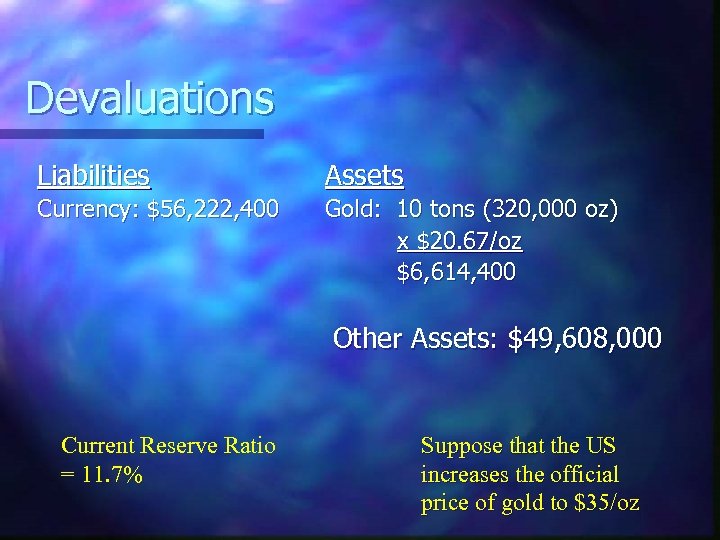 Devaluations Liabilities Assets Currency: $56, 222, 400 Gold: 10 tons (320, 000 oz) x $20. 67/oz $6, 614, 400 Other Assets: $49, 608, 000 Current Reserve Ratio = 11. 7% Suppose that the US increases the official price of gold to $35/oz
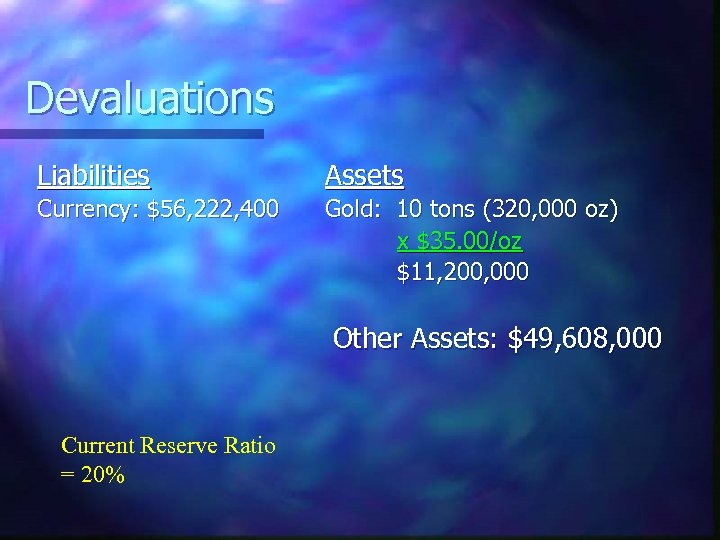 Devaluations Liabilities Assets Currency: $56, 222, 400 Gold: 10 tons (320, 000 oz) x $35. 00/oz $11, 200, 000 Other Assets: $49, 608, 000 Current Reserve Ratio = 20%
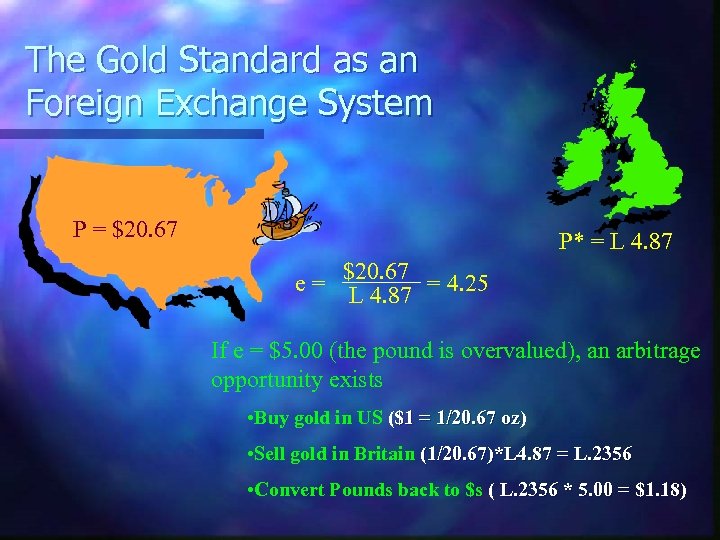 The Gold Standard as an Foreign Exchange System P = $20. 67 P* = L 4. 87 e = $20. 67 = 4. 25 L 4. 87 If e = $5. 00 (the pound is overvalued), an arbitrage opportunity exists • Buy gold in US ($1 = 1/20. 67 oz) oz • Sell gold in Britain (1/20. 67)*L 4. 87 = L. 2356 • Convert Pounds back to $s ( L. 2356 * 5. 00 = $1. 18)
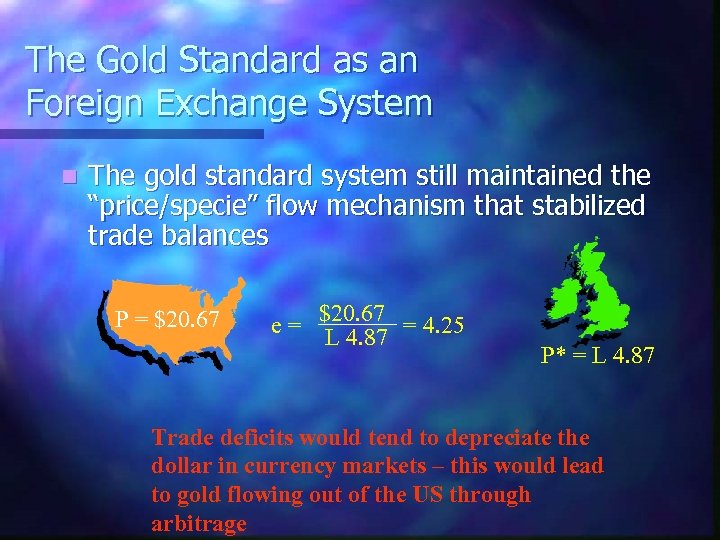 The Gold Standard as an Foreign Exchange System n The gold standard system still maintained the “price/specie” flow mechanism that stabilized trade balances P = $20. 67 e = $20. 67 = 4. 25 L 4. 87 P* = L 4. 87 Trade deficits would tend to depreciate the dollar in currency markets – this would lead to gold flowing out of the US through arbitrage
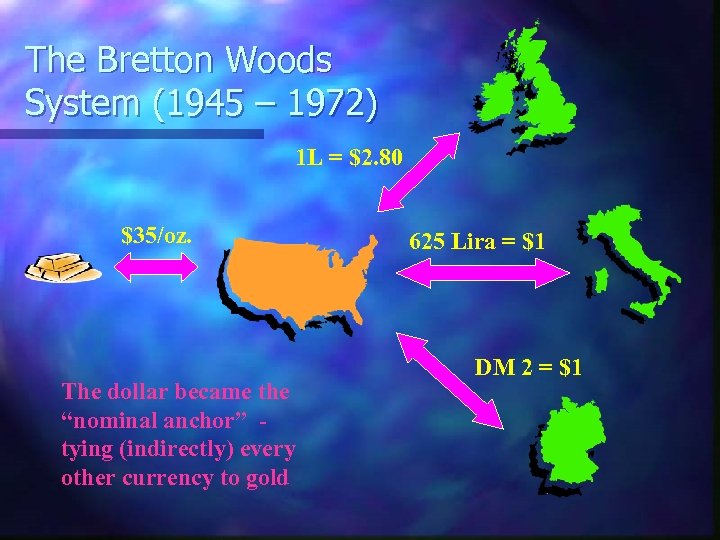 The Bretton Woods System (1945 – 1972) 1 L = $2. 80 $35/oz. The dollar became the “nominal anchor” tying (indirectly) every other currency to gold 625 Lira = $1 DM 2 = $1
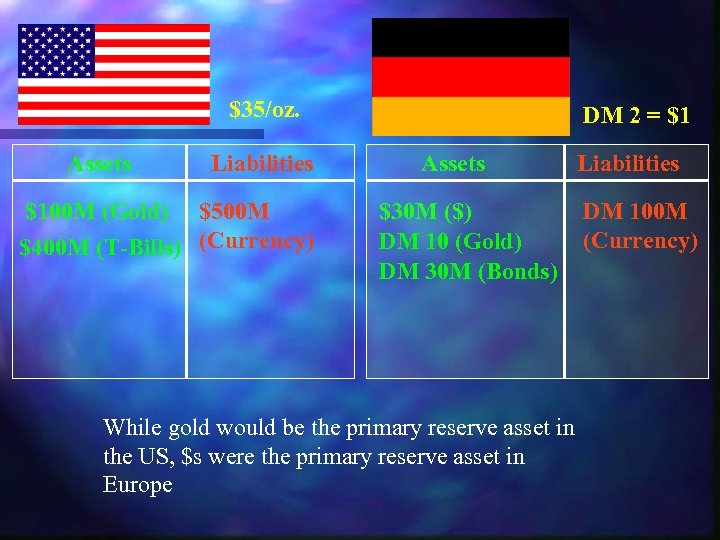 $35/oz. Assets Liabilities $100 M (Gold) $500 M $400 M (T-Bills) (Currency) DM 2 = $1 Assets $30 M ($) DM 10 (Gold) DM 30 M (Bonds) While gold would be the primary reserve asset in the US, $s were the primary reserve asset in Europe Liabilities DM 100 M (Currency)
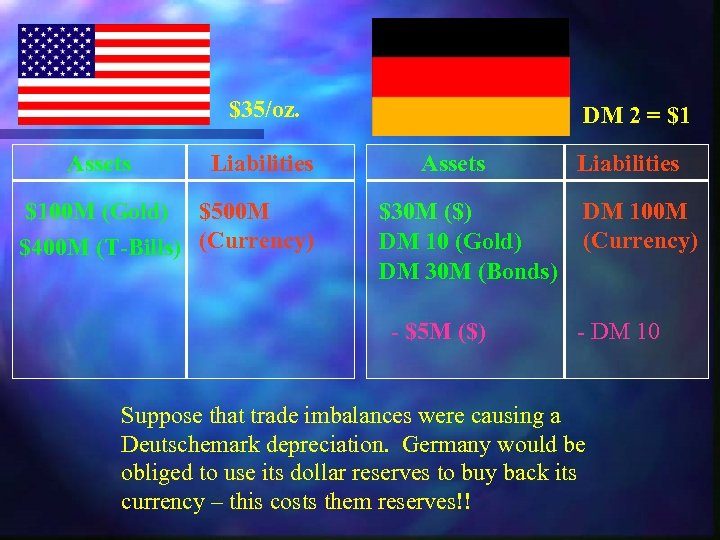 $35/oz. Assets Liabilities $100 M (Gold) $500 M $400 M (T-Bills) (Currency) DM 2 = $1 Assets $30 M ($) DM 10 (Gold) DM 30 M (Bonds) - $5 M ($) Liabilities DM 100 M (Currency) - DM 10 Suppose that trade imbalances were causing a Deutschemark depreciation. Germany would be obliged to use its dollar reserves to buy back its currency – this costs them reserves!!
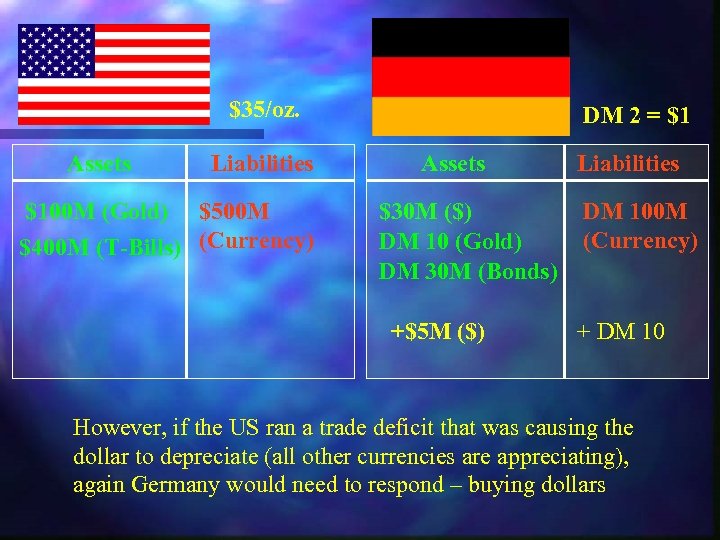 $35/oz. Assets Liabilities $100 M (Gold) $500 M $400 M (T-Bills) (Currency) DM 2 = $1 Assets $30 M ($) DM 10 (Gold) DM 30 M (Bonds) +$5 M ($) Liabilities DM 100 M (Currency) + DM 10 However, if the US ran a trade deficit that was causing the dollar to depreciate (all other currencies are appreciating), again Germany would need to respond – buying dollars
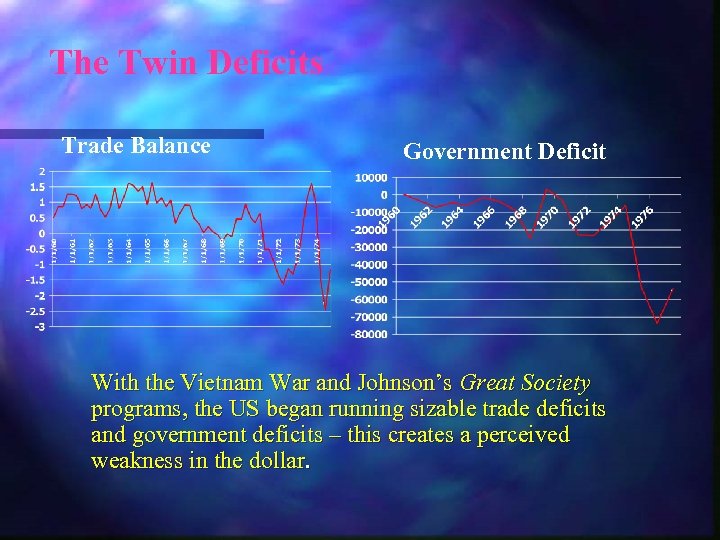 The Twin Deficits Trade Balance Government Deficit With the Vietnam War and Johnson’s Great Society programs, the US began running sizable trade deficits and government deficits – this creates a perceived weakness in the dollar.
 Collapse of Bretton Woods In 1967 -1968: the British pond devalues to $2. 40 (-14%). This triggers a massive run on US gold. The US loses $3. 2 B (20% of reserves) in three months! Private market prices of gold rise as high as $45! Convertibility of gold is suspended in open markets n 1969 -1971: The US enters a recession. This creates even more speculation against the dollar. n 1970 -1971: In an effort to stimulate the economy (and to get re -elected), Nixon pressures the Fed to cut interest rates n August 15, 1971: Nixon officially closes the gold window. Without implicit gold backing, the system totally collapses. n
 Creation of the Euro n n n 1979: European Community Members (Belgium, Denmark, France, Germany, Greece, Ireland, Italy, Luxembourg, Netherlands, Portugal, Spain, UK) agree to the European Exchange Rate Mechanism An artificial currency (European currency unit) is created. Each country fixes to the ECU. Margins of 2. 25% are set for each bilateral rate. 1992: high German interest rates and a recession in Britain led George Soros to speculate against the pound. The pound is devalued by 25%. Italy and Britain drop out of the ERM 1998: Euro introduced. ECU converted to Euros at 1: 1 rate. January 2002: Euros begin circulating
 The Eurozone n n Current member countries (12): Austria, Belgium, Finland, France, Germany, Greece, Ireland, Italy, Luxembourg, Netherlands, Portugal, Spain Will join in 2004 (10): Cyprus, Czech Republic, Estonia, Hungary, Latvia, Lithuania, Malta, Poland, Slovakia, Slovenia Will join in 2007 (4): Bulgaria, Croatia, Romania, Turkey Will most likely NOT join (3): Denmark, Sweden, UK
 Requirements of the Eurozone A Budget Deficit of no more than 3% of GDP n National debt of no more than 60% of GDP n Inflation within 1. 5% of 3 best performing EU countries n Long term interest rates within 2% of 3 lowest interest rate EU countries n
 Can the Euro Last? The common currency makes it much more difficult for countries to abandon the system. n Decision making power of ECB spread out over a large number of people – each with their own national interests n Monetary policy must compete with several fiscal policies. n