


 Скачать презентацию Exchange rate economics A carry on in France
f2cfca3f4e051120aeb8fdcf0dbdf7e3.ppt
- Количество слайдов: 13
 Exchange rate economics: A carry on in France Michael Metcalfe Head of Global Macro Strategy June 2007
 Puzzles from the world’s largest financial market > Globalisation … but of what? > More floating, but less volatility and more reserves > The great moderation in global economic volatility > Exchange rates and fair value > Why carry is robust and when it will end 1
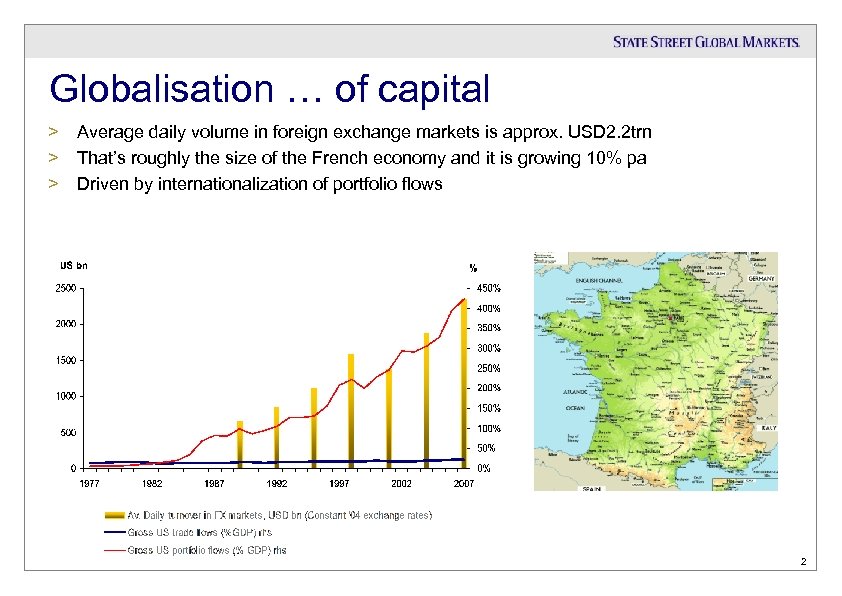 Globalisation … of capital > > > Average daily volume in foreign exchange markets is approx. USD 2. 2 trn That’s roughly the size of the French economy and it is growing 10% pa Driven by internationalization of portfolio flows 2
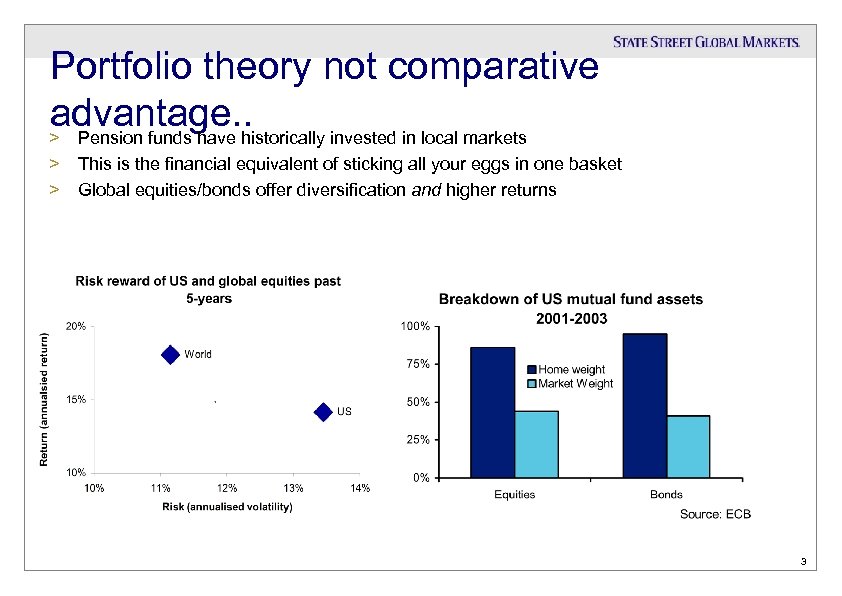 Portfolio theory not comparative advantage. . > Pension funds have historically invested in local markets > > This is the financial equivalent of sticking all your eggs in one basket Global equities/bonds offer diversification and higher returns 3
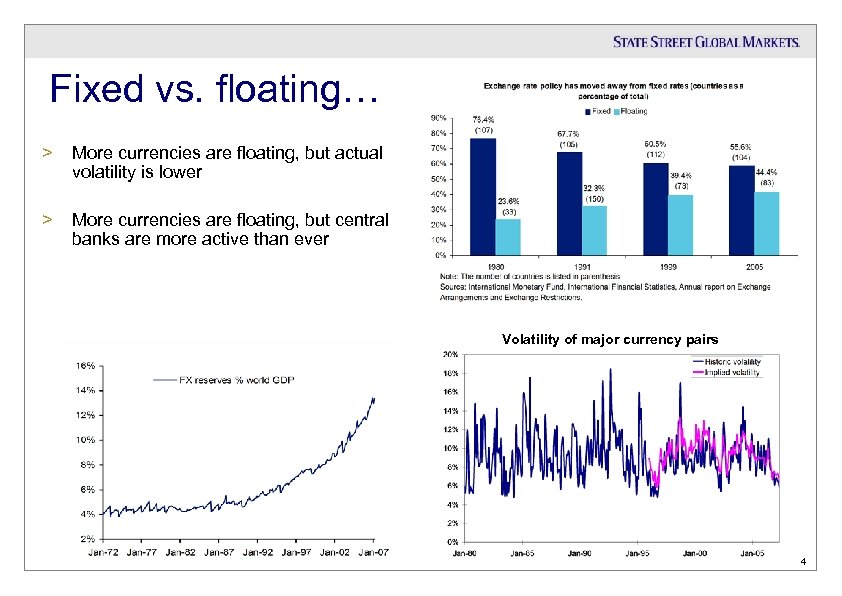 Fixed vs. floating… > More currencies are floating, but actual volatility is lower > More currencies are floating, but central banks are more active than ever Volatility of major currency pairs 4
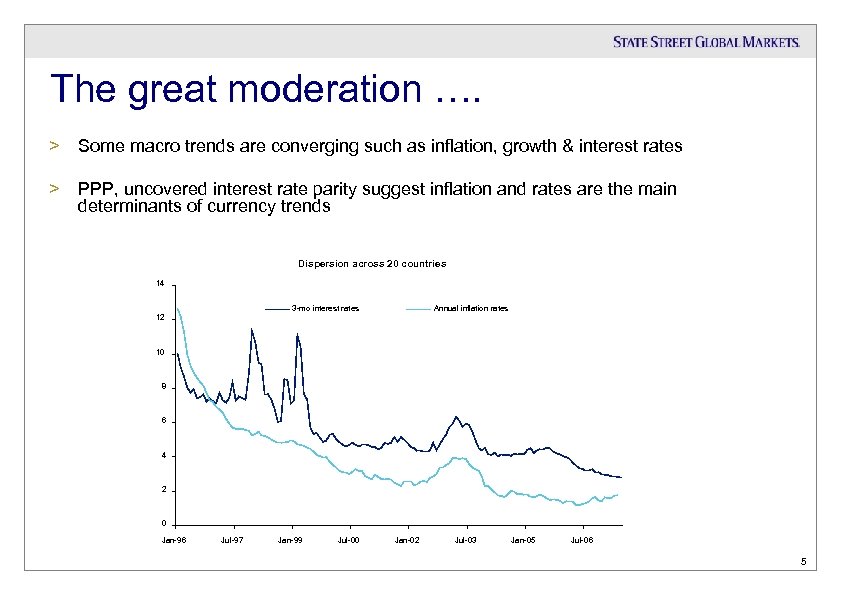 The great moderation …. > Some macro trends are converging such as inflation, growth & interest rates > PPP, uncovered interest rate parity suggest inflation and rates are the main determinants of currency trends Dispersion across 20 countries 14 3 -mo interest rates Annual inflation rates 12 10 8 6 4 2 0 Jan-96 Jul-97 Jan-99 Jul-00 Jan-02 Jul-03 Jan-05 Jul-06 5
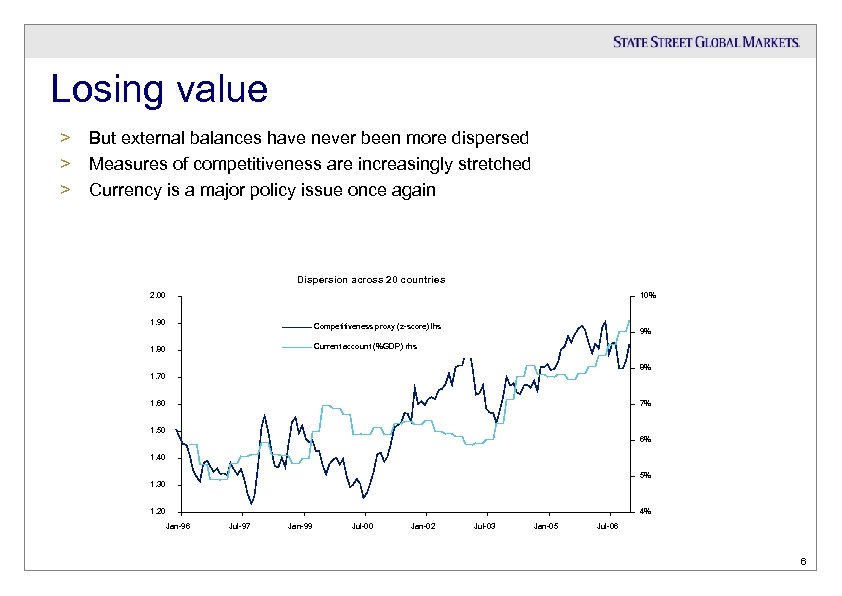 Losing value > > > But external balances have never been more dispersed Measures of competitiveness are increasingly stretched Currency is a major policy issue once again Dispersion across 20 countries 2. 00 10% 1. 90 Competitiveness proxy (z-score) lhs 9% Current account (%GDP) rhs 1. 80 8% 1. 70 1. 60 7% 1. 50 6% 1. 40 5% 1. 30 1. 20 Jan-96 4% Jul-97 Jan-99 Jul-00 Jan-02 Jul-03 Jan-05 Jul-06 6
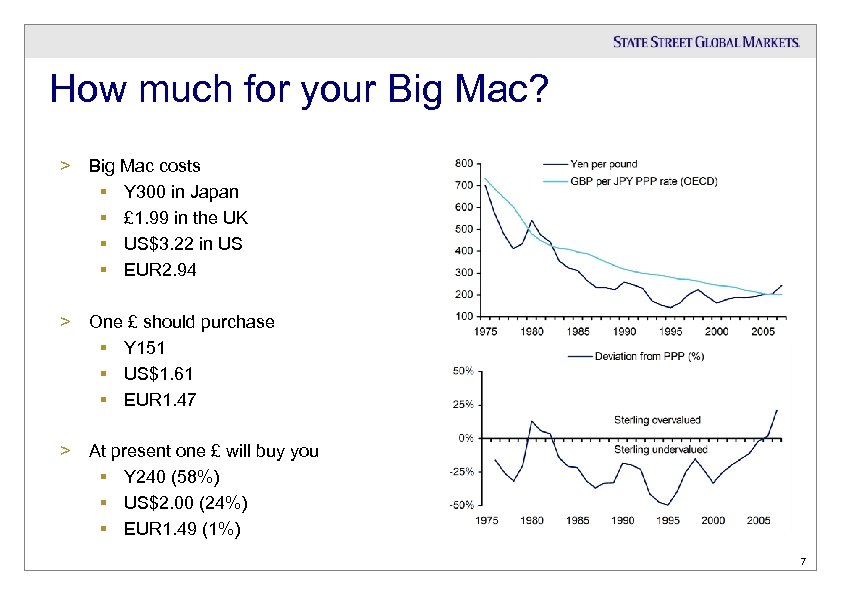 How much for your Big Mac? > Big Mac costs § Y 300 in Japan § £ 1. 99 in the UK § US$3. 22 in US § EUR 2. 94 > One £ should purchase § Y 151 § US$1. 61 § EUR 1. 47 > At present one £ will buy you § Y 240 (58%) § US$2. 00 (24%) § EUR 1. 49 (1%) 7
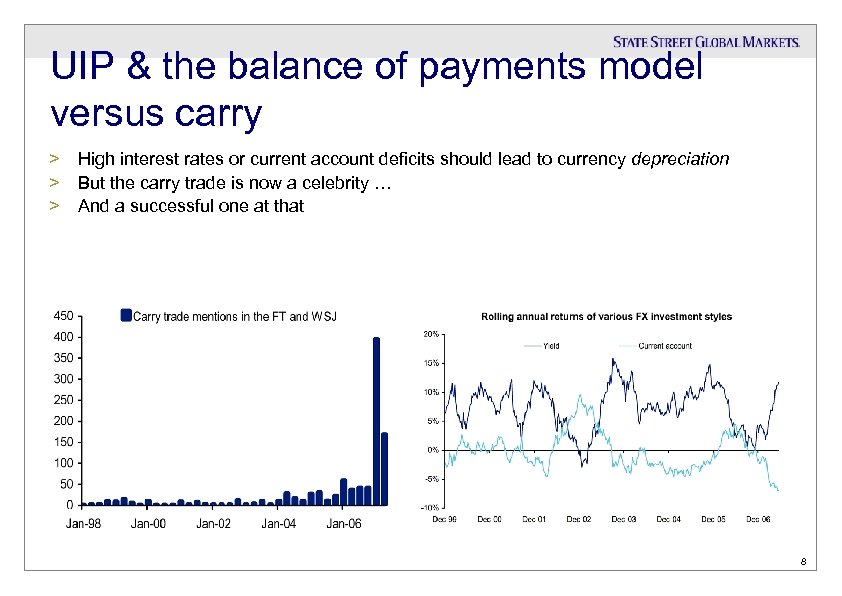 UIP & the balance of payments model versus carry > > > High interest rates or current account deficits should lead to currency depreciation But the carry trade is now a celebrity … And a successful one at that 8
 Why carry is robust > Covered interest rate parity dictates the forward rate must equal today’s rate adjusted by the interest rate differential § § Example today’s rate is JPY 240 per £ 1 -year UK interest rates are 6%, Japanese rates are 1% Today’s forward rate sets the price of GBP in JPY 1 year from now This must be JPY 228 otherwise a risk free arbitrage exists – If the forward rate is JPY 240, I would borrow JPY 10 mn, exchange it into GBP at today’s exchange rate (JPY 240), and deposit £ 41, 667 with a UK bank – In one year’s time I would have £ 44, 167 thanks to the 6% interest, I convert this back to JPY at the pre-agreed JPY 240 rate and get Y 10. 6 mn – Y 10. 1 mn repays my loan and interest, JPY 0. 5 mn (£ 2, 083) is my risk free profit > But what is the best prediction of the spot rate in 12 -months time ? § Uncovered interest rate parity suggests that the forward rate is an unbiased predictor of the future spot rate 9
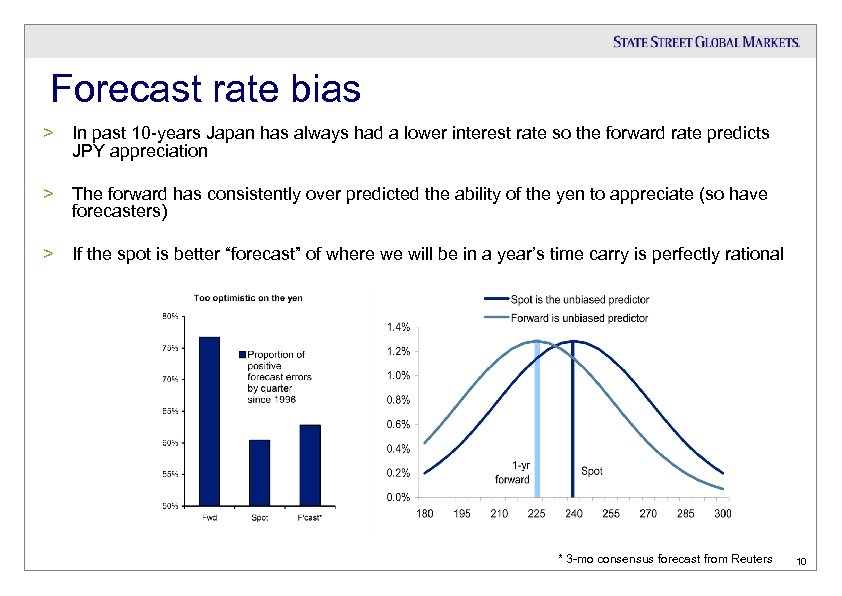 Forecast rate bias > In past 10 -years Japan has always had a lower interest rate so the forward rate predicts JPY appreciation > The forward has consistently over predicted the ability of the yen to appreciate (so have forecasters) > If the spot is better “forecast” of where we will be in a year’s time carry is perfectly rational * 3 -mo consensus forecast from Reuters 10
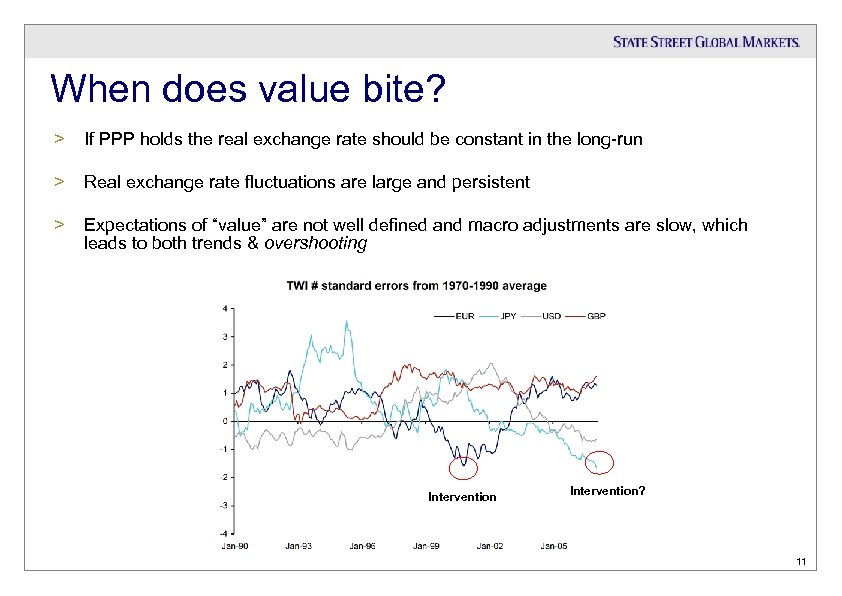 When does value bite? > If PPP holds the real exchange rate should be constant in the long-run > Real exchange rate fluctuations are large and persistent > Expectations of “value” are not well defined and macro adjustments are slow, which leads to both trends & overshooting Intervention? 11
 FX market puzzles > Globalisation … but of what? § Internationalisation of portfolios is main driver of growth in FX market > More floating, but less volatility and higher reserves § There are fewer pegs § Current account imbalances are leading to a surge in CB reserves > The great moderation in economic volatility § Interest and inflation rates are converging > Exchange rates and fair value § Value and external balances are diverging rapidly > Why carry is robust and when it will end § Uncovered Interest Rate Parity fails in a world of mobile capital flows § At some point high (low) yielding currencies will become so over (under) valued that it will impact monetary policy leading to lower (higher) interest rates and possibly FX intervention 12