


 Скачать презентацию Exchange Rate Dynamics I Dr J D Han King s
55a4e9ef8a357728a0f4164674475d76.ppt
- Количество слайдов: 41
 Exchange Rate Dynamics(I) Dr. J. D. Han King’s College U. W. O. 1
 (Key Question) 1. What causes exchange rates to fluctuate? 2. How do you predict exchange rates (and their changes)? 3. What is the ‘correct exchange rate’? 4. What are the benefits of having exchange rates as opposed to not having ones (using the big country’s currency)? 2
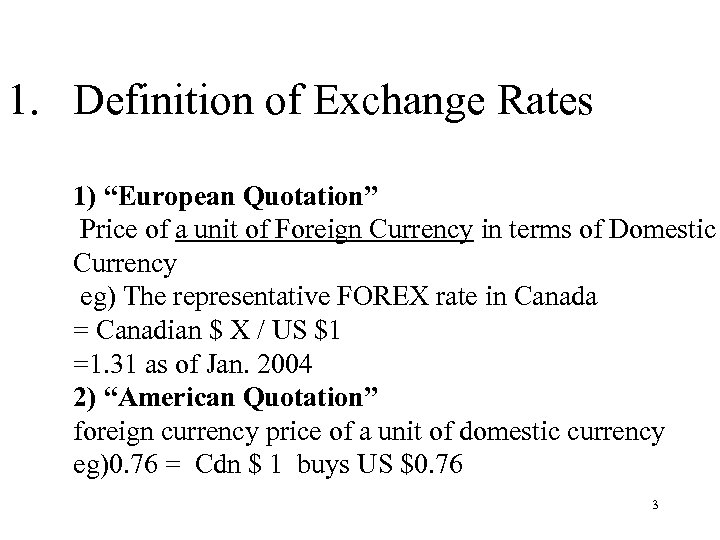 1. Definition of Exchange Rates 1) “European Quotation” Price of a unit of Foreign Currency in terms of Domestic Currency eg) The representative FOREX rate in Canada = Canadian $ X / US $1 =1. 31 as of Jan. 2004 2) “American Quotation” foreign currency price of a unit of domestic currency eg)0. 76 = Cdn $ 1 buys US $0. 76 3
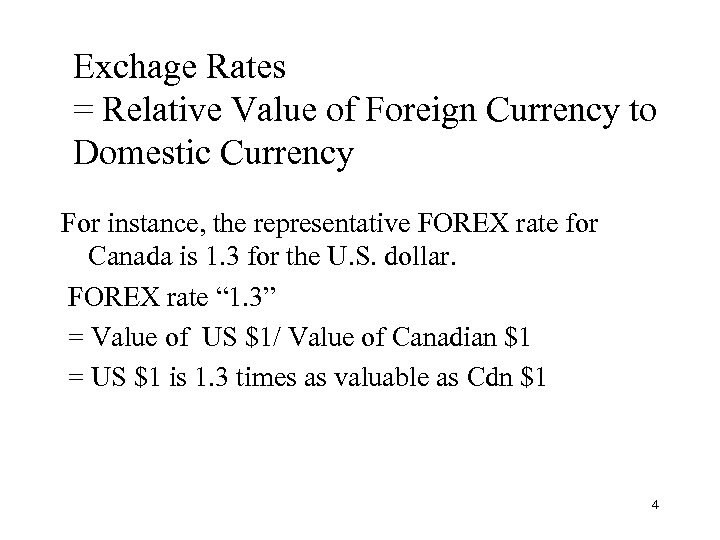 Exchage Rates = Relative Value of Foreign Currency to Domestic Currency For instance, the representative FOREX rate for Canada is 1. 3 for the U. S. dollar. FOREX rate “ 1. 3” = Value of US $1/ Value of Canadian $1 = US $1 is 1. 3 times as valuable as Cdn $1 4
 2. What is the correct FOREX rate? : Is there an equilibrium FOREX rate which correctly reflect the economy-wide and market fundamentals? The actual FOREX rate may differ from this equilibrium FOREX rate for a short-term, but eventually the actual FOREX rate should gravitate to the equilibrium value. There are three theories which link the economic fundamental to a specific equilibrium exchange rate • International Trade ->Purchasing Power Parity • International Investment -> Interest Parity Theorem • Real Factor Analysis 5
 3. International Trade’s perspective Links FOREX Rates to the economic and market fundamentals in International Trade • Short-run Disequilibrium: Exports pushes FX rate down, Imports pushes FX rates up. • Long-Run Equilibrium: Purchasing Power Parity 6
 1) Purchasing Power Parity says Under a certain set of conditions • Exchange Rate is determined in such a way that a unit of a certain currency should, through the conversion using the exchange rate, fetch the same amount of goods in the foreign country as it would in the domestic countries; “ A currency should have the same purchasing power everywhere in the world. . ” • A merchandise should have the same price, in a currency, everywhere in the world: “ Law of One Price for One Good” 7
 2) Under what set of conditions does Purchasing Power Parity hold? • No changes in Supply or Demand for domestic/foreign goods; “other things being equal”(ceteris paribus) • In the Long Run equilibrium situation; • With tradable; • Works best with free trade; . 8
 *In contrast, there is no reason why a price of nontradable good should have the same price in two different countries unless the production factors are completely mobile between the two countries. Eg) A hair cut costs U. S. $25 in New York. An equally good hair costs 5 Yuan in Beijing. - The PPP might dictate the FOREX rate of 1 Yuan for U. S. $ ___. - In fact, the actual FOREX rate is the opposite. 9
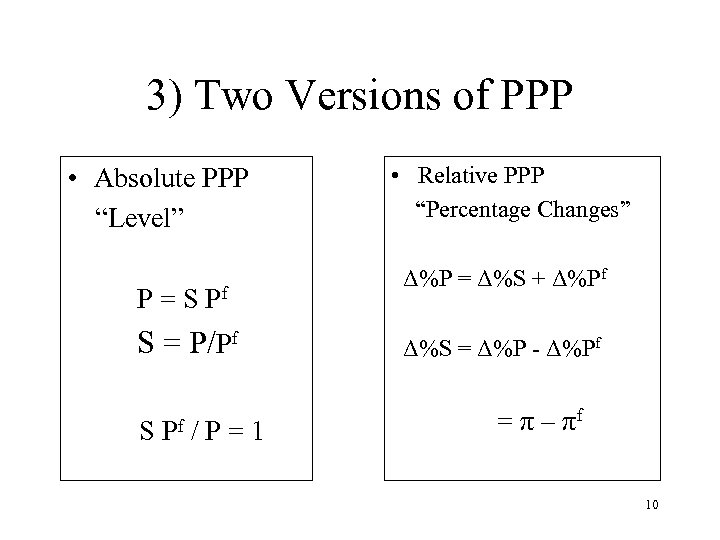 3) Two Versions of PPP • Absolute PPP “Level” P = S Pf S = P/Pf S Pf /P=1 • Relative PPP “Percentage Changes” Δ%P = Δ%S + Δ%Pf Δ%S = Δ%P - Δ%Pf = π – πf 10
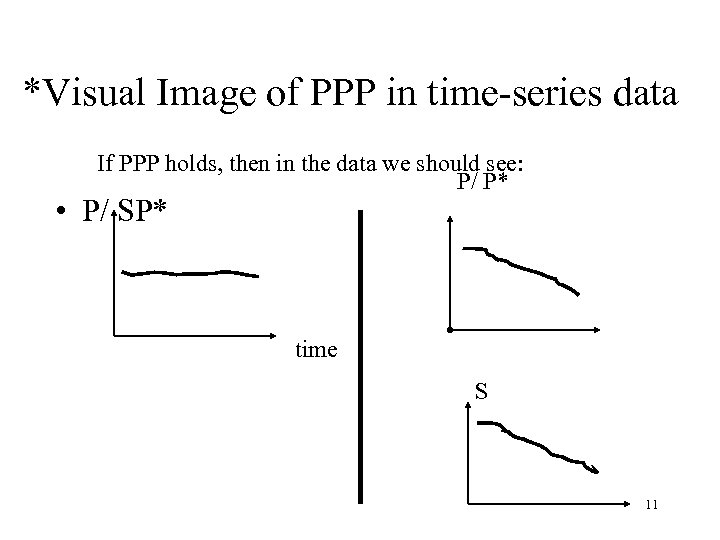 *Visual Image of PPP in time-series data If PPP holds, then in the data we should see: P/ P* • P/ SP* time S 11
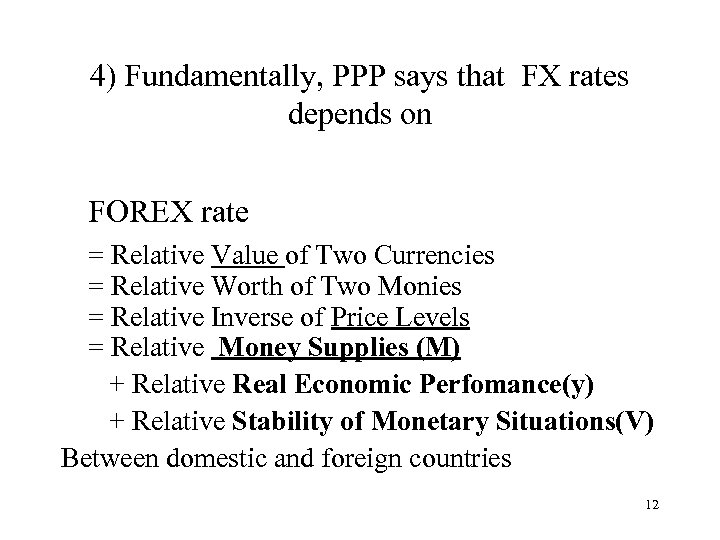 4) Fundamentally, PPP says that FX rates depends on FOREX rate = Relative Value of Two Currencies = Relative Worth of Two Monies = Relative Inverse of Price Levels = Relative Money Supplies (M) + Relative Real Economic Perfomance(y) + Relative Stability of Monetary Situations(V) Between domestic and foreign countries 12
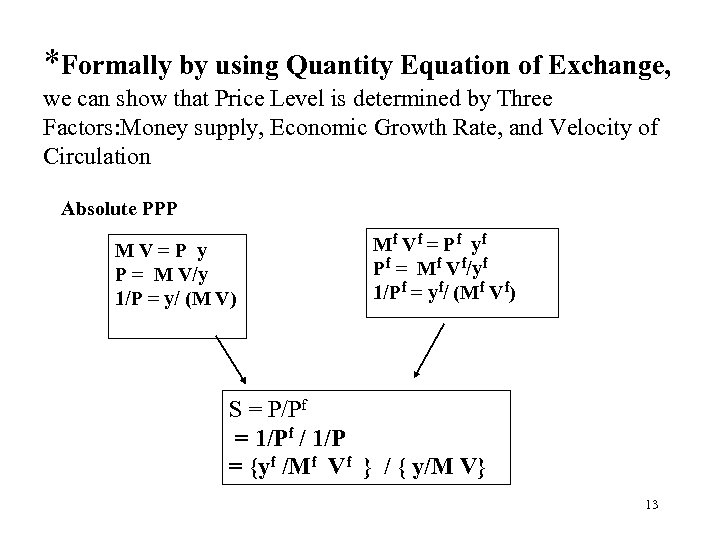 *Formally by using Quantity Equation of Exchange, we can show that Price Level is determined by Three Factors: Money supply, Economic Growth Rate, and Velocity of Circulation Absolute PPP MV=P y P = M V/y 1/P = y/ (M V) Mf Vf = Pf yf Pf = Mf Vf/yf 1/Pf = yf/ (Mf Vf) S = P/Pf = 1/Pf / 1/P = {yf /Mf Vf } / { y/M V} 13
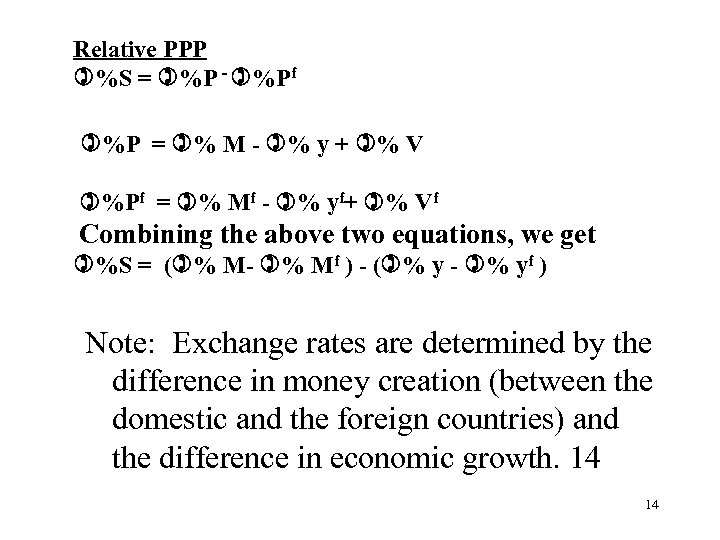 Relative PPP %S = %P - %Pf %P = % M - % y + % V %Pf = % Mf - % yf+ % Vf Combining the above two equations, we get %S = ( % M- % Mf ) - ( % y - % yf ) Note: Exchange rates are determined by the difference in money creation (between the domestic and the foreign countries) and the difference in economic growth. 14 14
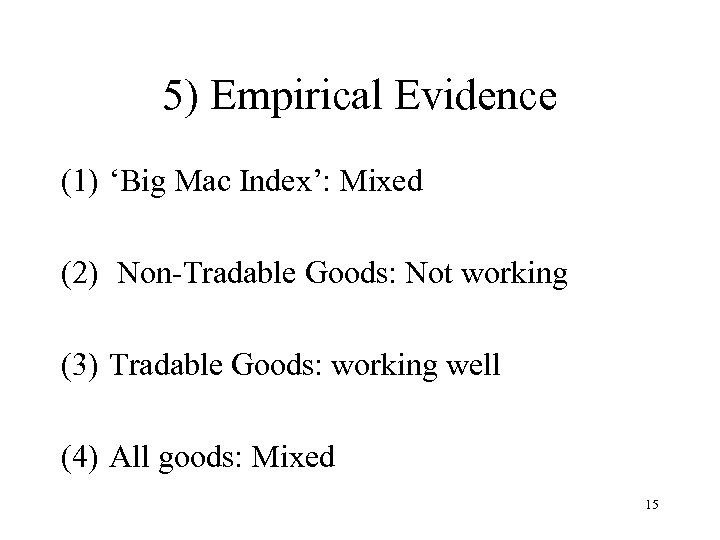 5) Empirical Evidence (1) ‘Big Mac Index’: Mixed (2) Non-Tradable Goods: Not working (3) Tradable Goods: working well (4) All goods: Mixed 15
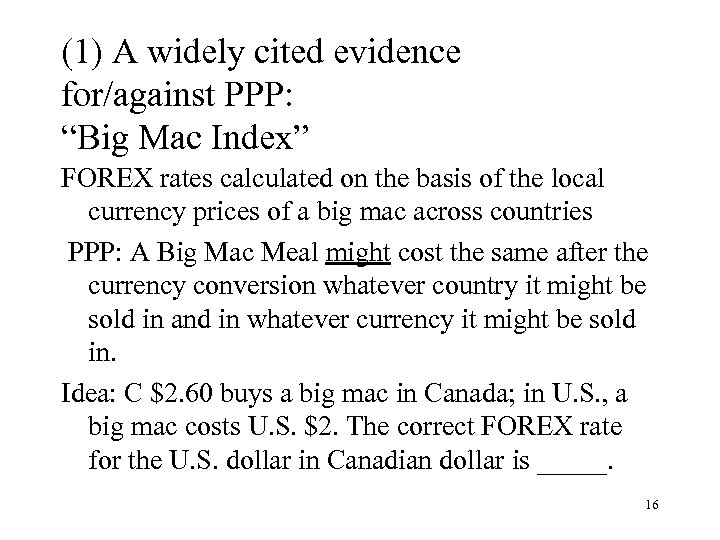 (1) A widely cited evidence for/against PPP: “Big Mac Index” FOREX rates calculated on the basis of the local currency prices of a big mac across countries PPP: A Big Mac Meal might cost the same after the currency conversion whatever country it might be sold in and in whatever currency it might be sold in. Idea: C $2. 60 buys a big mac in Canada; in U. S. , a big mac costs U. S. $2. The correct FOREX rate for the U. S. dollar in Canadian dollar is _____. 16
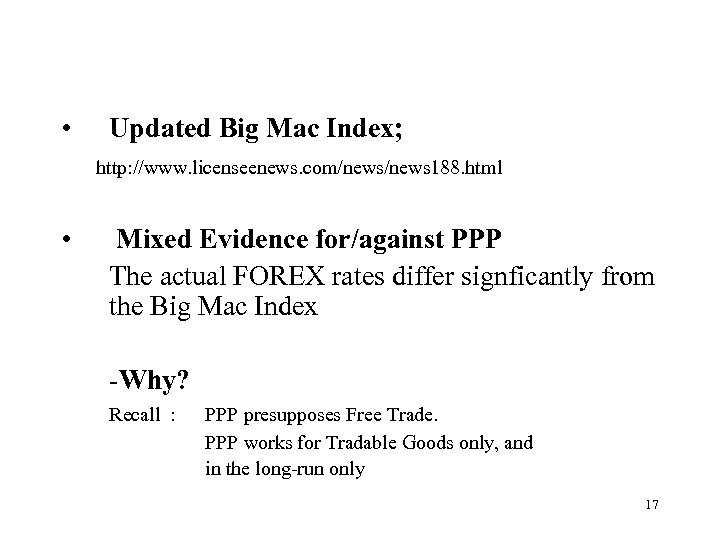 • Updated Big Mac Index; http: //www. licenseenews. com/news 188. html • Mixed Evidence for/against PPP The actual FOREX rates differ signficantly from the Big Mac Index -Why? Recall : PPP presupposes Free Trade. PPP works for Tradable Goods only, and in the long-run only 17
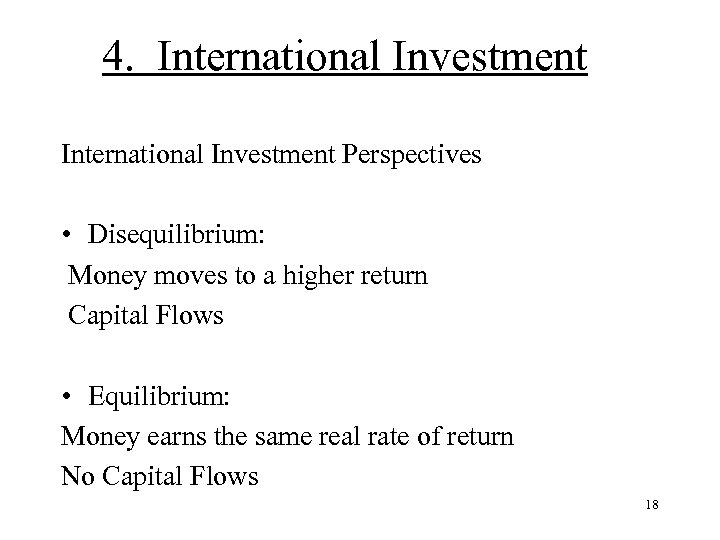 4. International Investment Perspectives • Disequilibrium: Money moves to a higher return Capital Flows • Equilibrium: Money earns the same real rate of return No Capital Flows 18
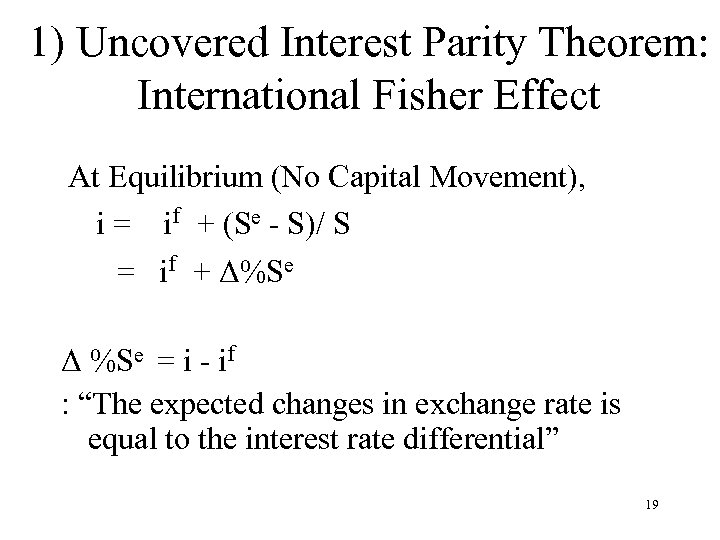 1) Uncovered Interest Parity Theorem: International Fisher Effect At Equilibrium (No Capital Movement), i = if + (Se - S)/ S = if + Δ%Se Δ %Se = i - if : “The expected changes in exchange rate is equal to the interest rate differential” 19
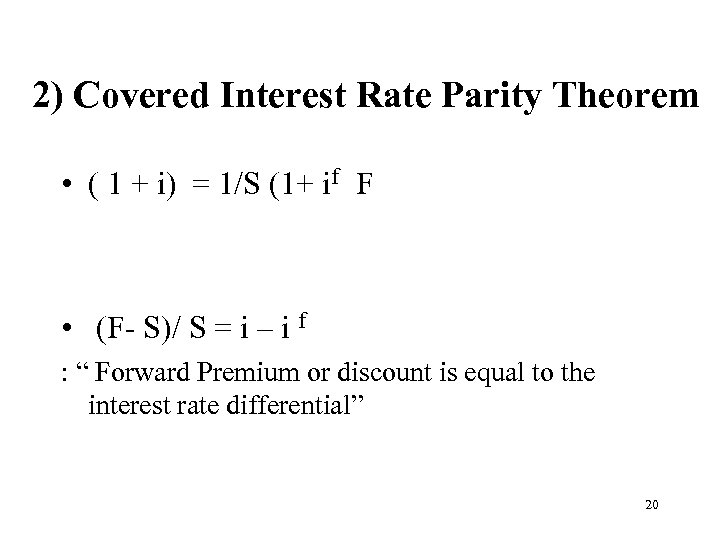 2) Covered Interest Rate Parity Theorem • ( 1 + i) = 1/S (1+ if F • (F- S)/ S = i – i f : “ Forward Premium or discount is equal to the interest rate differential” 20
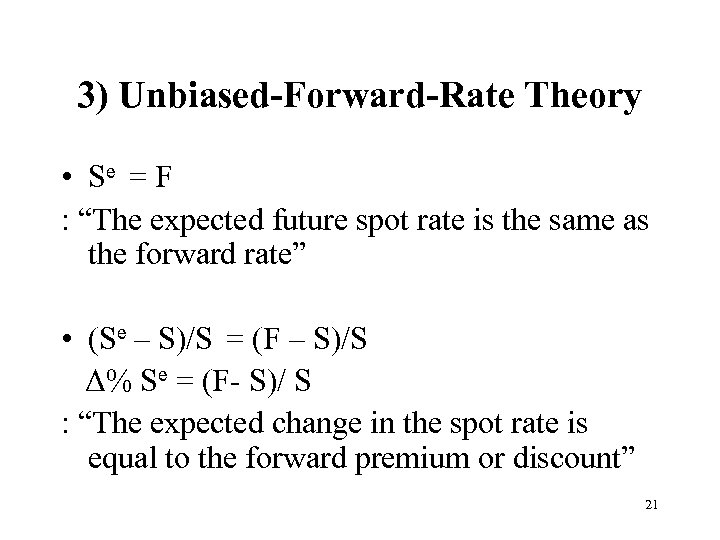 3) Unbiased-Forward-Rate Theory • Se = F : “The expected future spot rate is the same as the forward rate” • (Se – S)/S = (F – S)/S Δ% Se = (F- S)/ S : “The expected change in the spot rate is equal to the forward premium or discount” 21
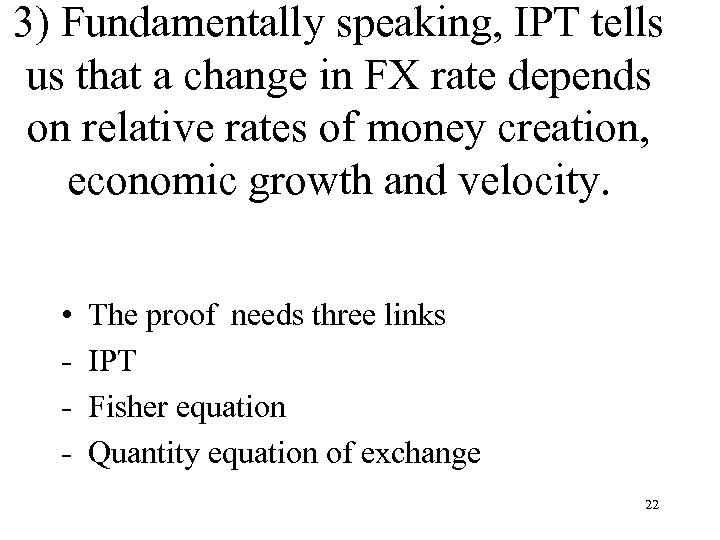 3) Fundamentally speaking, IPT tells us that a change in FX rate depends on relative rates of money creation, economic growth and velocity. • - The proof needs three links IPT Fisher equation Quantity equation of exchange 22
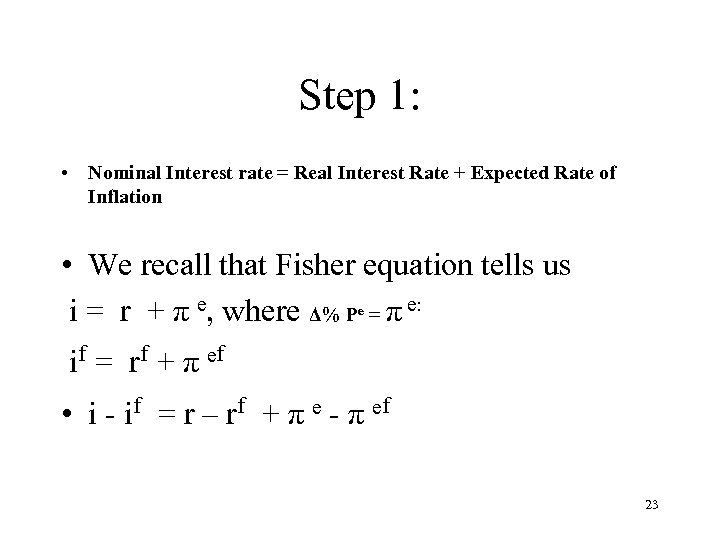 Step 1: • Nominal Interest rate = Real Interest Rate + Expected Rate of Inflation • We recall that Fisher equation tells us i = r + π e, where Δ% Pe = π e: i f = rf + π e f • i - i f = r – rf + π e - π e f 23
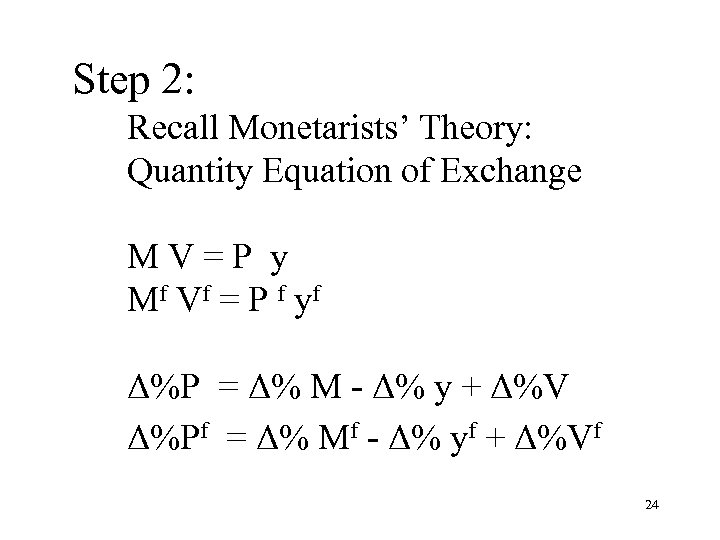 Step 2: Recall Monetarists’ Theory: Quantity Equation of Exchange MV=P y Mf Vf = P f yf Δ%P = Δ% M - Δ% y + Δ%V Δ%Pf = Δ% Mf - Δ% yf + Δ%Vf 24
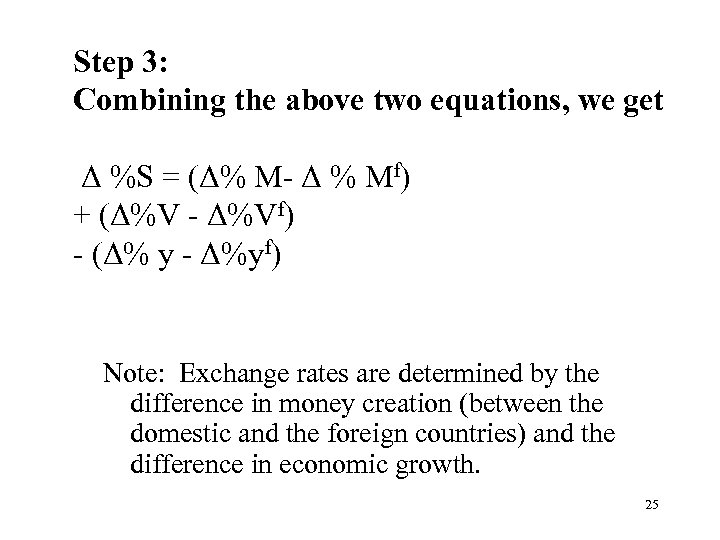 Step 3: Combining the above two equations, we get Δ %S = (Δ% M- Δ % Mf) + (Δ%V - Δ%Vf) - (Δ% y - Δ%yf) Note: Exchange rates are determined by the difference in money creation (between the domestic and the foreign countries) and the difference in economic growth. 25
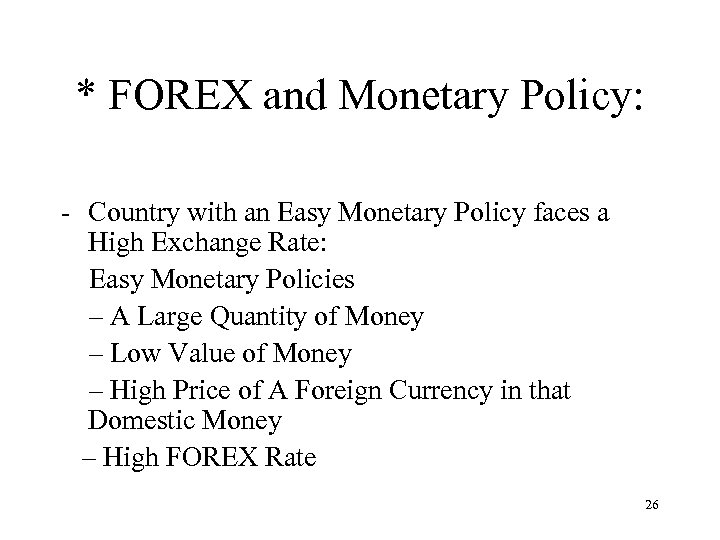 * FOREX and Monetary Policy: - Country with an Easy Monetary Policy faces a High Exchange Rate: Easy Monetary Policies – A Large Quantity of Money – Low Value of Money – High Price of A Foreign Currency in that Domestic Money – High FOREX Rate 26
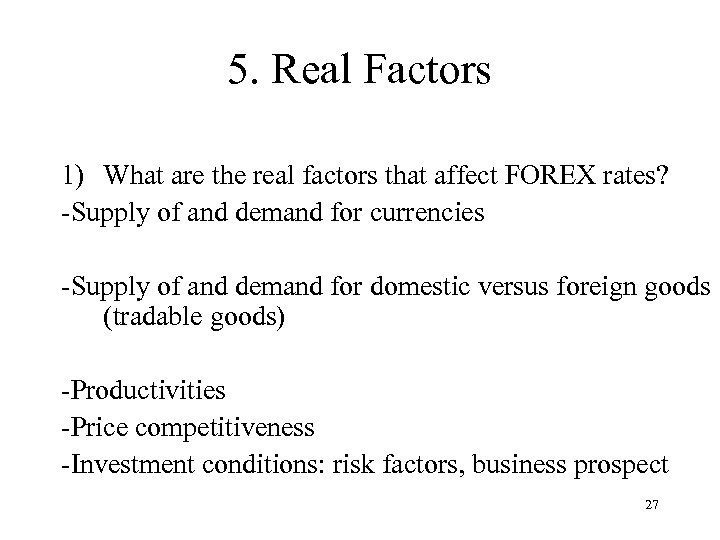 5. Real Factors 1) What are the real factors that affect FOREX rates? -Supply of and demand for currencies -Supply of and demand for domestic versus foreign goods (tradable goods) -Productivities -Price competitiveness -Investment conditions: risk factors, business prospect 27
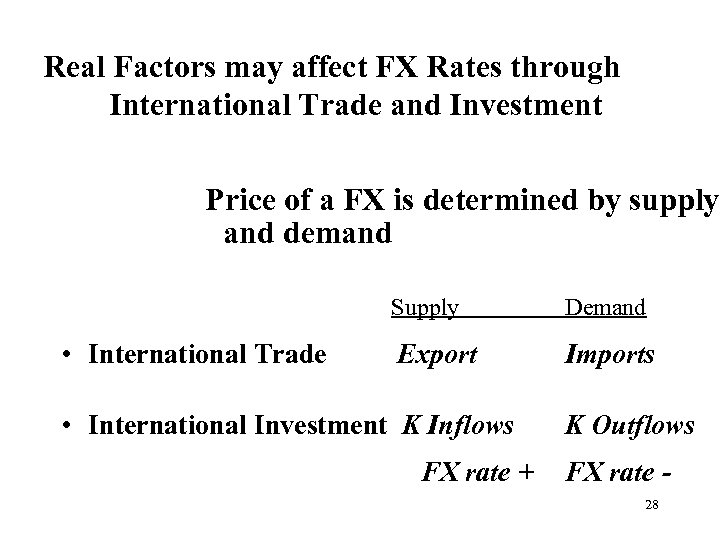 Real Factors may affect FX Rates through International Trade and Investment Price of a FX is determined by supply and demand Supply • International Trade Demand Export Imports • International Investment K Inflows FX rate + K Outflows FX rate 28
 2) PPP in Japan of the 1970 -80 s : Did it work? Background: -after the oil crisis, Japanese cars became popular -Japan was also having technical innovations in electronic industry -Japanese exports rose -Japanese Yen became strong: for the Japanese, FX rate or S fell 29
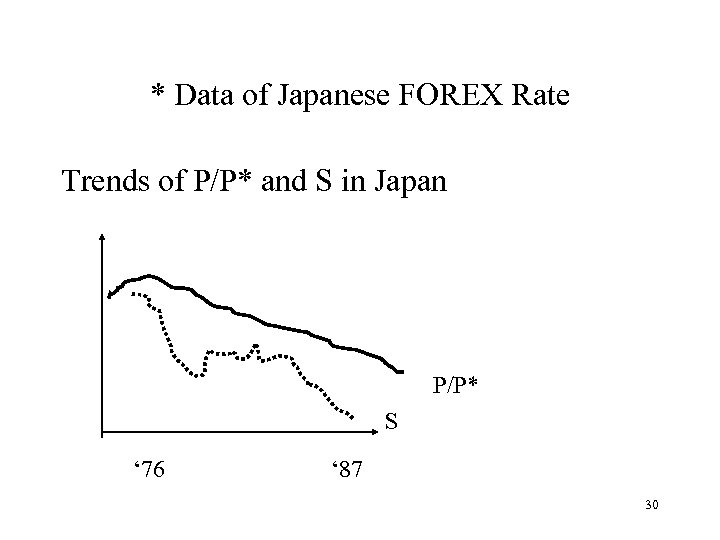 * Data of Japanese FOREX Rate Trends of P/P* and S in Japan P/P* S ‘ 76 ‘ 87 30
 ** Observations : - Changes in Exchange Rates: S can be partially explained by P / Pf as PPP suggests; - Still there are ‘Residual Changes in Exchange Rates’ that cannot be explained by PPP: S fell more than P / Pf 31
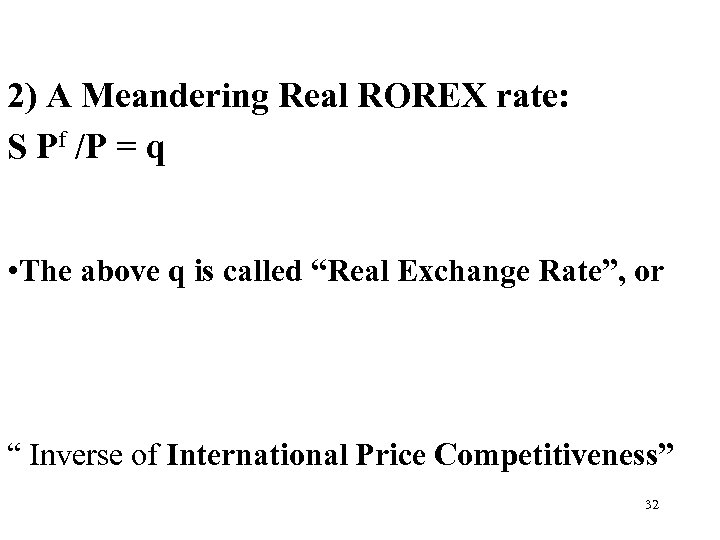 2) A Meandering Real ROREX rate: S Pf /P = q • The above q is called “Real Exchange Rate”, or “ Inverse of International Price Competitiveness” 32
 *Explaining stable f P/P - Suppose that there is not much change in overall P/Pf. - In Japan, P = 0. 5 PT + 0. 5 PNT - Due to Technical Innovations, Japanese Tradable becomes cheaper. However, Non-tradable becomes expensive. Thus the weighted average of the two, P, does not change very much. 33
 **Explaining a falling S and a Meandering q in Japan • If S PT f / PT >1 for Tradable Goods, Domestic Tradable goods have price competitiveness edge over Foreign-produced Tradable goods. International Substitution from foreign Tradable goods to domestic tradable goods Trade surplus for domestic country Excess Demand for domestic currency (Excess Supply of foreign currency) S 34 f/P is stable. q if overall price ratio P
 6. Case study of Canada 1) Facts • Between 1975 -1990 s -S continued to rise (against Canadian dollars) -Nominal factors: Money supply increased faster in Canada than in U. S. -Real factors: Canadian productivity lagged behind the U. S. productivity • Between 2001 -2003 - S continues to fall - Manily disequilibrium capital flows from U. S. 35
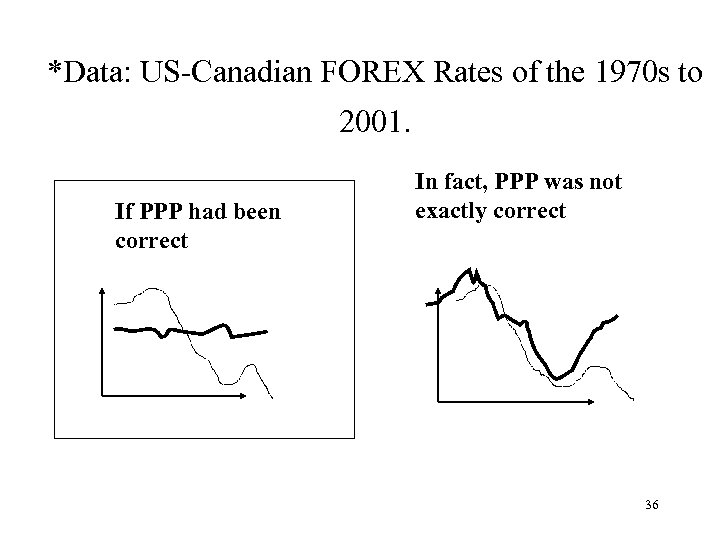 *Data: US-Canadian FOREX Rates of the 1970 s to 2001. If PPP had been correct In fact, PPP was not exactly correct 36
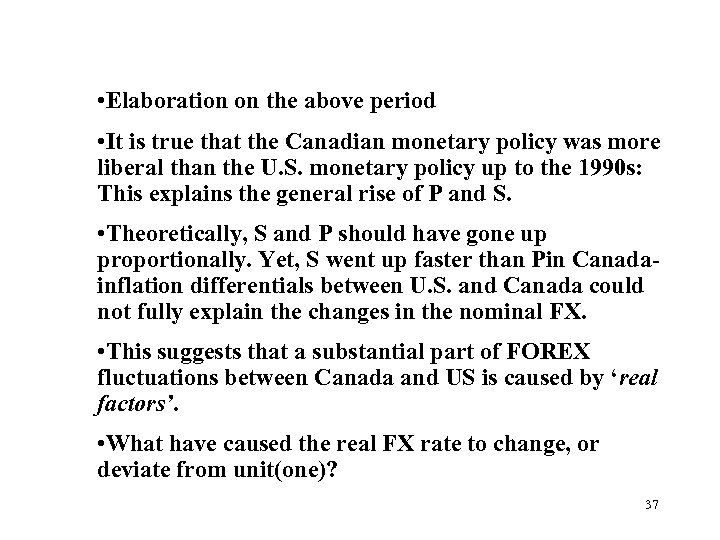 • Elaboration on the above period • It is true that the Canadian monetary policy was more liberal than the U. S. monetary policy up to the 1990 s: This explains the general rise of P and S. • Theoretically, S and P should have gone up proportionally. Yet, S went up faster than Pin Canadainflation differentials between U. S. and Canada could not fully explain the changes in the nominal FX. • This suggests that a substantial part of FOREX fluctuations between Canada and US is caused by ‘real factors’. • What have caused the real FX rate to change, or deviate from unit(one)? 37
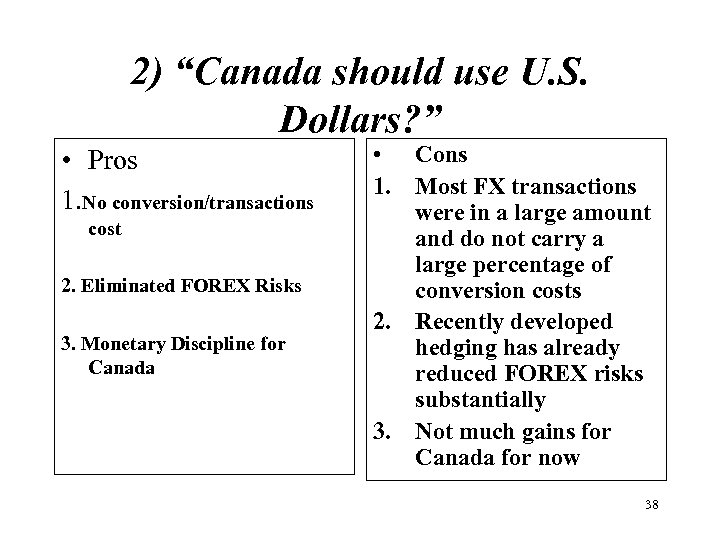 2) “Canada should use U. S. Dollars? ” • Pros 1. No conversion/transactions cost 2. Eliminated FOREX Risks 3. Monetary Discipline for Canada • Cons 1. Most FX transactions were in a large amount and do not carry a large percentage of conversion costs 2. Recently developed hedging has already reduced FOREX risks substantially 3. Not much gains for Canada for now 38
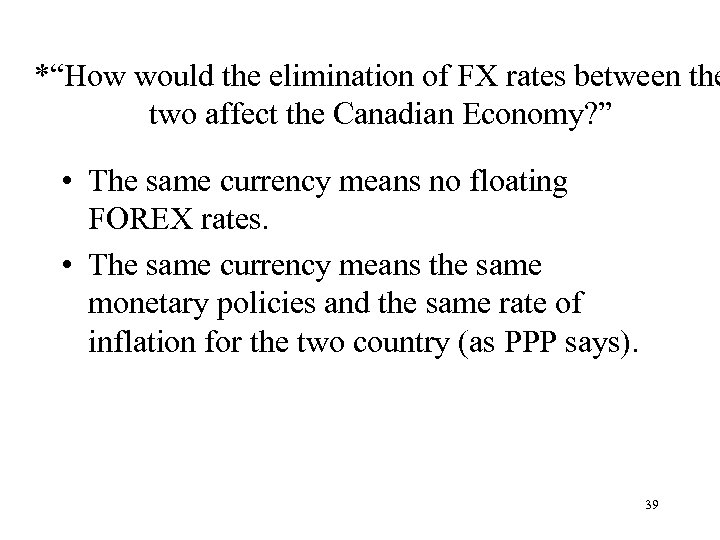 *“How would the elimination of FX rates between the two affect the Canadian Economy? ” • The same currency means no floating FOREX rates. • The same currency means the same monetary policies and the same rate of inflation for the two country (as PPP says). 39
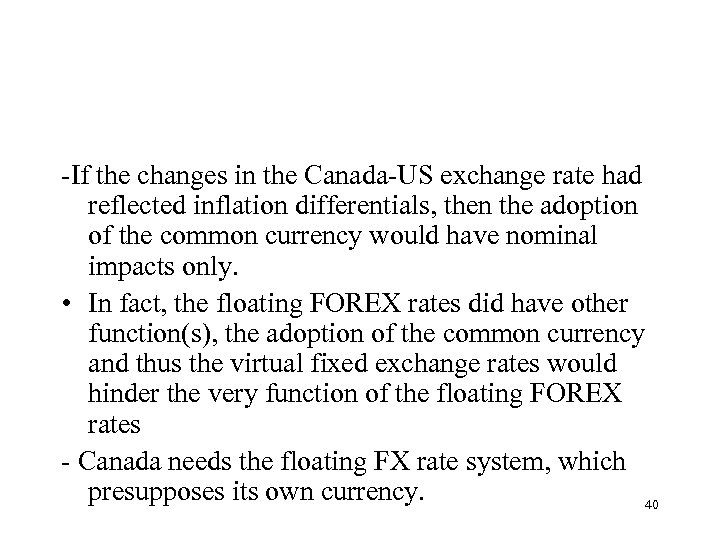 -If the changes in the Canada-US exchange rate had reflected inflation differentials, then the adoption of the common currency would have nominal impacts only. • In fact, the floating FOREX rates did have other function(s), the adoption of the common currency and thus the virtual fixed exchange rates would hinder the very function of the floating FOREX rates - Canada needs the floating FX rate system, which presupposes its own currency. 40
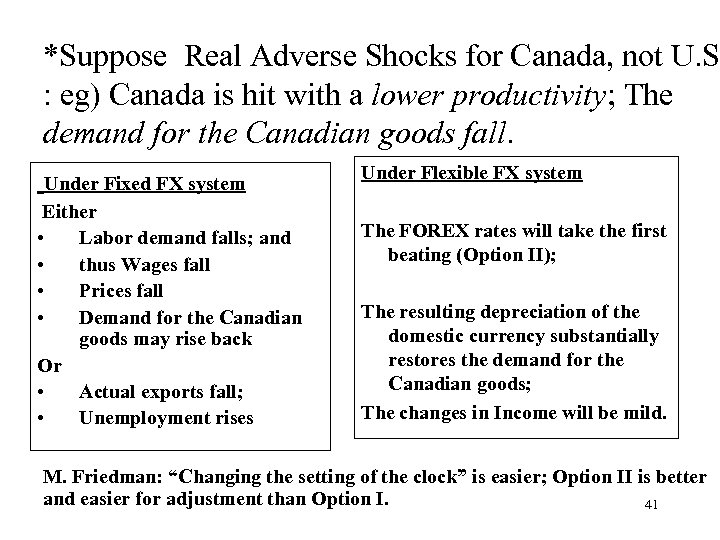 *Suppose Real Adverse Shocks for Canada, not U. S : eg) Canada is hit with a lower productivity; The demand for the Canadian goods fall. Under Fixed FX system Either • Labor demand falls; and • thus Wages fall • Prices fall • Demand for the Canadian goods may rise back Or • Actual exports fall; • Unemployment rises Under Flexible FX system The FOREX rates will take the first beating (Option II); The resulting depreciation of the domestic currency substantially restores the demand for the Canadian goods; The changes in Income will be mild. M. Friedman: “Changing the setting of the clock” is easier; Option II is better and easier for adjustment than Option I. 41