


 Скачать презентацию Exchange market as a part of international financial
9da84082fab143168d10dba49a07a72b.ppt
- Количество слайдов: 16
 Exchange market as a part of international financial markets, participants and functions of exchange markets Andrea Ubrežiová Jana Zentková MPA, 2007/2008
 Exchange market (EM) n A place, where the supply of foreign currencies meets the demand for them and where the price of particular currencies is created – the exchange rate n A mechanism, which enables access to foreign currencies in international trade and international financial transactions n It is the biggest and most liquid market in the world, belongs to the oldest markets n The most important EMs are situated in the large financial world centres, e. g. London, New York, Paris, Frankfurt, Tokyo and create one global international EM
 n Exchange transaction – exchange of financial means, short -term receivables and obligations in one currency on the other one EM from time point of view: 1. Prompt EM 2. Term EM - forwards - swap - financial futurities - option From territorial point of view: 1. EM of particular states 2. International markets n
 Trading on EM 1. Over the counter trade - - in the form of freely accessible secondary market Exchange operations are informal Unorganized way of trading 90 % of all transactions 2. Stock exchange - Trading conditions are set by stock exchange regulations In the public place Participants must be members of the stock exchange - - § It’s necessary that EM trades 24 hours/day, because exchange rates and market conditions can vary anytime and are influenced by current events in the world
 n EM is a system of these components: a) Market forces (market mechanism) Financial bank and non-bank institutions and other participants of EM Financial tools in foreign currencies Types of exchange trade and their techniques b) c) d) n n n The national EMs are connected and have global character The integration process is a result of free exchange of national currencies and progressive development of the world-wide currency market EM is connected also through off-shore banking centres, the tax breaks which provide investors with many advantages, but are risky as well. (Singapore, Hong Kong, Panama, etc. )
 n ü ü ü Liquidity of EM depends on: the amount of potential participants in the worldwide scale, who are available EM trades the most intensively when 2 basic world markets are opened – the american and main markets in Europe On the currency of trade n Exchange rate – is the price of one currency expressed in other currency, it’s the relative price of two national currencies Quotation of exchange rates: 1. Direct exchange list n – mostly used We use 2 currencies in exchange transactions - basic (usually USD) and variable. 2. Indirect exchange list
 n 1. 2. 3. n 1. 2. 3. Exchange rates can be divided according to: financial tools: - valutove - devizove time point of view: - prompt - term types of trade: - prompt - forward - futures - option Basic types of exchange trade: Prompt – immediate, spot trading (arbitrage) Term – forwards, futures, option trades Combined prompt and term trades – swap operations.
 Participants of International Exchange Market = each economic subject that offers or purchases foreign currency n • • • n § § Main subjects (financial institutions): Commercial banks and their exchange brokers (dealers) Central banks Hedge funds, insurance companies, mutual funds and others Non-financial institutions: Export and import companies citizens
 n n n 1 2 Commercial banks – offer a number of services associated with EM (trading among banks, on behalf of their customers) Market makers – buy or sell foreign exchange /FE/(help of brokers) Trade among them can be direct or indirect, they quote bid and offer difference between these two prices is bid-offer spread (bid-offer/bid)*100 Central banks Main goal: to stabilize (influence)the exchange rate of domestic currency due to its : Appreciation Depreciation
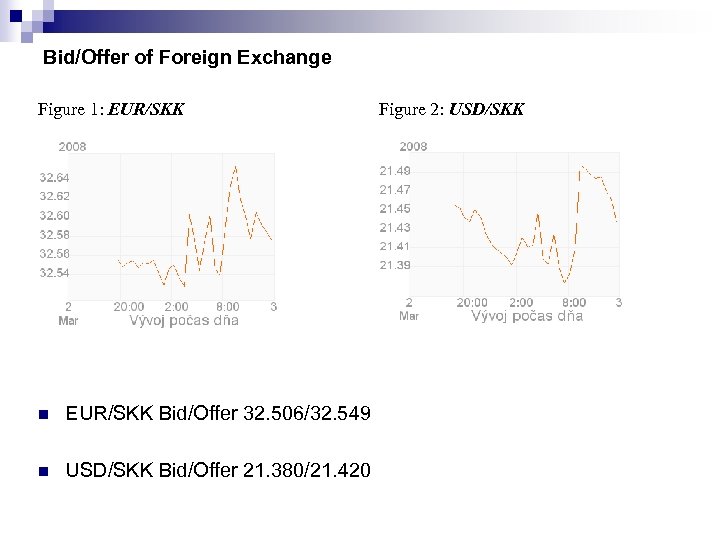 Bid/Offer of Foreign Exchange Figure 1: EUR/SKK n EUR/SKK Bid/Offer 32. 506/32. 549 n USD/SKK Bid/Offer 21. 380/21. 420 Figure 2: USD/SKK
 n n n Hedge funds – provide aggressive currency speculations since 1990 (Soros Fund Management) control billions of dollars of equity volumes of these operations are high - speculations are backed by loans Brokers – agents/mediators among market makers do not have an open position on EM trade on behalf of customers for a fee/percentage from the value of a contract security of information and liquidity of EMs Insurance companies, mutual funds – wide range of services for international investors (export/import)
 n 1. 2. - 2 types of trading on EMs: Trading on interbank market /commercial, central banks, non-bank institutions Trading on retail market /export and import companies – sell/buy FE in liabilities, insure their assets, try to find optimal structure of their FE accounts Non-financial participants position of export and import companies on EM: Opened Closed Citizens (tourists, foreign investors…)
 Functions of EM n n 1. 2. 3. 4. n Basic function – to shift financial funds from one country to another and to identify the price of FE / FE rate There are 4 main functions of EM: Security of foreign currencies Hedging Exchange speculations Exchange arbitrage Security of foreign currencies – opportunity to change sum of money in one currency for another sum in a different currency
 n Hedging – risk occurs when supply and demand of foreign exchange in time - Insurance against adverse change of exchange rate during purchasing or financial contracting n Exchange speculations – are operations, which are based on prediction of future development of exchange rate Opposite of hedging Speculations can be divided: Stable speculations Unstable speculations 1) 2)
 n Exchange arbitrage – purchase of one currency in one financial EM and its selling in other n Aim: reach profit from the price difference in two or three financial exchange markets n Arbitrage can be divided into: Direct arbitrage (two-side) Indirect arbitrage (triangular, three-side) 1. 2.
 Thank you for your attention!