Скачать презентацию Exchange and the Saints Gift-Giving and Commerce of
Exchange and the Saints.pptx
- Количество слайдов: 26
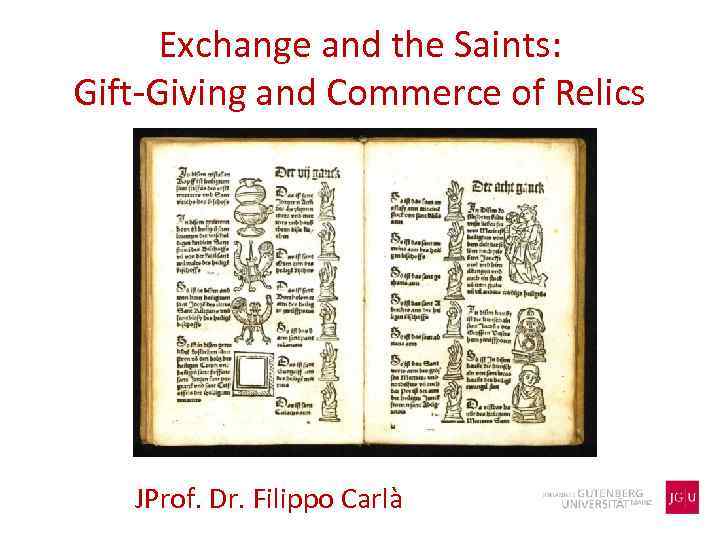 Exchange and the Saints: Gift-Giving and Commerce of Relics JProf. Dr. Filippo Carlà
 Mrs Rose’s Interview (Cheal 1988) “I appreciate these things, and they mean something to me, because I remember the occasion they were given on, and that it was from my mother, and the relationship we’ve had. And this is why I think that it’s good to give gifts, because it does sort of cement a relationship and it gives you something to remember a person by. That’s why I object to money. Money is kind of cold. It’s spent usually on nothing in particular, and when it’s gone the memory’s gone”.
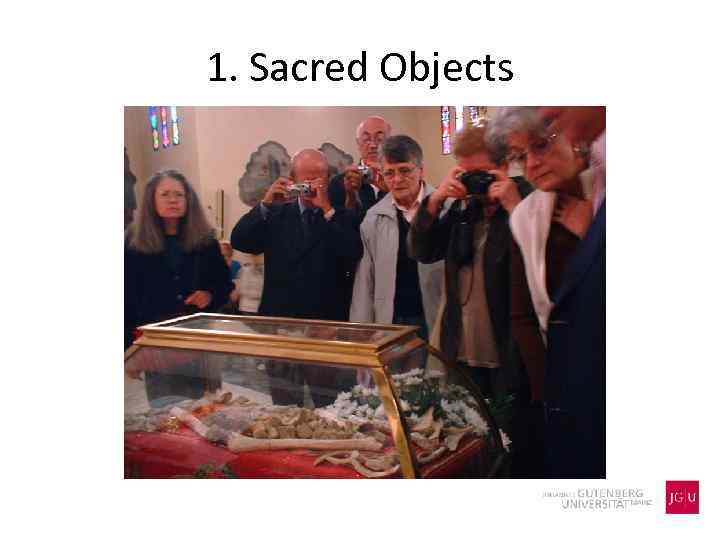 1. Sacred Objects
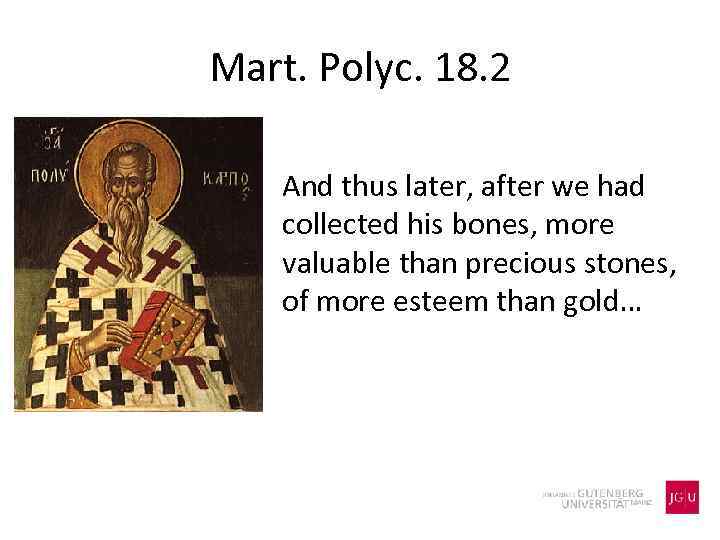 Mart. Polyc. 18. 2 And thus later, after we had collected his bones, more valuable than precious stones, of more esteem than gold…
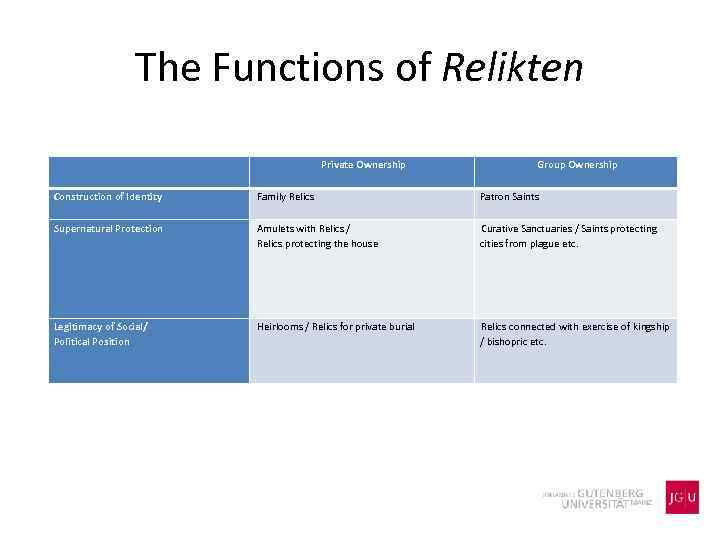 The Functions of Relikten Private Ownership Group Ownership Construction of Identity Family Relics Patron Saints Supernatural Protection Amulets with Relics / Relics protecting the house Curative Sanctuaries / Saints protecting cities from plague etc. Legitimacy of Social/ Political Position Heirlooms / Relics for private burial Relics connected with exercise of kingship / bishopric etc.
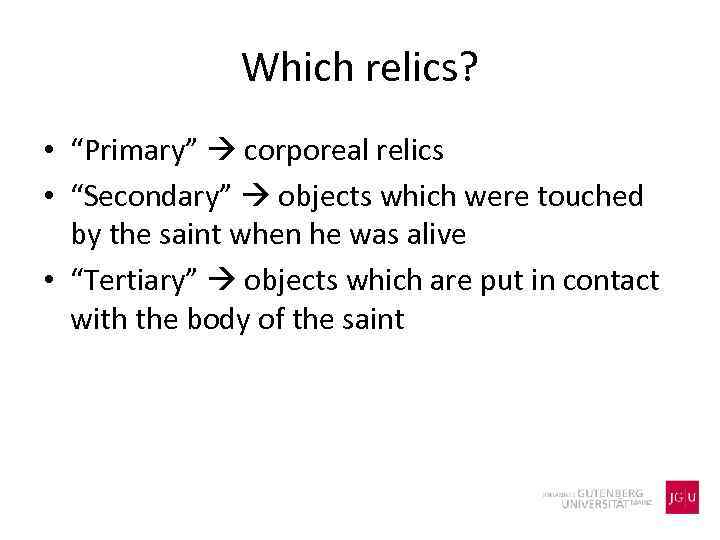 Which relics? • “Primary” corporeal relics • “Secondary” objects which were touched by the saint when he was alive • “Tertiary” objects which are put in contact with the body of the saint
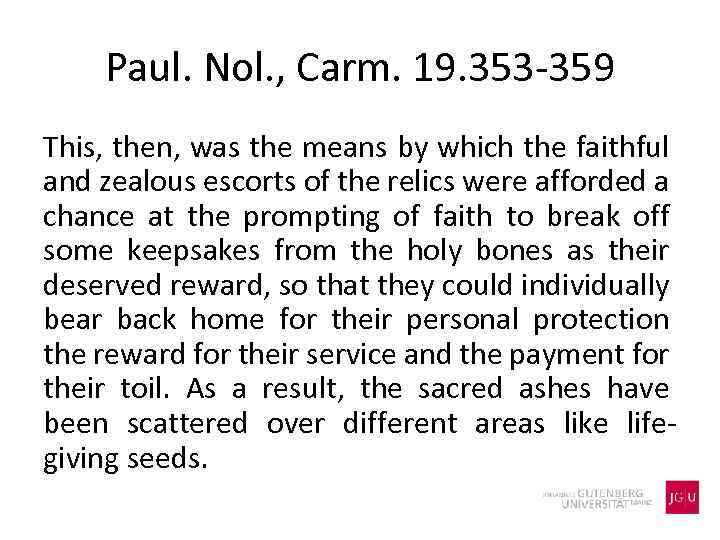 Paul. Nol. , Carm. 19. 353 -359 This, then, was the means by which the faithful and zealous escorts of the relics were afforded a chance at the prompting of faith to break off some keepsakes from the holy bones as their deserved reward, so that they could individually bear back home for their personal protection the reward for their service and the payment for their toil. As a result, the sacred ashes have been scattered over different areas like lifegiving seeds.
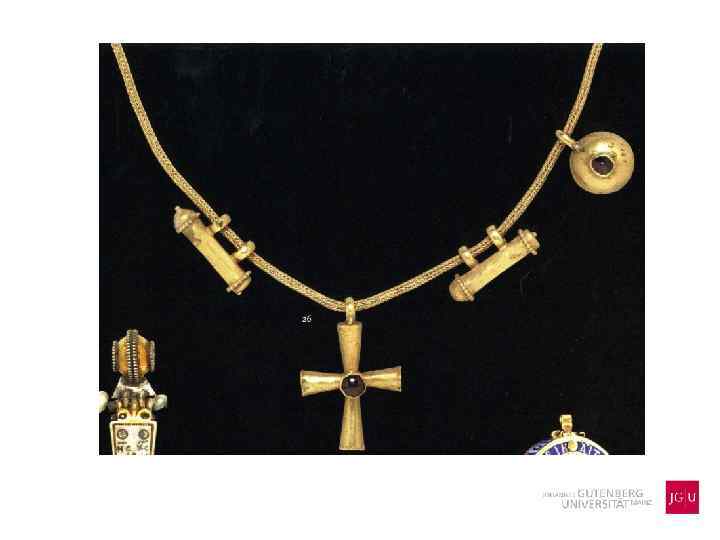
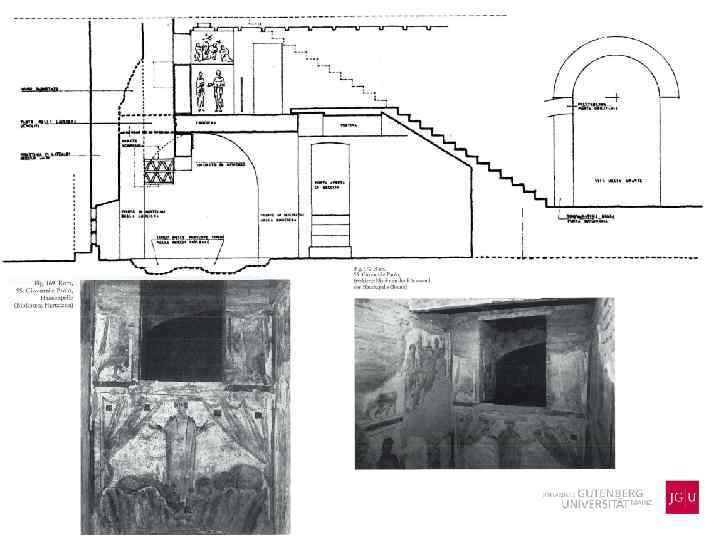
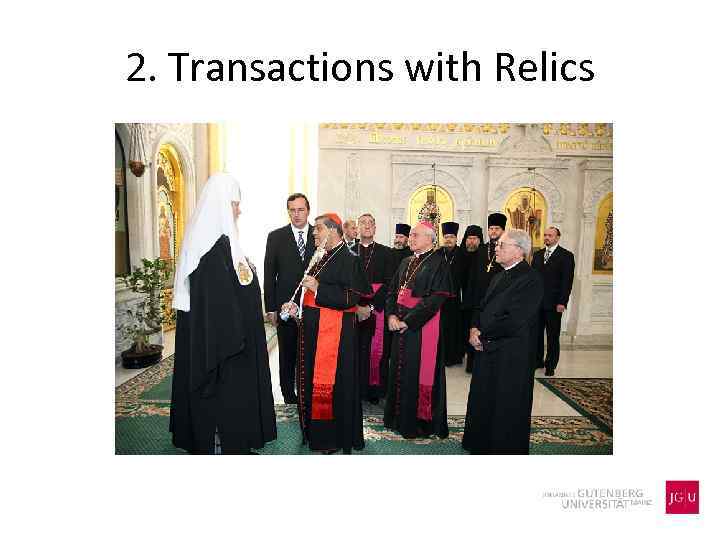 2. Transactions with Relics
 How do I acquire relics? • I find them (inventio) / I assist to the martyrium / I produce them ( division; contact relics) • Voluntary exchange: gift / testamentary bequest “valeur de lien” (Godbout) / “tie-signs” (Cheal)
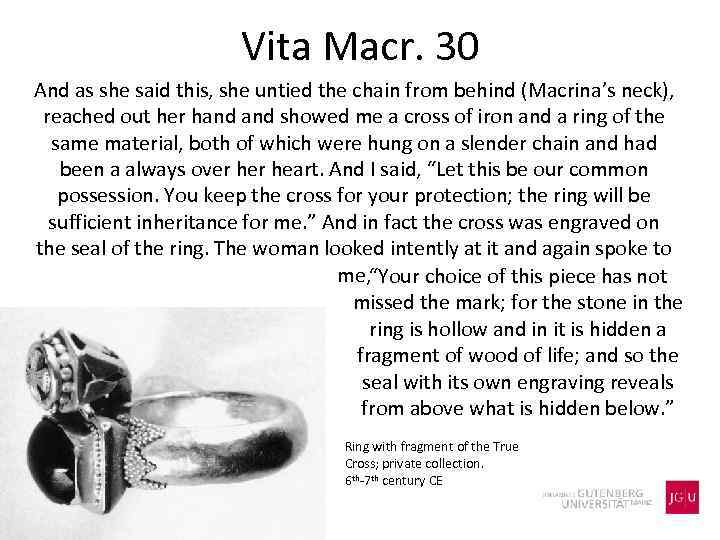 Vita Macr. 30 And as she said this, she untied the chain from behind (Macrina’s neck), reached out her hand showed me a cross of iron and a ring of the same material, both of which were hung on a slender chain and had been a always over heart. And I said, “Let this be our common possession. You keep the cross for your protection; the ring will be sufficient inheritance for me. ” And in fact the cross was engraved on the seal of the ring. The woman looked intently at it and again spoke to me, “Your choice of this piece has not missed the mark; for the stone in the ring is hollow and in it is hidden a fragment of wood of life; and so the seal with its own engraving reveals from above what is hidden below. ” Ring with fragment of the True Cross; private collection. 6 th-7 th century CE
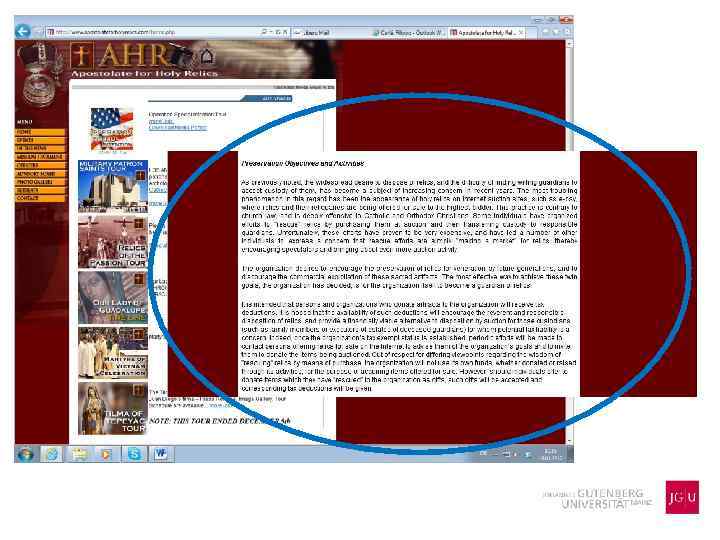
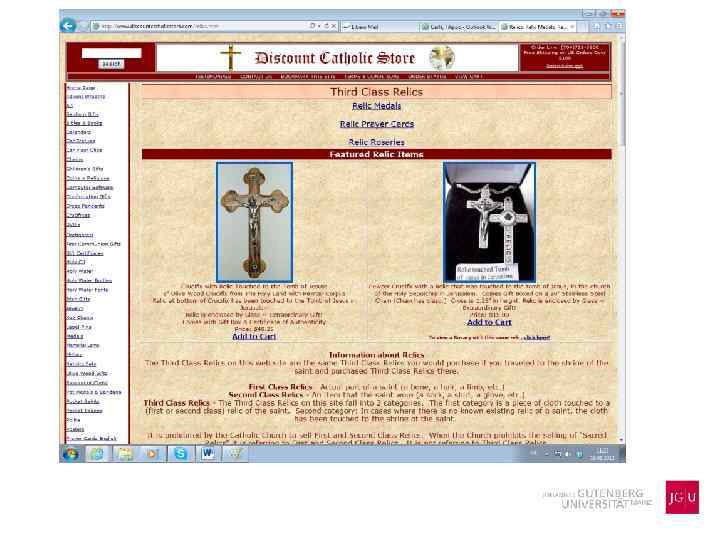
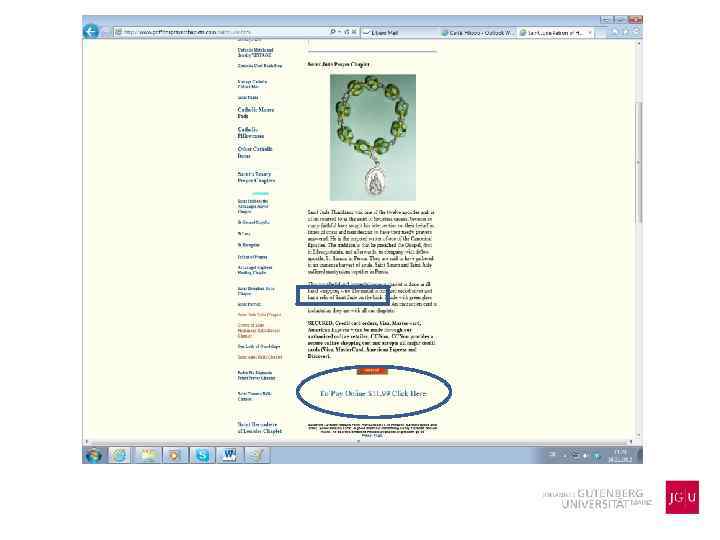
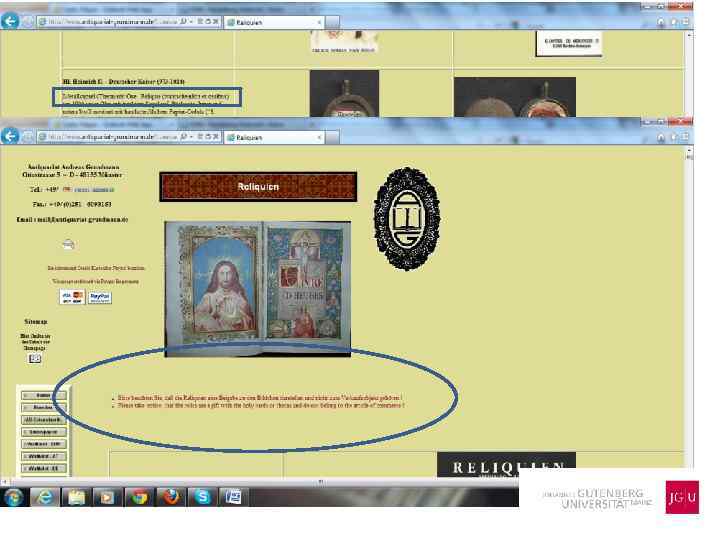
 How do I acquire relics? • I find them (inventio) / I assist to the martyrium / I produce them (division; contact relics) • Voluntary exchange: gift / testamentary bequest “valeur de lien” (Godbout) / “tie-signs” (Cheal) • “Violent” exchange: theft / conquest • I buy them (commercial exchange)
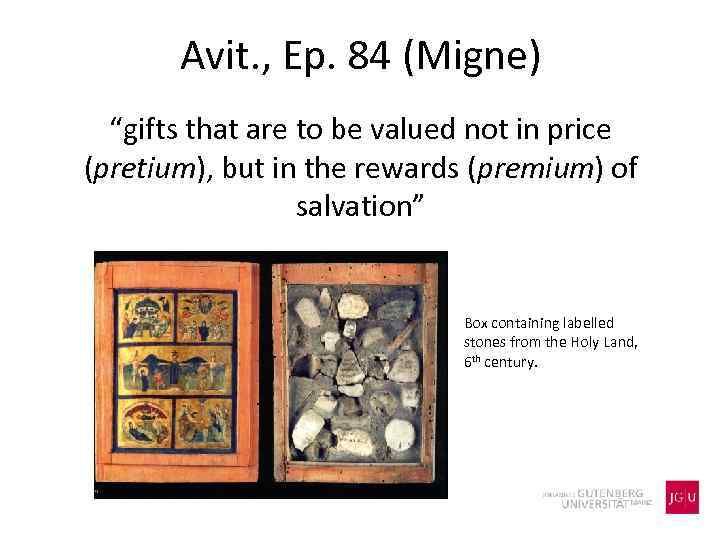 Avit. , Ep. 84 (Migne) “gifts that are to be valued not in price (pretium), but in the rewards (premium) of salvation” Box containing labelled stones from the Holy Land, 6 th century.
 3. Desire and Demand
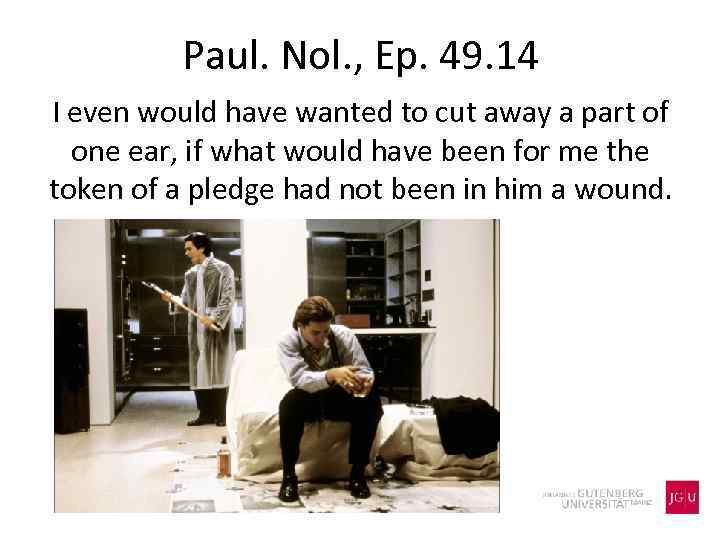 Paul. Nol. , Ep. 49. 14 I even would have wanted to cut away a part of one ear, if what would have been for me the token of a pledge had not been in him a wound.
 P. Geary, The Ninth-Century Relic Trade: A Response to Popular Piety? , in J. Obelkevich (Ed. ), Religion and the People, 800 -1700, Chapel Hill 1979, pp. 8 -19. “For the merchants, relics were an excellent article of trade. They were small and easily transported, since even entire bodies of saints centuries old were nothing more than dust and a few bones which could be placed in a small cloth bag. As highly desirable luxury items, they brought an excellent price for very little capital investment. The risks were immaterial except for the danger of the wrath of the local populace at having their patron stolen if one bothered to steal genuine relics and the constant danger that the thief might himself lose the relics to another thief it he were not careful. Perhaps best of all, owing to lack of communication and information as well as to the peculiar nature of the items traded, the fact that the body of a particular saint had already been sold did not prevent one from selling it again to another customer at some future time”
 Why should not relics be sold? • It can imply their division • It can imply juridical problems • They can be bought by ANYONE • They lose their “bonding-value” (they lose “symbolic utility”: “extended utility” coincides now eith “substantive utility”).
 CTh 9. 17. 7 The same Augustus to Cynegius, Pratorian Prefect. No Person shall transfer a buried body to another place. No person shall sell the relics of a martyr; no person shall traffic in them. But if anyone of the saints has been buried in any place whatever, persons shall have it in their power to add whatever building they may wish in veneration of such a place, and such building must be called a martyry. Given on the fourth day before the kalends of March at Constantinople in the year of the consulship of Emperor Designate Honorius and of Evodius. February 26 th, 386.
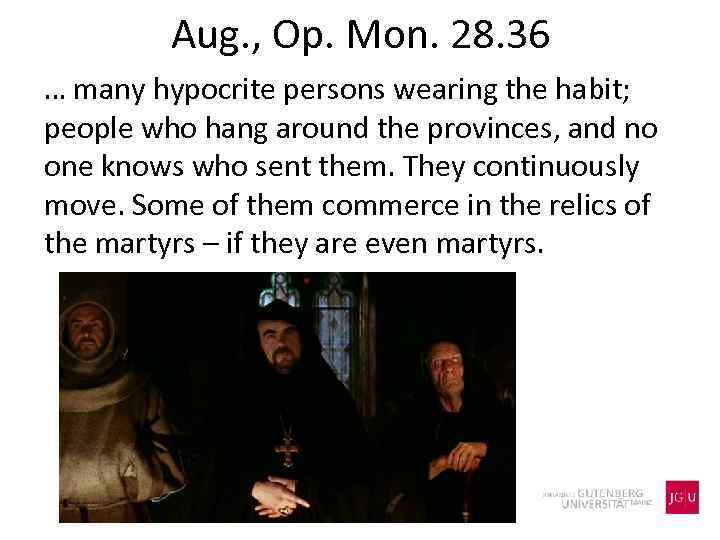 Aug. , Op. Mon. 28. 36 … many hypocrite persons wearing the habit; people who hang around the provinces, and no one knows who sent them. They continuously move. Some of them commerce in the relics of the martyrs – if they are even martyrs.
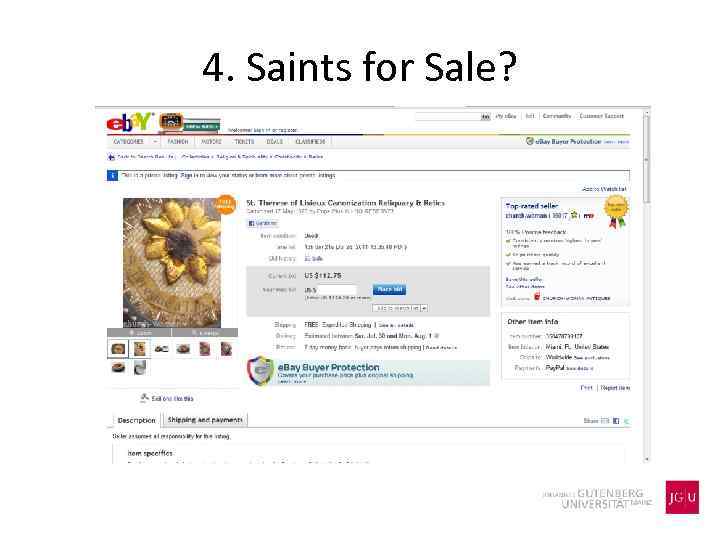 4. Saints for Sale?