 Скачать презентацию Excellence in Governance for CAA Boards 2011 Texas
040f97cffdfc140cbc03d538480ed25a.ppt
- Количество слайдов: 90



Excellence in Governance for CAA Boards 2011 Texas Community Action Agency August 3, 2011 Anita Lichtblau, Esq. Executive Director/General Counsel Community Action Program Legal Services (CAPLAW) www. caplaw. org 617. 357. 6915 This workshop is not intended as legal advice. Consult with a Texas attorney for advice on legal issues. © 2011 Community Action Program Legal Services, Inc.
Agenda– Who, How, and What? • • • Governance Trends What law governs CAA boards? What are a CAA board’s duties? Head Start board requirements IRS Form 990 Areas to look at: – – – – Board composition and selection Certificate of Formation and bylaws Board-executive director relationship Board orientation and training Board meetings Board committees Financial literacy and oversight Governance and other policies © 2011 Community Action Program Legal Services, Inc. 2
Governance Trends • • More active, informed boards Greater accountability and oversight over nonprofit Due diligence in selecting board members Transparency – Disclosure of financial info and policies on website • Panel on the Nonprofit Sector – Principles for Good Governance • Revised Form 990 • Head Start Reauthorization © 2011 Community Action Program Legal Services, Inc. . 3
Grant Thornton 2009 National Nonprofit Board Governance Survey ¡ Formal process to review 73% executive compensation ¡ Whistleblower policy 84% ¡ Finance committee 83% ¡ Audit committee 65% ¡ Audit committee includes CPA 74% ¡ Auditor met with full board 38% ¡ Board or committee reviews IRS 78% Form 990 © 2011 Community Action Program Legal Services, Inc. 4
What Law Governs CAA Boards? • Federal CSBG Act – Tripartite board provision – 42 U. S. C. § 9910 – OCS Information Memorandum 82 (IM 82) – guidance only, not binding; available on OCS website: http: //www. acf. hhs. gov/programs/ocs/csbg/guidance/im 82. html • Texas CSBG Statute: Tex. Gov't Code §§ 2306. 092 and 2306. 097 • Texas CSBG regulations: 10 TAC §§ 5. 1 – 5. 22 and §§ 5. 201– 5. 217 • Private CAAs – Texas Business Organizations Code, Title 2, Chapter 22 • Public CAAs – delegation of authority from political subdivision • Head Start Act – 42 U. S. C. § 9801 et seq. © 2011 Community Action Program Legal Services, Inc. 5
Who? • CAA Board Composition © 2011 Community Action Program Legal Services, Inc. 6
Tripartite Board Composition • CSBG requires three sectors: – Exactly 1/3 public officials or their representatives – At least 1/3 low-income representatives – Balance from major groups or interests in the community served • Directors are to be chosen by grantee – Must use democratic selection process for low-income directors • (42 U. S. C. § 9910; 10 T. A. C. § 5. 213) © 2011 Community Action Program Legal Services, Inc. 7
Public Official Directors • Under federal law, no longer required to include or be chosen by “chief elected officials” – For private CAAs, best to specify in bylaws that CAA itself elects public official directors – but not to specify which ones – Texas – CAAs may permit governing officials of political jurisdiction to select and/or recommend officials for board – Texas – For public CAAs, public organization may selected officials for board • If elected officials not available, may select appointed officials instead • Texas - Officials must either have general governmental responsibilities or responsibilities that require them to deal with poverty-related issues • (10 T. A. C. § 5. 213 (d)) © 2011 Community Action Program Legal Services, Inc. 8
Public Official Directors cont. • CSBG Act says “holding office at time of selection” [to CAA Board] – OCS IM 82 recommends that public officials serve only while they are in office • Seat filled by official or her representative – Texas – Official may choose permanent representative to serve on board in either full-time capacity or in place of official when she is unable to attend – Representative must have full authority to act for public official at board meetings – Or, official may designate alternate – Only permanent representatives may be officers • (10 T. A. C. § 5. 213 (d)) © 2011 Community Action Program Legal Services, Inc. 9
Low-Income Directors – Private CAAs • CSBG requires democratic selection to assure that they are representative of low-income people in service area • If chosen to represent a particular neighborhood, must live there • (42 U. S. C. § 9910; 10 T. A. C. § 5. 213) © 2011 Community Action Program Legal Services, Inc. 10
Low-Income Directors – Public CAAs • Must be representative of low-income individuals and families in service area • Must live in service area • Must be able to participate actively in development, planning, implementation and evaluation of CSBG programs • (10 T. A. C. § 5. 213 and § 5. 213) © 2011 Community Action Program Legal Services, Inc. 11
Do They Need to Be Low-Income Themselves? • Should represent current low-income residents, but don’t need to be low-income themselves – CAA BEST PRACTICE: Have at least some lowincome directors who are or were low-income themselves © 2011 Community Action Program Legal Services, Inc. 12
Democratic Selection • Broad array of processes available, e. g. : – Nominations and elections by ballot in neighborhood or entire community – Selection at open community meeting to which poor are invited – Elected by or designated from elected leaders of predominantly low-income groups (e. g. Head Start Policy Council, neighborhood ass’n, public housing tenants’ ass’n, community health center board ) – Selected by boards of neighborhood-based groups who themselves are selected by residents • Selection process must be documented to show democratic process © 2011 Community Action Program Legal Services, Inc. 13
Democratic Selection cont. • Should not be chosen simply by CAA board or nominating committee • Should not be staff of another low-income service provider picked by CAA board or nominating committee or by executive director of other organization © 2011 Community Action Program Legal Services, Inc. 14
Democratic Selection cont. • Bylaws may, but do not need to, describe democratic selection procedure – If not described in bylaws, selection procedure should be described in a separate document referred to in the bylaws and approved by the board © 2011 Community Action Program Legal Services, Inc. 15
Private Sector • Officials or members of business, industry, labor, religious, welfare, education, law enforcement, or other major groups and interests in community served – May include both private and public sector groups and interests • CAA may select representatives from organizations or individuals – If choosing reps from organizations, board has more flexibility if bylaws don’t specify which organizations • (42 U. S. C. § 9910; 10 T. A. C. § 5. 213) © 2010 Community Action Program Legal Services, Inc. 16
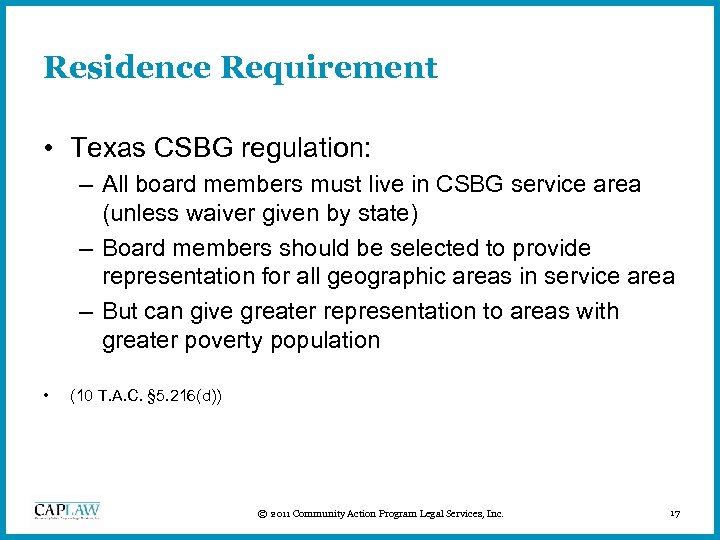
Residence Requirement • Texas CSBG regulation: – All board members must live in CSBG service area (unless waiver given by state) – Board members should be selected to provide representation for all geographic areas in service area – But can give greater representation to areas with greater poverty population • (10 T. A. C. § 5. 216(d)) © 2011 Community Action Program Legal Services, Inc. 17
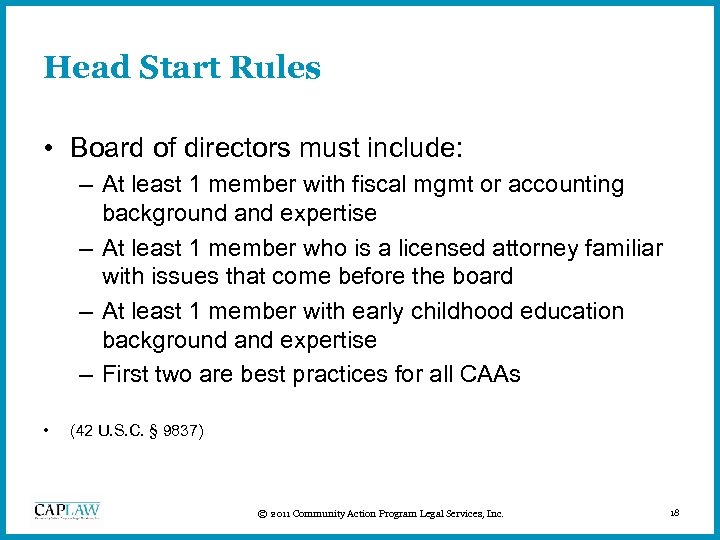
Head Start Rules • Board of directors must include: – At least 1 member with fiscal mgmt or accounting background and expertise – At least 1 member who is a licensed attorney familiar with issues that come before the board – At least 1 member with early childhood education background and expertise – First two are best practices for all CAAs • (42 U. S. C. § 9837) © 2011 Community Action Program Legal Services, Inc. 18
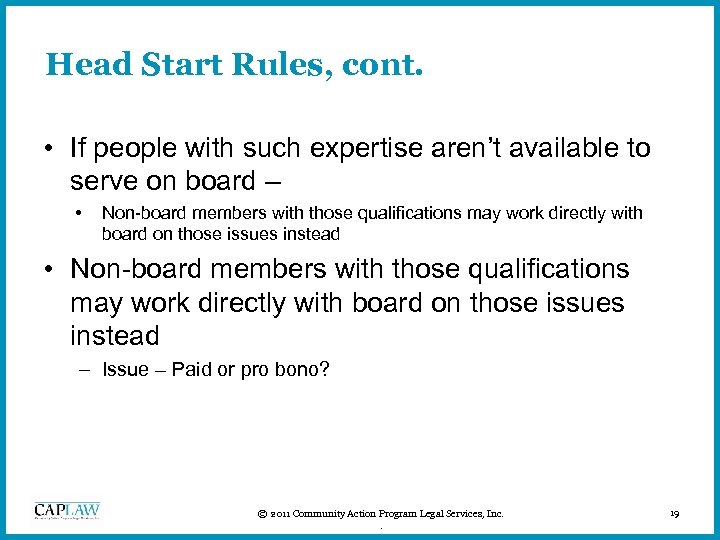
Head Start Rules, cont. • If people with such expertise aren’t available to serve on board – • Non-board members with those qualifications may work directly with board on those issues instead • Non-board members with those qualifications may work directly with board on those issues instead – Issue – Paid or pro bono? © 2011 Community Action Program Legal Services, Inc. . 19
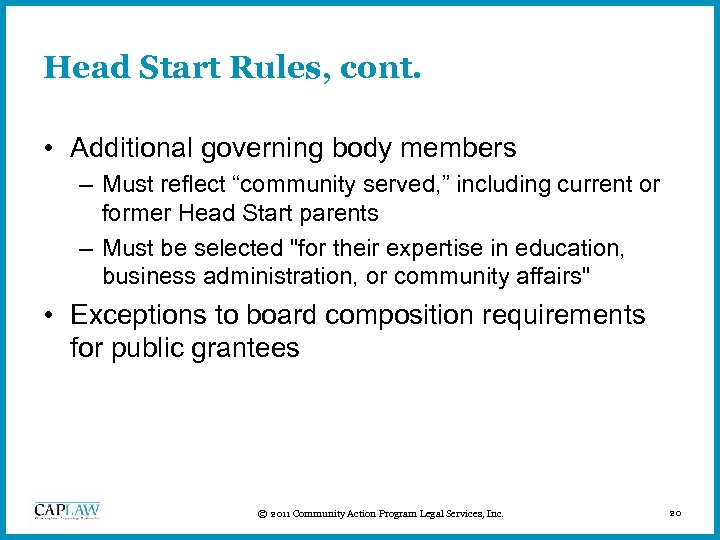
Head Start Rules, cont. • Additional governing body members – Must reflect “community served, ” including current or former Head Start parents – Must be selected "for their expertise in education, business administration, or community affairs" • Exceptions to board composition requirements for public grantees © 2011 Community Action Program Legal Services, Inc. 20
Head Start Rules, cont. • No financial conflict of interest – Board members may not have financial conflict of interest with grantee or delegate agency and may not receive compensation for serving on board or for providing services to grantee • Board members and immediate family members may not be employed by grantee or delegate agency • Board must operate independently of grantee staff • See OHS Policy Clarifications OHS–PC–E– 027 and OHS–PC–E– 029 available at http: //eclkc. ohs. acf. hhs. gov/hslc (click “Regulations and Policies” drop down menu, under “Policy Clarifications”) © 2011 Community Action Program Legal Services, Inc. 21
Head Start Rules, cont. • Public Head Start grantees: – If person holds public position as result of public election or political appointment; and – Position carries with it concurrent appointment to serve as member of a Head Start grantee board; – That person may serve on grantee board even if: • s/he receives compensation for serving on Board or providing services to Head Start grantee; or • s/he or immediate family member works for grantee or delegate agency • But grantee must report conflict to HHS © 2011 Community Action Program Legal Services, Inc. 22
Board Selection Procedure • Create board development/governance committee to oversee selection process • Require applications – Applicants sign certification re no disbarment or convictions of certain offenses and conflicts of interest policy • Determine skills and background needed • Use spreadsheet to track fulfillment of requirements • Full board elects directors once chosen through appropriate selection process • Unless bylaws specify otherwise, ex officio members not entitled to vote © 2011 Community Action Program Legal Services, Inc. 23
Petitions for Board Representation • Low-income individuals, community organization, religious organization or representative of lowincome individuals that considers its organization, or low-income individuals, to be underrepresented on the CAA board may petition for representation • CAAs must establish procedures for petition • (42 U. S. C. § 9908(b)(10)) © 2011 Community Action Program Legal Services, Inc. 24
Board Size • Neither federal CSBG Act nor TX CSBG regs address board size • TX corporate law requires at least 3 directors – (TX BUS ORG § 22. 204) • Factors to consider © 2010 Community Action Program Legal Services, Inc. 25
Term Limits • Nonprofit CAAs – If bylaws don’t specify term, director holds office until next annual election of directors – (TX BUS ORG § 22. 208) • Public CAAs – Specified in delegation from public body or bylaws © 2010 Community Action Program Legal Services, Inc. 26
Term Limits • Specify board members’ terms in bylaws – Board members from each sector should have specific term • May provide for staggered terms • Different sectors may have different length terms © 2010 Community Action Program Legal Services, Inc. 27
Term Limits • Texas CSBG regs: – Board may establish term limits in bylaws (10 T. A. C. § 5. 215 (a)) • Since federal CSBG Act does not address term limits, CAA board members may serve for any number of successive terms – Individual CAAs may decide to have term limits – Some CAAs permit board members who have reached their term limits to re-join the board after a break (e. g. , 1 year) © 2010 Community Action Program Legal Services, Inc. 28
Vacancies • Should be filled as soon as reasonably possible • May not have 25% or more of public or lowincome seats vacant for more than 90 days • CAAs must report monthly to TDHCA number of board vacancies • (10 T. A. C. § 5. 215(b)(1)) © 2011 Community Action Program Legal Services, Inc. 29
Removal of Directors • CAA BEST PRACTICE: Include strong removal provisions in bylaws – Permit board to remove any director (including public officials) • With or without cause? • Examples of cause: false certification on board application, unexcused absences from a certain number of board meetings, failure to comply with CAA policies, taking actions against the best interests of the CAA, incapacity • (TX BUS ORG § 22. 211) © 2011 Community Action Program Legal Services, Inc. 30
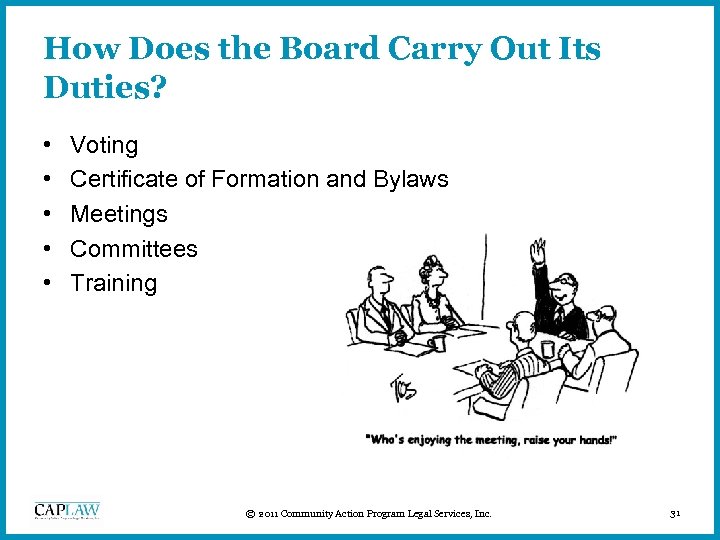
How Does the Board Carry Out Its Duties? • • • Voting Certificate of Formation and Bylaws Meetings Committees Training © 2011 Community Action Program Legal Services, Inc. 31
Voting Issues • Alternates permitted (Texas CSBG regs) – If low-income and private sector organizations have alternates, should select or be designated at same time as regular board member • Votes by email or phone polling not allowed • Quorum – The lesser of: – Majority of number of directors set by bylaws or certificate of formation; or; – Any number, not less than three, set as a quorum by the certificate of formation or bylaws. – (TX BUS ORG§ 22. 213) • No telephone conference call meetings except if emergency conditions apply – (TX BUS ORG§ 22. 002) © 2011 Community Action Program Legal Services, Inc. 32
Alternates • Alternates permitted, but… – Alternates not permitted to hold officer positions on board – If low-income and private sector organizations have alternates, should select or be designated at same time as regular board member (10 T. A. C. § 5. 213 (d)(1)(B)(ii)) – Although proxy voting is permitted by TX nonprofit corporations law, it is prohibited by Texas Open Meetings Act (See Tex. Govt. Code. Ann. Ch. 551; see also Tex. Att’y Gen. LO 94 -028 (1994); Op. Tex. Att’y Gen. No. JM-903 (1988)) © 2010 Community Action Program Legal Services, Inc. 33
Alternates • So, don’t permit alternates to vote, but can permit them to: – Attend meetings and report to primary board member – Fill vacancies © 2010 Community Action Program Legal Services, Inc. 34
Certificate of Formation and Bylaws • CAA BEST PRACTICE: Review certificate of formation (for private CAAs) and bylaws at least once every 3 years • Purpose statement should be in certificate of formation for private CAAs – Neither it nor mission statement needed in private CAA bylaws • Bylaws – see CAPLAW Bylaws Toolkit for main issues CAA bylaws usually address (not all topics apply to public CAA bylaws) – Info on ordering at www. caplaw. org under “Publications” © 2011 Community Action Program Legal Services, Inc. 35
Quorum • Specify quorum requirement in bylaws • State specifically needed fraction of voting directors then in office – Most nonprofits use majority of directors in office as quorum © 2011 Community Action Program Legal Services, Inc. 36
Board Meetings • How often does board meet? – Texas CSBG regs: • Once per calendar quarter and at least 5 times/year – (10 T. A. C. § 5. 217(a)) • Notice must be given to board members 5 days in advance of meeting • Any problems meeting quorum requirements? • Sanctions for failure to attend? • Who sets agendas – board chair/executive committee and ED or just ED/management? • Are minutes of previous meeting, committee reports, financial information etc. distributed before the meeting? © 2011 Community Action Program Legal Services, Inc. 37
Board Meetings, cont. • Any problems meeting quorum requirements? • Sanctions for failure to attend? • Who sets agendas – board chair/executive committee and ED or just ED/management? • Are minutes of previous meeting, committee reports, financial information etc. distributed before meeting • What happens at board meetings–just reporting by committees or staff or discussion of critical issues for board decision ? • How active are board members? Read materials in advance? Informed? Ask questions? © 2010 Community Action Program Legal Services, Inc. 38
Open Meetings Act • Under Texas law, CAAs are subject to Open Meetings Act (and Public Information Act) • In general, board meetings must be open to the public, except for authorized executive sessions • Public must be given notice of time, place, subject matter of meetings • (Tex. Gov’t. Code. Ann. Ch. 551) © 2011 Community Action Program Legal Services, Inc. 39
Open Meetings: Executive Session • Consultation with attorney re pending or contemplated litigation, settlement matters or other matters requiring confidentiality • Certain discussions re real estate, negotiated contracts, prospective gifts or donations • Certain employment matters • Final action must be in open meeting © 2011 Community Action Program Legal Services, Inc. 40
Minutes: Texas CSBG Regulation • Minutes must be taken of all open meetings – Record of members present by category – Items presented to board for action – Votes on all motions • Distribute minutes of previous meeting before next meeting • Available to public upon request • (Tex. Gov’t. Code. Ann. 551. 021) © 2011 Community Action Program Legal Services, Inc. 41
Board Committees • Do committees specified in bylaws and board resolutions reflect CAA’s current operations? • Were committees created as provided in by-laws? • What authority do committees have? • How often do committees meet? • What do they do? Written descriptions? • Several important committees: – Executive committee (depending on board size) – Finance/audit committee – Governance/board development committee © 2011 Community Action Program Legal Services, Inc. 42
Committees, cont. • Texas law: – If committee is given full authority of board, it must be designated by resolution approved by a majority of directors in office • (TX BUS ORG § 22. 218) – If not given such authority, may be designated by majority of quorum at meeting or by president authorized by such resolution • (TX BUS ORG § 22. 219) © 2011 Community Action Program Legal Services, Inc. 43
Committees, cont. • Use committee charters to set out responsibilities • Require that committees reflect tripartite board structure? • How often do committees meet? • What do they do? Written descriptions? © 2010 Community Action Program Legal Services, Inc. 44
Finance/Audit Committee Functions • • • Select auditor Meet with auditor to determine audit plan Review audit report directly with auditor Ensure corrective action taken Address conflicts of interest and whistleblower complaints © 2011 Community Action Program Legal Services, Inc. 45
Governance/Develop. Committee Functions • Develop and periodically review key organizational governance policies, including conflict of interest and whistleblower policies • Periodically review bylaws and other governing documents • Implement selection process for recruiting new board members, consistent with CSBG Act tripartite board selection requirements © 2011 Community Action Program Legal Services, Inc. 46
Fidelity Bond Coverage • Texas regs require that fidelity bond coverage include all persons authorized to sign or countersign checks or to disburse sizable amounts of cash – Don’t have to bond persons who carry petty cash (less than $250) • (10 T. A. C. § 5. 7) © 2011 Community Action Program Legal Services, Inc. 47
Board Orientation and Training • Does CAA have an orientation process for new board members? – Could include mentoring by existing board members • Does CAA give board members a board handbook? • Does CAA provide regular training for board members? © 2011 Community Action Program Legal Services, Inc. 48
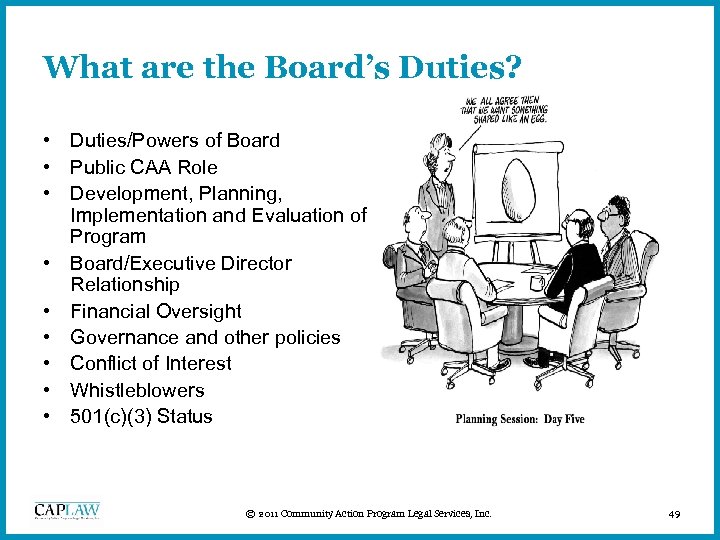
What are the Board’s Duties? • Duties/Powers of Board • Public CAA Role • Development, Planning, Implementation and Evaluation of Program • Board/Executive Director Relationship • Financial Oversight • Governance and other policies • Conflict of Interest • Whistleblowers • 501(c)(3) Status © 2011 Community Action Program Legal Services, Inc. 49
Powers of CAA Boards • For private CAAs, board’s powers set by state corporate law – Texas Business Organizations Code § 22. 201: The affairs of a corporation shall be managed by a board of directors. • For public CAAs, tripartite boards’ powers depend on authority delegated to it by political subdivision – Do not need to be merely advisory boards © 2011 Community Action Program Legal Services, Inc. 50
Duties of Private CAA Boards • Directors have “fiduciary” duties under Texas nonprofit law: carry out duties in good faith, with ordinary care, and in manner s/he reasonably believes to be in best interest of corporation – Duty of care in governing CAA • Be reasonably informed • Participate in decisions, reasonably inquire about matters coming before the board • Do so in good faith and with the care of a prudent person in similar circumstances – Duty of loyalty • Act in the CAA’s best interests, not own or someone else’s • (TX BUS ORG § 22. 221) © 2011 Community Action Program Legal Services, Inc. 51
Federal CSBG Act and Texas CSBG Regulation • Tripartite board administers CAA’s CSBG program – Except for public CAAs in cases where state specifies another mechanism that assures decision-making and participation by low-income individuals • Board fully participates in program’s development, planning, implementation and evaluation • (42 U. S. C. § 9910; 10 T. A. C. § 5. 213(a)) © 2011 Community Action Program Legal Services, Inc. 52
Board Powers: Texas CSBG Regulation • Private CAAs: – Responsible for abiding by terms of contracts – Determine CAA policies to assure accountability for public funding • Public CAAs: – Determined by governing officials of political subdivision • Advisory board or governing board • But must be given authority required by federal CSBG Act to administer CSBG program and participate actively in development, planning, implementation, and evaluation of programs © 2011 Community Action Program Legal Services, Inc. 53
Mission and Strategic Direction • Understand purposes statement in certification formation and, if one exists, separate mission statement – Note: new IRS Form 990 asks re: mission statement • Review existing and proposed activities and transactions against mission • Be sure assets used to further mission • Establish overall strategic direction • Ensure mission and strategic direction are being followed © 2011 Community Action Program Legal Services, Inc. 54
CSBG Duties – Development • Clarifying mission – In-house panel of “experts” on community needs, resources and opportunities – Consistent with certificate of formation • Or amend certificate – Mission statement • Determine whether it still fits • Create good public “soundbite” © 2011 Community Action Program Legal Services, Inc. 55
CSBG Duties – Development • Needs assessment – Participate actively in ensuring completion of Community Needs Assessment and in reviewing assessment results to ensure responsiveness to any identified gaps in services – Source of information/insight on conditions in community – Create outreach and communication strategies within each sector – Gov’t- or privately-sponsored studies, assessments of local economic, social, educational and other conditions © 2011 Community Action Program Legal Services, Inc. 56
CSBG Duties – Planning • Active participation in development and ongoing implementation and evaluation of CAA’s Community Action Plan • Long-range strategic planning – Identify broad goals – Mobilize programs and activities within and outside CAA – Establish and maintain procedures for gathering and presenting info on goals and results © 2011 Community Action Program Legal Services, Inc. 57
CSBG Duties – Planning • Annual planning – Identify what CAA hopes to accomplish each year – Help CAA establish performance expectations – qualitative and quantitative – Work with CAA staff to establish milestones used to track progress during year – Identify ways to strengthen operations © 2011 Community Action Program Legal Services, Inc. 58
CSBG Duties – Implementation • Stay informed of CAA programs and activities throughout the year – Track progress toward milestones; ensure that CAA adjusts performance as necessary to meet milestones • Receive financial information – budgets etc. – and monitor CAA’s finances; work with fiscal staff to ensure finances are on track • Oversee compliance with funding source rules • Be involved in preparing for and responding to monitoring by funding sources © 2011 Community Action Program Legal Services, Inc. 59
CSBG Duties – Evaluation • Obtain information on results of CAA’s programs and activities – Actual changes or improvements in clients and community • Compare outcomes with performance expectations developed during planning process • Oversee data gathering for ROMA and similar evaluation tools for other grants – Participate actively in identification and evaluation of ROMA Performance Outcomes used in measuring CAA’s effectiveness in achieving 6 ROMA goals – ROMA = Results Orientated Management and Accountability © 2011 Community Action Program Legal Services, Inc. 60
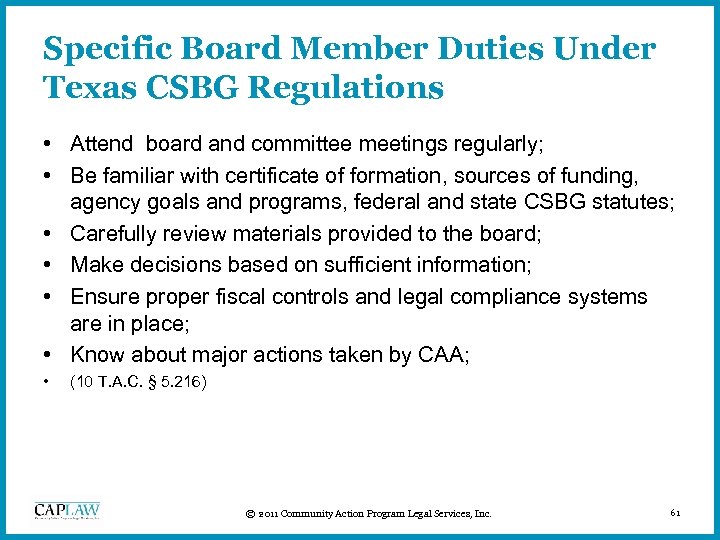
Specific Board Member Duties Under Texas CSBG Regulations • Attend board and committee meetings regularly; • Be familiar with certificate of formation, sources of funding, agency goals and programs, federal and state CSBG statutes; • Carefully review materials provided to the board; • Make decisions based on sufficient information; • Ensure proper fiscal controls and legal compliance systems are in place; • Know about major actions taken by CAA; • (10 T. A. C. § 5. 216) © 2011 Community Action Program Legal Services, Inc. 61
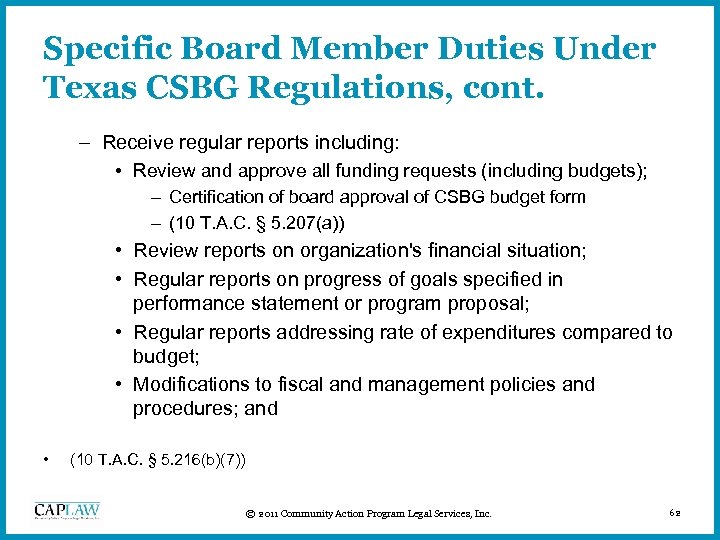
Specific Board Member Duties Under Texas CSBG Regulations, cont. – Receive regular reports including: • Review and approve all funding requests (including budgets); – Certification of board approval of CSBG budget form – (10 T. A. C. § 5. 207(a)) • Review reports on organization's financial situation; • Regular reports on progress of goals specified in performance statement or program proposal; • Regular reports addressing rate of expenditures compared to budget; • Modifications to fiscal and management policies and procedures; and • (10 T. A. C. § 5. 216(b)(7)) © 2011 Community Action Program Legal Services, Inc. 62
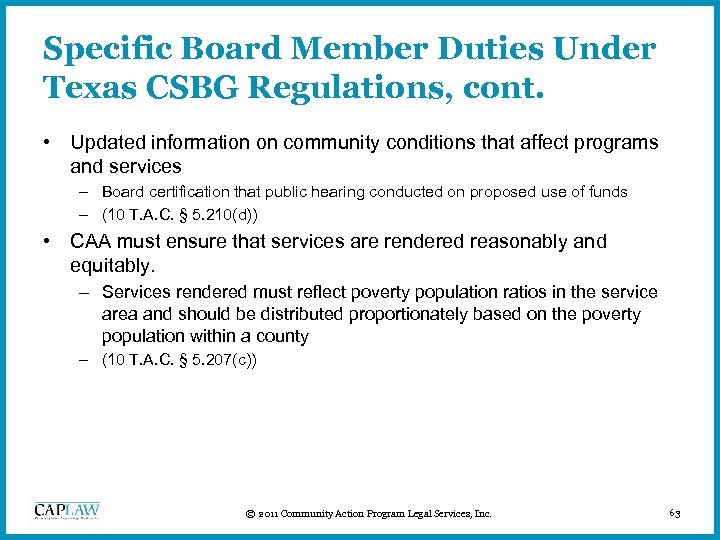
Specific Board Member Duties Under Texas CSBG Regulations, cont. • Updated information on community conditions that affect programs and services – Board certification that public hearing conducted on proposed use of funds – (10 T. A. C. § 5. 210(d)) • CAA must ensure that services are rendered reasonably and equitably. – Services rendered must reflect poverty population ratios in the service area and should be distributed proportionately based on the poverty population within a county – (10 T. A. C. § 5. 207(c)) © 2011 Community Action Program Legal Services, Inc. 63
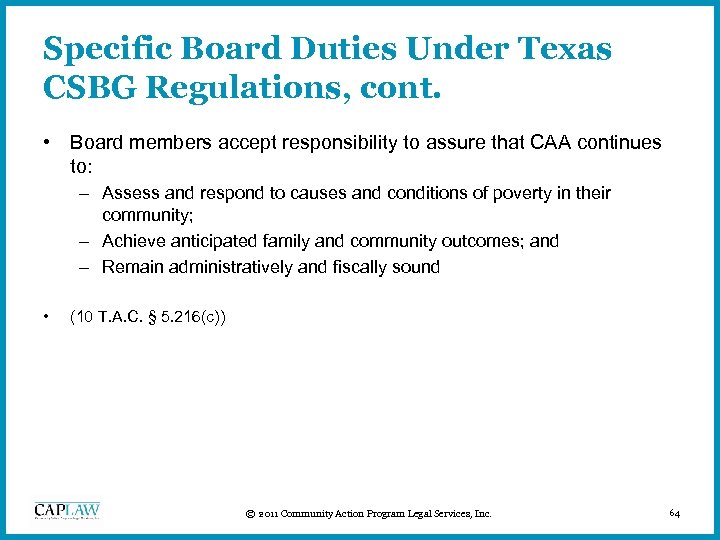
Specific Board Duties Under Texas CSBG Regulations, cont. • Board members accept responsibility to assure that CAA continues to: – Assess and respond to causes and conditions of poverty in their community; – Achieve anticipated family and community outcomes; and – Remain administratively and fiscally sound • (10 T. A. C. § 5. 216(c)) © 2011 Community Action Program Legal Services, Inc. 64
CAA Duties Under Texas CSBG Regulations, cont. • Boards should assure that CAA incorporates integrated case management systems in the administration of CSBG program • (10 T. A. C. § 5. 210(f)) © 2011 Community Action Program Legal Services, Inc. 65
Board-Executive Director Relationship • Board sets mission and policy, executive director and management staff implement policy • Generally, board supervises only one employee: the executive director – Board hires, evaluates, sets compensation for and (if necessary) terminates ED – ED hires staff in accordance with personnel policies set by board (and may consult with board) – Staff generally communicate with board through ED – ED meets regularly with board chair/executive committee – Board provides a balance of support and accountability for ED © 2011 Community Action Program Legal Services, Inc. 66
Financial Oversight • Board responsible for overseeing CAA’s finances – Ensure accurate and current financial records maintained in accordance with GAAP – Regular review, discussion and votes on financial statements and other financial info – e. g. , annual audit, Form 990 • Income and Expense Statements • Cash Flow Statements • Balance Sheets © 2011 Community Action Program Legal Services, Inc. 67
Financial Oversight, cont. – Review and approve CAA’s annual budget and monitor performance against it during year – Approve grant proposals and budgets – Make decisions on major financial transactions – Establish fiscal policies and internal controls and ensure they are being followed – Texas law – Board must annually approve financial report and make available to public • Statement of support, revenue and expenses and changes in fund balances • Statement of functional expenses • Balance sheet • (TX BUS ORG § 22. 352) © 2011 Community Action Program Legal Services, Inc. 68
Financial Oversight, cont. • CAA BEST PRACTICES: – Include one or more financial experts on board – Ensure that other directors are financially literate – Establish audit committee or another committee to perform functions of audit committee – include financial expert(s) © 2011 Community Action Program Legal Services, Inc. 69
Internal Controls • Extend beyond fiscal policies and procedures – involve management, program and administrative functions • OCS Information Memo 112 – COSO framework • Summary available at http: //www. coso. org/ICIntegrated. Framework-summary. htm – GAO standards for internal control in the federal government http: //www. gao. gov/special. pubs/ai 00021 p. pdf © 2011 Community Action Program Legal Services, Inc. 70
Internal Controls • COSO framework – – – Control environment Risk assessment Control activities Information & effective communication Monitoring • Sample internal control review checklist for CAAs – in handouts and available online at: http: //www. caplaw. org/Stimulus. Package/documents/Internal. Controls Review. Checklist 2. pdf © 2011 Community Action Program Legal Services, Inc. 71
Governance and Other Policies • CAA BEST PRACTICE: Adopt and implement: – Conflict of interest policy – Whistleblower policy • Complaint resolution policy required for H. S. grantees – Record retention policy – Travel Policy (required by Texas law) • Must follow either federal or state travel regulations • (10 T. A. C. § 5. 9) • Regular board review of other policies and how they are implemented – e. g. , personnel policy, financial policies and procedures, procurement policy, internet and computer use etc. © 2011 Community Action Program Legal Services, Inc. 72
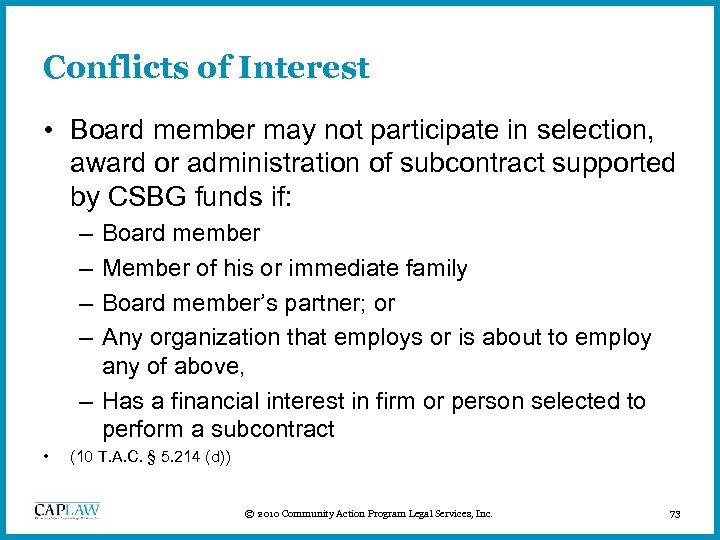
Conflicts of Interest • Board member may not participate in selection, award or administration of subcontract supported by CSBG funds if: – – Board member Member of his or immediate family Board member’s partner; or Any organization that employs or is about to employ any of above, – Has a financial interest in firm or person selected to perform a subcontract • (10 T. A. C. § 5. 214 (d)) © 2010 Community Action Program Legal Services, Inc. 73
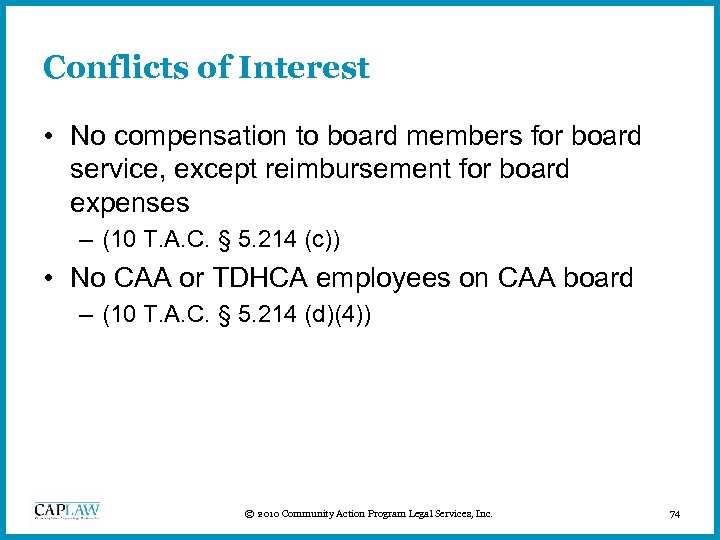
Conflicts of Interest • No compensation to board members for board service, except reimbursement for board expenses – (10 T. A. C. § 5. 214 (c)) • No CAA or TDHCA employees on CAA board – (10 T. A. C. § 5. 214 (d)(4)) © 2010 Community Action Program Legal Services, Inc. 74
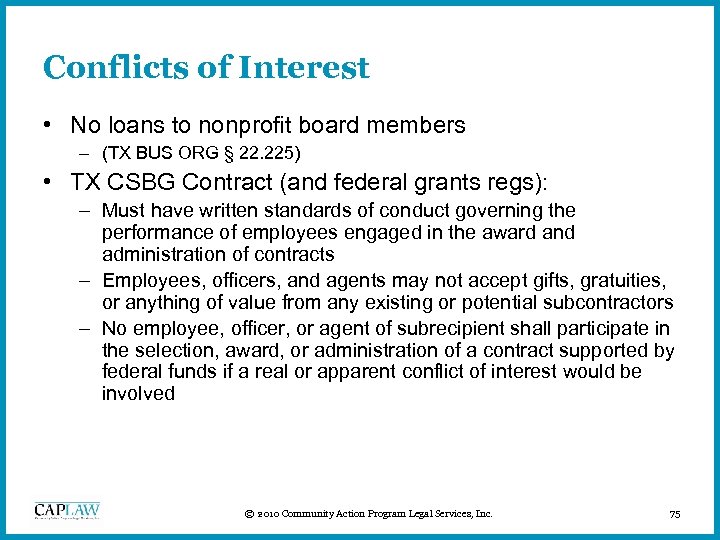
Conflicts of Interest • No loans to nonprofit board members – (TX BUS ORG § 22. 225) • TX CSBG Contract (and federal grants regs): – Must have written standards of conduct governing the performance of employees engaged in the award and administration of contracts – Employees, officers, and agents may not accept gifts, gratuities, or anything of value from any existing or potential subcontractors – No employee, officer, or agent of subrecipient shall participate in the selection, award, or administration of a contract supported by federal funds if a real or apparent conflict of interest would be involved © 2010 Community Action Program Legal Services, Inc. 75
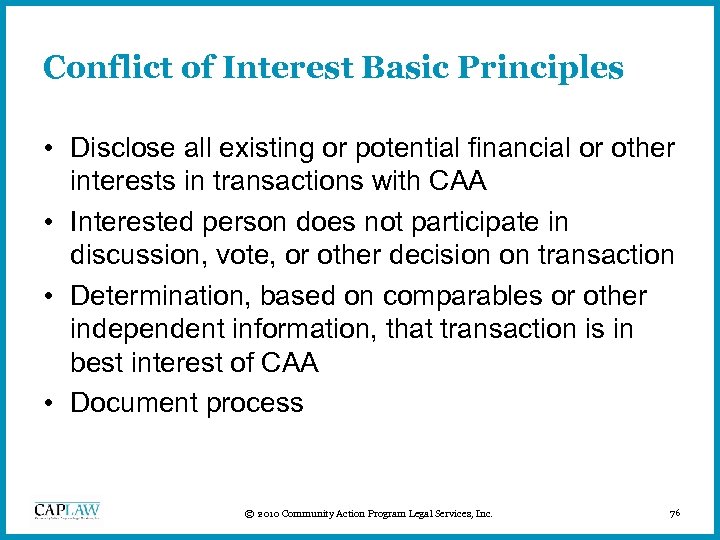
Conflict of Interest Basic Principles • Disclose all existing or potential financial or other interests in transactions with CAA • Interested person does not participate in discussion, vote, or other decision on transaction • Determination, based on comparables or other independent information, that transaction is in best interest of CAA • Document process © 2010 Community Action Program Legal Services, Inc. 76
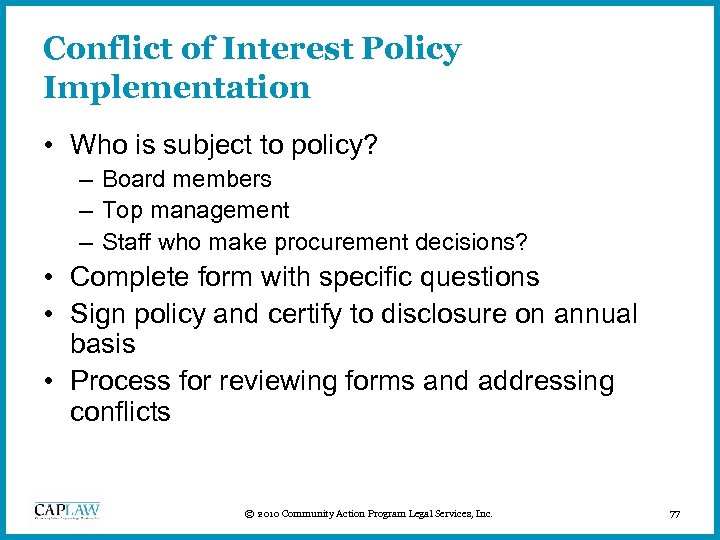
Conflict of Interest Policy Implementation • Who is subject to policy? – Board members – Top management – Staff who make procurement decisions? • Complete form with specific questions • Sign policy and certify to disclosure on annual basis • Process for reviewing forms and addressing conflicts © 2010 Community Action Program Legal Services, Inc. 77
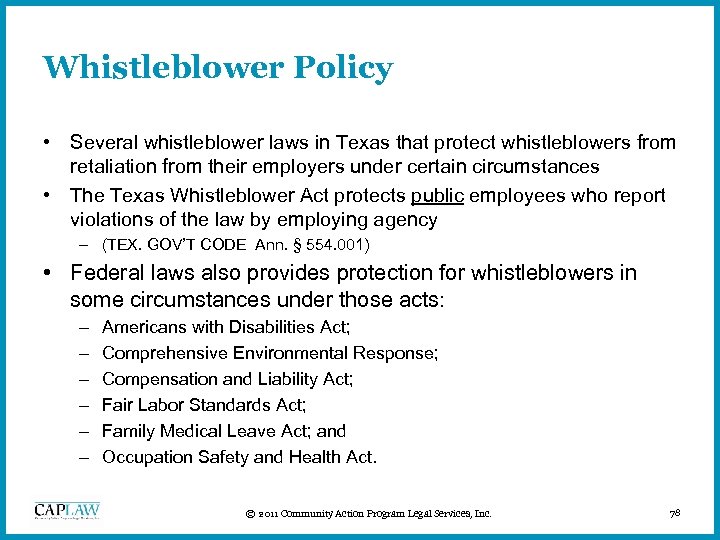
Whistleblower Policy • Several whistleblower laws in Texas that protect whistleblowers from retaliation from their employers under certain circumstances • The Texas Whistleblower Act protects public employees who report violations of the law by employing agency – (TEX. GOV’T CODE Ann. § 554. 001) • Federal laws also provides protection for whistleblowers in some circumstances under those acts: – – – Americans with Disabilities Act; Comprehensive Environmental Response; Compensation and Liability Act; Fair Labor Standards Act; Family Medical Leave Act; and Occupation Safety and Health Act. © 2011 Community Action Program Legal Services, Inc. 78
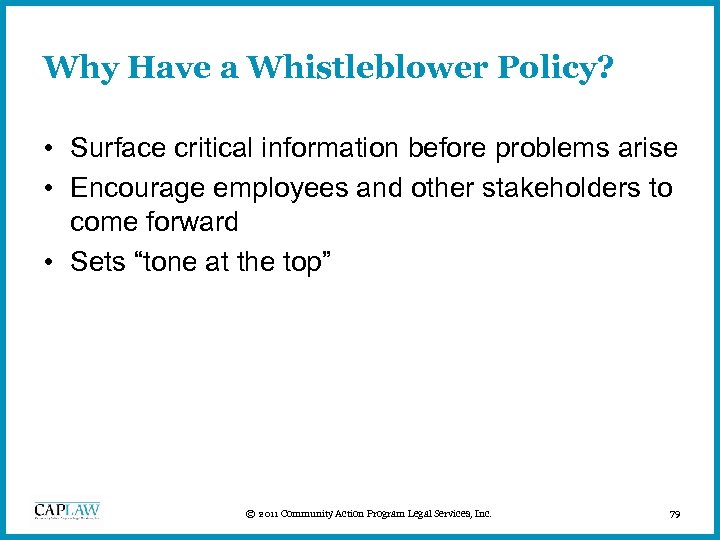
Why Have a Whistleblower Policy? • Surface critical information before problems arise • Encourage employees and other stakeholders to come forward • Sets “tone at the top” © 2011 Community Action Program Legal Services, Inc. 79
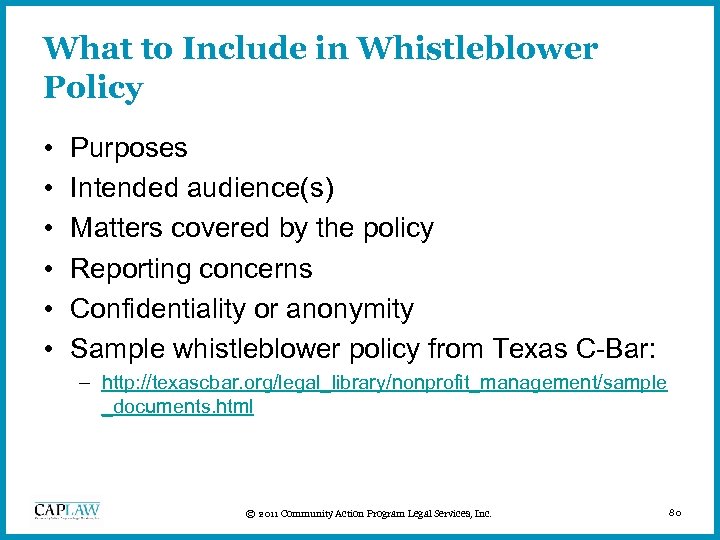
What to Include in Whistleblower Policy • • • Purposes Intended audience(s) Matters covered by the policy Reporting concerns Confidentiality or anonymity Sample whistleblower policy from Texas C-Bar: – http: //texascbar. org/legal_library/nonprofit_management/sample _documents. html © 2011 Community Action Program Legal Services, Inc. 80
Additional CAA Board Responsibilities • Ensure compliance with federal, and applicable state and local, laws and regs – Withholding taxes, for example • Ensure compliance with program rules and terms and conditions • Appropriate legal counsel • Legal Liability Audit © 2011 Community Action Program Legal Services, Inc. 81
Ensure Maintenance of 501(c)(3) Tax. Exempt Status • Activities further exempt purposes – Charitable or educational • • No private inurement No participation in political elections Limited legislative lobbying Limited unrelated business activity © 2011 Community Action Program Legal Services, Inc. 82
More Board Roles • Setting and updating CAA mission – Consistent with certificate of formation • Or amend Articles – Mission statement – Determine whether it still fits – Create good public “soundbite” © 2011 Community Action Program Legal Services, Inc. 83
More Board Roles, cont. • Public outreach and advocacy – Work with staff to educate community know about CAA and its programs – Identify issues of significance to low-income community – Advocate on issues of importance to CAA and its clients – Comply with lobbying and political activity rules – Speak on behalf of CAA only as authorized by board © 2011 Community Action Program Legal Services, Inc. 84
More Board Roles, cont. • Fundraising – Private sector board members – Think about fundraising capability in selecting private sector members – Encourage financial contributions, according to financial capability, and/or participating in fundraising efforts – Designate a board member or committee to work with staff © 2011 Community Action Program Legal Services, Inc. 85
Head Start Grantees: Board Responsibilities • Select delegate agencies and their service areas • Establish procedures and criteria for recruitment, selection and enrollment of children • Review and approve all major policies of CAA, including: – Annual self-assessment • Develop selection procedures for policy council members • Where appropriate, establish advisory committees to oversee responsibilities re: program governance and improvement • Establish and update standards of conduct © 2011 Community Action Program Legal Services, Inc. 86
Head Start Grantees: Board Responsibilities, cont. • Approve personnel policies and procedures, including those for hiring, evaluation, compensation, and termination of executive director, Head Start director, HR director, and CFO • Establish procedures and guidelines for accessing and collecting information required to be presented to board and policy council • Board and policy council must receive: – – – Monthly program info summaries Program enrollment reports Monthly reports of USDA meals and snacks Annual self-assessment Communication and guidance from HHS © 2011 Community Action Program Legal Services, Inc. 87
Resources: Texas C-Bar Nonprofit Legal Toolkit • Extraordinarily helpful legal toolkit developed for nonprofits existing under Texas law • Provides overview of state and federal law affecting a nonprofit’s day to day operations • http: //www. texascbar. org/content/legal_library/pu bs/downloads/Non. Profit. Legal. Toolkit 2011. pdf © 2011 Community Action Program Legal Services, Inc. 88
Resources: For More Information • Visit www. caplaw. org Call CAPLAW at (617) 357 -6915 • See Governance Resources attachment • CAPLAW Financial and Governance toolkits: – http: //www. caplaw. org/toolkits/governanceonlinetoolkit. html • CAPLAW CSBG Training Module: – http: //www. caplaw. org/trainingmodules/csbgtrainingmod ule. htm • Texas Association of Nonprofit Organizations – www. tano. org © 2011 Community Action Program Legal Services, Inc. 89
© 2011 Community Action Program Legal Services, Inc. 90
Скачать презентацию Excellence in Governance for CAA Boards 2011 Texas
040f97cffdfc140cbc03d538480ed25a.ppt