 Скачать презентацию Example-based Machine Translation based on Deeper NLP Toshiaki
4115b055e6196ccb73c464636996c1ca.ppt
- Количество слайдов: 24




Example-based Machine Translation based on Deeper NLP Toshiaki Nakazawa 1, Kun Yu 1, Sadao Kurohashi 2 1. Graduate School of Information Science and Technology, The University of Tokyo, Japan, 113 -8656 2. Graduate School of Informatics, Kyoto University, Kyoto, Japan, 606 -8501
Outline Ø Why EBMT? Ø Description of Kyoto-U EBMT System Ø Japanese Particular Processing Ø Pronoun Estimation Ø Japanese Flexible Matching Ø Result and Discussion Ø Conclusion and Future Work
Outline Ø Why EBMT? Ø Description of Kyoto-U EBMT System Ø Japanese Particular Processing Ø Pronoun Estimation Ø Japanese Flexible Matching Ø Result and Discussion Ø Conclusion and Future Work
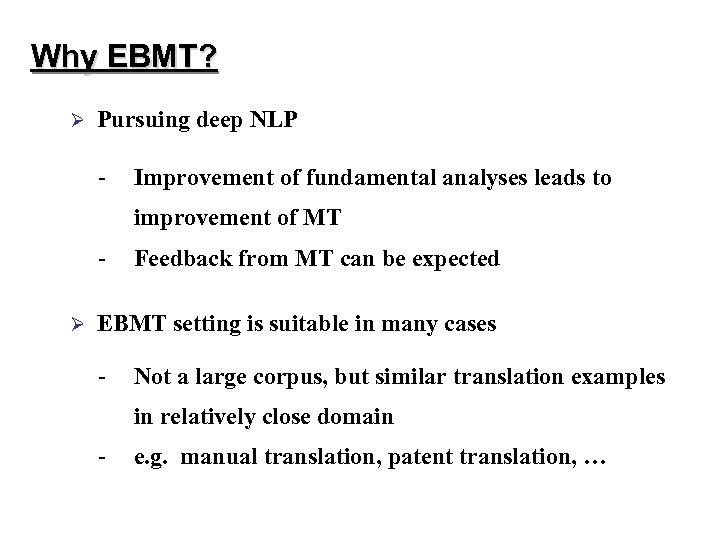
Why EBMT? Ø Pursuing deep NLP - Improvement of fundamental analyses leads to improvement of MT Ø Feedback from MT can be expected EBMT setting is suitable in many cases - Not a large corpus, but similar translation examples in relatively close domain - e. g. manual translation, patent translation, …
Outline Ø Why EBMT? Ø Description of Kyoto-U EBMT System Ø Japanese Particular Processing Ø Pronoun Estimation Ø Japanese Flexible Matching Ø Result and Discussion Ø Conclusion and Future Work
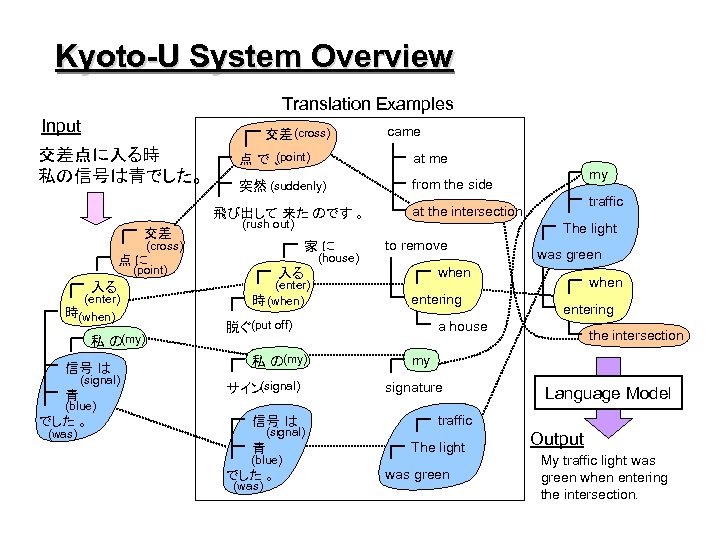
Kyoto-U System Overview Translation Examples Input 交差 (cross) 交差点に入る時 私の信号は青でした。 (point) 点で、 at me 突然 (suddenly) from the side 飛び出して 来た のです 。 交差 (rush out) (cross) (house) (point) (enter) 時(when) 私 の(my) 信号 は (signal) 青 (was) to remove 私 の(my) (signal) サイン (signal) 青 (blue) でした 。 (was) was green when entering a house 脱ぐ(put off) 信号 は traffic at the intersection 入る (enter) 時 (when) (blue) でした 。 my The light 家に 点に 入る came the intersection my signature Language Model traffic The light was green Output My traffic light was green when entering the intersection.
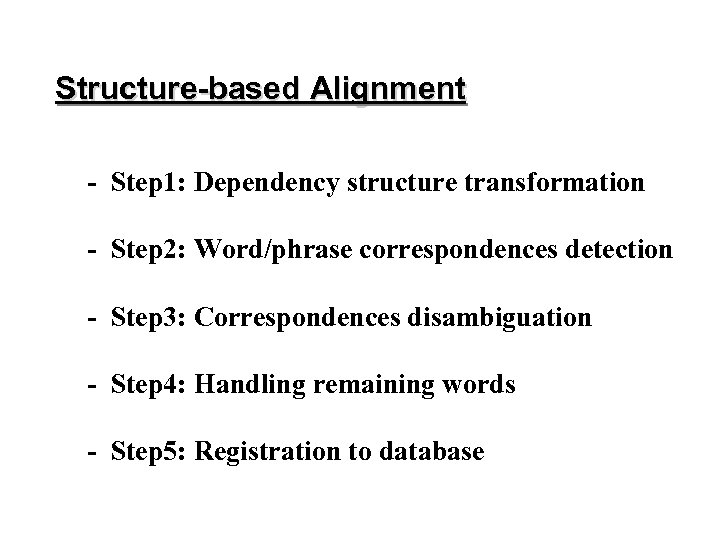
Structure-based Alignment - Step 1: Dependency structure transformation - Step 2: Word/phrase correspondences detection - Step 3: Correspondences disambiguation - Step 4: Handling remaining words - Step 5: Registration to database
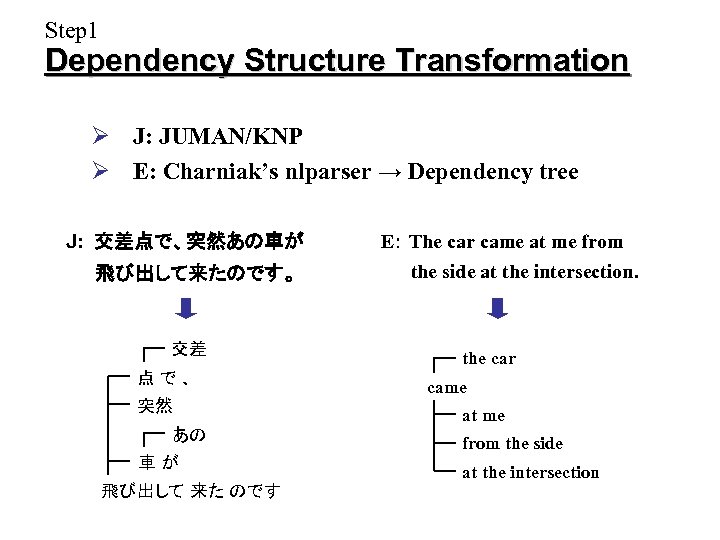
Step 1 Dependency Structure Transformation Ø J: JUMAN/KNP Ø E: Charniak’s nlparser → Dependency tree J: 交差点で、突然あの車が 飛び出して来たのです。 交差 点で、 突然 あの 車が 飛び出して 来た のです E: The car came at me from the side at the intersection. the car came at me from the side at the intersection
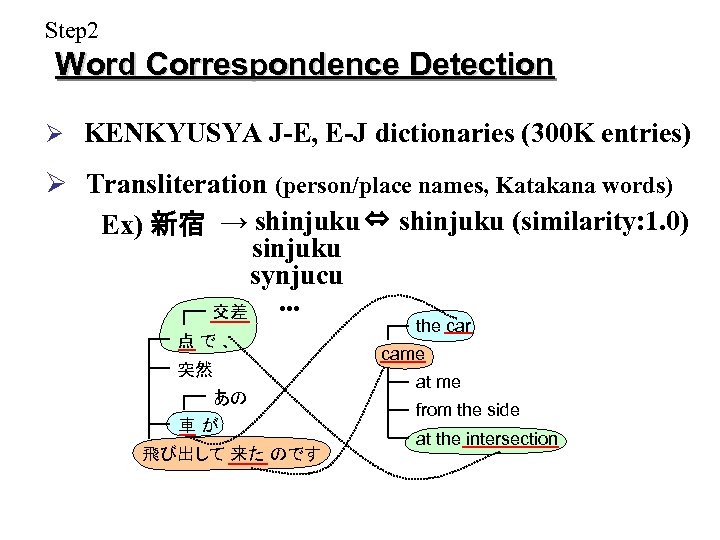
Step 2 Word Correspondence Detection Ø KENKYUSYA J-E, E-J dictionaries (300 K entries) Ø Transliteration (person/place names, Katakana words) Ex) 新宿 → shinjuku ⇔ shinjuku (similarity: 1. 0) sinjuku synjucu. . . 交差 点で、 突然 あの 車が 飛び出して 来た のです the car came at me from the side at the intersection
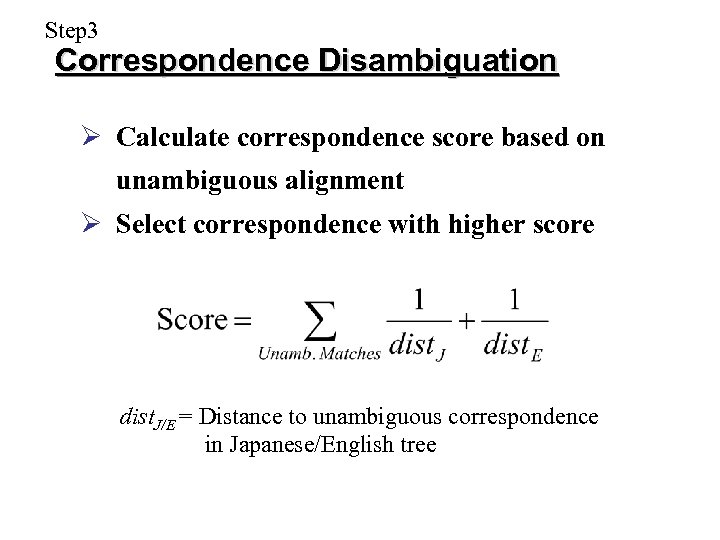
Step 3 Correspondence Disambiguation Ø Calculate correspondence score based on unambiguous alignment Ø Select correspondence with higher score dist. J/E = Distance to unambiguous correspondence in Japanese/English tree
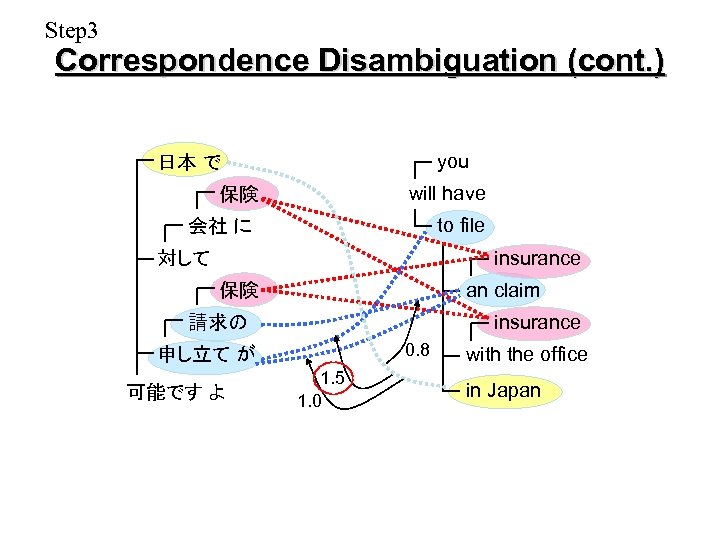
Step 3 Correspondence Disambiguation (cont. ) you 日本 で will have 保険 to file 会社 に insurance 対して an claim 保険 insurance 請求の 0. 8 申し立て が 可能です よ 1. 5 1. 0 with the office in Japan
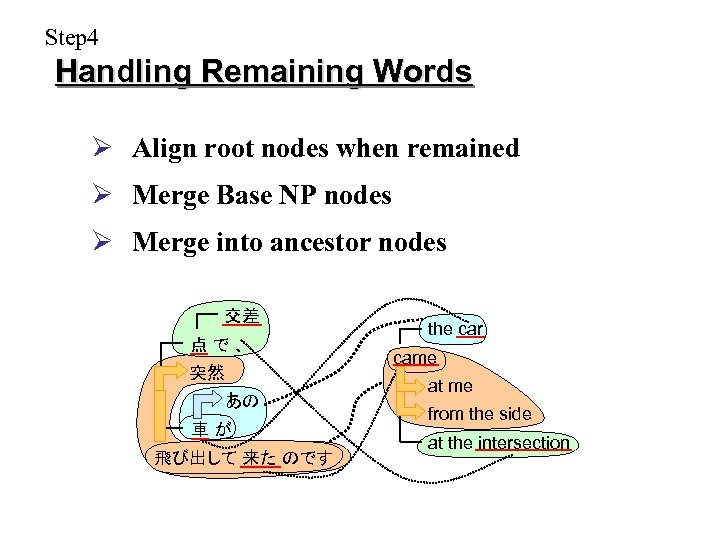
Step 4 Handling Remaining Words Ø Align root nodes when remained Ø Merge Base NP nodes Ø Merge into ancestor nodes 交差 点で、 突然 あの 車が 飛び出して 来た のです the car came at me from the side at the intersection
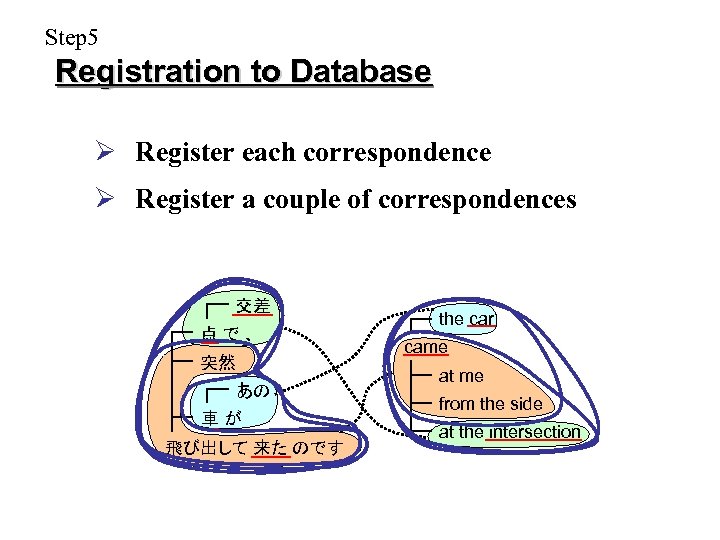
Step 5 Registration to Database Ø Register each correspondence Ø Register a couple of correspondences 交差 点で、 突然 あの 車が 飛び出して 来た のです the car came at me from the side at the intersection
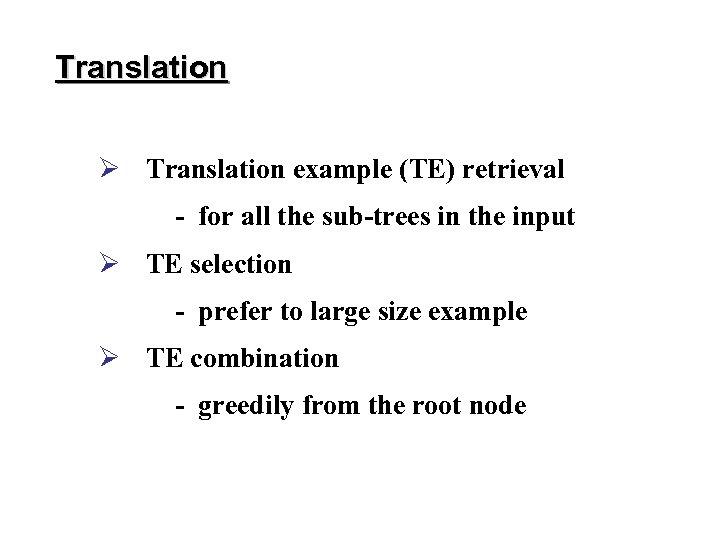
Translation Ø Translation example (TE) retrieval - for all the sub-trees in the input Ø TE selection - prefer to large size example Ø TE combination - greedily from the root node
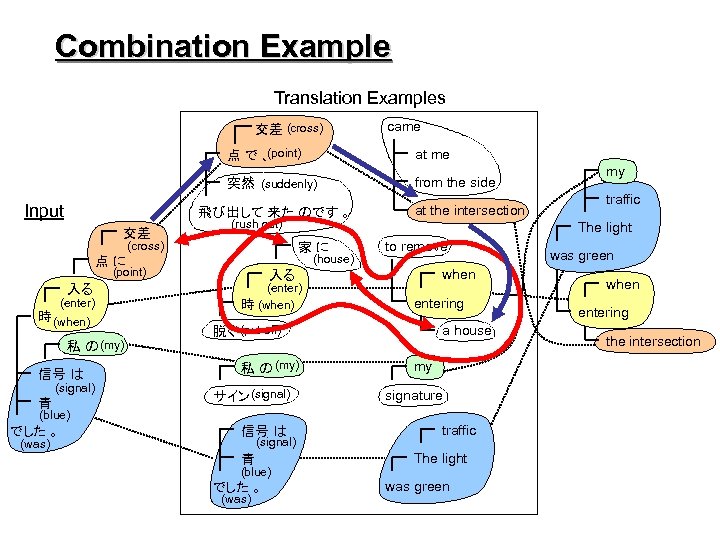
Combination Example Translation Examples 交差 (cross) came (point) 点で、 突然 (suddenly) Input at me from the side 飛び出して 来た のです 。 交差 (rush out) (cross) (house) 点に 入る (enter) 時 (when) 私 の (my) 信号 は (signal) 青 to remove when 入る (enter) 時 (when) entering a house 脱ぐ (put off) 私 の (my) サイン (signal) my signature (blue) でした 。 (was) 信号 は (signal) 青 (blue) でした 。 (was) traffic The light 家に (point) at the intersection my traffic The light was green when entering the intersection
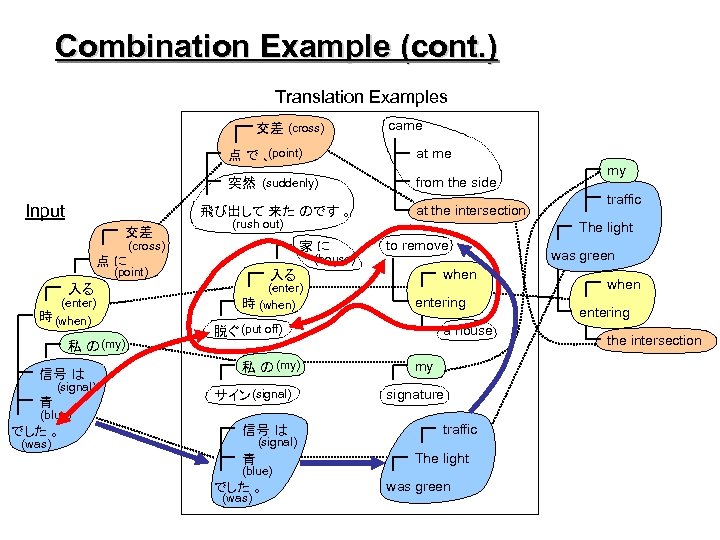
Combination Example (cont. ) Translation Examples 交差 (cross) came (point) 点で、 突然 (suddenly) Input at me from the side 飛び出して 来た のです 。 交差 (rush out) (cross) (house) 点に 入る (enter) 時 (when) 私 の (my) 信号 は (signal) 青 to remove when 入る (enter) 時 (when) entering a house 脱ぐ (put off) 私 の (my) サイン (signal) my signature (blue) でした 。 (was) 信号 は (signal) 青 (blue) でした 。 (was) traffic The light 家に (point) at the intersection my traffic The light was green when entering the intersection
Outline Ø Why EBMT? Ø Description of Kyoto-U EBMT System Ø Japanese Particular Processing Ø Pronoun Estimation Ø Japanese Flexible Matching Ø Result and Discussion Ø Conclusion and Future Work
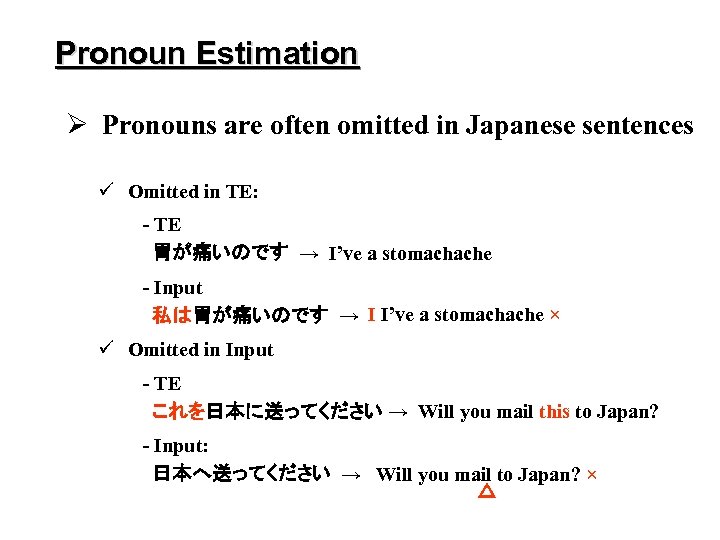
Pronoun Estimation Ø Pronouns are often omitted in Japanese sentences ü Omitted in TE: - TE 胃が痛いのです → I’ve a stomachache - Input 私は胃が痛いのです → I I’ve a stomachache × ü Omitted in Input - TE これを日本に送ってください → Will you mail this to Japan? - Input: 日本へ送ってください → Will you mail to Japan? × △
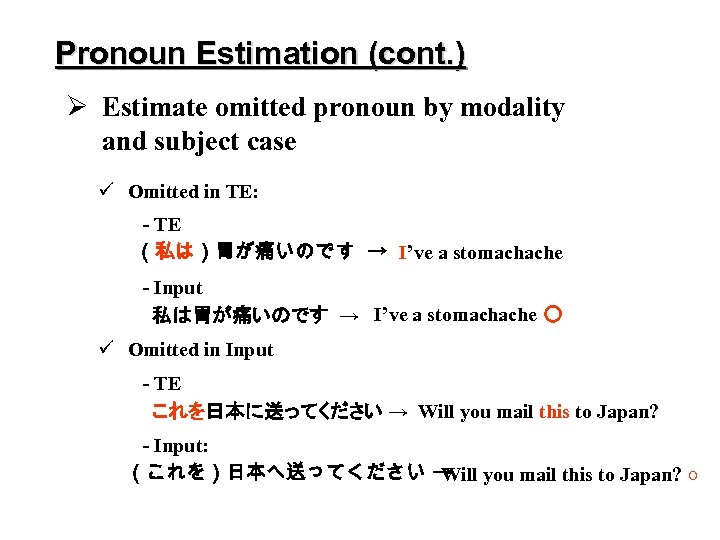
Pronoun Estimation (cont. ) Ø Estimate omitted pronoun by modality and subject case ü Omitted in TE: - TE (私は)胃が痛いのです → I’ve a stomachache - Input 私は胃が痛いのです → I’ve a stomachache ○ ü Omitted in Input - TE これを日本に送ってください → Will you mail this to Japan? - Input: (これを)日本へ送ってください → Will you mail this to Japan? ○ 日本へ送ってください →
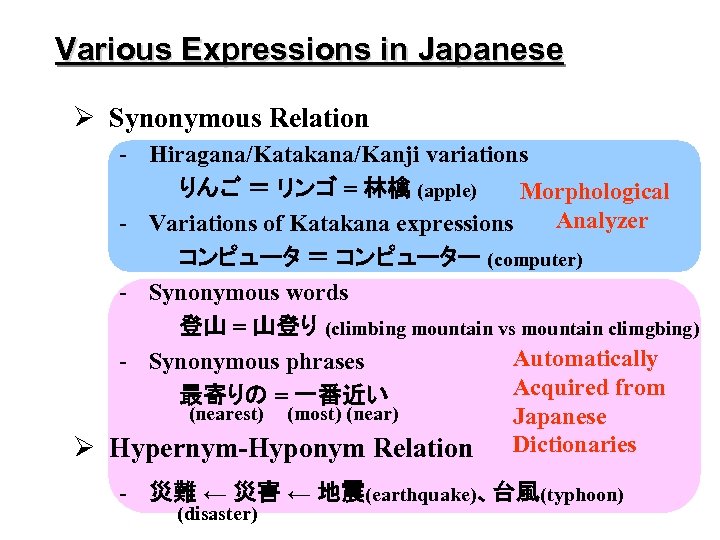
Various Expressions in Japanese Ø Synonymous Relation - Hiragana/Katakana/Kanji variations りんご = リンゴ = 林檎 (apple) Morphological Analyzer - Variations of Katakana expressions コンピュータ = コンピューター (computer) - Synonymous words 登山 = 山登り (climbing mountain vs mountain climgbing) Automatically - Synonymous phrases Acquired from 最寄りの = 一番近い (nearest) (most) (near) Japanese Ø Hypernym-Hyponym Relation Dictionaries - 災難 ← 災害 ← 地震(earthquake)、台風(typhoon) (disaster)
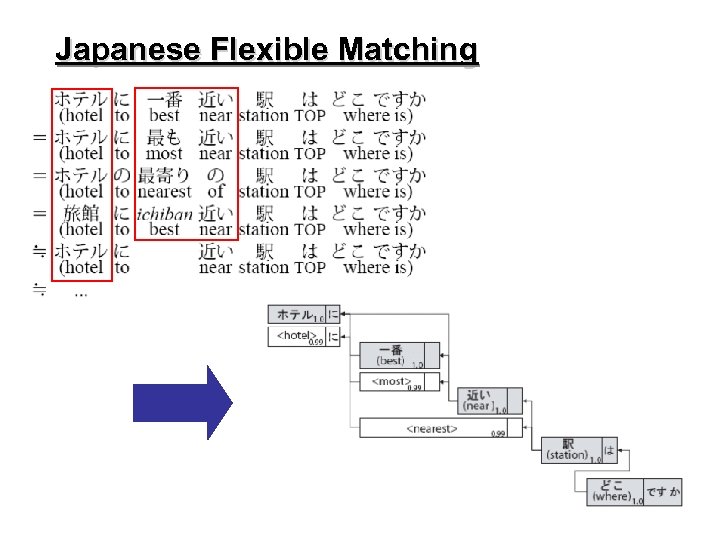
Japanese Flexible Matching
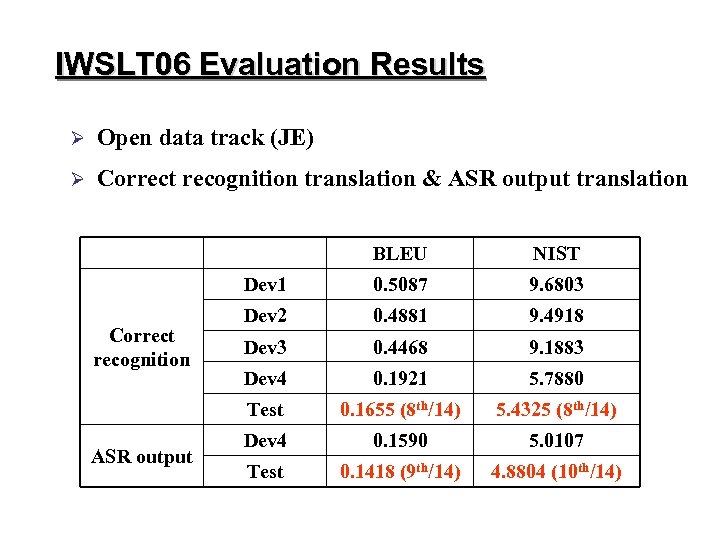
IWSLT 06 Evaluation Results Ø Open data track (JE) Ø Correct recognition translation & ASR output translation BLEU Dev 1 ASR output 0. 5087 9. 6803 Dev 2 0. 4881 9. 4918 Dev 3 0. 4468 9. 1883 Dev 4 0. 1921 5. 7880 Test Correct recognition NIST 0. 1655 (8 th/14) 5. 4325 (8 th/14) Dev 4 0. 1590 5. 0107 Test 0. 1418 (9 th/14) 4. 8804 (10 th/14)
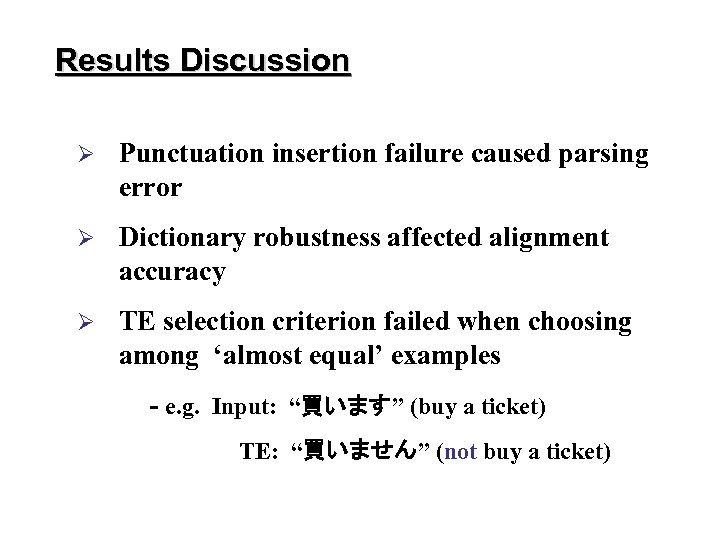
Results Discussion Ø Punctuation insertion failure caused parsing error Ø Dictionary robustness affected alignment accuracy Ø TE selection criterion failed when choosing among ‘almost equal’ examples - e. g. Input: “買います” (buy a ticket) TE: “買いません” (not buy a ticket)

Conclusion and Future Work Ø We not only aim at the development of MT, but also tackle this task from the viewpoint of structural NLP. Ø Implement statistical method on alignment Ø Improve parsing accuracies (both J and E) Ø Improve Japanese flexible matching method Ø J-C and C-J MT Project with NICT
Скачать презентацию Example-based Machine Translation based on Deeper NLP Toshiaki
4115b055e6196ccb73c464636996c1ca.ppt