


 Скачать презентацию Examination Software E-patent examiner World Wide United Patent
e779b3cca279bdbc07f075025366861d.ppt
- Количество слайдов: 34
 Examination Software «E-patent examiner» World Wide United Patent Space WW UPS
 Content 1. 2. 3. 4. 5. 6. 7. 8. 9. 10. 11. 12. Introduction. Big data and how handle them. Machine learning and natural language processing. Statistics and/or semantics. Successful collaboration. Patent Information Space structure. Evaluation of novelty and industrial applicability «E-patent examiner» : aims, scope and procedure Multidimensional Patent Information Space Patent Information Portrait Unified Patent Information Space: distributed base of knowledge Experiment description: one language, one class Experiment description: one language, patents and open sources Pilot project: bilingual, “cloud”-deployed. (Examination from mobile phone) Conclusions and Future. 2
 3
3
 Types of tools typically used in Big Data Scenario • Where is the processing hosted? – Distributed server/cloud • Where data is stored? – Distributed Storage (eg: Amazon s 3) • Where is the programming model? – Distributed processing (Map Reduce) • How data is stored and indexed? – High performance schema free database • What operations are performed on the data? – Analytic/Semantic Processing (Eg. RDF/OWL) 4
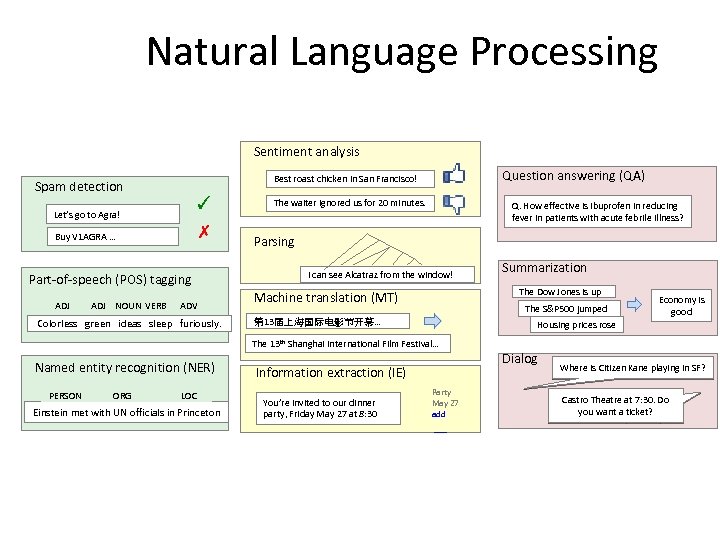 Natural Language Processing Sentiment analysis ✓ Let’s go to Agra! ✗ Buy V 1 AGRA … The waiter ignored us for 20 minutes. ADJ NOUN VERB ADV Colorless green ideas sleep furiously. I can see Alcatraz from the window! PERSON ORG LOC Einstein met with UN officials in Princeton The S&P 500 jumped 第 13届上海国际电影节开幕… 13 th Summarization The Dow Jones is up Machine translation (MT) The Named entity recognition (NER) Q. How effective is ibuprofen in reducing fever in patients with acute febrile illness? Parsing Part-of-speech (POS) tagging ADJ Question answering (QA) Best roast chicken in San Francisco! Spam detection Economy is good Housing prices rose Shanghai International Film Festival… Dialog Information extraction (IE) You’re invited to our dinner party, Friday May 27 at 8: 30 Party May 27 add Where is Citizen Kane playing in SF? Castro Theatre at 7: 30. Do you want a ticket?
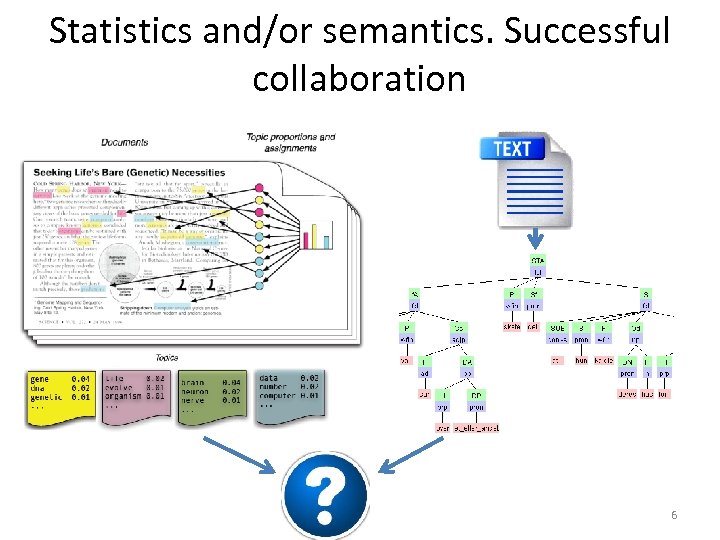 Statistics and/or semantics. Successful collaboration 6
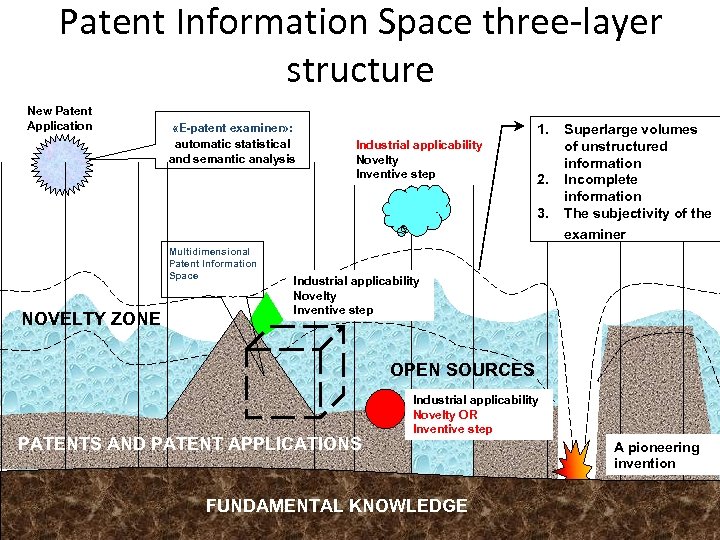 Patent Information Space three-layer structure New Patent Application «E-patent examiner» : automatic statistical and semantic analysis 1. Industrial applicability Novelty Inventive step 2. 3. Multidimensional Patent Information Space NOVELTY ZONE Superlarge volumes of unstructured information Incomplete information The subjectivity of the examiner Industrial applicability Novelty Inventive step OPEN SOURCES PATENTS AND PATENT APPLICATIONS Industrial applicability Novelty OR Inventive step FUNDAMENTAL KNOWLEDGE A pioneering invention 7
 «E-patent examiner» procedure • New Patent Application (NPA) input • Automatic topics of NPA statistical profile positioning at the Patent Information Space • Establishing the sub-network of relevant documents by statistical profiles • Sub-network semantic analysis to complete the visualization and to make conclusions about: – – Novelty; Industrial applicability; Inventive step; A pioneering invention. 8
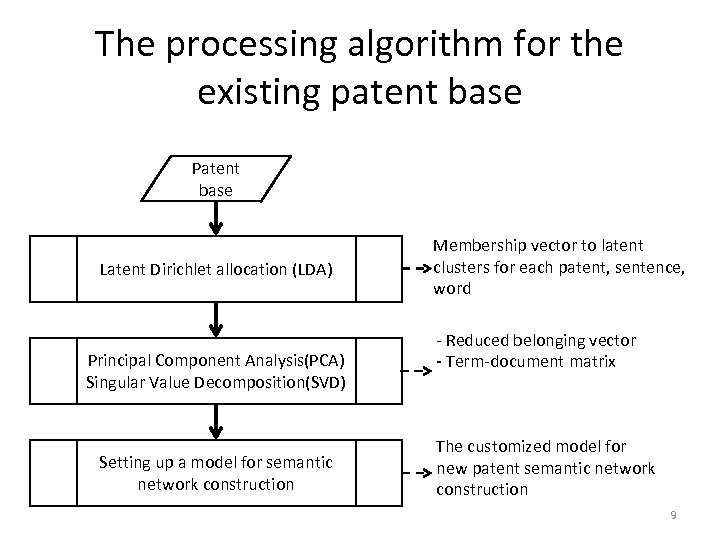 The processing algorithm for the existing patent base Patent base Latent Dirichlet allocation (LDA) Principal Component Analysis(PCA) Singular Value Decomposition(SVD) Setting up a model for semantic network construction Membership vector to latent clusters for each patent, sentence, word - Reduced belonging vector - Term-document matrix The customized model for new patent semantic network construction 9
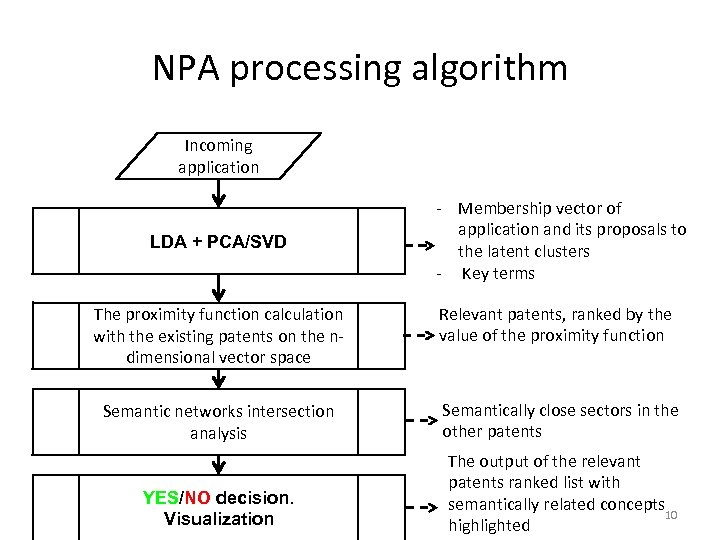 NPA processing algorithm Incoming application LDA + PCA/SVD - Membership vector of application and its proposals to the latent clusters - Key terms The proximity function calculation with the existing patents on the ndimensional vector space Relevant patents, ranked by the value of the proximity function Semantic networks intersection analysis Semantically close sectors in the other patents YES/NO decision. Visualization The output of the relevant patents ranked list with semantically related concepts 10 highlighted
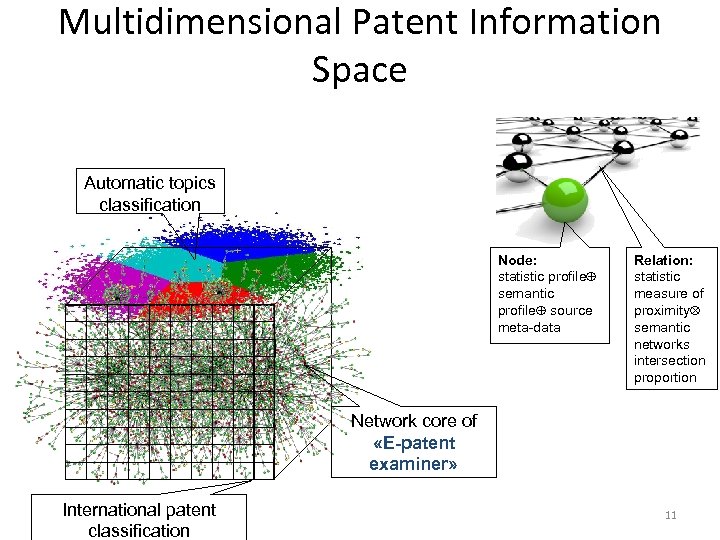 Multidimensional Patent Information Space Automatic topics classification Node: statistic profile semantic profile source meta-data Relation: statistic measure of proximity semantic networks intersection proportion Network core of «E-patent examiner» International patent classification 11
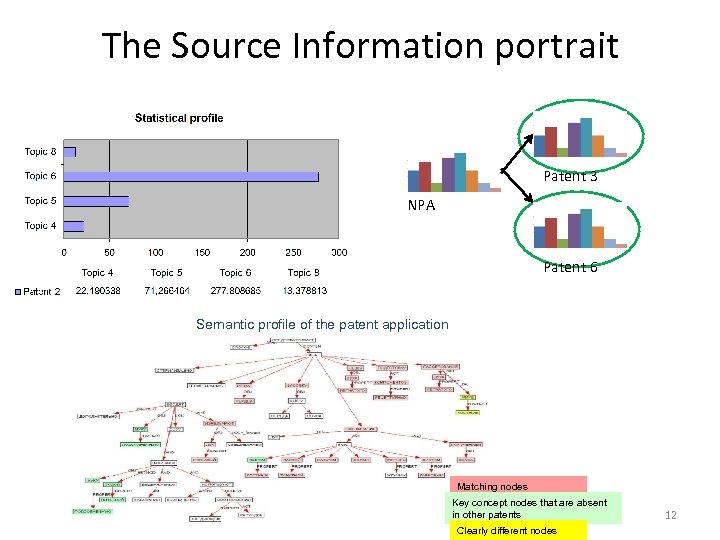 The Source Information portrait Patent 3 NPA Patent 6 Semantic profile of the patent application Matching nodes Key concept nodes that are absent in other patents Clearly different nodes 12
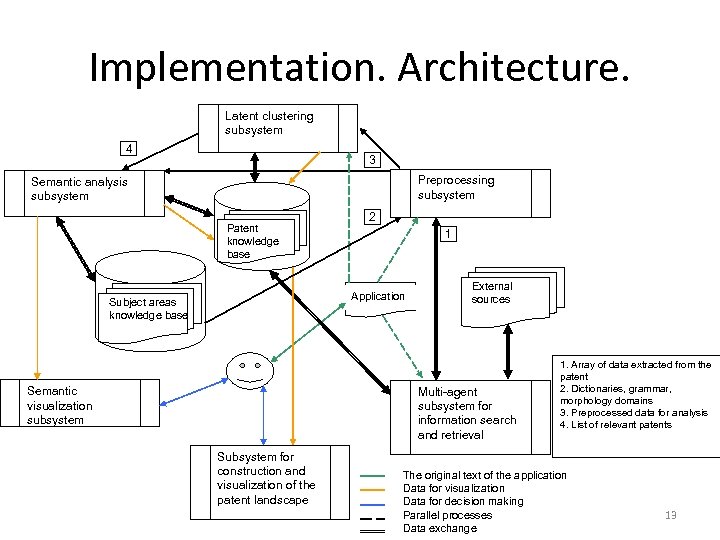 Implementation. Architecture. Latent clustering subsystem 4 3 Preprocessing subsystem Semantic analysis subsystem Patent knowledge base 2 1 Application Subject areas knowledge base Semantic visualization subsystem External sources Multi-agent subsystem for information search and retrieval Subsystem for construction and visualization of the patent landscape 1. Array of data extracted from the patent 2. Dictionaries, grammar, morphology domains 3. Preprocessed data for analysis 4. List of relevant patents The original text of the application Data for visualization Data for decision making Parallel processes Data exchange 13
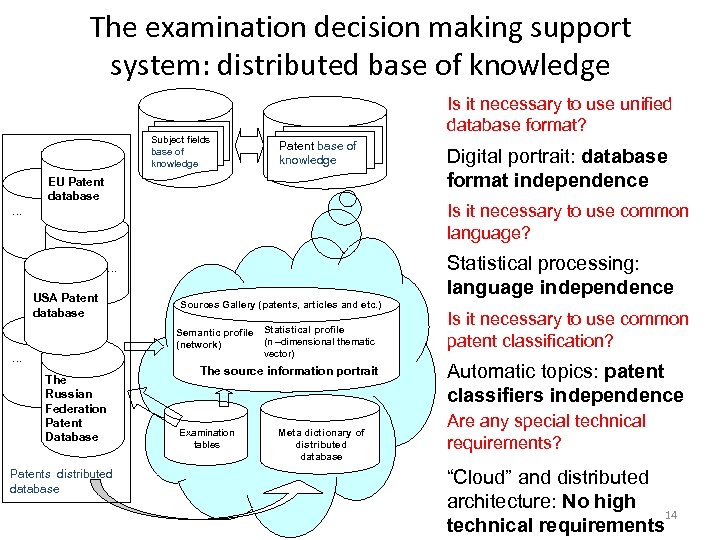 The examination decision making support system: distributed base of knowledge Subject fields base of knowledge Is it necessary to use unified database format? Patent base of knowledge EU Patent database Is it necessary to use common language? … РБД патентов … USA Patent database Statistical processing: language independence Sources Gallery (patents, articles and etc. ) Semantic profile Statistical profile (n –dimensional thematic (network) vector) … The Russian Federation Patent Database Patents distributed database Digital portrait: database format independence The source information portrait Examination tables Meta dictionary of distributed database Is it necessary to use common patent classification? Automatic topics: patent classifiers independence Are any special technical requirements? “Cloud” and distributed architecture: No high 14 technical requirements
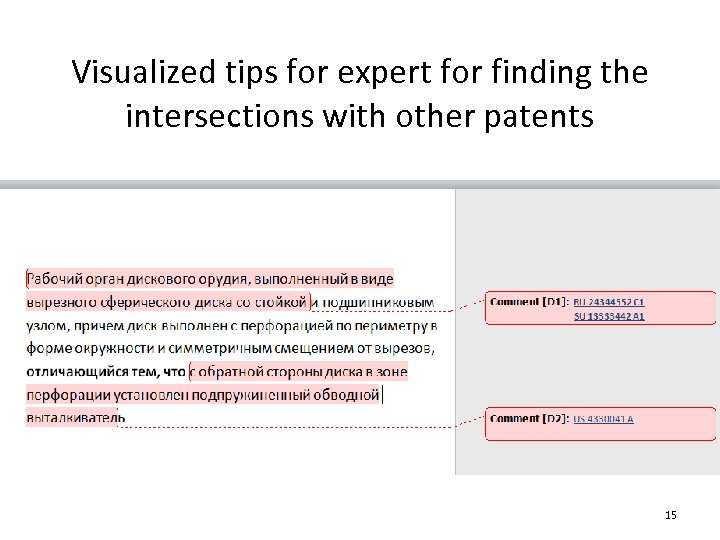 Visualized tips for expert for finding the intersections with other patents 15
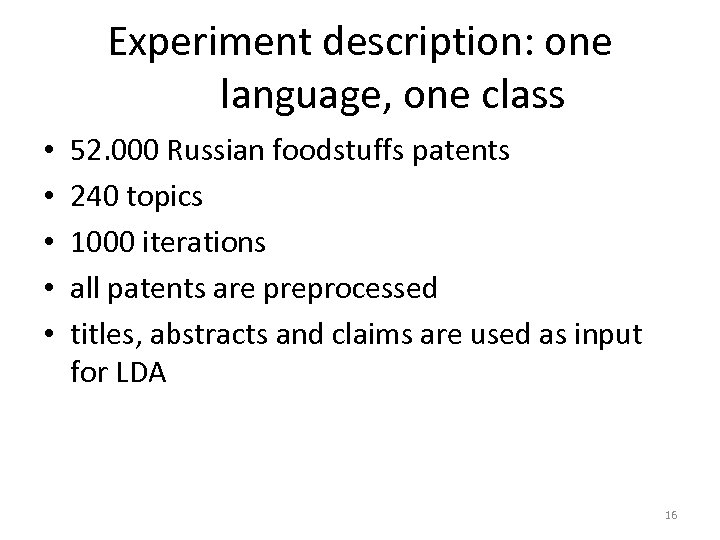 Experiment description: one language, one class • • • 52. 000 Russian foodstuffs patents 240 topics 1000 iterations all patents are preprocessed titles, abstracts and claims are used as input for LDA 16
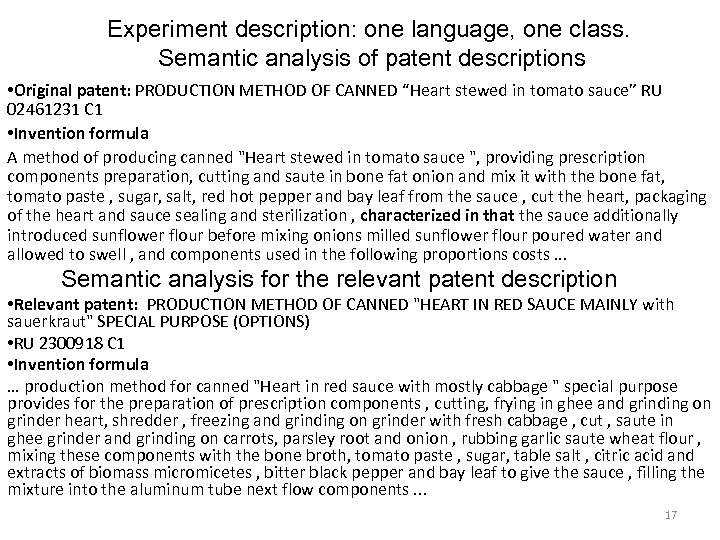 Experiment description: one language, one class. Semantic analysis of patent descriptions • Original patent: PRODUCTION METHOD OF CANNED “Heart stewed in tomato sauce” RU 02461231 C 1 • Invention formula A method of producing canned "Heart stewed in tomato sauce ", providing prescription components preparation, cutting and saute in bone fat onion and mix it with the bone fat, tomato paste , sugar, salt, red hot pepper and bay leaf from the sauce , cut the heart, packaging of the heart and sauce sealing and sterilization , characterized in that the sauce additionally introduced sunflower flour before mixing onions milled sunflower flour poured water and allowed to swell , and components used in the following proportions costs. . . Semantic analysis for the relevant patent description • Relevant patent: PRODUCTION METHOD OF CANNED "HEART IN RED SAUCE MAINLY with sauerkraut" SPECIAL PURPOSE (OPTIONS) • RU 2300918 C 1 • Invention formula … production method for canned "Heart in red sauce with mostly cabbage " special purpose provides for the preparation of prescription components , cutting, frying in ghee and grinding on grinder heart, shredder , freezing and grinding on grinder with fresh cabbage , cut , saute in ghee grinder and grinding on carrots, parsley root and onion , rubbing garlic saute wheat flour , mixing these components with the bone broth, tomato paste , sugar, table salt , citric acid and extracts of biomass micromicetes , bitter black pepper and bay leaf to give the sauce , filling the mixture into the aluminum tube next flow components. . . 17
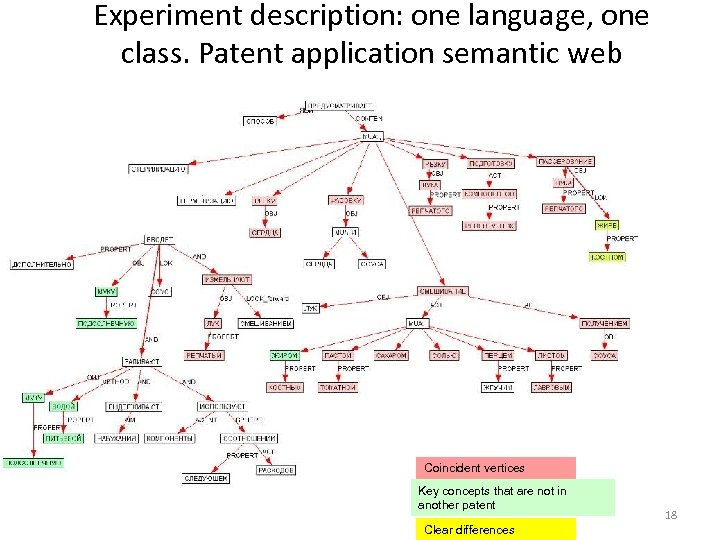 Experiment description: one language, one class. Patent application semantic web Coincident vertices Key concepts that are not in another patent Clear differences 18
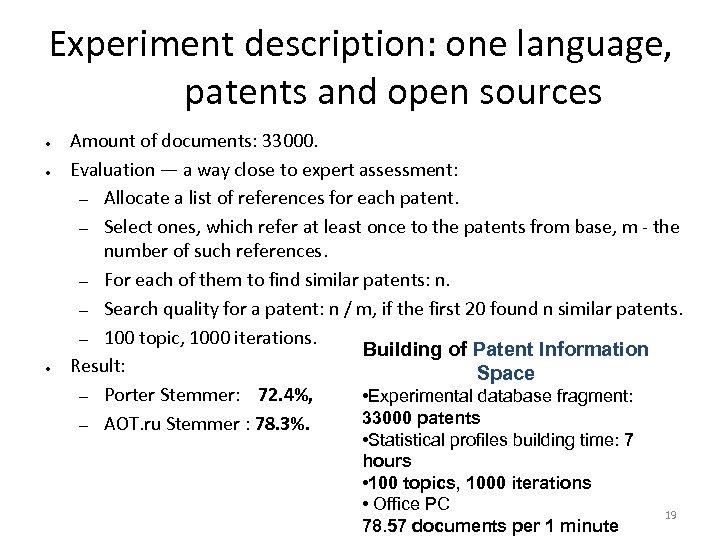 Experiment description: one language, patents and open sources ● ● ● Amount of documents: 33000. Evaluation — a way close to expert assessment: – Allocate a list of references for each patent. – Select ones, which refer at least once to the patents from base, m - the number of such references. – For each of them to find similar patents: n. – Search quality for a patent: n / m, if the first 20 found n similar patents. – 100 topic, 1000 iterations. Building of Patent Information Result: Space – Porter Stemmer: 72. 4%, • Experimental database fragment: 33000 patents – AOT. ru Stemmer : 78. 3%. • Statistical profiles building time: 7 hours • 100 topics, 1000 iterations • Office PC 78. 57 documents per 1 minute 19
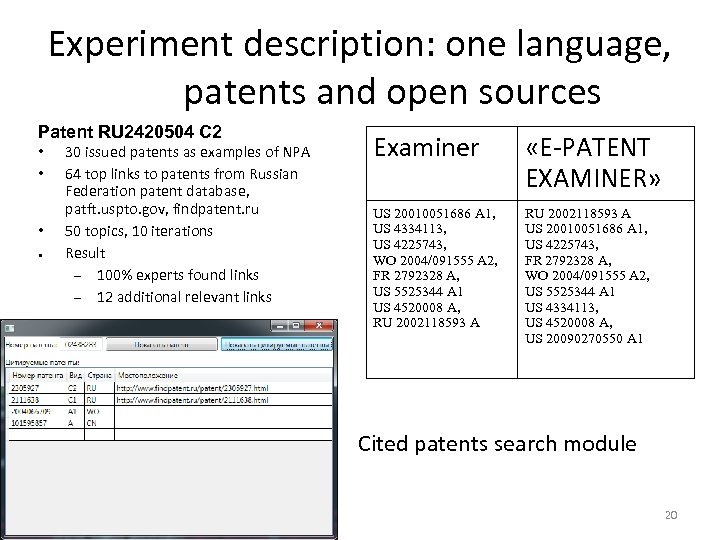 Experiment description: one language, patents and open sources Patent RU 2420504 C 2 • • • ● 30 issued patents as examples of NPA 64 top links to patents from Russian Federation patent database, patft. uspto. gov, findpatent. ru 50 topics, 10 iterations Result – 100% experts found links – 12 additional relevant links Examiner «E-PATENT EXAMINER» US 20010051686 A 1, US 4334113, US 4225743, WO 2004/091555 A 2, FR 2792328 A, US 5525344 A 1 US 4520008 A, RU 2002118593 A US 20010051686 A 1, US 4225743, FR 2792328 A, WO 2004/091555 A 2, US 5525344 A 1 US 4334113, US 4520008 A, US 20090270550 A 1 Cited patents search module 20
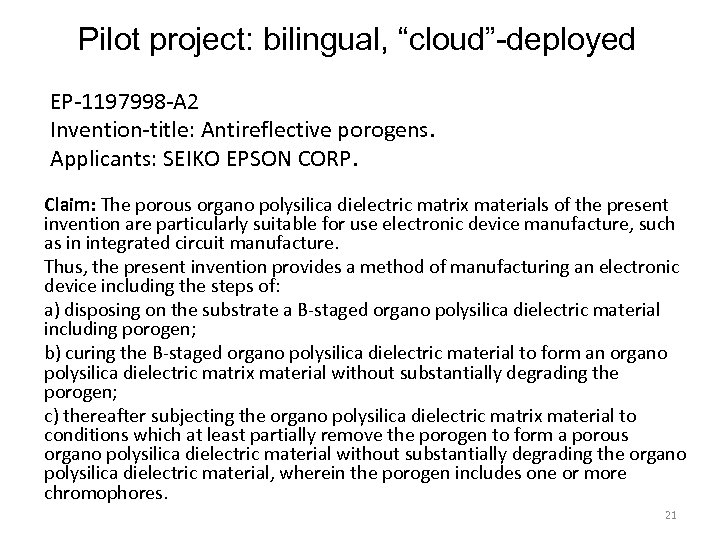 Pilot project: bilingual, “cloud”-deployed EP-1197998 -A 2 Invention-title: Antireflective porogens. Applicants: SEIKO EPSON CORP. Claim: The porous organo polysilica dielectric matrix materials of the present invention are particularly suitable for use electronic device manufacture, such as in integrated circuit manufacture. Thus, the present invention provides a method of manufacturing an electronic device including the steps of: a) disposing on the substrate a B-staged organo polysilica dielectric material including porogen; b) curing the B-staged organo polysilica dielectric material to form an organo polysilica dielectric matrix material without substantially degrading the porogen; c) thereafter subjecting the organo polysilica dielectric matrix material to conditions which at least partially remove the porogen to form a porous organo polysilica dielectric material without substantially degrading the organo polysilica dielectric material, wherein the porogen includes one or more chromophores. 21
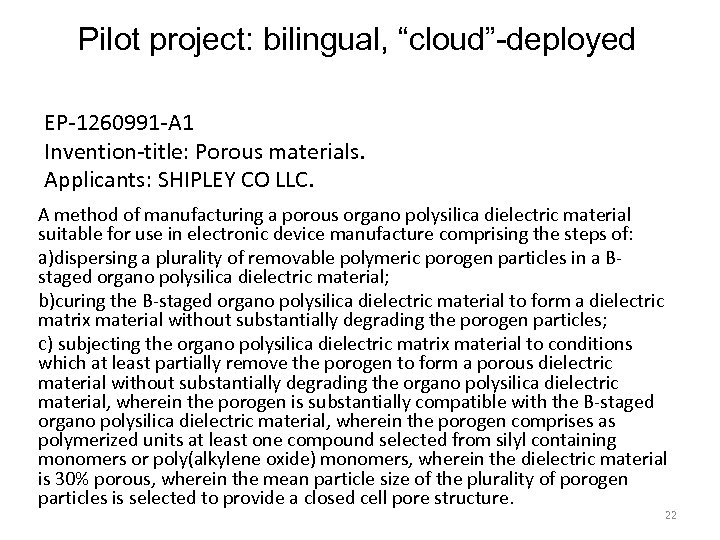 Pilot project: bilingual, “cloud”-deployed EP-1260991 -A 1 Invention-title: Porous materials. Applicants: SHIPLEY CO LLC. A method of manufacturing a porous organo polysilica dielectric material suitable for use in electronic device manufacture comprising the steps of: a)dispersing a plurality of removable polymeric porogen particles in a Bstaged organo polysilica dielectric material; b)curing the B-staged organo polysilica dielectric material to form a dielectric matrix material without substantially degrading the porogen particles; c) subjecting the organo polysilica dielectric matrix material to conditions which at least partially remove the porogen to form a porous dielectric material without substantially degrading the organo polysilica dielectric material, wherein the porogen is substantially compatible with the B-staged organo polysilica dielectric material, wherein the porogen comprises as polymerized units at least one compound selected from silyl containing monomers or poly(alkylene oxide) monomers, wherein the dielectric material is 30% porous, wherein the mean particle size of the plurality of porogen particles is selected to provide a closed cell pore structure. 22
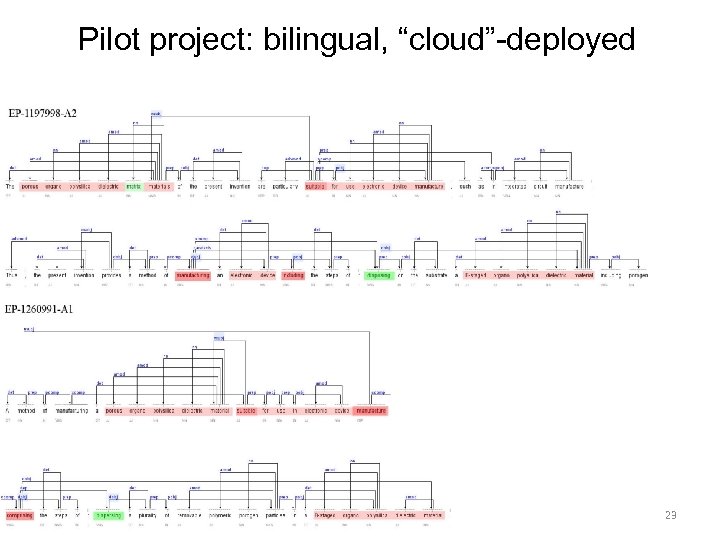 Pilot project: bilingual, “cloud”-deployed 23
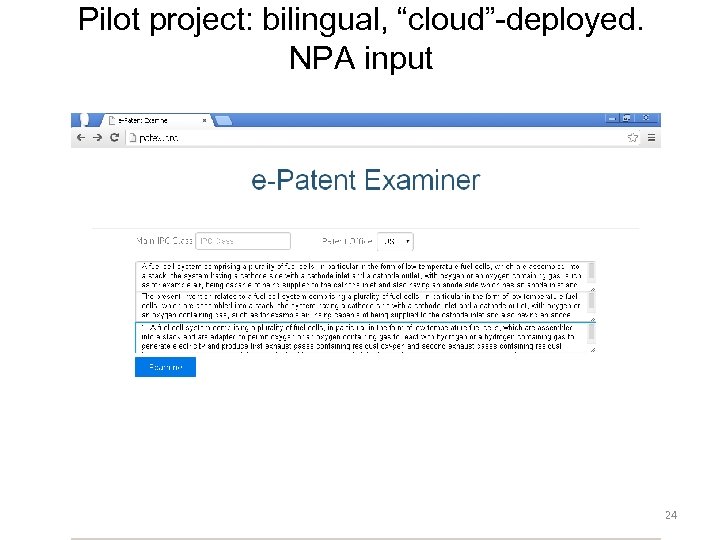 Pilot project: bilingual, “cloud”-deployed. NPA input 24
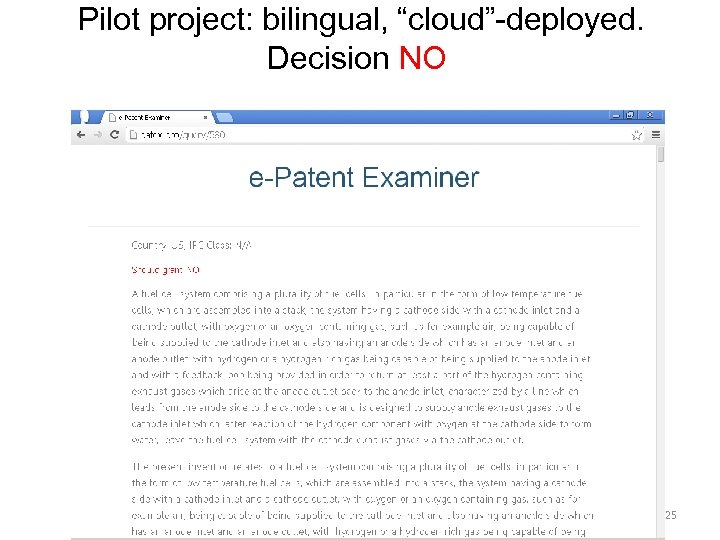 Pilot project: bilingual, “cloud”-deployed. Decision NO 25
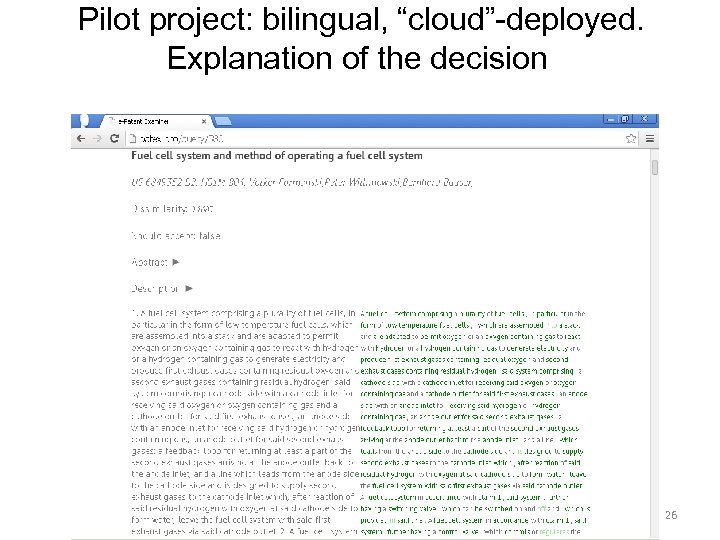 Pilot project: bilingual, “cloud”-deployed. Explanation of the decision 26
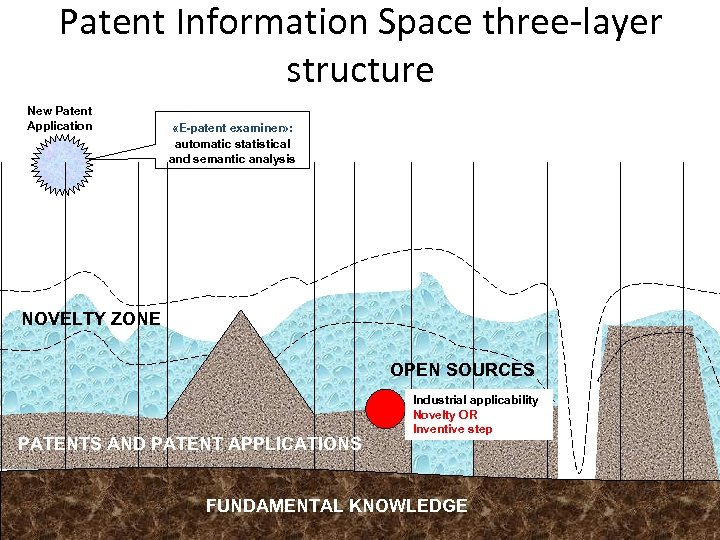 Patent Information Space three-layer structure New Patent Application «E-patent examiner» : automatic statistical and semantic analysis NOVELTY ZONE OPEN SOURCES PATENTS AND PATENT APPLICATIONS Industrial applicability Novelty OR Inventive step FUNDAMENTAL KNOWLEDGE 27
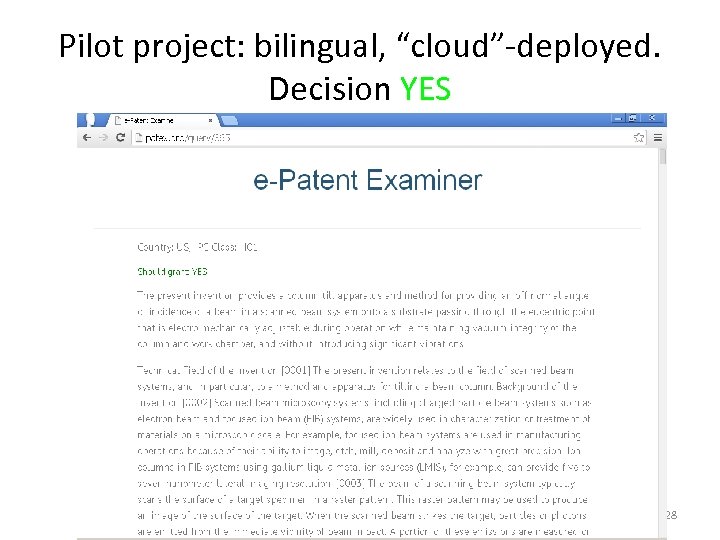 Pilot project: bilingual, “cloud”-deployed. Decision YES 28
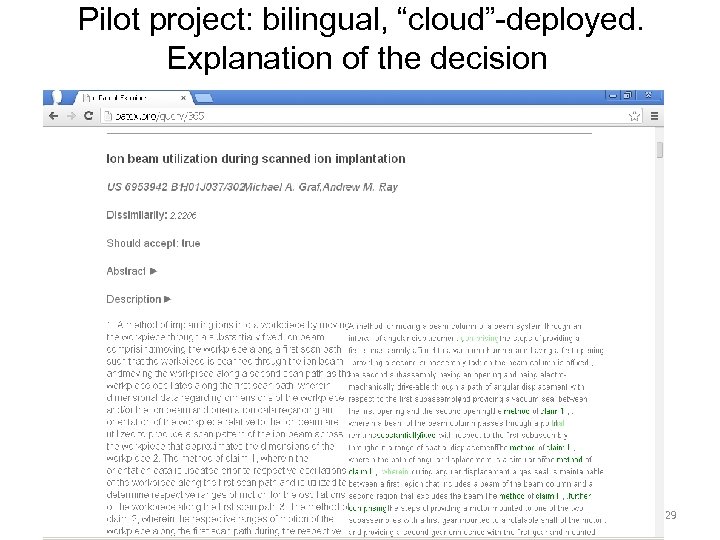 Pilot project: bilingual, “cloud”-deployed. Explanation of the decision 29
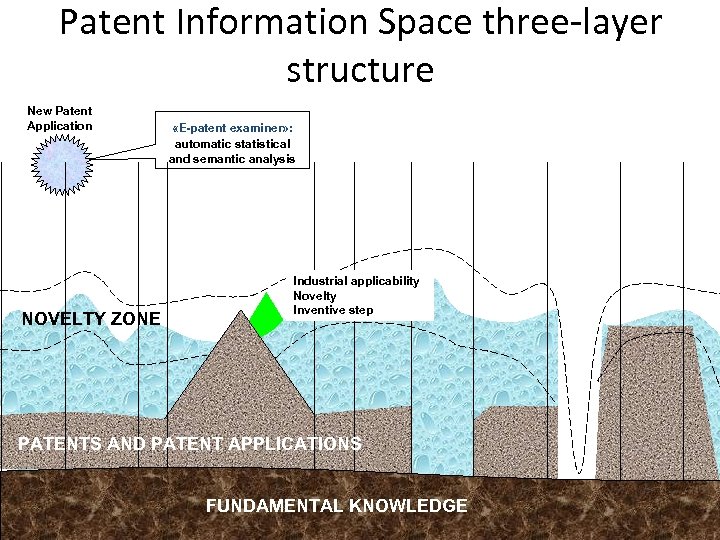 Patent Information Space three-layer structure New Patent Application NOVELTY ZONE «E-patent examiner» : automatic statistical and semantic analysis Industrial applicability Novelty Inventive step PATENTS AND PATENT APPLICATIONS FUNDAMENTAL KNOWLEDGE 30
 Results • Pilot version of «E-patent examiner» is deployed in Amazon “cloud” servers • The time of patents processing was reduced to 1000 docs in 58 sec by parallel algorithms • Bilingual algorithm was trained on more than 1000000 patents • Patents base of knowledge was created 31
 Future • Scaling algorithms for full patent base of knowledge • Application embedded objects processing • Multilingual processing • Implementation of new developed statistical method “Text explosion” that performs much better than LDA and is easily scalable 32
 Conclusions • «E-PATENT EXAMINER» solves problems of an examiner subjectivity and time spent for examination • It’s necessary to develop a fundamentally new approach to the analysis of patent space • The proposed approach implements a new global paradigm of United Patent Information Space • The united efforts of the international community will make the transition from local databases to a universal environment for creating new technical solutions 33
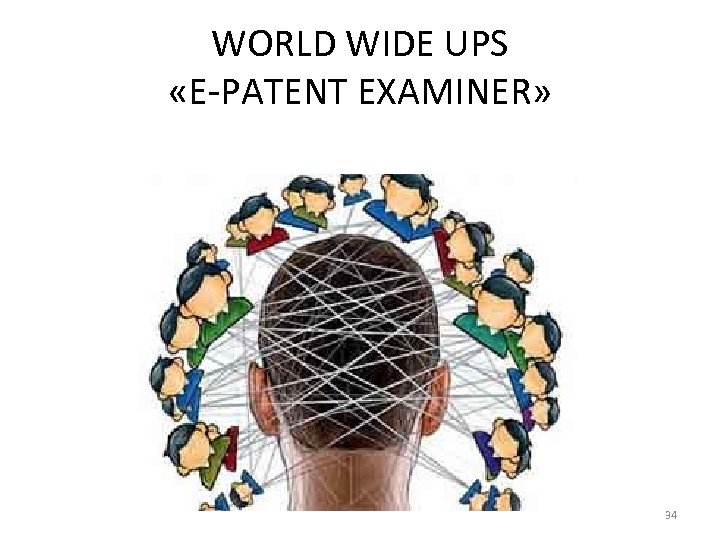 WORLD WIDE UPS «E-PATENT EXAMINER» 34