


 Скачать презентацию Exam III Physics 101 Lecture 18 Fluids II
a9e28d4b359c8e90ba5d3ab19be99aa2.ppt
- Количество слайдов: 16
 Exam III Physics 101: Lecture 18 Fluids II Textbook Sections 9. 6 – 9. 8 Physics 101: Lecture 18, Pg 1
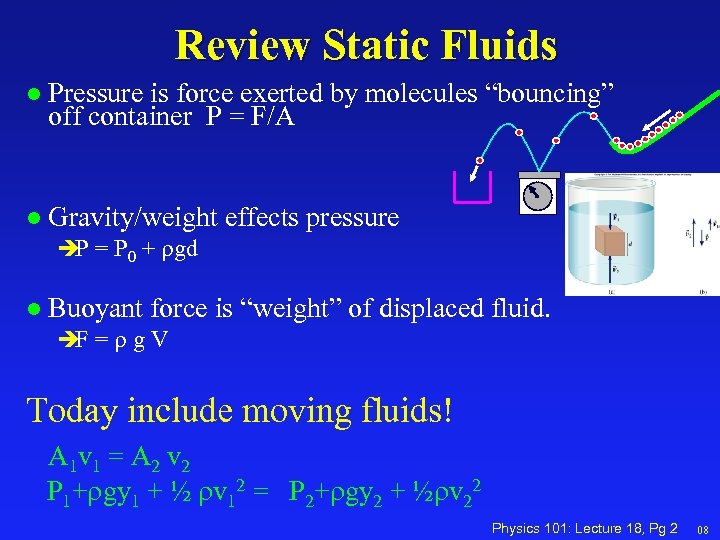 Review Static Fluids l Pressure is force exerted by molecules “bouncing” off container P = F/A l Gravity/weight effects pressure è = P 0 + gd P l Buoyant force is “weight” of displaced fluid. è = g. V F Today include moving fluids! A 1 v 1 = A 2 v 2 P 1+ gy 1 + ½ v 12 = P 2+ gy 2 + ½ v 22 Physics 101: Lecture 18, Pg 2 08
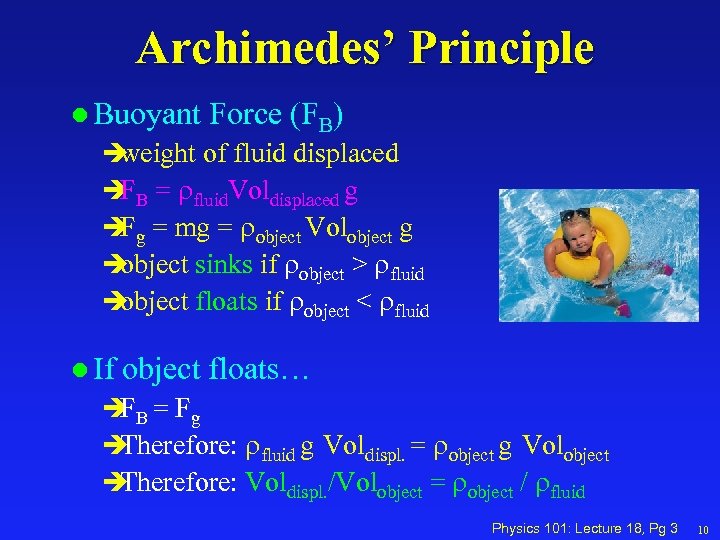 Archimedes’ Principle l Buoyant Force (FB) è weight of fluid displaced è B = fluid. Voldisplaced g F è g = mg = object Volobject g F è object sinks if object > fluid è object floats if object < fluid l If object floats… è B = Fg F è Therefore: fluid g Voldispl. = object g Volobject è Therefore: Voldispl. /Volobject = object / fluid Physics 101: Lecture 18, Pg 3 10
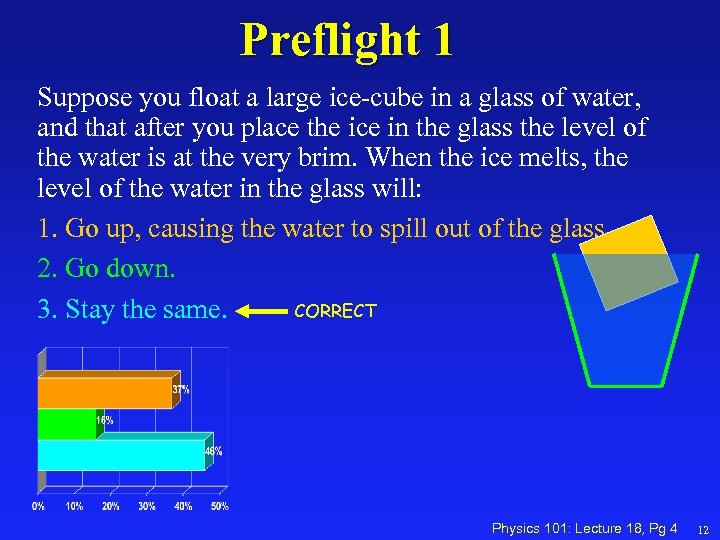 Preflight 1 Suppose you float a large ice-cube in a glass of water, and that after you place the ice in the glass the level of the water is at the very brim. When the ice melts, the level of the water in the glass will: 1. Go up, causing the water to spill out of the glass. 2. Go down. CORRECT 3. Stay the same. Physics 101: Lecture 18, Pg 4 12
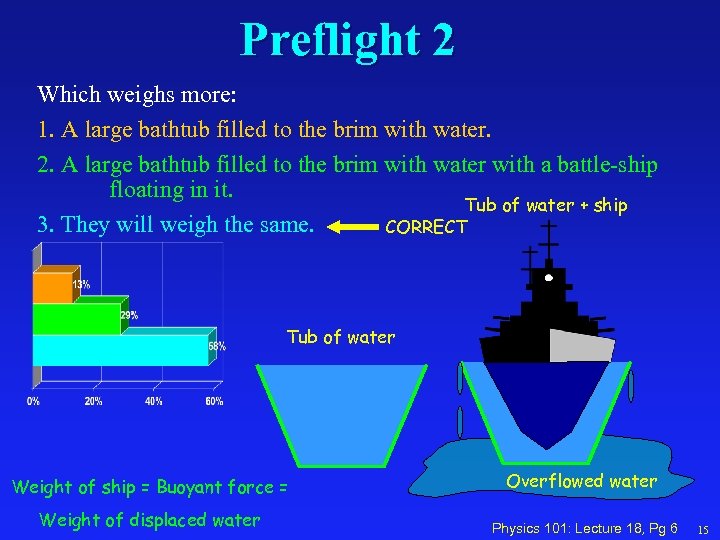 Preflight 2 Which weighs more: 1. A large bathtub filled to the brim with water. 2. A large bathtub filled to the brim with water with a battle-ship floating in it. Tub of water + ship 3. They will weigh the same. CORRECT Tub of water Weight of ship = Buoyant force = Overflowed water Weight of displaced water Physics 101: Lecture 18, Pg 6 15
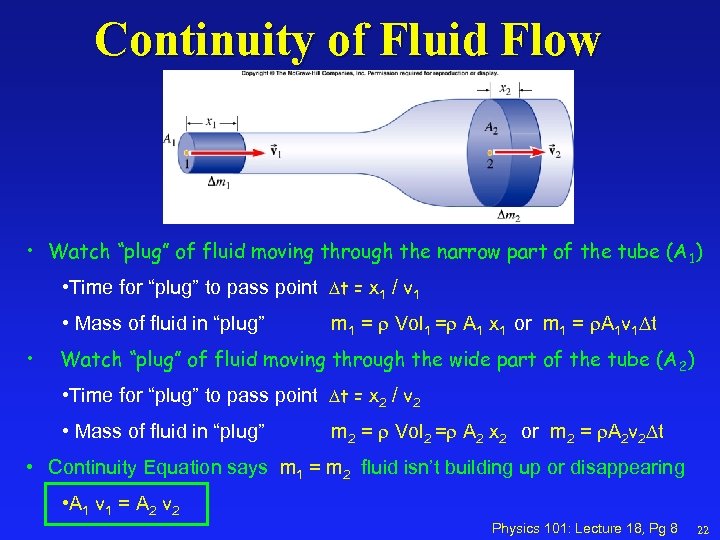 Continuity of Fluid Flow • Watch “plug” of fluid moving through the narrow part of the tube (A 1) • Time for “plug” to pass point Dt = x 1 / v 1 • Mass of fluid in “plug” • m 1 = Vol 1 = A 1 x 1 or m 1 = A 1 v 1 Dt Watch “plug” of fluid moving through the wide part of the tube (A 2) • Time for “plug” to pass point Dt = x 2 / v 2 • Mass of fluid in “plug” m 2 = Vol 2 = A 2 x 2 or m 2 = A 2 v 2 Dt • Continuity Equation says m 1 = m 2 fluid isn’t building up or disappearing • A 1 v 1 = A 2 v 2 Physics 101: Lecture 18, Pg 8 22
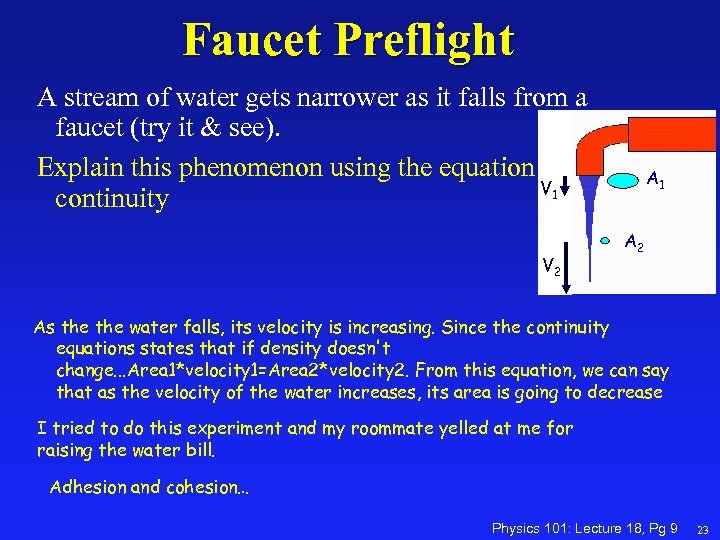 Faucet Preflight A stream of water gets narrower as it falls from a faucet (try it & see). Explain this phenomenon using the equation of V 1 continuity V 2 A 1 A 2 As the water falls, its velocity is increasing. Since the continuity equations states that if density doesn't change. . . Area 1*velocity 1=Area 2*velocity 2. From this equation, we can say that as the velocity of the water increases, its area is going to decrease I tried to do this experiment and my roommate yelled at me for raising the water bill. Adhesion and cohesion… Physics 101: Lecture 18, Pg 9 23
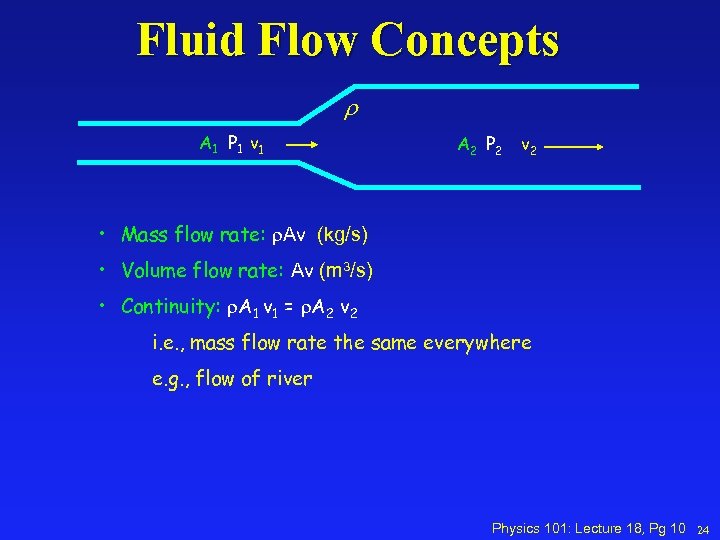 Fluid Flow Concepts r A 1 P 1 v 1 A 2 P 2 v 2 • Mass flow rate: Av (kg/s) • Volume flow rate: Av (m 3/s) • Continuity: A 1 v 1 = A 2 v 2 i. e. , mass flow rate the same everywhere e. g. , flow of river Physics 101: Lecture 18, Pg 10 24
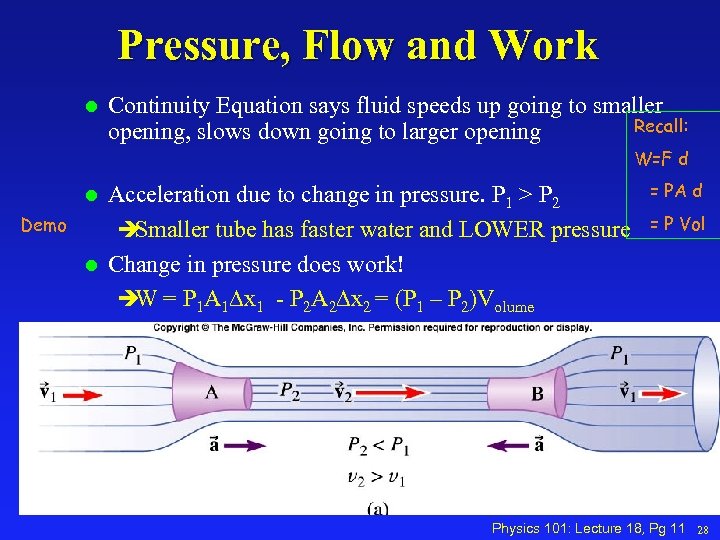 Pressure, Flow and Work l Continuity Equation says fluid speeds up going to smaller Recall: opening, slows down going to larger opening W=F d l Demo l Acceleration due to change in pressure. P 1 > P 2 è Smaller tube has faster water and LOWER pressure Change in pressure does work! è = P 1 A 1 Dx 1 - P 2 A 2 Dx 2 = (P 1 – P 2)Volume W = PA d = P Vol Physics 101: Lecture 18, Pg 11 28
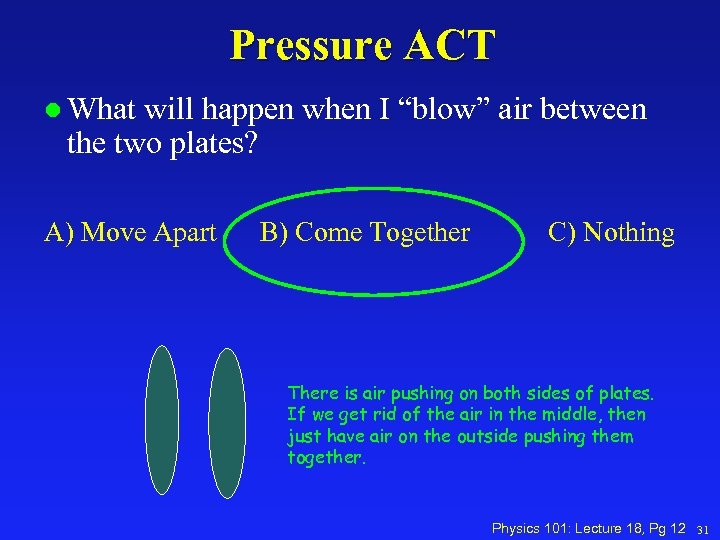 Pressure ACT l What will happen when I “blow” air between the two plates? A) Move Apart B) Come Together C) Nothing There is air pushing on both sides of plates. If we get rid of the air in the middle, then just have air on the outside pushing them together. Physics 101: Lecture 18, Pg 12 31
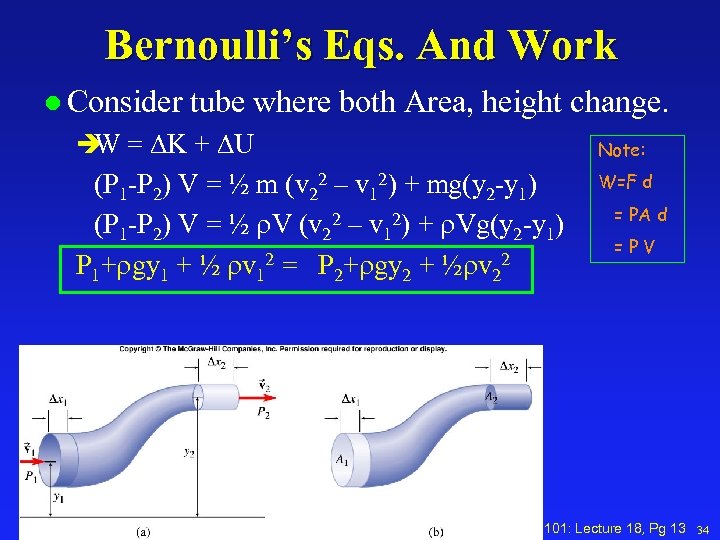 Bernoulli’s Eqs. And Work l Consider tube where both Area, height change. è = DK + DU W Note: (P 1 -P 2) V = ½ m (v 22 – v 12) + mg(y 2 -y 1) (P 1 -P 2) V = ½ V (v 22 – v 12) + Vg(y 2 -y 1) P 1+ gy 1 + ½ v 12 = P 2+ gy 2 + ½ v 22 W=F d = PA d =PV Physics 101: Lecture 18, Pg 13 34
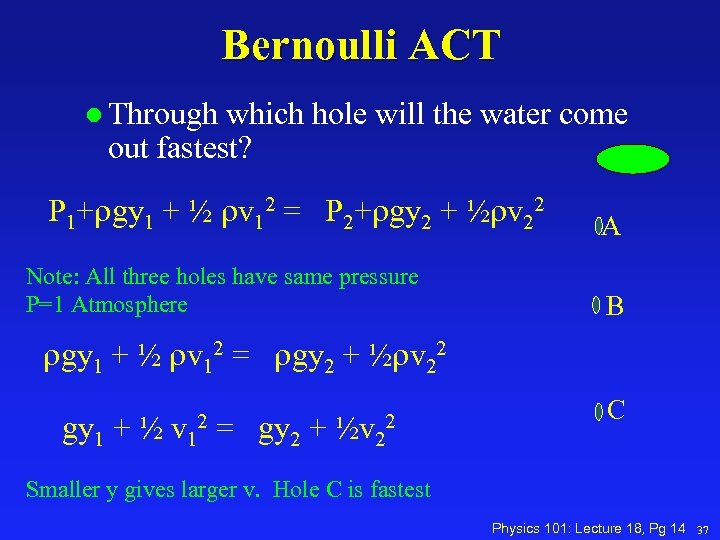 Bernoulli ACT l Through which hole will the water come out fastest? P 1+ gy 1 + ½ v 12 = P 2+ gy 2 + ½ v 22 Note: All three holes have same pressure P=1 Atmosphere A B gy 1 + ½ v 12 = gy 2 + ½ v 22 gy 1 + ½ v 1 = gy 2 + 2 ½v 22 C Smaller y gives larger v. Hole C is fastest Physics 101: Lecture 18, Pg 14 37
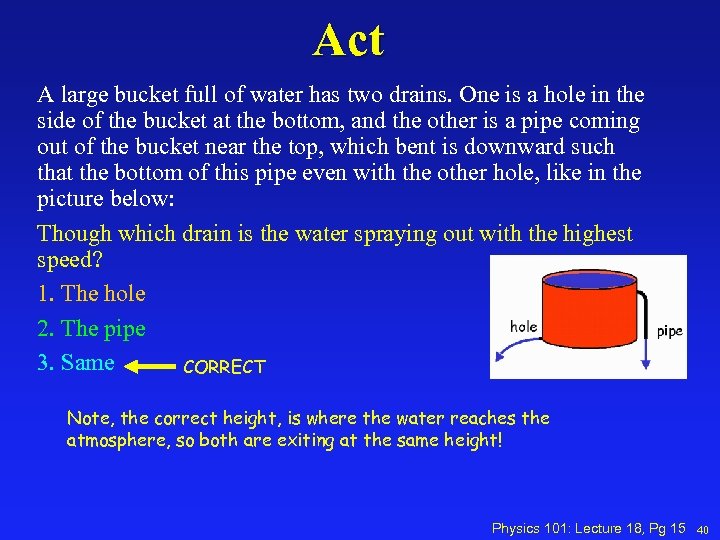 Act A large bucket full of water has two drains. One is a hole in the side of the bucket at the bottom, and the other is a pipe coming out of the bucket near the top, which bent is downward such that the bottom of this pipe even with the other hole, like in the picture below: Though which drain is the water spraying out with the highest speed? 1. The hole 2. The pipe 3. Same CORRECT Note, the correct height, is where the water reaches the atmosphere, so both are exiting at the same height! Physics 101: Lecture 18, Pg 15 40
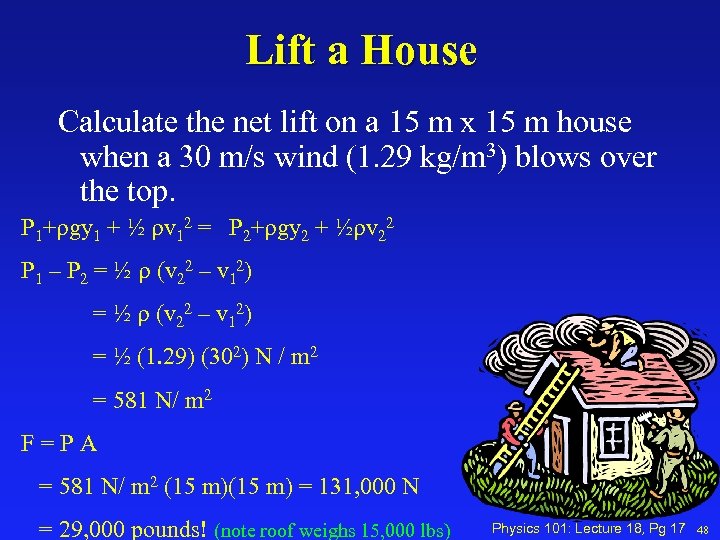 Lift a House Calculate the net lift on a 15 m x 15 m house when a 30 m/s wind (1. 29 kg/m 3) blows over the top. P 1+ gy 1 + ½ v 12 = P 2+ gy 2 + ½ v 22 P 1 – P 2 = ½ (v 22 – v 12) = ½ (1. 29) (302) N / m 2 = 581 N/ m 2 F=PA = 581 N/ m 2 (15 m) = 131, 000 N = 29, 000 pounds! (note roof weighs 15, 000 lbs) Physics 101: Lecture 18, Pg 17 48
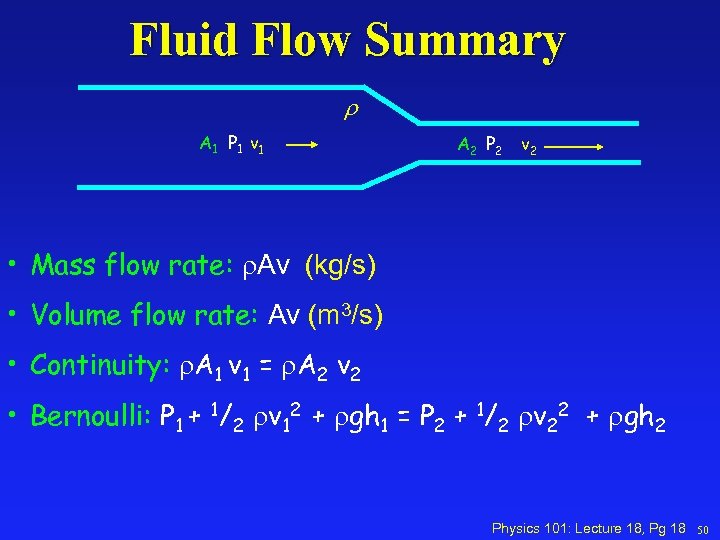 Fluid Flow Summary r A 1 P 1 v 1 A 2 P 2 v 2 • Mass flow rate: Av (kg/s) • Volume flow rate: Av (m 3/s) • Continuity: A 1 v 1 = A 2 v 2 • Bernoulli: P 1 + 1/2 v 12 + gh 1 = P 2 + 1/2 v 22 + gh 2 Physics 101: Lecture 18, Pg 18 50
 Practice Problems Chapt. 9, problems 1, 5, 9, 13, 15, 17, 21, 29, 33, 35, 41, 45, 47. Physics 101: Lecture 18, Pg 19