


 Скачать презентацию Ex 22 Forced Landing Ex 22 —
9e028dc22bbf9a1fd09a0ae6f0224f65.ppt
- Количество слайдов: 17
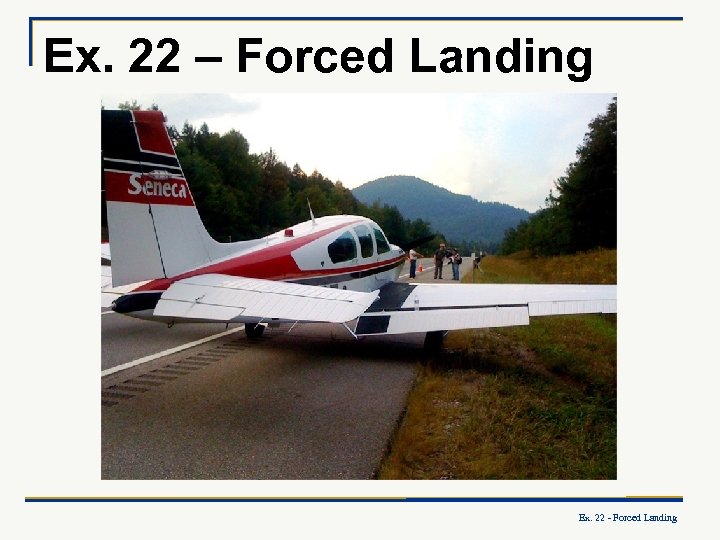 Ex. 22 – Forced Landing Ex. 22 - Forced Landing
 OBJECTIVE What you will learn: P How to select a landing site and carry out a safe forced approach and landing after an in-flight engine failure. Ex. 22 - Forced Landing
 MOTIVATION Why learn this: P Today’s planes are very reliable and engine failures are very rare – but they do happen P The best way to deal with an engine failure is to prevent it by: § § P thorough walk-arounds ensuring that plane’s inspection and maintenance schedules are followed careful flight planning (do you have enough fuel? ) using proper in-flight procedures to avoid engine shockcooling, engine over-heating, carb ice formation etc. However, it is important to be able to execute a safe forced landing should you still end up in a situation that requires one. Ex. 22 - Forced Landing
 LINKS Links: P You have already practiced: § gliding for range and estimating your touchdown point § § P selecting a good landing site estimating wind speed and direction All of these will help you in performing forced approaches. Ex. 22 - Forced Landing
 BACKGROUND KNOWLEDGE - TKT Let’s see how much you already know: Q How can you estimate wind direction? Q What are some characteristics of a good landing site? Q What is the definition of best glide speed, and what is the best glide speed for your aircraft, for no-wind conditions? Q How is best glide speed affected by wind? Q When gliding, how can you estimate your touchdown point? Q How can you correct the situation if it appears that you’re going to touch down beyond the desired touch-down point (i. e. , you are too high)? Q How can you correct the situation if it appears that you are going to touch down short of the desired touch-down point (i. e. , you are too low)? Ex. 22 - Forced Landing
 THEORIES & DEFINITIONS Theories and Definitions: P Estimating Wind Speed and Direction P Selecting a Landing Site P Circuit Forced Landing Pattern P 360 o Forced Landing Pattern Ex. 22 - Forced Landing
 THEORIES & DEFINITIONS Estimating Wind Speed and Direction P Visual indication of wind direction & speed § Smoke § Water, crops or tall grass ripples § § P Trees (some types of trees have light-coloured underside exposed on upwind side) Birds usually land into the wind If no visual indication available, recall area forecasts and observe ground speed and inflight drift. Ex. 22 - Forced Landing
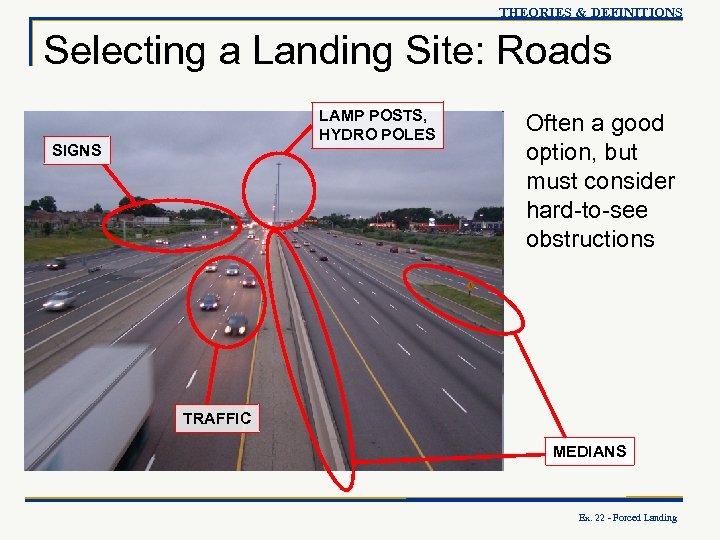 THEORIES & DEFINITIONS Selecting a Landing Site: Roads LAMP POSTS, HYDRO POLES SIGNS Often a good option, but must consider hard-to-see obstructions TRAFFIC MEDIANS Ex. 22 - Forced Landing
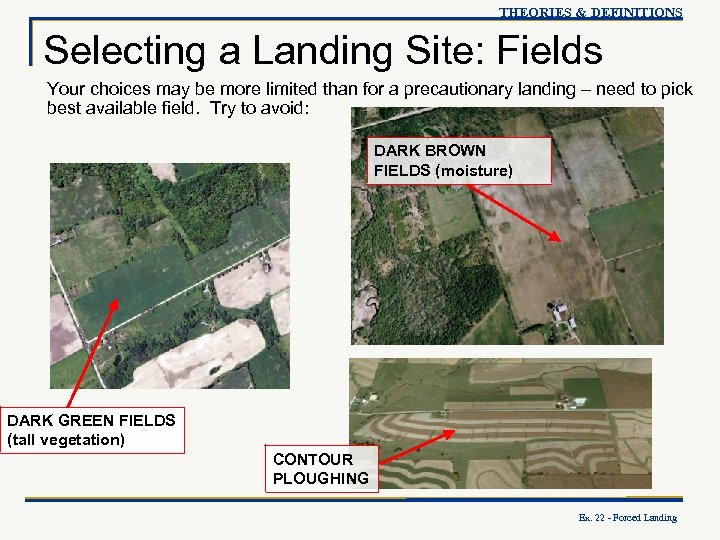 THEORIES & DEFINITIONS Selecting a Landing Site: Fields Your choices may be more limited than for a precautionary landing – need to pick best available field. Try to avoid: DARK BROWN FIELDS (moisture) DARK GREEN FIELDS (tall vegetation) CONTOUR PLOUGHING Ex. 22 - Forced Landing
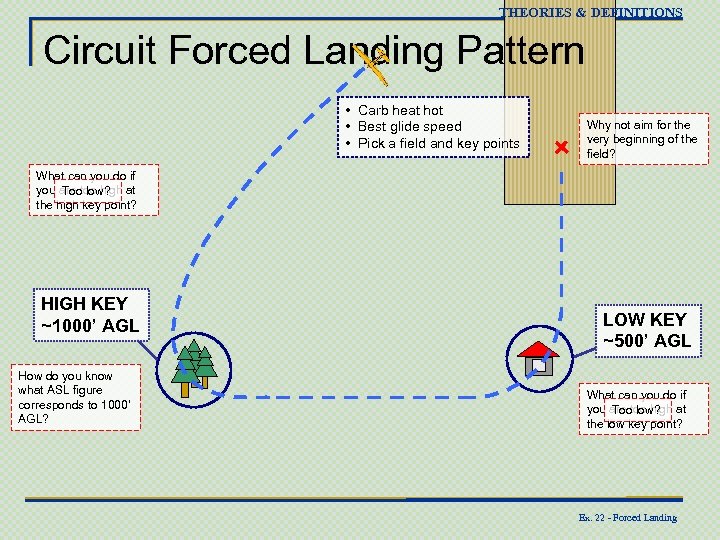 THEORIES & DEFINITIONS Circuit Forced Landing Pattern • Carb heat hot • Best glide speed • Pick a field and key points Why not aim for the very beginning of the field? What can you do if you are too high at Too low? the high key point? HIGH KEY ~1000’ AGL How do you know what ASL figure corresponds to 1000’ AGL? LOW KEY ~500’ AGL What can you do if you are too high at Too low? the low key point? Ex. 22 - Forced Landing
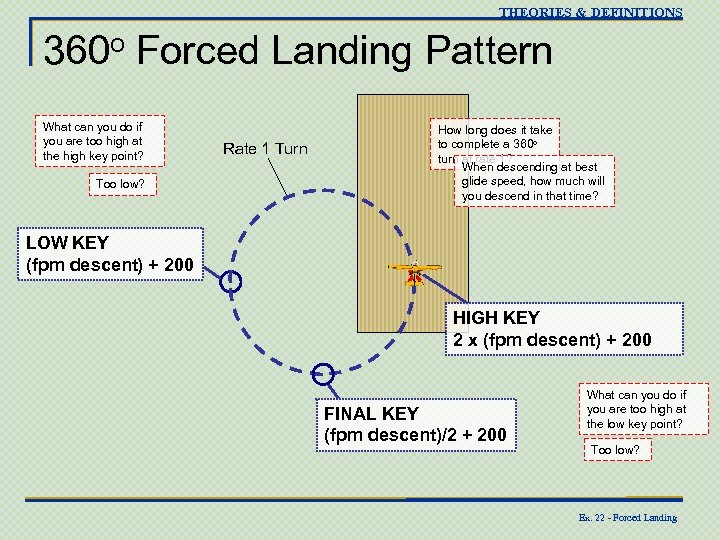 THEORIES & DEFINITIONS 360 o Forced Landing Pattern What can you do if you are too high at the high key point? Too low? Rate 1 Turn How long does it take to complete a 360 o turn at rate 1? When descending at best glide speed, how much will you descend in that time? LOW KEY (fpm descent) + 200 HIGH KEY 2 x (fpm descent) + 200 FINAL KEY (fpm descent)/2 + 200 What can you do if you are too high at the low key point? Too low? Ex. 22 - Forced Landing
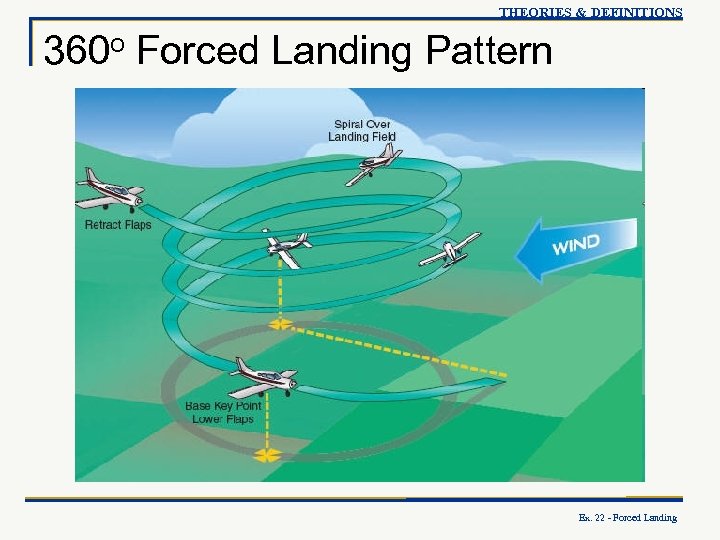 THEORIES & DEFINITIONS 360 o Forced Landing Pattern Ex. 22 - Forced Landing
 PROCEDURES Procedures P Forced Landing Ex. 22 - Forced Landing
 PROCEDURES Forced Landing P Carb heat, best glide speed P Pick a field and key points P Establish approach P When practicing: engine warm-ups every 500 feet! P Cause check, try engine restart (use emergency checklist if time permits) P Transponder 7700, MAYDAY call P Secure engine (leave master on) § power and mixture off § fuel off § mags off P Passenger briefing P Once field is made: § full flaps § master off § crack door open prior to touchdown. Ex. 22 - Forced Landing
 CONSIDERATIONS Considerations P This procedure deals with engine failure with some altitude available. Right after take-off or in traffic pattern you may not have enough time for all checks and calls. Concentrate on flying a good approach P In cruise, constantly be on look-out for good fields within gliding distance. There are many small, unmarked landing strips – see if you can notice those (parked planes are a big give-away). Prior to take-off, familiarize yourself with local terrain to know what the options available to you are P Good news: most forced landings are survivable – if you don’t stall the plane! Don’t try to “stretch a glide” by raising the nose and losing airspeed. Ex. 22 - Forced Landing
 SAFETY ! Keep an eye on your airspeed angle of bank! ! When practicing, conduct engine warm-ups every 500’ (to avoid shock-cooling the engine) ! When practicing solo, do not descend below 500’ AGL ! Aim to be slightly high on final in case wind shear or downdraft cause unanticipated altitude loss ! Keep calm and offer reassurance to your passengers. And you did remember to do a thorough pax briefing BEFORE even getting into the plane, right? Ex. 22 - Forced Landing
 CONCLUSION Conclusion P This exercise prepares you for dealing with one of the most challenging in-flight emergencies P After mastering the forced landing, you will be ready to venture beyond the practice area and actually go places! P Read for next lesson: Ex. 23, Navigation. QUESTIONS? Ex. 22 - Forced Landing