 Скачать презентацию Evolving Role of Mass Spectrometry in Bioanalytical Analysis
17cb3d067cf501a5503ea23efe9cca54.ppt
- Количество слайдов: 98



Evolving Role of Mass Spectrometry in Bioanalytical Analysis Daniel Pentek February 1, 2007 -UCONN Bioanalytical Chem 395
Topics to be covered: n Quick Review¨ ¨ MS Market & Technologies Basic ionization methods n ¨ Interfaces n n Electrospray, APCI, APPI Orifice, capillary MS Analyzers ¨ ¨ Performance Criteria Strengths & weaknesses for bioanalytical analyses n n n Feb. 1, 2007 Quadrupole (single &triple quads) Ion traps (3 -D and 2 -D) Time of flight (linear, reflectron, MALDI) Hybrids (Quad-TOF) and others… FTMS (ICRs and orbitraps) Bioanalytical Chem 395
What is a mass spectrometer? n An instrument that separates molecules or atoms (e. g. , ICP/MS) based on their mass/charge ratio (m/z). ¨ In order to control them, you need to put a charge on them. ¨ In order to separate them, you need an “analyzer” of some type… Feb. 1, 2007 Bioanalytical Chem 395
LC/MS Historical Perspective n Industry was desperate for a decent, rugged LC/MS interface. ¨ GC/MS required derivatization, etc. ¨ Not applicable to most biomolecules n n API ionization ALONG WITH new interface designs provided the solution. Now, all interfaces are differentially pumped. ¨ Pumping of interfaces was critical ¨ Orifice – skimmer (nozzle) designs ¨ Heated (or cold) capillary designs n (MW, etc. ) LC/MS is big business now! Feb. 1, 2007 Bioanalytical Chem 395
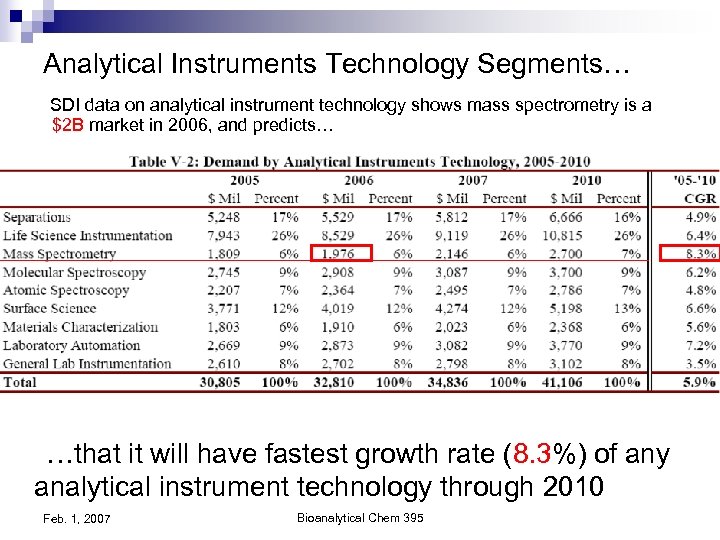
Analytical Instruments Technology Segments… SDI data on analytical instrument technology shows mass spectrometry is a $2 B market in 2006, and predicts… …that it will have fastest growth rate (8. 3%) of any analytical instrument technology through 2010 Feb. 1, 2007 Bioanalytical Chem 395
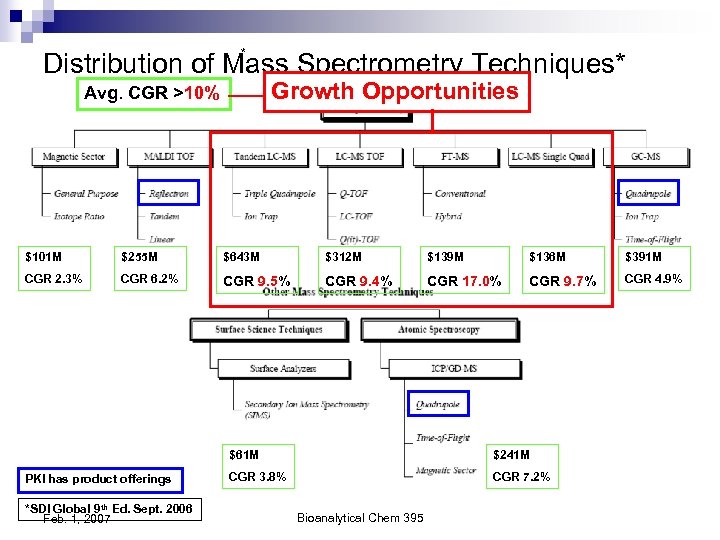
* Distribution of Mass Spectrometry Techniques* Growth Opportunities Avg. CGR >10% $101 M $255 M $643 M $312 M $139 M $136 M $391 M CGR 2. 3% CGR 6. 2% CGR 9. 5% CGR 9. 4% CGR 17. 0% CGR 9. 7% CGR 4. 9% $61 M PKI has product offerings *SDI Global 9 th Ed. Sept. 2006 Feb. 1, 2007 $241 M CGR 3. 8% CGR 7. 2% Bioanalytical Chem 395
LC/MS(/MS) is a Marriage of Liquid Chromatography and Mass Spectrometry n n Marriage (like any other close relationship) requires: COMPROMISE! LC Person: “MS is just another detector” MS Person: “LC is just an inlet” ¨ What’s good for LC may not be good for MS and vice versa. ¨ LC was around a long time before they figured out how to interface it to an MS. Feb. 1, 2007 Bioanalytical Chem 395
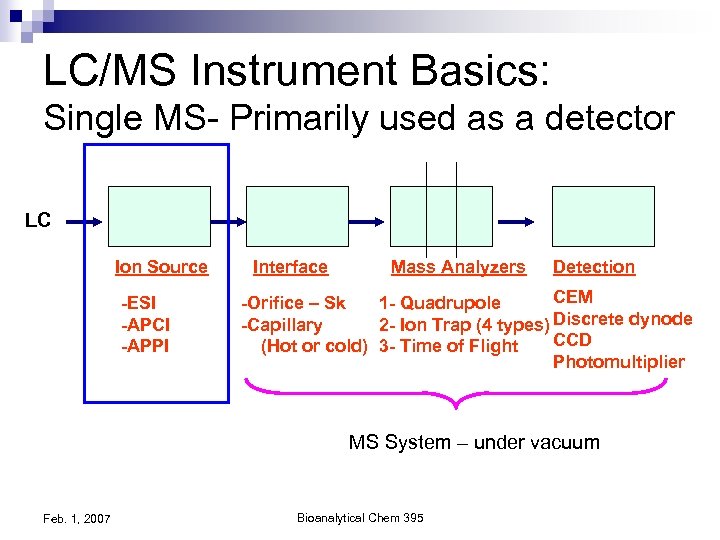
LC/MS Instrument Basics: Single MS- Primarily used as a detector LC Ion Source -ESI -APCI -APPI Interface Mass Analyzers Detection CEM -Orifice – Sk 1 - Quadrupole -Capillary 2 - Ion Trap (4 types) Discrete dynode CCD (Hot or cold) 3 - Time of Flight Photomultiplier MS System – under vacuum Feb. 1, 2007 Bioanalytical Chem 395
Today’s LC/MS Ionization Methods All Done at Atmospheric Pressure n On-line techniques: ¨ Electrospray (ESI) - Fenn @ Yale ~1984 n Shared Nobel Prize in 2002 for this work with K. Tanaka (MALDI) and K. Wüthrich (NMR) ¨ Atmospheric Pressure Chemical Ionization (APCI) n Irabarne & Thomson ~1979 ¨ Atmospheric Pressure Photo Ionization (APPI) n Emerging, not as widely used yet. n All of the above are done at atmospheric pressure ¨ Significant change from traditional ionization methods which were all done within the vacuum chamber. Feb. 1, 2007 Bioanalytical Chem 395
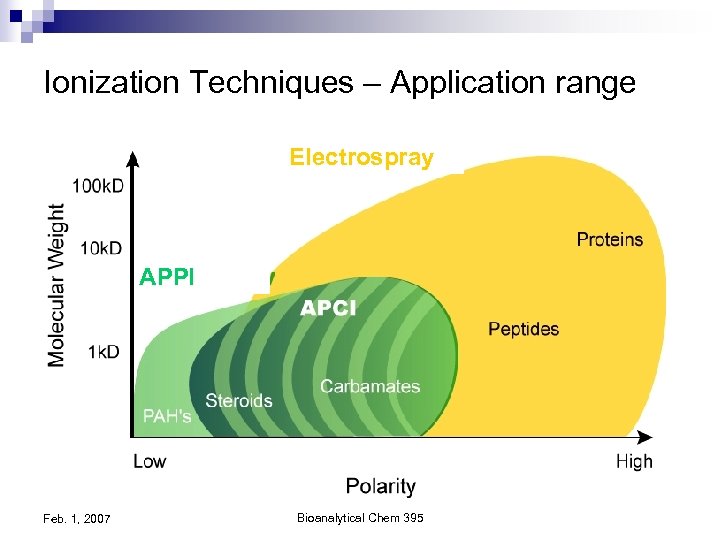
Ionization Techniques – Application range Electrospray APPI Feb. 1, 2007 Bioanalytical Chem 395
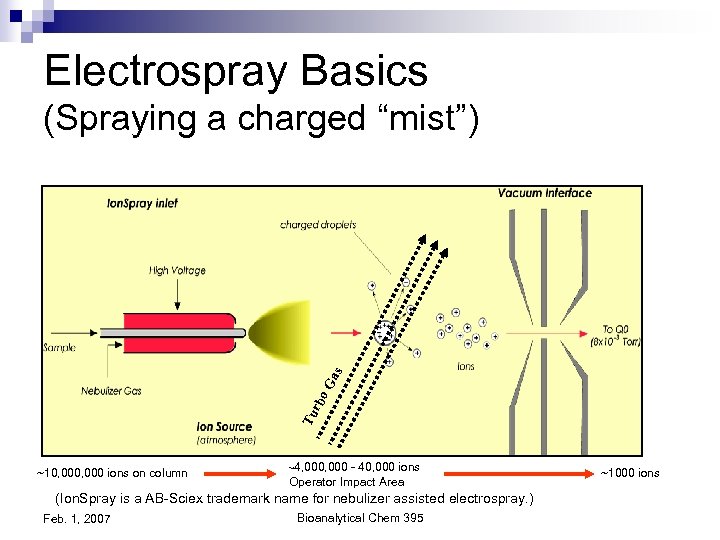
Electrospray Basics Tu rbo Ga s (Spraying a charged “mist”) ~10, 000 ions on column ~4, 000 - 40, 000 ions Operator Impact Area (Ion. Spray is a AB-Sciex trademark name for nebulizer assisted electrospray. ) Feb. 1, 2007 Bioanalytical Chem 395 ~1000 ions
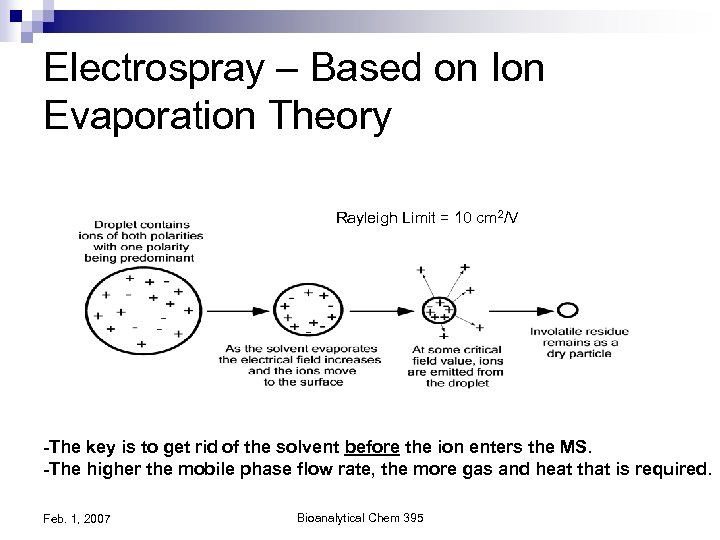
Electrospray – Based on Ion Evaporation Theory Rayleigh Limit = 10 cm 2/V -The key is to get rid of the solvent before the ion enters the MS. -The higher the mobile phase flow rate, the more gas and heat that is required. Feb. 1, 2007 Bioanalytical Chem 395
Electrospray n Take home message: ¨ Electrospray is concentration dependent technique. ¨ Started out as very low flow technique, which wasn’t very compatible with LC. LC Person: “Use lower flows and narrower column”. n MS Person: “Buy ESI probe that has higher gas flows and desolvates better”. n ¨ Ease of use and higher LC flow compatibility drove source development. Feb. 1, 2007 Bioanalytical Chem 395
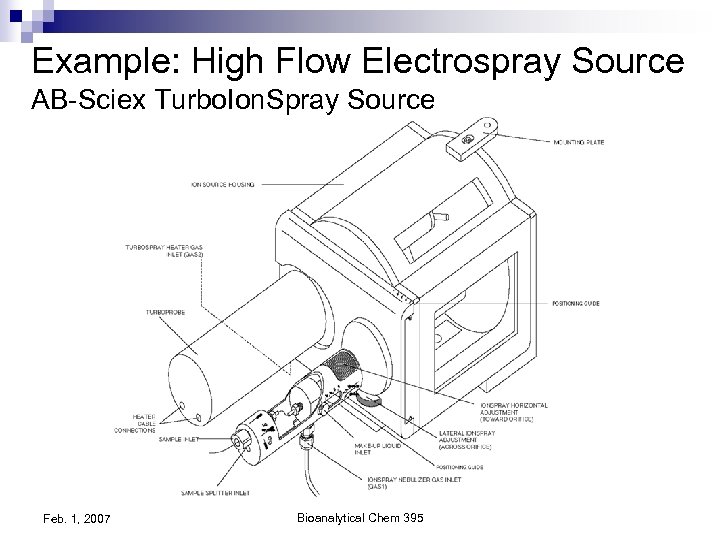
Example: High Flow Electrospray Source AB-Sciex Turbo. Ion. Spray Source Feb. 1, 2007 Bioanalytical Chem 395
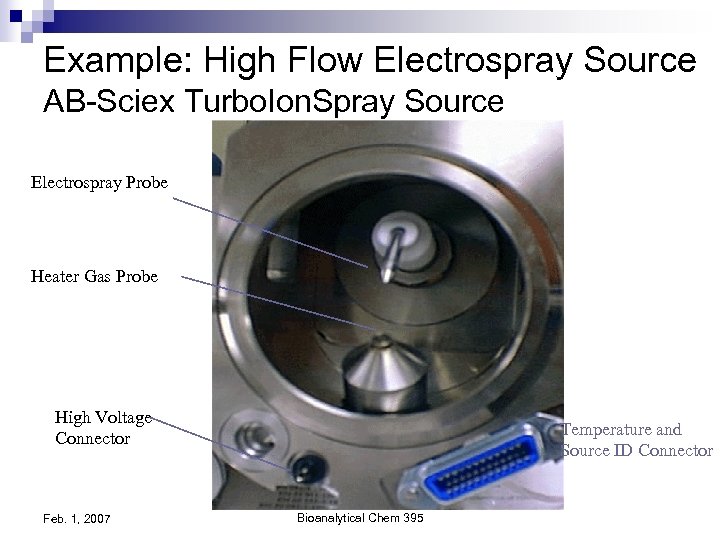
Example: High Flow Electrospray Source AB-Sciex Turbo. Ion. Spray Source Electrospray Probe Heater Gas Probe High Voltage Connector Feb. 1, 2007 Temperature and Source ID Connector Bioanalytical Chem 395
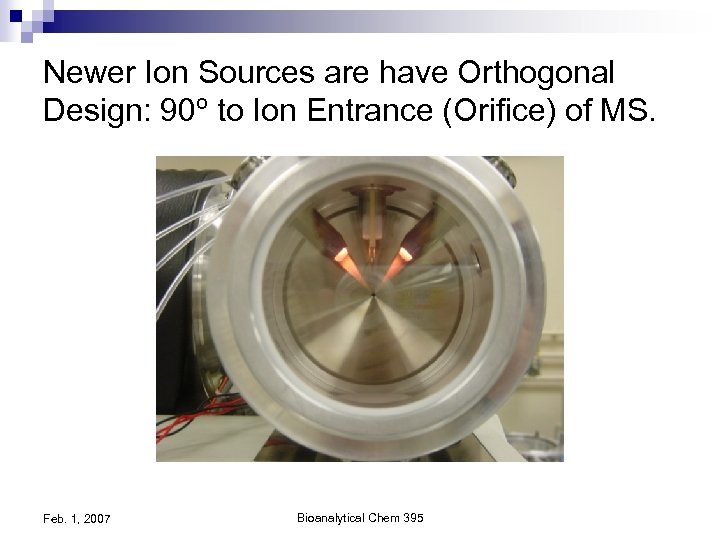
Newer Ion Sources are have Orthogonal Design: 90º to Ion Entrance (Orifice) of MS. Feb. 1, 2007 Bioanalytical Chem 395
Electrospray- Tips ¨ Modifiers Organic acids (e. g. formic, acetic) promote ionization of basic compounds (sp 3 N- containing) n Neutral compounds containing nucleophilic lone pairs (sp 2 N, sp 3 O) can be desorbed by cationization with alkali metal or ammonium ions. n Ammonium formate or acetate are recommended as buffers ( 2 -10 m. M optimum, can see suppression effects over 20 m. M) n Feb. 1, 2007 Bioanalytical Chem 395
Electrospray- Tips ¨ Modifiers (cont. ) Salts can interfere with ionization and can cluster to complicate spectrum (but also aid in identification) n Strong bases or quaternary amines can interfere with positive mode analytes n Sulfonic acids interfere with negative mode analytes n DO NOT USE PHOSPHATE BUFFERS n Feb. 1, 2007 Bioanalytical Chem 395
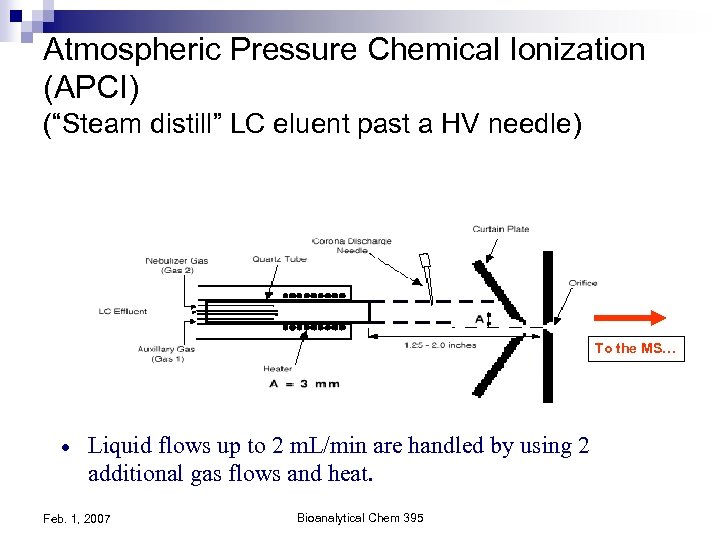
Atmospheric Pressure Chemical Ionization (APCI) (“Steam distill” LC eluent past a HV needle) To the MS… To MS Liquid flows up to 2 m. L/min are handled by using 2 additional gas flows and heat. Feb. 1, 2007 Bioanalytical Chem 395
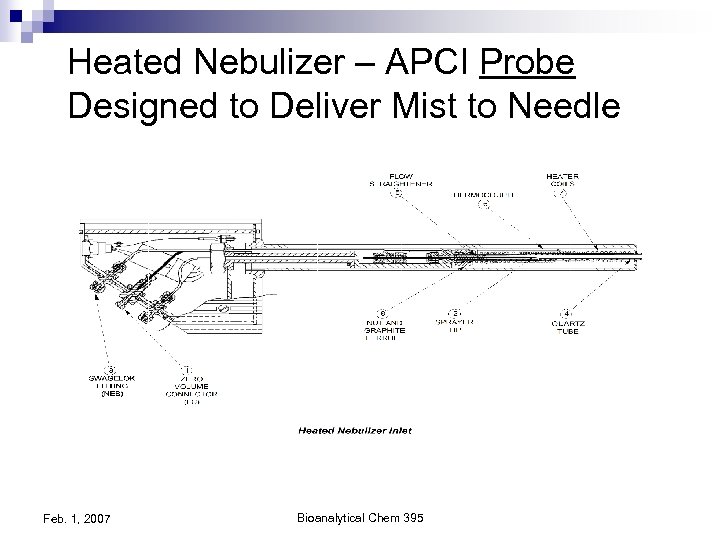
Heated Nebulizer – APCI Probe Designed to Deliver Mist to Needle Feb. 1, 2007 Bioanalytical Chem 395
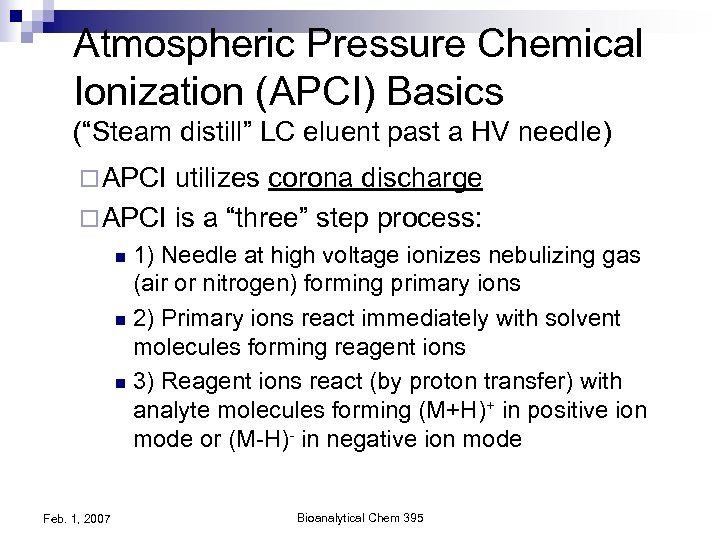
Atmospheric Pressure Chemical Ionization (APCI) Basics (“Steam distill” LC eluent past a HV needle) ¨ APCI utilizes corona discharge ¨ APCI is a “three” step process: 1) Needle at high voltage ionizes nebulizing gas (air or nitrogen) forming primary ions n 2) Primary ions react immediately with solvent molecules forming reagent ions n 3) Reagent ions react (by proton transfer) with analyte molecules forming (M+H)+ in positive ion mode or (M-H)- in negative ion mode n Feb. 1, 2007 Bioanalytical Chem 395
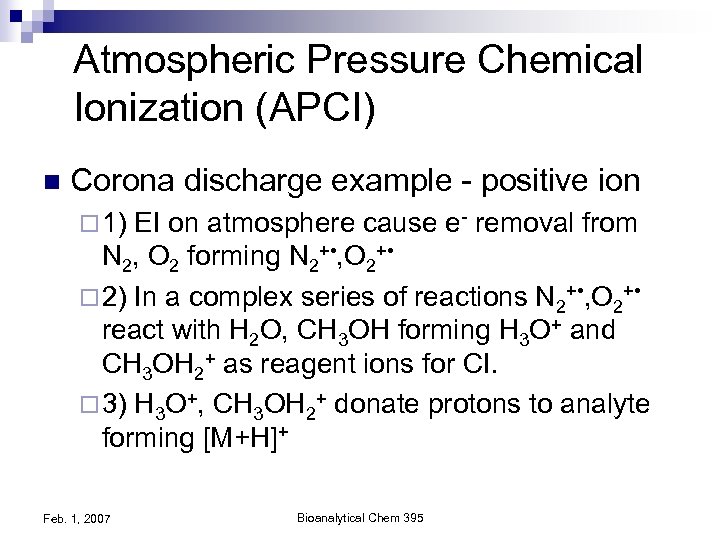
Atmospheric Pressure Chemical Ionization (APCI) n Corona discharge example - positive ion ¨ 1) EI on atmosphere cause e- removal from N 2, O 2 forming N 2+ • , O 2+ • ¨ 2) In a complex series of reactions N 2+ • , O 2+ • react with H 2 O, CH 3 OH forming H 3 O+ and CH 3 OH 2+ as reagent ions for CI. ¨ 3) H 3 O+, CH 3 OH 2+ donate protons to analyte forming [M+H]+ Feb. 1, 2007 Bioanalytical Chem 395
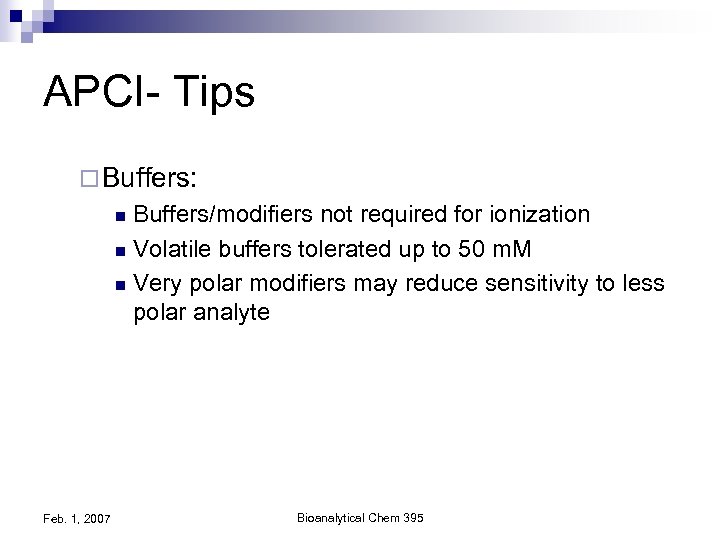
APCI- Tips ¨ Buffers: Buffers/modifiers not required for ionization n Volatile buffers tolerated up to 50 m. M n Very polar modifiers may reduce sensitivity to less polar analyte n Feb. 1, 2007 Bioanalytical Chem 395
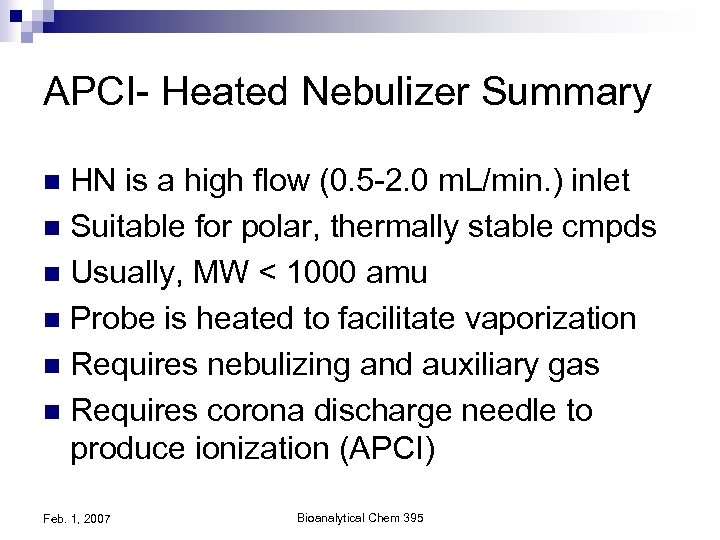
APCI- Heated Nebulizer Summary HN is a high flow (0. 5 -2. 0 m. L/min. ) inlet n Suitable for polar, thermally stable cmpds n Usually, MW < 1000 amu n Probe is heated to facilitate vaporization n Requires nebulizing and auxiliary gas n Requires corona discharge needle to produce ionization (APCI) n Feb. 1, 2007 Bioanalytical Chem 395
ESI or APCI? - Which is better? n n n For some applications, the choice is obvious… For analytes <1000 Da, you had to try both and see which one yielded the best sensitivity. Now, vendors are starting to offer “dual mode” sources to speed up method development… Feb. 1, 2007 Bioanalytical Chem 395
Dual Mode Source… Feb. 1, 2007 Bioanalytical Chem 395
Atmospheric Pressure Photo Ionization (APPI) n Emerging technique (about 5 years old) ¨ Uses typical 10 e. V UV lamp (similar to Photoionization lamps for GC). ¨ Similar to APCI, but applicable to broader range of compounds. Feb. 1, 2007 Bioanalytical Chem 395
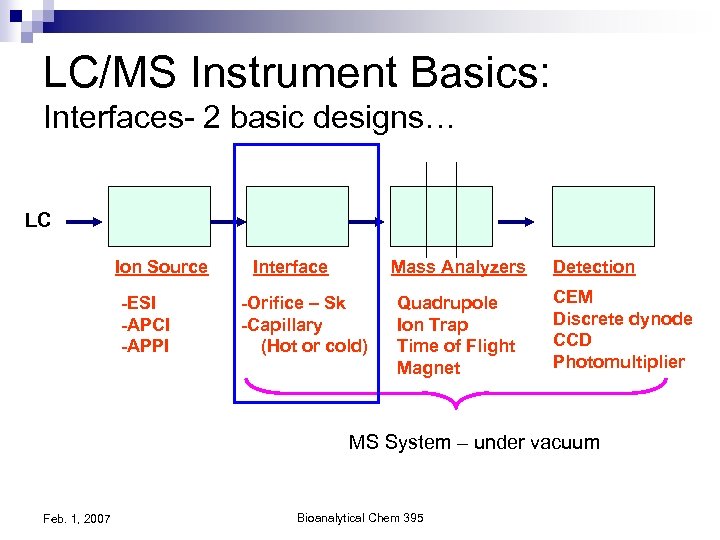
LC/MS Instrument Basics: Interfaces- 2 basic designs… LC Ion Source -ESI -APCI -APPI Interface Mass Analyzers -Orifice – Sk -Capillary (Hot or cold) Quadrupole Ion Trap Time of Flight Magnet Detection CEM Discrete dynode CCD Photomultiplier MS System – under vacuum Feb. 1, 2007 Bioanalytical Chem 395
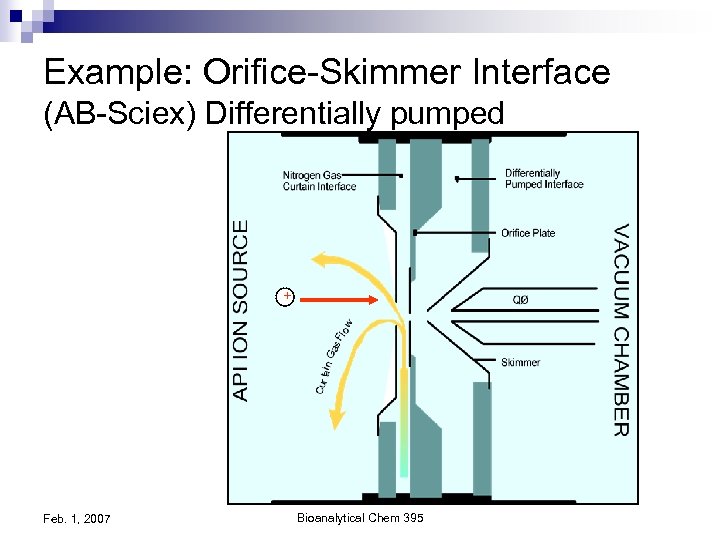
Example: Orifice-Skimmer Interface (AB-Sciex) Differentially pumped + Feb. 1, 2007 Bioanalytical Chem 395
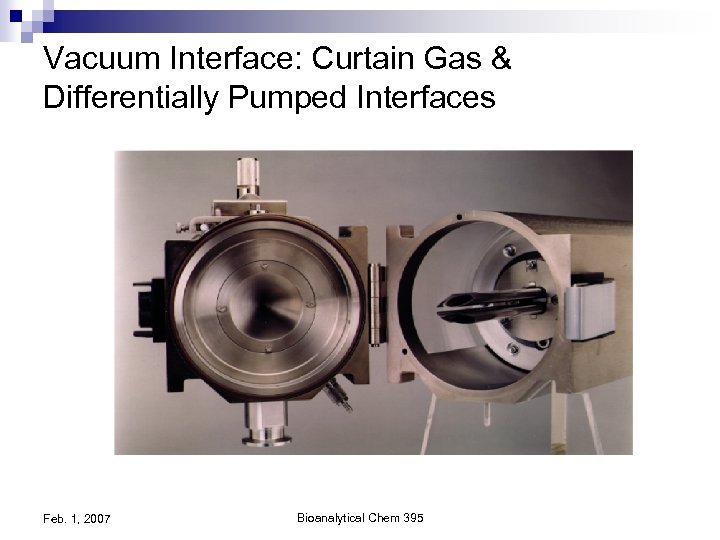
Vacuum Interface: Curtain Gas & Differentially Pumped Interfaces Feb. 1, 2007 Bioanalytical Chem 395
Vacuum Interface: Curtain Gas &Differentially Pumped Interfaces ¨ UHP nitrogen curtain gas (CG) keeps nonionized species out of the orifice and analyzer region ¨ CG aids in ion declustering (with CID potentials) ¨ Two stage transition from atmosphere to low pressure region of analyzer (1 x 10 -5 torr) ¨ Curtain gas and ions are drawn in due to; Pressure differential (both ions & CG) n Electric field gradients (ions only) n Feb. 1, 2007 Bioanalytical Chem 395
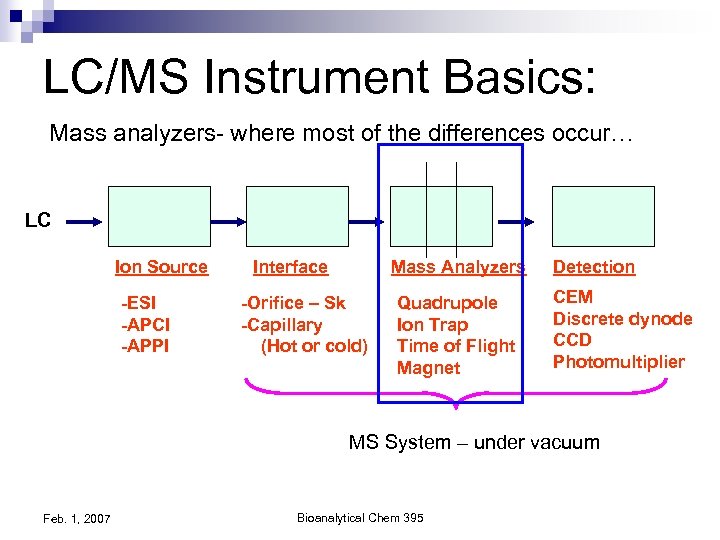
LC/MS Instrument Basics: Mass analyzers- where most of the differences occur… LC Ion Source -ESI -APCI -APPI Interface Mass Analyzers -Orifice – Sk -Capillary (Hot or cold) Quadrupole Ion Trap Time of Flight Magnet Detection CEM Discrete dynode CCD Photomultiplier MS System – under vacuum Feb. 1, 2007 Bioanalytical Chem 395
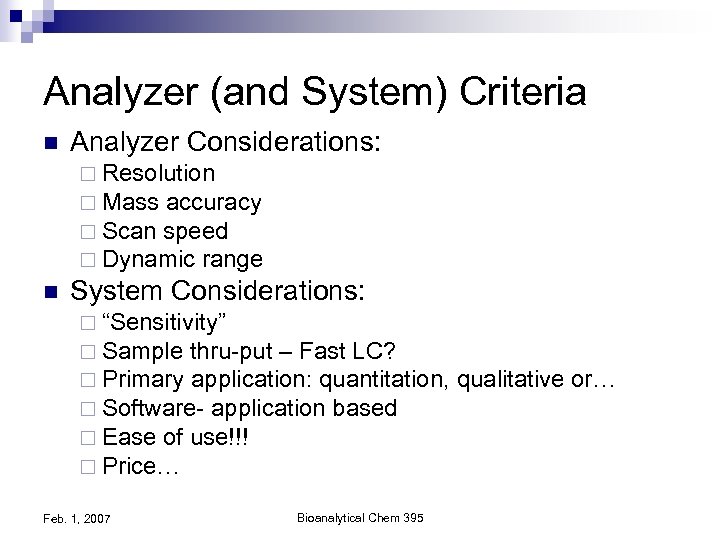
Analyzer (and System) Criteria n Analyzer Considerations: ¨ Resolution ¨ Mass accuracy ¨ Scan speed ¨ Dynamic range n System Considerations: ¨ “Sensitivity” ¨ Sample thru-put – Fast LC? ¨ Primary application: quantitation, ¨ Software- application based ¨ Ease of use!!! ¨ Price… Feb. 1, 2007 Bioanalytical Chem 395 qualitative or…
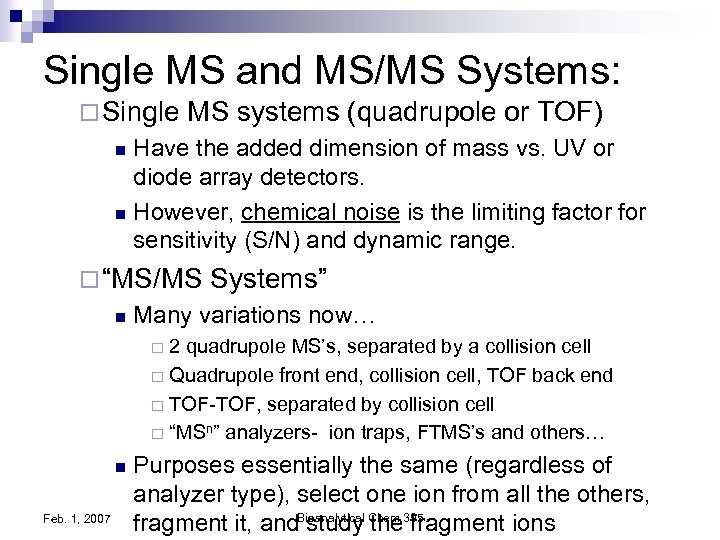
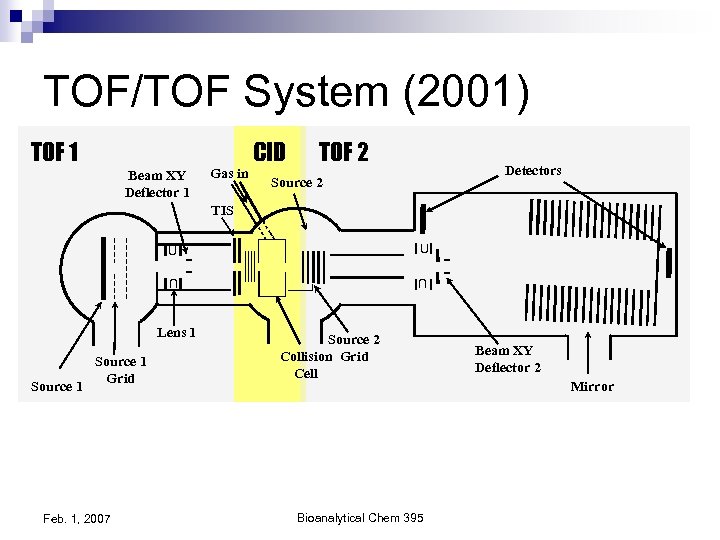
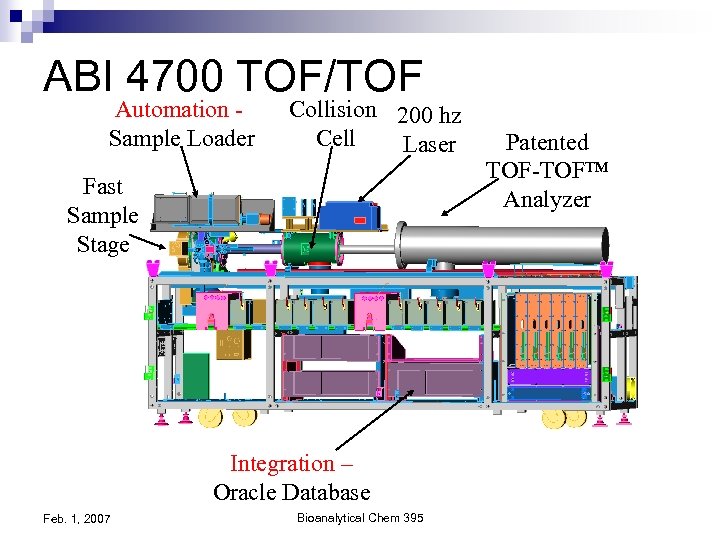
Single MS and MS/MS Systems: ¨ Single MS systems (quadrupole or TOF) Have the added dimension of mass vs. UV or diode array detectors. n However, chemical noise is the limiting factor for sensitivity (S/N) and dynamic range. n ¨ “MS/MS n Systems” Many variations now… 2 quadrupole MS’s, separated by a collision cell ¨ Quadrupole front end, collision cell, TOF back end ¨ TOF-TOF, separated by collision cell ¨ “MSn” analyzers- ion traps, FTMS’s and others… ¨ n Feb. 1, 2007 Purposes essentially the same (regardless of analyzer type), select one ion from all the others, fragment it, and. Bioanalytical Chem 395 study the fragment ions
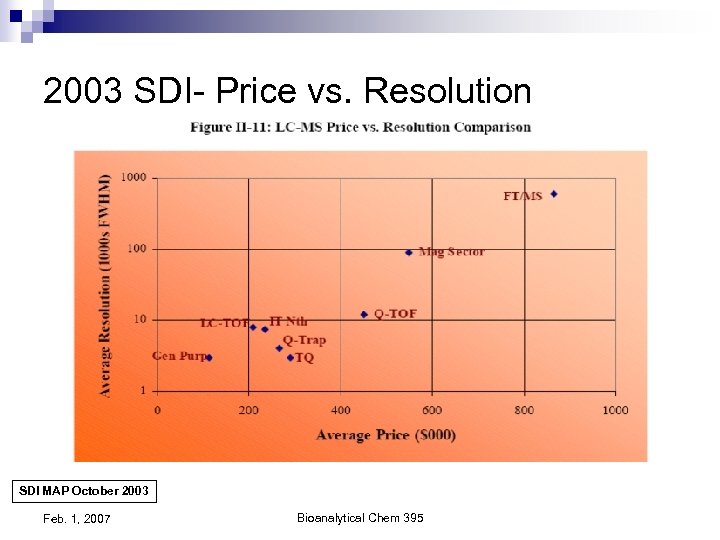
2003 SDI- Price vs. Resolution SDI MAP October 2003 Feb. 1, 2007 Bioanalytical Chem 395
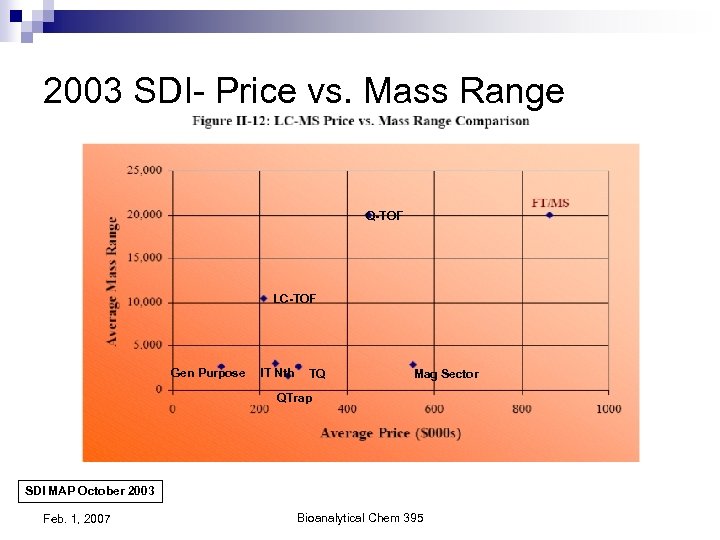
2003 SDI- Price vs. Mass Range Q-TOF LC-TOF Gen Purpose IT Nth TQ Mag Sector QTrap SDI MAP October 2003 Feb. 1, 2007 Bioanalytical Chem 395
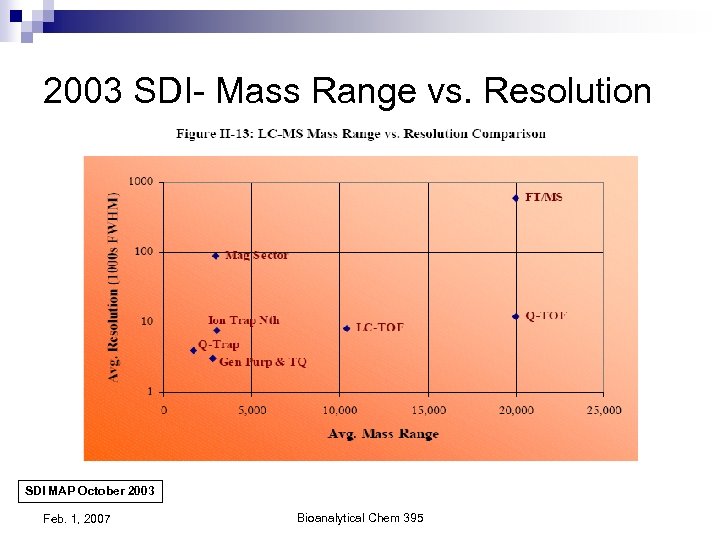
2003 SDI- Mass Range vs. Resolution SDI MAP October 2003 Feb. 1, 2007 Bioanalytical Chem 395
Resolution- What is it? n n Ability to separate (resolve) adjacent ions Typically defined as: M/∆M ¨ M: n Mass ∆M: Full Width at Half Max. Quadrupoles: scan at constant peak width ¨ 30/1=30, 300/1=300, 3000/1=3000… n Resolution increases as you go to higher mass n TOFs: scan at constant resolution ¨ 10 k res: m/z 10. 001, 1000. 1, 10, 001 n Peak width increases as you go to higher mass Feb. 1, 2007 Bioanalytical Chem 395
Analyzer Types: Quadrupoles (and hexapoles, octopoles, etc. ) Fundamental parts of virtually all LC/MS systems n Serve one of two purposes: n ¨ Ion n Capture and transmit ions from one place to another… ¨ Ion n Feb. 1, 2007 transmission devices (quad, hex, oct…) filtering devices (quadrupoles only…) Act as a mass filter (analogous to a magnet) Bioanalytical Chem 395
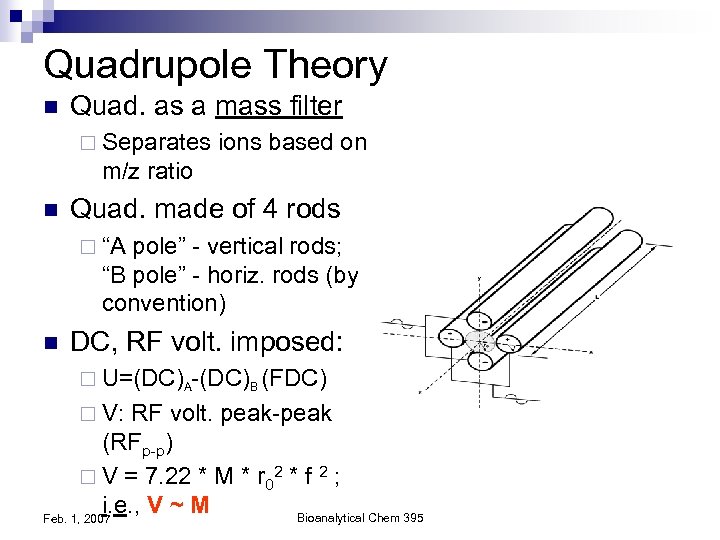
Quadrupole Theory n Quad. as a mass filter ¨ Separates ions based on m/z ratio n Quad. made of 4 rods ¨ “A pole” - vertical rods; “B pole” - horiz. rods (by convention) n DC, RF volt. imposed: ¨ U=(DC)A-(DC)B (FDC) ¨ V: RF volt. peak-peak (RFp-p) ¨ V = 7. 22 * M * r 02 * f 2 ; i. e. , V ~ M Bioanalytical Chem 395 Feb. 1, 2007
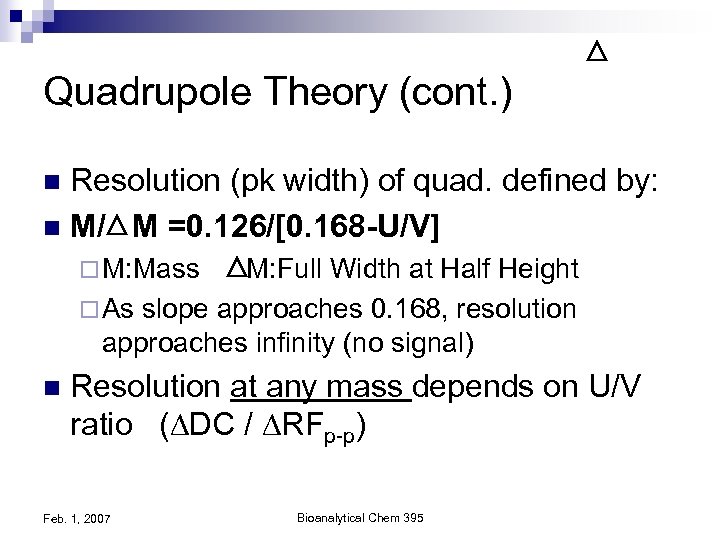
Quadrupole Theory (cont. ) Resolution (pk width) of quad. defined by: n M/ M =0. 126/[0. 168 -U/V] n ¨ M: Mass M: Full Width at Half Height ¨ As slope approaches 0. 168, resolution approaches infinity (no signal) n Resolution at any mass depends on U/V ratio (∆DC / ∆RFp-p) Feb. 1, 2007 Bioanalytical Chem 395
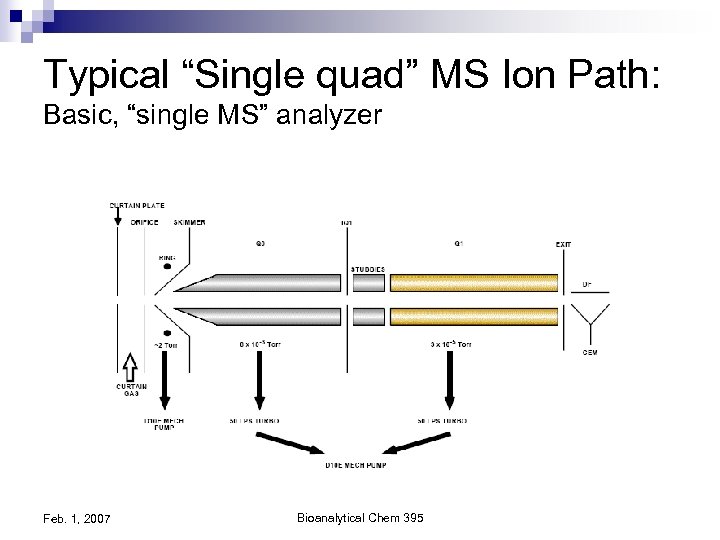
Typical “Single quad” MS Ion Path: Basic, “single MS” analyzer Feb. 1, 2007 Bioanalytical Chem 395
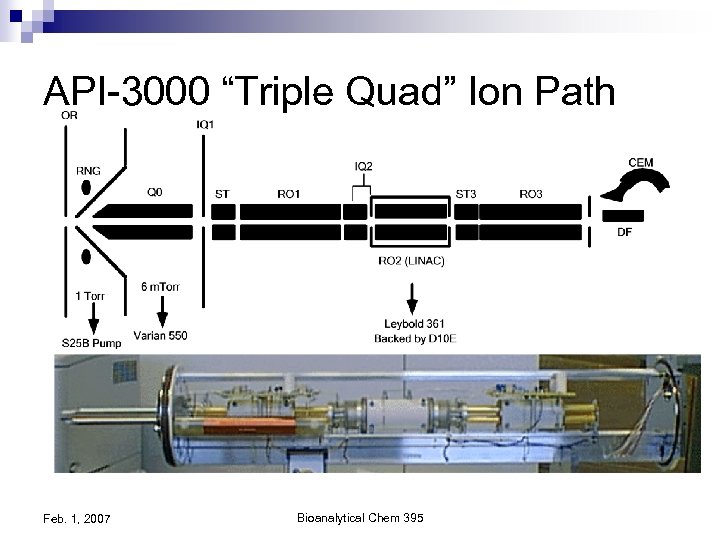
API-3000 “Triple Quad” Ion Path Feb. 1, 2007 Bioanalytical Chem 395
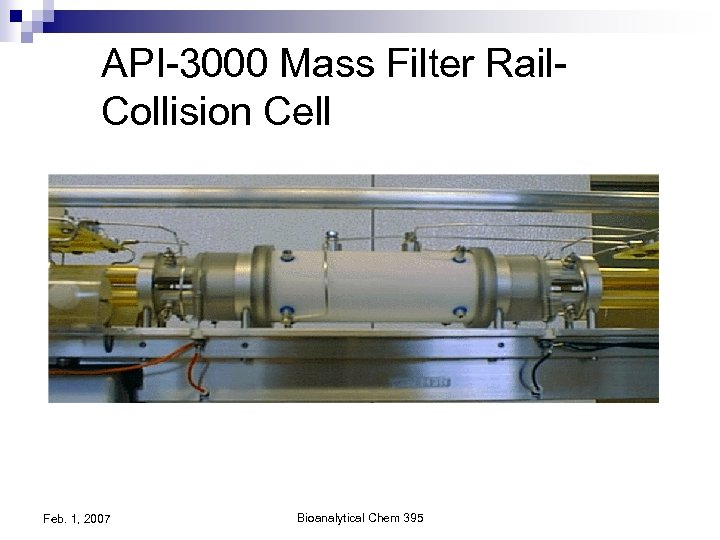
API-3000 Mass Filter Rail. Collision Cell Feb. 1, 2007 Bioanalytical Chem 395
All Triple Quads- Collision Cells must Overcome “Crosstalk” • Crosstalk: can occur when measuring common fragment from 2 different precursor ions • • ABI-Sciex uses “Linac” (linear accelerator) • • It takes time for ions to exit a collision cell Eliminates cross-talk and allows faster MS/MS scanning without sensitivity losses Q 2 rods are tilted and separate DC potentials are applied to each pair of rods to create an axial electric field Waters (Micromass) uses “T-Wave” Agilent uses something (they have to…) Feb. 1, 2007 Bioanalytical Chem 395
API-3000 Collision Cell - Linac Q 2 Linac (linear accelerator) eliminates cross-talk and allows faster MS/MS scanning without sensitivity losses • Q 2 rods are tilted and separate DC potentials are applied to each pair of rods to create an axial electric field • Feb. 1, 2007 Bioanalytical Chem 395
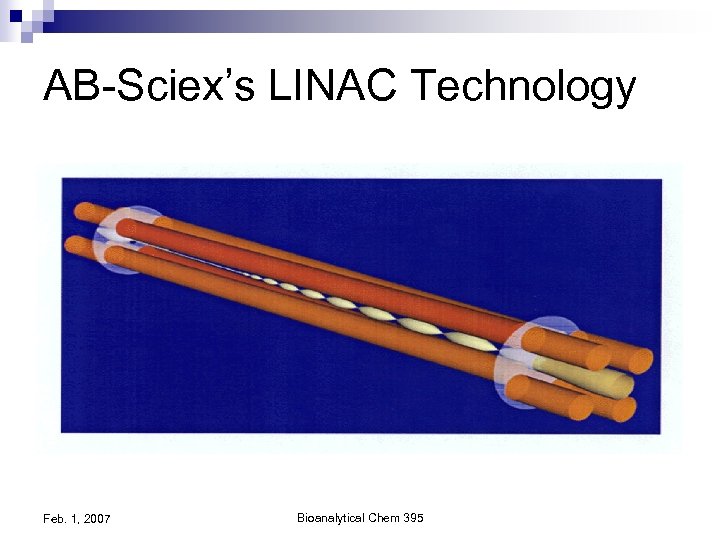
AB-Sciex’s LINAC Technology Feb. 1, 2007 Bioanalytical Chem 395
Triple Quad Scanning Modes: MS/MS - Product Ion Scan n Product ion scan- common MS/MS mode ¨ After identification, the precursor ion is sent into the collision cell and fragmented ¨ Q 1 is fixed, Q 3 sweeps a given mass range ¨ Used for structural information gathering and identification of product ions ¨ First step to developing quantitative method Feb. 1, 2007 Bioanalytical Chem 395
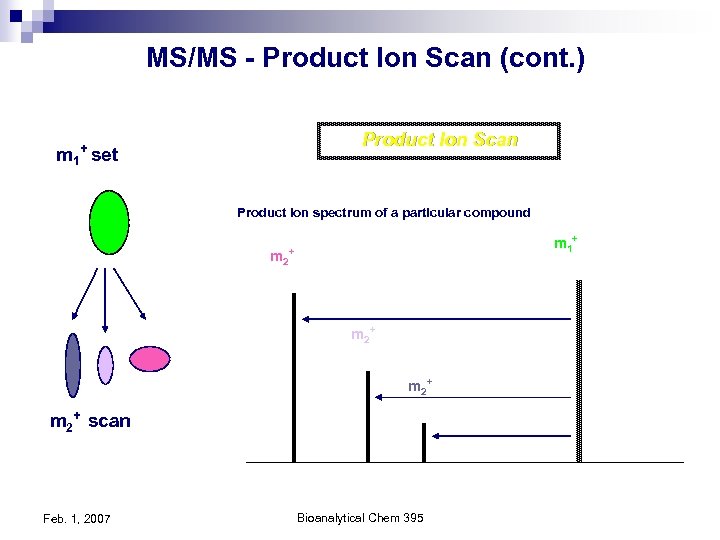
MS/MS - Product Ion Scan (cont. ) Product Ion Scan + m 1 set Product ion spectrum of a particular compound m 1+ m 2+ scan Feb. 1, 2007 Bioanalytical Chem 395
Triple Quad Scanning Modes: MS/MS - Precursor Ion Scan n Precursor ion scan ¨ Q 1 sweeps a given mass range, Q 3 is fixed ¨ Used to determine the “origin” of particular product ion(s) created in the collision cell ¨ Frequently used for drug metabolite identification (common product ion observed in the metabolites) Feb. 1, 2007 Bioanalytical Chem 395
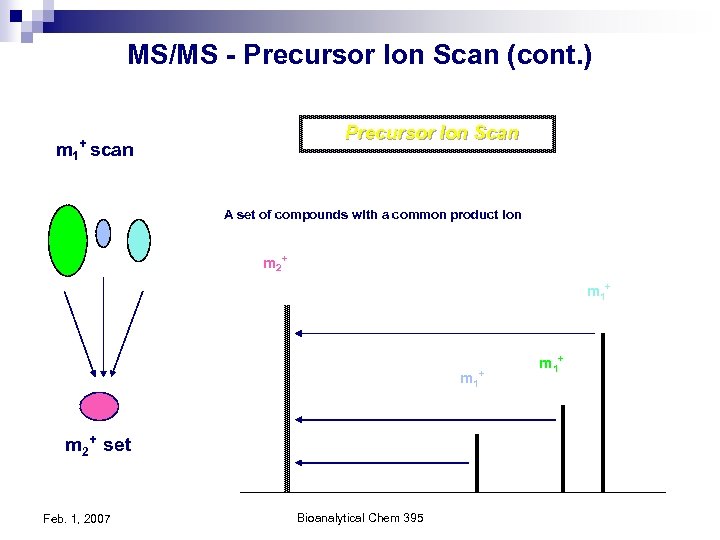
MS/MS - Precursor Ion Scan (cont. ) Precursor Ion Scan + m 1 scan A set of compounds with a common product ion m 2+ m 1+ m 2+ set Feb. 1, 2007 Bioanalytical Chem 395 m 1+
Triple Quad Scanning Modes: MS/MS Constant Neutral Loss n Neutral loss scan ¨ Q 1 & Q 3 both scan a given mass range but with a constant difference between ranges scanned ¨ Spectrum indicates which ions lose a neutral species equal to Q 1 - Q 3 difference ¨ Complement to Precursor Ion Scan ¨ Neutral “gain” indicates a multiply charged precursor ion was fragmented Feb. 1, 2007 Bioanalytical Chem 395
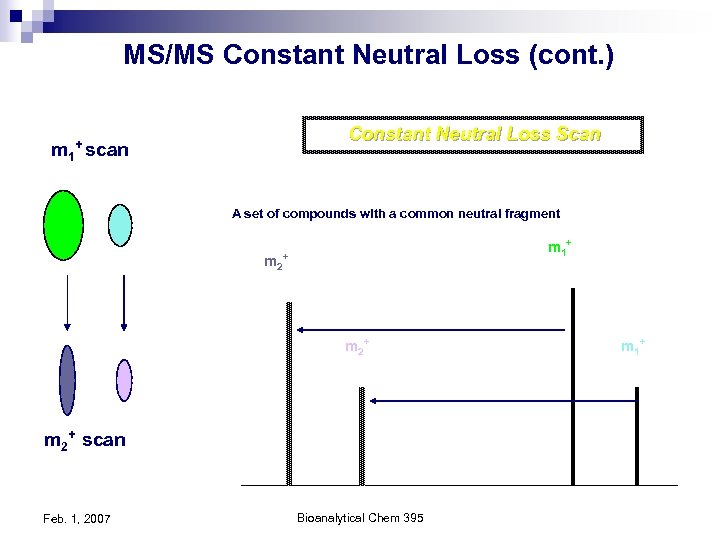
MS/MS Constant Neutral Loss (cont. ) Constant Neutral Loss Scan + m 1 scan A set of compounds with a common neutral fragment m 1+ m 2+ - m m m 2+ scan Feb. 1, 2007 Bioanalytical Chem 395 - m m 1+
Triple Quad Scanning Modes: Multiple reaction Monitoring (MRM) If Q 1 and Q 3 width=0, then MRM n Many precursor to product ion pairs can be monitored (A-B, A’-B’, A”-B”, etc. ) n MRM analysis is the best way to maximize signal intensity of product ions n MRM used primarily for quantitation studies n Feb. 1, 2007 Bioanalytical Chem 395
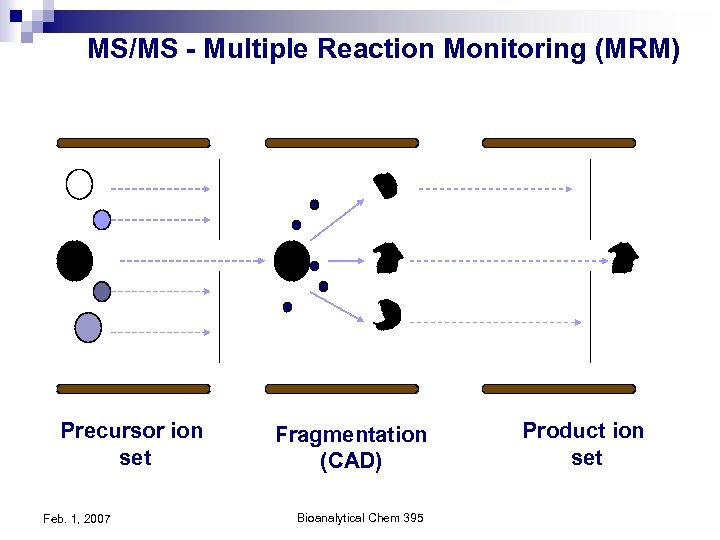
MS/MS - Multiple Reaction Monitoring (MRM) Precursor ion set Feb. 1, 2007 Fragmentation (CAD) Bioanalytical Chem 395 Product ion set
Triple Quad MS/MS Example… Feb. 1, 2007 Bioanalytical Chem 395
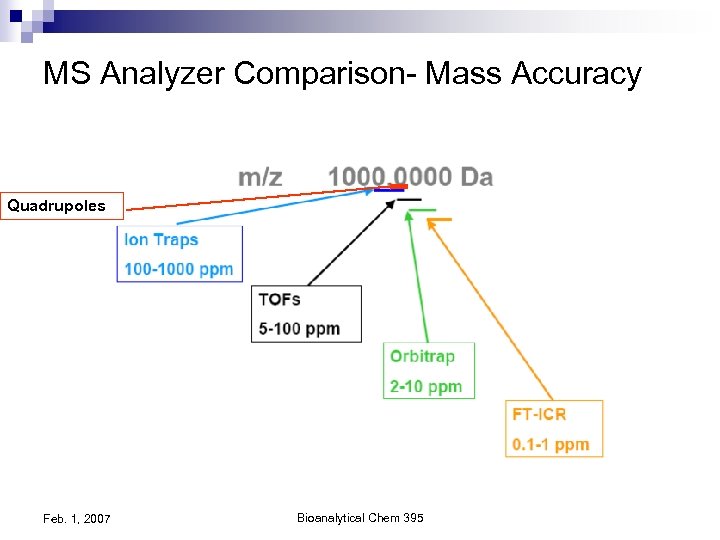
MS Analyzer Comparison- Mass Accuracy Quadrupoles Feb. 1, 2007 Bioanalytical Chem 395
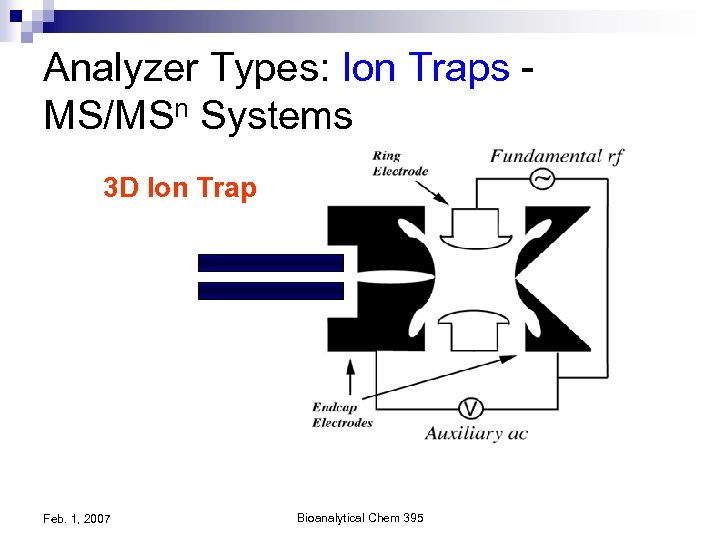
Analyzer Types: Ion Traps MS/MSn Systems 3 D Ion Trap Feb. 1, 2007 Bioanalytical Chem 395
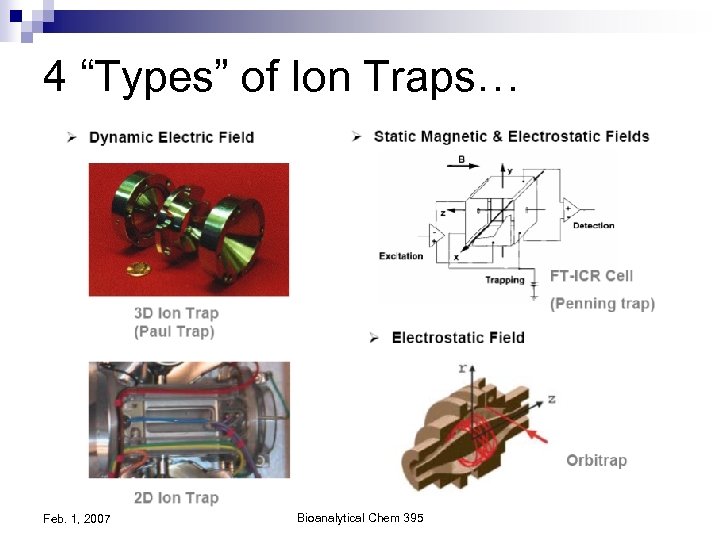
4 “Types” of Ion Traps… Feb. 1, 2007 Bioanalytical Chem 395
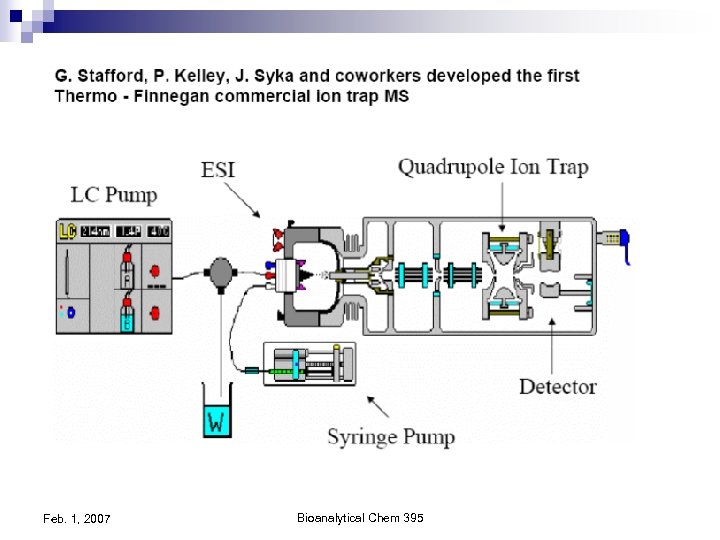
Feb. 1, 2007 Bioanalytical Chem 395
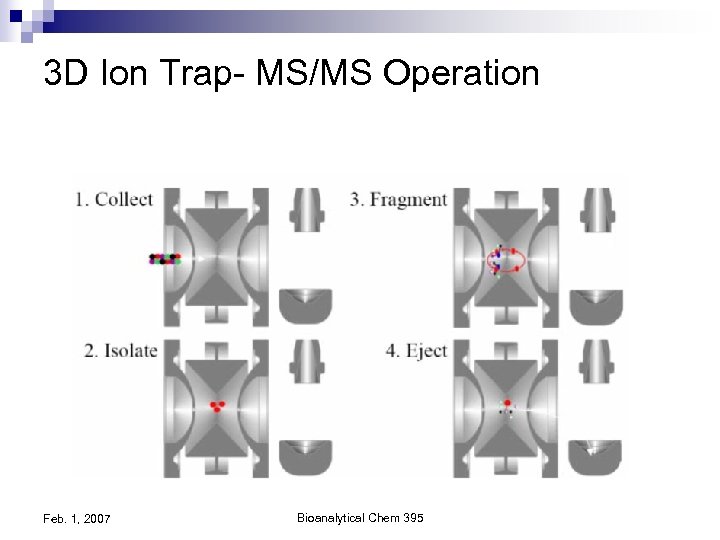
3 D Ion Trap- MS/MS Operation Feb. 1, 2007 Bioanalytical Chem 395
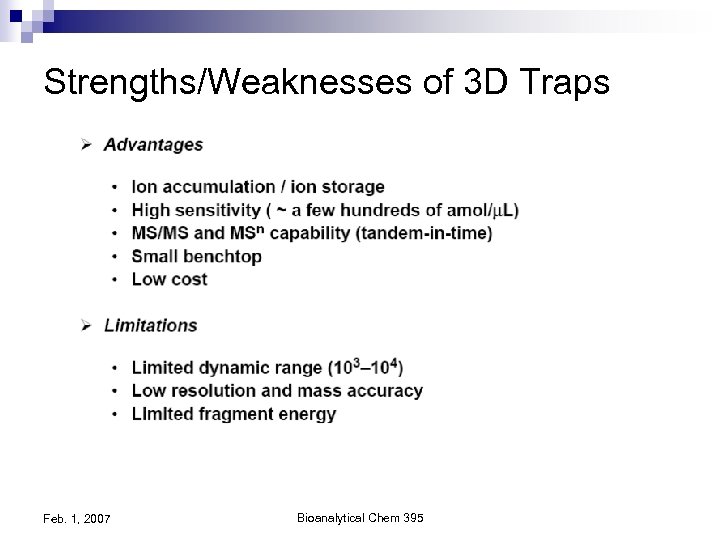
Strengths/Weaknesses of 3 D Traps Feb. 1, 2007 Bioanalytical Chem 395
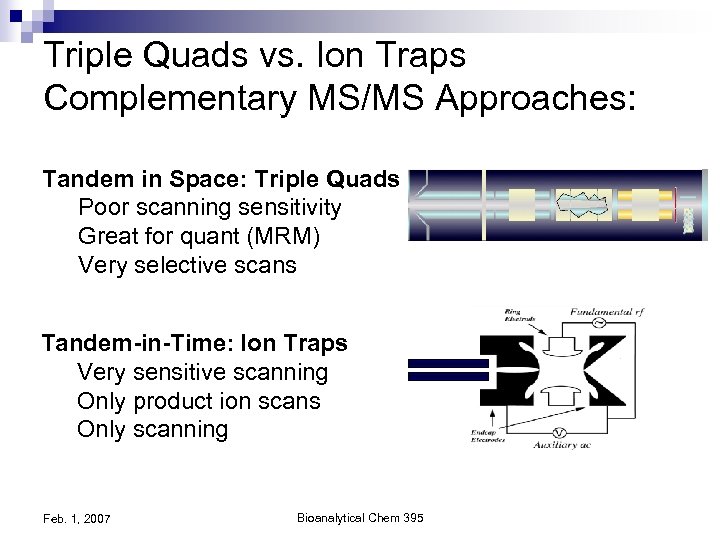
Triple Quads vs. Ion Traps Complementary MS/MS Approaches: Tandem in Space: Triple Quads Poor scanning sensitivity Great for quant (MRM) Very selective scans Tandem-in-Time: Ion Traps Very sensitive scanning Only product ion scans Only scanning Feb. 1, 2007 Bioanalytical Chem 395
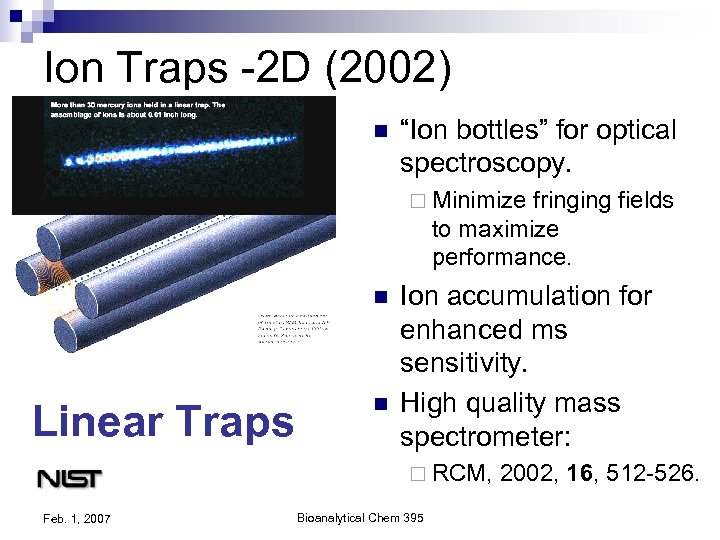
Ion Traps -2 D (2002) n “Ion bottles” for optical spectroscopy. ¨ Minimize fringing fields to maximize performance. n Linear Traps 3 -D Traps Feb. 1, 2007 n Ion accumulation for enhanced ms sensitivity. High quality mass spectrometer: ¨ RCM, Bioanalytical Chem 395 2002, 16, 512 -526.
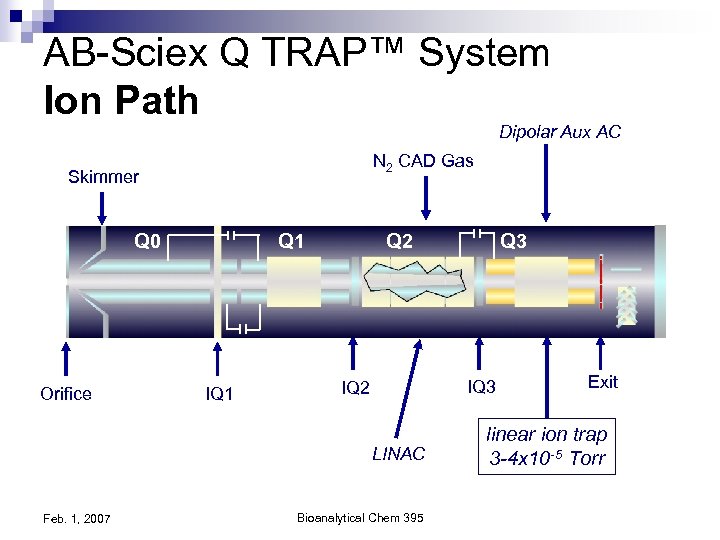
AB-Sciex Q TRAP™ System Ion Path Dipolar Aux AC N 2 CAD Gas Skimmer Q 0 Orifice Q 1 IQ 1 Q 2 IQ 3 IQ 2 LINAC Feb. 1, 2007 Q 3 Bioanalytical Chem 395 Exit linear ion trap 3 -4 x 10 -5 Torr
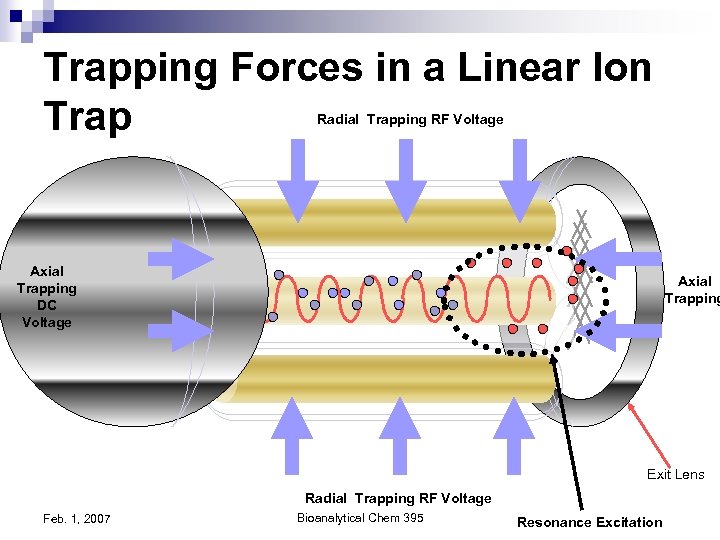
Trapping Forces in a Linear Ion Trap Radial Trapping RF Voltage Axial Trapping DC Voltage Axial Trapping Exit Lens Radial Trapping RF Voltage Feb. 1, 2007 Bioanalytical Chem 395 Resonance Excitation
Run Thermo 2 D Ion Trap Simulation… Feb. 1, 2007 Bioanalytical Chem 395
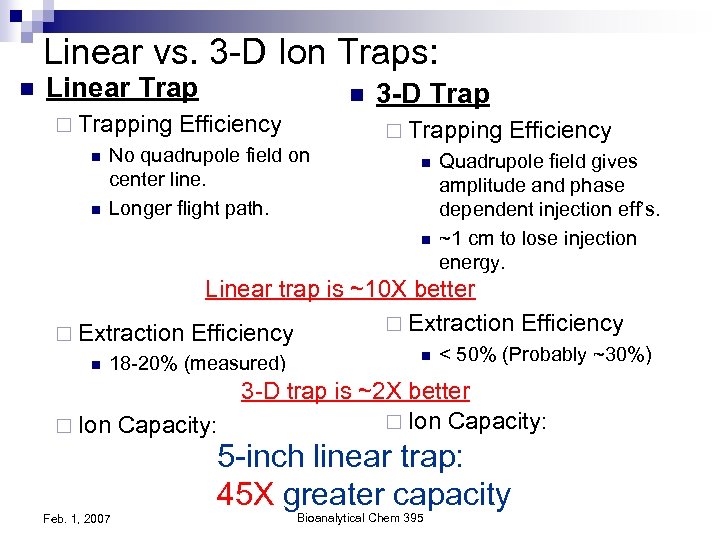
Linear vs. 3 -D Ion Traps: n Linear Trap ¨ Trapping n n n Efficiency 3 -D Trap ¨ Trapping No quadrupole field on center line. Longer flight path. n n Efficiency Quadrupole field gives amplitude and phase dependent injection eff’s. ~1 cm to lose injection energy. Linear trap is ~10 X better ¨ Extraction Efficiency n 18 -20% (measured) n < 50% (Probably ~30%) 3 -D trap is ~2 X better ¨ Ion Capacity: 5 -inch linear trap: 45 X greater capacity Feb. 1, 2007 Bioanalytical Chem 395
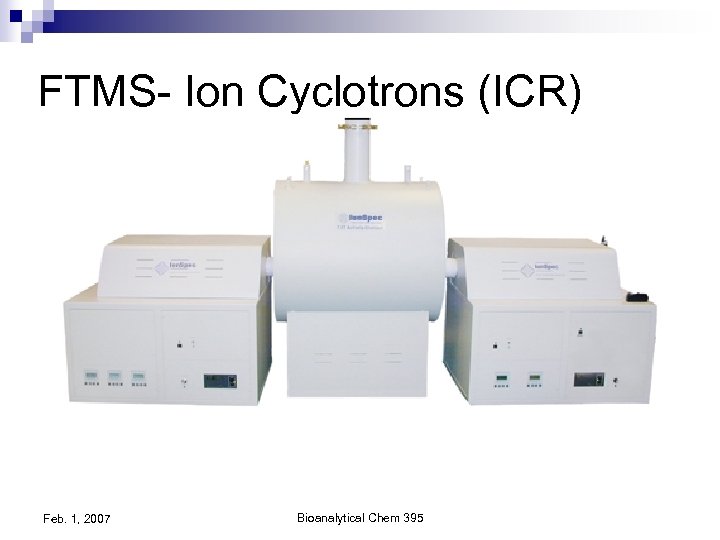
FTMS- Ion Cyclotrons (ICR) Feb. 1, 2007 Bioanalytical Chem 395
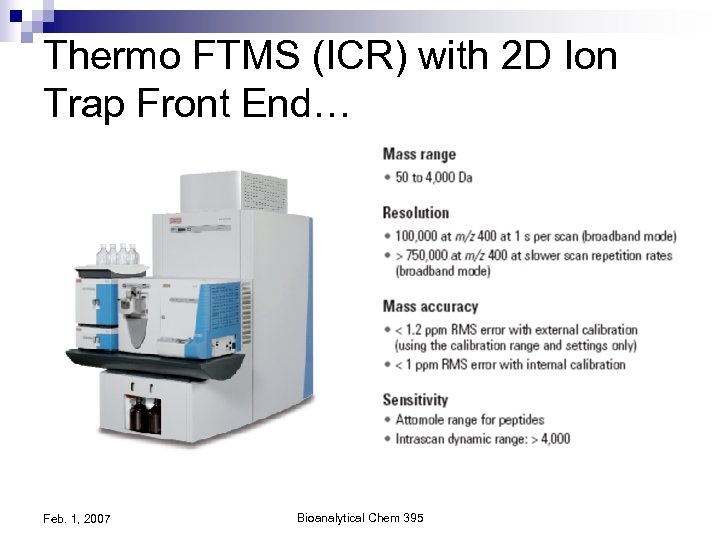
Thermo FTMS (ICR) with 2 D Ion Trap Front End… Feb. 1, 2007 Bioanalytical Chem 395
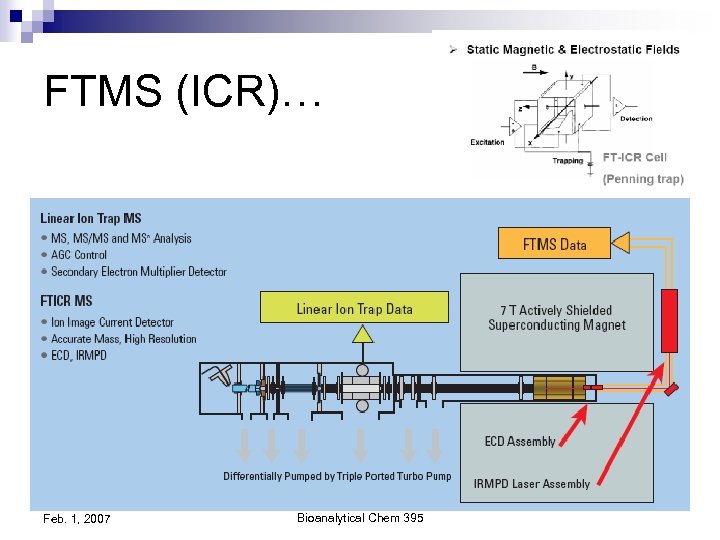
FTMS (ICR)… Feb. 1, 2007 Bioanalytical Chem 395
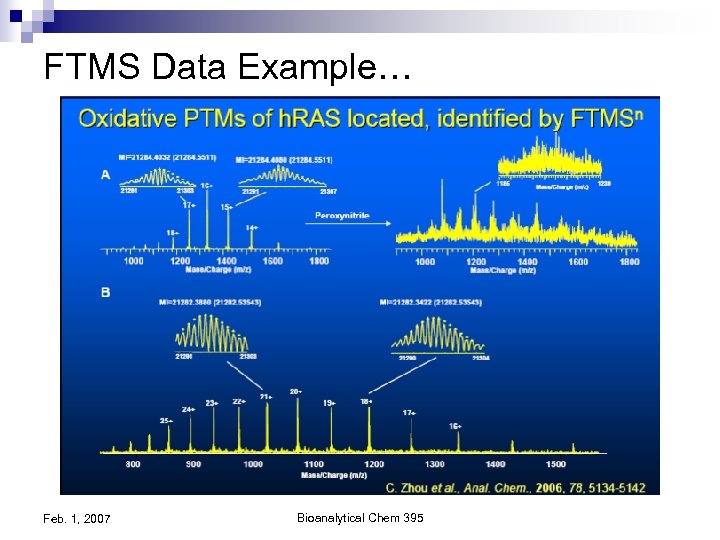
FTMS Data Example… Feb. 1, 2007 Bioanalytical Chem 395
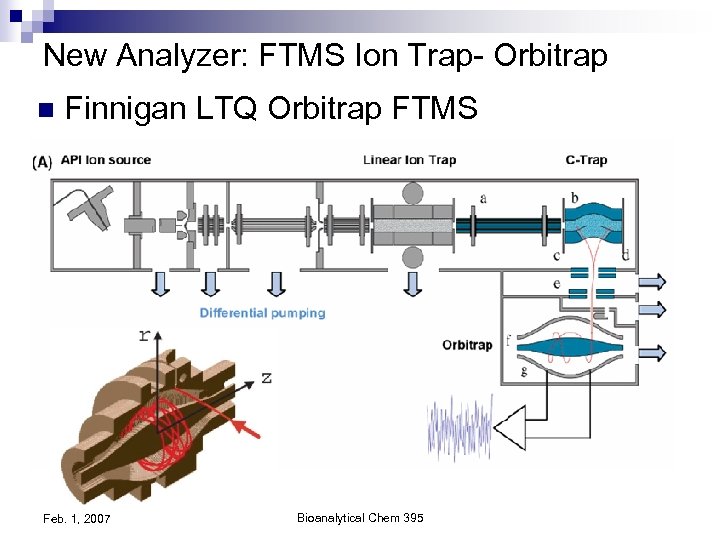
New Analyzer: FTMS Ion Trap- Orbitrap n Finnigan LTQ Orbitrap FTMS Feb. 1, 2007 Bioanalytical Chem 395
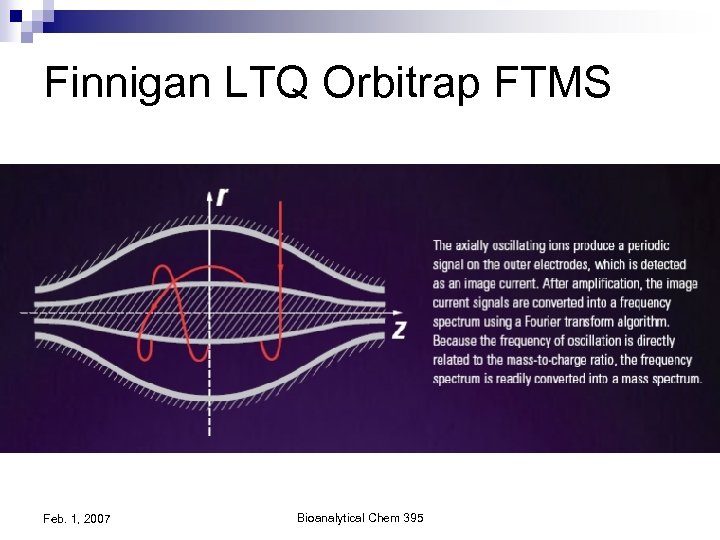
Finnigan LTQ Orbitrap FTMS Feb. 1, 2007 Bioanalytical Chem 395
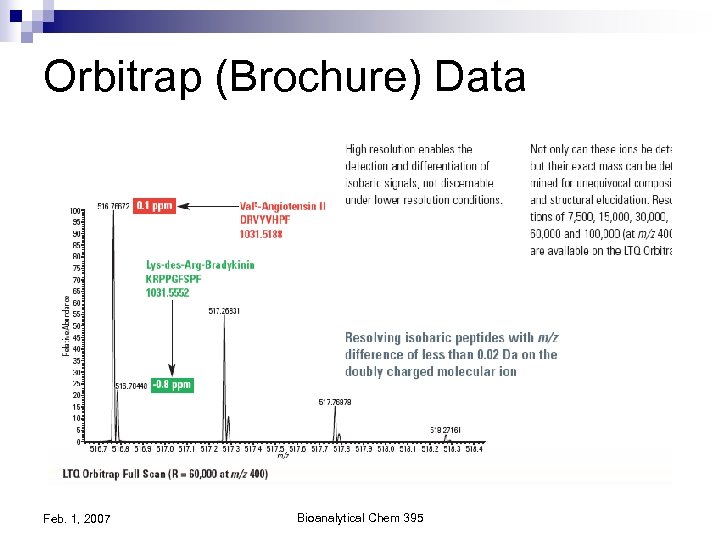
Orbitrap (Brochure) Data Feb. 1, 2007 Bioanalytical Chem 395
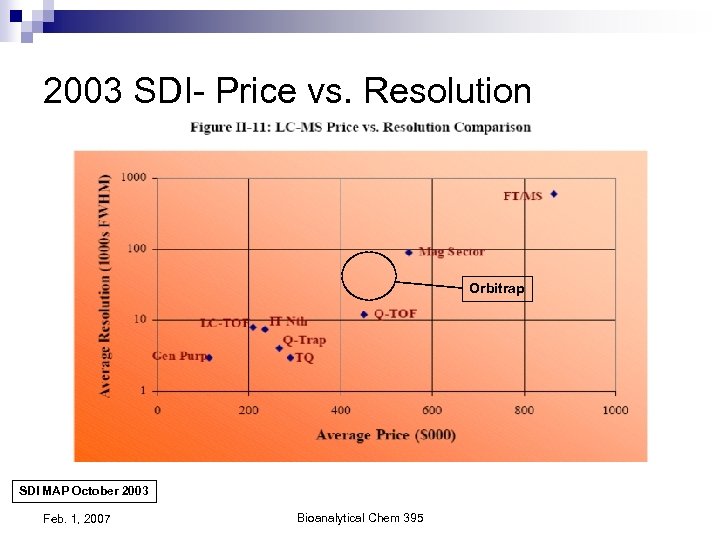
2003 SDI- Price vs. Resolution Orbitrap SDI MAP October 2003 Feb. 1, 2007 Bioanalytical Chem 395
‘Time-of-Flight’ Mass Spectrometry TOF Analyzer n Linear Mode n Reflectron Mode ¨Common Ionization Methods for TOF MS n MALDI n ESI ¨Sample Feb. 1, 2007 Application Bioanalytical Chem 395
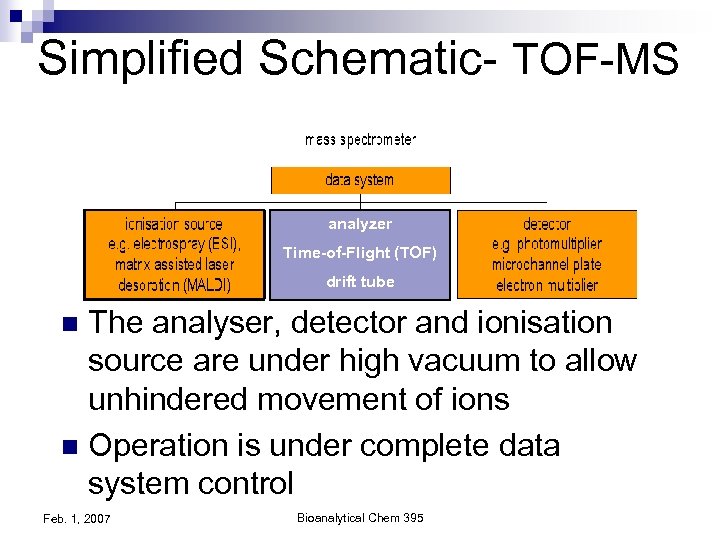
Simplified Schematic- TOF-MS analyzer Time-of-Flight (TOF) drift tube The analyser, detector and ionisation source are under high vacuum to allow unhindered movement of ions n Operation is under complete data system control n Feb. 1, 2007 Bioanalytical Chem 395
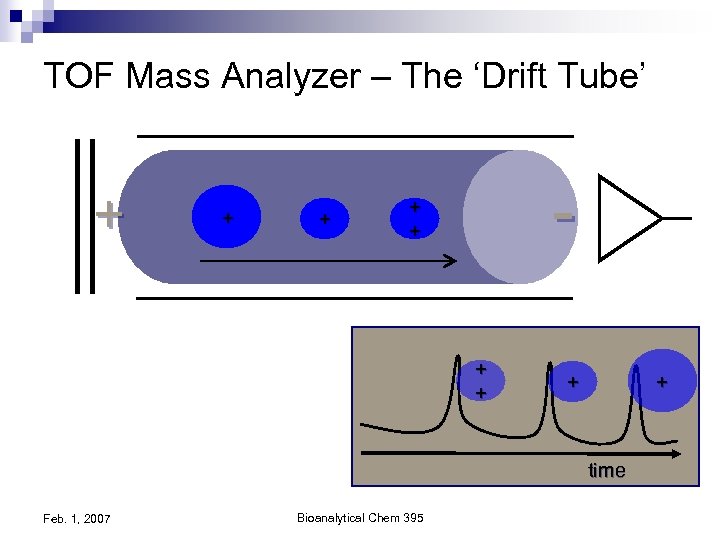
TOF Mass Analyzer – The ‘Drift Tube’ + + + - + + + time Feb. 1, 2007 Bioanalytical Chem 395
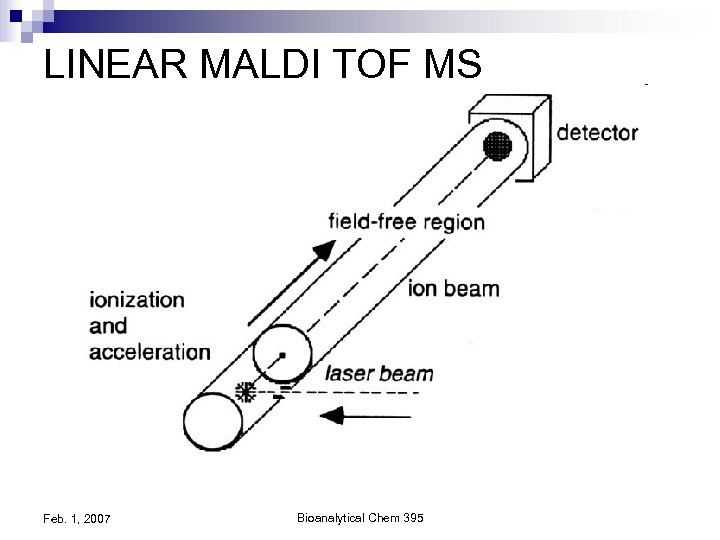
LINEAR MALDI TOF MS Feb. 1, 2007 Bioanalytical Chem 395
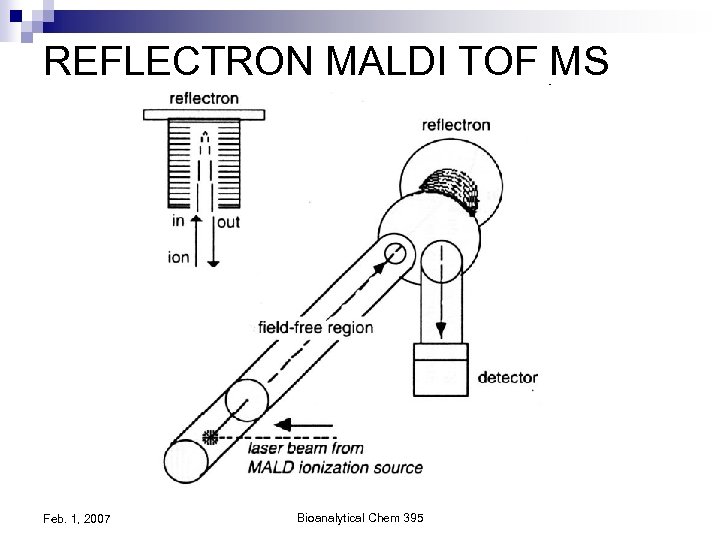
REFLECTRON MALDI TOF MS Feb. 1, 2007 Bioanalytical Chem 395
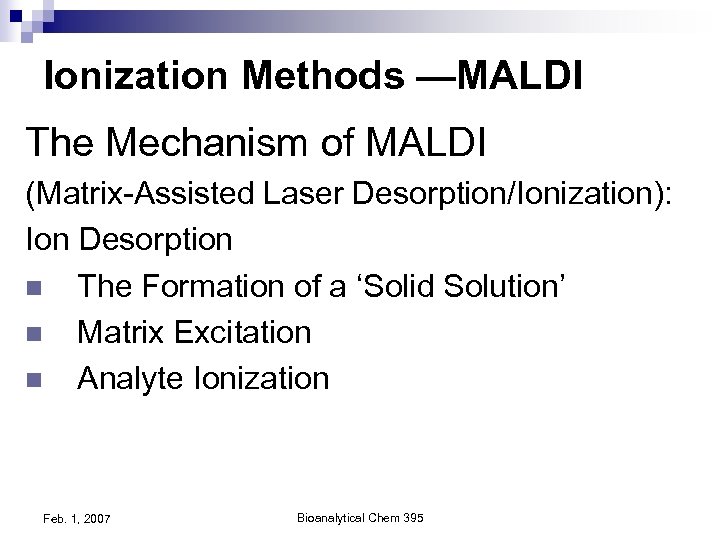
Ionization Methods —MALDI The Mechanism of MALDI (Matrix-Assisted Laser Desorption/Ionization): Ion Desorption n The Formation of a ‘Solid Solution’ n Matrix Excitation n Analyte Ionization Feb. 1, 2007 Bioanalytical Chem 395
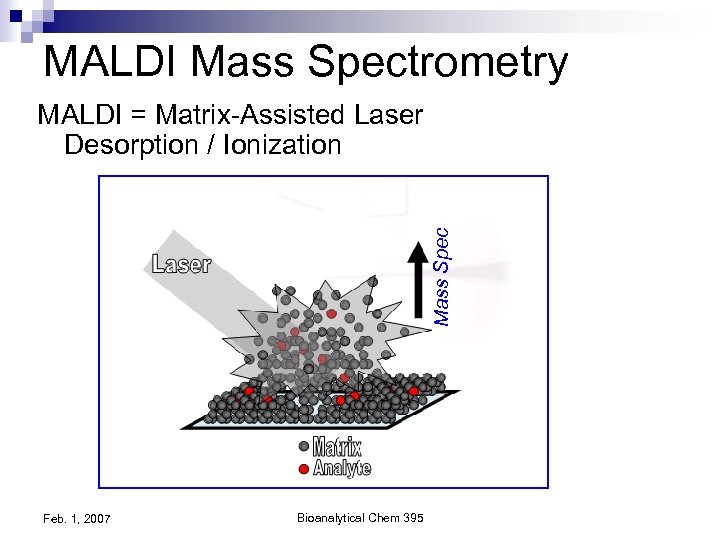
MALDI Mass Spectrometry Mass Spec MALDI = Matrix-Assisted Laser Desorption / Ionization Feb. 1, 2007 Bioanalytical Chem 395
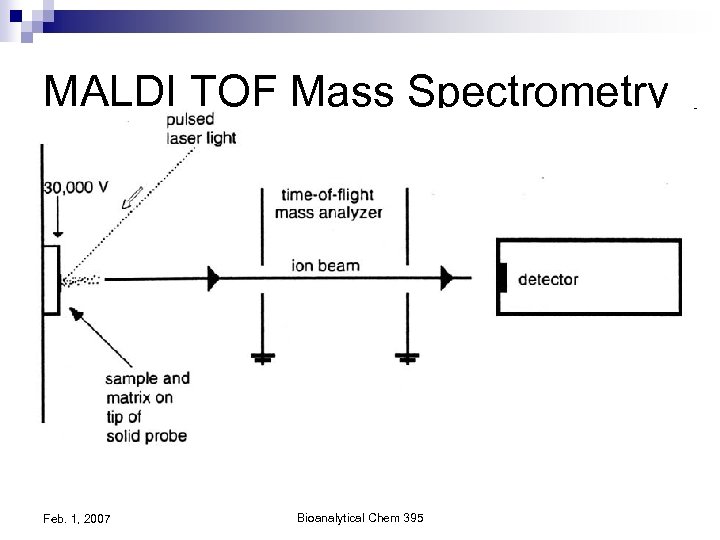
MALDI TOF Mass Spectrometry Feb. 1, 2007 Bioanalytical Chem 395
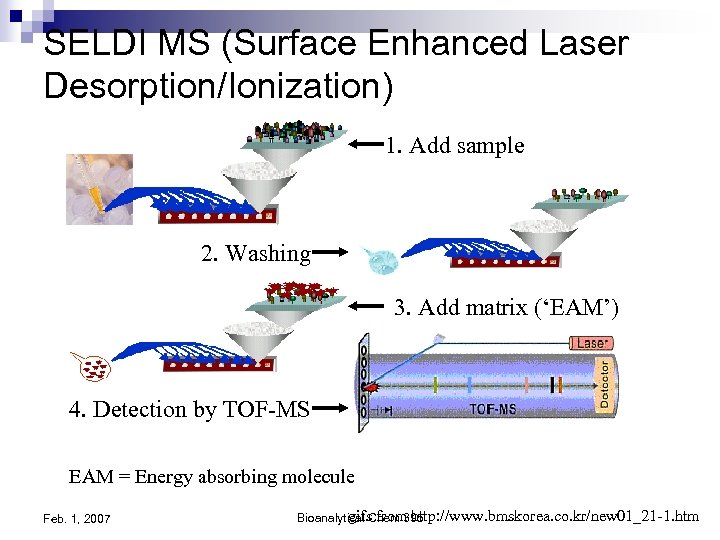
SELDI MS (Surface Enhanced Laser Desorption/Ionization) 1. Add sample 2. Washing 3. Add matrix (‘EAM’) 4. Detection by TOF-MS EAM = Energy absorbing molecule Feb. 1, 2007 gifs from http: //www. bmskorea. co. kr/new 01_21 -1. htm Bioanalytical Chem 395
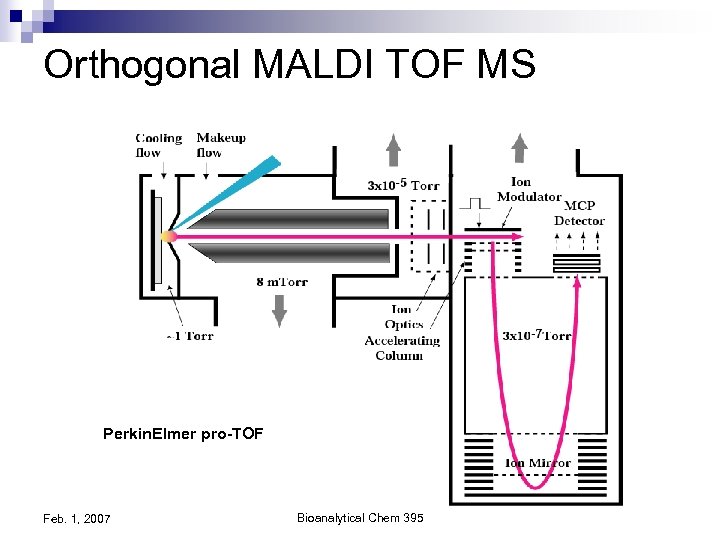
Orthogonal MALDI TOF MS Perkin. Elmer pro-TOF Feb. 1, 2007 Bioanalytical Chem 395
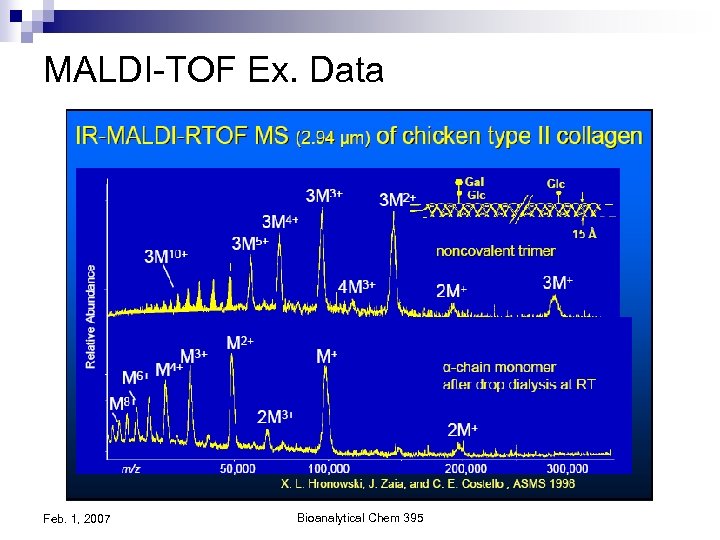
MALDI-TOF Ex. Data Feb. 1, 2007 Bioanalytical Chem 395
Feb. 1, 2007 Bioanalytical Chem 395
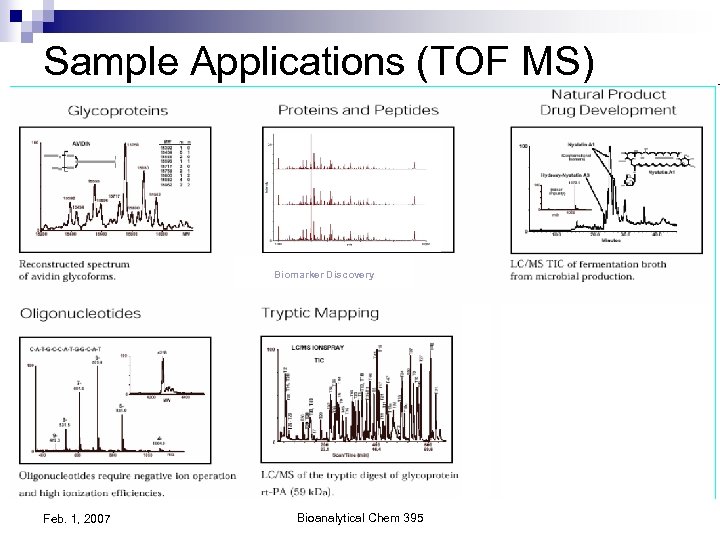
Sample Applications (TOF MS) Biomarker Discovery Feb. 1, 2007 Bioanalytical Chem 395
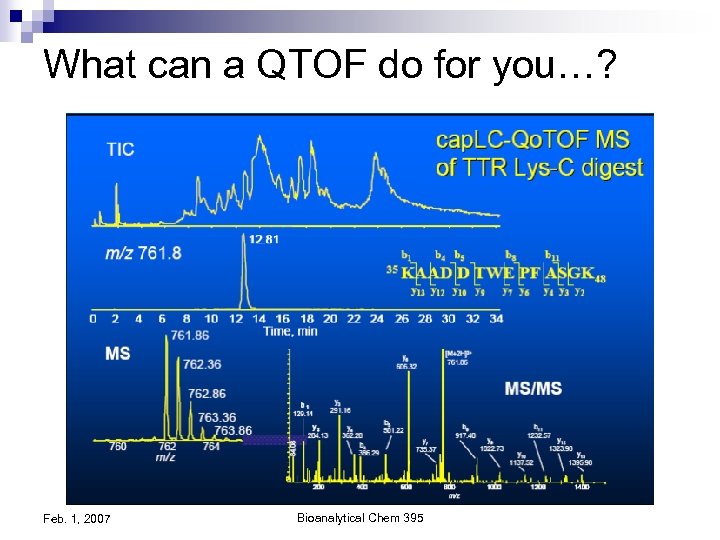
Quadrupole- TOF MS/MS Systems (QTOF) ¨ Introduced commercially by Micromass around 1995. Brilliant innovation, first commercial hybrid MS/MS. n They charged “what the market would bear” n $500 -600 k ¨ No competition! ¨ Great qualitative analyzer ¨ n TOF analyzer provided: Incredibly fast scan rates ¨ Accurate mass capability (MW confirmation) ¨ Higher resolution (8 k initially, now 10 -12 k w/ 1 reflectron) ¨ Feb. 1, 2007 Bioanalytical Chem 395
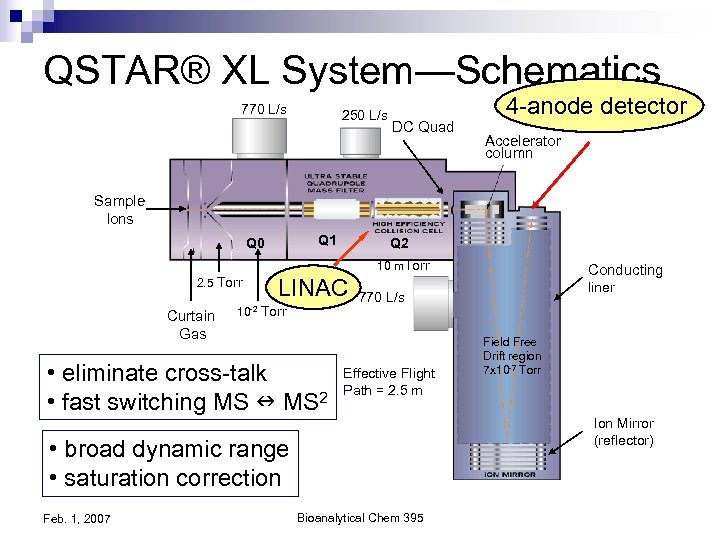
QSTAR® XL System—Schematics 770 L/s 250 L/s DC Quad 4 -anode detector Accelerator column Sample Ions Q 1 Q 0 Q 2 10 m. Torr 2. 5 Torr Curtain Gas LINAC 10 -2 Torr • eliminate cross-talk • fast switching MS 2 liner 770 L/s Effective Flight Path = 2. 5 m Field Free Drift region 7 x 10 -7 Torr Ion Mirror (reflector) • broad dynamic range • saturation correction Feb. 1, 2007 Conducting Bioanalytical Chem 395
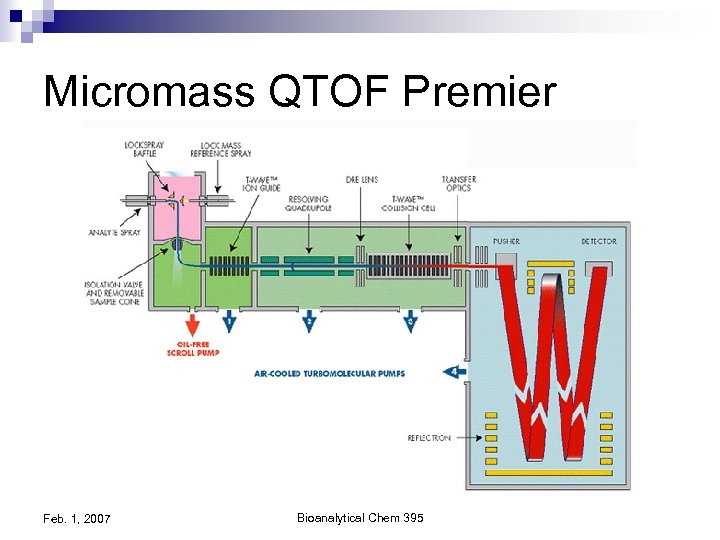
Micromass QTOF Premier Feb. 1, 2007 Bioanalytical Chem 395
What can a QTOF do for you…? Feb. 1, 2007 Bioanalytical Chem 395
TOF/TOF System (2001) TOF 1 Beam XY Deflector 1 Gas in CID TOF 2 Detectors Source 2 TIS U U Lens 1 Source 1 Grid Feb. 1, 2007 Source 2 Collision Grid Cell Bioanalytical Chem 395 Beam XY Deflector 2 Mirror
ABI 4700 TOF/TOF Automation Sample Loader Collision 200 hz Cell Laser Fast Sample Stage Integration – Oracle Database Feb. 1, 2007 Bioanalytical Chem 395 Patented TOF-TOF™ Analyzer
New Model: ABI-4800 TOF-TOF Feb. 1, 2007 Bioanalytical Chem 395
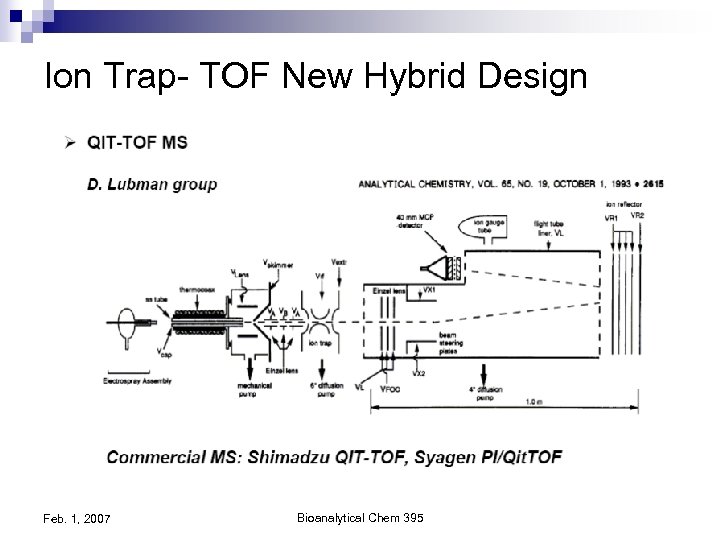
Ion Trap- TOF New Hybrid Design Feb. 1, 2007 Bioanalytical Chem 395
Summary ¨ Role and importance of MS in bioanalytical analysis continues to grow and evolve MS is typically no longer the bottleneck (sample handling and data acquisition/processing slow thru-put) n Power of new MS technology providing new dimension of information on biomolecules n ¨ There are 3 fundamental MS analyzer technologies, each with it’s advantages and disadvantages. n ‘Hybrids’ can take advantage of best of 2 technologies ¨ LC/MS n continues to evolve at a rapid rate Better, faster, cheaper… Feb. 1, 2007 Bioanalytical Chem 395
Скачать презентацию Evolving Role of Mass Spectrometry in Bioanalytical Analysis
17cb3d067cf501a5503ea23efe9cca54.ppt