


 Скачать презентацию Evolution of Life To suppose that the eye
e6bb06904b99dba61fe607e2213af09d.ppt
- Количество слайдов: 31
 Evolution of Life To suppose that the eye with all of its inimitable contrivances for adjusting the focus to different distances, for admitting different amounts of light, and for the correction of spherical and chromatic aberration, could have been formed by natural selection, seems, I confess, absurd in the highest degree. - Charles Darwin
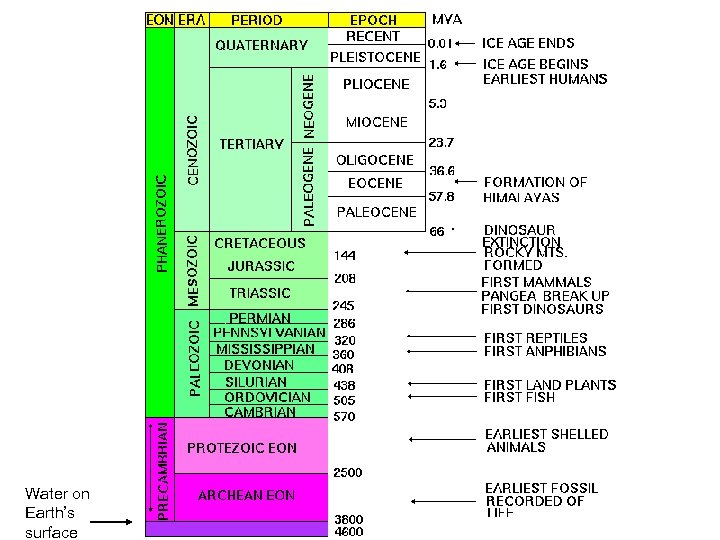 Water on Earth’s surface
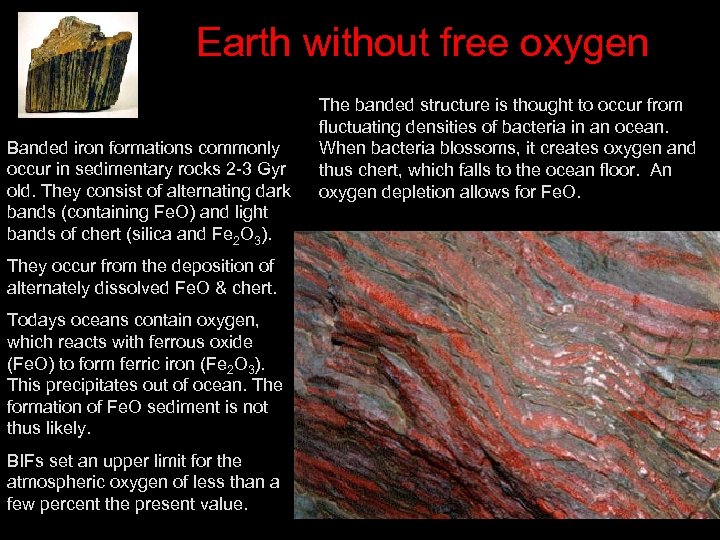 Earth without free oxygen Banded iron formations commonly occur in sedimentary rocks 2 -3 Gyr old. They consist of alternating dark bands (containing Fe. O) and light bands of chert (silica and Fe 2 O 3). They occur from the deposition of alternately dissolved Fe. O & chert. Todays oceans contain oxygen, which reacts with ferrous oxide (Fe. O) to form ferric iron (Fe 2 O 3). This precipitates out of ocean. The formation of Fe. O sediment is not thus likely. BIFs set an upper limit for the atmospheric oxygen of less than a few percent the present value. The banded structure is thought to occur from fluctuating densities of bacteria in an ocean. When bacteria blossoms, it creates oxygen and thus chert, which falls to the ocean floor. An oxygen depletion allows for Fe. O.
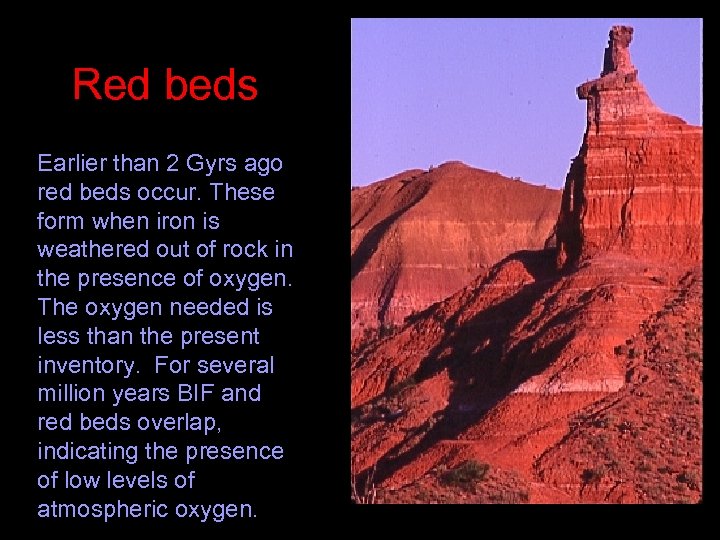 Red beds Earlier than 2 Gyrs ago red beds occur. These form when iron is weathered out of rock in the presence of oxygen. The oxygen needed is less than the present inventory. For several million years BIF and red beds overlap, indicating the presence of low levels of atmospheric oxygen.
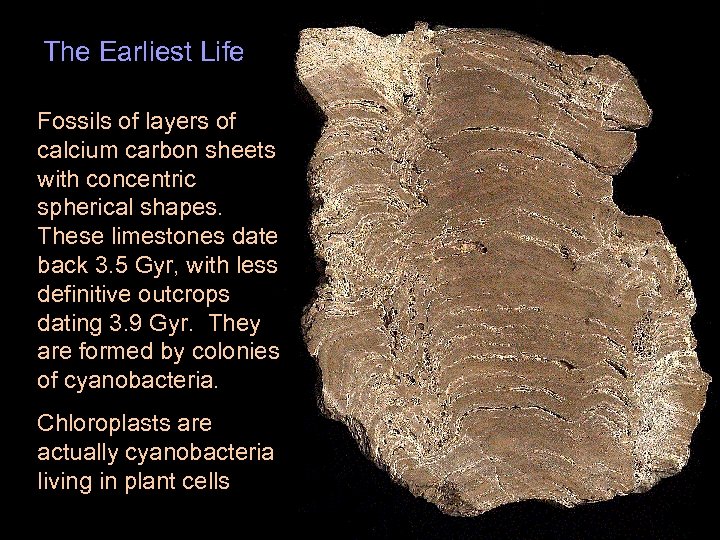 The Earliest Life Fossils of layers of calcium carbon sheets with concentric spherical shapes. These limestones date back 3. 5 Gyr, with less definitive outcrops dating 3. 9 Gyr. They are formed by colonies of cyanobacteria. Chloroplasts are actually cyanobacteria living in plant cells
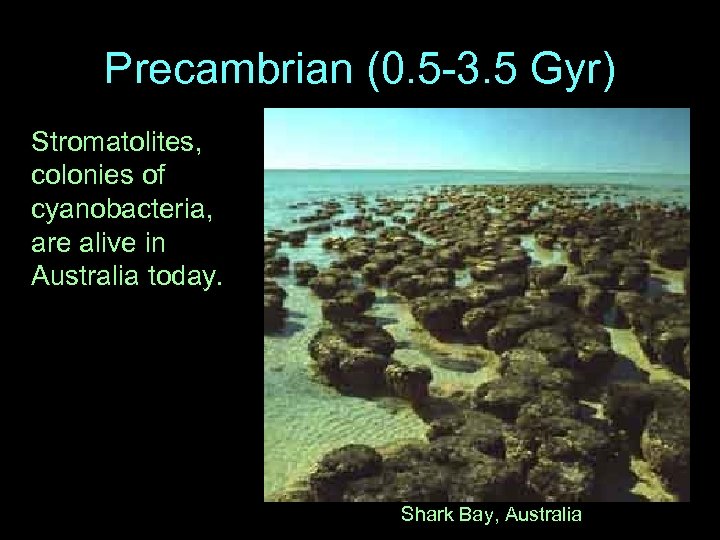 Precambrian (0. 5 -3. 5 Gyr) Stromatolites, colonies of cyanobacteria, are alive in Australia today. Shark Bay, Australia
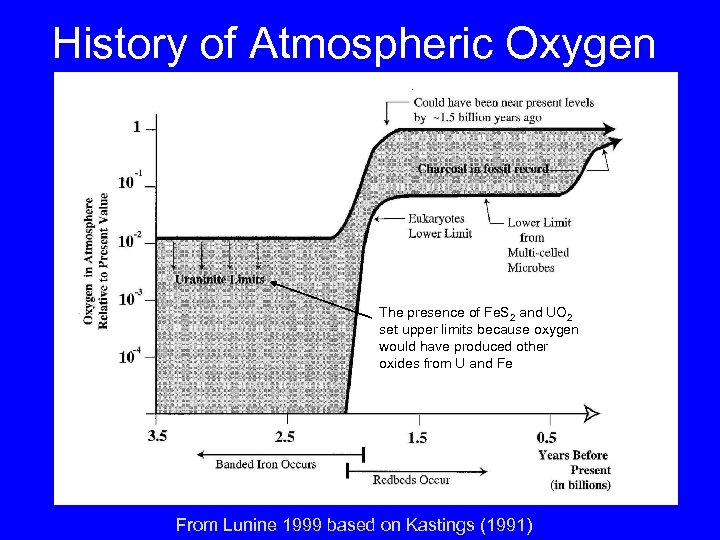 History of Atmospheric Oxygen The presence of Fe. S 2 and UO 2 set upper limits because oxygen would have produced other oxides from U and Fe From Lunine 1999 based on Kastings (1991)
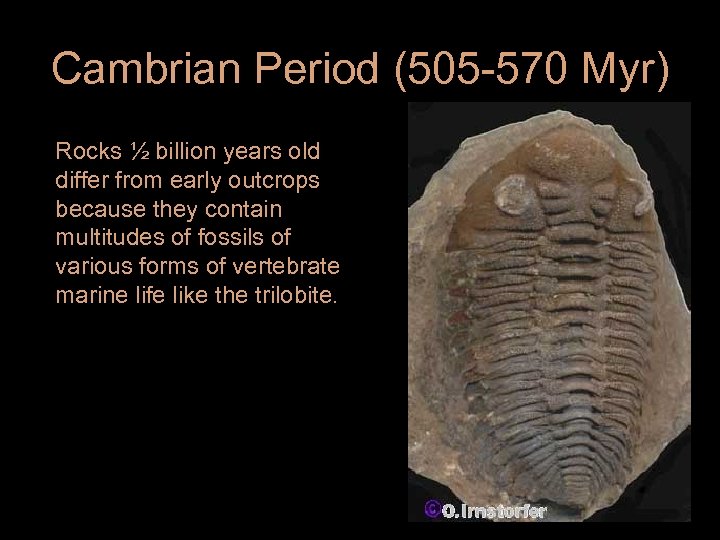 Cambrian Period (505 -570 Myr) Rocks ½ billion years old differ from early outcrops because they contain multitudes of fossils of various forms of vertebrate marine life like the trilobite.
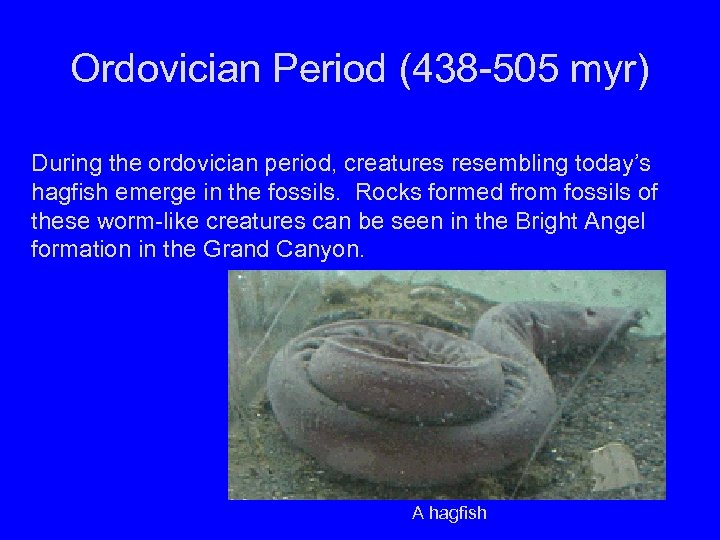 Ordovician Period (438 -505 myr) During the ordovician period, creatures resembling today’s hagfish emerge in the fossils. Rocks formed from fossils of these worm-like creatures can be seen in the Bright Angel formation in the Grand Canyon. A hagfish
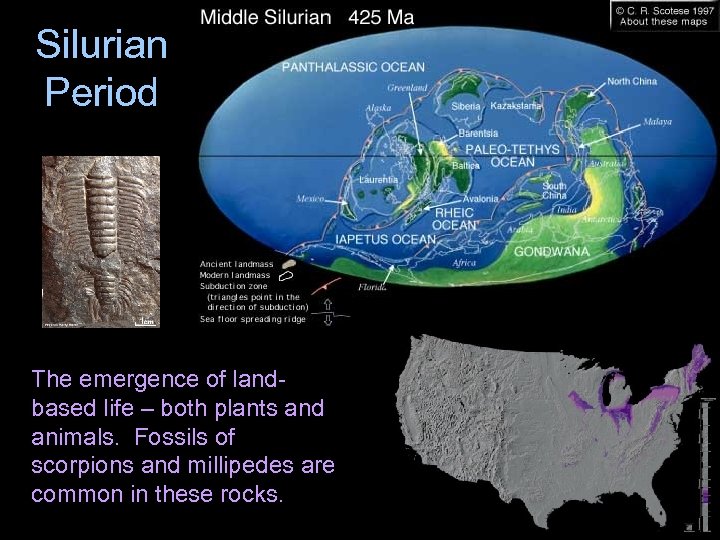 Silurian Period The emergence of landbased life – both plants and animals. Fossils of scorpions and millipedes are common in these rocks.
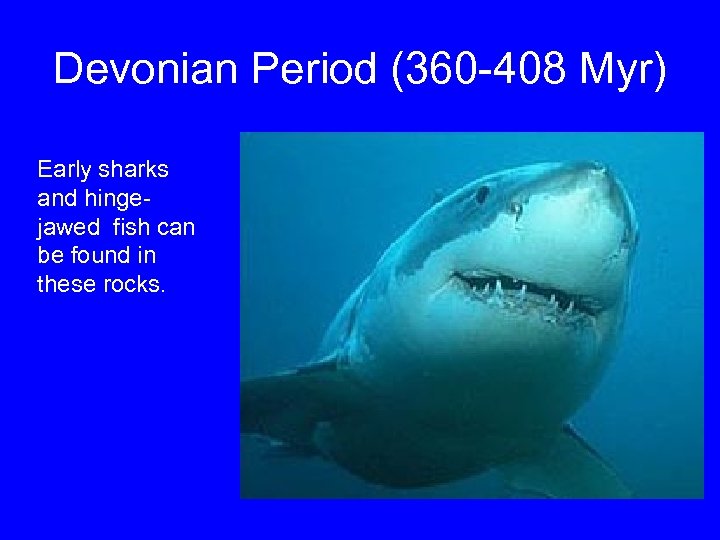 Devonian Period (360 -408 Myr) Early sharks and hingejawed fish can be found in these rocks.
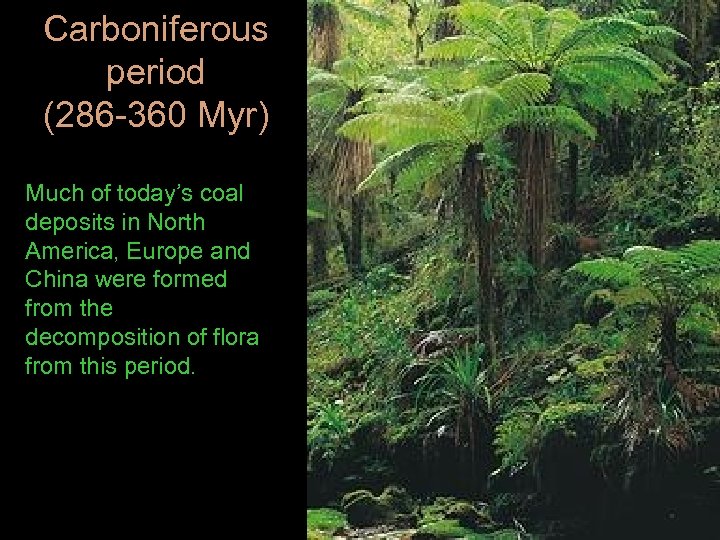 Carboniferous period (286 -360 Myr) Much of today’s coal deposits in North America, Europe and China were formed from the decomposition of flora from this period.
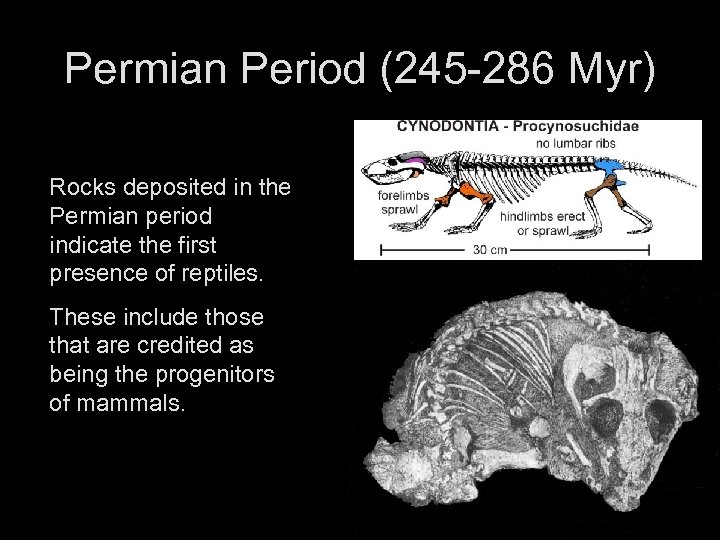 Permian Period (245 -286 Myr) Rocks deposited in the Permian period indicate the first presence of reptiles. These include those that are credited as being the progenitors of mammals.
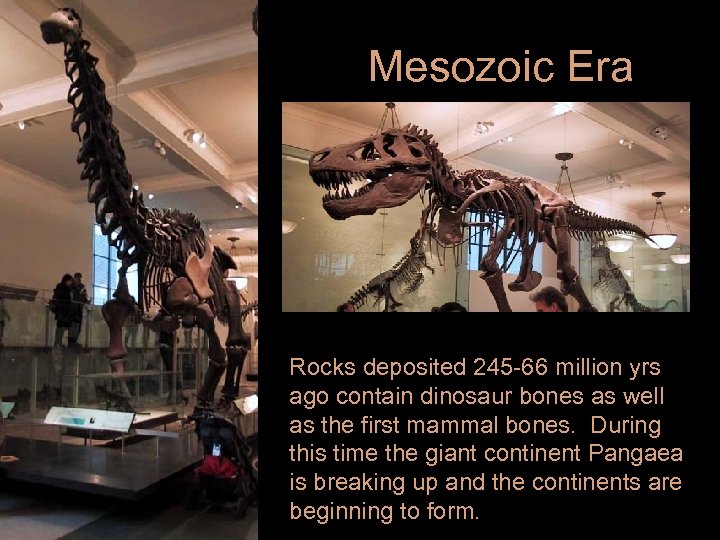 Mesozoic Era Rocks deposited 245 -66 million yrs ago contain dinosaur bones as well as the first mammal bones. During this time the giant continent Pangaea is breaking up and the continents are beginning to form.
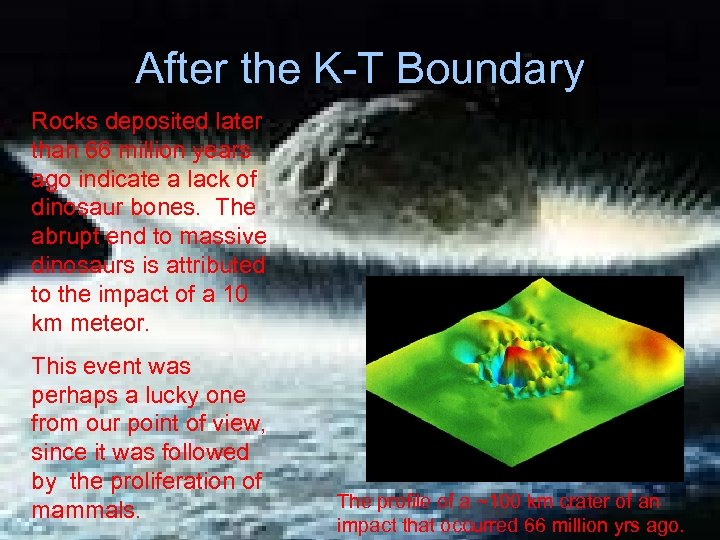 After the K-T Boundary Rocks deposited later than 66 million years ago indicate a lack of dinosaur bones. The abrupt end to massive dinosaurs is attributed to the impact of a 10 km meteor. This event was perhaps a lucky one from our point of view, since it was followed by the proliferation of mammals. The profile of a ~100 km crater of an impact that occurred 66 million yrs ago.
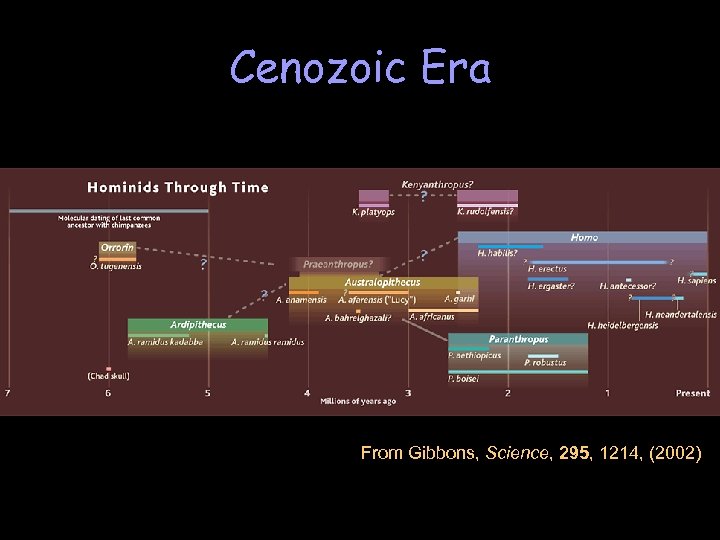 Cenozoic Era From Gibbons, Science, 295, 1214, (2002)
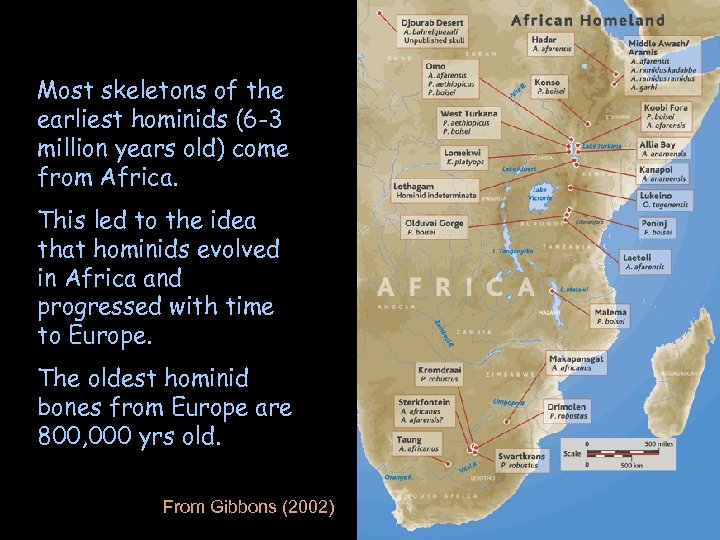 Most skeletons of the earliest hominids (6 -3 million years old) come from Africa. This led to the idea that hominids evolved in Africa and progressed with time to Europe. The oldest hominid bones from Europe are 800, 000 yrs old. From Gibbons (2002)
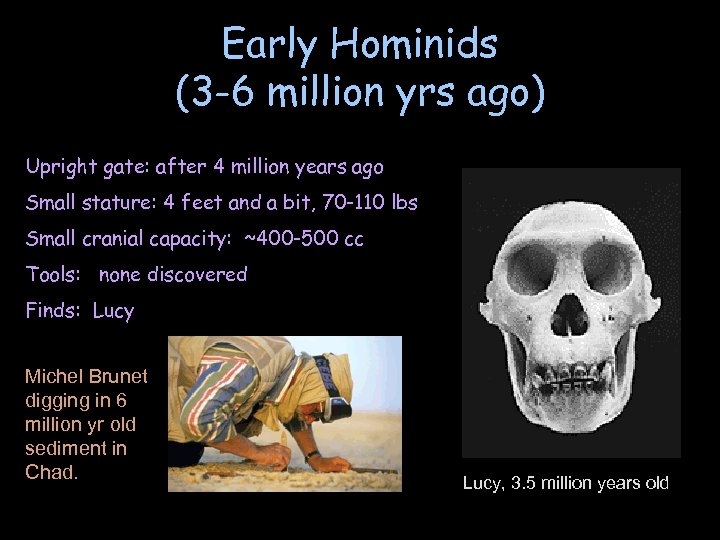 Early Hominids (3 -6 million yrs ago) Upright gate: after 4 million years ago Small stature: 4 feet and a bit, 70 -110 lbs Small cranial capacity: ~400 -500 cc Tools: none discovered Finds: Lucy Michel Brunet digging in 6 million yr old sediment in Chad. Lucy, 3. 5 million years old
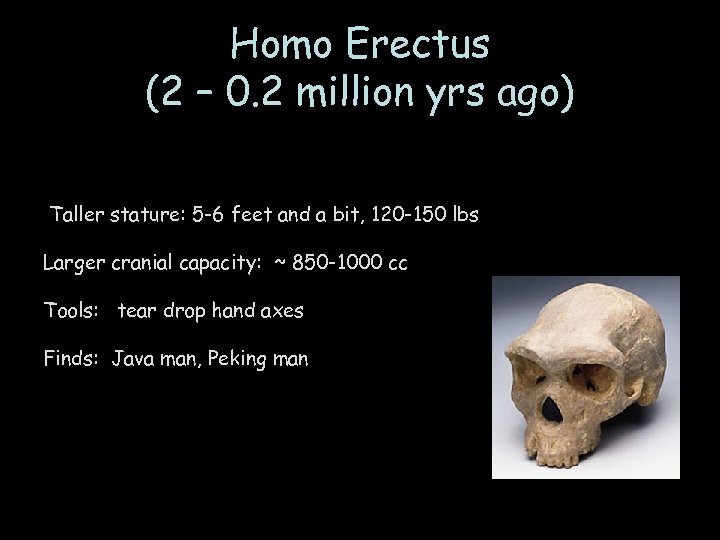 Homo Erectus (2 – 0. 2 million yrs ago) Taller stature: 5 -6 feet and a bit, 120 -150 lbs Larger cranial capacity: ~ 850 -1000 cc Tools: tear drop hand axes Finds: Java man, Peking man
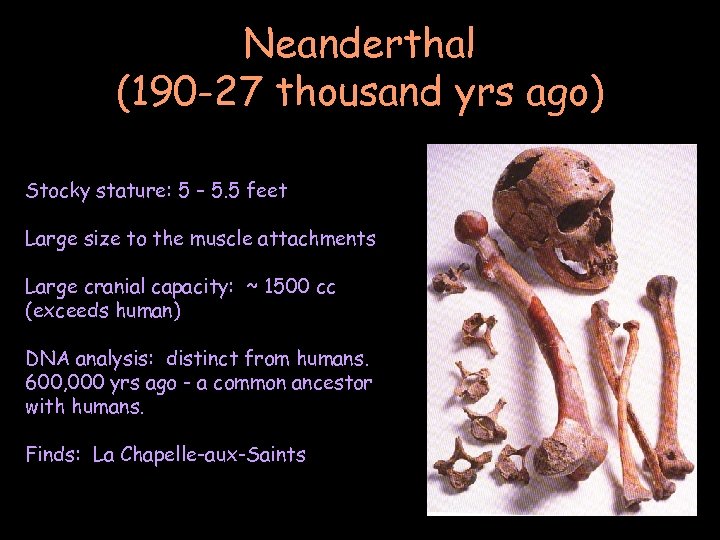 Neanderthal (190 -27 thousand yrs ago) Stocky stature: 5 – 5. 5 feet Large size to the muscle attachments Large cranial capacity: ~ 1500 cc (exceeds human) DNA analysis: distinct from humans. 600, 000 yrs ago - a common ancestor with humans. Finds: La Chapelle-aux-Saints
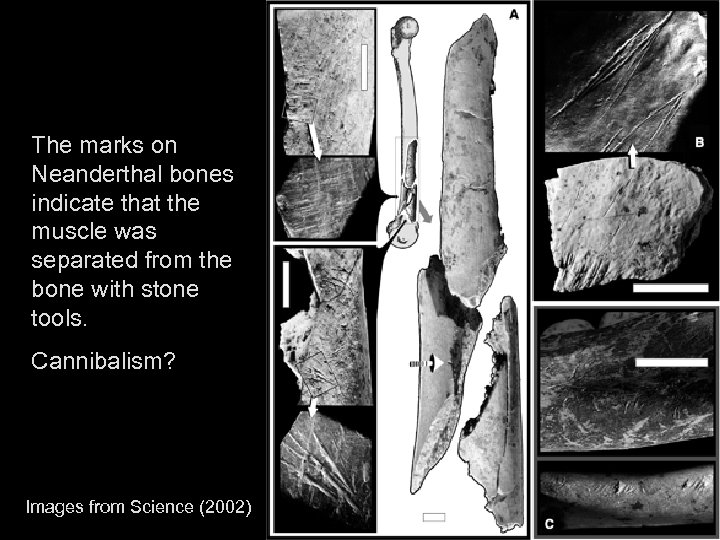 The marks on Neanderthal bones indicate that the muscle was separated from the bone with stone tools. Cannibalism? Images from Science (2002)
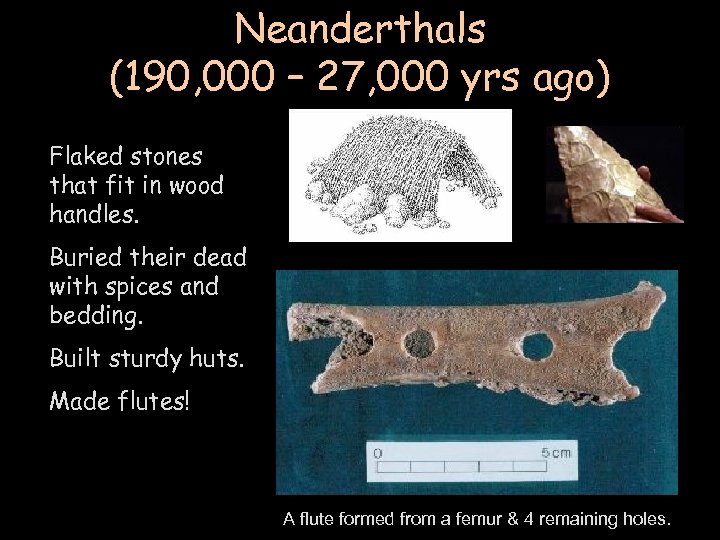 Neanderthals (190, 000 – 27, 000 yrs ago) Flaked stones that fit in wood handles. Buried their dead with spices and bedding. Built sturdy huts. Made flutes! A flute formed from a femur & 4 remaining holes.
 The shapes & sizes of hominid heads can be seen to evolve with time.
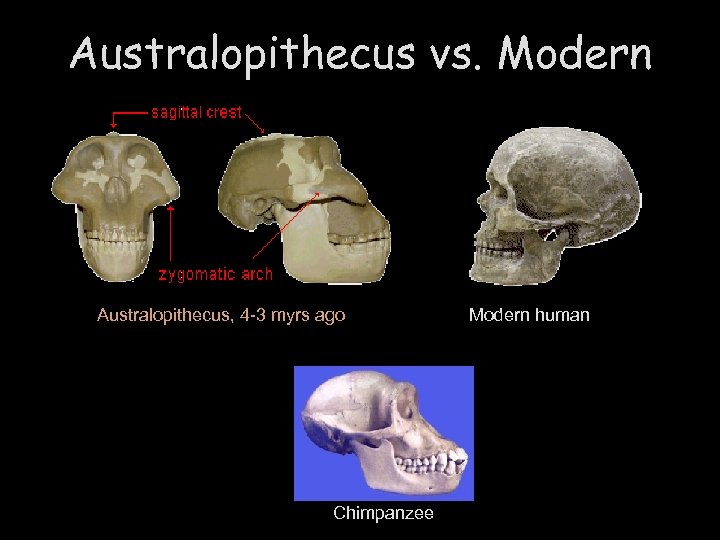 Australopithecus vs. Modern Australopithecus, 4 -3 myrs ago Chimpanzee Modern human
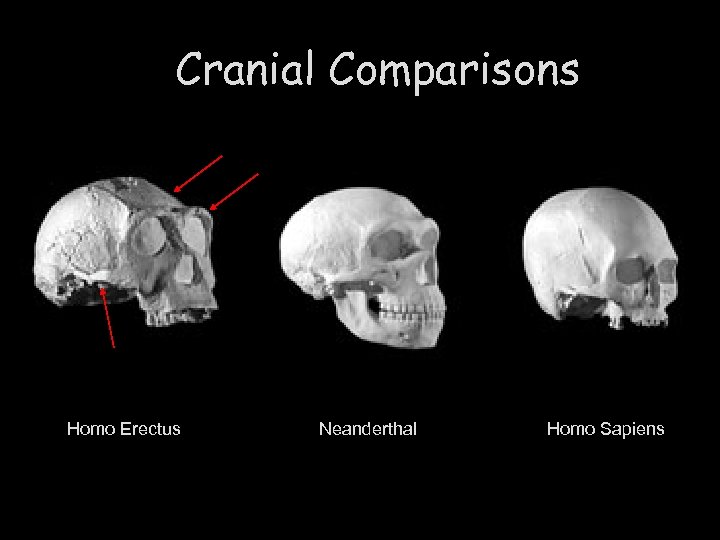 Cranial Comparisons Homo Erectus Neanderthal Homo Sapiens
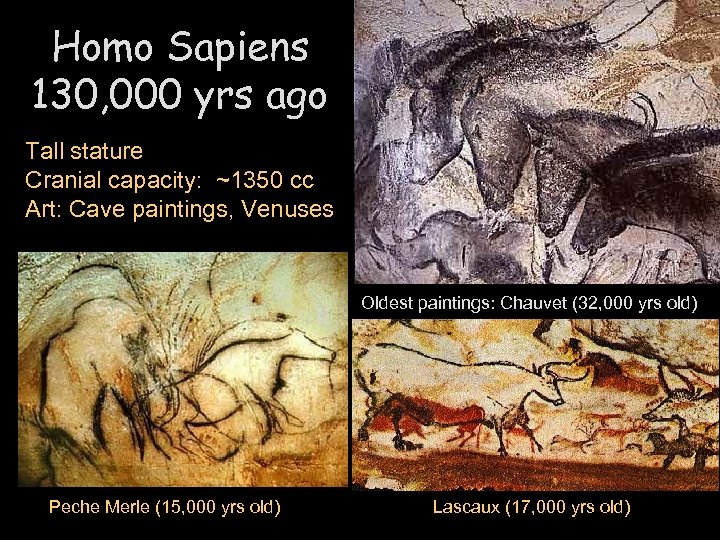 Homo Sapiens 130, 000 yrs ago Tall stature Cranial capacity: ~1350 cc Art: Cave paintings, Venuses Oldest paintings: Chauvet (32, 000 yrs old) Peche Merle (15, 000 yrs old) Lascaux (17, 000 yrs old)
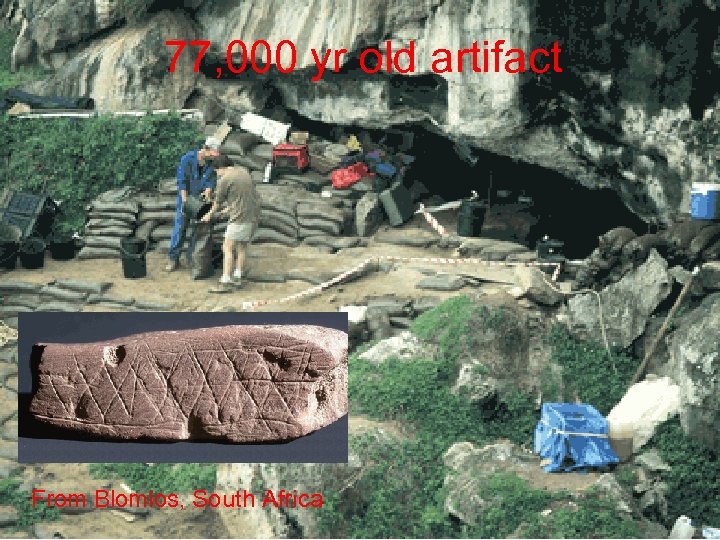 77, 000 yr old artifact From Blomlos, South Africa
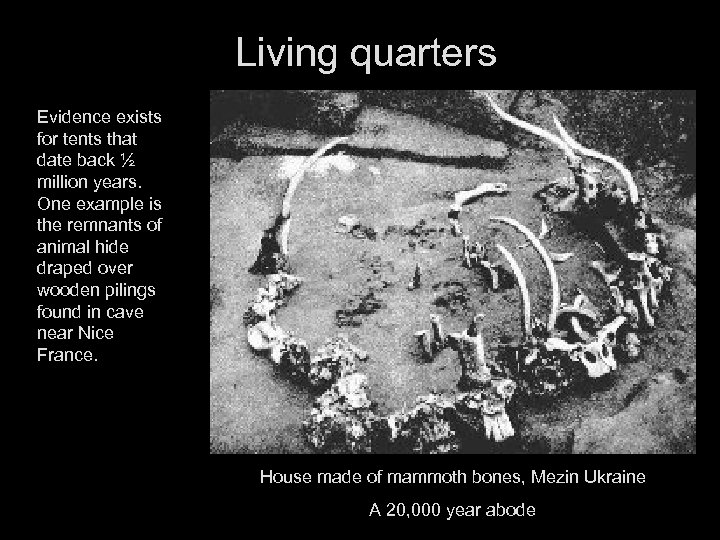 Living quarters Evidence exists for tents that date back ½ million years. One example is the remnants of animal hide draped over wooden pilings found in cave near Nice France. House made of mammoth bones, Mezin Ukraine A 20, 000 year abode
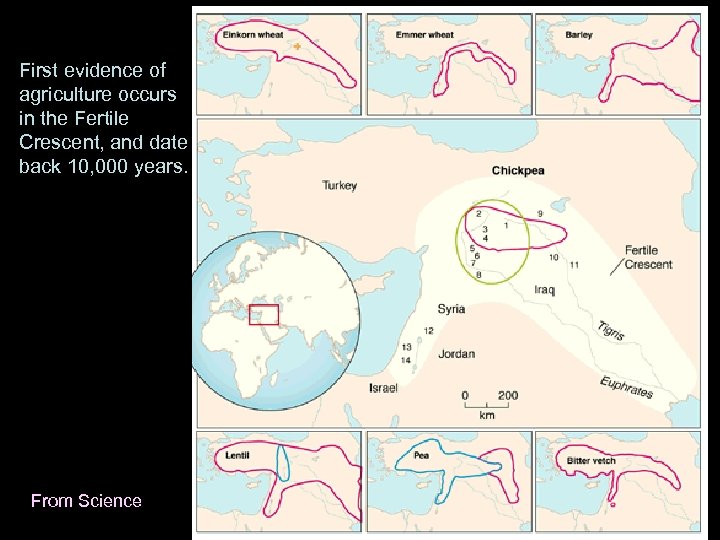 First evidence of agriculture occurs in the Fertile Crescent, and date back 10, 000 years. From Science
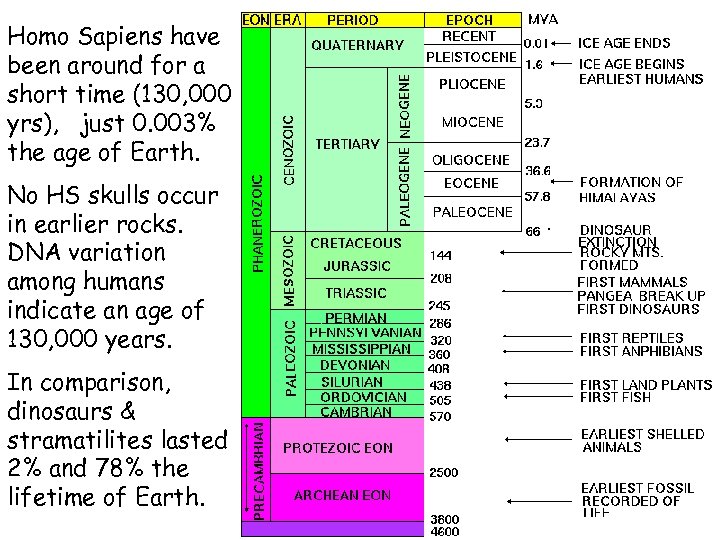 Homo Sapiens have been around for a short time (130, 000 yrs), just 0. 003% the age of Earth. No HS skulls occur in earlier rocks. DNA variation among humans indicate an age of 130, 000 years. In comparison, dinosaurs & stramatilites lasted 2% and 78% the lifetime of Earth.
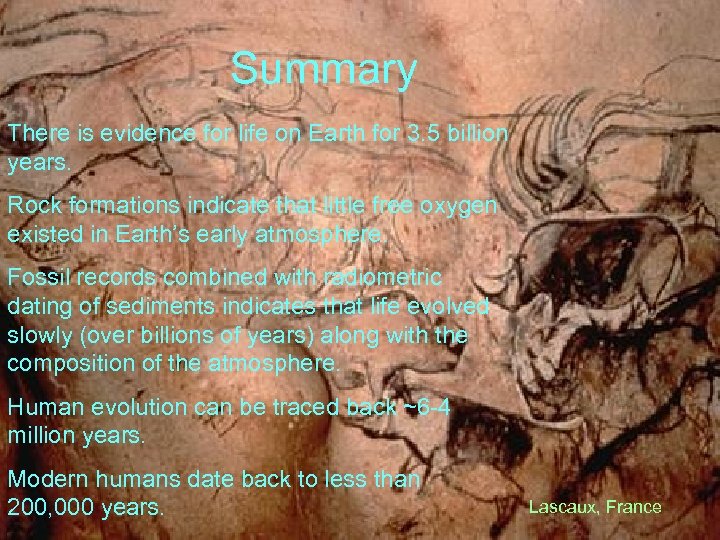 Summary There is evidence for life on Earth for 3. 5 billion years. Rock formations indicate that little free oxygen existed in Earth’s early atmosphere. Fossil records combined with radiometric dating of sediments indicates that life evolved slowly (over billions of years) along with the composition of the atmosphere. Human evolution can be traced back ~6 -4 million years. Modern humans date back to less than 200, 000 years. Lascaux, France