 Скачать презентацию Evolution of ICT in the Chamber of Deputies
54c4cab028ee668d59ebef0e3924c9cb.ppt
- Количество слайдов: 20



Evolution of ICT in the Chamber of Deputies ECPRD - ICT Working Group Meeting 2010 Bucharest, Parliament of Romania, 18 -19 November 2010 Vasile Lapteş
Evolution of ICT Division • 1994 – Information Technology Division is established – goal: provide information technology support for the legislative process • 1998 – Communications Technology Division is included • 2001 – Information and Communications Technology Division expands goals with Administrative, Economic and Financial Applications
Current structure of the ITC Division – 1 director and 1 deputy director – services: • Infrastructure management and help desk – 5 IT specialists, 1 assistant • Communications – 3 engineers, 7 technicians, 5 operators & assistants • Administrative databases – 4 senior analysts, 2 assistants • Legislative databases and web site – 4 senior analysts, 4 assistants – no outsourcing
ITC clients • 334 MPs – Standing bureau - 13 members – 6 Parliamentary groups + not affiliated MPs – Committees: • Chamber of Dep: 17 standing comm. + 5 special comm. • Joint: 6 standing comm. + 4 special comm. • 1500 employees – 1 secretary general + 2 deputy secretaries general – 23 departments & divisions • Other institutions: Legislative Council, Constitutional Court
ITC users • Parliamentary offices in the constituencies – 334 MPs: • desktop PC, multifunctional printer, laptop • mailbox • contracts with mobile telephony service providers • Palace of the Parliament – 1500 users • 1200 PCs • 1000 printers • 90 scanners • 900 mailboxes – 1500 users on wireless devices – 2000 extension connections and over 200 land line connections – 1350 beneficiaries of contracts with mobile telephony service providers - staff
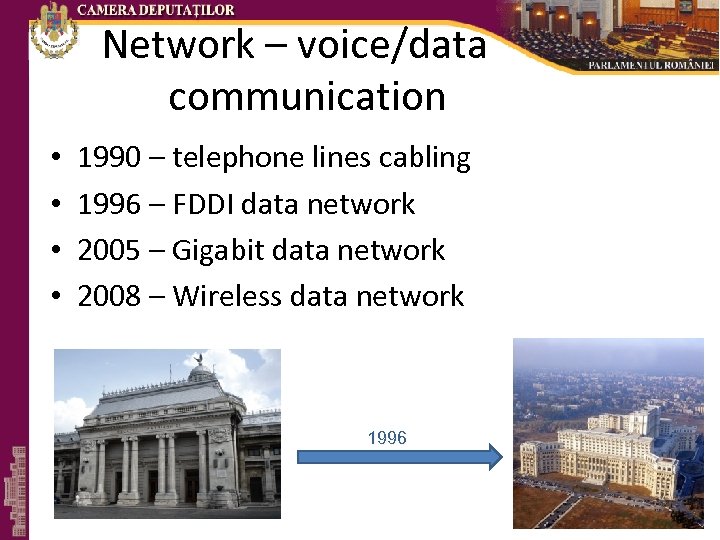
Network – voice/data communication • • 1990 – telephone lines cabling 1996 – FDDI data network 2005 – Gigabit data network 2008 – Wireless data network 1996
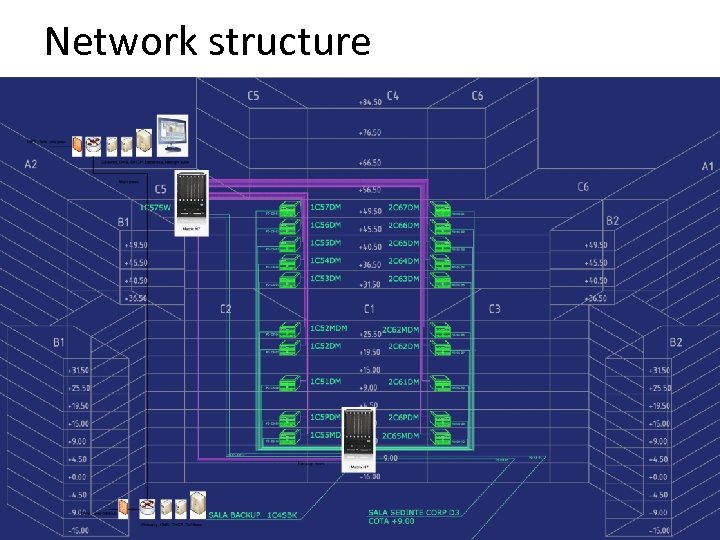
Network structure
Hardware & Software platforms • • 1992 – stand-alone workstations 1995 – Nortel PABX 1996 – Alpha Server (Unix + Oracle DB + Web) 2000 – Tru 64 cluster (3 servers) 2003 – First Video server (Real Networks) 2009 – IBM PPC 64 Oracle RAC (3 servers) 2010 – 2 Data Centers: main DC + backup DC (DR) – – 24 servers (Linux PPC 64 & Intel, HP Tru 64, MS Windows) 20 Tb storage
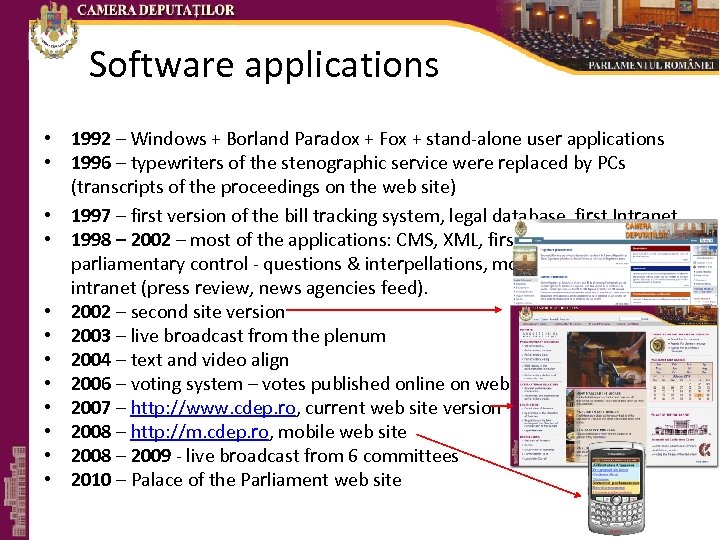
Software applications • 1992 – Windows + Borland Paradox + Fox + stand-alone user applications • 1996 – typewriters of the stenographic service were replaced by PCs (transcripts of the proceedings on the web site) • 1997 – first version of the bill tracking system, legal database, first Intranet • 1998 – 2002 – most of the applications: CMS, XML, first DMS (committees, parliamentary control - questions & interpellations, motions, library, intranet (press review, news agencies feed). • 2002 – second site version • 2003 – live broadcast from the plenum • 2004 – text and video align • 2006 – voting system – votes published online on web • 2007 – http: //www. cdep. ro, current web site version • 2008 – http: //m. cdep. ro, mobile web site • 2008 – 2009 - live broadcast from 6 committees • 2010 – Palace of the Parliament web site
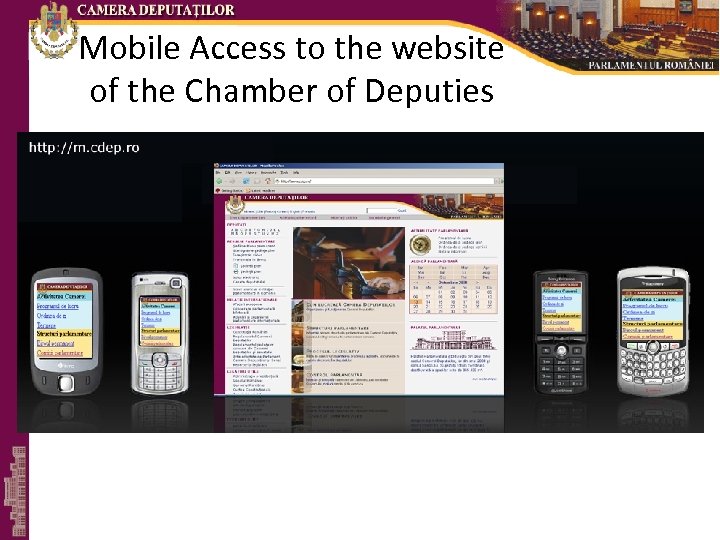
Mobile Access to the website of the Chamber of Deputies
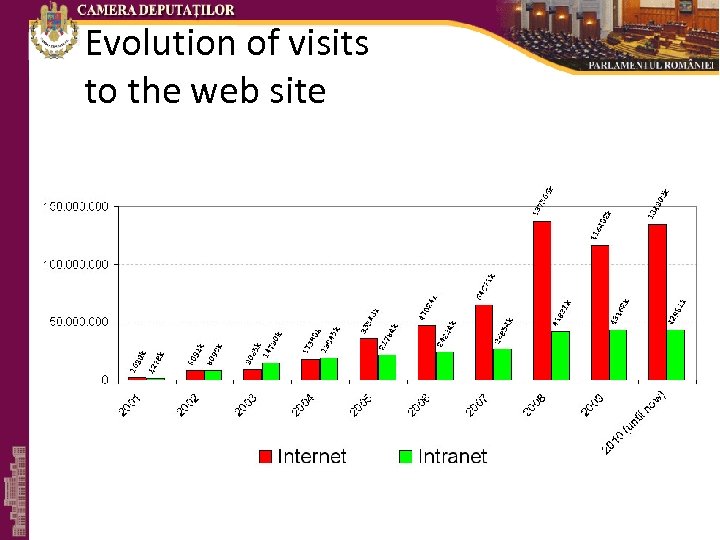
Evolution of visits to the web site
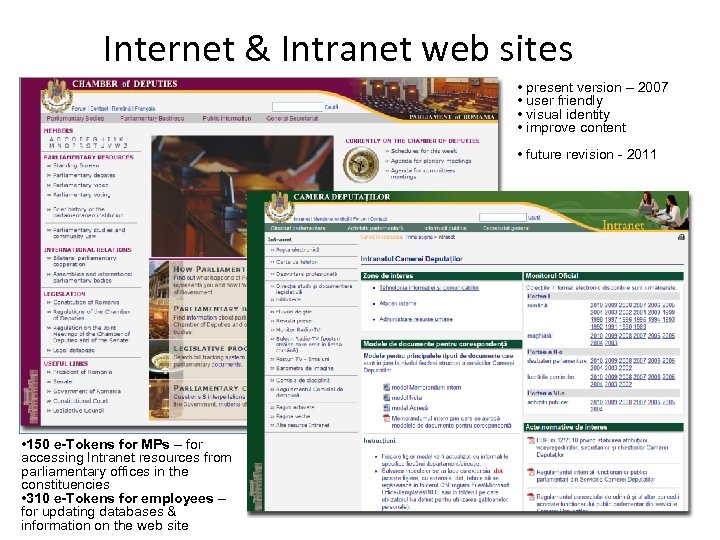
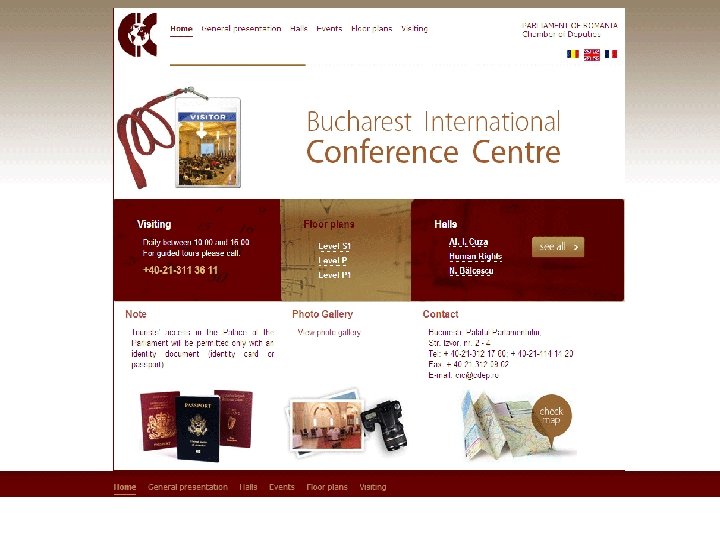
Internet & Intranet web sites • present version – 2007 • user friendly • visual identity • improve content • future revision - 2011 • 150 e-Tokens for MPs – for accessing Intranet resources from parliamentary offices in the constituencies • 310 e-Tokens for employees – for updating databases & information on the web site
Chamber of Deputies information system (Internet) • Bill tracking system (9. 700 bills) • Activity in plenum (text + video) – agenda, debates, votes • Activity in committees (text + video) – agenda, debates, documents • • • Parliamentary control (q & i, motions) Documents distributed to MPs (19. 750 docs) Legal database (93. 000 docs) Chamber of Deputies bodies and structure Economic information For each MP, full activity (list of initiated bills, q & i, motions, speeches)
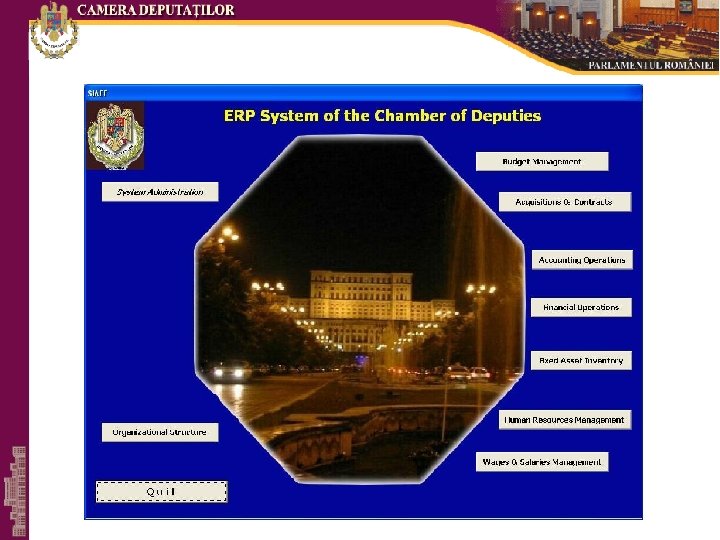
Chamber of Deputies information system (Intranet) • • • ERP Subsystem Library information system Press review, news agencies feed Spaces and equipment inventory management Telephony costs management Archive
Library Application Suitable for storing many types of resources (books, periodicals, maps, multimedia content) Authorized persons are responsible with data mantaining: - acquisition and inventory processing - detailed description of each resource - classify books according to a specific Subject or Domain of interest - extract and organize relevant articles from periodicals - borrowers management Database is available on web as Online Catalogue containing ~ 50. 000 bibliographic resources: - 34. 000 books, 10. 500 periodicals ; oldest document dated in 1721 - 6. 000 resources have scanned PDF summary attached
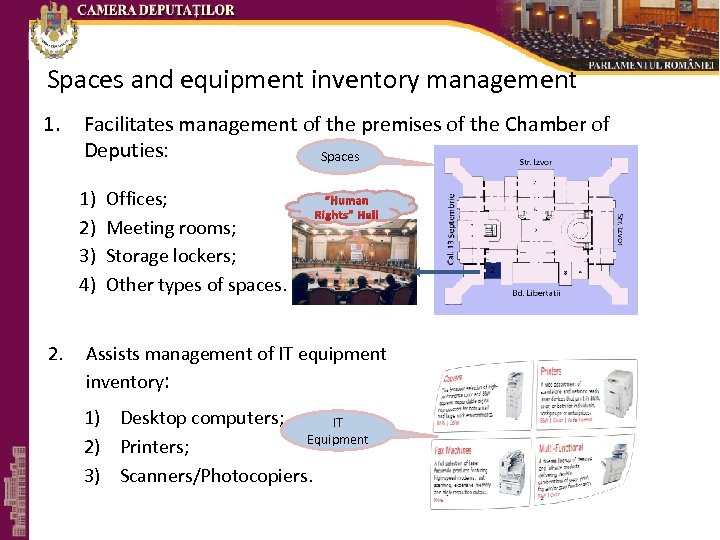
Spaces and equipment inventory management 1. Facilitates management of the premises of the Chamber of Deputies: Spaces 1) 2) 3) 4) 2. Offices; Meeting rooms; Storage lockers; Other types of spaces. “Human Rights” Hall Assists management of IT equipment inventory: 1) Desktop computers; IT Equipment 2) Printers; 3) Scanners/Photocopiers.
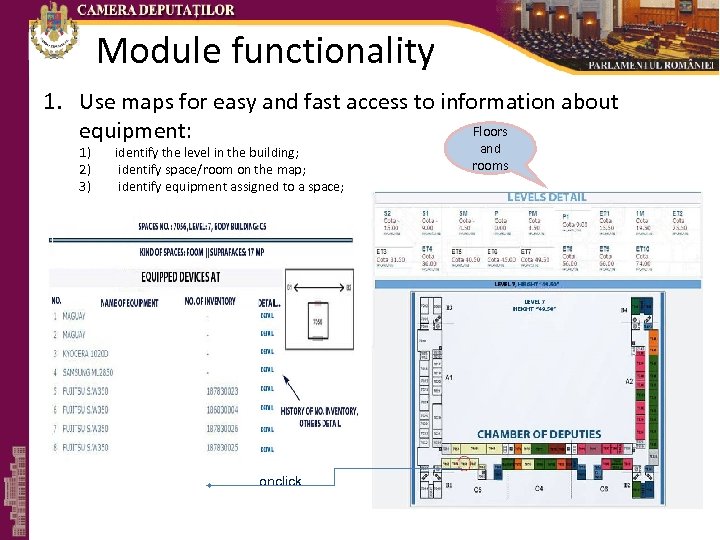
Module functionality 1. Use maps for easy and fast access to information about Floors equipment: 1) 2) 3) identify the level in the building; identify space/room on the map; identify equipment assigned to a space; onclick and rooms
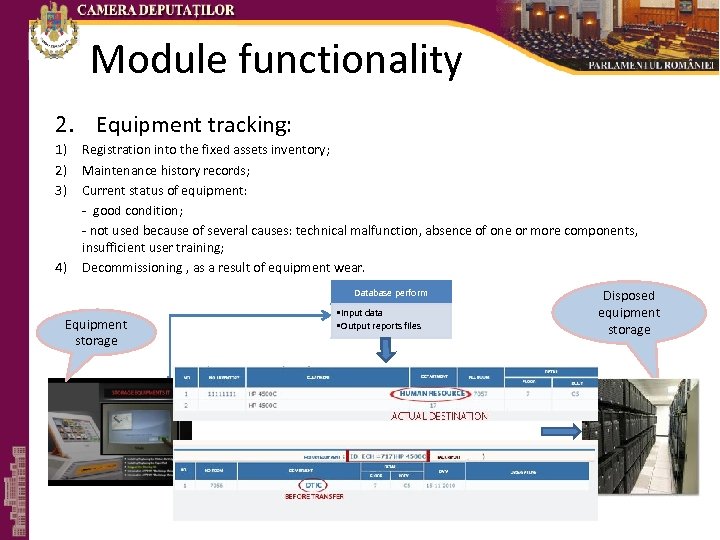
Module functionality 2. Equipment tracking: 1) 2) 3) 4) Registration into the fixed assets inventory; Maintenance history records; Current status of equipment: - good condition; - not used because of several causes: technical malfunction, absence of one or more components, insufficient user training; Decommissioning , as a result of equipment wear. Database perform Equipment storage • Input data • Output reports files Disposed equipment storage
Скачать презентацию Evolution of ICT in the Chamber of Deputies
54c4cab028ee668d59ebef0e3924c9cb.ppt