 Скачать презентацию EVOLUTION OF ENGLISH VERB Brainstorming activity What
verb.ppt
- Количество слайдов: 16



EVOLUTION OF ENGLISH VERB
Brainstorming activity What grammatical categories of verb do you know in Modern English?
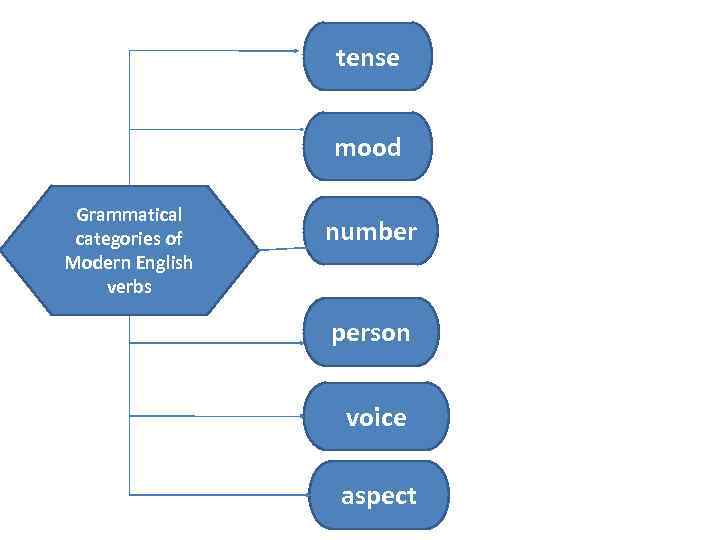
tense mood Grammatical categories of Modern English verbs number person voice aspect
Brainstorming activity What’s the structure of the Modern English language? When did the analytical tenses appear? What do you know about the terms synthetic and analytical?
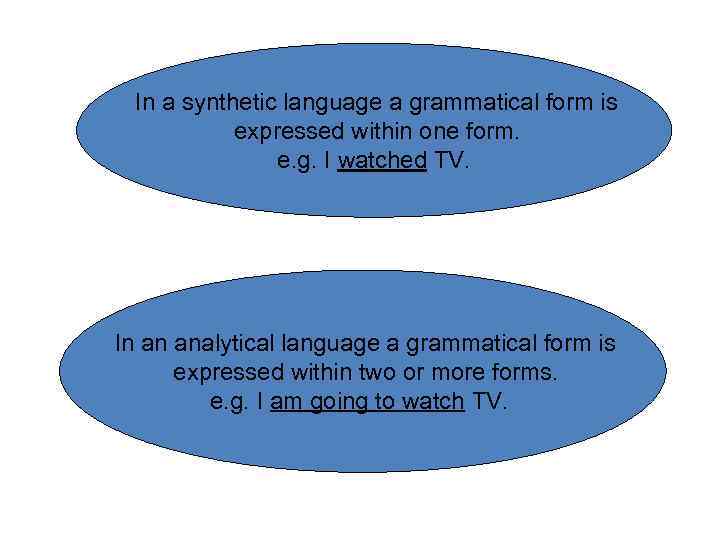
In a synthetic language a grammatical form is expressed within one form. e. g. I watched TV. In an analytical language a grammatical form is expressed within two or more forms. e. g. I am going to watch TV.
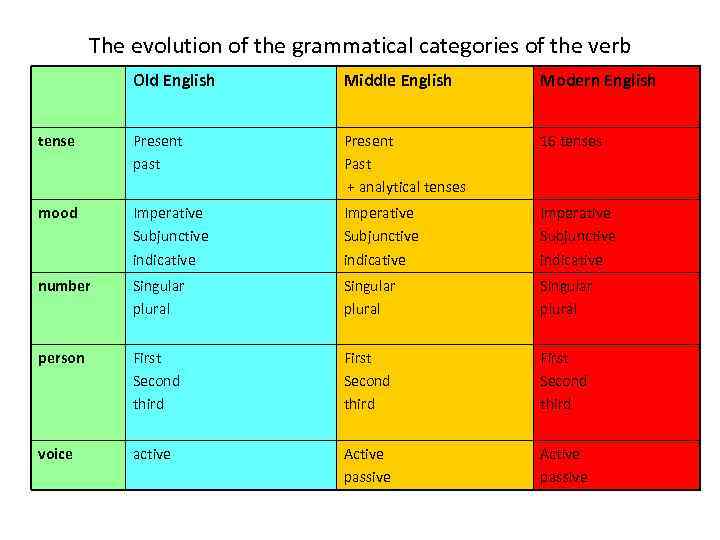
The evolution of the grammatical categories of the verb Old English Middle English Modern English tense Present past Present Past + analytical tenses 16 tenses mood Imperative Subjunctive indicative number Singular plural person First Second third voice active Active passive
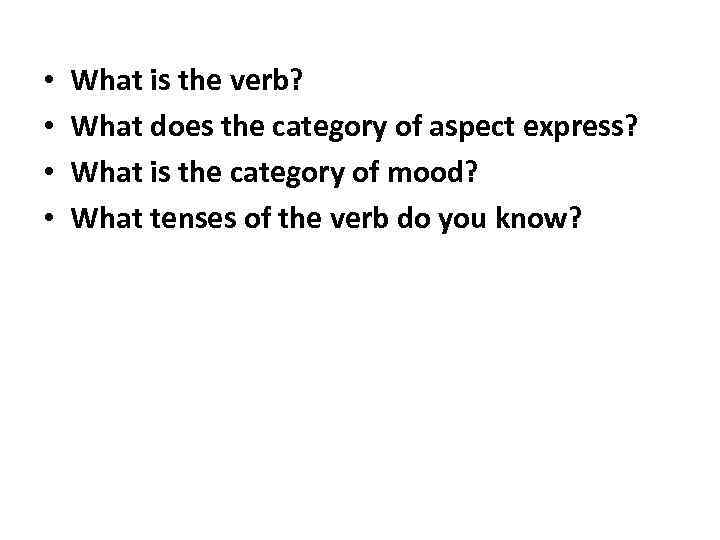
• • What is the verb? What does the category of aspect express? What is the category of mood? What tenses of the verb do you know?
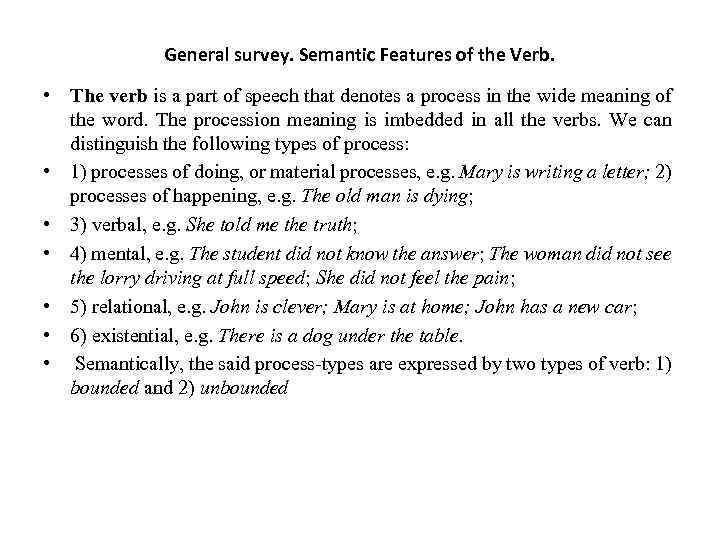
General survey. Semantic Features of the Verb. • The verb is a part of speech that denotes a process in the wide meaning of the word. The procession meaning is imbedded in all the verbs. We can distinguish the following types of process: • 1) processes of doing, or material processes, e. g. Mary is writing a letter; 2) processes of happening, e. g. The old man is dying; • 3) verbal, e. g. She told me the truth; • 4) mental, e. g. The student did not know the answer; The woman did not see the lorry driving at full speed; She did not feel the pain; • 5) relational, e. g. John is clever; Mary is at home; John has a new car; • 6) existential, e. g. There is a dog under the table. • Semantically, the said process types are expressed by two types of verb: 1) bounded and 2) unbounded
• ASPECT. • There are two sets of forms in the Modern English verb which are contrasted with each other on the principle of use or non use of the pattern “be+first participle” • Writes is writing • Wrote was writing • The basic difference between the two sets of forms, appears to be this: 1 an action going on continuously during a given period of time and 2 an action not limited and not described by the very form of the verb as proceeding in such a manner.
• SPECIAL USES. • It must be now mentioned the uses of the con tinuous aspect which do not easily fit into the definition. Forms of this aspect are occasionally used with the adverbs always, continually, etc. , when the action is meant to be unlimited by time. Here are some typical examples of this use: He was constantly ex perimenting with new seed. (LINKLATER) Rose is always wanting James to retire. (GARY) The adverbial modifier always shows that Rose's wish is thought of as something constant, not restricted to any particular moment. So the difference between the sentence as it stands and the possible variant, Rose always wants James to re tiredoes not lie in the character of the action. Obviously the pecu liar shade of meaning in the original sentence is emphatic;
• DIFFERENT INTERPRETATIONS • We will now consider some different interpreta tions proposed by various scholars. • O. Jespersen treated the type is writing as a means of ex pressing limited duration, that is, in his own words, expressing an action serving as frame to another which is performed within the frame set by that first action. A somewhat similar view has been propounded by Prof. N. Irtenyeva, who thinks that the basic meaning of the type is writing is that of simultaneity of an action with another action. • Another view is held by Prof. I. Ivanova. She recognizes the existence of the aspect category in English, but treats it in a pecu liar way. According to Prof. Ivanova, is writing is an aspect form, namely that of the continuous aspect, but writes is not an aspect form at all, because its meaning is vague and cannot be clearly defined.
• • • TENSE. Time and tense. Time is an unlimited duration in which things are considered as happening in the past, present or future. Time stands for a concept with which all mankind is familiar. Time is independent of language. Tense, which derives from the Latin word tempus, stands for a verb form used to express a time relation. Time is the same to all mankind while tenses vary in different languages. Graphically, time can be represented as a straight line, with the past represented to the left and the future to the right. Between the two points there is the present. Time can be expressed in language in two basic ways: 1) lexically; 2) grammatically. Cf. John is working in his study now. This sentence expresses the present time in two ways: grammatically (is) and lexically (now). As for lexical means, English has three sets of temporal adjuncts: those which refer to the present (now, today, this morning, this week, this month, this century, this epoch, etc. ); those which refer to the past (yesterday, last week, last month, last year, last century, last decade, etc. ; two minutes, days, weeks, months, etc. ago); those which refer to the future.
• • The verb. Mood. The category of mood in the present English verb has given rise to so many discussions, and has been treated in so many dif ferentways, that it seems hardly possible to arrive at any more or less convincing and universally acceptable conclusion concerning it. Indeed, the only points in the sphere of mood which have not so far been disputed seem to be these: (a) there is a category of mood in Modern English, (b) there at least two moods in the modern Eng lishverb, one of which is the indicative. As to the number of the other moods and as to their meanings and the names they ought to be given, opinions to day are as far apart as ever. It should be noted at once that there are other ways of indicating the reality or possibility of an action, besides the verbal category of mood, viz. modal verbs (may, can, must, etc. ), and modal words (perhaps, probably, etc. ), which do not concern us here. All these phenomena fall under the very wide notion of modality, which is not confined to grammar but includes some parts of lexicology and of phonetics (intonation) as well. The main division of moods, which has been universally recognized, is into the one which represents an action ; as real, i. e. as actually taking place (the indicative) as against that or those which represent it as non real, i. e. as merely imaginary, conditional, etc.
• • THE INDICATIVE. The use of the indicative mood shows that the speaker represents the action as real. Two additional remarks are necessary here. (1) The mention of the speaker (or writer) who represents the ac tion as real is most essential. If we limited ourselves to saying that the indicative mood is used to represent real actions, we should ar rive at the absurd conclusion that whatever has been stated by any body (in speech or in writing) in a sentence with its predicate verb in the indicative mood is therefore necessarily true. We should then ignore the possibility of the speaker either being mistaken or else telling a deliberate lie. The point is that grammar (and indeed lin guistics as a whole) does not deal with the ultimate truth or untruth of a statement with its predicate verb in the indicative (or, for that matter, in any other) mood. What is essential from the grammatical point of view is the meaning of the category as used by the author of this or that sentence. Besides, what are we to make of statements with their predicate verb in the indicative mood found in works of fiction? In what sense could we say, for instance, that the sentence David Copperfield married Dora or the sentence Soames Forsyte divorced his first wife, Irene represent "real facts", since we are aware that the men and women mentioned in these sentences never existed "in real life"? This is more evident still for such nur sery rhyme sentences as, The cow jumped over the moon. This pecu liarity of the category of mood should be always firmly kept in mind.
• • • (2) Some doubt about the meaning of the indicative mood may arise if we take into account its use in conditional sentences such as the following: I will speak to him if I meet him. It may be argued that the action denoted by the verb in the in dicativemood (in the subordinate clauses as well as in the main clauses) is not here represented as a fact but merely as a possibility (I may meet him, and I may not, etc. ). However, this does not affect the meaning of the grammatical form as such. The conditional mean ing is expressed by the conjunction, and of course it does alter the modal meaning of the sentence, but the meaning of the verb form as such remains what it was. As to the predicate verb of the main clause, which expresses the action bound to follow the fulfilment of the condition laid down in the subordinate clause, it is no more un certainthan an action belonging to the future generally is. This brings us to the question of a peculiar modal character of the future indicative, as distinct from the present or past indicative. In the sentence If he was there I did not see him the action of the main clause is stated as certain, in spite of the fact that the subordinate clause is introduced by if and, consequently, its action is hypo thetical. On the whole, then, the hypothetical meaning attached to clauses introduced by if is no objection to the meaning of the indicative as a verbal category.
• • • THE IMPERATIVE. The imperative mood in English is represented by one form only, viz. come(!), without any suffix or ending. 2 It differs from all other moods in several important points. It has no person, number, tense, or aspect distinctions, and, which is the main thing, it is limited in its use to one type of sentence only, viz. imperative sentences. Most usually a verb in the imperative has no pronoun acting as subject. However, the pronoun may be used in emotional speech, as in the following example: "But, Tessie—" he pleaded, going towards her. "You leave me alone!" she cried out loudly. (E. CALDWELL) These are essential peculiarities distinguish ing the imperative, and they have given rise to doubts as to whether the imperative can be numbered among the moods at all. This of course depends on what we mean by mood. If we accept the defini tion of mood given above there would seem to be no ground to deny that the imperative is a mood. The definition does not say anything about the possibility of using a form belonging to a modal category in one or more types of sentences: that syntactical problem is not a problem of defining mood.
Скачать презентацию EVOLUTION OF ENGLISH VERB Brainstorming activity What
verb.ppt