


 Скачать презентацию EVLA Status and Prospects Stars On and Off
656d484581c5a771de98058e7f3fc176.ppt
- Количество слайдов: 58
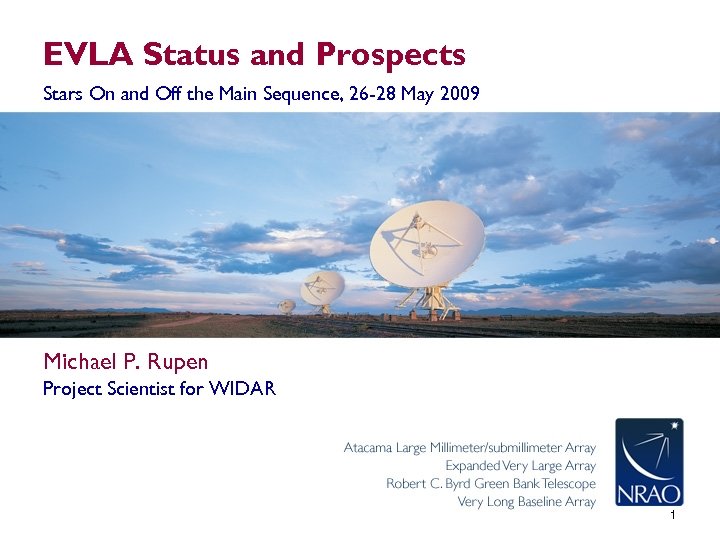 EVLA Status and Prospects Stars On and Off the Main Sequence, 26 -28 May 2009 Michael P. Rupen Project Scientist for WIDAR 1
 The promise of the EVLA 2
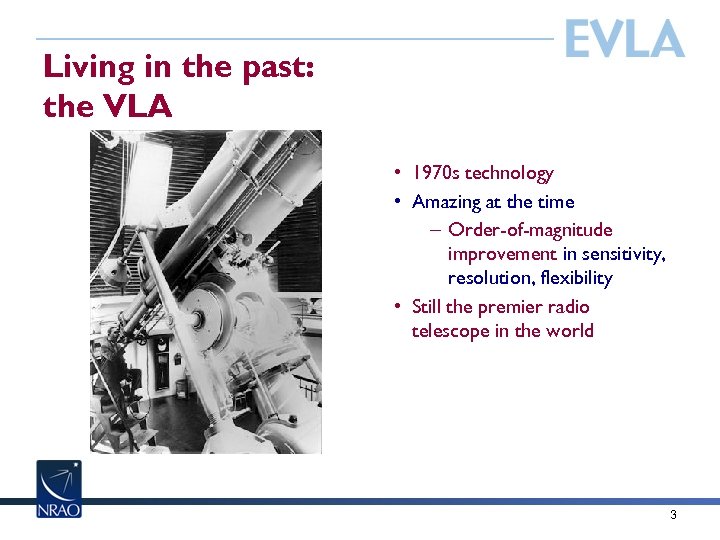 Living in the past: the VLA • 1970 s technology • Amazing at the time – Order-of-magnitude improvement in sensitivity, resolution, flexibility • Still the premier radio telescope in the world 3
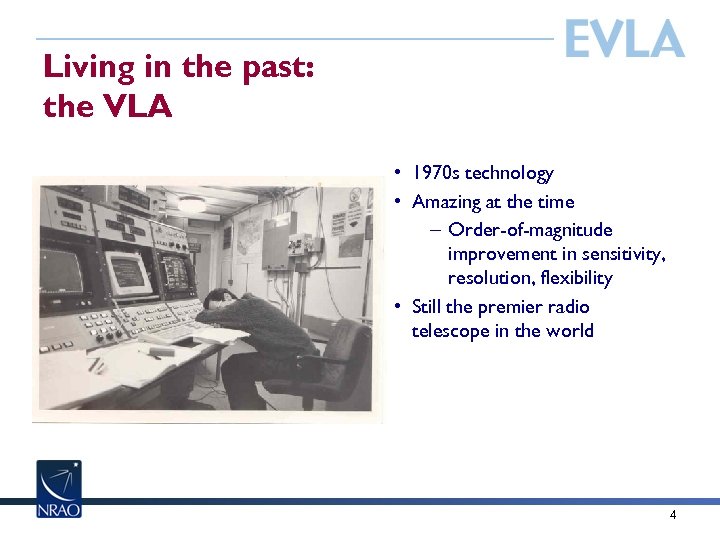 Living in the past: the VLA • 1970 s technology • Amazing at the time – Order-of-magnitude improvement in sensitivity, resolution, flexibility • Still the premier radio telescope in the world 4
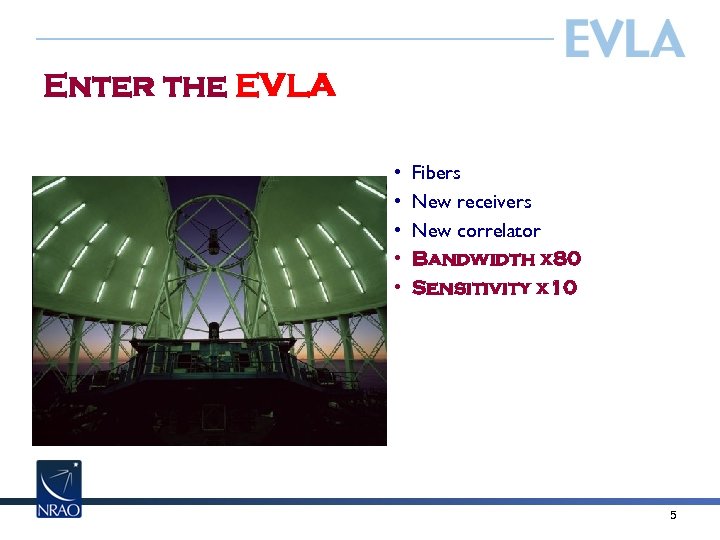 Enter the EVLA • • • Fibers New receivers New correlator Bandwidth x 80 Sensitivity x 10 5
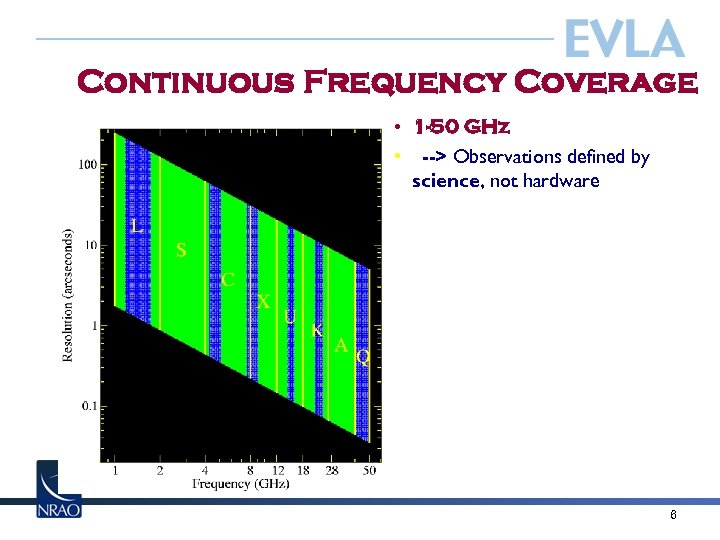 Continuous Frequency Coverage • 1 -50 GHz • --> Observations defined by science, not hardware 6
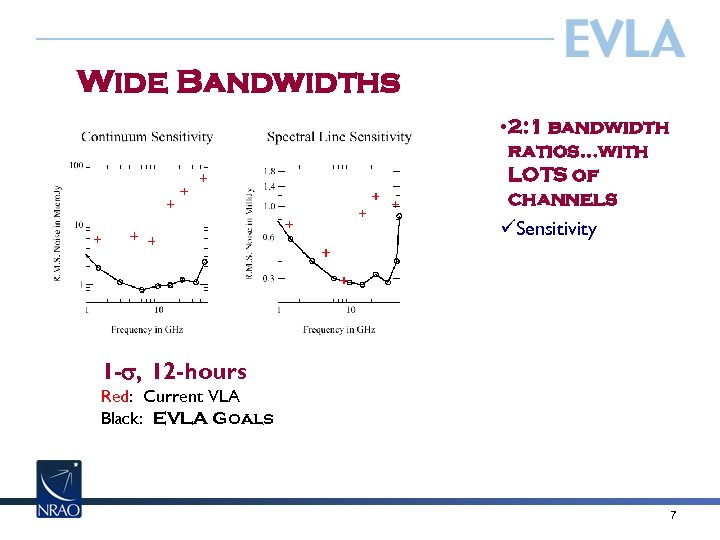 Wide Bandwidths • 2: 1 bandwidth ratios…with LOTS of channels üSensitivity 1 - , 12 -hours Red: Current VLA Black: EVLA Goals 7
 Wide Bandwidths 1. 702 GHz 1. 302 - 2. 102 GHz • 2: 1 bandwidth ratios…with LOTS of channels üSensitivity üUV-coverage Rau, Owen, Cornwell, Eilek 8
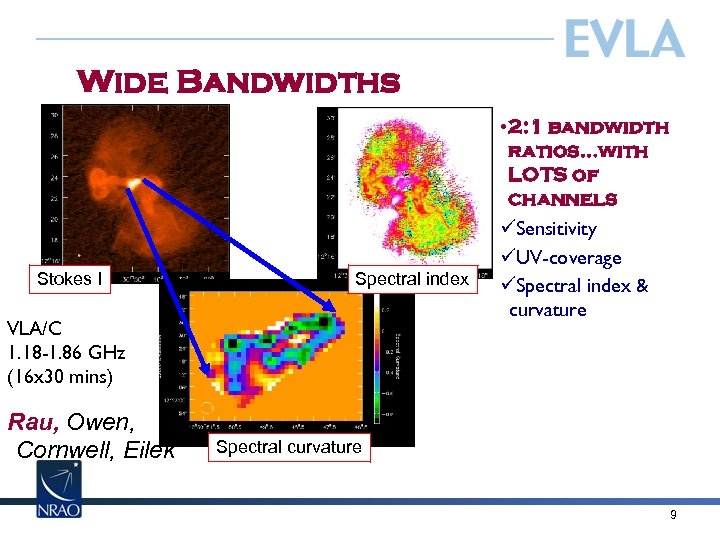 Wide Bandwidths Stokes I Spectral index VLA/C 1. 18 -1. 86 GHz (16 x 30 mins) Rau, Owen, Cornwell, Eilek • 2: 1 bandwidth ratios…with LOTS of channels üSensitivity üUV-coverage üSpectral index & curvature Spectral curvature 9
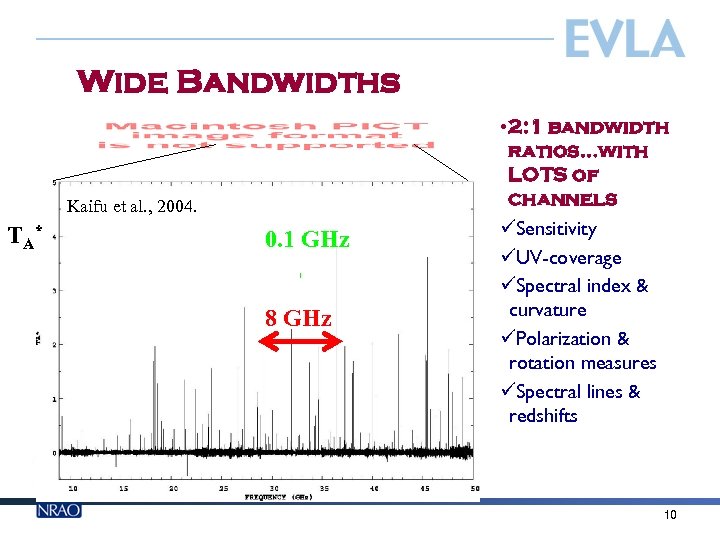 Wide Bandwidths Kaifu et al. , 2004. T A* 0. 1 GHz 8 GHz • 2: 1 bandwidth ratios…with LOTS of channels üSensitivity üUV-coverage üSpectral index & curvature üPolarization & rotation measures üSpectral lines & redshifts 10
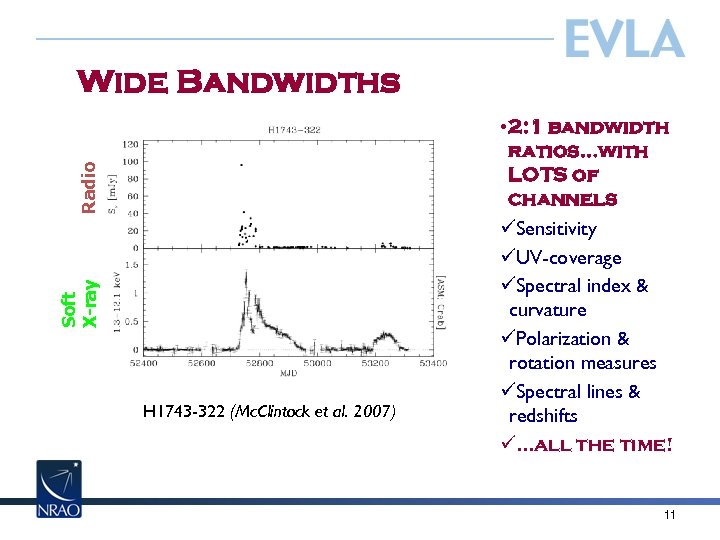 Soft X-ray Radio Wide Bandwidths H 1743 -322 (Mc. Clintock et al. 2007) • 2: 1 bandwidth ratios…with LOTS of channels üSensitivity üUV-coverage üSpectral index & curvature üPolarization & rotation measures üSpectral lines & redshifts ü…all the time! 11
 Status & schedule 12
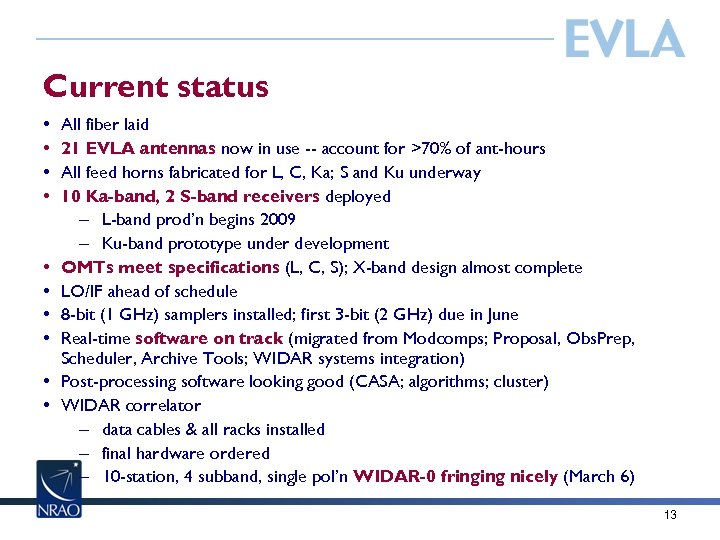 Current status • • • All fiber laid 21 EVLA antennas now in use -- account for >70% of ant-hours All feed horns fabricated for L, C, Ka; S and Ku underway 10 Ka-band, 2 S-band receivers deployed – L-band prod’n begins 2009 – Ku-band prototype under development OMTs meet specifications (L, C, S); X-band design almost complete LO/IF ahead of schedule 8 -bit (1 GHz) samplers installed; first 3 -bit (2 GHz) due in June Real-time software on track (migrated from Modcomps; Proposal, Obs. Prep, Scheduler, Archive Tools; WIDAR systems integration) Post-processing software looking good (CASA; algorithms; cluster) WIDAR correlator – data cables & all racks installed – final hardware ordered – 10 -station, 4 subband, single pol’n WIDAR-0 fringing nicely (March 6) 13
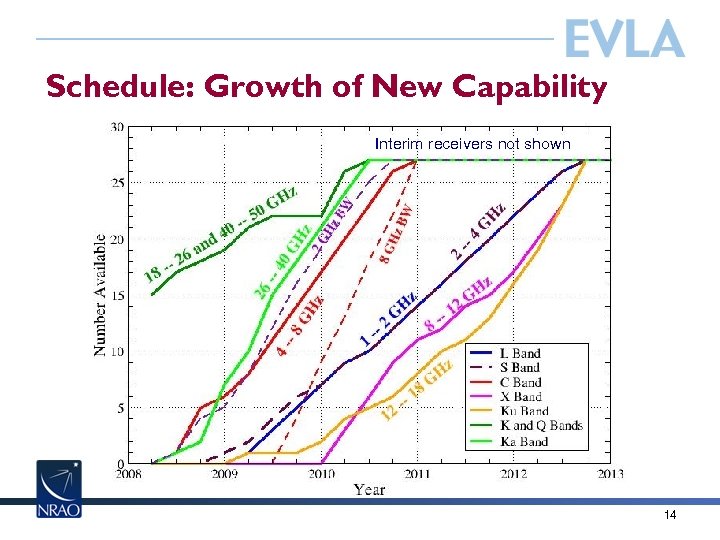 Schedule: Growth of New Capability Interim receivers not shown 14
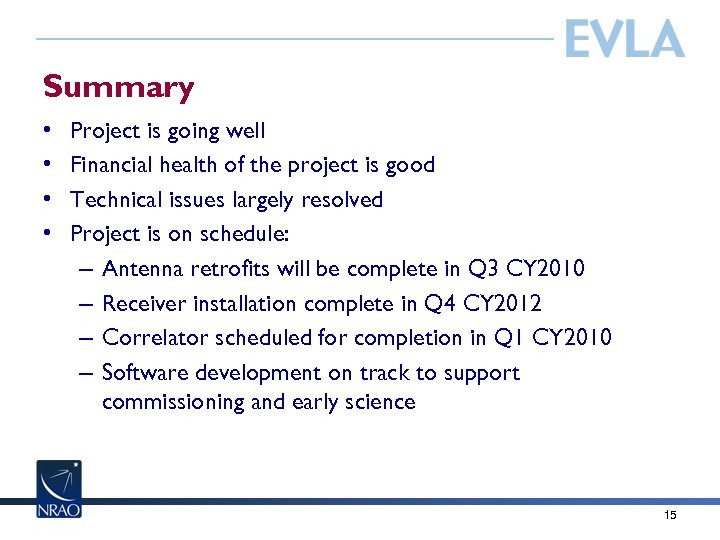 Summary • • Project is going well Financial health of the project is good Technical issues largely resolved Project is on schedule: – Antenna retrofits will be complete in Q 3 CY 2010 – Receiver installation complete in Q 4 CY 2012 – Correlator scheduled for completion in Q 1 CY 2010 – Software development on track to support commissioning and early science 15
 Will it work? 16
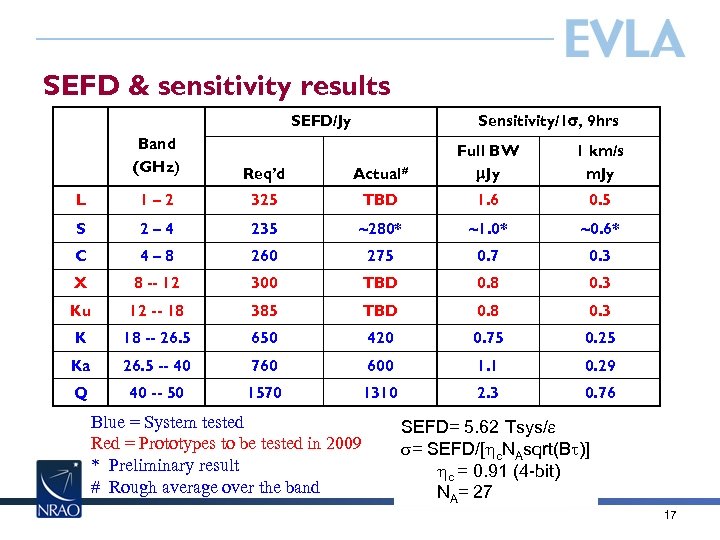 SEFD & sensitivity results SEFD/Jy Band (GHz) Req’d L 1– 2 S Sensitivity/1 , 9 hrs Actual# Full BW Jy 1 km/s m. Jy 325 TBD 1. 6 0. 5 2– 4 235 ~280* ~1. 0* ~0. 6* C 4– 8 260 275 0. 7 0. 3 X 8 -- 12 300 TBD 0. 8 0. 3 Ku 12 -- 18 385 TBD 0. 8 0. 3 K 18 -- 26. 5 650 420 0. 75 0. 25 Ka 26. 5 -- 40 760 600 1. 1 0. 29 Q 40 -- 50 1570 1310 2. 3 0. 76 Blue = System tested Red = Prototypes to be tested in 2009 * Preliminary result # Rough average over the band SEFD= 5. 62 Tsys/ = SEFD/[ c. NAsqrt(B )] c = 0. 91 (4 -bit) NA= 27 17
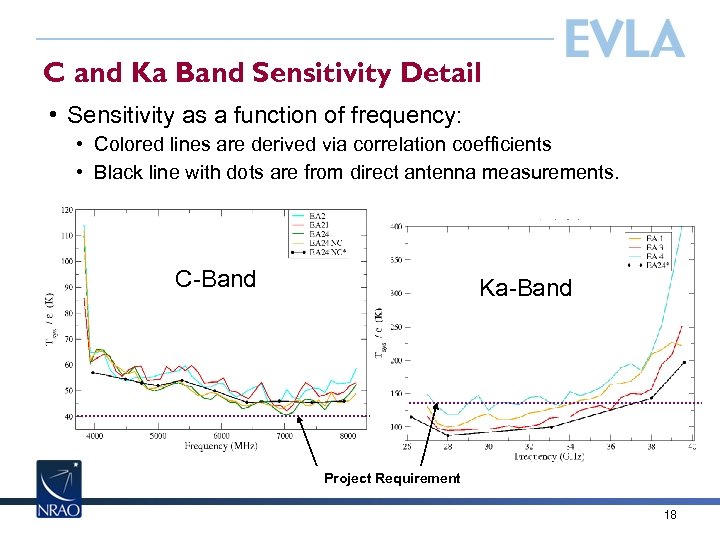 C and Ka Band Sensitivity Detail • Sensitivity as a function of frequency: • Colored lines are derived via correlation coefficients • Black line with dots are from direct antenna measurements. C-Band Ka-Band Project Requirement 18
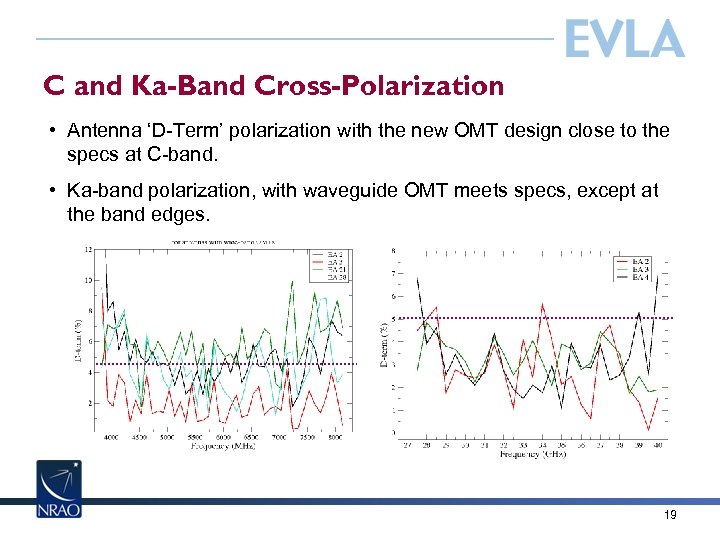 C and Ka-Band Cross-Polarization • Antenna ‘D-Term’ polarization with the new OMT design close to the specs at C-band. • Ka-band polarization, with waveguide OMT meets specs, except at the band edges. 19
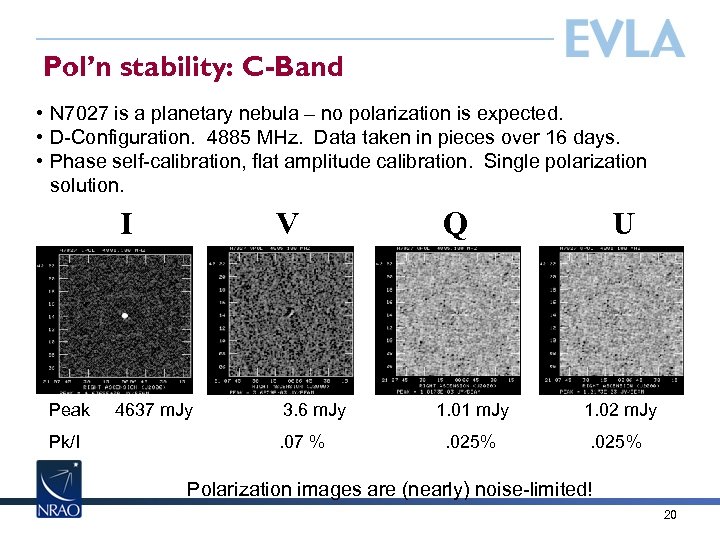 Pol’n stability: C-Band • N 7027 is a planetary nebula – no polarization is expected. • D-Configuration. 4885 MHz. Data taken in pieces over 16 days. • Phase self-calibration, flat amplitude calibration. Single polarization solution. I Peak Pk/I V 4637 m. Jy 3. 6 m. Jy. 07 % Q U 1. 01 m. Jy 1. 02 m. Jy . 025% Polarization images are (nearly) noise-limited! 20
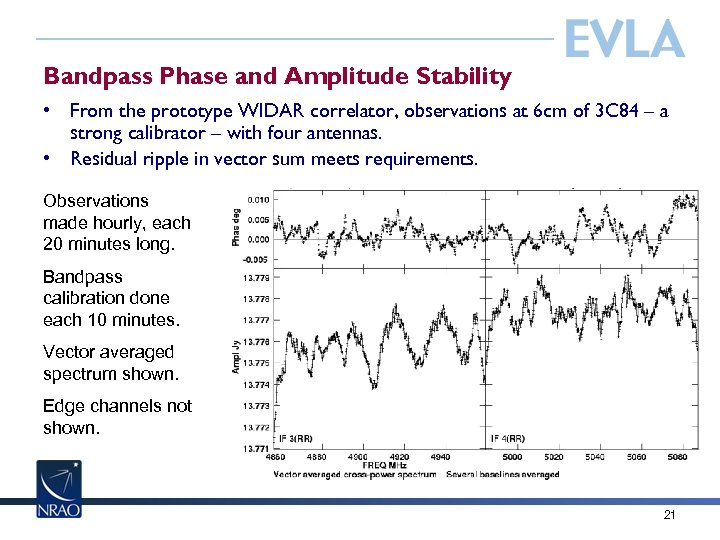 Bandpass Phase and Amplitude Stability • From the prototype WIDAR correlator, observations at 6 cm of 3 C 84 – a strong calibrator – with four antennas. • Residual ripple in vector sum meets requirements. Observations made hourly, each 20 minutes long. Bandpass calibration done each 10 minutes. Vector averaged spectrum shown. Edge channels not shown. 21
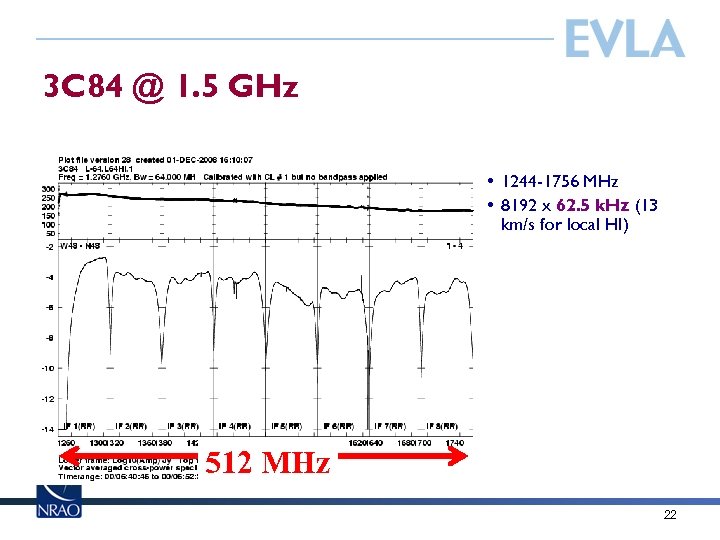 3 C 84 @ 1. 5 GHz • 1244 -1756 MHz • 8192 x 62. 5 k. Hz (13 km/s for local HI) 512 MHz 22
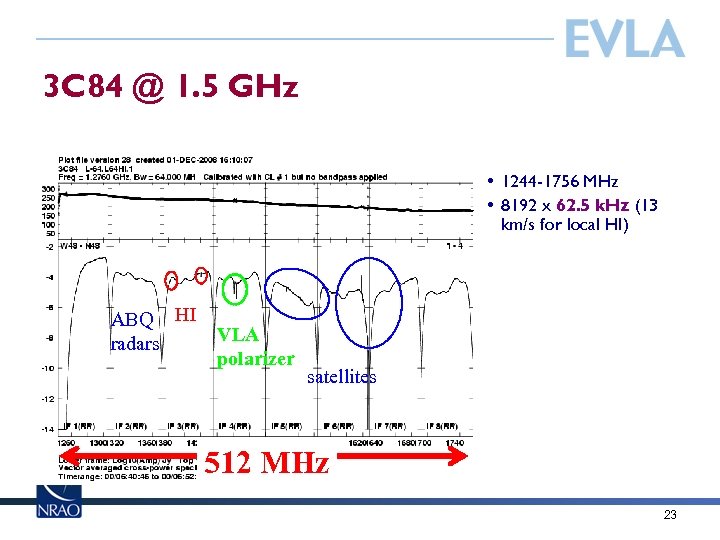 3 C 84 @ 1. 5 GHz • 1244 -1756 MHz • 8192 x 62. 5 k. Hz (13 km/s for local HI) ABQ HI radars VLA polarizer satellites 512 MHz 23
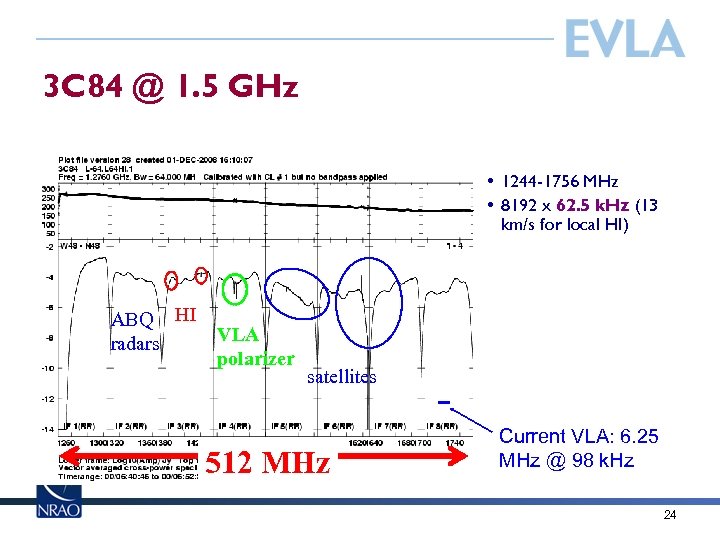 3 C 84 @ 1. 5 GHz • 1244 -1756 MHz • 8192 x 62. 5 k. Hz (13 km/s for local HI) ABQ HI radars VLA polarizer satellites 512 MHz Current VLA: 6. 25 MHz @ 98 k. Hz 24
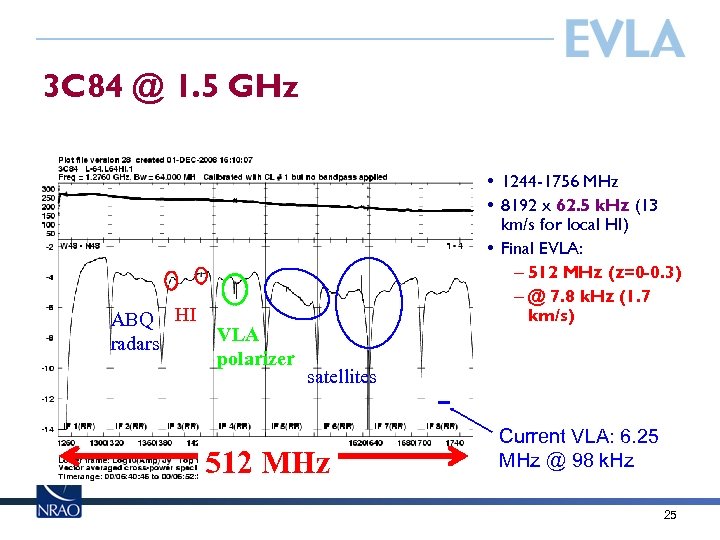 3 C 84 @ 1. 5 GHz ABQ HI radars VLA polarizer • 1244 -1756 MHz • 8192 x 62. 5 k. Hz (13 km/s for local HI) • Final EVLA: – 512 MHz (z=0 -0. 3) – @ 7. 8 k. Hz (1. 7 km/s) satellites 512 MHz Current VLA: 6. 25 MHz @ 98 k. Hz 25
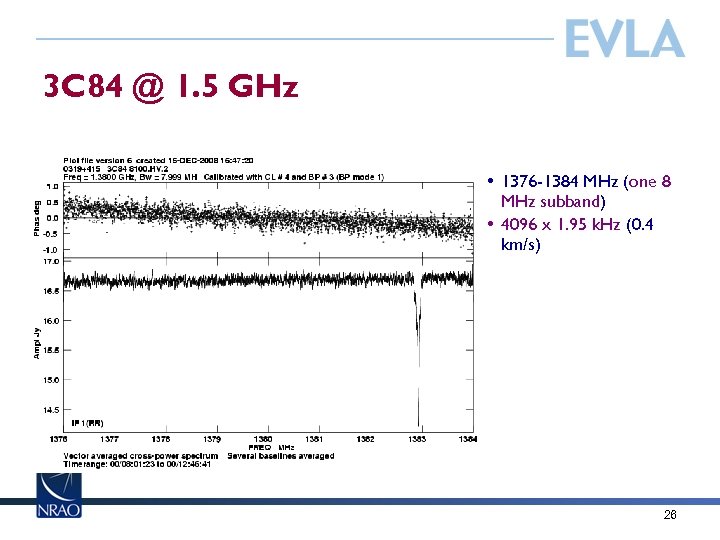 3 C 84 @ 1. 5 GHz • 1376 -1384 MHz (one 8 MHz subband) • 4096 x 1. 95 k. Hz (0. 4 km/s) 26
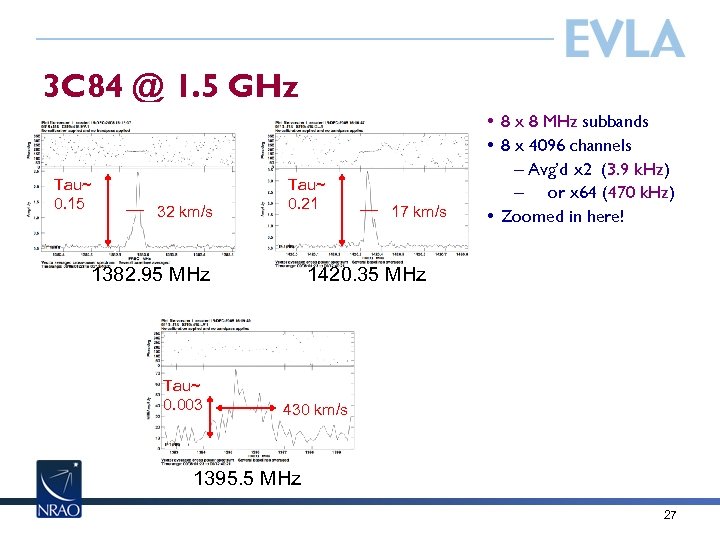 3 C 84 @ 1. 5 GHz Tau~ 0. 15 32 km/s Tau~ 0. 21 1382. 95 MHz Tau~ 0. 003 17 km/s • 8 x 8 MHz subbands • 8 x 4096 channels – Avg’d x 2 (3. 9 k. Hz) – or x 64 (470 k. Hz) • Zoomed in here! 1420. 35 MHz 430 km/s 1395. 5 MHz 27
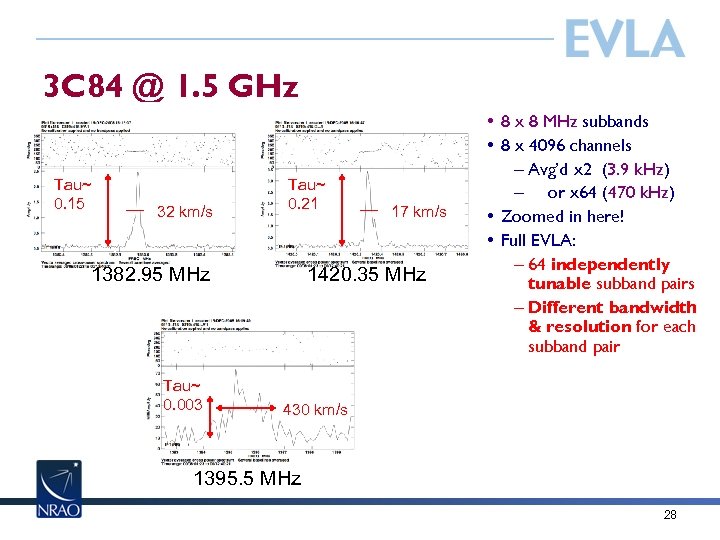 3 C 84 @ 1. 5 GHz Tau~ 0. 15 32 km/s Tau~ 0. 21 1382. 95 MHz Tau~ 0. 003 17 km/s 1420. 35 MHz • 8 x 8 MHz subbands • 8 x 4096 channels – Avg’d x 2 (3. 9 k. Hz) – or x 64 (470 k. Hz) • Zoomed in here! • Full EVLA: – 64 independently tunable subband pairs – Different bandwidth & resolution for each subband pair 430 km/s 1395. 5 MHz 28
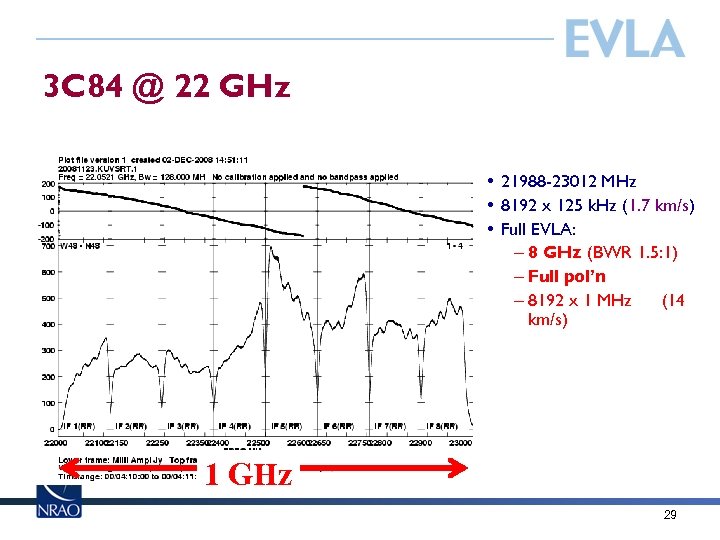 3 C 84 @ 22 GHz • 21988 -23012 MHz • 8192 x 125 k. Hz (1. 7 km/s) • Full EVLA: – 8 GHz (BWR 1. 5: 1) – Full pol’n – 8192 x 1 MHz (14 km/s) 1 GHz 29
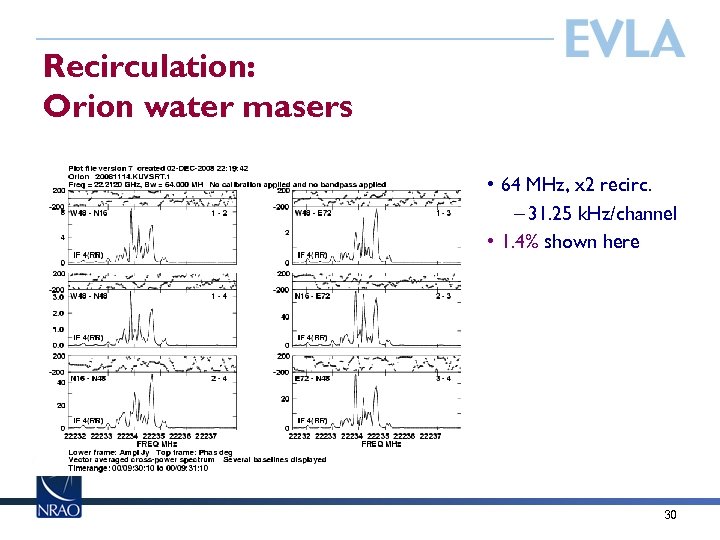 Recirculation: Orion water masers • 64 MHz, x 2 recirc. – 31. 25 k. Hz/channel • 1. 4% shown here 30
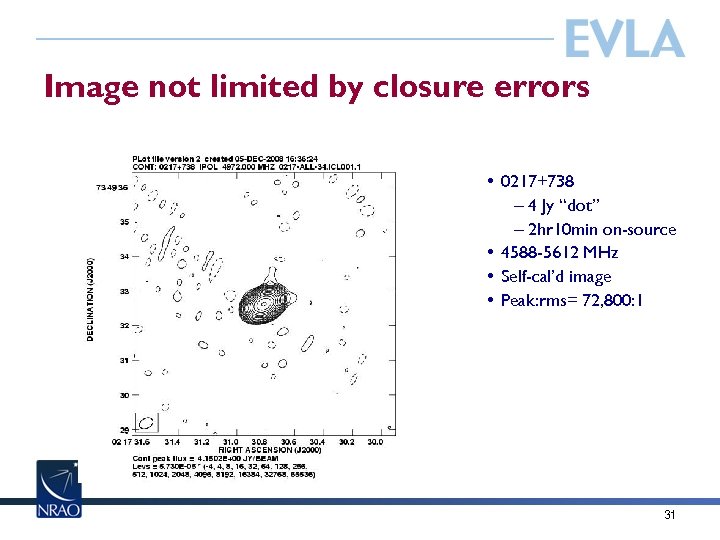 Image not limited by closure errors • 0217+738 – 4 Jy “dot” – 2 hr 10 min on-source • 4588 -5612 MHz • Self-cal’d image • Peak: rms= 72, 800: 1 31
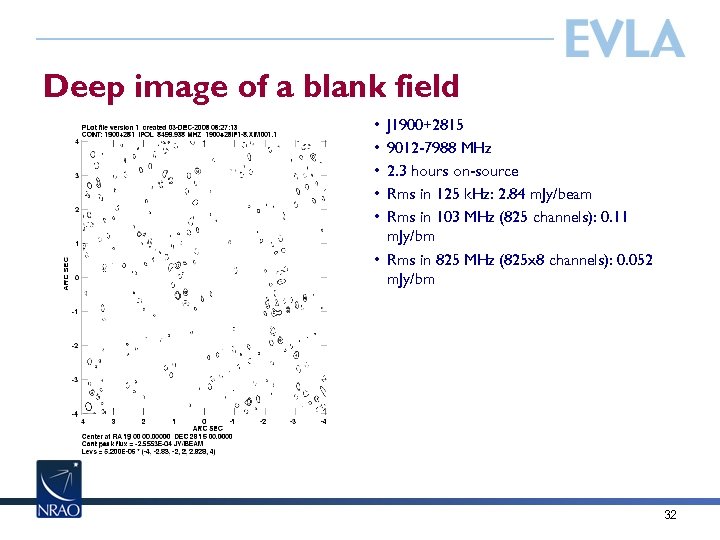 Deep image of a blank field • • • J 1900+2815 9012 -7988 MHz 2. 3 hours on-source Rms in 125 k. Hz: 2. 84 m. Jy/beam Rms in 103 MHz (825 channels): 0. 11 m. Jy/bm • Rms in 825 MHz (825 x 8 channels): 0. 052 m. Jy/bm 32
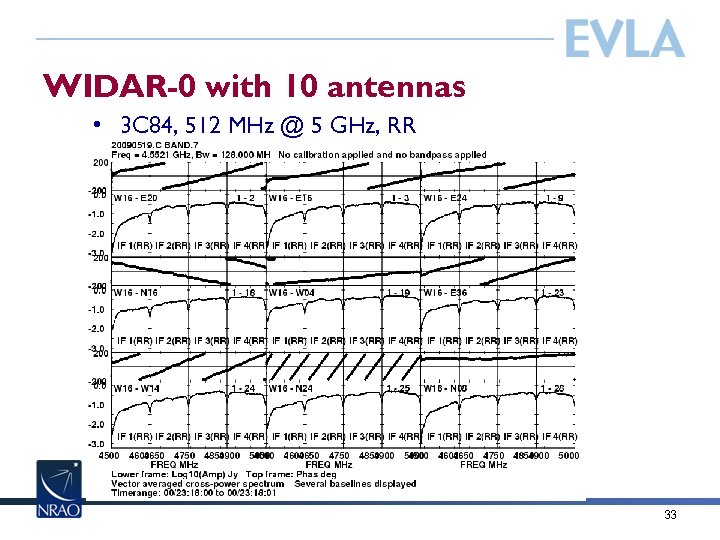 WIDAR-0 with 10 antennas • 3 C 84, 512 MHz @ 5 GHz, RR 33
 Using the EVLA: OSRO, RSRO, & you 34
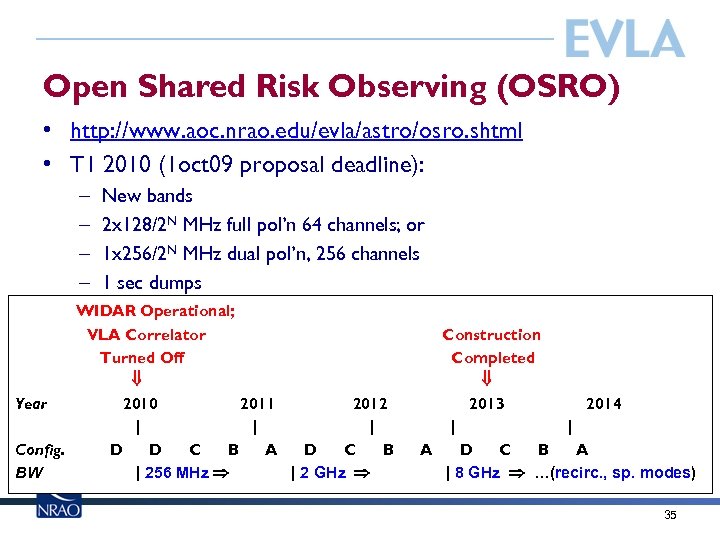 Open Shared Risk Observing (OSRO) • http: //www. aoc. nrao. edu/evla/astro/osro. shtml • T 1 2010 (1 oct 09 proposal deadline): – – New bands 2 x 128/2 N MHz full pol’n 64 channels; or 1 x 256/2 N MHz dual pol’n, 256 channels 1 sec dumps WIDAR Operational; VLA Correlator Turned Off Year 2010 2011 2012 | | | Config. D D C B A D C B BW | 256 MHz | 2 GHz Construction Completed 2013 2014 | | A D C B A | 8 GHz …(recirc. , sp. modes) 35
 Resident Shared Risk Observing (RSRO) • http: //www. aoc. nrao. edu/evla/astro/rsro. shtml • Experts in residence as temporary staff members in exchange for early access – up to 100 hrs/month – NRAO staff also have early access • Scientific, technical, & budgetary review • Regular proposal calls, starting 1 October 2009 • Rough schedule: – T 1 2010: 2 x 1 GHz total BW, 0. 1 sec dumps – T 2 2010: 2 x 8 GHz total BW – T 3 2010: Recirculation (lots more channels) – T 1 -T 2 2011: Increased flexibility in correlator resource allocation – T 3 2011 -: Special modes (pulsars, speed dumps, …) 36
 Tables & useful details 37
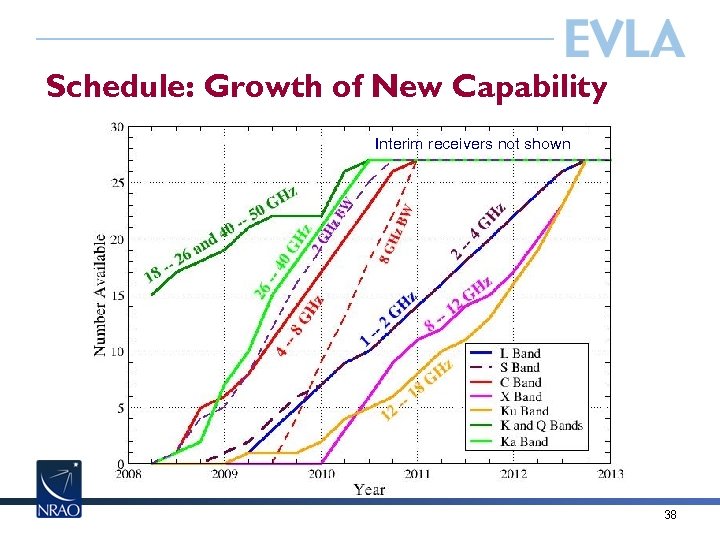 Schedule: Growth of New Capability Interim receivers not shown 38
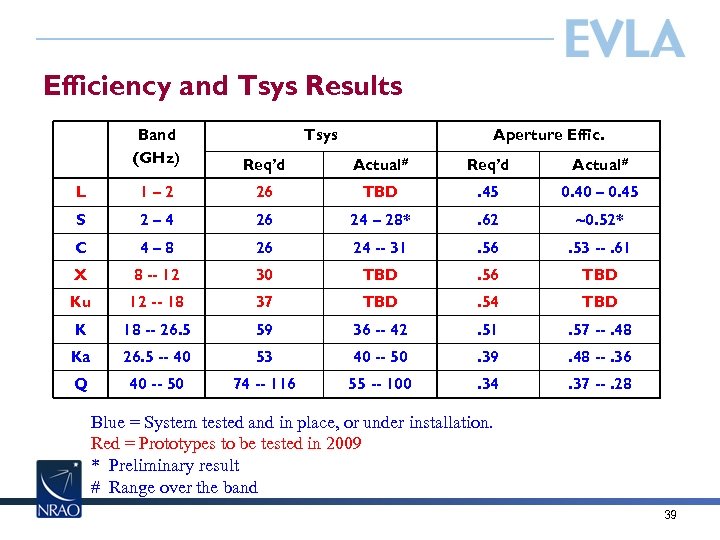 Efficiency and Tsys Results Band (GHz) Tsys Aperture Effic. Req’d Actual# L 1– 2 26 TBD . 45 0. 40 – 0. 45 S 2– 4 26 24 – 28* . 62 ~0. 52* C 4– 8 26 24 -- 31 . 56 . 53 --. 61 X 8 -- 12 30 TBD . 56 TBD Ku 12 -- 18 37 TBD . 54 TBD K 18 -- 26. 5 59 36 -- 42 . 51 . 57 --. 48 Ka 26. 5 -- 40 53 40 -- 50 . 39 . 48 --. 36 Q 40 -- 50 74 -- 116 55 -- 100 . 34 . 37 --. 28 Blue = System tested and in place, or under installation. Red = Prototypes to be tested in 2009 * Preliminary result # Range over the band 39
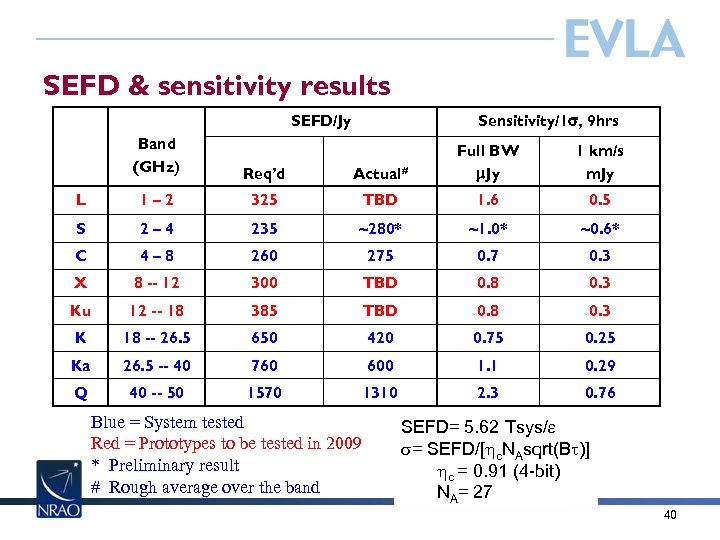 SEFD & sensitivity results SEFD/Jy Band (GHz) Req’d L 1– 2 S Sensitivity/1 , 9 hrs Actual# Full BW Jy 1 km/s m. Jy 325 TBD 1. 6 0. 5 2– 4 235 ~280* ~1. 0* ~0. 6* C 4– 8 260 275 0. 7 0. 3 X 8 -- 12 300 TBD 0. 8 0. 3 Ku 12 -- 18 385 TBD 0. 8 0. 3 K 18 -- 26. 5 650 420 0. 75 0. 25 Ka 26. 5 -- 40 760 600 1. 1 0. 29 Q 40 -- 50 1570 1310 2. 3 0. 76 Blue = System tested Red = Prototypes to be tested in 2009 * Preliminary result # Rough average over the band SEFD= 5. 62 Tsys/ = SEFD/[ c. NAsqrt(B )] c = 0. 91 (4 -bit) NA= 27 40
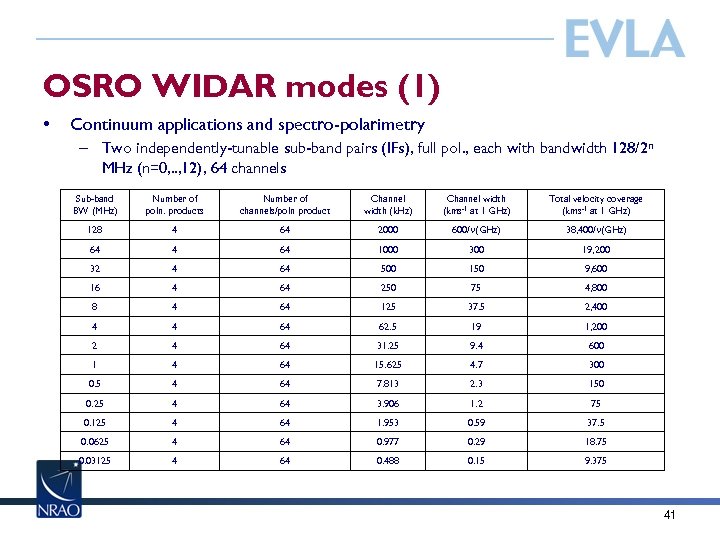 OSRO WIDAR modes (1) • Continuum applications and spectro-polarimetry – Two independently-tunable sub-band pairs (IFs), full pol. , each with bandwidth 128/2 n MHz (n=0, . . , 12), 64 channels Sub-band BW (MHz) Number of poln. products Number of channels/poln product Channel width (k. Hz) Channel width (kms-1 at 1 GHz) Total velocity coverage (kms-1 at 1 GHz) 128 4 64 2000 600/n(GHz) 38, 400/n(GHz) 64 4 64 1000 300 19, 200 32 4 64 500 150 9, 600 16 4 64 250 75 4, 800 8 4 64 125 37. 5 2, 400 4 4 64 62. 5 19 1, 200 2 4 64 31. 25 9. 4 600 1 4 64 15. 625 4. 7 300 0. 5 4 64 7. 813 2. 3 150 0. 25 4 64 3. 906 1. 2 75 0. 125 4 64 1. 953 0. 59 37. 5 0. 0625 4 64 0. 977 0. 29 18. 75 0. 03125 4 64 0. 488 0. 15 9. 375 41
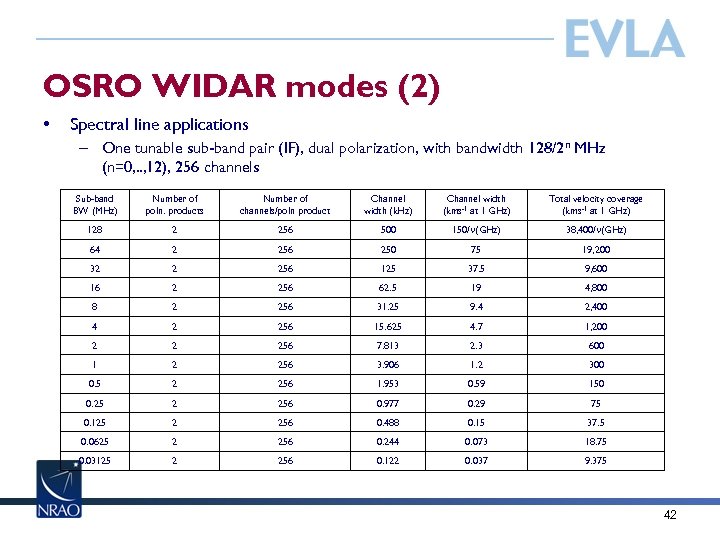 OSRO WIDAR modes (2) • Spectral line applications – One tunable sub-band pair (IF), dual polarization, with bandwidth 128/2 n MHz (n=0, . . , 12), 256 channels Sub-band BW (MHz) Number of poln. products Number of channels/poln product Channel width (k. Hz) Channel width (kms-1 at 1 GHz) Total velocity coverage (kms-1 at 1 GHz) 128 2 256 500 150/n(GHz) 38, 400/n(GHz) 64 2 256 250 75 19, 200 32 2 256 125 37. 5 9, 600 16 2 256 62. 5 19 4, 800 8 2 256 31. 25 9. 4 2, 400 4 2 256 15. 625 4. 7 1, 200 2 2 256 7. 813 2. 3 600 1 2 256 3. 906 1. 2 300 0. 5 2 256 1. 953 0. 59 150 0. 25 2 256 0. 977 0. 29 75 0. 125 2 256 0. 488 0. 15 37. 5 0. 0625 2 256 0. 244 0. 073 18. 75 0. 03125 2 256 0. 122 0. 037 9. 375 42
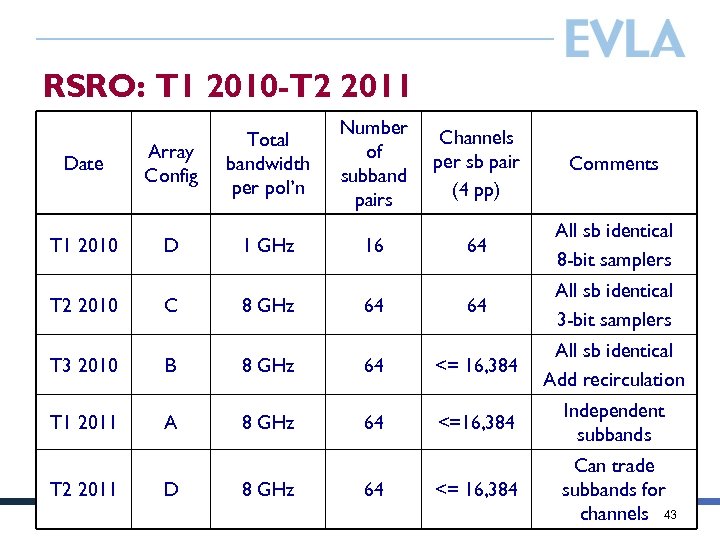 RSRO: T 1 2010 -T 2 2011 Number of subband pairs Channels per sb pair (4 pp) Comments Date Array Config Total bandwidth per pol’n T 1 2010 D 1 GHz 16 64 All sb identical 8 -bit samplers T 2 2010 C 8 GHz 64 64 All sb identical 3 -bit samplers T 3 2010 B 8 GHz 64 <= 16, 384 All sb identical Add recirculation T 1 2011 A 8 GHz 64 <=16, 384 Independent subbands <= 16, 384 Can trade subbands for channels 43 T 2 2011 D 8 GHz 64
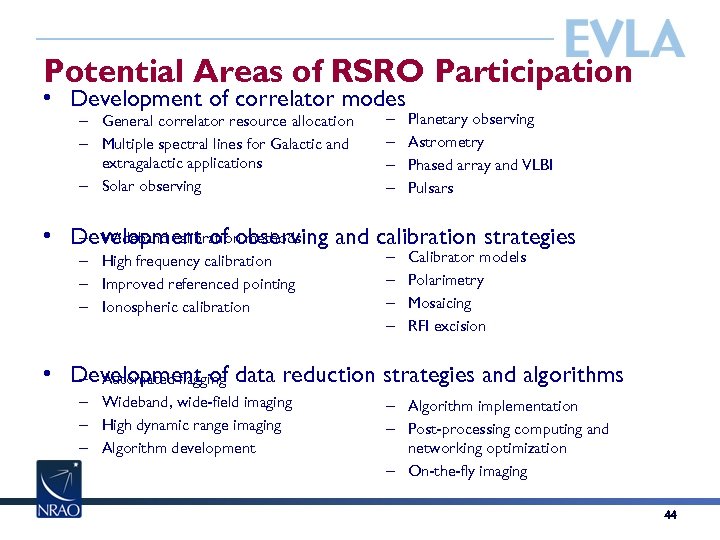 Potential Areas of RSRO Participation • Development of correlator modes – General correlator resource allocation – Multiple spectral lines for Galactic and extragalactic applications – Solar observing – – Planetary observing Astrometry Phased array and VLBI Pulsars – Wideband calibration methods • Development of observing and calibration strategies – High frequency calibration – Improved referenced pointing – Ionospheric calibration – – Calibrator models Polarimetry Mosaicing RFI excision • Development of data reduction strategies and algorithms – Automated flagging – Wideband, wide-field imaging – High dynamic range imaging – Algorithm development – Algorithm implementation – Post-processing computing and networking optimization – On-the-fly imaging 44 44
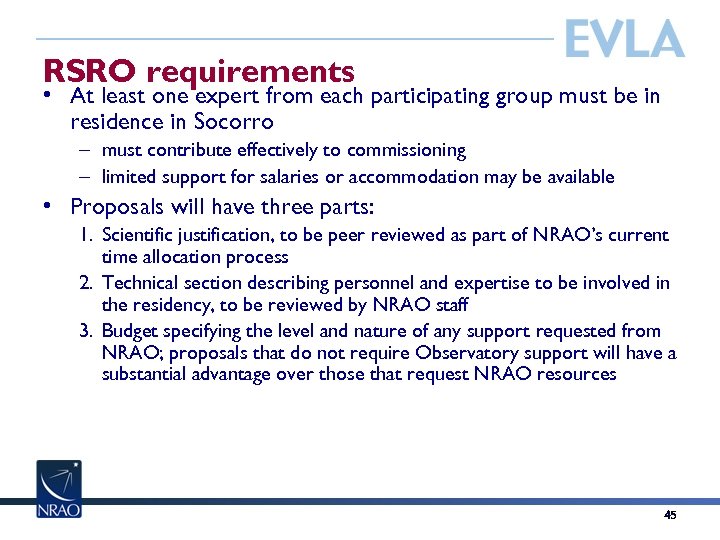 RSRO requirements • At least one expert from each participating group must be in residence in Socorro – must contribute effectively to commissioning – limited support for salaries or accommodation may be available • Proposals will have three parts: 1. Scientific justification, to be peer reviewed as part of NRAO’s current time allocation process 2. Technical section describing personnel and expertise to be involved in the residency, to be reviewed by NRAO staff 3. Budget specifying the level and nature of any support requested from NRAO; proposals that do not require Observatory support will have a substantial advantage over those that request NRAO resources 45 45
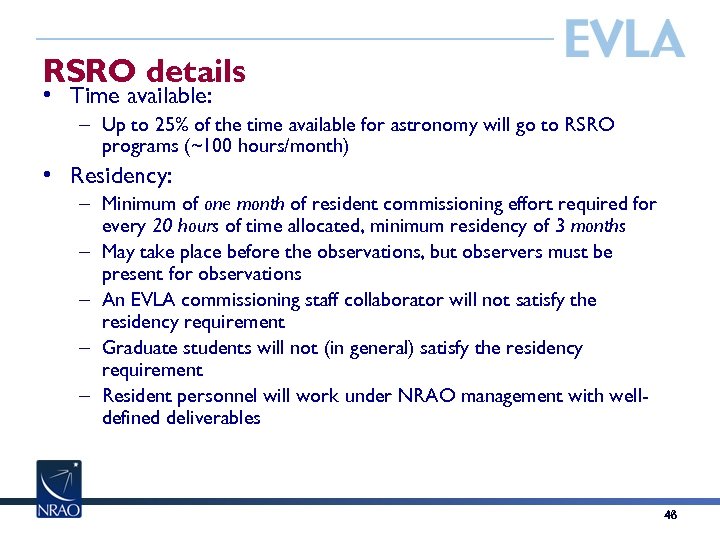 RSRO details • Time available: – Up to 25% of the time available for astronomy will go to RSRO programs (~100 hours/month) • Residency: – Minimum of one month of resident commissioning effort required for every 20 hours of time allocated, minimum residency of 3 months – May take place before the observations, but observers must be present for observations – An EVLA commissioning staff collaborator will not satisfy the residency requirement – Graduate students will not (in general) satisfy the residency requirement – Resident personnel will work under NRAO management with welldefined deliverables 46 46
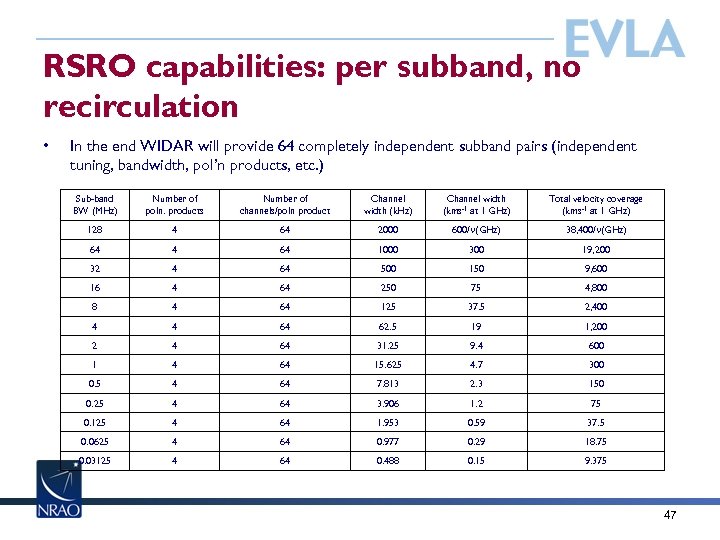 RSRO capabilities: per subband, no recirculation • In the end WIDAR will provide 64 completely independent subband pairs (independent tuning, bandwidth, pol’n products, etc. ) Sub-band BW (MHz) Number of poln. products Number of channels/poln product Channel width (k. Hz) Channel width (kms-1 at 1 GHz) Total velocity coverage (kms-1 at 1 GHz) 128 4 64 2000 600/n(GHz) 38, 400/n(GHz) 64 4 64 1000 300 19, 200 32 4 64 500 150 9, 600 16 4 64 250 75 4, 800 8 4 64 125 37. 5 2, 400 4 4 64 62. 5 19 1, 200 2 4 64 31. 25 9. 4 600 1 4 64 15. 625 4. 7 300 0. 5 4 64 7. 813 2. 3 150 0. 25 4 64 3. 906 1. 2 75 0. 125 4 64 1. 953 0. 59 37. 5 0. 0625 4 64 0. 977 0. 29 18. 75 0. 03125 4 64 0. 488 0. 15 9. 375 47
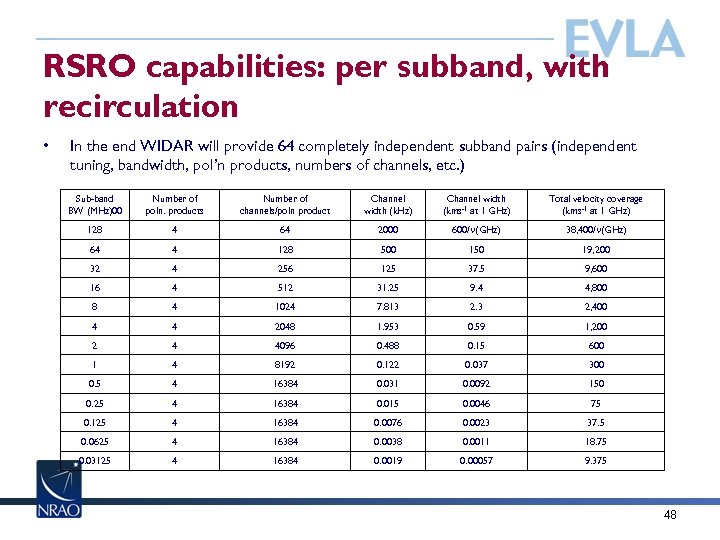 RSRO capabilities: per subband, with recirculation • In the end WIDAR will provide 64 completely independent subband pairs (independent tuning, bandwidth, pol’n products, numbers of channels, etc. ) Sub-band BW (MHz)00 Number of poln. products Number of channels/poln product Channel width (k. Hz) Channel width (kms-1 at 1 GHz) Total velocity coverage (kms-1 at 1 GHz) 128 4 64 2000 600/n(GHz) 38, 400/n(GHz) 64 4 128 500 150 19, 200 32 4 256 125 37. 5 9, 600 16 4 512 31. 25 9. 4 4, 800 8 4 1024 7. 813 2. 3 2, 400 4 4 2048 1. 953 0. 59 1, 200 2 4 4096 0. 488 0. 15 600 1 4 8192 0. 122 0. 037 300 0. 5 4 16384 0. 031 0. 0092 150 0. 25 4 16384 0. 015 0. 0046 75 0. 125 4 16384 0. 0076 0. 0023 37. 5 0. 0625 4 16384 0. 0038 0. 0011 18. 75 0. 03125 4 16384 0. 0019 0. 00057 9. 375 48
 Upcoming Proposal Deadlines • VLA correlator will be turned off at the end of the next D-configuration, January 2010 – see “EVLA Information for Astronomers” web page, at http: //www. aoc. nrao. edu/evla/astro/ • Configuration cycle will also reverse at this time, from A→B→C→D to D→C→B→A • June 1, 2009: proposal deadline for the last VLA D-configuration • October 1, 2009: proposal deadline for the first EVLA D-configuration • October 1, 2009: first call for RSRO proposals 49 49
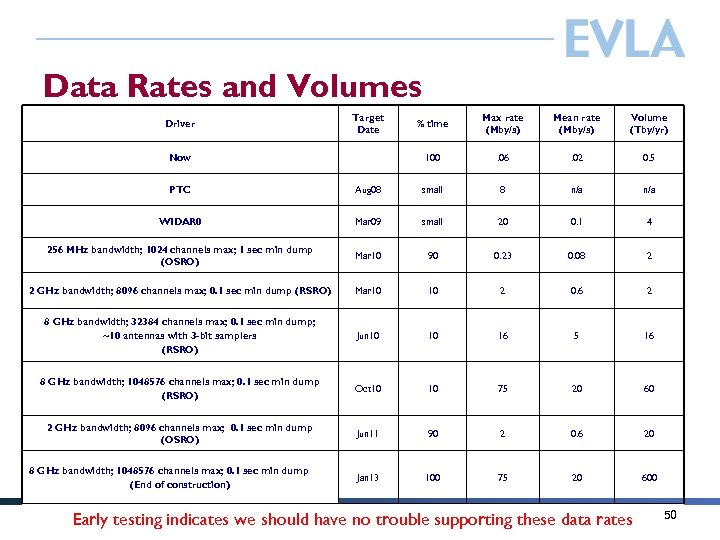 Data Rates and Volumes Driver Target Date Max rate (Mby/s) Mean rate (Mby/s) Volume (Tby/yr) 100 Now % time . 06 . 02 0. 5 PTC Aug 08 small 8 n/a WIDAR 0 Mar 09 small 20 0. 1 4 256 MHz bandwidth; 1024 channels max; 1 sec min dump (OSRO) Mar 10 90 0. 23 0. 08 2 2 GHz bandwidth; 8096 channels max; 0. 1 sec min dump (RSRO) Mar 10 10 2 0. 6 2 8 GHz bandwidth; 32384 channels max; 0. 1 sec min dump; ~10 antennas with 3 -bit samplers (RSRO) Jun 10 10 16 5 16 8 GHz bandwidth; 1048576 channels max; 0. 1 sec min dump (RSRO) Oct 10 10 75 20 60 2 GHz bandwidth; 8096 channels max; 0. 1 sec min dump (OSRO) Jun 11 90 2 0. 6 20 Jan 13 100 75 20 600 8 GHz bandwidth; 1048576 channels max; 0. 1 sec min dump (End of construction) Early testing indicates we should have no trouble supporting these data rates 50
 Backup slides 51
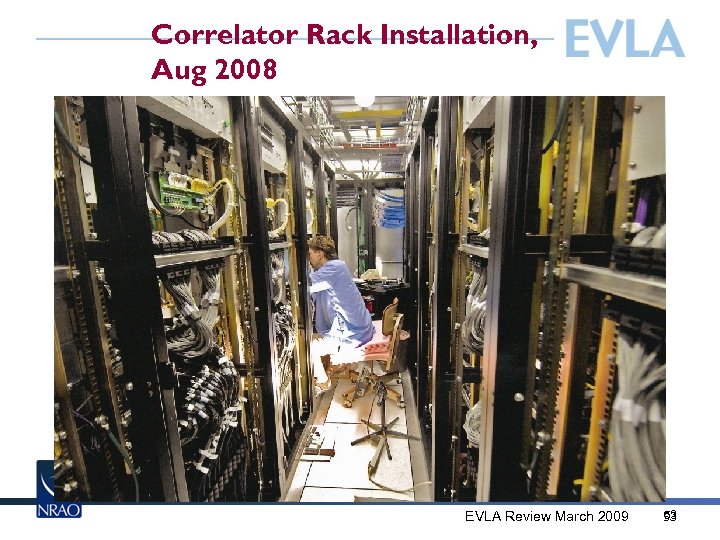 Correlator Rack Installation, Aug 2008 EVLA Review March 2009 53 53
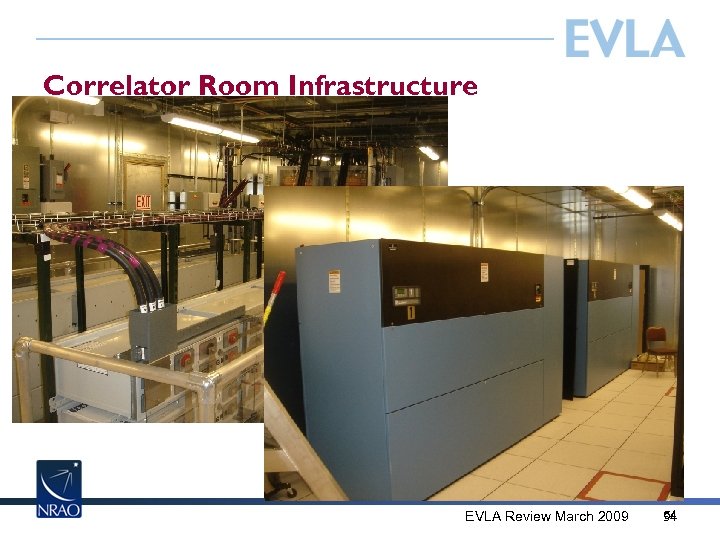 Correlator Room Infrastructure EVLA Review March 2009 54 54
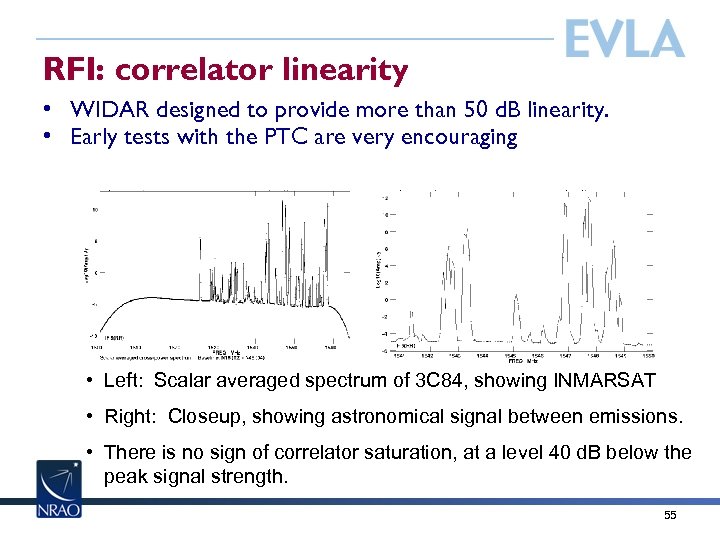 RFI: correlator linearity • WIDAR designed to provide more than 50 d. B linearity. • Early tests with the PTC are very encouraging • Left: Scalar averaged spectrum of 3 C 84, showing INMARSAT • Right: Closeup, showing astronomical signal between emissions. • There is no sign of correlator saturation, at a level 40 d. B below the peak signal strength. 55
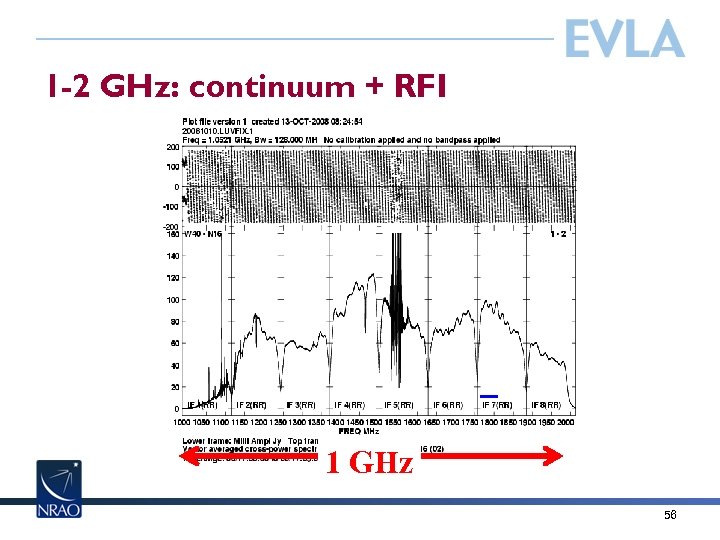 1 -2 GHz: continuum + RFI 1 GHz 56
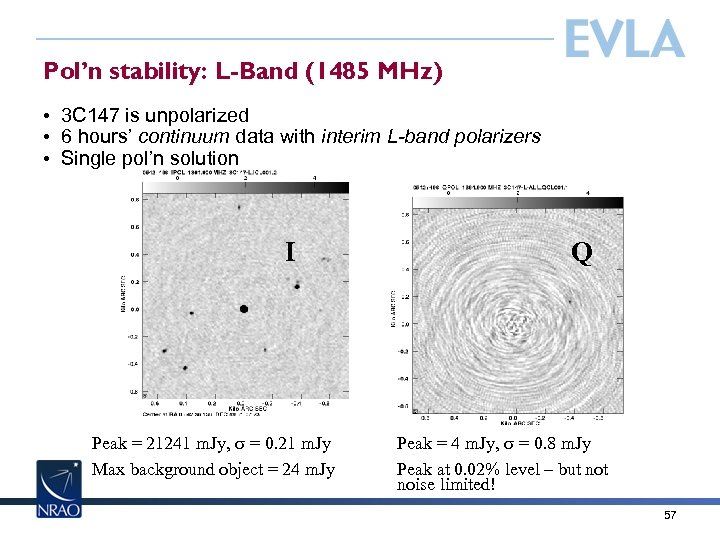 Pol’n stability: L-Band (1485 MHz) • 3 C 147 is unpolarized • 6 hours’ continuum data with interim L-band polarizers • Single pol’n solution I Peak = 21241 m. Jy, = 0. 21 m. Jy Max background object = 24 m. Jy Q Peak = 4 m. Jy, = 0. 8 m. Jy Peak at 0. 02% level – but noise limited! 57
 Cygnus A: MS-MFS Stokes I Spectral Index Rau, Owen, Cornwell, Eilek 58
 Cygnus A: MS-MFS Stokes I Spectral Index Carilli et al. 1991: VLA A+B+C+D, 1. 4+4. 8 GHz 1 arcsec resolution) Rau, Owen, Cornwell, Eilek 59