


 Скачать презентацию EVLA Software E 2 E Perspective Doug Tody
47398ece79f061fd702d37c229bb6bb9.ppt
- Количество слайдов: 14
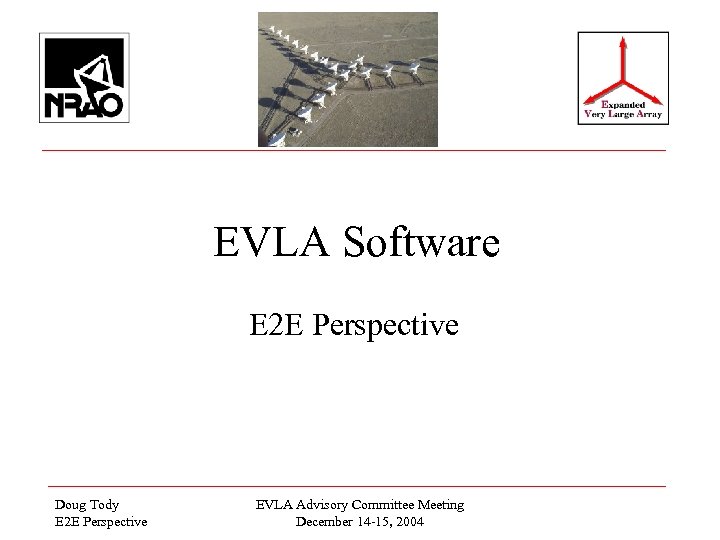 EVLA Software E 2 E Perspective Doug Tody E 2 E Perspective EVLA Advisory Committee Meeting December 14 -15, 2004
 Topics • What is E 2 E? – purpose – EVLA roadmap • EVLA Design Review • Next steps – Coordinated Development Strategy Gustaaf will cover later what EVLA E 2 E has actually done, and resource issues affecting what can be done Doug Tody E 2 E Perspective EVLA Advisory Committee Meeting December 14 -15, 2004
 What is E 2 E? • History – E 2 E oversight and architecture committee formed 1 year ago • Goals – Coordinate E 2 E efforts for all NRAO telescopes including ALMA – Optimize the impact of limited resources across the Observatory – Provide a modern end-to-end data-flow and data management system for all NRAO telescopes. – Provide the user community with a common look and feel for observing with all NRAO telescopes • Constraints – Delivering an operational telescope remains first priority – Schedule and budget Doug Tody E 2 E Perspective EVLA Advisory Committee Meeting December 14 -15, 2004
 EVLA E 2 E Roadmap • Develop common E 2 E system models – Observatory model, Project model, Observing model, Science Data model – Common system models required for consistent function and to enable software sharing – System modeling required for design in any case • Develop EVLA system design conformant to E 2 E models – Subject of initial E 2 E review • Identify common elements – Largely done – Issues of complexity and risk • Coordinated development strategy and plan • Subsystem design Doug Tody E 2 E Perspective EVLA Advisory Committee Meeting December 14 -15, 2004
 EVLA Design Review • Design sound "to the level that it has been worked out" – Much improved coordination with ALMA and E 2 E • Design mainly addresses control system and transition plan – – Expertise of EVLA team lies primarily in control system Transition plan looks good; EVLA unique in this respect Dataflow through data capture well specified Concern about communications infrastructure • E 2 E and post-processing largely not addressed yet – – Need to get "hooks" for post-processing into telescope system Concept of observing modes absent Uncertain support for project model (e. g. , observers intent) Online functionality, future scalability of archive unclear Doug Tody E 2 E Perspective EVLA Advisory Committee Meeting December 14 -15, 2004
 Coordinated Development Strategy • Primary focus of EVLA team should be on core telescope functionality – What is the minimal core system we have to deliver? • Anything required for basic telescope operations should be done directly by the EVLA team • Observe, produce quality raw observation data product for the archive • Enable if not achieve automated post-processing • Leverage ALMA for advanced capabilities – e. g. , observation planning and preparation, dynamic scheduling – Minimize risk • Most post-processing is common – Data capture, archive, pipeline, offline – ISD in Socorro responsible for most of this for both EVLA, ALMA Doug Tody E 2 E Perspective EVLA Advisory Committee Meeting December 14 -15, 2004
 Common Elements • Scope of E 2 E is all NRAO telescopes, but for EVLA our main concern is the overlap with ALMA • How much do ALMA and EVLA have in common? Doug Tody E 2 E Perspective EVLA Advisory Committee Meeting December 14 -15, 2004
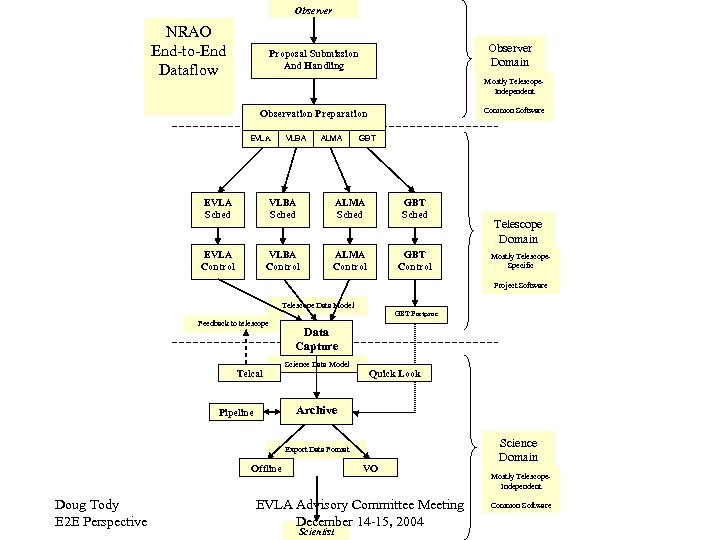 Observer NRAO End-to-End Dataflow Observer Domain Proposal Submission And Handling Mostly Telescope. Independent Common Software Observation Preparation EVLA VLBA ALMA GBT EVLA Sched VLBA Sched ALMA Sched GBT Sched EVLA Control VLBA Control ALMA Control GBT Control Telescope Domain Mostly Telescope. Specific Project Software Telescope Data Model GBT Postproc Feedback to telescope Telcal Data Capture Science Data Model Quick Look Archive Pipeline Export Data Format Offline Doug Tody E 2 E Perspective VO EVLA Advisory Committee Meeting December 14 -15, 2004 Scientist Science Domain Mostly Telescope. Independent Common Software
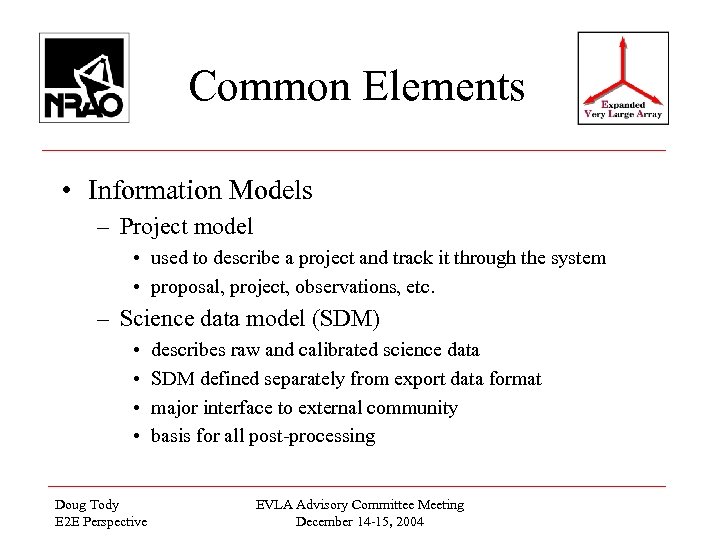 Common Elements • Information Models – Project model • used to describe a project and track it through the system • proposal, project, observations, etc. – Science data model (SDM) • • Doug Tody E 2 E Perspective describes raw and calibrated science data SDM defined separately from export data format major interface to external community basis for all post-processing EVLA Advisory Committee Meeting December 14 -15, 2004
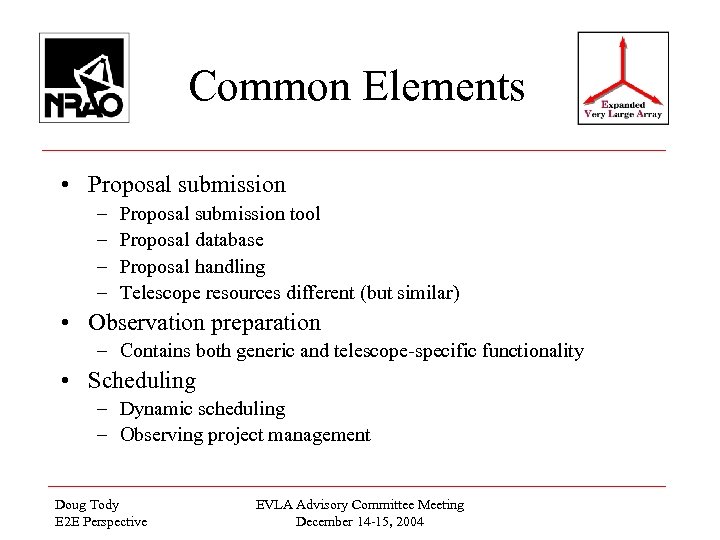 Common Elements • Proposal submission – – Proposal submission tool Proposal database Proposal handling Telescope resources different (but similar) • Observation preparation – Contains both generic and telescope-specific functionality • Scheduling – Dynamic scheduling – Observing project management Doug Tody E 2 E Perspective EVLA Advisory Committee Meeting December 14 -15, 2004
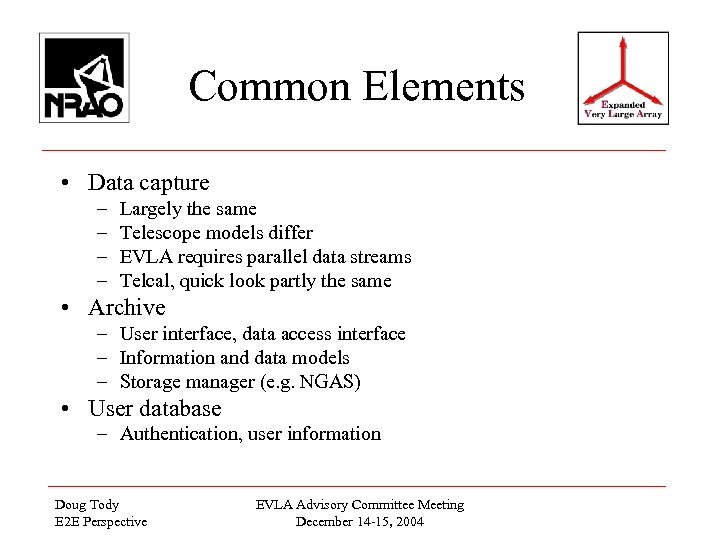 Common Elements • Data capture – – Largely the same Telescope models differ EVLA requires parallel data streams Telcal, quick look partly the same • Archive – User interface, data access interface – Information and data models – Storage manager (e. g. NGAS) • User database – Authentication, user information Doug Tody E 2 E Perspective EVLA Advisory Committee Meeting December 14 -15, 2004
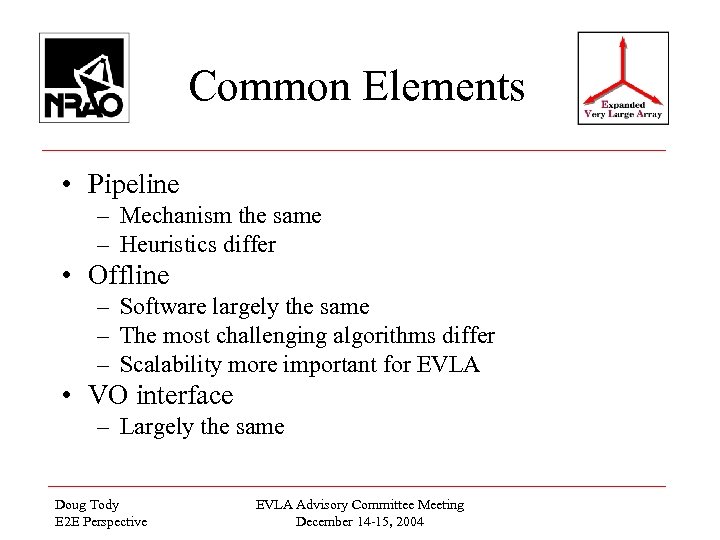 Common Elements • Pipeline – Mechanism the same – Heuristics differ • Offline – Software largely the same – The most challenging algorithms differ – Scalability more important for EVLA • VO interface – Largely the same Doug Tody E 2 E Perspective EVLA Advisory Committee Meeting December 14 -15, 2004
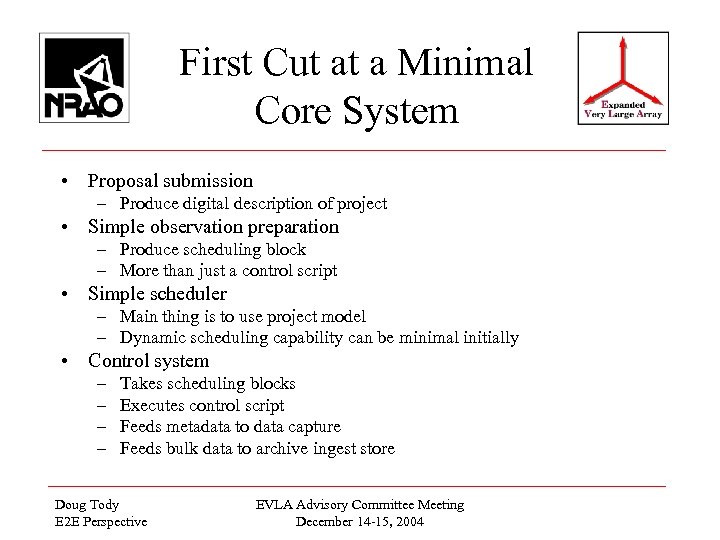 First Cut at a Minimal Core System • Proposal submission – Produce digital description of project • Simple observation preparation – Produce scheduling block – More than just a control script • Simple scheduler – Main thing is to use project model – Dynamic scheduling capability can be minimal initially • Control system – – Takes scheduling blocks Executes control script Feeds metadata to data capture Feeds bulk data to archive ingest store Doug Tody E 2 E Perspective EVLA Advisory Committee Meeting December 14 -15, 2004
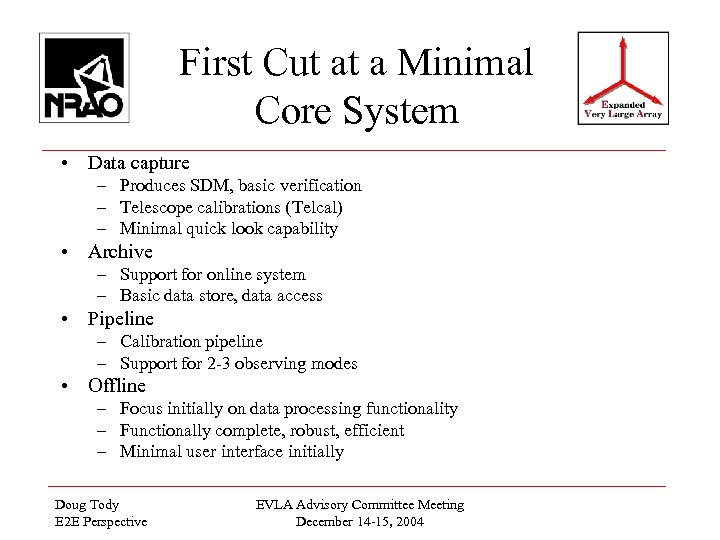 First Cut at a Minimal Core System • Data capture – Produces SDM, basic verification – Telescope calibrations (Telcal) – Minimal quick look capability • Archive – Support for online system – Basic data store, data access • Pipeline – Calibration pipeline – Support for 2 -3 observing modes • Offline – Focus initially on data processing functionality – Functionally complete, robust, efficient – Minimal user interface initially Doug Tody E 2 E Perspective EVLA Advisory Committee Meeting December 14 -15, 2004