 Скачать презентацию Evidence from Content LBSC 796 INFM 718 R Session
9da204b75678e8909e63aad02a70aae5.ppt
- Количество слайдов: 88



Evidence from Content LBSC 796/INFM 718 R Session 2 September 17, 2007
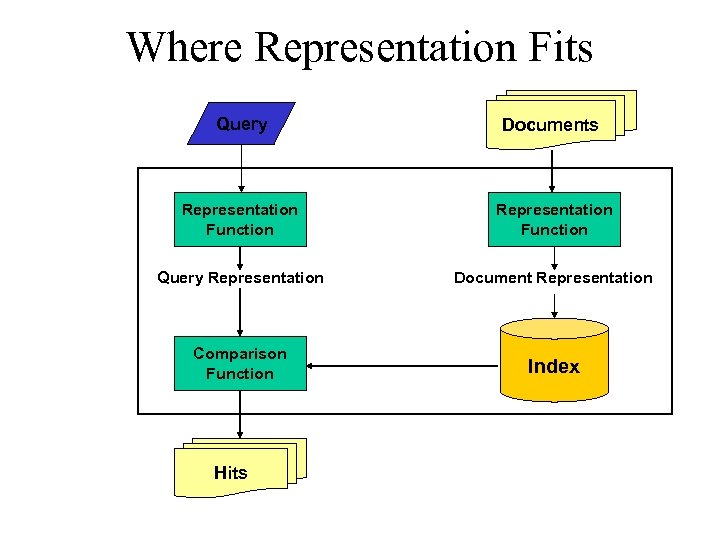
Where Representation Fits Query Documents Representation Function Query Representation Document Representation Comparison Function Index Hits
Agenda Ø Character sets • Terms as units of meaning • Building an index • Project overview
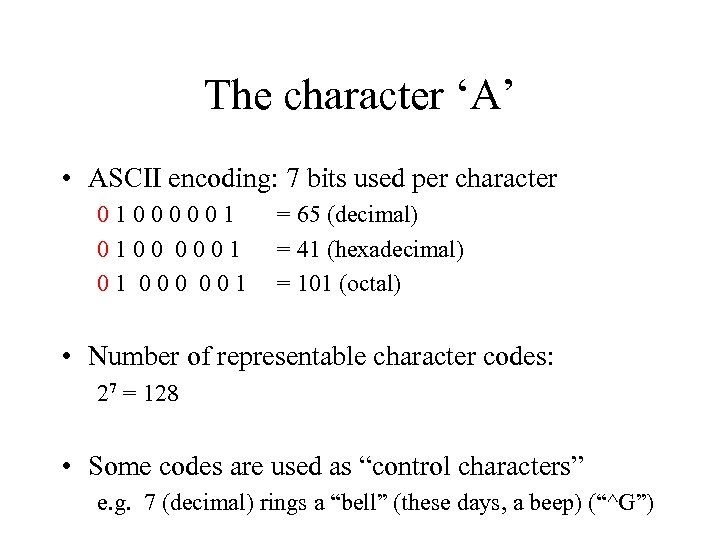
The character ‘A’ • ASCII encoding: 7 bits used per character 01000001 0100 0001 01 000 001 = 65 (decimal) = 41 (hexadecimal) = 101 (octal) • Number of representable character codes: 27 = 128 • Some codes are used as “control characters” e. g. 7 (decimal) rings a “bell” (these days, a beep) (“^G”)
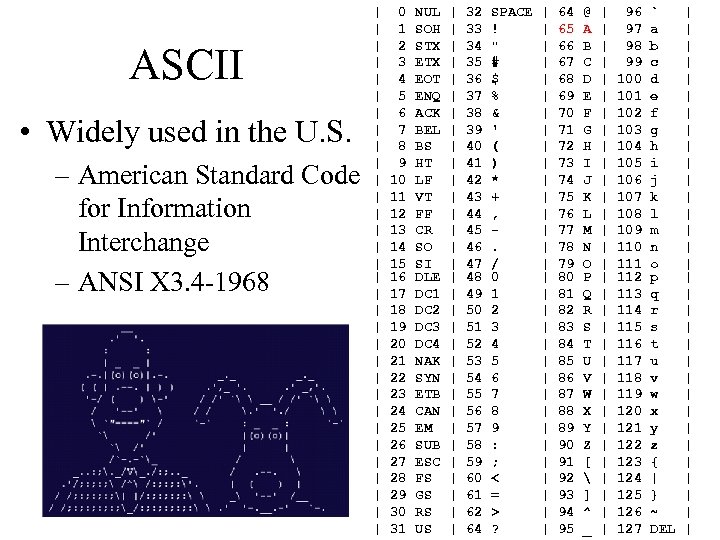
ASCII • Widely used in the U. S. – American Standard Code for Information Interchange – ANSI X 3. 4 -1968 | | | | | | | | 0 1 2 3 4 5 6 7 8 9 10 11 12 13 14 15 16 17 18 19 20 21 22 23 24 25 26 27 28 29 30 31 NUL SOH STX EOT ENQ ACK BEL BS HT LF VT FF CR SO SI DLE DC 1 DC 2 DC 3 DC 4 NAK SYN ETB CAN EM SUB ESC FS GS RS US | | | | | | | | 32 33 34 35 36 37 38 39 40 41 42 43 44 45 46 47 48 49 50 51 52 53 54 55 56 57 58 59 60 61 62 64 SPACE ! " # $ % & ' ( ) * + , . / 0 1 2 3 4 5 6 7 8 9 : ; < = > ? | | | | | | | | 64 65 66 67 68 69 70 71 72 73 74 75 76 77 78 79 80 81 82 83 84 85 86 87 88 89 90 91 92 93 94 95 @ A B C D E F G H I J K L M N O P Q R S T U V W X Y Z [ ] ^ _ | | | | | | | | 96 97 98 99 100 101 102 103 104 105 106 107 108 109 110 111 112 113 114 115 116 117 118 119 120 121 122 123 124 125 126 127 ` a b c d e f g h i j k l m n o p q r s t u v w x y z { | } ~ DEL | | | | | | | |
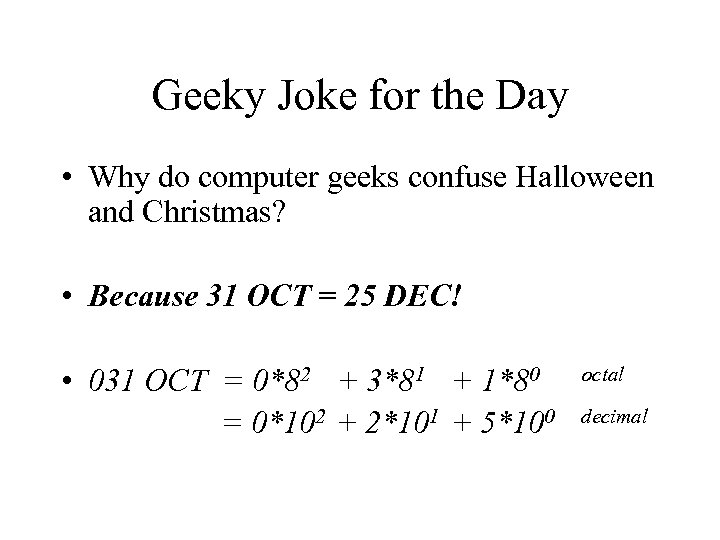
Geeky Joke for the Day • Why do computer geeks confuse Halloween and Christmas? • Because 31 OCT = 25 DEC! • 031 OCT = 0*82 + 3*81 + 1*80 = 0*102 + 2*101 + 5*100 octal decimal
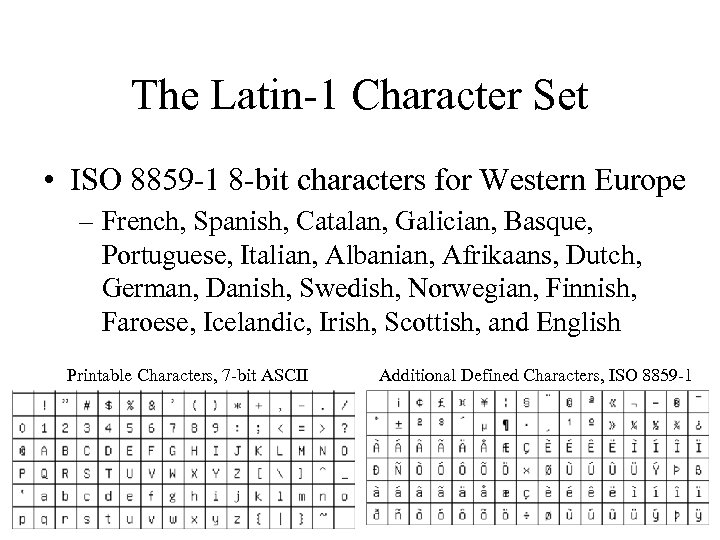
The Latin-1 Character Set • ISO 8859 -1 8 -bit characters for Western Europe – French, Spanish, Catalan, Galician, Basque, Portuguese, Italian, Albanian, Afrikaans, Dutch, German, Danish, Swedish, Norwegian, Finnish, Faroese, Icelandic, Irish, Scottish, and English Printable Characters, 7 -bit ASCII Additional Defined Characters, ISO 8859 -1
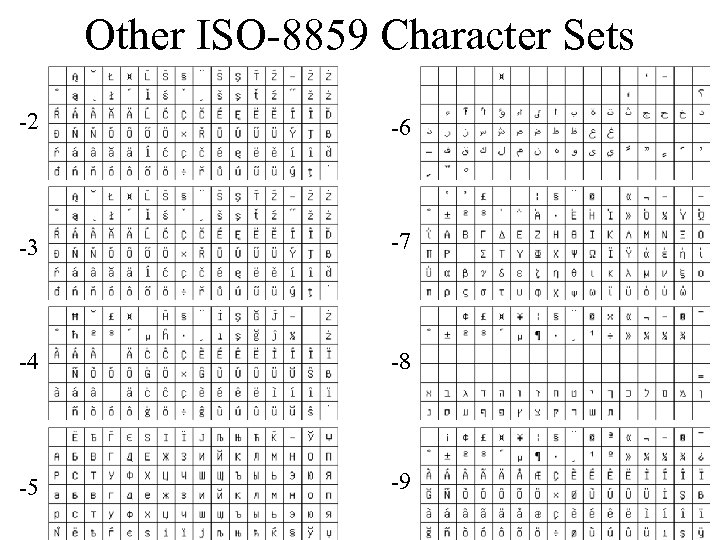
Other ISO-8859 Character Sets -2 -6 -3 -7 -4 -8 -5 -9
East Asian Character Sets • More than 256 characters are needed – Two-byte encoding schemes (e. g. , EUC) are used • Several countries have unique character sets – GB in Peoples Republic of China, BIG 5 in Taiwan, JIS in Japan, KS in Korea, TCVN in Vietnam • Many characters appear in several languages – Research Libraries Group developed EACC • Unified “CJK” character set for USMARC records
Unicode • Single code for all the world’s characters – ISO Standard 10646 • Separates “code space” from “encoding” – Code space extends Latin-1 • The first 256 positions are identical – UTF-7 encoding will pass through email • Uses only the 64 printable ASCII characters – UTF-8 encoding is designed for disk file systems
Limitations of Unicode • Produces larger files than Latin-1 • Fonts may be hard to obtain for some characters • Some characters have multiple representations – e. g. , accents can be part of a character or separate • Some characters look identical when printed – But they come from unrelated languages • Encoding does not define the “sort order”
Drawing it Together • Key concepts – Character, Encoding, Font, Sort order • Discussion question – How do you know what character set a document is written in? – What if a mixture of character sets was used?
Agenda • Character sets Ø Terms as units of meaning • Building an index • Project overview
Strings and Segments • Retrieval is (often) a search for concepts – But what we actually search are character strings • What strings best represent concepts? – In English, words are often a good choice • Well-chosen phrases might also be helpful – In German, compounds may need to be split • Otherwise queries using constituent words would fail – In Chinese, word boundaries are not marked • Thissegmentationproblemissimilartothatofspeech
Tokenization • Words (from linguistics): – Morphemes are the units of meaning – Combined to make words • Anti (disestablishmentarian) ism • Tokens (from Computer Science) – Doug ’s running late !
Morphology • Inflectional morphology – Preserves part of speech – Destructions = Destruction+PLURAL – Destroyed = Destroy+PAST • Derivational morphology – Relates parts of speech – Destructor = AGENTIVE(destroy)
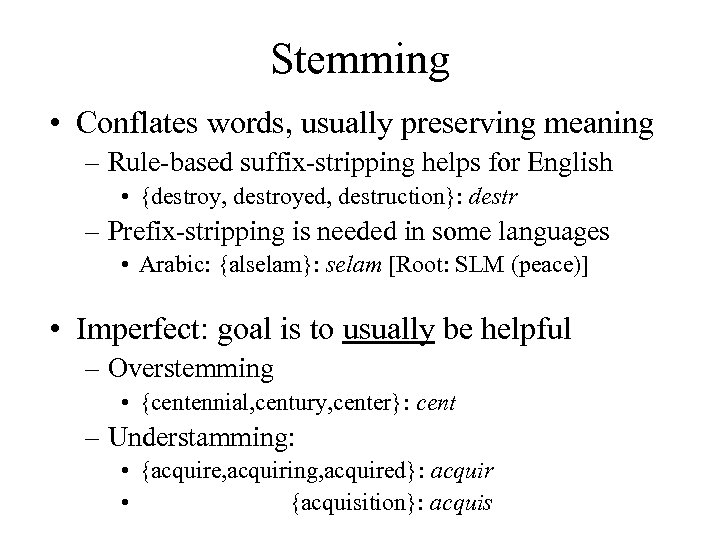
Stemming • Conflates words, usually preserving meaning – Rule-based suffix-stripping helps for English • {destroy, destroyed, destruction}: destr – Prefix-stripping is needed in some languages • Arabic: {alselam}: selam [Root: SLM (peace)] • Imperfect: goal is to usually be helpful – Overstemming • {centennial, century, center}: cent – Understamming: • {acquire, acquiring, acquired}: acquir • {acquisition}: acquis
Longest Substring Segmentation • Greedy algorithm based on a lexicon • Start with a list of every possible term • For each unsegmented string – Remove the longest single substring in the list – Repeat until no substrings are found in the list • Can be extended to explore alternatives
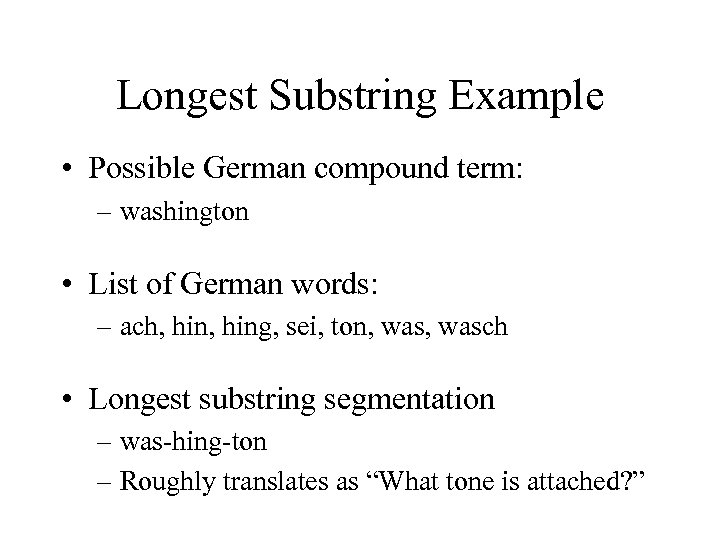
Longest Substring Example • Possible German compound term: – washington • List of German words: – ach, hing, sei, ton, wasch • Longest substring segmentation – was-hing-ton – Roughly translates as “What tone is attached? ”
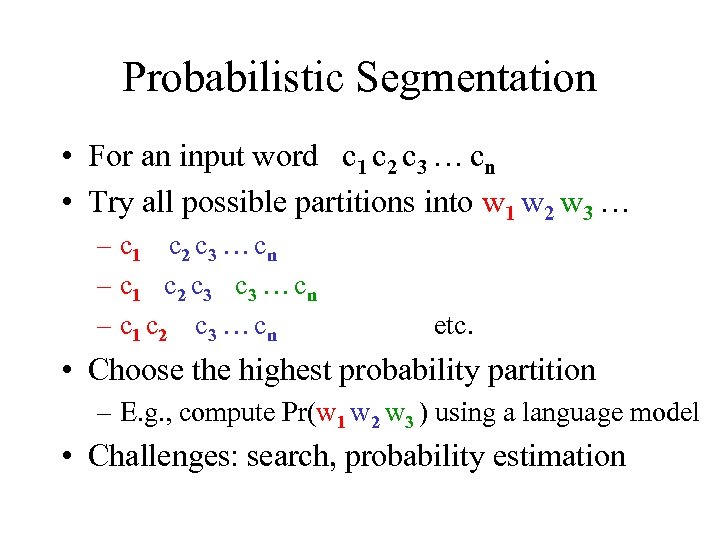
Probabilistic Segmentation • For an input word c 1 c 2 c 3 … cn • Try all possible partitions into w 1 w 2 w 3 … – c 1 c 2 c 3 … cn etc. • Choose the highest probability partition – E. g. , compute Pr(w 1 w 2 w 3 ) using a language model • Challenges: search, probability estimation
Non-Segmentation: N-gram Indexing • Consider a Chinese document c 1 c 2 c 3 … cn • Don’t segment (you could be wrong!) • Instead, treat every character bigram as a term c 1 c 2 , c 2 c 3 , c 3 c 4 , … , cn-1 cn • Break up queries the same way
Relating Words and Concepts • Homonymy: bank (river) vs. bank (financial) – Different words are written the same way – We’d like to work with word senses rather than words • Polysemy: fly (pilot) vs. fly (passenger) – A word can have different “shades of meaning” – Not bad for IR: often helps more than it hurts • Synonymy: class vs. course – Causes search failures … well address this next week!
Word Sense Disambiguation • Context provides clues to word meaning – “The doctor removed the appendix. ” • For each occurrence, note surrounding words – e. g. , +/- 5 non-stopwords • Group similar contexts into clusters – Based on overlaps in the words that they contain • Separate clusters represent different senses
Disambiguation Example • Consider four example sentences – The doctor removed the appendix – The appendix was incomprehensible – The doctor examined the appendix – The appendix was removed • What clues can you find from nearby words? – Can you find enough word senses this way? – Might you find too many word senses? – What will you do when you aren’t sure?
Why Disambiguation Hurts • Disambiguation tries to reduce incorrect matches – But errors can also reduce correct matches • Ranked retrieval techniques already disambiguate – When more query terms are present, documents rank higher – Essentially, queries give each term a context
Phrases • Phrases can yield more precise queries – “University of Maryland”, “solar eclipse” • Automated phrase detection can be harmful – Infelicitous choices result in missed matches – Therefore, never index only phrases • Better to index phrases and their constituent words – IR systems are good at evidence combination • Better evidence combination less help from phrases • Parsing is still relatively slow and brittle – But Powerset is now trying to parse the entire Web
Lexical Phrases • Same idea as longest substring match – But look for word (not character) sequences • Compile a term list that includes phrases – Technical terminology can be very helpful • Index any phrase that occurs in the list • Most effective in a limited domain – Otherwise hard to capture most useful phrases
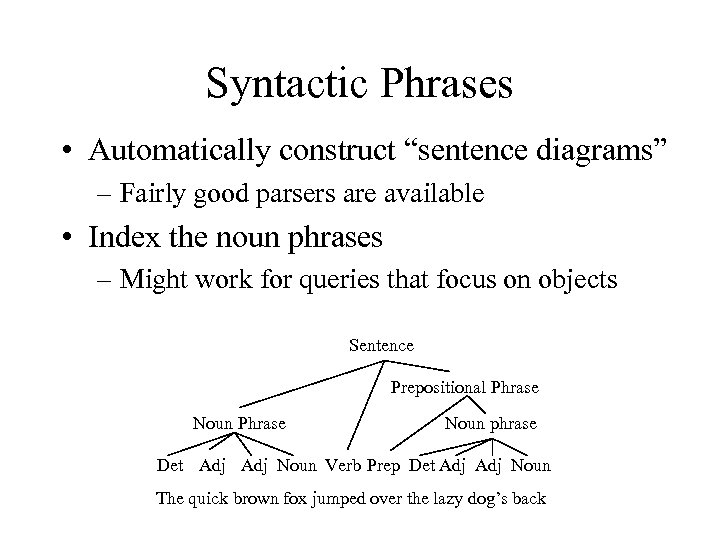
Syntactic Phrases • Automatically construct “sentence diagrams” – Fairly good parsers are available • Index the noun phrases – Might work for queries that focus on objects Sentence Prepositional Phrase Noun phrase Det Adj Noun Verb Prep Det Adj Noun The quick brown fox jumped over the lazy dog’s back
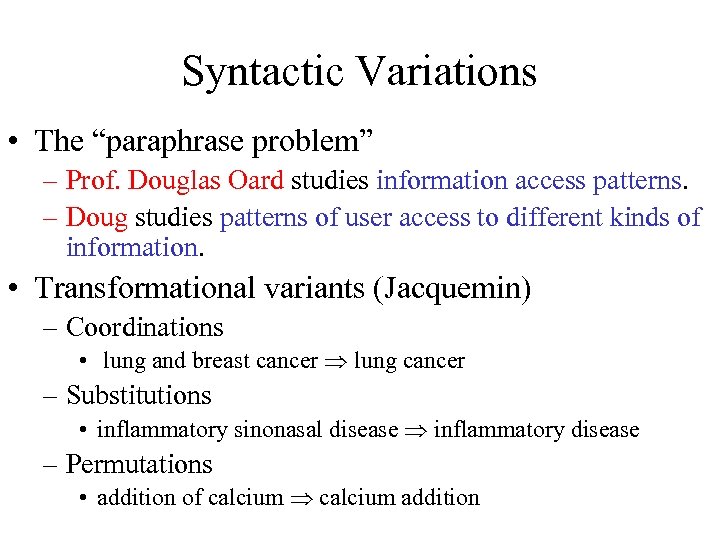
Syntactic Variations • The “paraphrase problem” – Prof. Douglas Oard studies information access patterns. – Doug studies patterns of user access to different kinds of information. • Transformational variants (Jacquemin) – Coordinations • lung and breast cancer lung cancer – Substitutions • inflammatory sinonasal disease inflammatory disease – Permutations • addition of calcium addition
“Named Entity” Tagging • Automatically assign “types” to words or phrases – Person, organization, location, date, money, … • More rapid and robust than parsing • Best algorithms use “supervised learning” – Annotate a corpus identifying entities and types – Train a probabilistic model – Apply the model to new text
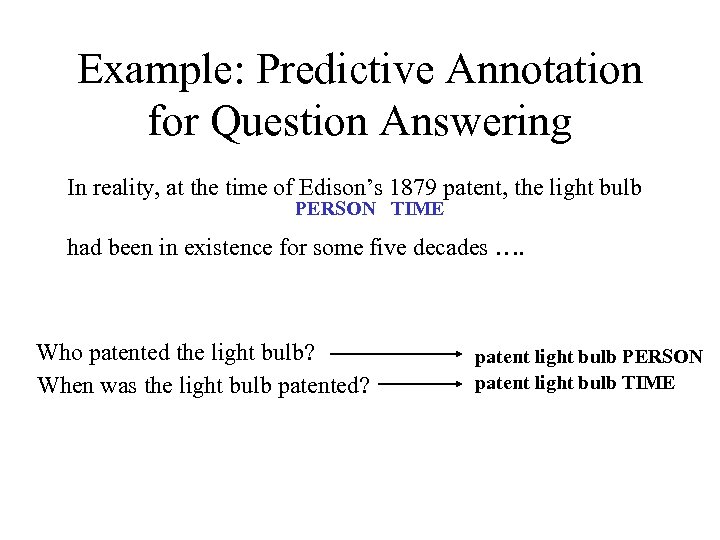
Example: Predictive Annotation for Question Answering In reality, at the time of Edison’s 1879 patent, the light bulb PERSON TIME had been in existence for some five decades …. Who patented the light bulb? When was the light bulb patented? patent light bulb PERSON patent light bulb TIME
A “Term” is Whatever You Index • • • Word sense Token Word Stem Character n-gram Phrase
Summary • The key is to index the right kind of terms • Start by finding fundamental features – So far all we have talked about are character codes – Same ideas apply to handwriting, OCR, and speech • Combine them into easily recognized units – Words where possible, character n-grams otherwise • Apply further processing to optimize the system – Stemming is the most commonly used technique – Some “good ideas” don’t pan out that way
Agenda • Character sets • Terms as units of meaning Ø Building an index • Project overview
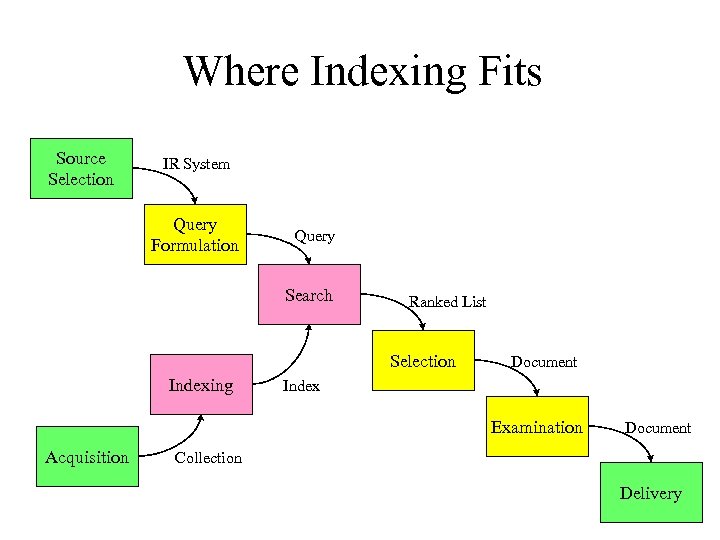
Where Indexing Fits Source Selection IR System Query Formulation Query Search Ranked List Selection Indexing Document Index Examination Acquisition Document Collection Delivery
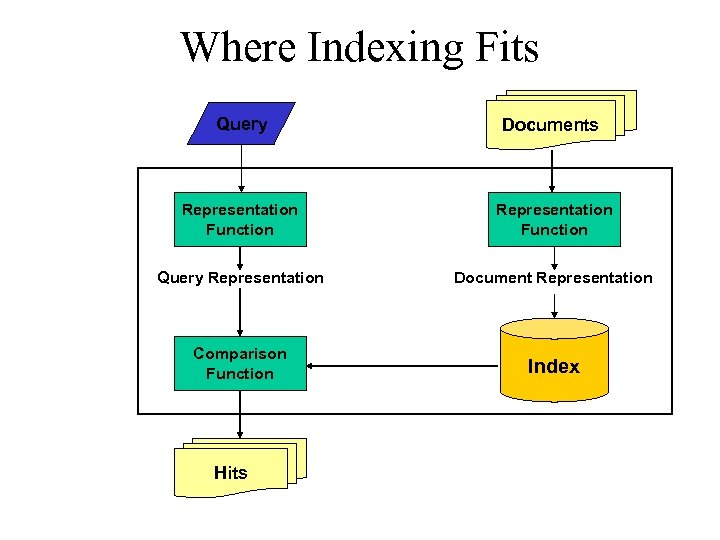
Where Indexing Fits Query Documents Representation Function Query Representation Document Representation Comparison Function Index Hits
A Cautionary Tale • Windows “Search” scans a hard drive in minutes – If it only looks at the file names. . . • How long would it take to scan all text on … – A 100 GB disk? – For the World Wide Web? • Computers are getting faster, but… – How does Google give answers in seconds?
Some Questions for Today • How long will it take to find a document? – Is there any work we can do in advance? – If so, how long will that take? • How big a computer will I need? – How much disk space? How much RAM? • What if more documents arrive? – How much of the advance work must be repeated? – Will searching become slower? – How much more disk space will be needed?
Desirable Index Characteristics • Very rapid search – Less than ~100 ms is typically imperceivable • Reasonable hardware requirements – Processor speed, disk size, main memory size • “Fast enough” creation and updates – Every couple of weeks may suffice for the Web – Every couple of minutes is needed for news
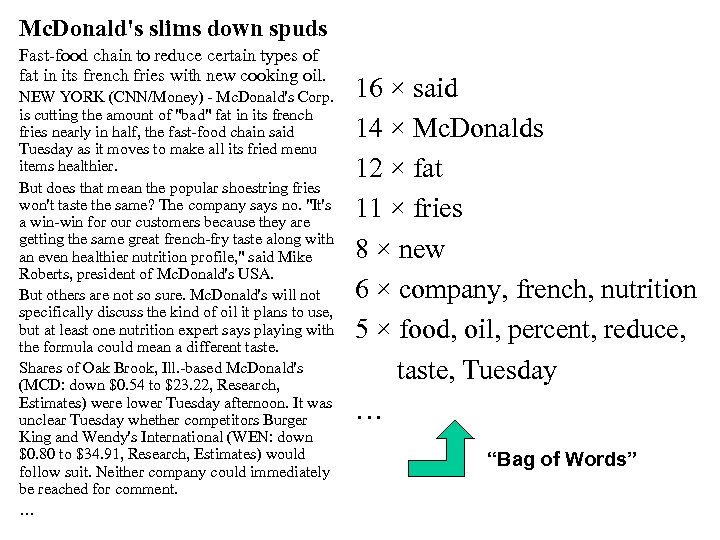
Mc. Donald's slims down spuds Fast-food chain to reduce certain types of fat in its french fries with new cooking oil. NEW YORK (CNN/Money) - Mc. Donald's Corp. is cutting the amount of "bad" fat in its french fries nearly in half, the fast-food chain said Tuesday as it moves to make all its fried menu items healthier. But does that mean the popular shoestring fries won't taste the same? The company says no. "It's a win-win for our customers because they are getting the same great french-fry taste along with an even healthier nutrition profile, " said Mike Roberts, president of Mc. Donald's USA. But others are not so sure. Mc. Donald's will not specifically discuss the kind of oil it plans to use, but at least one nutrition expert says playing with the formula could mean a different taste. Shares of Oak Brook, Ill. -based Mc. Donald's (MCD: down $0. 54 to $23. 22, Research, Estimates) were lower Tuesday afternoon. It was unclear Tuesday whether competitors Burger King and Wendy's International (WEN: down $0. 80 to $34. 91, Research, Estimates) would follow suit. Neither company could immediately be reached for comment. … 16 × said 14 × Mc. Donalds 12 × fat 11 × fries 8 × new 6 × company, french, nutrition 5 × food, oil, percent, reduce, taste, Tuesday … “Bag of Words”
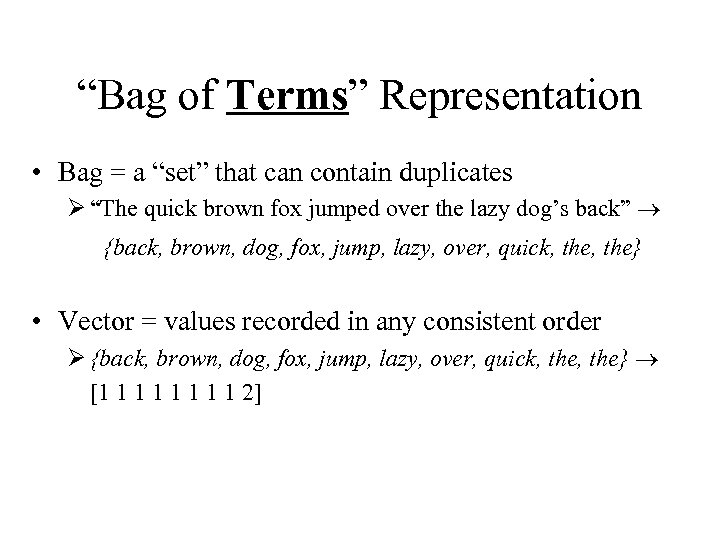
“Bag of Terms” Representation • Bag = a “set” that can contain duplicates Ø “The quick brown fox jumped over the lazy dog’s back” {back, brown, dog, fox, jump, lazy, over, quick, the} • Vector = values recorded in any consistent order Ø {back, brown, dog, fox, jump, lazy, over, quick, the} [1 1 1 1 2]
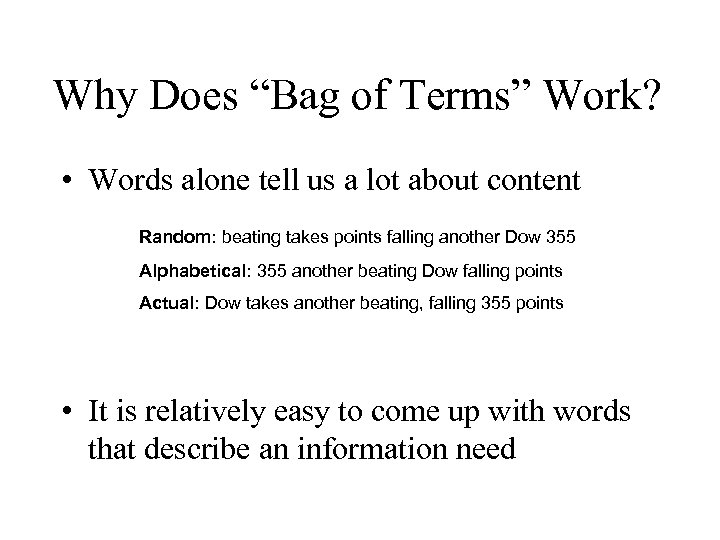
Why Does “Bag of Terms” Work? • Words alone tell us a lot about content Random: beating takes points falling another Dow 355 Alphabetical: 355 another beating Dow falling points Actual: Dow takes another beating, falling 355 points • It is relatively easy to come up with words that describe an information need
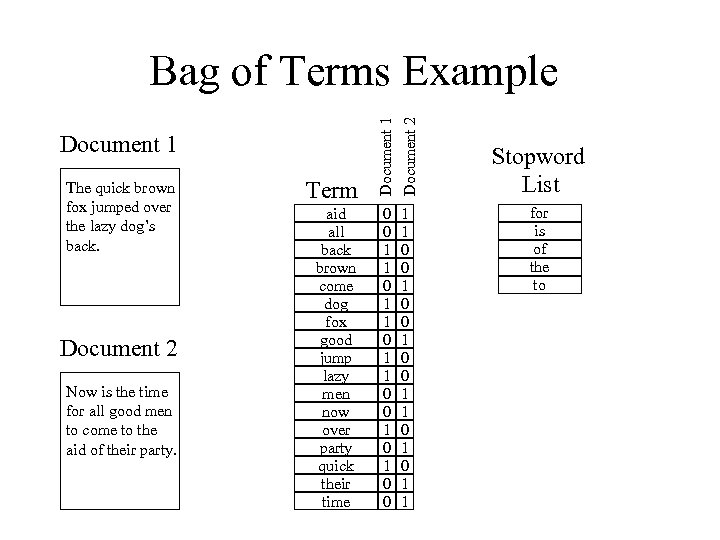
Document 1 The quick brown fox jumped over the lazy dog’s back. Document 2 Now is the time for all good men to come to the aid of their party. Term aid all back brown come dog fox good jump lazy men now over party quick their time Document 1 Document 2 Bag of Terms Example 0 0 1 1 0 0 1 0 0 1 1 0 1 1 Stopword List for is of the to
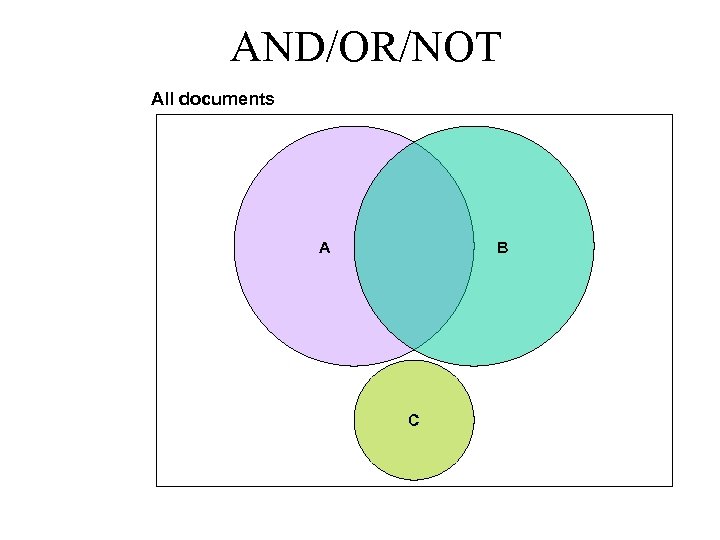
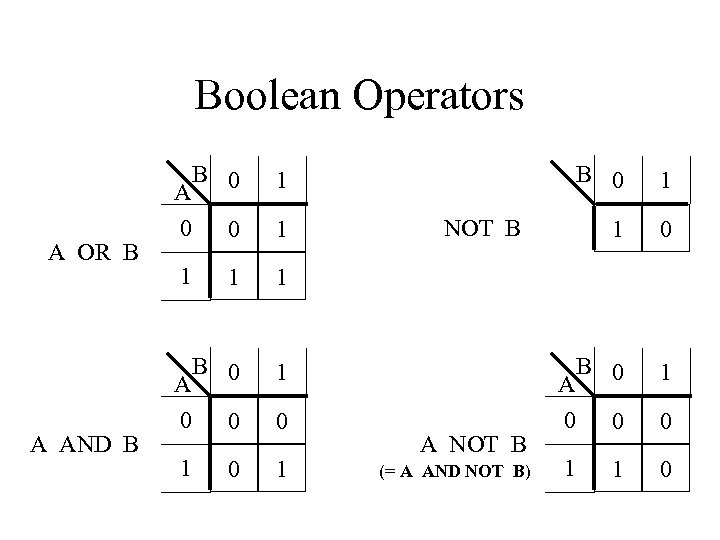
Boolean “Free Text” Retrieval • Limit the bag of words to “absent” and “present” – “Boolean” values, represented as 0 and 1 • Represent terms as a “bag of documents” – Same representation, but rows rather than columns • Combine the rows using “Boolean operators” – AND, OR, NOT • Result set: every document with a 1 remaining
AND/OR/NOT All documents A B C
Boolean Operators B 0 A A AND B 0 0 1 1 B 0 A A OR B 1 B 0 1 1 0 1 B 0 A 1 0 0 0 1 0 1 1 1 0 NOT B A NOT B (= A AND NOT B)
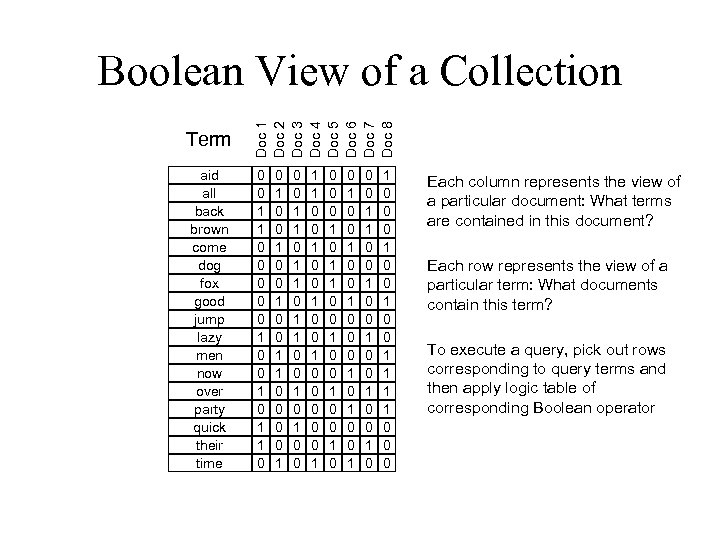
Term aid all back brown come dog fox good jump lazy men now over party quick their time Doc 1 Doc 2 Doc 3 Doc 4 Doc 5 Doc 6 Doc 7 Doc 8 Boolean View of a Collection 0 0 1 1 0 0 0 1 0 1 1 0 0 1 0 0 1 1 0 0 1 1 0 0 0 0 0 1 0 1 1 0 0 1 0 0 0 1 0 0 1 0 0 1 0 0 1 1 0 0 0 Each column represents the view of a particular document: What terms are contained in this document? Each row represents the view of a particular term: What documents contain this term? To execute a query, pick out rows corresponding to query terms and then apply logic table of corresponding Boolean operator
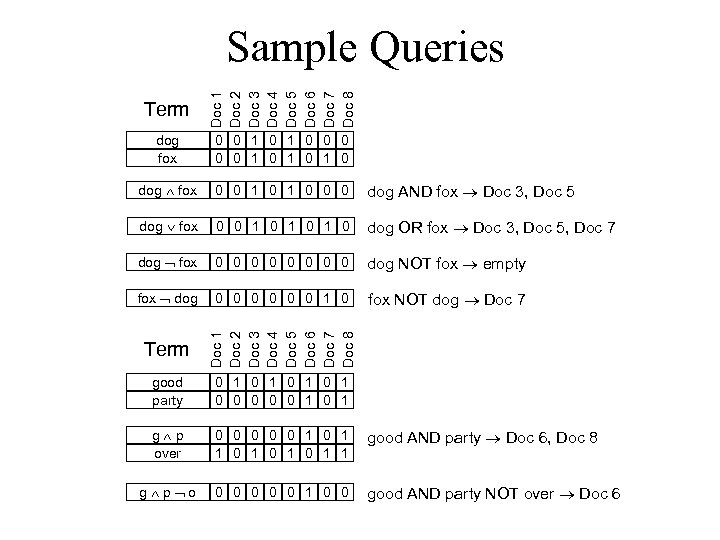
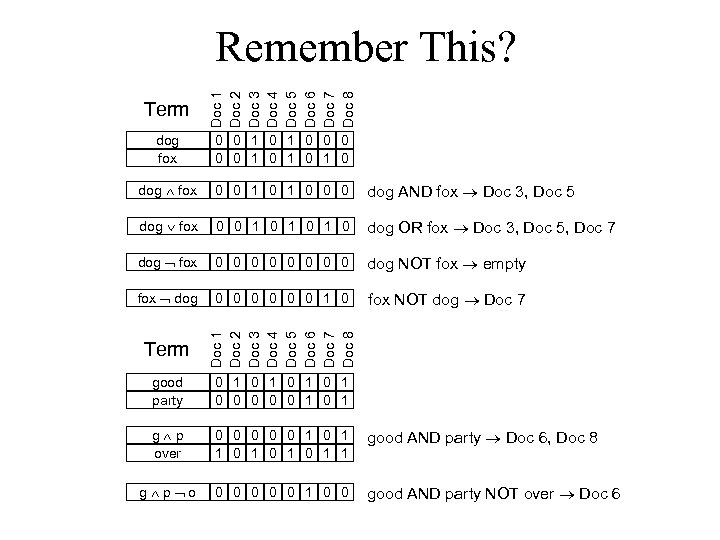
Term Doc 1 Doc 2 Doc 3 Doc 4 Doc 5 Doc 6 Doc 7 Doc 8 dog fox 0 0 1 0 1 0 dog fox 0 0 1 0 0 0 dog AND fox Doc 3, Doc 5 dog fox 0 0 1 0 1 0 dog OR fox Doc 3, Doc 5, Doc 7 dog fox 0 0 0 0 dog NOT fox empty fox dog 0 0 0 1 0 fox NOT dog Doc 7 Term Doc 1 Doc 2 Doc 3 Doc 4 Doc 5 Doc 6 Doc 7 Doc 8 Sample Queries good party 0 1 0 1 0 0 0 1 g p over 0 0 0 1 1 0 1 0 1 1 good AND party Doc 6, Doc 8 g p o 0 0 0 1 0 0 good AND party NOT over Doc 6
Why Boolean Retrieval Works • Boolean operators approximate natural language – Find documents about a good party that is not over • AND can discover relationships between concepts – good party • OR can discover alternate terminology – excellent party • NOT can discover alternate meanings – Democratic party
Proximity Operators • More precise versions of AND – “NEAR n” allows at most n-1 intervening terms – “WITH” requires terms to be adjacent and in order • Easy to implement, but less efficient – Store a list of positions for each word in each doc • Warning: stopwords become important! – Perform normal Boolean computations • Treat WITH and NEAR like AND with an extra constraint
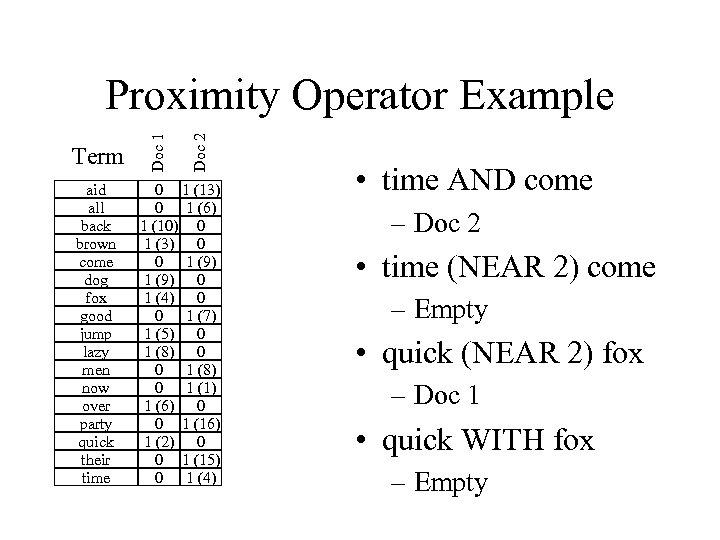
aid all back brown come dog fox good jump lazy men now over party quick their time Doc 2 Term Doc 1 Proximity Operator Example 0 1 (13) 0 1 (6) 1 (10) 0 1 (3) 0 0 1 (9) 0 1 (4) 0 0 1 (7) 1 (5) 0 1 (8) 0 1 (1) 1 (6) 0 0 1 (16) 1 (2) 0 0 1 (15) 0 1 (4) • time AND come – Doc 2 • time (NEAR 2) come – Empty • quick (NEAR 2) fox – Doc 1 • quick WITH fox – Empty
Other Extensions • Ability to search on fields – Leverage document structure: title, headings, etc. • Wildcards – lov* = love, loving, loves, loved, etc. • Special treatment of dates, names, companies, etc.
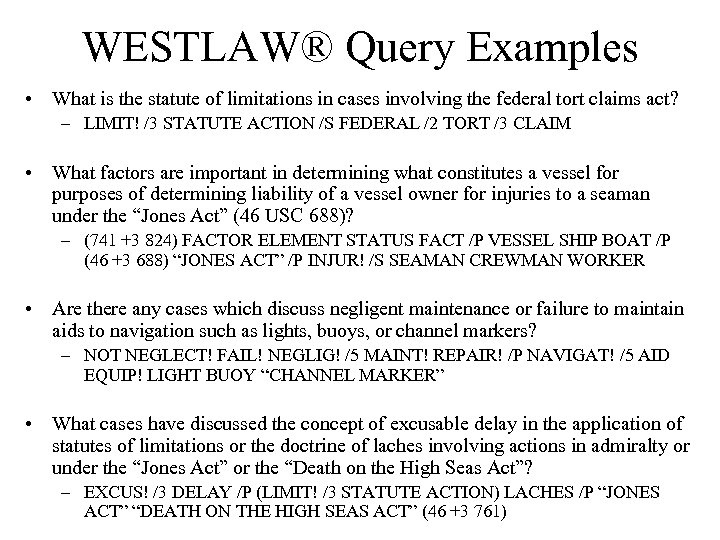
WESTLAW® Query Examples • What is the statute of limitations in cases involving the federal tort claims act? – LIMIT! /3 STATUTE ACTION /S FEDERAL /2 TORT /3 CLAIM • What factors are important in determining what constitutes a vessel for purposes of determining liability of a vessel owner for injuries to a seaman under the “Jones Act” (46 USC 688)? – (741 +3 824) FACTOR ELEMENT STATUS FACT /P VESSEL SHIP BOAT /P (46 +3 688) “JONES ACT” /P INJUR! /S SEAMAN CREWMAN WORKER • Are there any cases which discuss negligent maintenance or failure to maintain aids to navigation such as lights, buoys, or channel markers? – NOT NEGLECT! FAIL! NEGLIG! /5 MAINT! REPAIR! /P NAVIGAT! /5 AID EQUIP! LIGHT BUOY “CHANNEL MARKER” • What cases have discussed the concept of excusable delay in the application of statutes of limitations or the doctrine of laches involving actions in admiralty or under the “Jones Act” or the “Death on the High Seas Act”? – EXCUS! /3 DELAY /P (LIMIT! /3 STATUTE ACTION) LACHES /P “JONES ACT” “DEATH ON THE HIGH SEAS ACT” (46 +3 761)
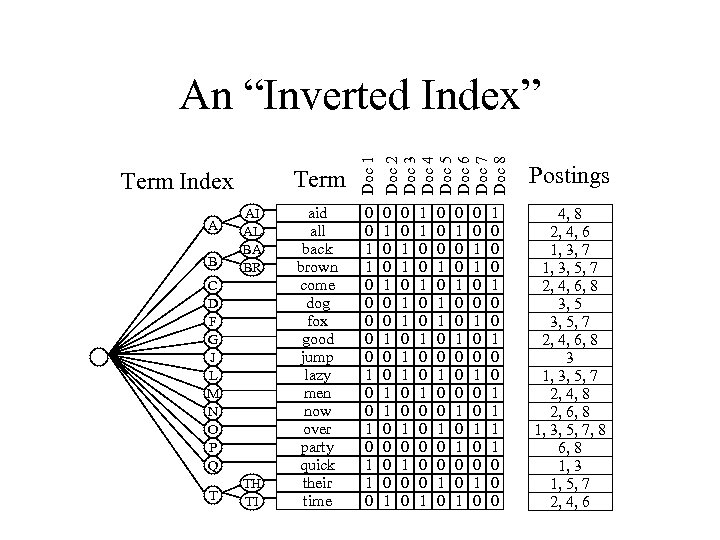
Term Index A B AI AL BA BR C D F G J L M N O P Q T TH TI aid all back brown come dog fox good jump lazy men now over party quick their time Doc 1 Doc 2 Doc 3 Doc 4 Doc 5 Doc 6 Doc 7 Doc 8 An “Inverted Index” 0 0 1 1 0 0 0 1 0 1 1 0 0 1 0 0 1 1 0 0 1 1 0 0 0 0 0 1 0 1 1 0 0 1 0 0 0 1 0 0 1 0 0 1 0 0 1 1 0 0 0 Postings 4, 8 2, 4, 6 1, 3, 7 1, 3, 5, 7 2, 4, 6, 8 3 1, 3, 5, 7 2, 4, 8 2, 6, 8 1, 3, 5, 7, 8 6, 8 1, 3 1, 5, 7 2, 4, 6
Saving Space • Can we make this data structure smaller, keeping in mind the need for fast retrieval? • Observations: – The nature of the search problem requires us to quickly find which documents contain a term – The term-document matrix is very sparse – Some terms are more useful than others
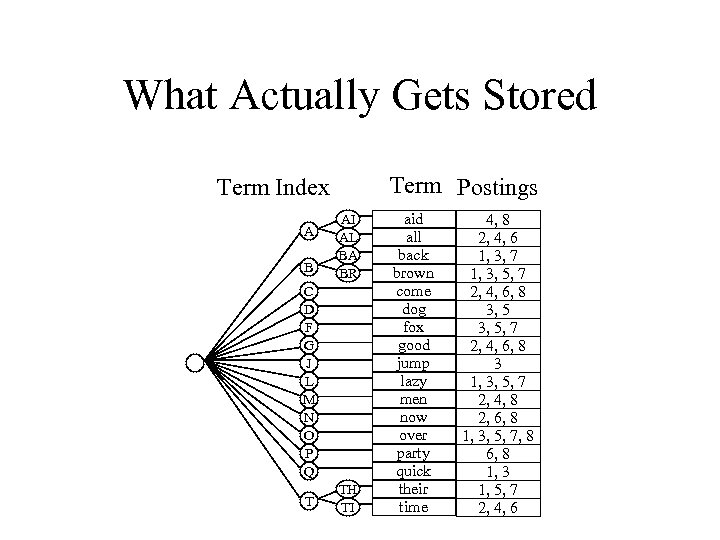
What Actually Gets Stored Term Postings Term Index A B AI AL BA BR C D F G J L M N O P Q T TH TI aid all back brown come dog fox good jump lazy men now over party quick their time 4, 8 2, 4, 6 1, 3, 7 1, 3, 5, 7 2, 4, 6, 8 3 1, 3, 5, 7 2, 4, 8 2, 6, 8 1, 3, 5, 7, 8 6, 8 1, 3 1, 5, 7 2, 4, 6
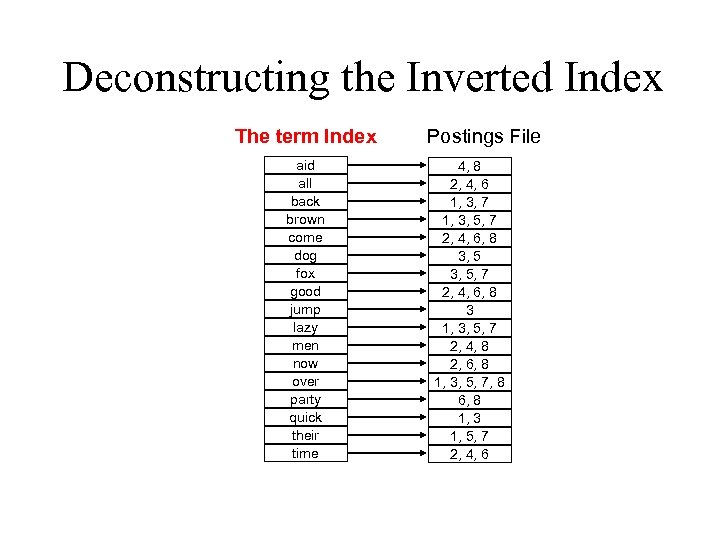
Deconstructing the Inverted Index The term Index aid all back brown come dog fox good jump lazy men now over party quick their time Postings File 4, 8 2, 4, 6 1, 3, 7 1, 3, 5, 7 2, 4, 6, 8 3 1, 3, 5, 7 2, 4, 8 2, 6, 8 1, 3, 5, 7, 8 6, 8 1, 3 1, 5, 7 2, 4, 6
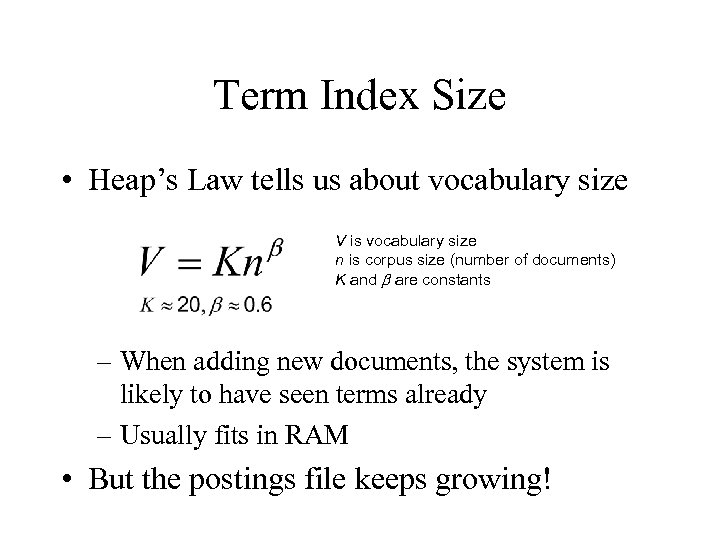
Term Index Size • Heap’s Law tells us about vocabulary size V is vocabulary size n is corpus size (number of documents) K and are constants – When adding new documents, the system is likely to have seen terms already – Usually fits in RAM • But the postings file keeps growing!
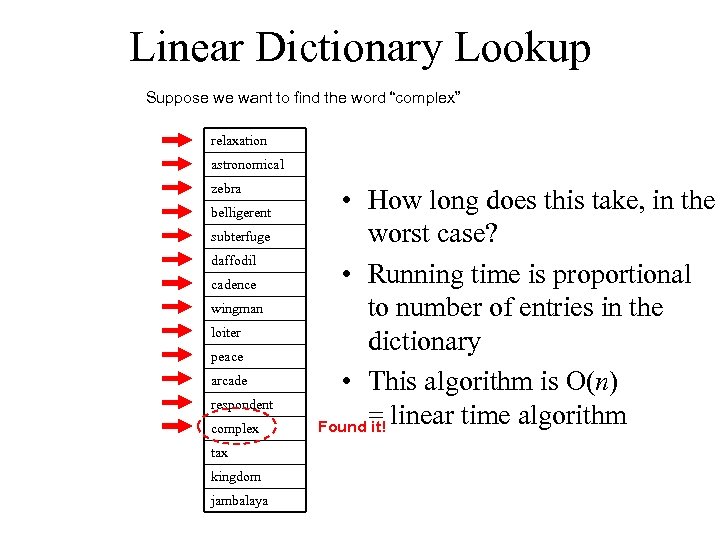
Linear Dictionary Lookup Suppose we want to find the word “complex” relaxation astronomical zebra belligerent subterfuge daffodil cadence wingman loiter peace arcade respondent complex tax kingdom jambalaya • How long does this take, in the worst case? • Running time is proportional to number of entries in the dictionary • This algorithm is O(n) = linear time algorithm Found it!
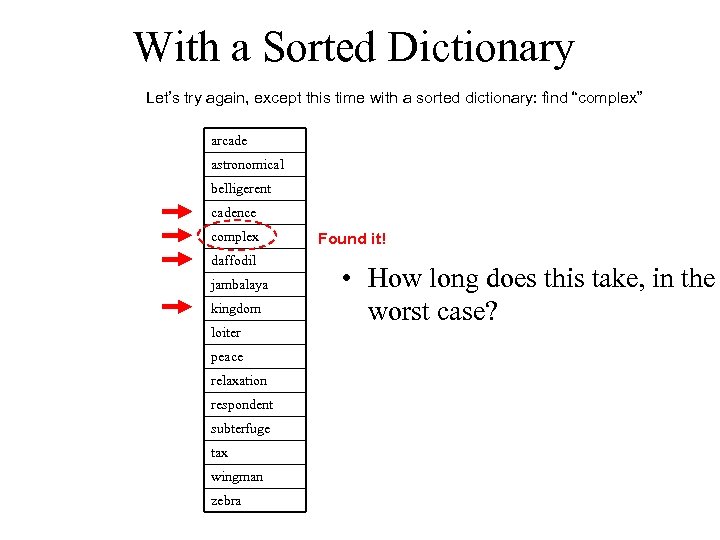
With a Sorted Dictionary Let’s try again, except this time with a sorted dictionary: find “complex” arcade astronomical belligerent cadence complex daffodil jambalaya kingdom loiter peace relaxation respondent subterfuge tax wingman zebra Found it! • How long does this take, in the worst case?
Which is Faster? • Two algorithms: – O(n): – O(log n): Sequentially “search” Binary “search” • Big-O notation – Allows us to compare different algorithms on very large collections
Computational Complexity • Time complexity: how long will it take … – At index-creation time? – At query time? • Space complexity: how much memory is needed … – In RAM? – On disk? • Things you need to know to assess complexity: – What is the “size” of the input? (“n”) – What are the internal data structures? – What is the algorithm?
Complexity for Small n
“Asymptotic” Complexity
Building a Term Index • Simplest solution is a single sorted array – Fast lookup using binary search – But sorting is expensive [it’s O(n * log n)] • And adding one document means starting over • Tree structures allow easy insertion – But the worst case lookup time is O(n) • Balanced trees provide the best of both – Fast lookup [O (log n) and easy insertion [O(log n)] – But they require 45% more disk space
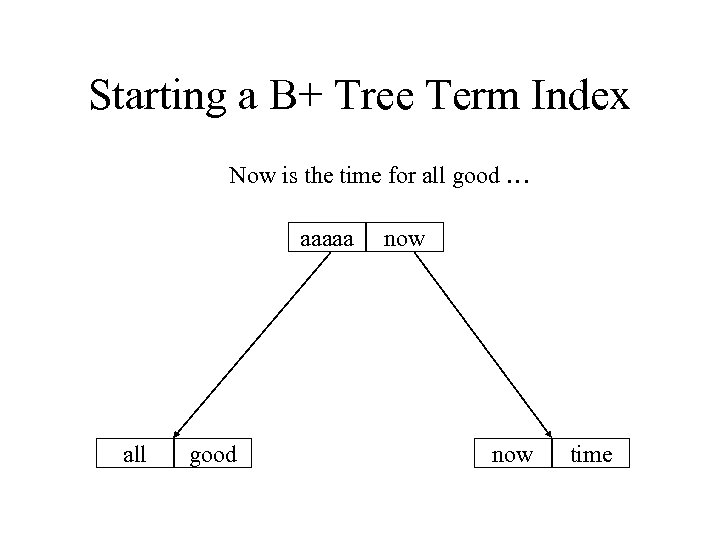
Starting a B+ Tree Term Index Now is the time for all good … aaaaa all good now time
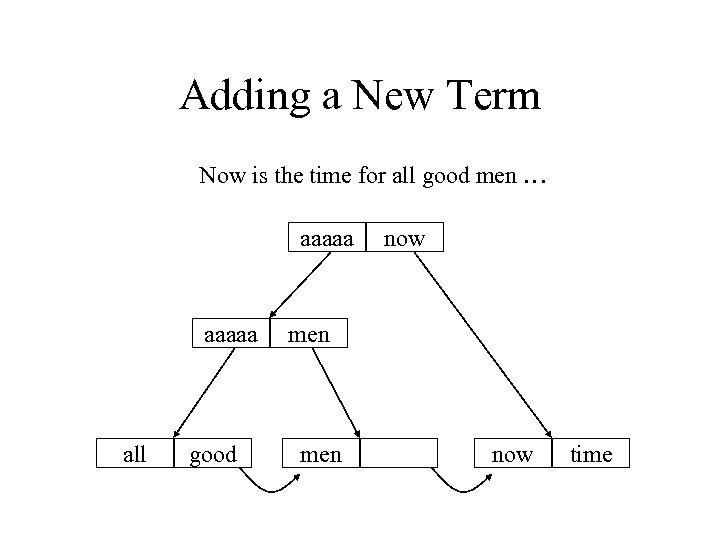
Adding a New Term Now is the time for all good men … aaaaa all good now men now time
What’s in the Postings File? • Boolean retrieval – Just the document number • Proximity operators – Word offsets for each occurrence of the term • Example: Doc 3 (t 17, t 36), Doc 13 (t 3, t 45) • Ranked Retrieval – Document number and term weight
How Big Is a Raw Postings File? • Very compact for Boolean retrieval – About 10% of the size of the documents • If an aggressive stopword list is used! • Not much larger for ranked retrieval – Perhaps 20% • Enormous for proximity operators – Sometimes larger than the documents!
Large Postings Files are Slow • RAM – Typical size: 1 GB – Typical access speed: 50 ns • Hard drive: – Typical size: 80 GB (my laptop) – Typical access speed: 10 ms • Hard drive is 200, 000 x slower than RAM! • Discussion question: – How does stopword removal improve speed?
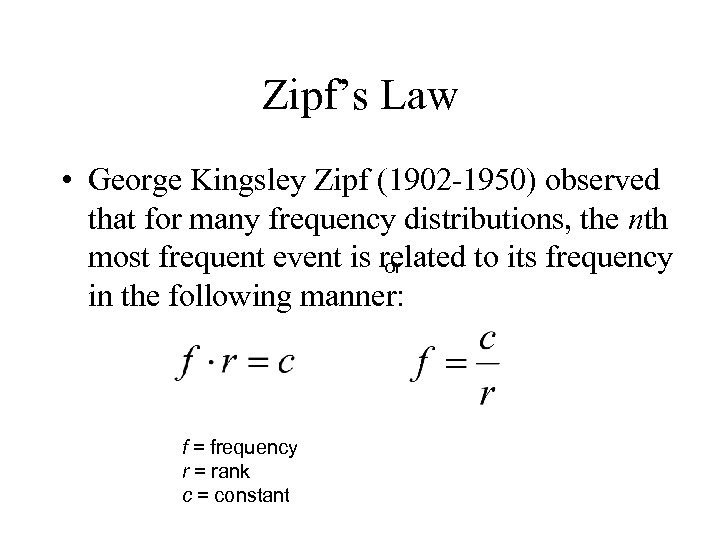
Zipf’s Law • George Kingsley Zipf (1902 -1950) observed that for many frequency distributions, the nth most frequent event is related to its frequency or in the following manner: f = frequency r = rank c = constant
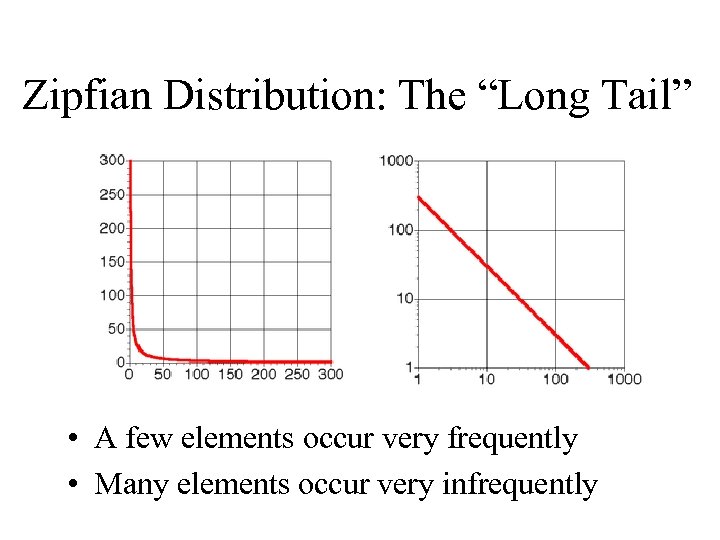
Zipfian Distribution: The “Long Tail” • A few elements occur very frequently • Many elements occur very infrequently
Some Zipfian Distributions • • • Library book checkout patterns Website popularity Incoming Web page requests Outgoing Web page requests Document size on Web
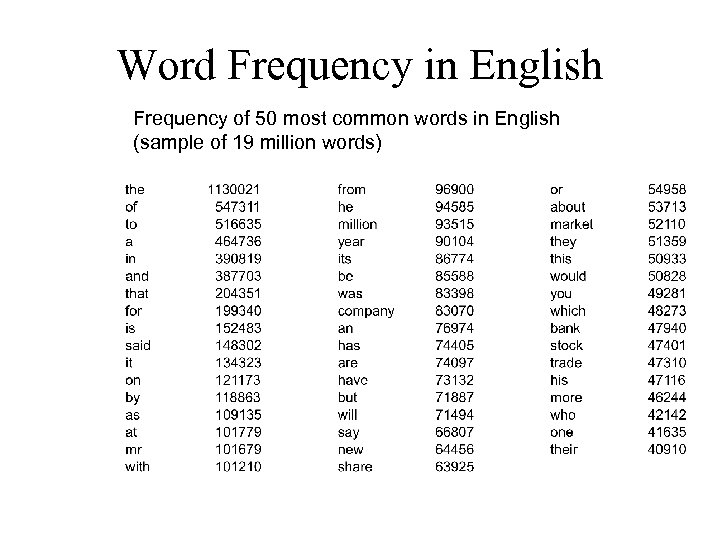
Word Frequency in English Frequency of 50 most common words in English (sample of 19 million words)
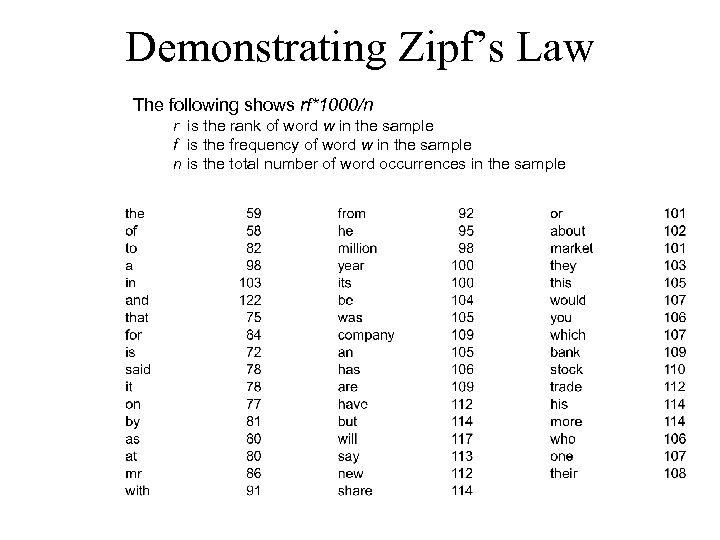
Demonstrating Zipf’s Law The following shows rf*1000/n r is the rank of word w in the sample f is the frequency of word w in the sample n is the total number of word occurrences in the sample
Index Compression • CPU’s are much faster than disks – A disk can transfer 1, 000 bytes in ~20 ms – The CPU can do ~10 million instructions in that time • Compressing the postings file is a big win – Trade decompression time for fewer disk reads • Key idea: reduce redundancy – Trick 1: store relative offsets (some will be the same) – Trick 2: use an optimal coding scheme
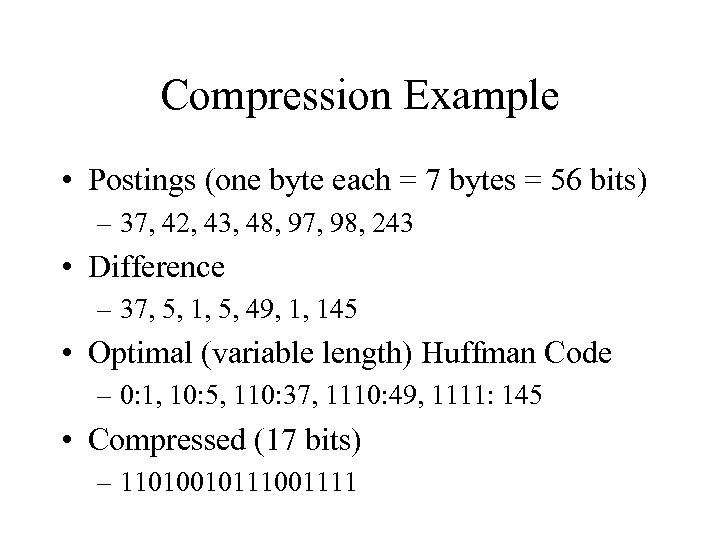
Compression Example • Postings (one byte each = 7 bytes = 56 bits) – 37, 42, 43, 48, 97, 98, 243 • Difference – 37, 5, 1, 5, 49, 1, 145 • Optimal (variable length) Huffman Code – 0: 1, 10: 5, 110: 37, 1110: 49, 1111: 145 • Compressed (17 bits) – 11010010111001111
Term Doc 1 Doc 2 Doc 3 Doc 4 Doc 5 Doc 6 Doc 7 Doc 8 dog fox 0 0 1 0 1 0 dog fox 0 0 1 0 0 0 dog AND fox Doc 3, Doc 5 dog fox 0 0 1 0 1 0 dog OR fox Doc 3, Doc 5, Doc 7 dog fox 0 0 0 0 dog NOT fox empty fox dog 0 0 0 1 0 fox NOT dog Doc 7 Term Doc 1 Doc 2 Doc 3 Doc 4 Doc 5 Doc 6 Doc 7 Doc 8 Remember This? good party 0 1 0 1 0 0 0 1 g p over 0 0 0 1 1 0 1 0 1 1 good AND party Doc 6, Doc 8 g p o 0 0 0 1 0 0 good AND party NOT over Doc 6
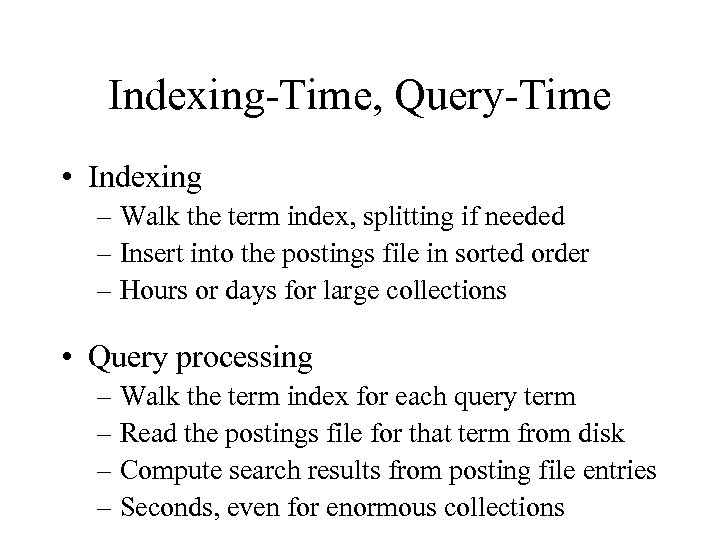
Indexing-Time, Query-Time • Indexing – Walk the term index, splitting if needed – Insert into the postings file in sorted order – Hours or days for large collections • Query processing – Walk the term index for each query term – Read the postings file for that term from disk – Compute search results from posting file entries – Seconds, even for enormous collections
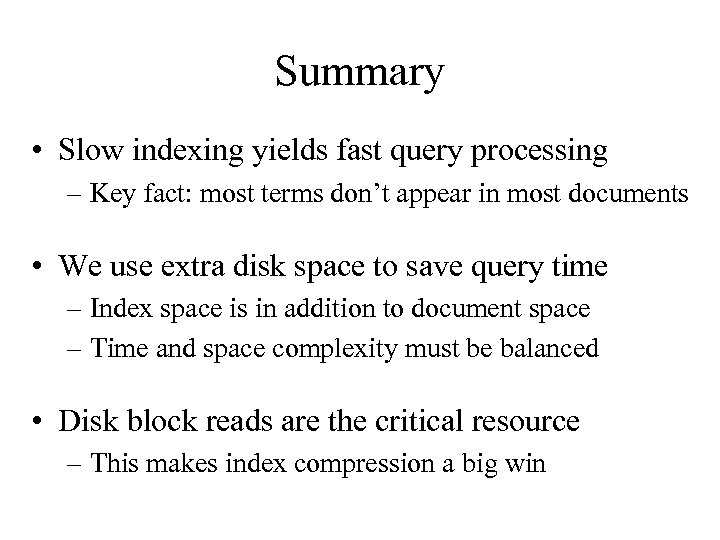
Summary • Slow indexing yields fast query processing – Key fact: most terms don’t appear in most documents • We use extra disk space to save query time – Index space is in addition to document space – Time and space complexity must be balanced • Disk block reads are the critical resource – This makes index compression a big win
Agenda • Character sets • Terms as units of meaning • Building an index Ø Project overview
Project Options • Instructor-designed project – Team of ~6: design, implementation, evaluation – Data is in hand, broad goals are outlined – Fixed “deliverable” schedule • Roll-your-own project – Individual, or group of any (reasonable) size – Pick your own topic and deliverables – Requires my approval (start discussion by Sep 27)
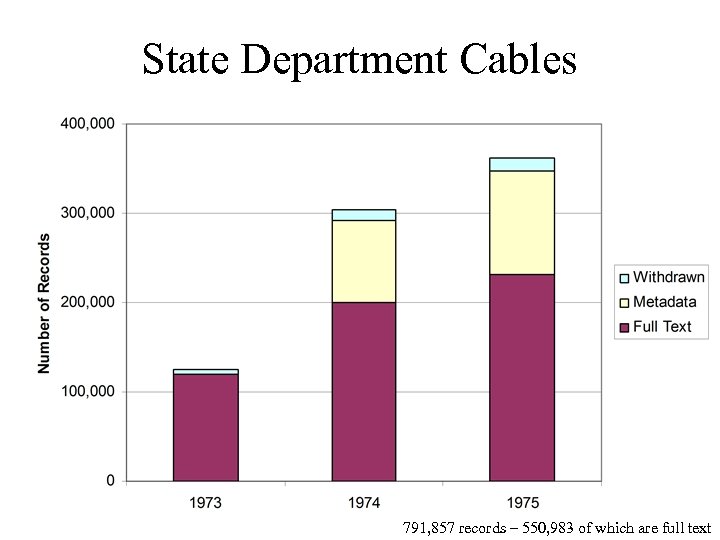
State Department Cables 791, 857 records – 550, 983 of which are full text
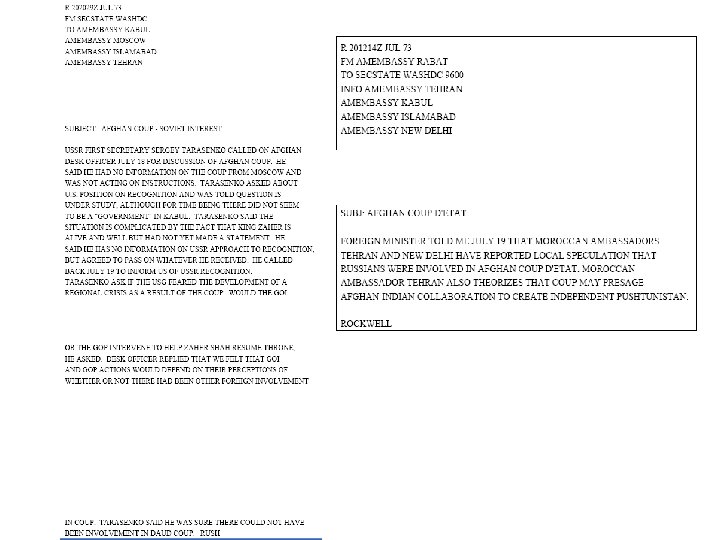
Some Questions User’s May Ask • Who are those people? • What is already known about the events that they are talking about? • Are there other messages about this? • Is there any way to do one search across this whole collection? • What do the “tags” on each message mean? • Can I be confident that if I didn’t find something it is really not there?
Some Ideas • Index the dates, people, organizations, full text, and tags separately – Lucene would be a natural choice for this • Try sliders for time, social network depictions for people, maps for organizations, pull down lists for tags, … • Provide a “more like this” capability based on any subset of that evidence • Refine your design based on automatic testing (for accuracy) and user testing (for usability)
Deliverables • • Functional design (Oct 22) Batch evaluation design (Nov 5) User evaluation design (Nov 12) Relevance judgments (Nov 26) Batch evaluation results (Dec 3) (in-class presentation) (Dec 10) Project report [w/user eval results] (Dec 14)
Before You Go! On a sheet of paper, please briefly answer the following question (no names): What was the muddiest point in today’s lecture? Don’t forget the homework due next week!
Скачать презентацию Evidence from Content LBSC 796 INFM 718 R Session
9da204b75678e8909e63aad02a70aae5.ppt