


 Скачать презентацию Evidence for the Effectiveness of Individual Placement and
a79c9c8ba5ab4fa67a83a9f0c635cdb3.ppt
- Количество слайдов: 42
 Evidence for the Effectiveness of Individual Placement and Support Model of Supported Employment Updated 2/12/14 by Gary Bond
 Presentation Outline § Role of work in recovery § Core principles of Individual Placement and Support (IPS) § Evidence for effectiveness § Implementation strategies
 Why Focus on Work? § Most clients want to work! § Most clients see work as an essential part of recovery § Being productive = Basic human need § In most societies, typical adult role § Most clients live in poverty § Working may prevent entry into disability system
 Most Clients Want Jobs in Competitive (Open) Employment § Regular community job § Pays at least minimum wage § Nondisabled coworkers § Not temporary or “make work” § Job belongs to the client, not to the mental health or rehabilitation agency
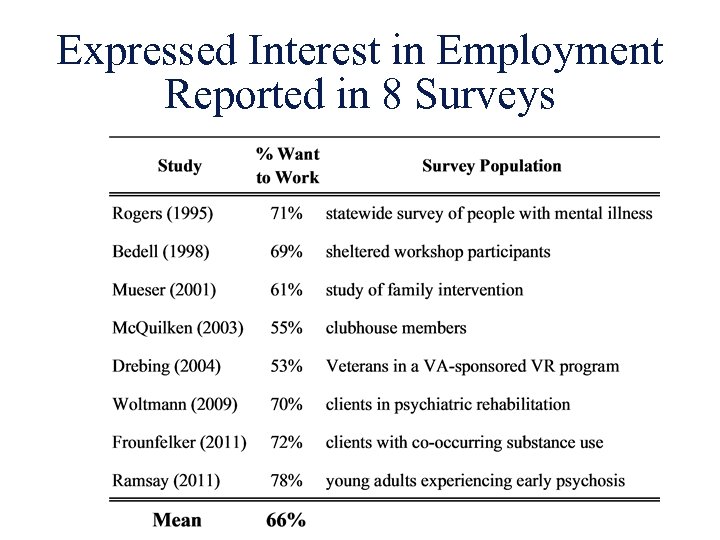 Expressed Interest in Employment Reported in 8 Surveys
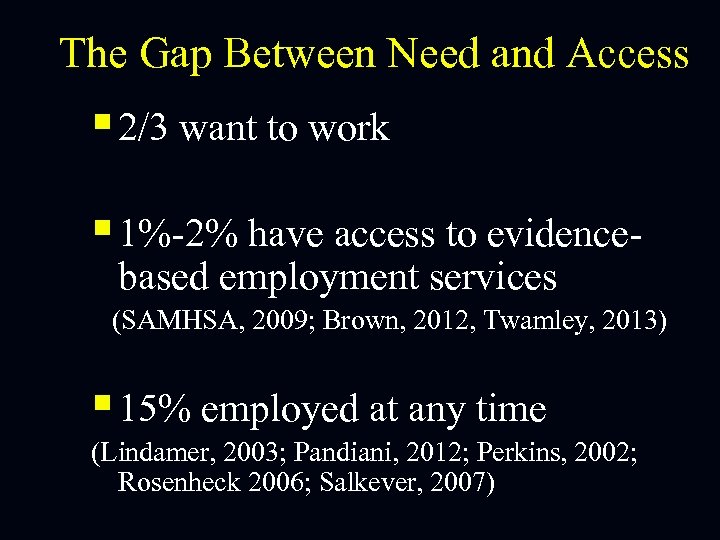 The Gap Between Need and Access § 2/3 want to work § 1%-2% have access to evidencebased employment services (SAMHSA, 2009; Brown, 2012, Twamley, 2013) § 15% employed at any time (Lindamer, 2003; Pandiani, 2012; Perkins, 2002; Rosenheck 2006; Salkever, 2007)
 Core Principles of the Individual Placement and Support (IPS) Model
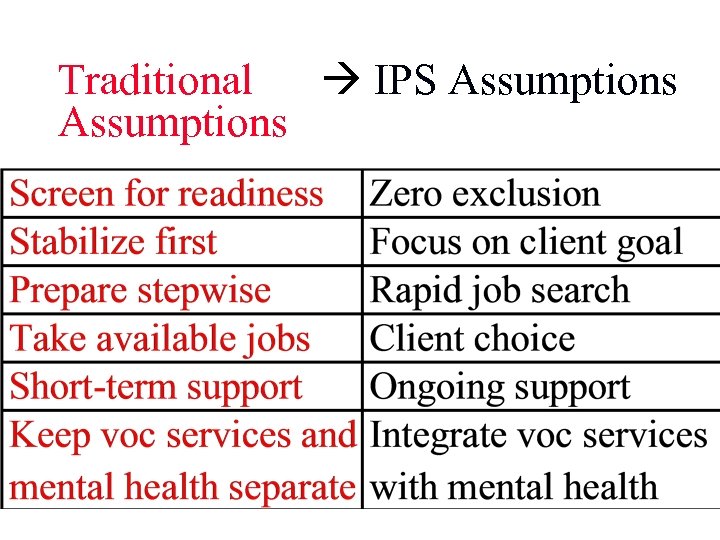 Traditional IPS Assumptions
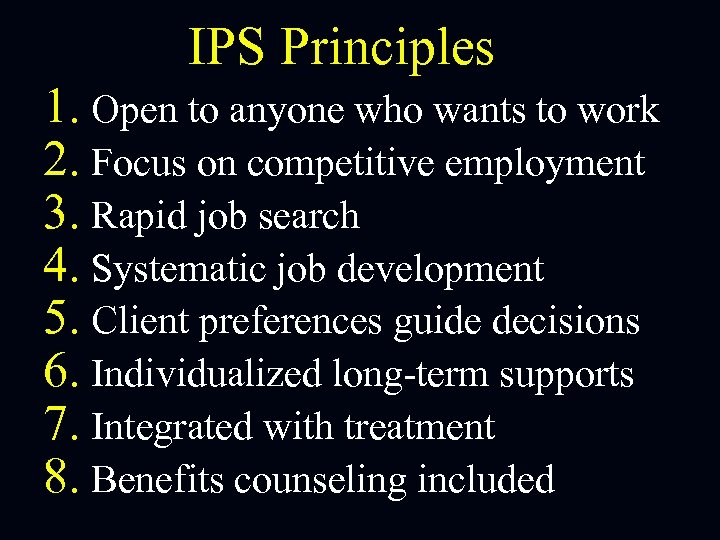 IPS Principles 1. Open to anyone who wants to work 2. Focus on competitive employment 3. Rapid job search 4. Systematic job development 5. Client preferences guide decisions 6. Individualized long-term supports 7. Integrated with treatment 8. Benefits counseling included
 Research Evidence for Effectiveness
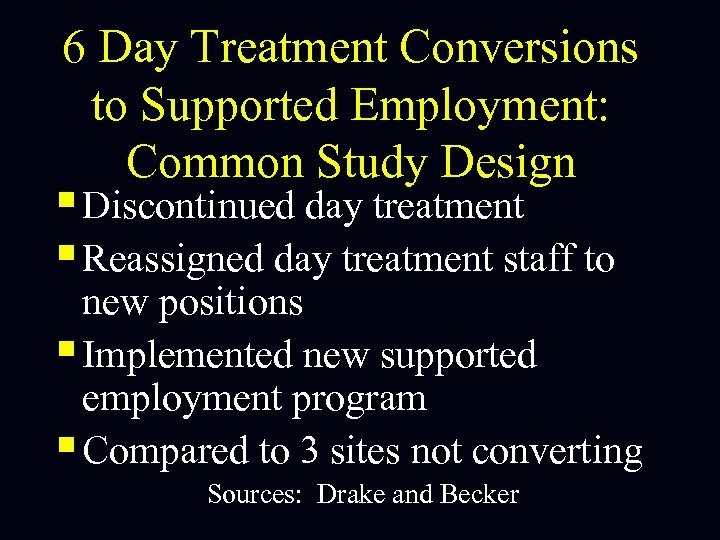 6 Day Treatment Conversions to Supported Employment: Common Study Design § Discontinued day treatment § Reassigned day treatment staff to new positions § Implemented new supported employment program § Compared to 3 sites not converting Sources: Drake and Becker
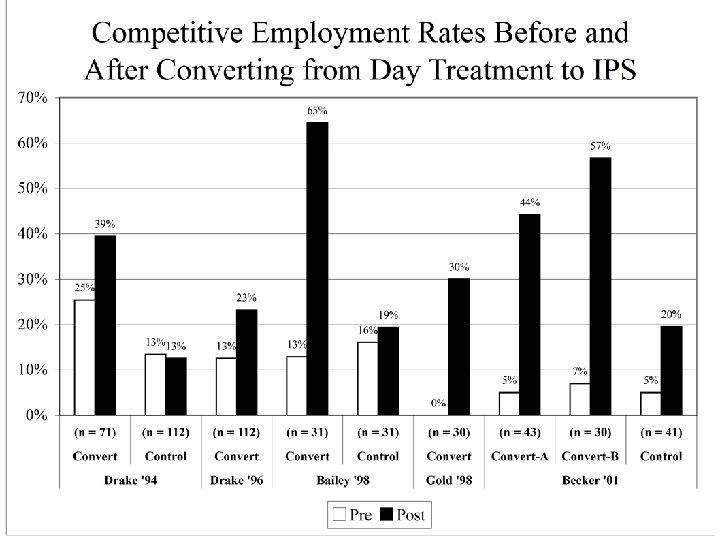
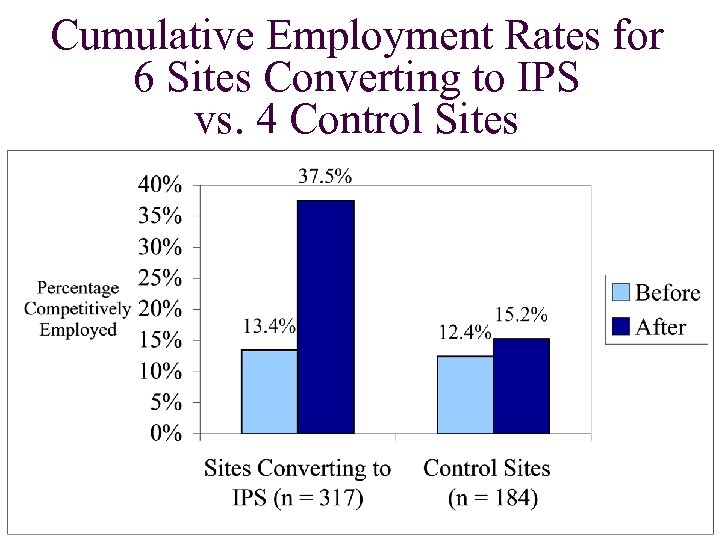 Cumulative Employment Rates for 6 Sites Converting to IPS vs. 4 Control Sites
 Similar Results in All Day Treatment Conversions § Large increase in employment rates § No negative outcomes (e. g. , relapses) § Clients, families, staff liked change § Overall, all former day treatment clients got out into community more § Resulted in cost savings
 20 Randomized Controlled Trials (RCTs) of Individual Placement and Support (IPS) § Best evidence available on effectiveness § RCTs are gold standard in medical research: Random assignment = Participants assigned by a flip of a coin
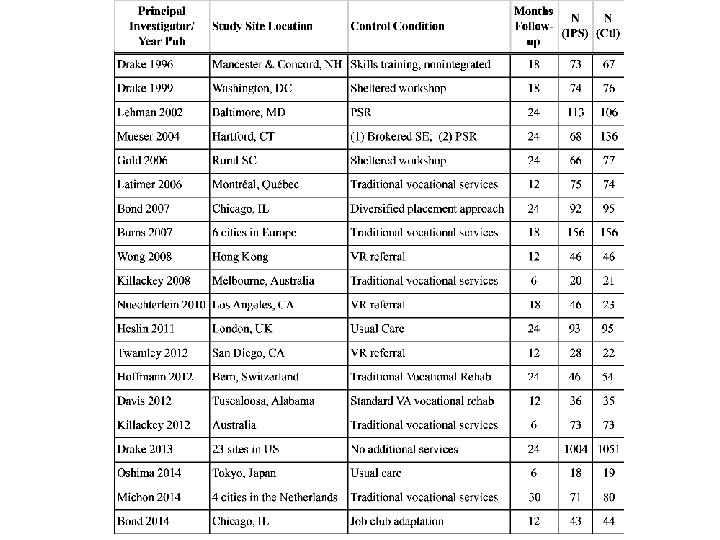
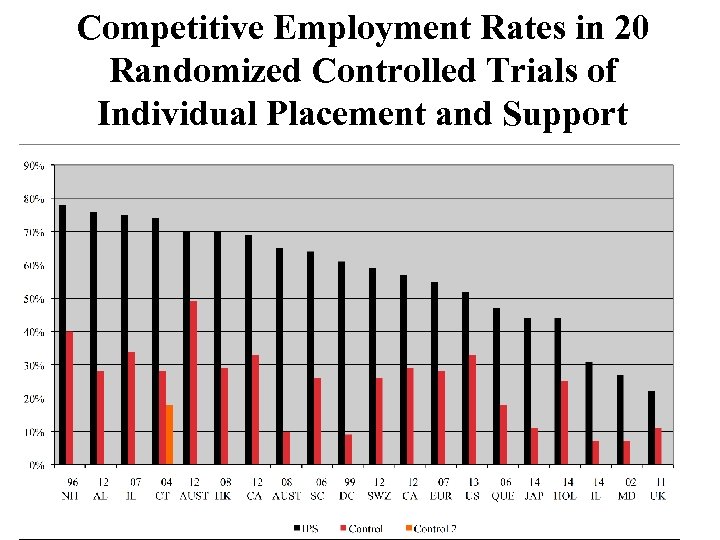 Competitive Employment Rates in 20 Randomized Controlled Trials of Individual Placement and Support
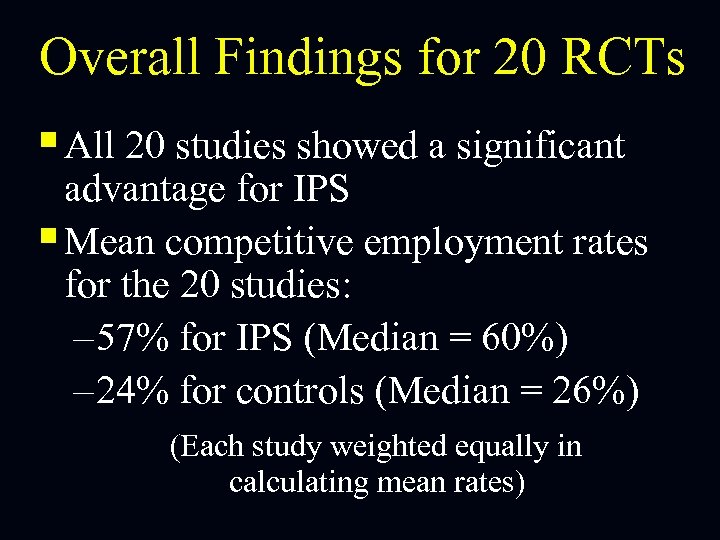 Overall Findings for 20 RCTs § All 20 studies showed a significant advantage for IPS § Mean competitive employment rates for the 20 studies: – 57% for IPS (Median = 60%) – 24% for controls (Median = 26%) (Each study weighted equally in calculating mean rates)
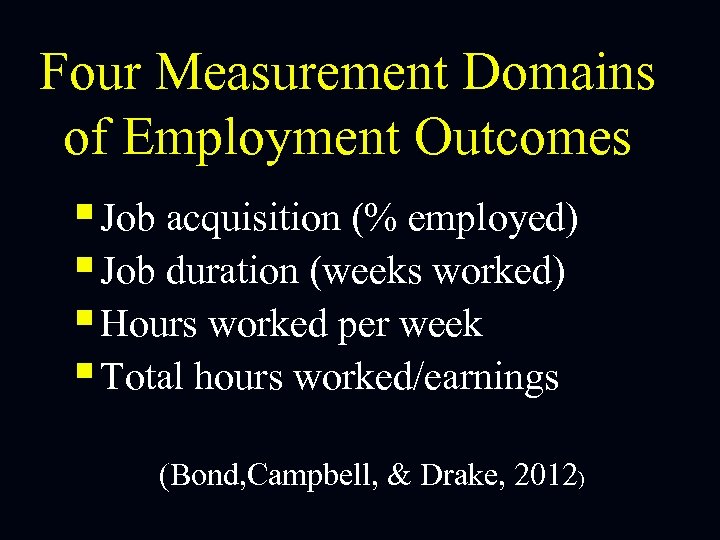 Four Measurement Domains of Employment Outcomes § Job acquisition (% employed) § Job duration (weeks worked) § Hours worked per week § Total hours worked/earnings (Bond, Campbell, & Drake, 2012)
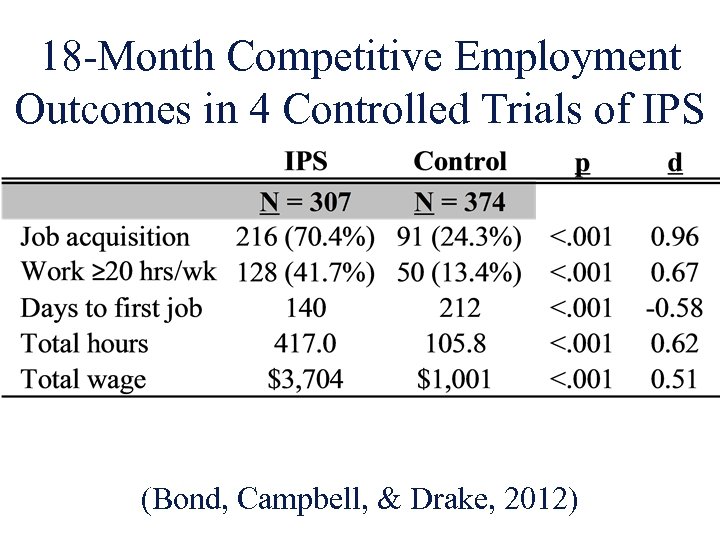 18 -Month Competitive Employment Outcomes in 4 Controlled Trials of IPS (Bond, Campbell, & Drake, 2012)
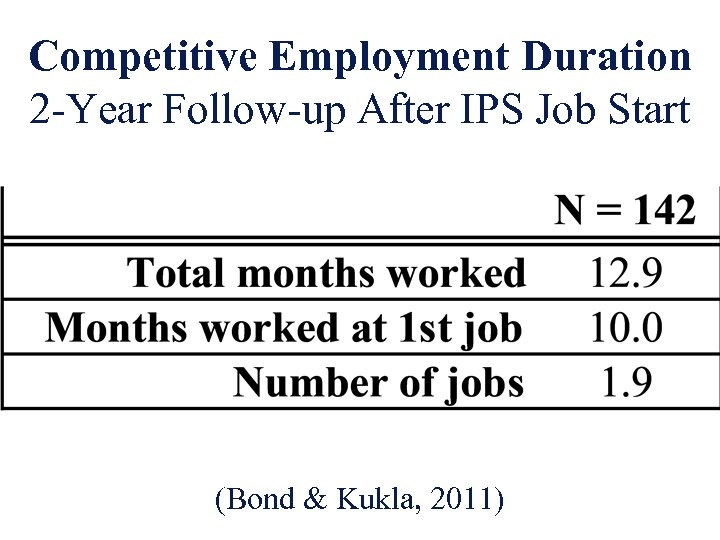 Competitive Employment Duration 2 -Year Follow-up After IPS Job Start (Bond & Kukla, 2011)
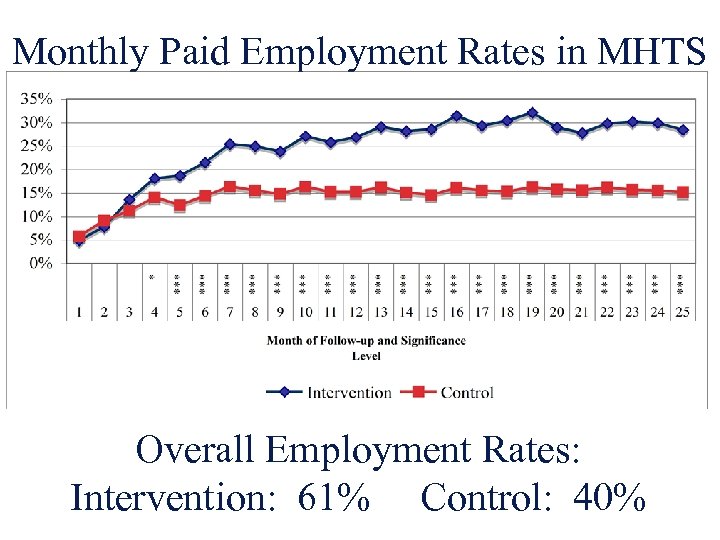
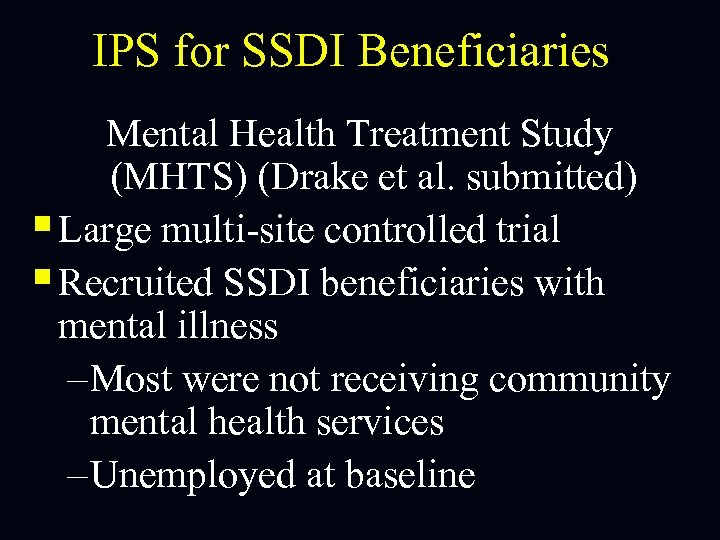 IPS for SSDI Beneficiaries Mental Health Treatment Study (MHTS) (Drake et al. submitted) § Large multi-site controlled trial § Recruited SSDI beneficiaries with mental illness – Most were not receiving community mental health services – Unemployed at baseline
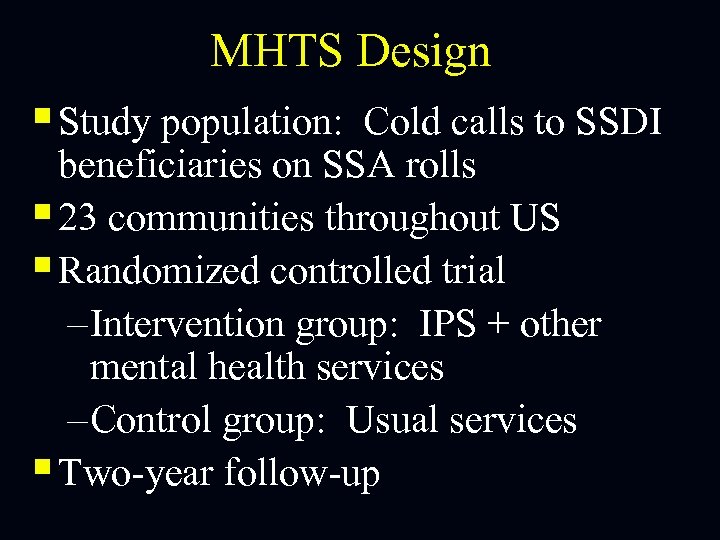 MHTS Design § Study population: Cold calls to SSDI beneficiaries on SSA rolls § 23 communities throughout US § Randomized controlled trial – Intervention group: IPS + other mental health services – Control group: Usual services § Two-year follow-up
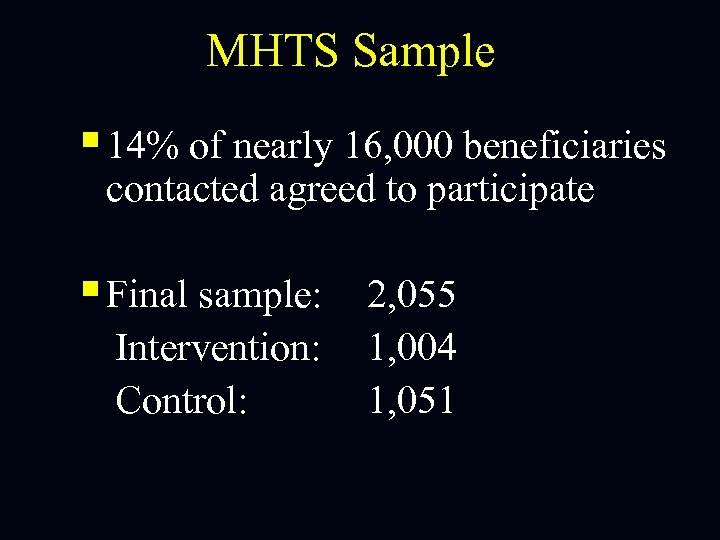 MHTS Sample § 14% of nearly 16, 000 beneficiaries contacted agreed to participate § Final sample: Intervention: Control: 2, 055 1, 004 1, 051
 Monthly Paid Employment Rates in MHTS Overall Employment Rates: Intervention: 61% Control: 40%
 What About Long-Term Outcomes? § Many psychosocial interventions produce improvements in short-term outcomes § BUT improvements often disappear over the long term § True for IPS?
 2 Long-Term IPS Follow-up Studies (Salyers 2004; Becker, 2007) Clients also reported: Greater selfconfidence and hopefulness, more energy, less loneliness and boredom
 Conclusion: IPS Has… Strong Evidence for Effectiveness Across a Range of Employment Measures, Including Long-Term Outcomes
 Impact of IPS on Recovery
 Is Work Too Stressful? § As compared to what? § Joe Marrone: If you think work is stressful, try unemployment
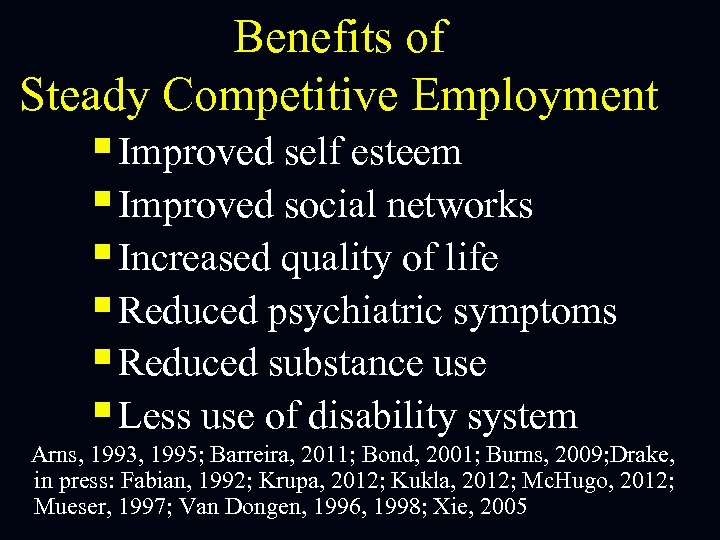 Benefits of Steady Competitive Employment § Improved self esteem § Improved social networks § Increased quality of life § Reduced psychiatric symptoms § Reduced substance use § Less use of disability system Arns, 1993, 1995; Barreira, 2011; Bond, 2001; Burns, 2009; Drake, in press: Fabian, 1992; Krupa, 2012; Kukla, 2012; Mc. Hugo, 2012; Mueser, 1997; Van Dongen, 1996, 1998; Xie, 2005
 Conclusion: Steady Employment Contributes to Long-Term Recovery
 IPS Implementation §National EBP Project (Mc. Hugo, 2007) §IPS Learning Collaborative (Becker. 2011)
 Fidelity § Fidelity defined as: the degree to which a service model is implemented as intended § Working hypothesis: Better implemented programs (with higher fidelity) have better outcomes
 Implementation Factors in National EBP Project § After 2 years, 29 (55%) of 53 sites implemented at high fidelity – Training, staff attitudes, and barriers not predictive § Strongly predictive: – Leadership at all levels – Integration of new practices into work flow (Torrey, Bond, et al. , 2011)
 8 Keys to Implementing IPS §End old ways of doing things (e. g. , day programs) §Use fidelity reviews as guide §Exercise leadership: –Agency directors provide resources –Supervisors set firm behavioral expectations
 8 Keys to Implementing IPS (continued) § Hire and retain staff suited for IPS § Provide field mentoring § Collaborate closely with treatment teams § Track indicators you want to improve (Bond et al. , 2008)
 IPS Learning Collaborative § Launched in 2002 § Grown to 130 programs in 14 states § 83% of programs joining since 2002 have been sustained (Becker et al. , 2011)
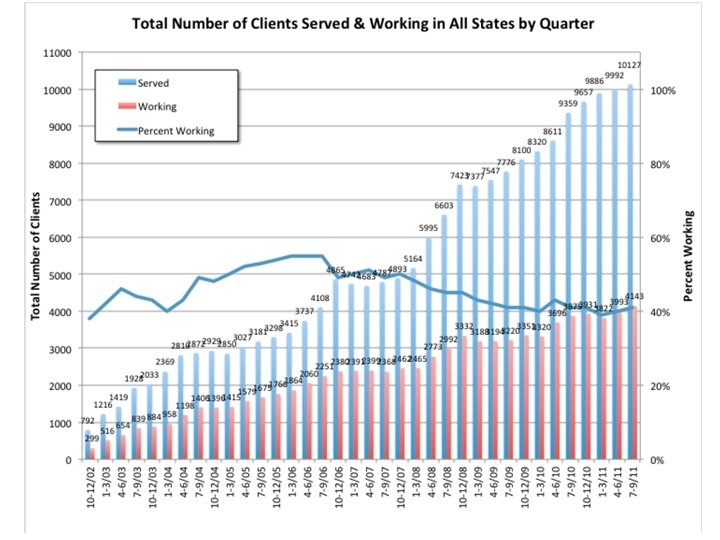 .
.
 Features of IPS Learning Collaborative § Provide time-limited seed money § Create position of IPS state leader § State agency buy-in (MH and VR) § Start small, grow gradually § Commit to fidelity and outcome reporting § Nurture mechanisms for sharing of experiences
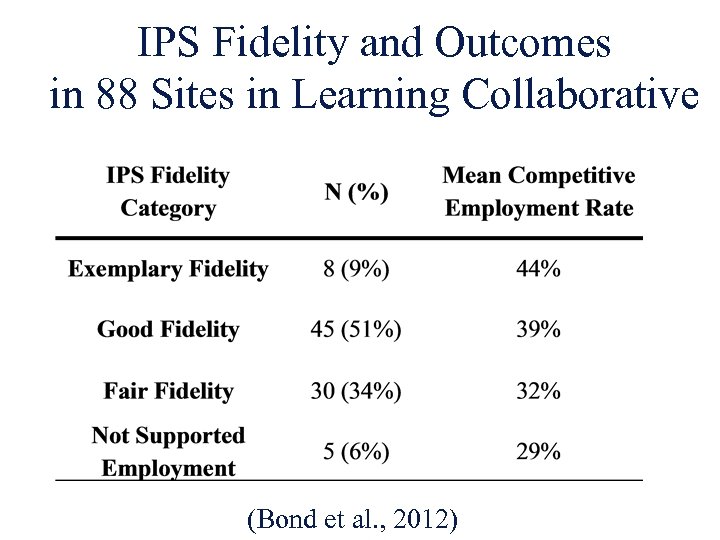 IPS Fidelity and Outcomes in 88 Sites in Learning Collaborative (Bond et al. , 2012)
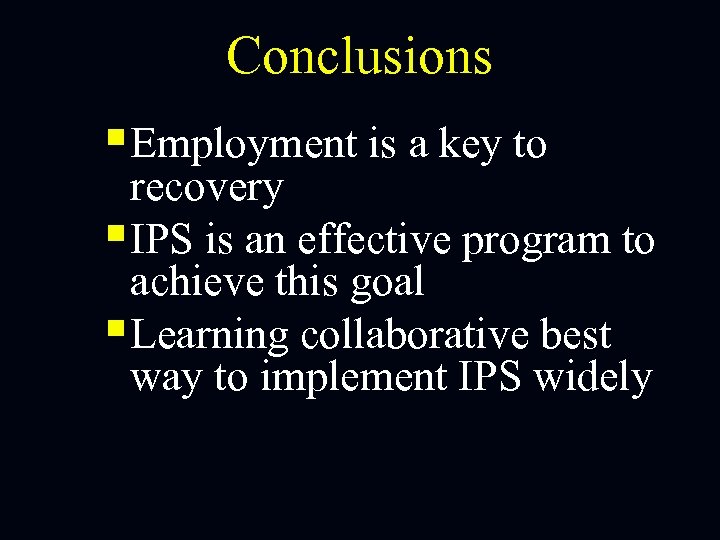 Conclusions §Employment is a key to recovery §IPS is an effective program to achieve this goal §Learning collaborative best way to implement IPS widely