


 Скачать презентацию Evidence for Perkinsus marinus Resistance In Natural Crassostrea
14ada61bcd972b1aaaa49c58ace2a662.ppt
- Количество слайдов: 17
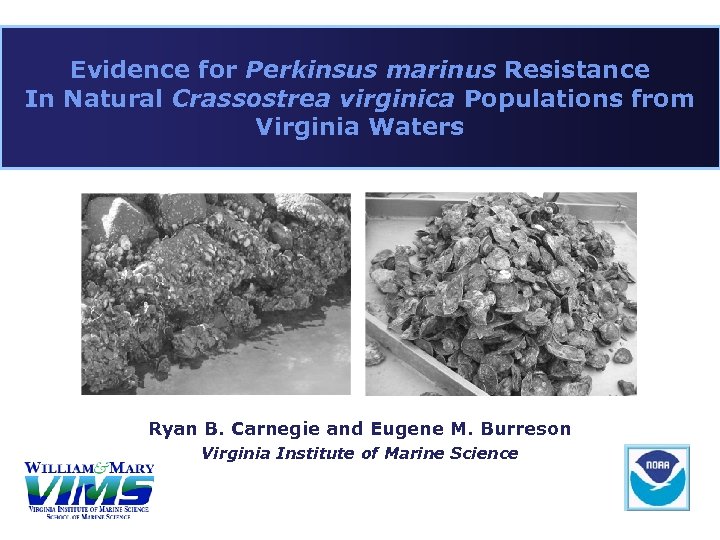 Evidence for Perkinsus marinus Resistance In Natural Crassostrea virginica Populations from Virginia Waters Ryan B. Carnegie and Eugene M. Burreson Virginia Institute of Marine Science
 Definitions: “Resistance” vs. “Tolerance” • Roy and Kirchner 2000 (Evolution 54: 51 -63): ® “Resistance”: host limits infection ® “Tolerance”: infection not limited, but fitness consequences reduced ® Parasite virulence is likely variable geographically (Bushek and Allen, Jr. , 1996) and perhaps temporally, which complicates interpretations, but with C. virginica-P. marinus we may see both resistance and tolerance
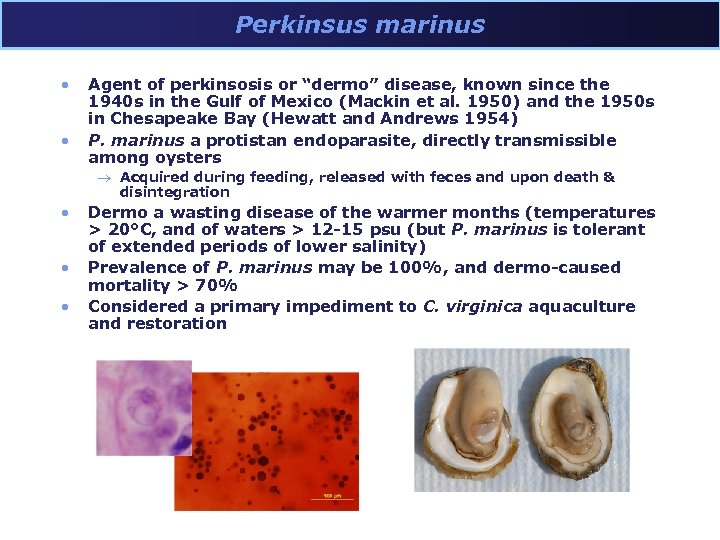 Perkinsus marinus • • Agent of perkinsosis or “dermo” disease, known since the 1940 s in the Gulf of Mexico (Mackin et al. 1950) and the 1950 s in Chesapeake Bay (Hewatt and Andrews 1954) P. marinus a protistan endoparasite, directly transmissible among oysters ® Acquired during feeding, released with feces and upon death & disintegration • • • Dermo a wasting disease of the warmer months (temperatures > 20°C, and of waters > 12 -15 psu (but P. marinus is tolerant of extended periods of lower salinity) Prevalence of P. marinus may be 100%, and dermo-caused mortality > 70% Considered a primary impediment to C. virginica aquaculture and restoration
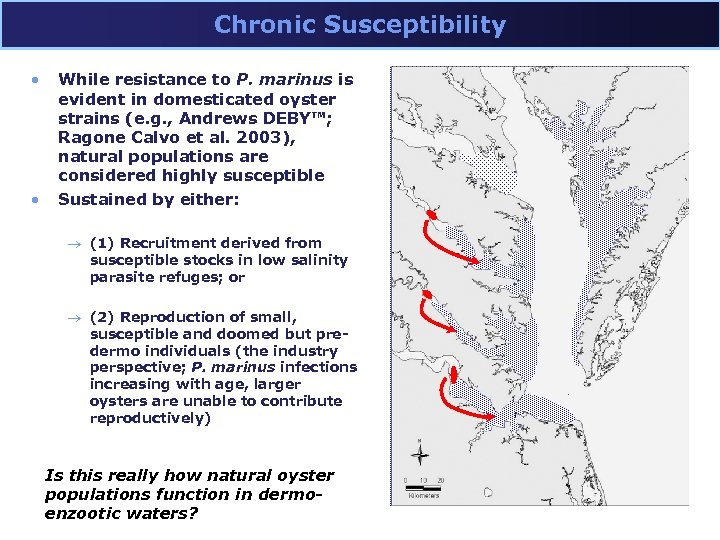 Chronic Susceptibility • • While resistance to P. marinus is evident in domesticated oyster strains (e. g. , Andrews DEBY™; Ragone Calvo et al. 2003), natural populations are considered highly susceptible Sustained by either: ® (1) Recruitment derived from susceptible stocks in low salinity parasite refuges; or ® (2) Reproduction of small, susceptible and doomed but predermo individuals (the industry perspective; P. marinus infections increasing with age, larger oysters are unable to contribute reproductively) Is this really how natural oyster populations function in dermoenzootic waters?
 1) Are Natural Oyster Populations from Dermo Disease. Enzootic Waters Intolerant of P. marinus? • Field comparisons of a deployed domesticated, diseaseresistant C. virginica stock (Andrews DEBY™) vs. naturally recruited oysters in a disease-enzootic location (GREAT WICOMICO RIVER FIELD ANALYSIS--2005/6) • Field comparisons of Andrews DEBY™ oysters, naïve Ross Rock (Rappahannock River) oysters, and representatives from two disease-enzootic locations (Wreck Shoal in the James, Aberdeen Rock in the York)(YORK RIVER BEACH TRIAL--2006)
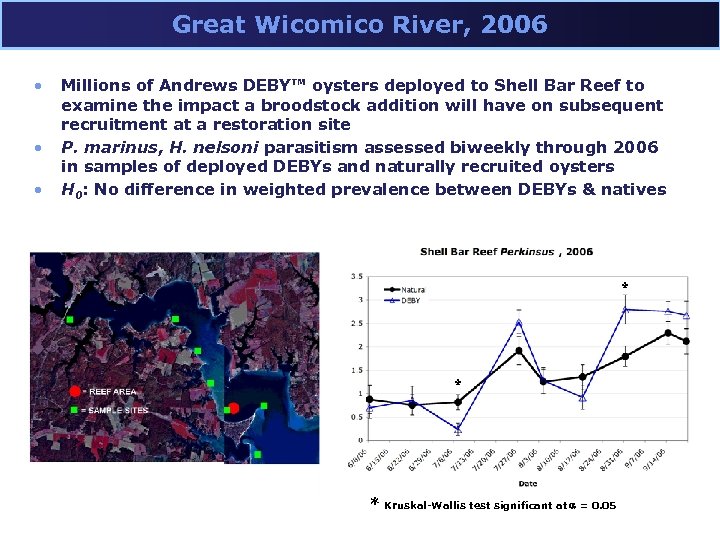 Great Wicomico River, 2006 • • • Millions of Andrews DEBY™ oysters deployed to Shell Bar Reef to examine the impact a broodstock addition will have on subsequent recruitment at a restoration site P. marinus, H. nelsoni parasitism assessed biweekly through 2006 in samples of deployed DEBYs and naturally recruited oysters H 0: No difference in weighted prevalence between DEBYs & natives * * * Kruskal-Wallis test significant at = 0. 05
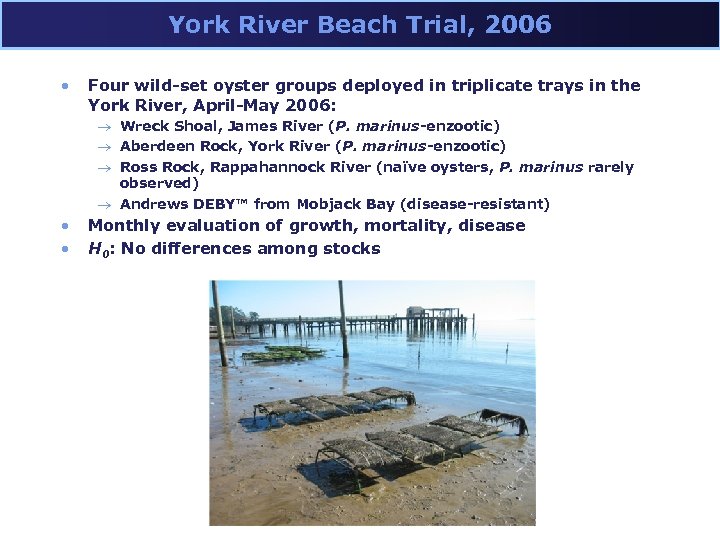 York River Beach Trial, 2006 • Four wild-set oyster groups deployed in triplicate trays in the York River, April-May 2006: ® Wreck Shoal, James River (P. marinus-enzootic) ® Aberdeen Rock, York River (P. marinus-enzootic) ® Ross Rock, Rappahannock River (naïve oysters, P. marinus rarely observed) ® Andrews DEBY™ from Mobjack Bay (disease-resistant) • • Monthly evaluation of growth, mortality, disease H 0: No differences among stocks
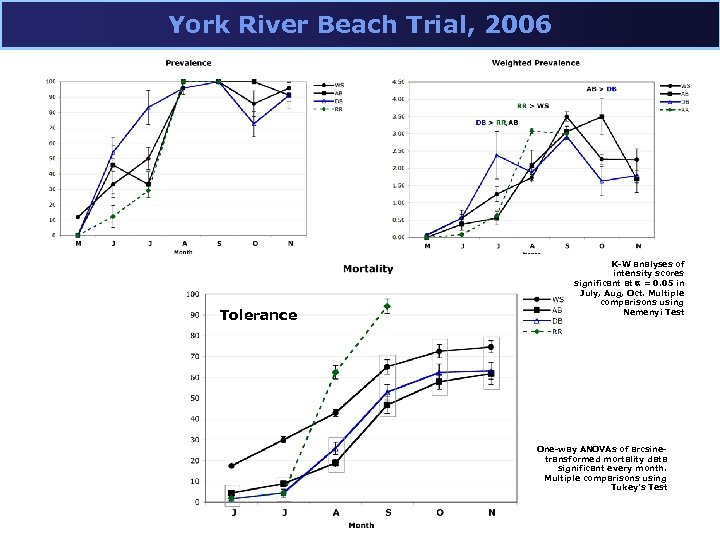 York River Beach Trial, 2006 Tolerance K-W analyses of intensity scores significant at = 0. 05 in July, Aug, Oct. Multiple comparisons using Nemenyi Test One-way ANOVAs of arcsinetransformed mortality data significant every month. Multiple comparisons using Tukey’s Test
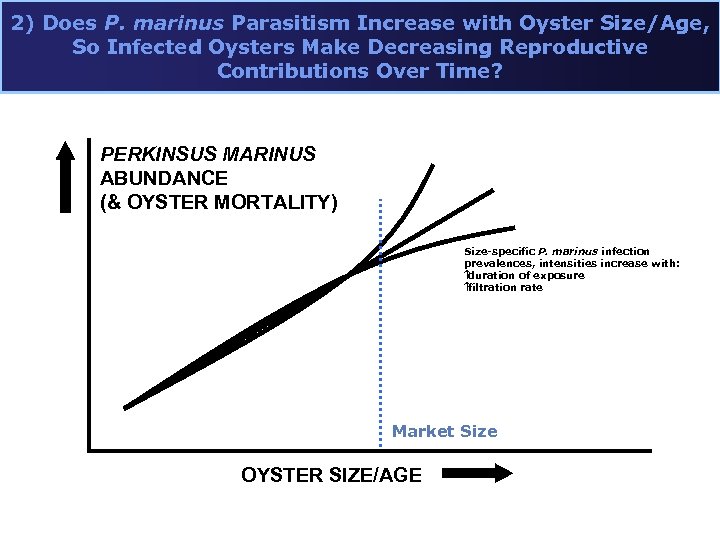 2) Does P. marinus Parasitism Increase with Oyster Size/Age, So Infected Oysters Make Decreasing Reproductive Contributions Over Time? PERKINSUS MARINUS ABUNDANCE (& OYSTER MORTALITY) Size-specific P. marinus infection prevalences, intensities increase with: duration of exposure filtration rate Market Size OYSTER SIZE/AGE
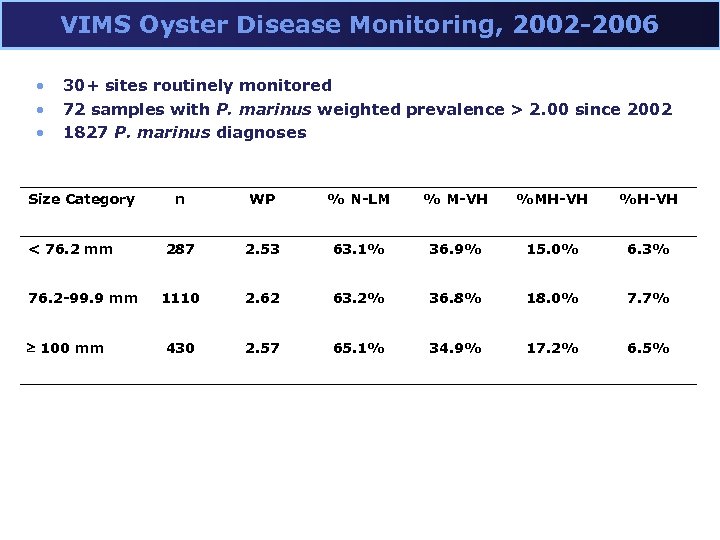 VIMS Oyster Disease Monitoring, 2002 -2006 • • • 30+ sites routinely monitored 72 samples with P. marinus weighted prevalence > 2. 00 since 2002 1827 P. marinus diagnoses Size Category < 76. 2 mm 76. 2 -99. 9 mm 100 mm n WP % N-LM % M-VH %MH-VH %H-VH 287 2. 53 63. 1% 36. 9% 15. 0% 6. 3% 1110 2. 62 63. 2% 36. 8% 18. 0% 7. 7% 430 2. 57 65. 1% 34. 9% 17. 2% 6. 5%
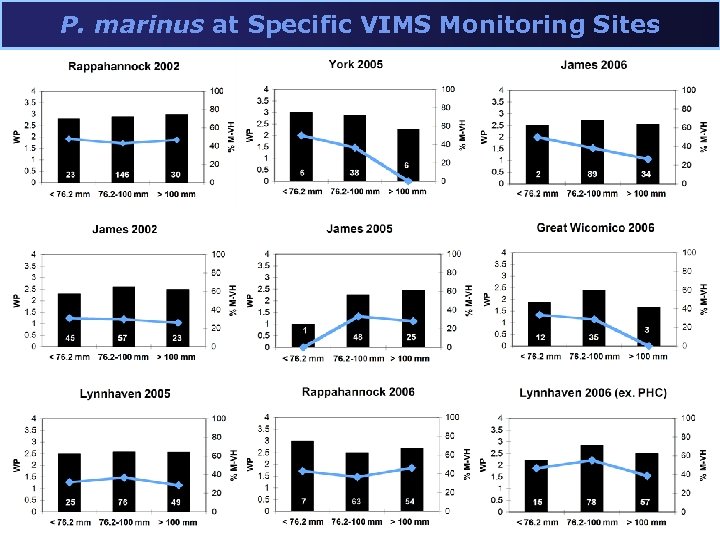 P. marinus at Specific VIMS Monitoring Sites
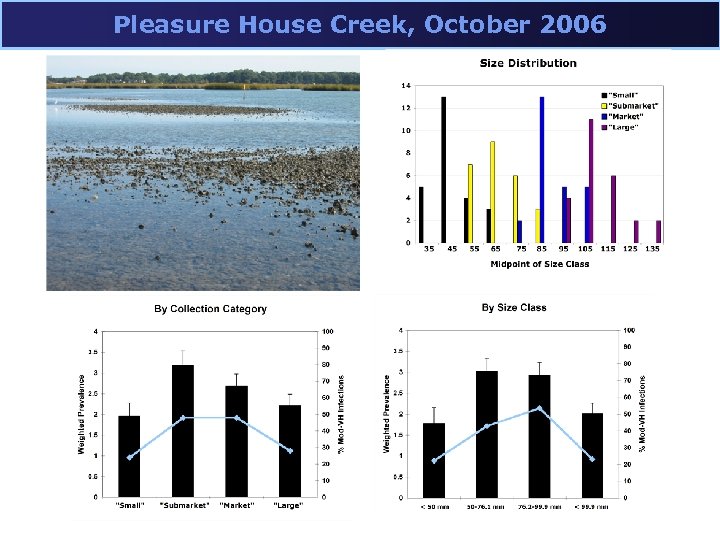 Pleasure House Creek, October 2006
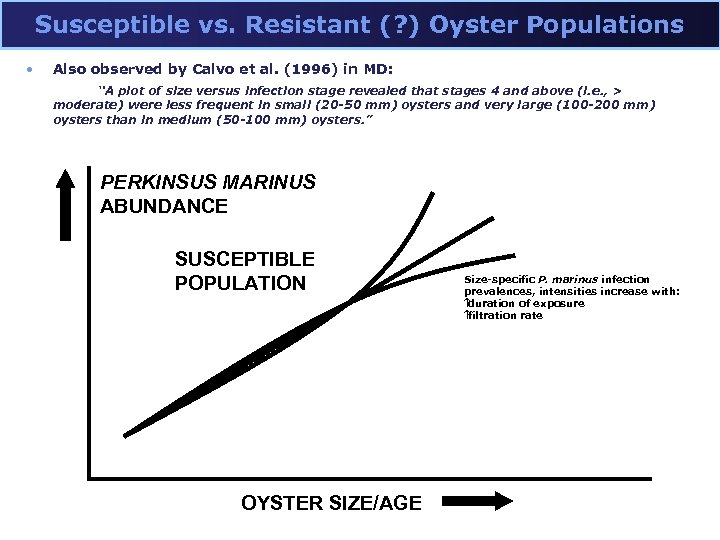 Susceptible vs. Resistant (? ) Oyster Populations • Also observed by Calvo et al. (1996) in MD: “A plot of size versus infection stage revealed that stages 4 and above (i. e. , > moderate) were less frequent in small (20 -50 mm) oysters and very large (100 -200 mm) oysters than in medium (50 -100 mm) oysters. ” PERKINSUS MARINUS ABUNDANCE SUSCEPTIBLE POPULATION OYSTER SIZE/AGE Size-specific P. marinus infection prevalences, intensities increase with: duration of exposure filtration rate
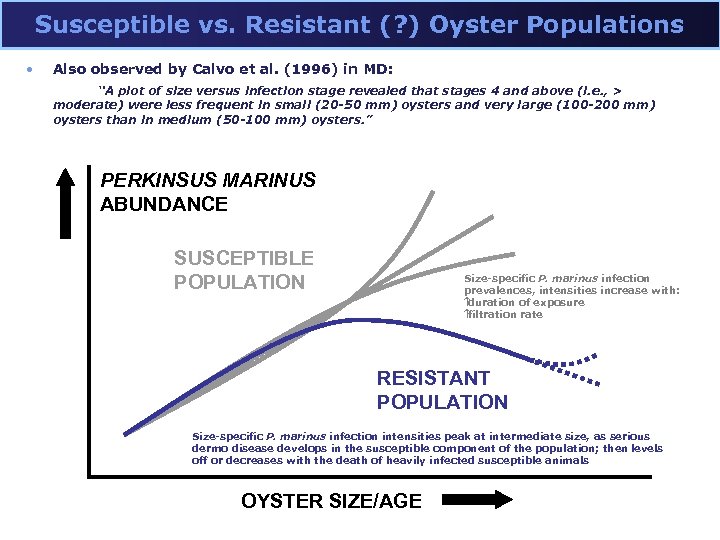 Susceptible vs. Resistant (? ) Oyster Populations • Also observed by Calvo et al. (1996) in MD: “A plot of size versus infection stage revealed that stages 4 and above (i. e. , > moderate) were less frequent in small (20 -50 mm) oysters and very large (100 -200 mm) oysters than in medium (50 -100 mm) oysters. ” PERKINSUS MARINUS ABUNDANCE SUSCEPTIBLE POPULATION Size-specific P. marinus infection prevalences, intensities increase with: duration of exposure filtration rate RESISTANT POPULATION Size-specific P. marinus infection intensities peak at intermediate size, as serious dermo disease develops in the susceptible component of the population; then levels off or decreases with the death of heavily infected susceptible animals OYSTER SIZE/AGE
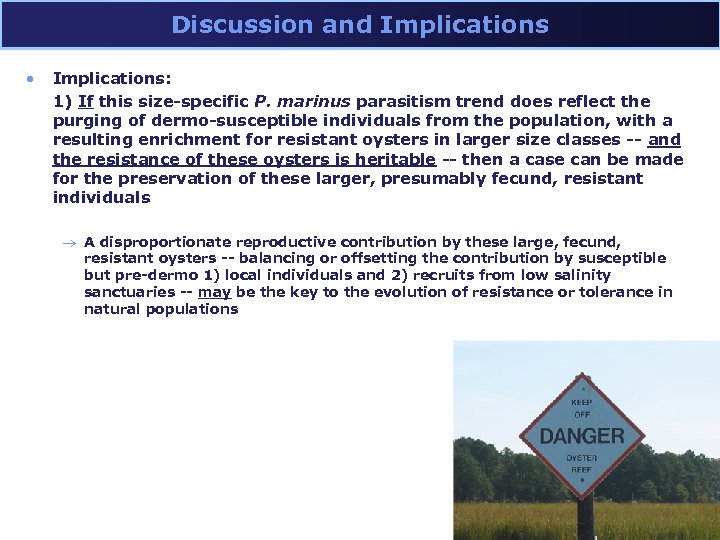 Discussion and Implications • Implications: 1) If this size-specific P. marinus parasitism trend does reflect the purging of dermo-susceptible individuals from the population, with a resulting enrichment for resistant oysters in larger size classes -- and the resistance of these oysters is heritable -- then a case can be made for the preservation of these larger, presumably fecund, resistant individuals ® A disproportionate reproductive contribution by these large, fecund, resistant oysters -- balancing or offsetting the contribution by susceptible but pre-dermo 1) local individuals and 2) recruits from low salinity sanctuaries -- may be the key to the evolution of resistance or tolerance in natural populations
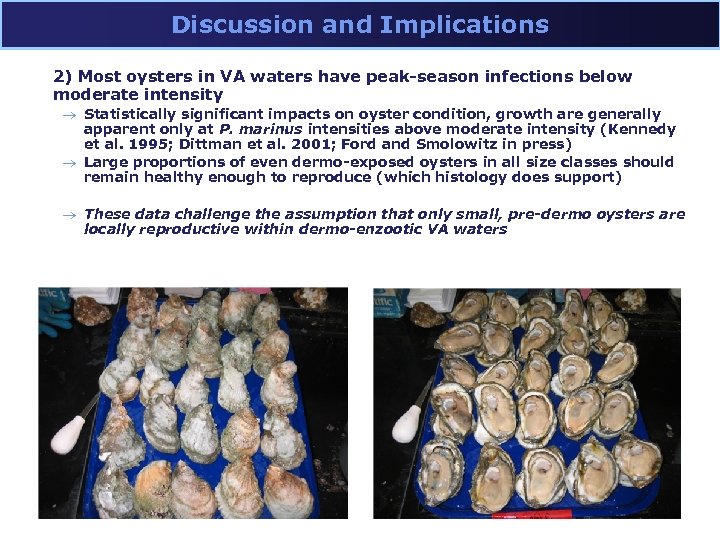 Discussion and Implications 2) Most oysters in VA waters have peak-season infections below moderate intensity ® Statistically significant impacts on oyster condition, growth are generally apparent only at P. marinus intensities above moderate intensity (Kennedy et al. 1995; Dittman et al. 2001; Ford and Smolowitz in press) ® Large proportions of even dermo-exposed oysters in all size classes should remain healthy enough to reproduce (which histology does support) ® These data challenge the assumption that only small, pre-dermo oysters are locally reproductive within dermo-enzootic VA waters
 Acknowledgments • Rita Crockett, Susan Denny, Nancy Stokes, Corinne Audemard, Jessica Moss, Margaret Fagan, Zachary Kator (VIMS Shellfish Pathology Laboratory) • Melissa Southworth (VIMS Molluscan Ecology Program) • Paul Oliver (VIMS Vessel Operations) • Lionel Degremont, Stan Allen (VIMS Aquaculture Genetics and Breeding Technology Center) • Jim Wesson (VA Marine Resources Commission)