


 Скачать презентацию Evian Preparation Meeting DA aspects and hints F
5e3f35ce8996a11ed0b296427ad41a81.ppt
- Количество слайдов: 7
 Evian Preparation Meeting: DA aspects and hints F. Antoniou, S. Fartoukh, G. Iadarola, Y. Papaphilippou, D. Pellegrini
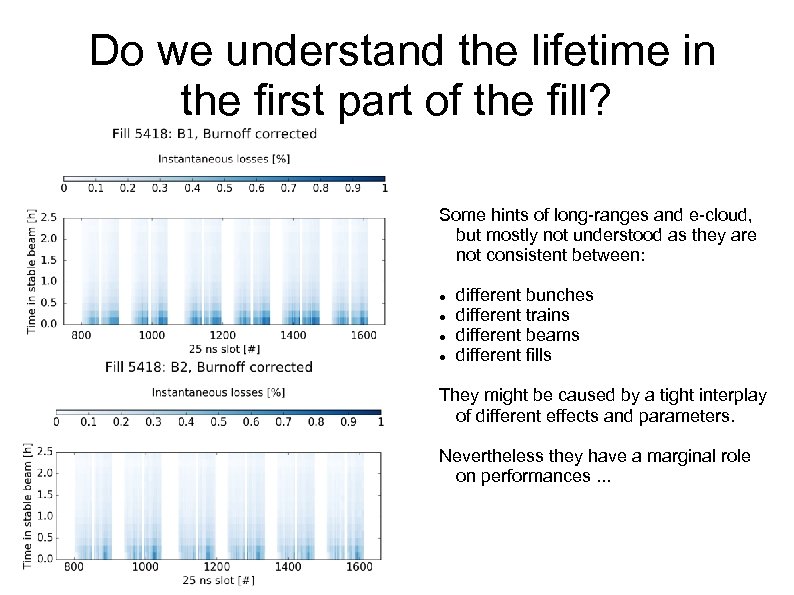 Do we understand the lifetime in the first part of the fill? Some hints of long-ranges and e-cloud, but mostly not understood as they are not consistent between: different bunches different trains different beams different fills They might be caused by a tight interplay of different effects and parameters. Nevertheless they have a marginal role on performances. . .
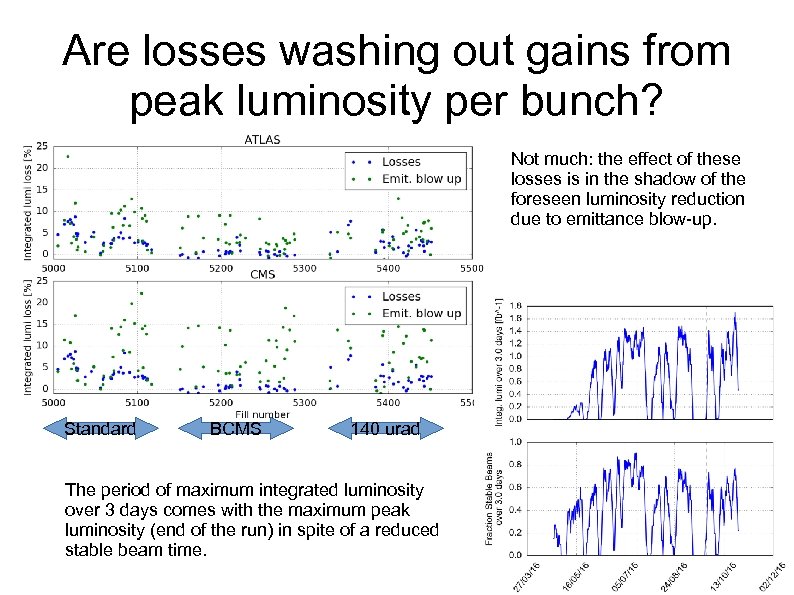 Are losses washing out gains from peak luminosity per bunch? Not much: the effect of these losses is in the shadow of the foreseen luminosity reduction due to emittance blow-up. Standard BCMS 140 urad The period of maximum integrated luminosity over 3 days comes with the maximum peak luminosity (end of the run) in spite of a reduced stable beam time.
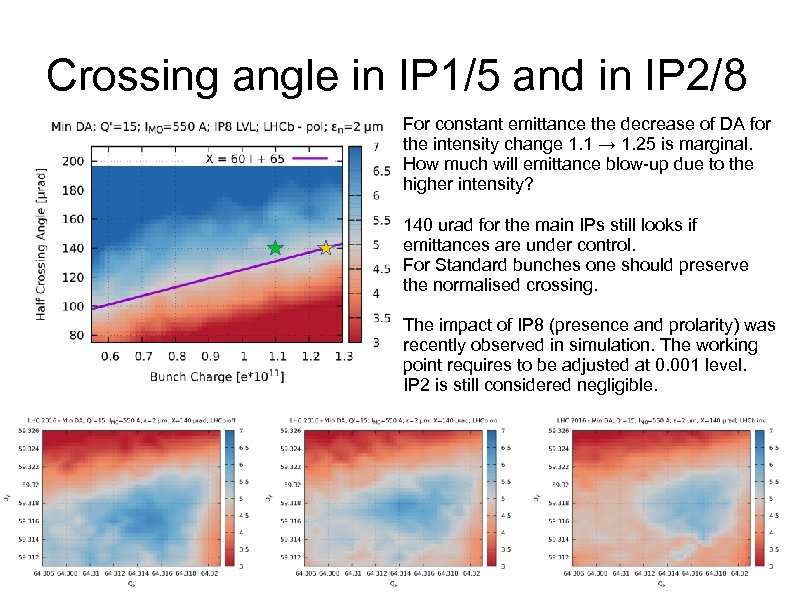 Crossing angle in IP 1/5 and in IP 2/8 For constant emittance the decrease of DA for the intensity change 1. 1 → 1. 25 is marginal. How much will emittance blow-up due to the higher intensity? 140 urad for the main IPs still looks if emittances are under control. For Standard bunches one should preserve the normalised crossing. The impact of IP 8 (presence and prolarity) was recently observed in simulation. The working point requires to be adjusted at 0. 001 level. IP 2 is still considered negligible.
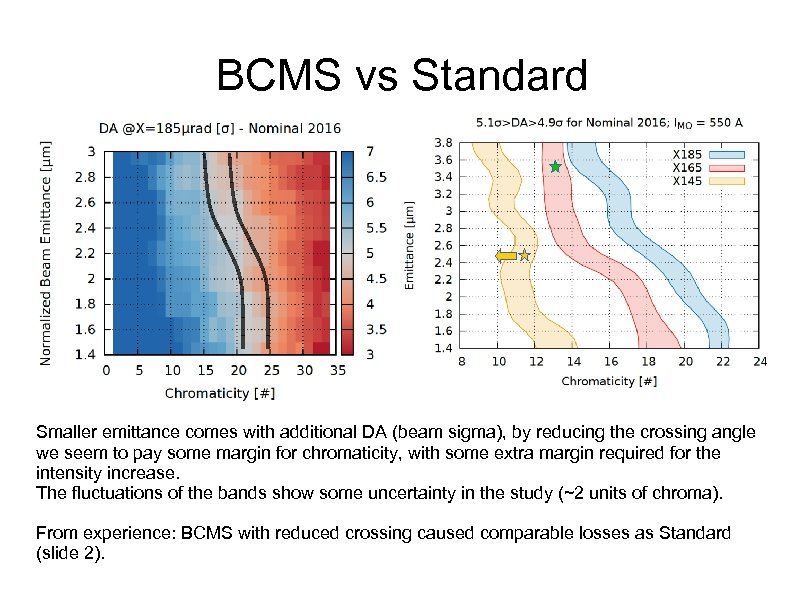 BCMS vs Standard Smaller emittance comes with additional DA (beam sigma), by reducing the crossing angle we seem to pay some margin for chromaticity, with some extra margin required for the intensity increase. The fluctuations of the bands show some uncertainty in the study (~2 units of chroma). From experience: BCMS with reduced crossing caused comparable losses as Standard (slide 2).
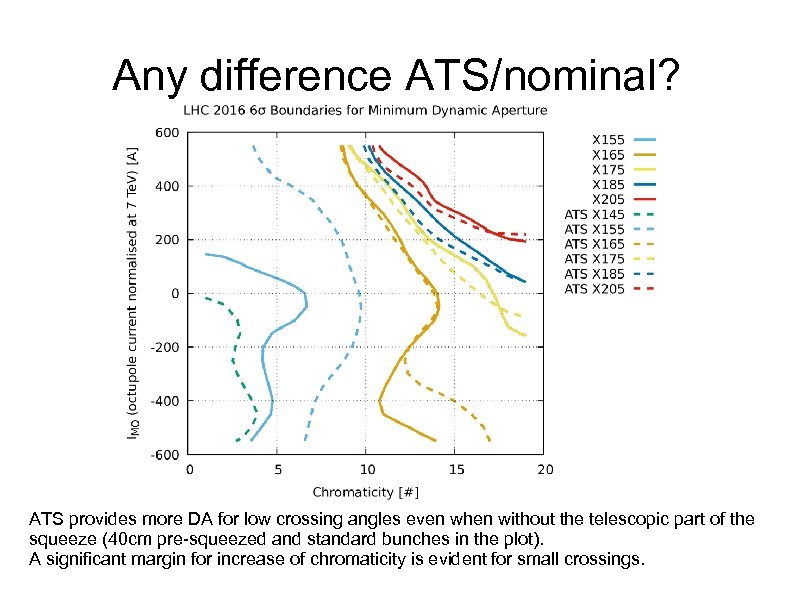 Any difference ATS/nominal? ATS provides more DA for low crossing angles even when without the telescopic part of the squeeze (40 cm pre-squeezed and standard bunches in the plot). A significant margin for increase of chromaticity is evident for small crossings.
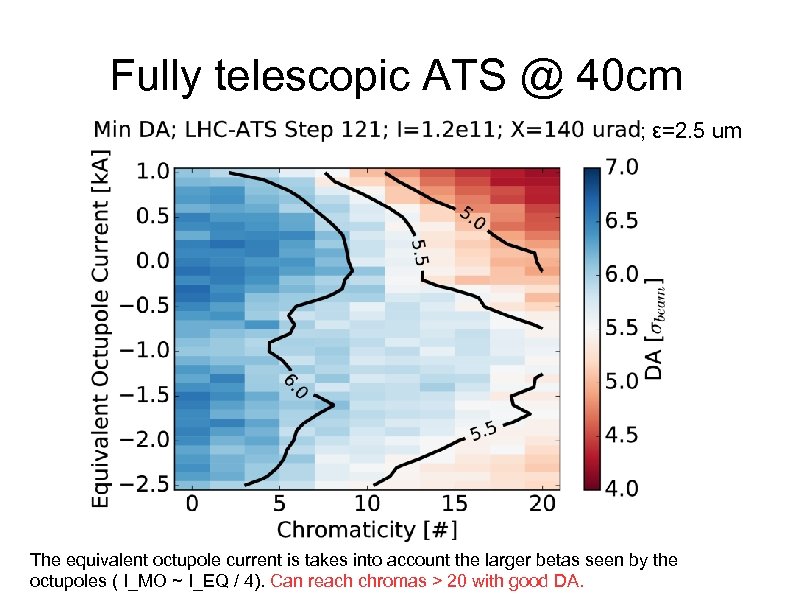 Fully telescopic ATS @ 40 cm ; ε=2. 5 um The equivalent octupole current is takes into account the larger betas seen by the octupoles ( I_MO ~ I_EQ / 4). Can reach chromas > 20 with good DA.