 Скачать презентацию Everything You Wanted to Know About Bonds But
2c938e3bc02bff894955873e569f51ad.ppt
- Количество слайдов: 63



Everything You Wanted to Know About Bonds But Were Afraid to Ask January 5, 2005 Texas Bond Review Board Bob Kline, Executive Director kline@brb. state. tx. us 512 -463 -1741 www. brb. state. tx. us Texas Public Finance Authority Kim Edwards, Executive Director kim. edwards@tpfa. state. tx. us 512 -463 -5544 www. tpfa. state. tx. us

1. Introduction
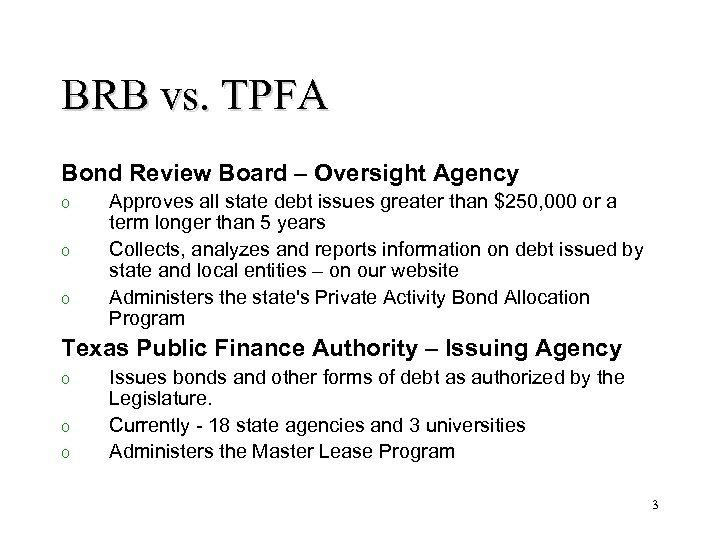
BRB vs. TPFA Bond Review Board – Oversight Agency o o o Approves all state debt issues greater than $250, 000 or a term longer than 5 years Collects, analyzes and reports information on debt issued by state and local entities – on our website Administers the state's Private Activity Bond Allocation Program Texas Public Finance Authority – Issuing Agency o o o Issues bonds and other forms of debt as authorized by the Legislature. Currently - 18 state agencies and 3 universities Administers the Master Lease Program 3
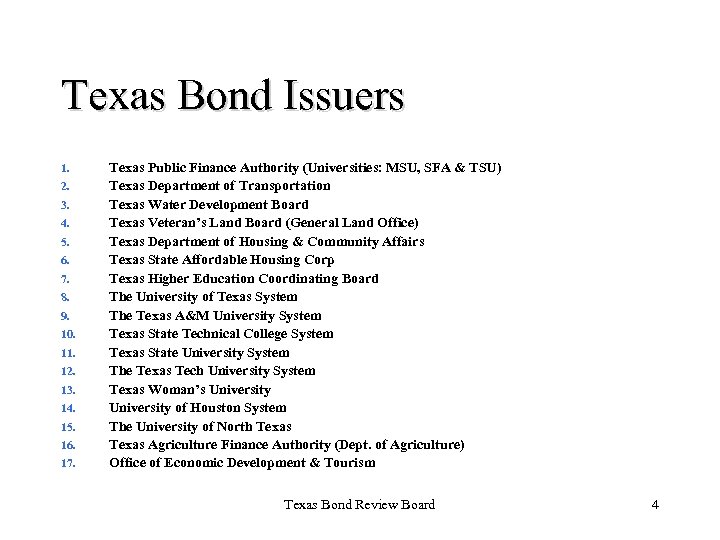
Texas Bond Issuers 1. 2. 3. 4. 5. 6. 7. 8. 9. 10. 11. 12. 13. 14. 15. 16. 17. Texas Public Finance Authority (Universities: MSU, SFA & TSU) Texas Department of Transportation Texas Water Development Board Texas Veteran’s Land Board (General Land Office) Texas Department of Housing & Community Affairs Texas State Affordable Housing Corp Texas Higher Education Coordinating Board The University of Texas System The Texas A&M University System Texas State Technical College System Texas State University System The Texas Tech University System Texas Woman’s University of Houston System The University of North Texas Agriculture Finance Authority (Dept. of Agriculture) Office of Economic Development & Tourism Texas Bond Review Board 4
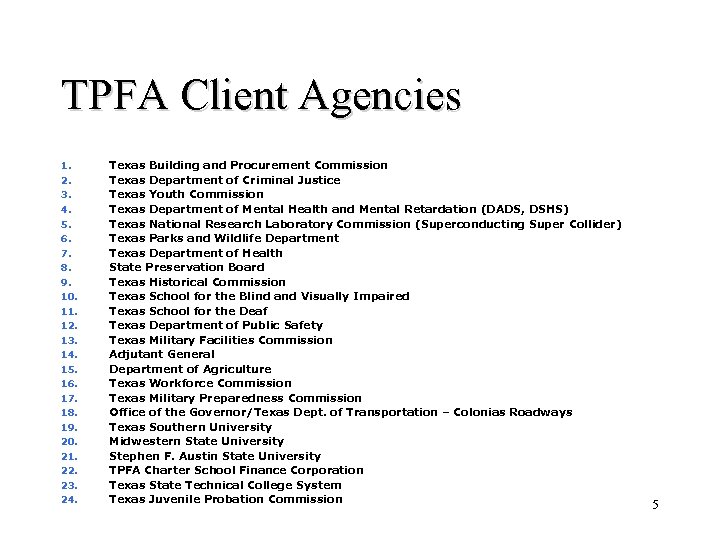
TPFA Client Agencies 1. 2. 3. 4. 5. 6. 7. 8. 9. 10. 11. 12. 13. 14. 15. 16. 17. 18. 19. 20. 21. 22. 23. 24. Texas Building and Procurement Commission Texas Department of Criminal Justice Texas Youth Commission Texas Department of Mental Health and Mental Retardation (DADS, DSHS) Texas National Research Laboratory Commission (Superconducting Super Collider) Texas Parks and Wildlife Department Texas Department of Health State Preservation Board Texas Historical Commission Texas School for the Blind and Visually Impaired Texas School for the Deaf Texas Department of Public Safety Texas Military Facilities Commission Adjutant General Department of Agriculture Texas Workforce Commission Texas Military Preparedness Commission Office of the Governor/Texas Dept. of Transportation – Colonias Roadways Texas Southern University Midwestern State University Stephen F. Austin State University TPFA Charter School Finance Corporation Texas State Technical College System Texas Juvenile Probation Commission 5
2. What is a Bond?
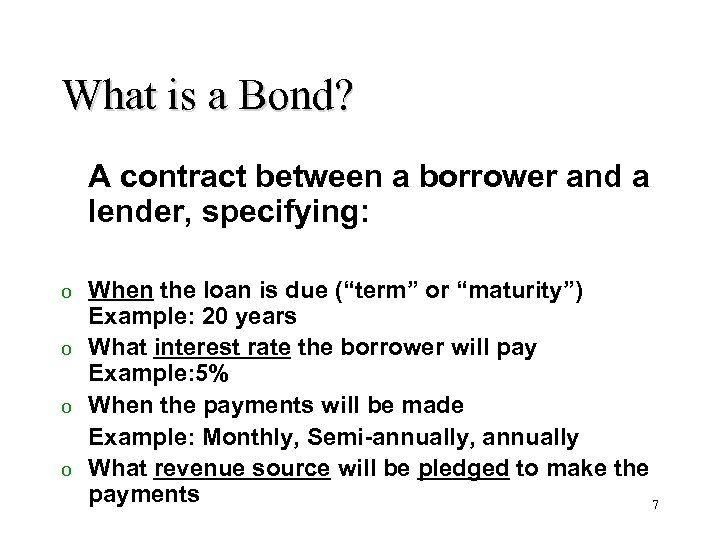
What is a Bond? A contract between a borrower and a lender, specifying: When the loan is due (“term” or “maturity”) Example: 20 years o What interest rate the borrower will pay Example: 5% o When the payments will be made Example: Monthly, Semi-annually, annually o What revenue source will be pledged to make the payments 7 o
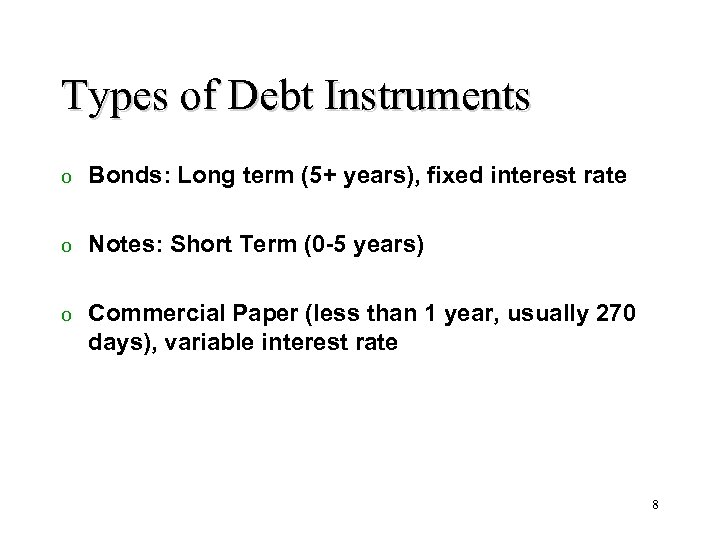
Types of Debt Instruments o Bonds: Long term (5+ years), fixed interest rate o Notes: Short Term (0 -5 years) o Commercial Paper (less than 1 year, usually 270 days), variable interest rate 8
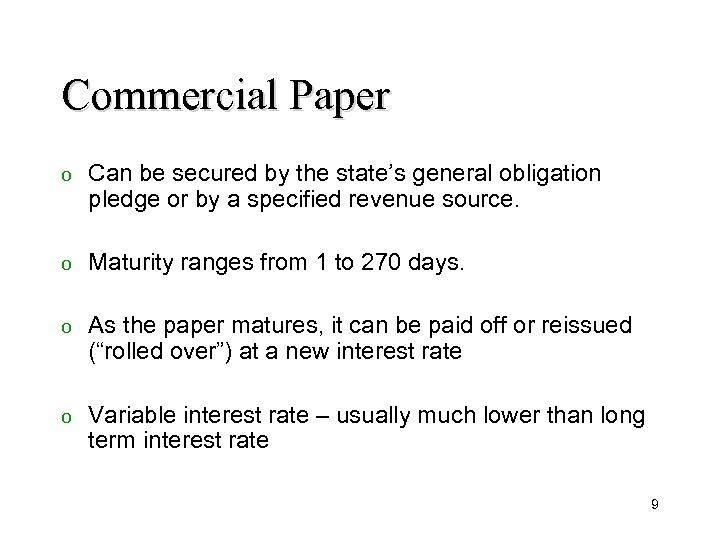
Commercial Paper o Can be secured by the state’s general obligation pledge or by a specified revenue source. o Maturity ranges from 1 to 270 days. o As the paper matures, it can be paid off or reissued (“rolled over”) at a new interest rate o Variable interest rate – usually much lower than long term interest rate 9
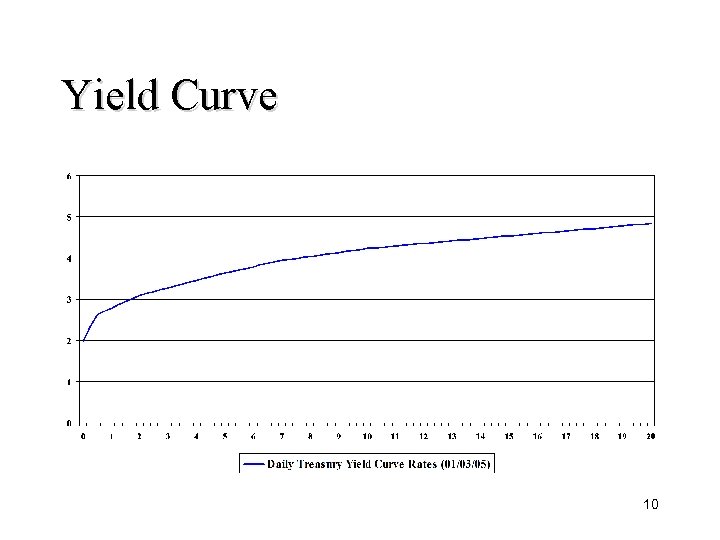
Yield Curve 10
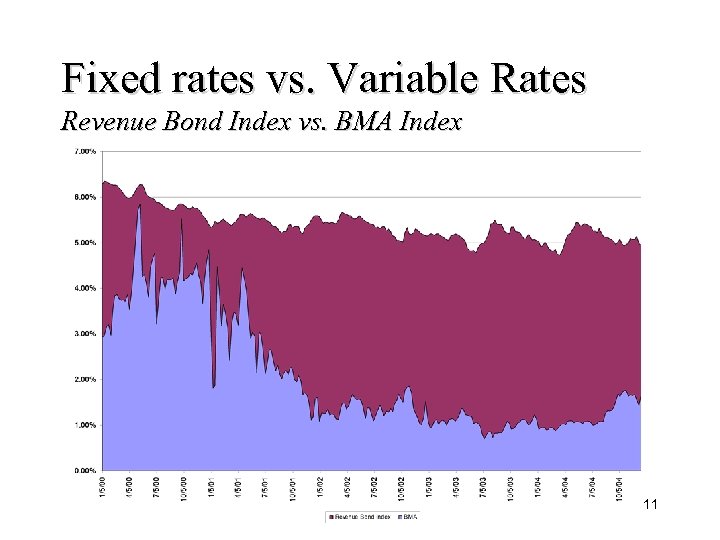
Fixed rates vs. Variable Rates Revenue Bond Index vs. BMA Index 11
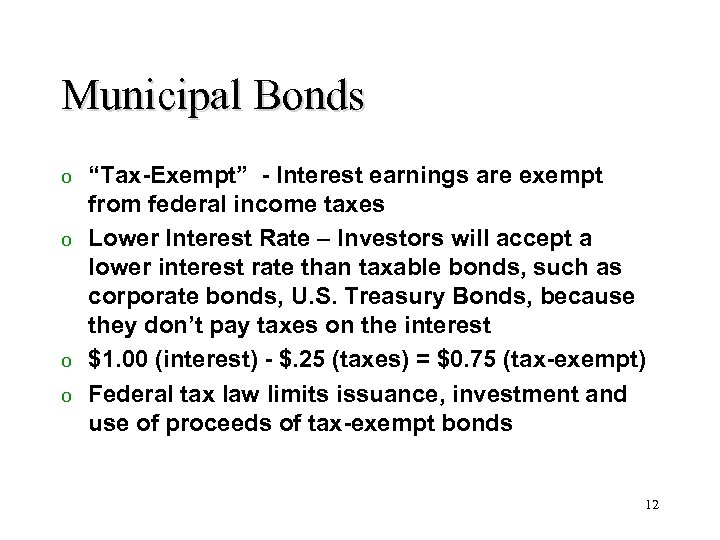
Municipal Bonds “Tax-Exempt” - Interest earnings are exempt from federal income taxes o Lower Interest Rate – Investors will accept a lower interest rate than taxable bonds, such as corporate bonds, U. S. Treasury Bonds, because they don’t pay taxes on the interest o $1. 00 (interest) - $. 25 (taxes) = $0. 75 (tax-exempt) o Federal tax law limits issuance, investment and use of proceeds of tax-exempt bonds o 12
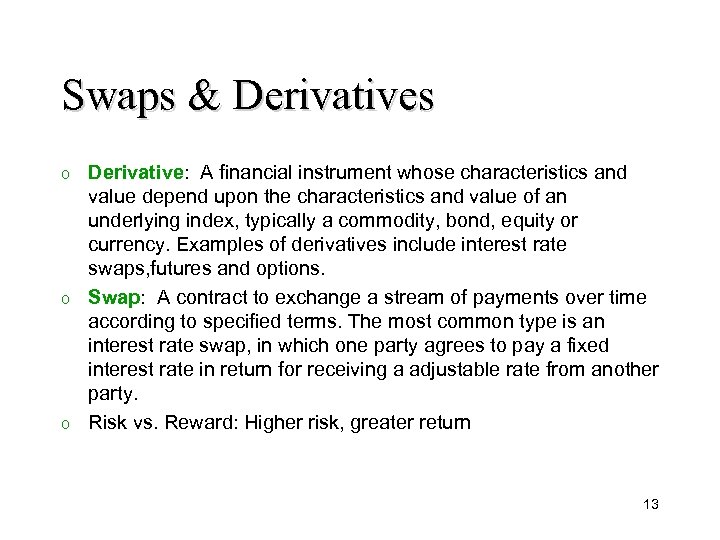
Swaps & Derivatives Derivative: A financial instrument whose characteristics and value depend upon the characteristics and value of an underlying index, typically a commodity, bond, equity or currency. Examples of derivatives include interest rate swaps, futures and options. o Swap: A contract to exchange a stream of payments over time according to specified terms. The most common type is an interest rate swap, in which one party agrees to pay a fixed interest rate in return for receiving a adjustable rate from another party. o Risk vs. Reward: Higher risk, greater return o 13
3. Types of Debt used by the State of Texas
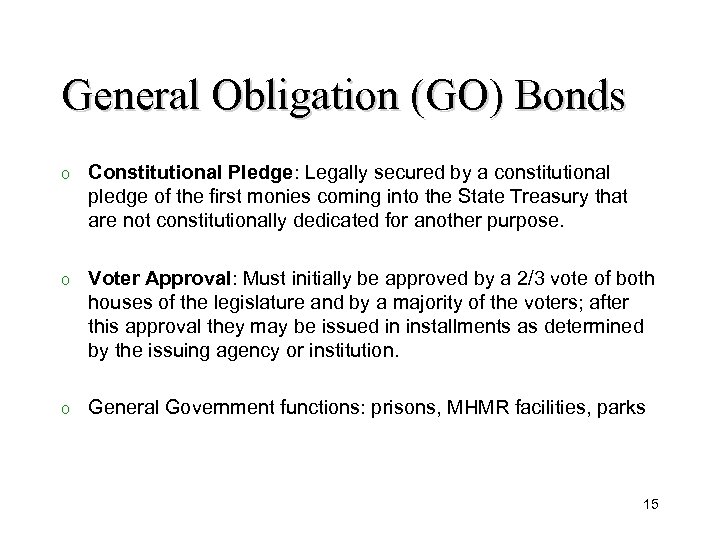
General Obligation (GO) Bonds o Constitutional Pledge: Legally secured by a constitutional pledge of the first monies coming into the State Treasury that are not constitutionally dedicated for another purpose. o Voter Approval: Must initially be approved by a 2/3 vote of both houses of the legislature and by a majority of the voters; after this approval they may be issued in installments as determined by the issuing agency or institution. o General Government functions: prisons, MHMR facilities, parks 15
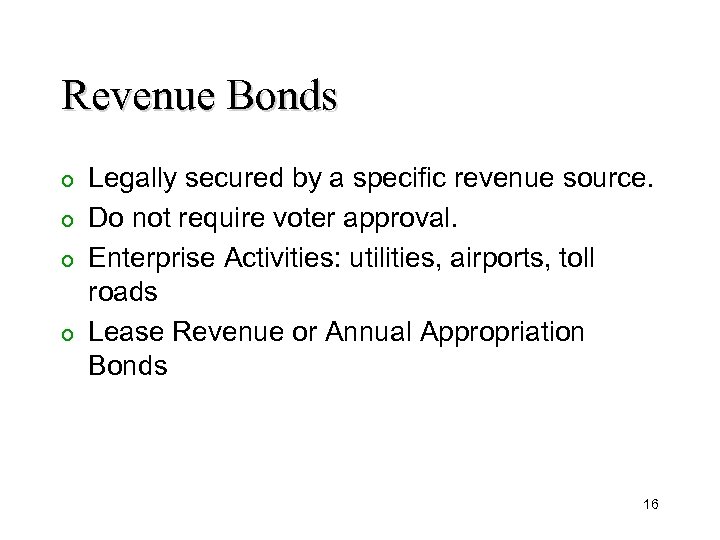
Revenue Bonds Legally secured by a specific revenue source. o Do not require voter approval. o Enterprise Activities: utilities, airports, toll roads o Lease Revenue or Annual Appropriation Bonds o 16
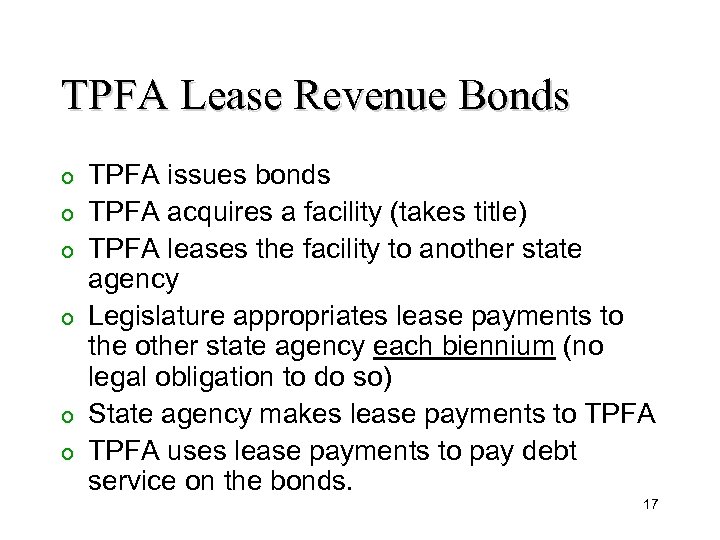
TPFA Lease Revenue Bonds o o o TPFA issues bonds TPFA acquires a facility (takes title) TPFA leases the facility to another state agency Legislature appropriates lease payments to the other state agency each biennium (no legal obligation to do so) State agency makes lease payments to TPFA uses lease payments to pay debt service on the bonds. 17
Lease Purchases o Lease purchases are the purchase of an asset over time through lease payments that include principal and interest. o Lease purchases are typically financed through a private vendor, or through one of the state’s pool programs, such as TPFA’s Master Lease Purchase Program. o Examples: State prisons and office buildings have been financed using lease-purchasing from nonprofit corporations; equipment, vehicles, software financed through the TPFA’s Master Lease Program 18
Master Lease Purchase Program The Master Lease Purchase Program ("MLPP") is a lease revenue financing program established in 1992, primarily to finance capital equipment acquisitions by state agencies, authorized by Texas Civil Statutes, Article 601 d, § 9 A (now, Texas Gov’t. Code, § 1232. 103. ) o MLPP also may be used to finance other types of projects that have been specifically authorized by the Legislature and approved by the TPFA Board. The financing vehicle for the MLPP program is a tax-exempt revenue commercial paper program. o 19
Tax and Revenue Anticipation Notes (TRANs) o TRANs are issued by the Comptroller of Public Accounts, Treasury Operations to address cash flow shortages caused by the mismatch in the timing of revenues and expenditures in the general revenue fund. o They must be repaid by the end of the biennium in which they are used, but are usually repaid by the end of each fiscal year. o TRANs are repaid with tax receipts and other revenues of the General Revenue fund. o TRANs must be approved by the Cash Management Committee, which is composed of the Governor, the Lieutenant Governor, and the Comptroller of Public Accounts, as voting members, and the Speaker of the House (as a non-voting member) 20
Debt Issued by Universities o Revenue Bonds: Under Chapter 55 of the Education Code, universities may issue revenue bonds or notes to finance permanent improvements for their institution(s). The universities may establish, and most have established, system-wide revenue financing programs which pledge all system-wide revenue, except legislative appropriations, to the repayment of the revenue bonds and notes (“Revenue Financing System”) o Tuition Revenue Bonds: The Legislature may also authorize “tuition revenue bonds”, usually for specific purposes or projects, and appropriate general revenue to offset the institution’s debt service; legislative appropriations made directly for debt service would be unconstitutional. o PUF/HEAF: The University of Texas and Texas A&M Systems may issue obligations backed by income of the Permanent University Fund (PUF), in accordance with Texas Constitution, Art. VII, § 18. Texas’ other institutions may issue Higher Education Assistance Fund (HEAF) bonds, in accordance with Texas Constitution, Art. VII, § 17. 21
Tuition Revenue Bonds o In addition to the general authority of Chapter 55 of the Education Code, the Legislature periodically authorizes tuition revenue bonds for specific institutions, for specific projects or purposes. o "Tuition revenue bonds" are revenue bonds issued by the institution, equally secured by and payable from the same pledge for the institution's other revenue bonds. However, historically the Legislature has appropriated general revenue to the institution to off-set all or a portion of the debt service on the bonds. o Tuition revenue bond issues must be approved by the Bond Review Board, and the projects may have to be approved or reviewed by the Higher Education Coordinating Board. 22
Refunding Bonds o o o Refinance - Issue new bonds to pay off old bonds Lower interest rate - BRB recommends 3% Change Bond Covenants Change Repayment Schedule (“Restructure”) One-Time - Federal tax law prohibits tax-exempt bonds issued after 1986 from being advance refunded more than one time. 23
Advance Refunding o Advance refunding: If the call date (pre-payment date) on the old bonds is in the future, the proceeds of the refunding issue are used to purchase government securities. These securities are deposited in an escrow account. An escrow agreement is signed and the bank ensures that the securities on deposit, along with their earnings, are used to pay the interest and principal on the outstanding issue. Technically, there are two outstanding issues: the refunded bonds, which are no longer a legal obligation of the issuer, and the refunding bonds. o The Bond Review Board’s Debt Management Guidelines recommend state debt issuers to continually monitor their debt portfolio for opportunities to refinance or refund outstanding debt, as market conditions, tax law and debt covenants allow. Refundings should achieve a minimum present value savings equal to 3% of the par amount of the refunded bonds, and be structured to maximize present value savings and achieve level debt service savings. 24
5. General Revenue Impact Self Supporting vs. Non Self Supporting
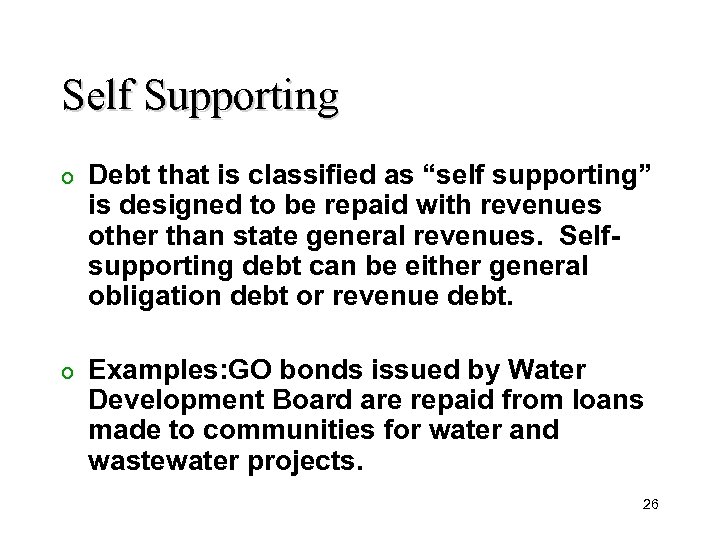
Self Supporting o Debt that is classified as “self supporting” is designed to be repaid with revenues other than state general revenues. Selfsupporting debt can be either general obligation debt or revenue debt. o Examples: GO bonds issued by Water Development Board are repaid from loans made to communities for water and wastewater projects. 26
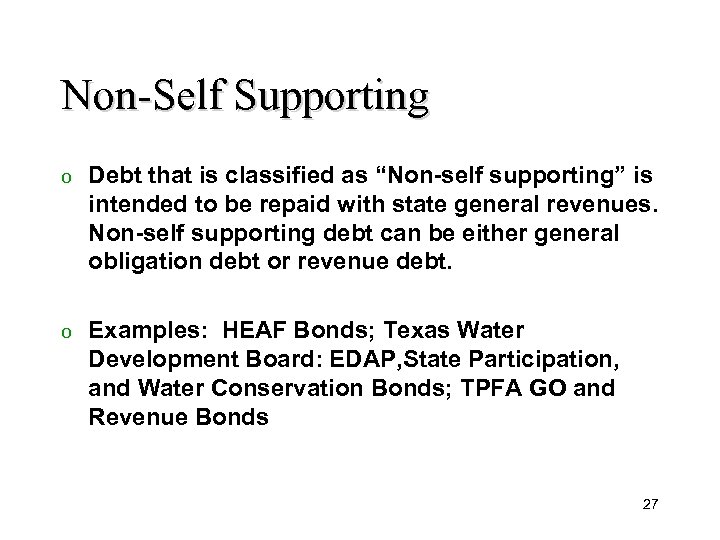
Non-Self Supporting o Debt that is classified as “Non-self supporting” is intended to be repaid with state general revenues. Non-self supporting debt can be either general obligation debt or revenue debt. o Examples: HEAF Bonds; Texas Water Development Board: EDAP, State Participation, and Water Conservation Bonds; TPFA GO and Revenue Bonds 27
6. State Debt
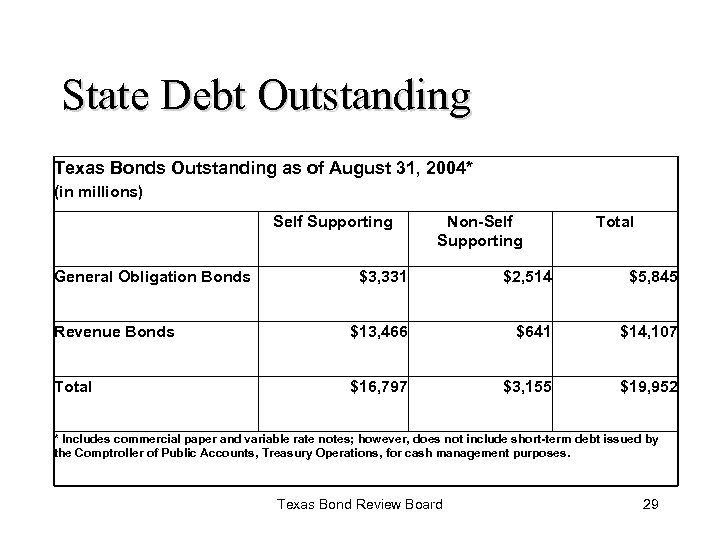
State Debt Outstanding Texas Bonds Outstanding as of August 31, 2004* (in millions) Self Supporting General Obligation Bonds Non-Self Supporting Total $3, 331 $2, 514 $5, 845 Revenue Bonds $13, 466 $641 $14, 107 Total $16, 797 $3, 155 $19, 952 * Includes commercial paper and variable rate notes; however, does not include short-term debt issued by the Comptroller of Public Accounts, Treasury Operations, for cash management purposes. Texas Bond Review Board 29
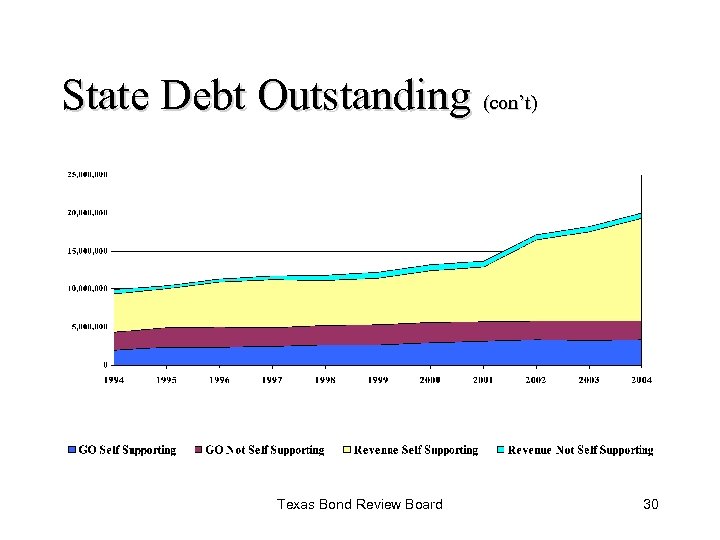
State Debt Outstanding (con’t) Texas Bond Review Board 30
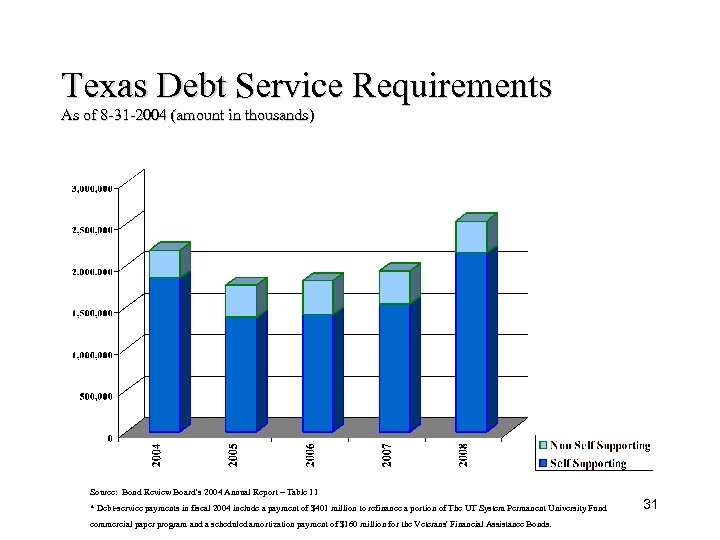
Texas Debt Service Requirements As of 8 -31 -2004 (amount in thousands) Source: Bond Review Board’s 2004 Annual Report – Table 11 * Debt-service payments in fiscal 2004 include a payment of $401 million to refinance a portion of The UT System Permanent University Fund commercial paper program and a scheduled amortization payment of $160 million for the Veterans' Financial Assistance Bonds. 31
Constitutional Debt Limit The Texas Constitution prohibits the issuance of additional state debt if the percentage of debt service payable by general revenue in any fiscal year exceeds 5% of the average of unrestricted general revenue for the past three years. For FY 2004, this percentage was 1. 51% of issued debt and 2. 31%, including authorized but unissued debt. Texas Bond Review Board 32
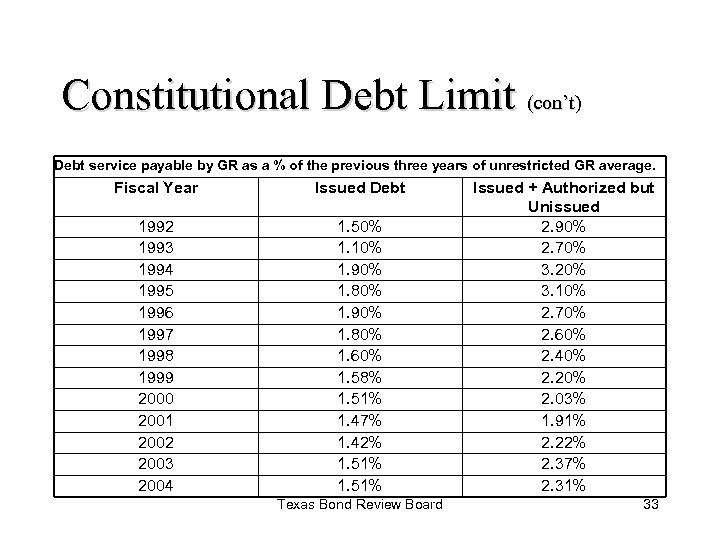
Constitutional Debt Limit (con’t) Debt service payable by GR as a % of the previous three years of unrestricted GR average. Fiscal Year Issued Debt 1992 1993 1994 1995 1996 1997 1998 1999 2000 2001 2002 2003 2004 1. 50% 1. 10% 1. 90% 1. 80% 1. 60% 1. 58% 1. 51% 1. 47% 1. 42% 1. 51% Texas Bond Review Board Issued + Authorized but Unissued 2. 90% 2. 70% 3. 20% 3. 10% 2. 70% 2. 60% 2. 40% 2. 20% 2. 03% 1. 91% 2. 22% 2. 37% 2. 31% 33
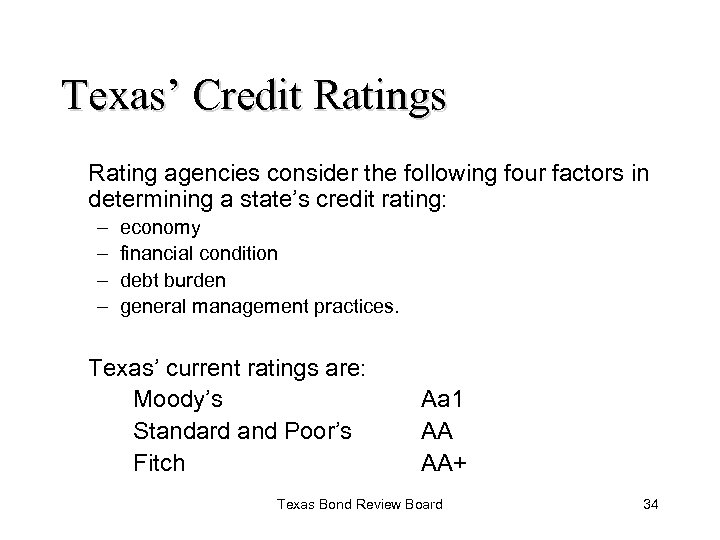
Texas’ Credit Ratings Rating agencies consider the following four factors in determining a state’s credit rating: – – economy financial condition debt burden general management practices. Texas’ current ratings are: Moody’s Standard and Poor’s Fitch Aa 1 AA AA+ Texas Bond Review Board 34
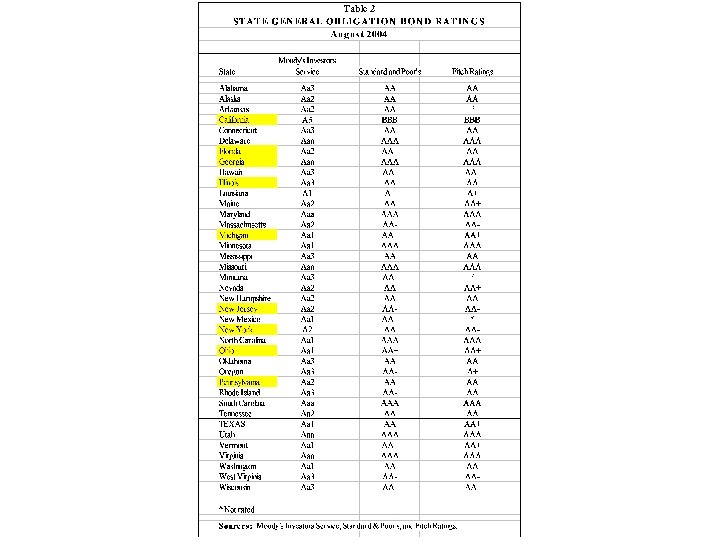
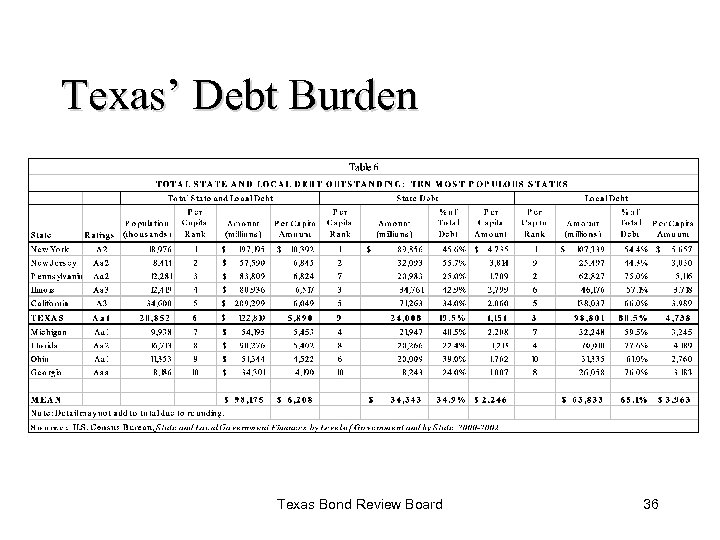
Texas’ Debt Burden Texas Bond Review Board 36
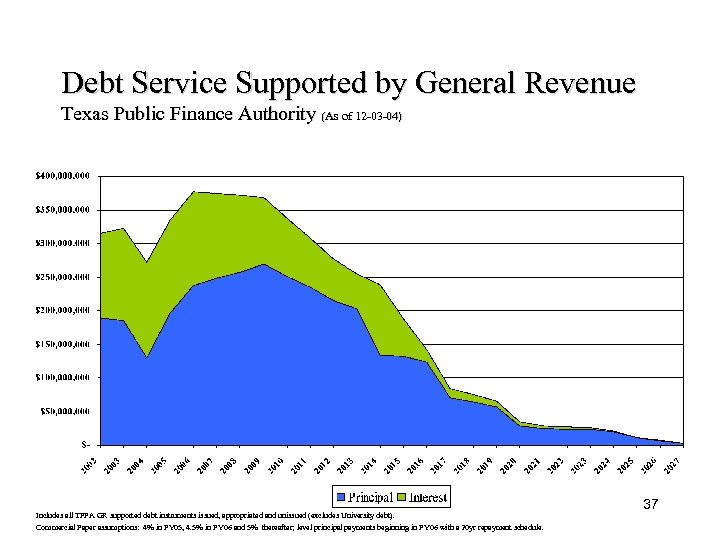
Debt Service Supported by General Revenue Texas Public Finance Authority (As of 12 -03 -04) Includes all TPFA GR supported debt instruments issued, appropriated and unissued (excludes University debt). Commercial Paper assumptions: 4% in FY 05, 4. 5% in FY 06 and 5% thereafter; level principal payments beginning in FY 06 with a 20 yr repayment schedule. 37
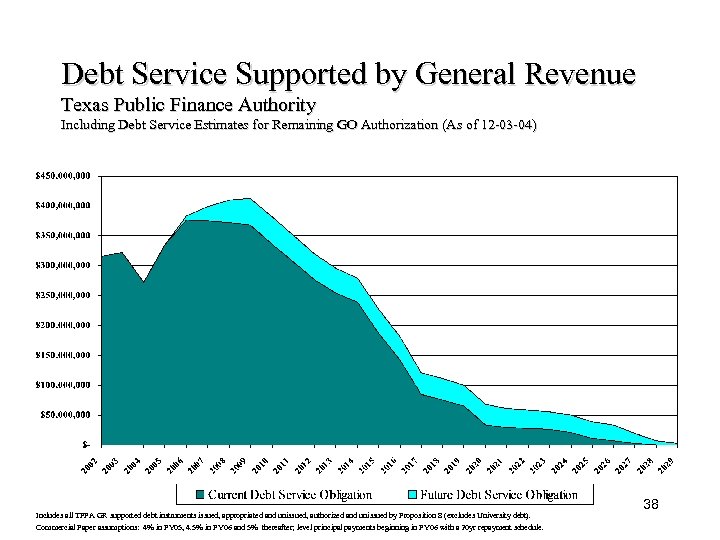
Debt Service Supported by General Revenue Texas Public Finance Authority Including Debt Service Estimates for Remaining GO Authorization (As of 12 -03 -04) Includes all TPFA GR supported debt instruments issued, appropriated and unissued, authorized and unissued by Proposition 8 (excludes University debt). Commercial Paper assumptions: 4% in FY 05, 4. 5% in FY 06 and 5% thereafter; level principal payments beginning in FY 06 with a 20 yr repayment schedule. 38
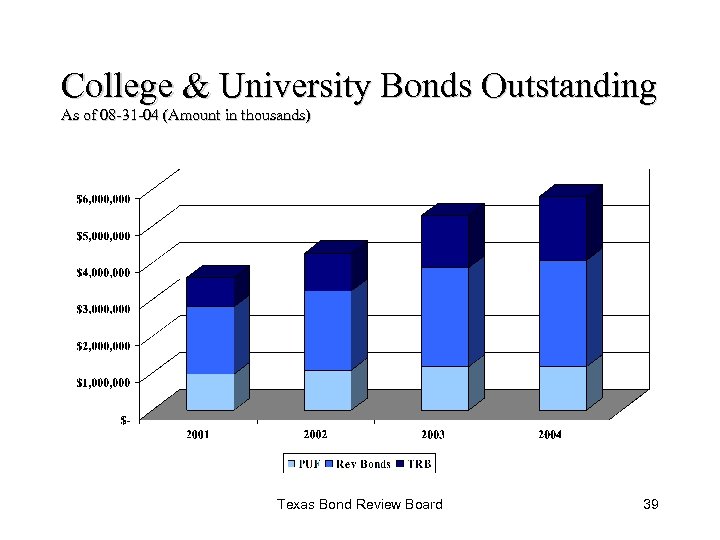
College & University Bonds Outstanding As of 08 -31 -04 (Amount in thousands) Texas Bond Review Board 39
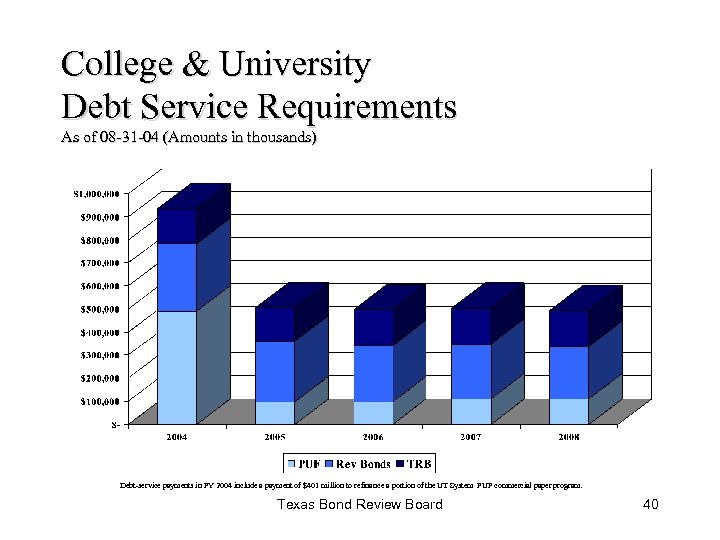
College & University Debt Service Requirements As of 08 -31 -04 (Amounts in thousands) Debt-service payments in FY 2004 include a payment of $401 million to refinance a portion of the UT System PUF commercial paper program. Texas Bond Review Board 40
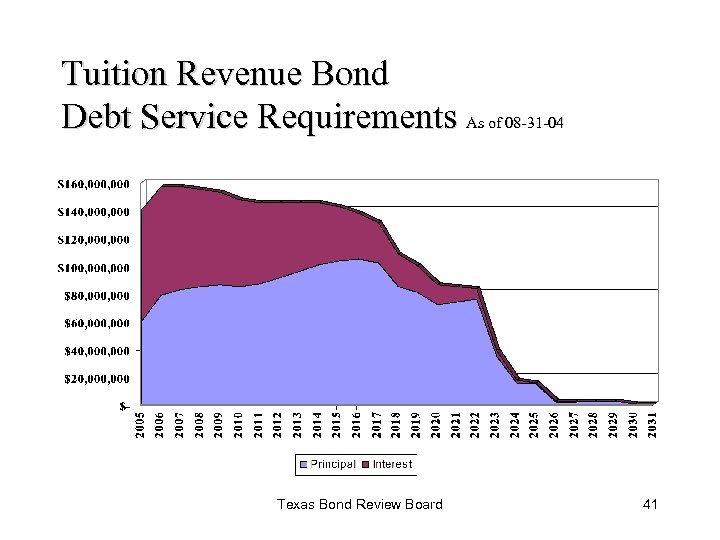
Tuition Revenue Bond Debt Service Requirements As of 08 -31 -04 Texas Bond Review Board 41
7. Local Debt Patrick Krishock Deputy Executive Director Texas Bond Review Board 512 -475 -4800 krishock@brb. state. tx. us www. brb. state. tx. us
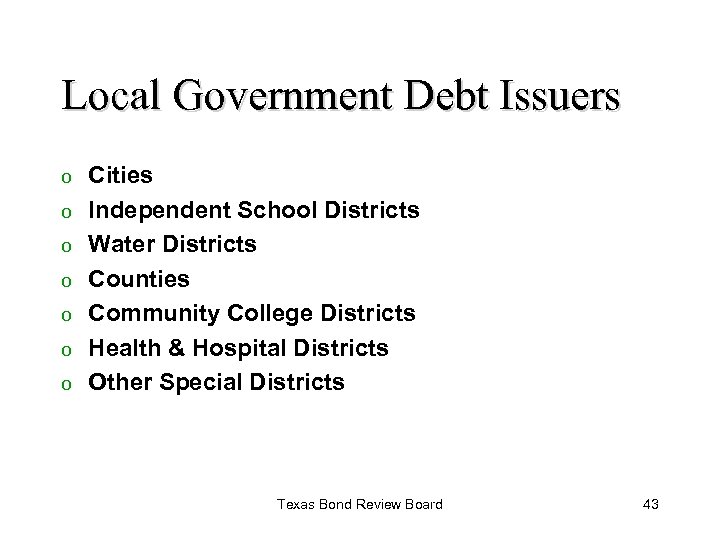
Local Government Debt Issuers o o o o Cities Independent School Districts Water Districts Counties Community College Districts Health & Hospital Districts Other Special Districts Texas Bond Review Board 43
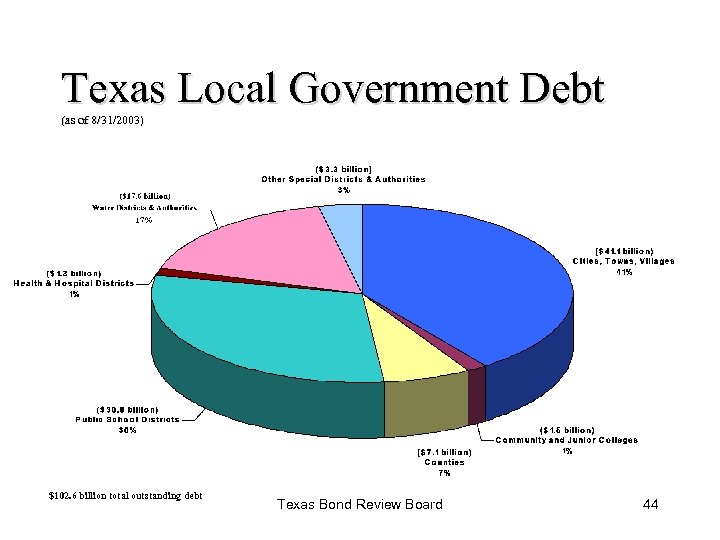
Texas Local Government Debt (as of 8/31/2003) $102. 6 billion total outstanding debt Texas Bond Review Board 44
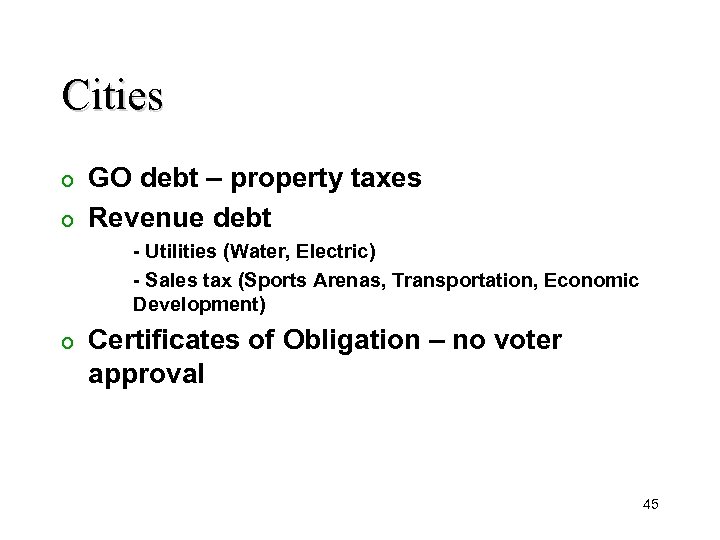
Cities GO debt – property taxes o Revenue debt o - Utilities (Water, Electric) - Sales tax (Sports Arenas, Transportation, Economic Development) o Certificates of Obligation – no voter approval 45
Independent School Districts o District issues GO Bonds – backed by property taxes o State supports School District debt through: – Permanent School Fund (PSF) – guarantees repayment of debt service – Instructional Facilities Allotment (IFA) and Existing Debt Allotment (EDA) Programs appropriate General Revenue to school districts to offset portion of debt service 46
Local Government Debt Regulation Local Government Debt Issuance Regulated by Title 9, Texas Government Code. http: //www. capitol. state. tx. us/statutes/gv. toc. htm o Attorney General must approve all Local Government Securities as required by Section 1201. 065 Texas Government Code. o Bond Review Board does not approve Local Government bond issues. o Bond Review Board reports on Local Debt using data collected by the Attorney General’s office as required by Section 1202. 008 Texas Government Code. o Texas Bond Review Board 47
BRB Online Database Local government searchable databases and downloadable data available on the Bond Review Board’s web site – www. brb. state. tx. us Texas Bond Review Board 48
8. The State of Texas Private Activity Bond Allocation Program in 2005 Rob Latsha Senior Financial Analyst & Program Administrator Texas Bond Review Board 512 -475 -0890 latsha@brb. state. tx. us www. brb. state. tx. us
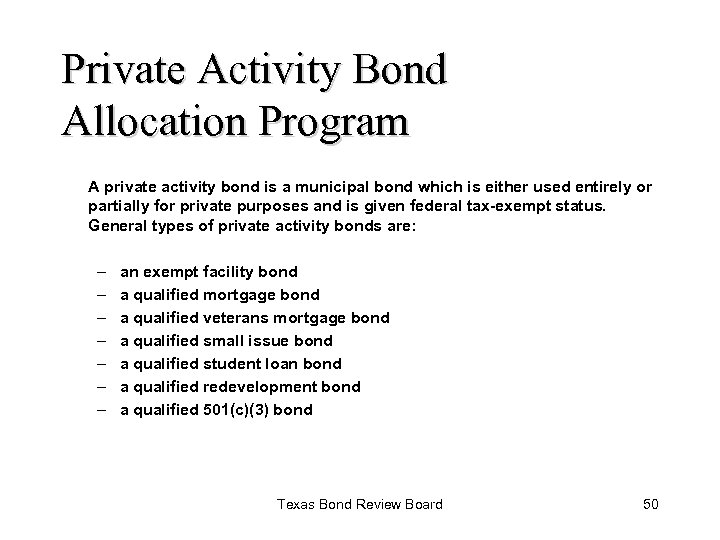
Private Activity Bond Allocation Program A private activity bond is a municipal bond which is either used entirely or partially for private purposes and is given federal tax-exempt status. General types of private activity bonds are: – – – – an exempt facility bond a qualified mortgage bond a qualified veterans mortgage bond a qualified small issue bond a qualified student loan bond a qualified redevelopment bond a qualified 501(c)(3) bond Texas Bond Review Board 50
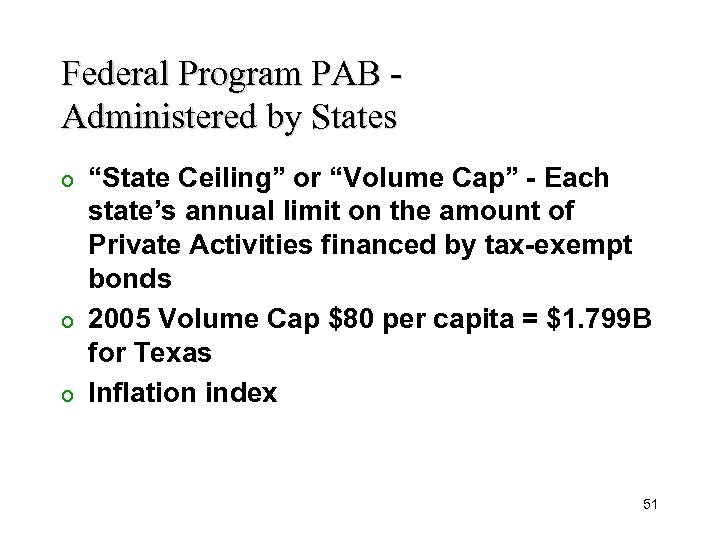
Federal Program PAB Administered by States “State Ceiling” or “Volume Cap” - Each state’s annual limit on the amount of Private Activities financed by tax-exempt bonds o 2005 Volume Cap $80 per capita = $1. 799 B for Texas o Inflation index o 51
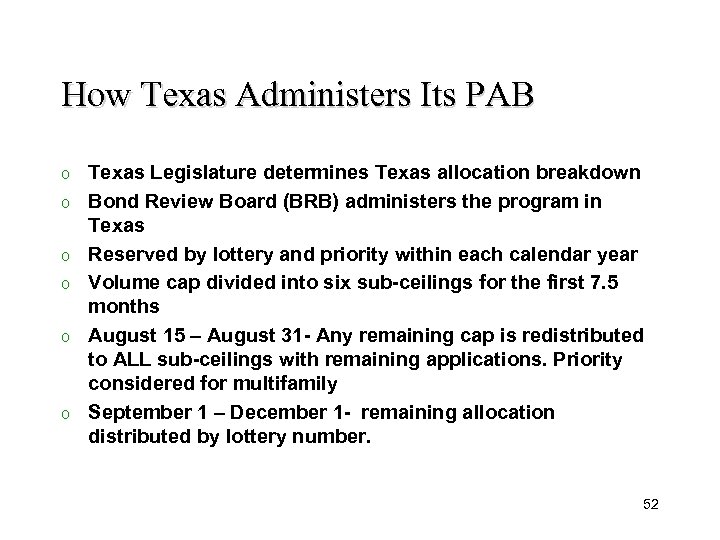
How Texas Administers Its PAB o o o Texas Legislature determines Texas allocation breakdown Bond Review Board (BRB) administers the program in Texas Reserved by lottery and priority within each calendar year Volume cap divided into six sub-ceilings for the first 7. 5 months August 15 – August 31 - Any remaining cap is redistributed to ALL sub-ceilings with remaining applications. Priority considered for multifamily September 1 – December 1 - remaining allocation distributed by lottery number. 52
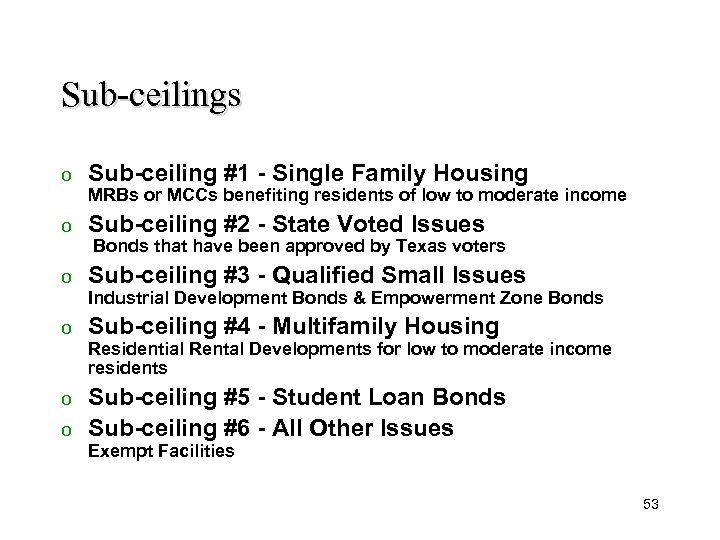
Sub-ceilings o Sub-ceiling #1 - Single Family Housing MRBs or MCCs benefiting residents of low to moderate income o Sub-ceiling #2 - State Voted Issues Bonds that have been approved by Texas voters o Sub-ceiling #3 - Qualified Small Issues Industrial Development Bonds & Empowerment Zone Bonds o Sub-ceiling #4 - Multifamily Housing Residential Rental Developments for low to moderate income residents Sub-ceiling #5 - Student Loan Bonds o Sub-ceiling #6 - All Other Issues o Exempt Facilities 53
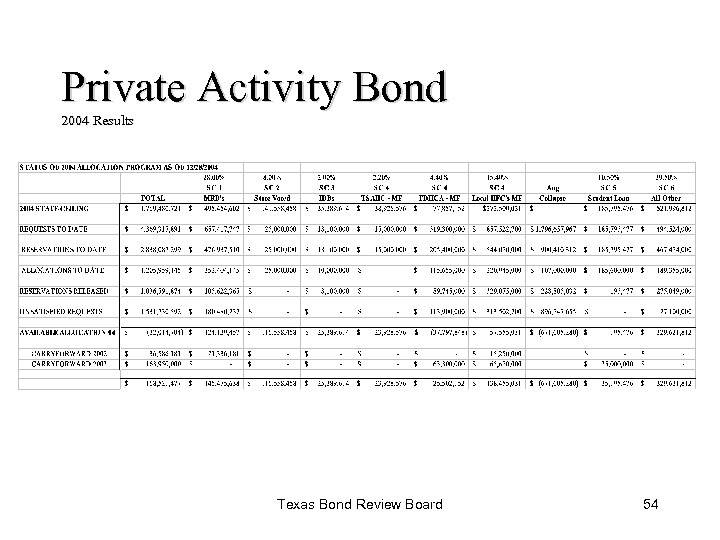
Private Activity Bond 2004 Results Texas Bond Review Board 54
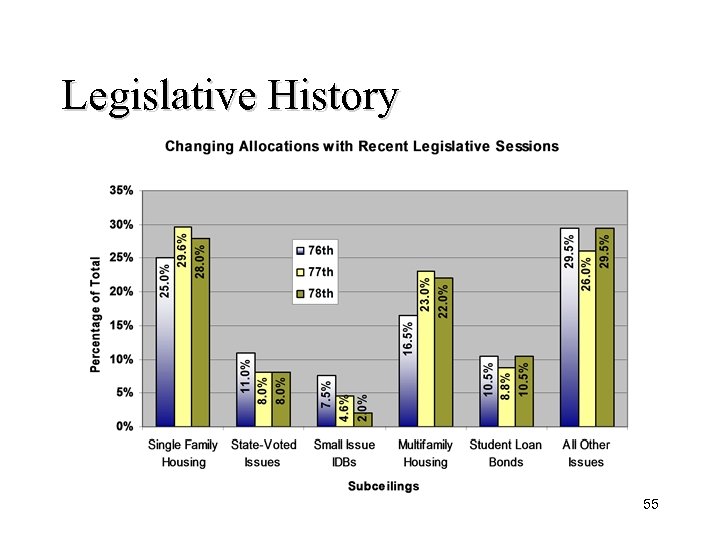
Legislative History 55
9. Bond Issuance Process
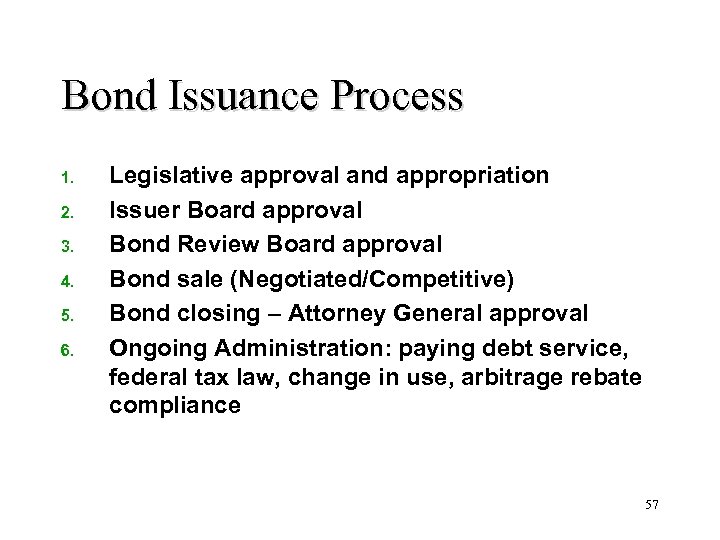
Bond Issuance Process 1. 2. 3. 4. 5. 6. Legislative approval and appropriation Issuer Board approval Bond Review Board approval Bond sale (Negotiated/Competitive) Bond closing – Attorney General approval Ongoing Administration: paying debt service, federal tax law, change in use, arbitrage rebate compliance 57
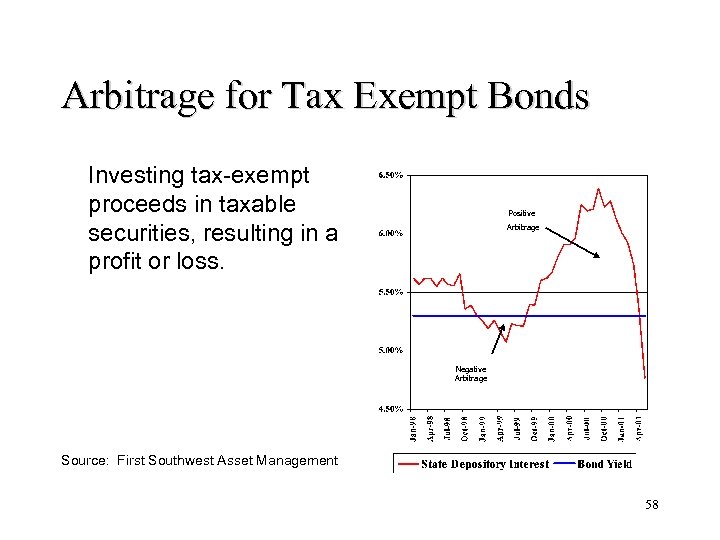
Arbitrage for Tax Exempt Bonds Investing tax-exempt proceeds in taxable securities, resulting in a profit or loss. Positive Arbitrage Negative Arbitrage Source: First Southwest Asset Management 58
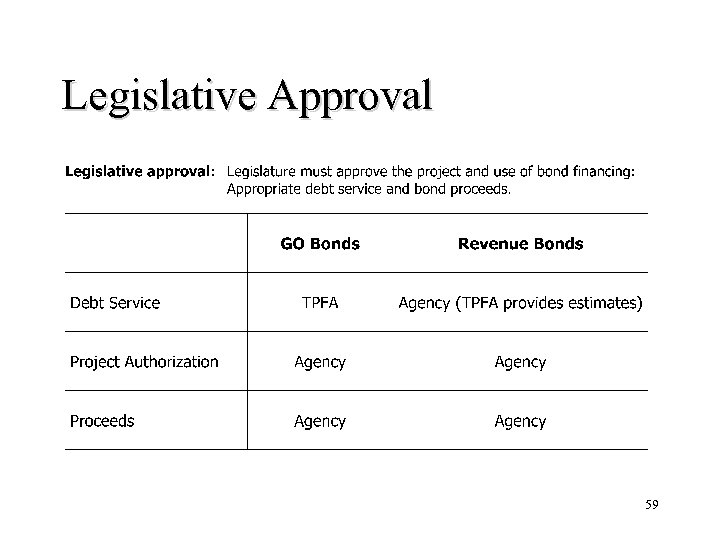
Legislative Approval 59
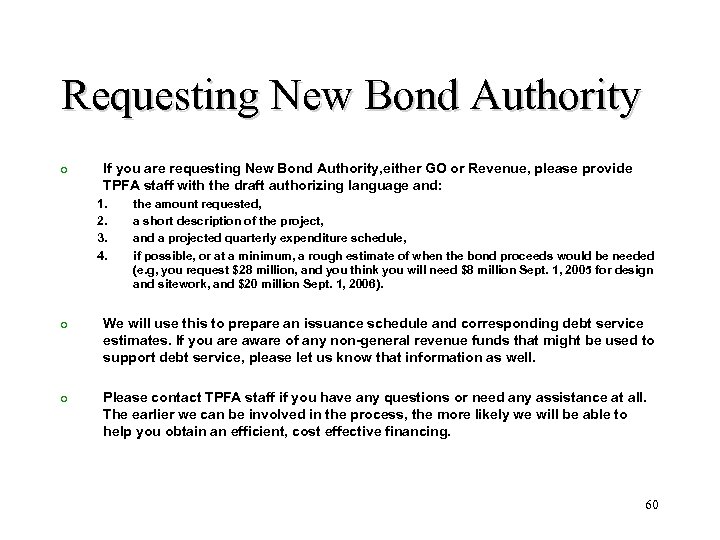
Requesting New Bond Authority o If you are requesting New Bond Authority, either GO or Revenue, please provide TPFA staff with the draft authorizing language and: 1. 2. 3. 4. the amount requested, a short description of the project, and a projected quarterly expenditure schedule, if possible, or at a minimum, a rough estimate of when the bond proceeds would be needed (e. g, you request $28 million, and you think you will need $8 million Sept. 1, 2005 for design and sitework, and $20 million Sept. 1, 2006). o We will use this to prepare an issuance schedule and corresponding debt service estimates. If you are aware of any non-general revenue funds that might be used to support debt service, please let us know that information as well. o Please contact TPFA staff if you have any questions or need any assistance at all. The earlier we can be involved in the process, the more likely we will be able to help you obtain an efficient, cost effective financing. 60
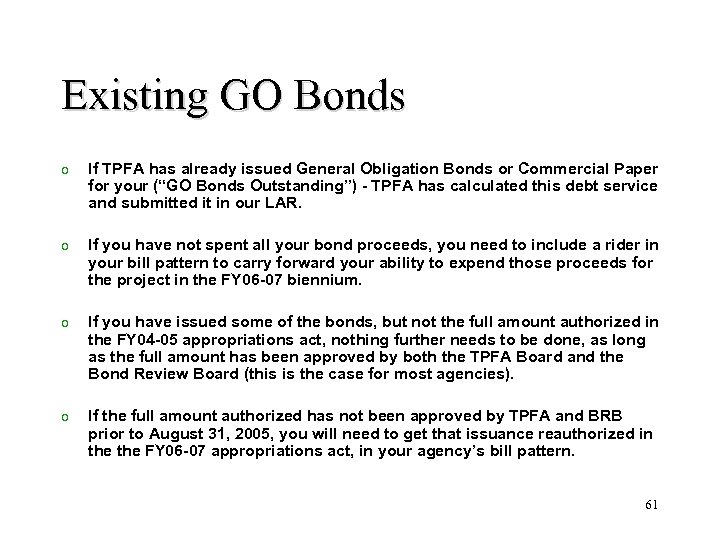
Existing GO Bonds o If TPFA has already issued General Obligation Bonds or Commercial Paper for your (“GO Bonds Outstanding”) - TPFA has calculated this debt service and submitted it in our LAR. o If you have not spent all your bond proceeds, you need to include a rider in your bill pattern to carry forward your ability to expend those proceeds for the project in the FY 06 -07 biennium. o If you have issued some of the bonds, but not the full amount authorized in the FY 04 -05 appropriations act, nothing further needs to be done, as long as the full amount has been approved by both the TPFA Board and the Bond Review Board (this is the case for most agencies). o If the full amount authorized has not been approved by TPFA and BRB prior to August 31, 2005, you will need to get that issuance reauthorized in the FY 06 -07 appropriations act, in your agency’s bill pattern. 61
Existing Revenue Bonds o If TPFA has already issued Revenue Bonds for you (“Revenue Bonds Outstanding”) - In April, TPFA sent a letter notifying you of the amount of Lease Payment due in FY 06 -07. You must request this lease payment (debt service) in your LAR. o If you have issued all the authorized bonds, but not spent all your bond proceeds, you need to include a rider in your bill pattern to carry forward your ability to expend those proceeds for the project in the FY 06 -07 biennium. o If you have issued some of the bonds, but not the full amount previously authorized, nothing further needs to be done, as long as the full amount has been approved by both the TPFA Board and the Bond Review Board (this is the case for most agencies). o If the full amount authorized has not been approved by TPFA and BRB prior to August 31, 2005, you will need to get that issuance reauthorized in the FY 06 -07 appropriations act, in your agency’s bill pattern. 62
10. Question and Answer
Скачать презентацию Everything You Wanted to Know About Bonds But
2c938e3bc02bff894955873e569f51ad.ppt