


 Скачать презентацию Everything Around the Core Practices policies and models
e8a2d316b2cc8179ddd469c00506088d.ppt
- Количество слайдов: 19
 Everything Around the Core Practices, policies, and models around Dublin Core Thomas Baker, Fraunhofer-Gesellschaft DC 2004, Shanghai Library 2004 -10 -11
 This Talk • Everything but the Core itself • DCMI Model of Practice – Grammatical principles and abstract model – Policies for identifying metadata terms – Documentation of metadata terms – Processes for maintenance – Taken together, a model for declaring and maintaining a metadata vocabulary
 Towards a data model • 1995: “catalog card for the Web” – Asking “what information belongs on the card? ” • Circa 1997, a shift: – “How will machines make sense of this? ” – “What is the data model? ” – “How does DC relate to other vocabularies? ”
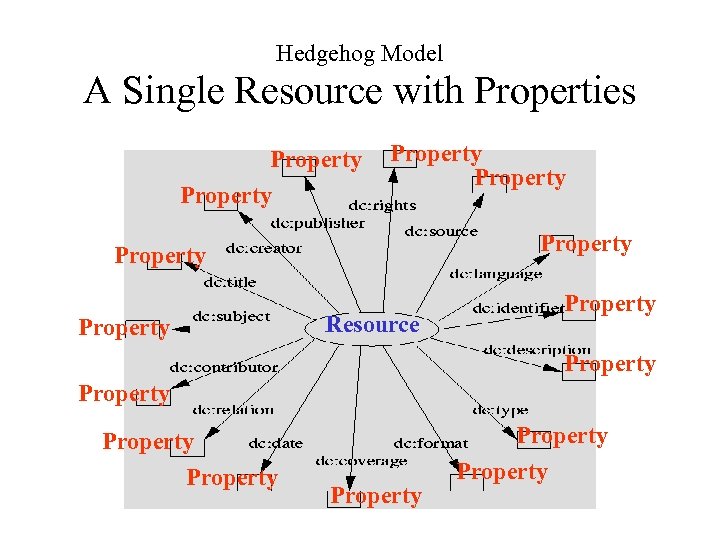 Hedgehog Model A Single Resource with Properties Property Property Resource Property Property
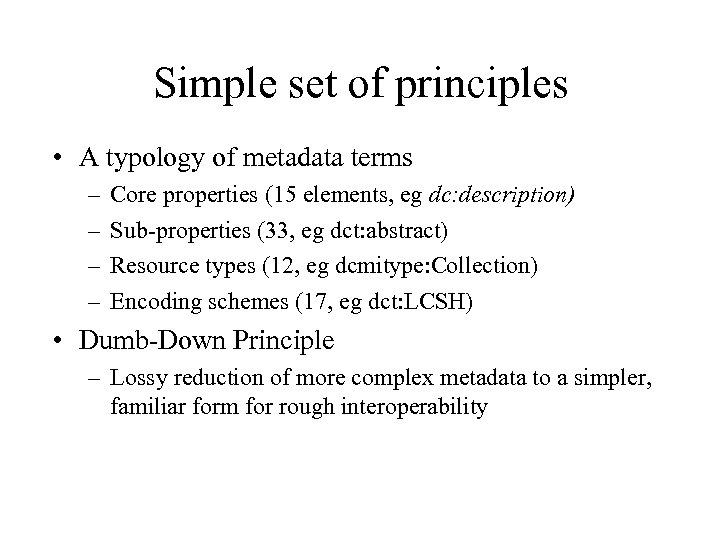 Simple set of principles • A typology of metadata terms – – Core properties (15 elements, eg dc: description) Sub-properties (33, eg dct: abstract) Resource types (12, eg dcmitype: Collection) Encoding schemes (17, eg dct: LCSH) • Dumb-Down Principle – Lossy reduction of more complex metadata to a simpler, familiar form for rough interoperability
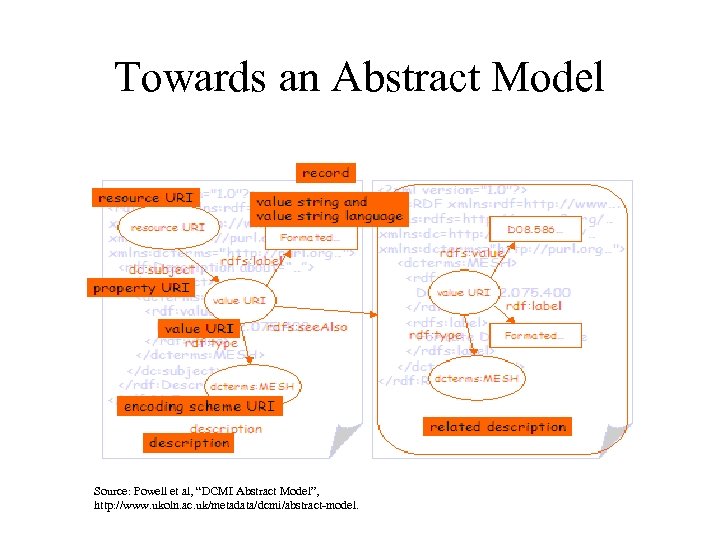 Towards an Abstract Model Source: Powell et al, “DCMI Abstract Model”, http: //www. ukoln. ac. uk/metadata/dcmi/abstract-model.
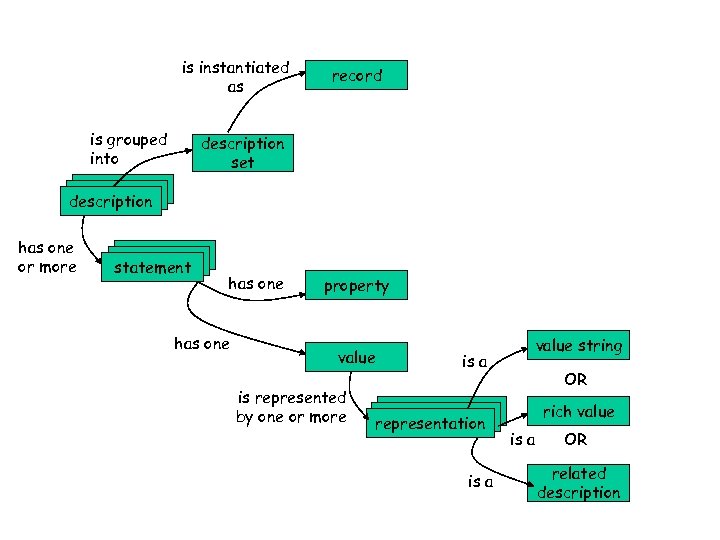 is instantiated as is grouped into record description set description has one or more statement has one property value is represented by one or more is a representation is a value string OR rich value is a OR related description
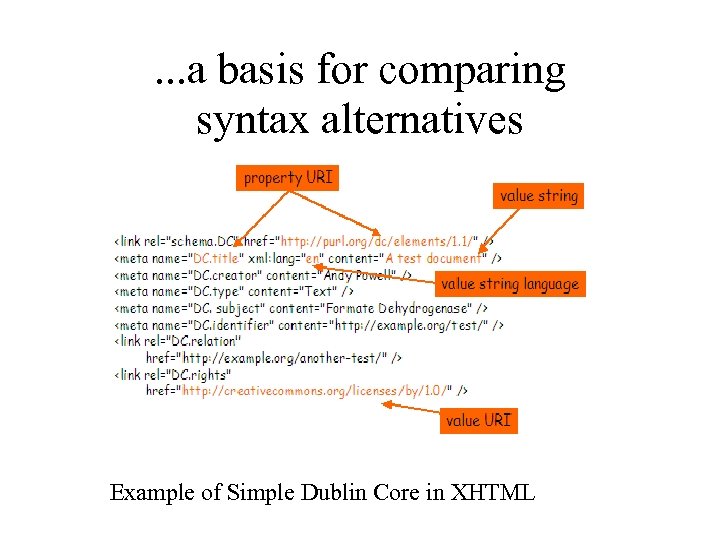 . . . a basis for comparing syntax alternatives Example of Simple Dublin Core in XHTML
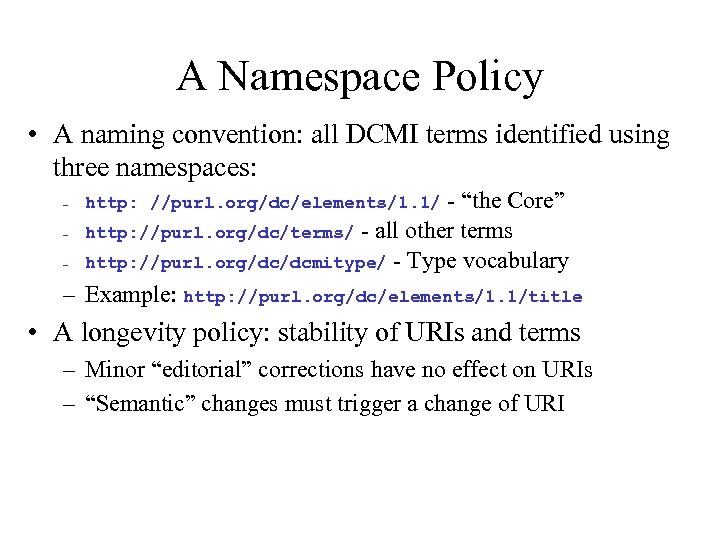 A Namespace Policy • A naming convention: all DCMI terms identified using three namespaces: - “the Core” – http: //purl. org/dc/terms/ - all other terms – http: //purl. org/dc/dcmitype/ - Type vocabulary – Example: http: //purl. org/dc/elements/1. 1/title – http: //purl. org/dc/elements/1. 1/ • A longevity policy: stability of URIs and terms – Minor “editorial” corrections have no effect on URIs – “Semantic” changes must trigger a change of URI
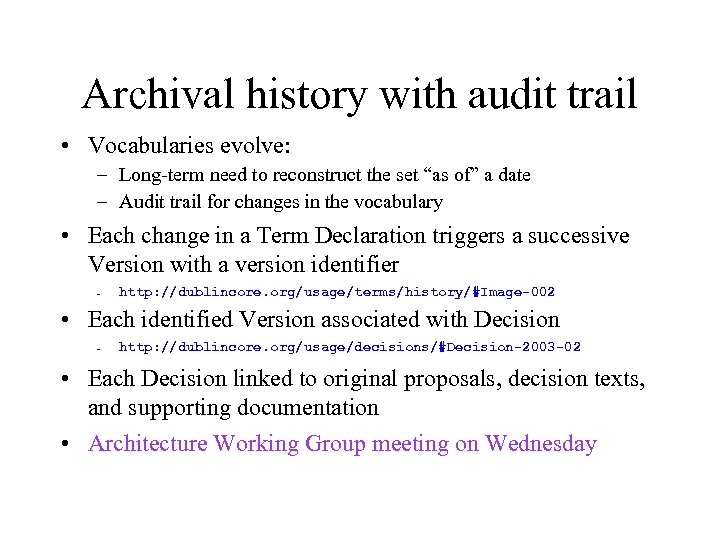 Archival history with audit trail • Vocabularies evolve: – Long-term need to reconstruct the set “as of” a date – Audit trail for changes in the vocabulary • Each change in a Term Declaration triggers a successive Version with a version identifier – http: //dublincore. org/usage/terms/history/#Image-002 • Each identified Version associated with Decision – http: //dublincore. org/usage/decisions/#Decision-2003 -02 • Each Decision linked to original proposals, decision texts, and supporting documentation • Architecture Working Group meeting on Wednesday
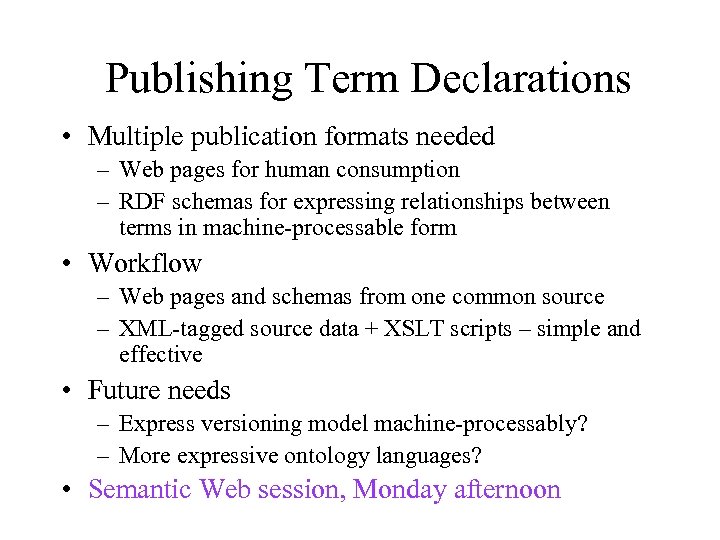 Publishing Term Declarations • Multiple publication formats needed – Web pages for human consumption – RDF schemas for expressing relationships between terms in machine-processable form • Workflow – Web pages and schemas from one common source – XML-tagged source data + XSLT scripts – simple and effective • Future needs – Express versioning model machine-processably? – More expressive ontology languages? • Semantic Web session, Monday afternoon
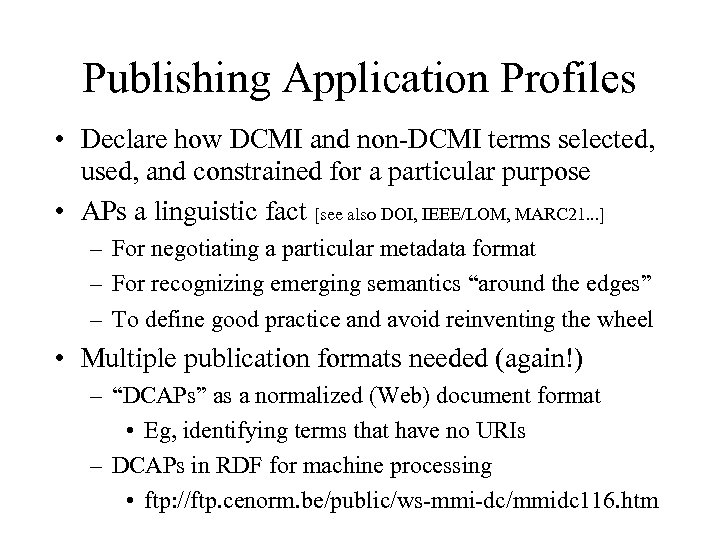 Publishing Application Profiles • Declare how DCMI and non-DCMI terms selected, used, and constrained for a particular purpose • APs a linguistic fact [see also DOI, IEEE/LOM, MARC 21. . . ] – For negotiating a particular metadata format – For recognizing emerging semantics “around the edges” – To define good practice and avoid reinventing the wheel • Multiple publication formats needed (again!) – “DCAPs” as a normalized (Web) document format • Eg, identifying terms that have no URIs – DCAPs in RDF for machine processing • ftp: //ftp. cenorm. be/public/ws-mmi-dc/mmidc 116. htm
 Dublin Core Registries • Indexed databases of metadata elements – Include information about metadata terms, translations of terms, and (potentially) application profiles – Federations of vocabulary maintainers share model for declaring and relating terms • Service Providers, existing and potential – Tsukuba: annotate DCMI term URIs with translations, usage notes, other vocabularies of interest to Japan – FAO (a UN agency): agricultural development – DCMI (OCLC): Web-services interface • Registry Working Group meeting on Thursday morning
 Editorial Review • DCMI Usage Board reviews proposals for new terms, usage clarifications, Application Profiles – Public comment period, evaluate for demonstrated buy-in and conformance to principle, assign status • Biases of the current Usage Board – Keep DCMI vocabularies small and generic – Recognize and reuse existing, complementary vocabularies maintained by others • Usage Board 8 th meeting in Shanghai, 9 -10 October
 Example MARC Roles as Refinements of dc: contributor • MARC Relator terms (Library of Congress) – More specific “roles”: Director, Choreographer… • Model: Library of Congress makes assertions – “marc: director is a sub-property of dc: contributor” • DCMI Endorses the assertions: – “DCMI agrees that marc: director is a sub-property of dc: contributor” • A general model for negotiating and expressing the relationship between different vocabularies?
 Identifying controlled vocabularies • Vocabulary Encoding Schemes – Term dcterms: LCSH says that the value of dc: subject is a Library of Congress Subject Heading – Need identifiers (URIrefs) designating other controlled vocabularies – Creating URIrefs for world’s vocabularies a huge task! • New DCMI approach (October 2004): – Explain how maintainers can create URIrefs for their own vocabularies • http: //www. ukoln. ac. uk/metadata/dcmi/term-identifiers-guidelines/ – Maintainers submit URIrefs for review – DCMI endorses
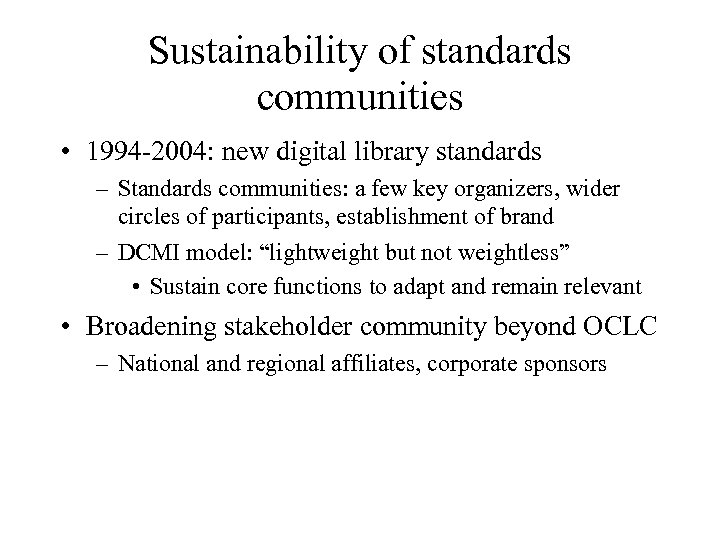 Sustainability of standards communities • 1994 -2004: new digital library standards – Standards communities: a few key organizers, wider circles of participants, establishment of brand – DCMI model: “lightweight but not weightless” • Sustain core functions to adapt and remain relevant • Broadening stakeholder community beyond OCLC – National and regional affiliates, corporate sponsors
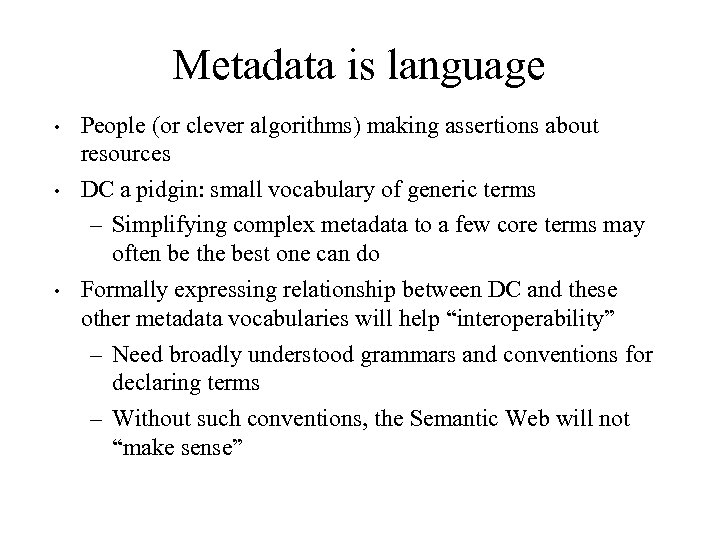 Metadata is language • People (or clever algorithms) making assertions about resources • DC a pidgin: small vocabulary of generic terms – Simplifying complex metadata to a few core terms may often be the best one can do • Formally expressing relationship between DC and these other metadata vocabularies will help “interoperability” – Need broadly understood grammars and conventions for declaring terms – Without such conventions, the Semantic Web will not “make sense”
 thomas. baker@izb. fraunhofer. de