Скачать презентацию EVENT Earth Viewing Extreme Nature Telescope Space telescope
87cd9458d70250b35e048c7462fc4d31.ppt
- Количество слайдов: 35
 EVENT (Earth Viewing Extreme Nature Telescope) Space telescope to observe extreme energy cosmic ray quanta & atmospheric phenomena Il H. Park (Ewha W. Univ. , Seoul) Discussion at SINP, Moscow State University (Oct. 19, 2005) Seminar at JINR, Dubna (Oct. 21, 2005) To be in preparation for Announcement of Opportunity from Korean 3 rd Science Satellite Program
 NT VE E Korean Science Satellite Program • 1 st science payload (FIMS, UV astronomy), satellite launched in Russia in 2003 – Scientific results not great because of problem in poor positioning accuracy • 2 nd science payload AO made, and payload of radiometer selected in 2004 – Requirements: 50 kg, 270 x 200 x 330 mm 3, 20 W, 200 kbps, 300~1500 km orbit, 80 degree inclined – will be launched in 2006 or 2007 by using Korean launching facility (~100 kg) 2 TU S
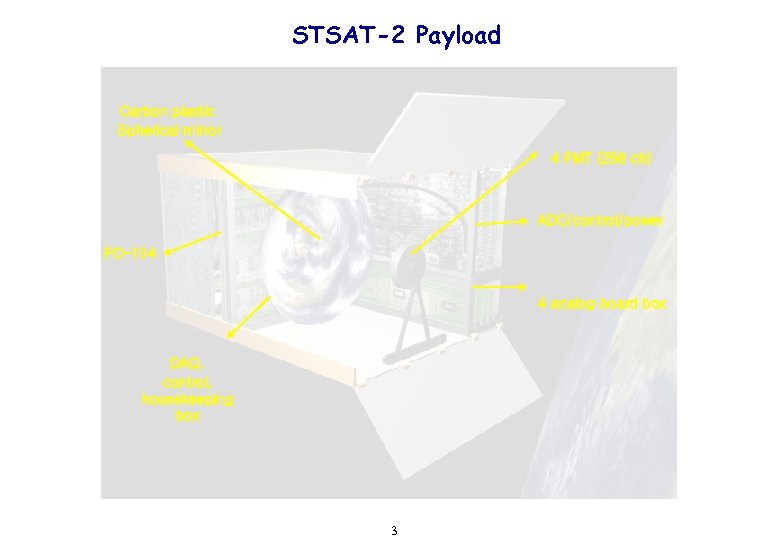 STSAT-2 Payload Carbon plastic Spherical mirror 4 PMT (256 ch) ADC/control/power PC-104 4 analog board box DAQ, control, housekeeping box 3
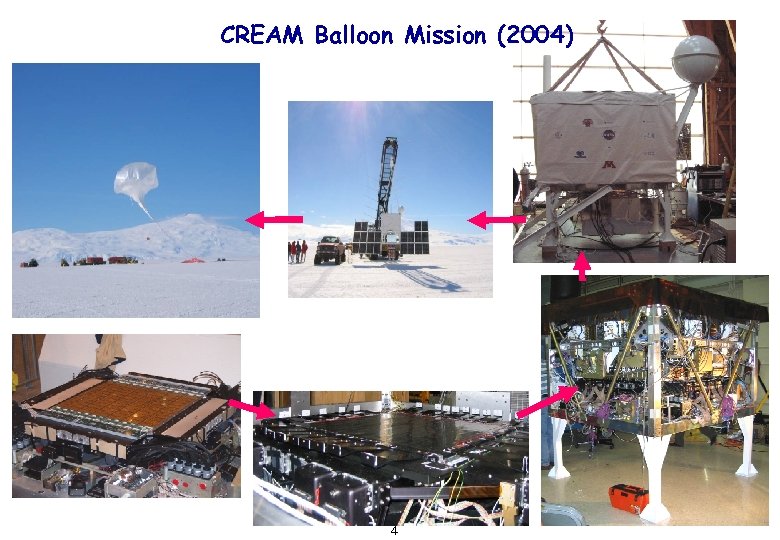 CREAM Balloon Mission (2004) 4
 NT VE E Korean Science Satellite Program • 3 rd science payload AO will be announced at the end of 2005 – Final selection will be made no later than summer 2006, and project immediately starts (no phase A, B, …, once selected, the project are guaranteed – Launch foreseen 2008~2009, preferably using Russian launching facility – Overall cost including launch should not exceed $20 M – Favor will be given to proposal which can give some scientific impact(? ) and technological feedback and improvement in the area of payload, platform and space parts – A few proposals, UHECR, infrared telescope, earth shinning, …, are likely to be in competition – I propose a collaboration for UHECR, named EVENT, same members as TUS • EVENT before TUS, EVENT after TUS, or same time TUS EVENT • Provide a sort of pilot experiment for future mission like EUSO, KLYPVE • 4 th AO will be announced and selected around 2007 – Plan to propose “tracking mirror telescope for observation of UHECR” 5 TU S
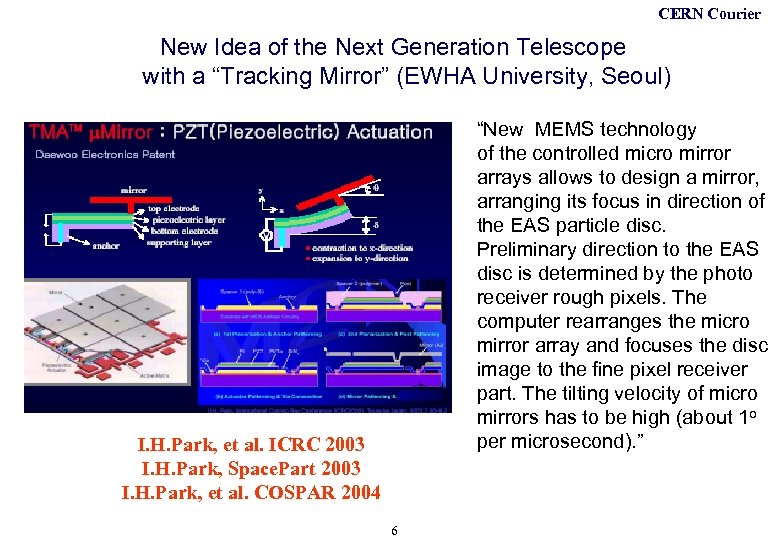 CERN Courier New Idea of the Next Generation Telescope with a “Tracking Mirror” (EWHA University, Seoul) “New MEMS technology of the controlled micro mirror arrays allows to design a mirror, arranging its focus in direction of the EAS particle disc. Preliminary direction to the EAS disc is determined by the photo receiver rough pixels. The computer rearranges the micro mirror array and focuses the disc image to the fine pixel receiver part. The tilting velocity of micro mirrors has to be high (about 1 o per microsecond). ” I. H. Park, et al. ICRC 2003 I. H. Park, Space. Part 2003 I. H. Park, et al. COSPAR 2004 6
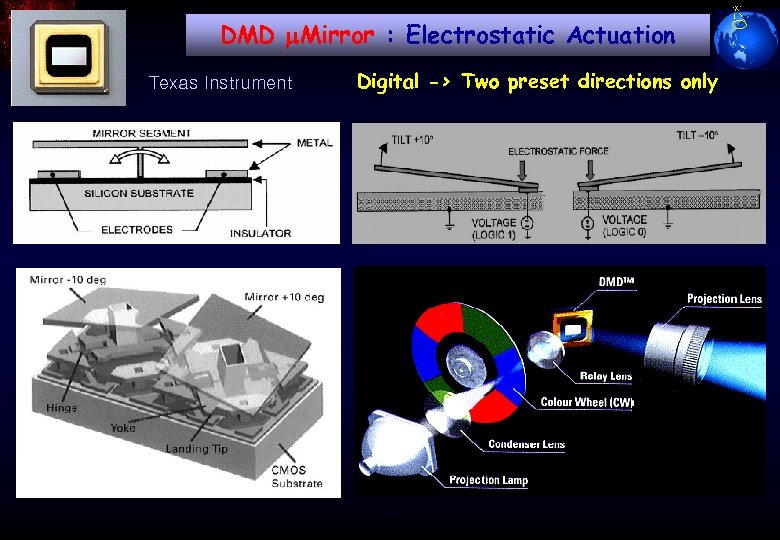 DMD m. Mirror : Electrostatic Actuation Texas Instrument Digital -> Two preset directions only 7
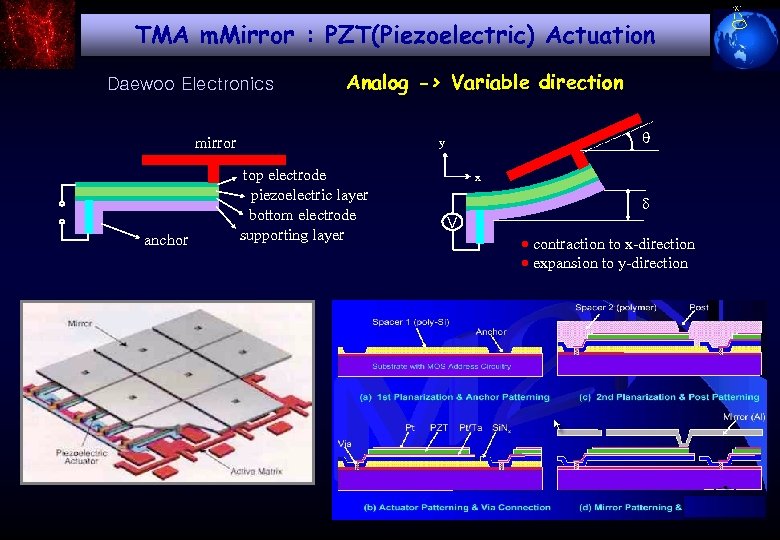 TMA m. Mirror : PZT(Piezoelectric) Actuation Daewoo Electronics Analog -> Variable direction mirror anchor q y top electrode piezoelectric layer bottom electrode supporting layer x d V · contraction to x-direction · expansion to y-direction 8
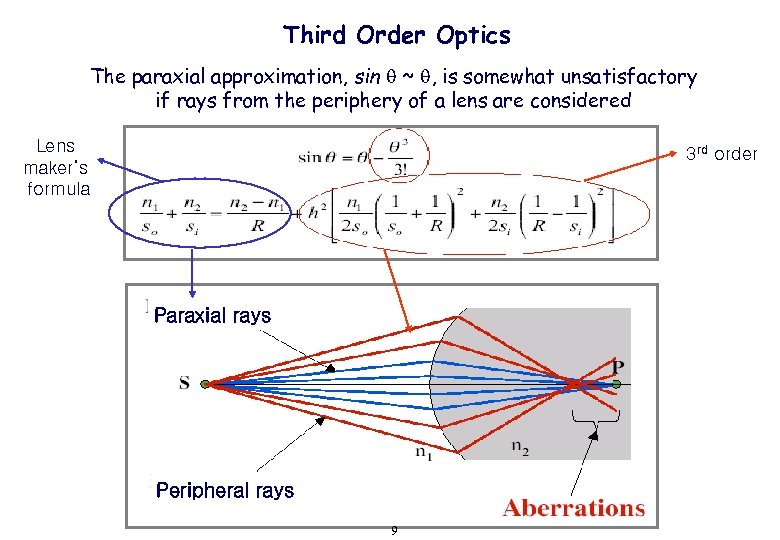 Third Order Optics The paraxial approximation, sin q ~ q, is somewhat unsatisfactory if rays from the periphery of a lens are considered Lens maker’s formula 3 rd order Paraxial rays Peripheral rays 9
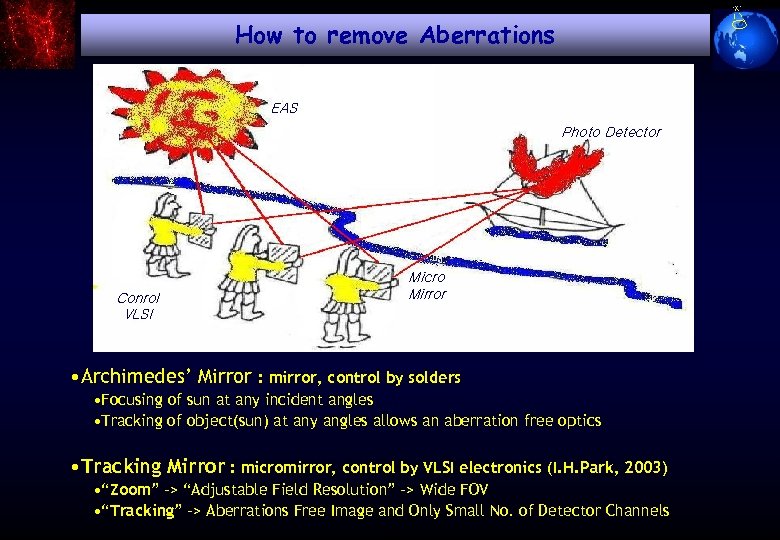 How to remove Aberrations EAS Photo Detector Micro Mirror Conrol VLSI • Archimedes’ Mirror : mirror, control by solders • Focusing of sun at any incident angles • Tracking of object(sun) at any angles allows an aberration free optics • Tracking Mirror : micromirror, control by VLSI electronics (I. H. Park, 2003) • “Zoom” -> “Adjustable Field Resolution” -> Wide FOV • “Tracking” -> Aberrations Free Image and Only Small No. of Detector Channels 10
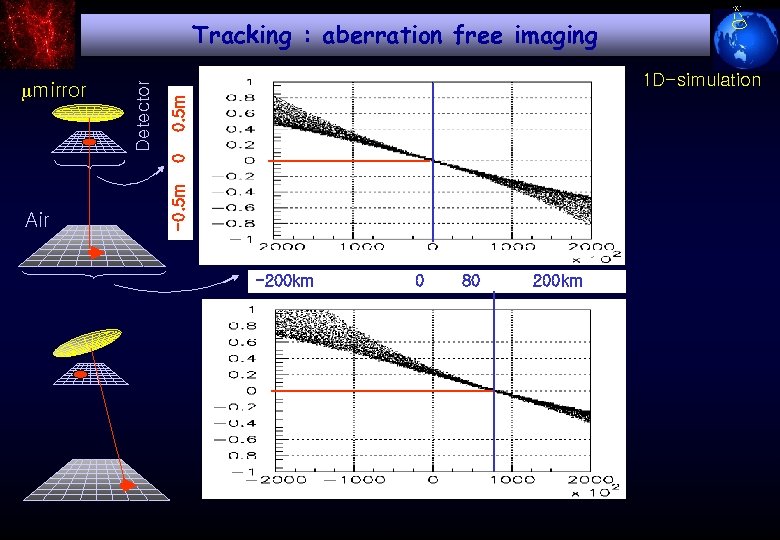 0. 5 m 1 D-simulation Air -0. 5 m 0 mmirror Detector Tracking : aberration free imaging -200 km 0 11 80 200 km
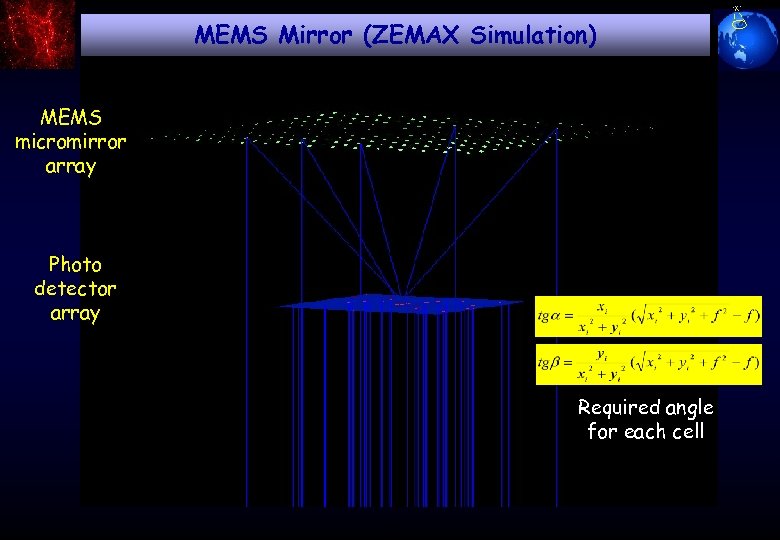 MEMS Mirror (ZEMAX Simulation) MEMS micromirror array Photo detector array Required angle for each cell 12
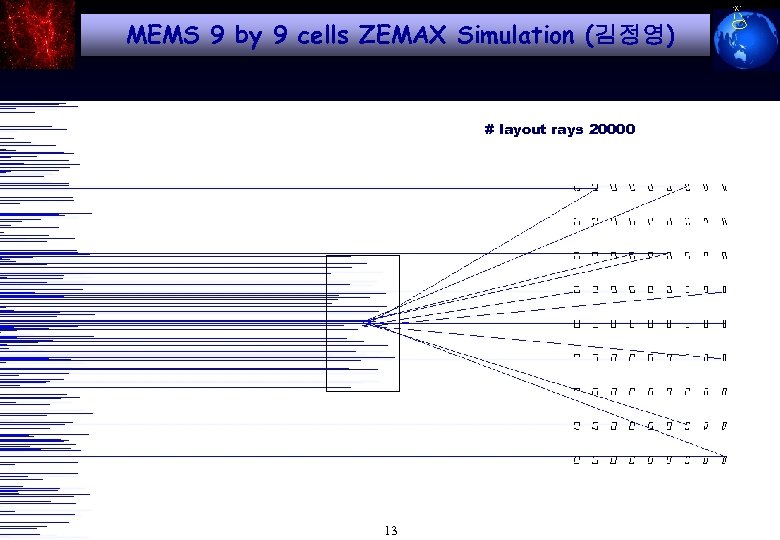 MEMS 9 by 9 cells ZEMAX Simulation (김정영) # layout rays 20000 13
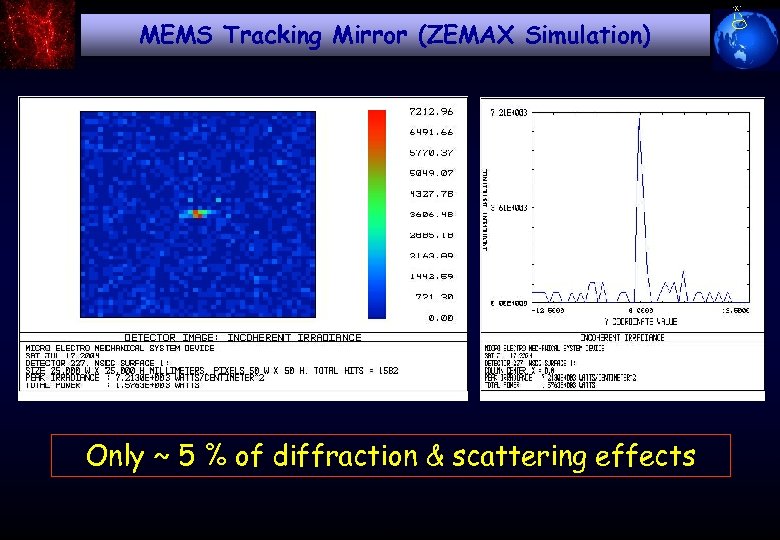 MEMS Tracking Mirror (ZEMAX Simulation) Only ~ 5 % of diffraction & scattering effects 14
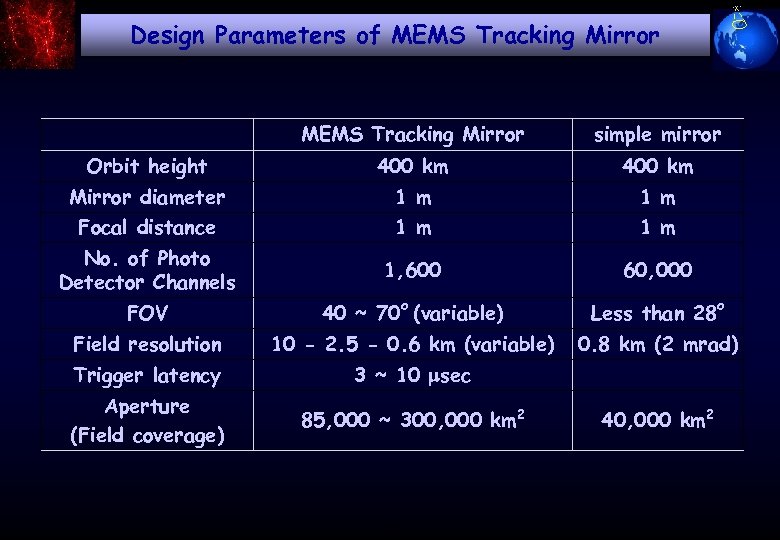 Design Parameters of MEMS Tracking Mirror simple mirror Orbit height 400 km Mirror diameter 1 m Focal distance 1 m No. of Photo Detector Channels 1, 600 60, 000 FOV 40 ~ 70 o (variable) Less than 28 o Field resolution 10 - 2. 5 - 0. 6 km (variable) 0. 8 km (2 mrad) Trigger latency 3 ~ 10 msec Aperture (Field coverage) 85, 000 ~ 300, 000 km 2 15 40, 000 km 2
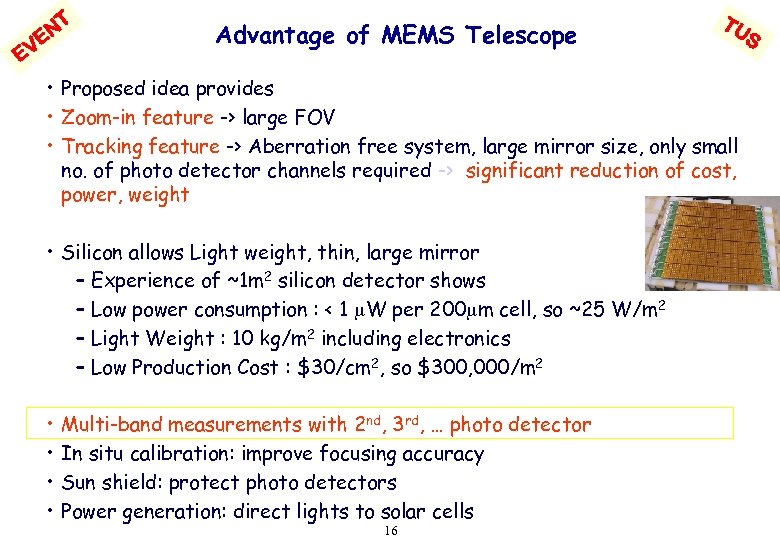 NT VE E Advantage of MEMS Telescope TU S • Proposed idea provides • Zoom-in feature -> large FOV • Tracking feature -> Aberration free system, large mirror size, only small no. of photo detector channels required -> significant reduction of cost, power, weight • Silicon allows Light weight, thin, large mirror – Experience of ~1 m 2 silicon detector shows – Low power consumption : < 1 m. W per 200 mm cell, so ~25 W/m 2 – Light Weight : 10 kg/m 2 including electronics – Low Production Cost : $30/cm 2, so $300, 000/m 2 • • Multi-band measurements with 2 nd, 3 rd, … photo detector In situ calibration: improve focusing accuracy Sun shield: protect photo detectors Power generation: direct lights to solar cells 16
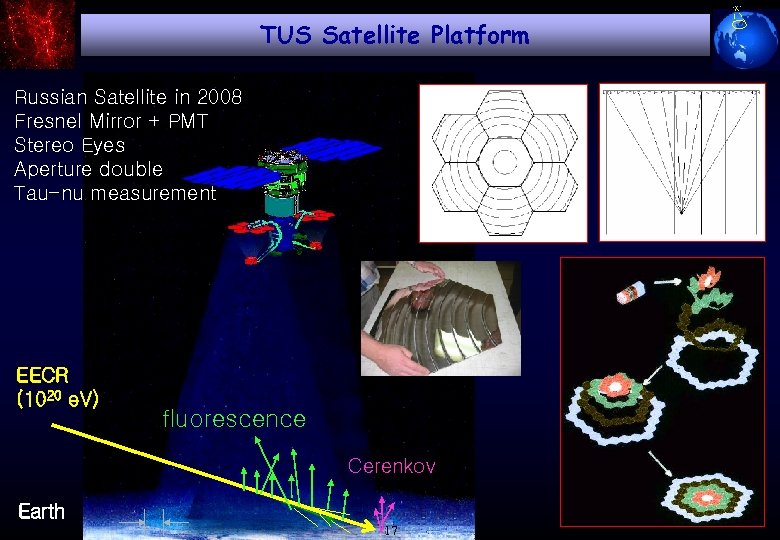 TUS Satellite Platform Russian Satellite in 2008 Fresnel Mirror + PMT Stereo Eyes Aperture double Tau-nu measurement EECR (1020 e. V) fluorescence Cerenkov Earth 17
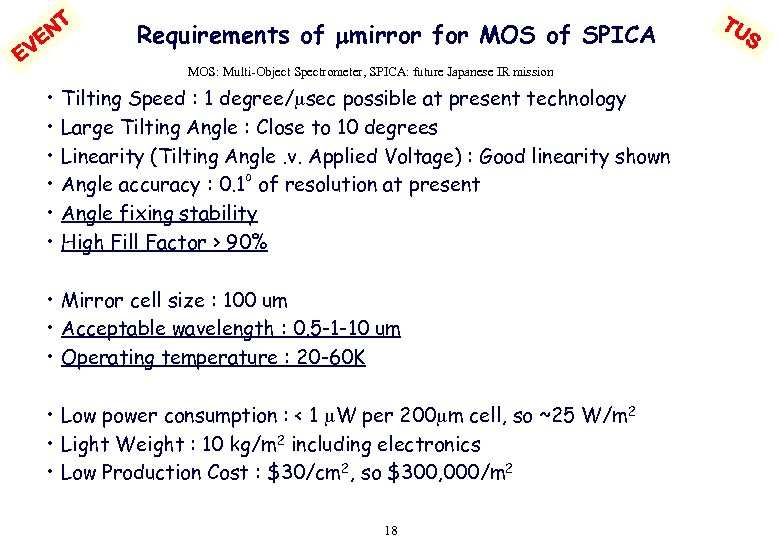 NT VE E • • • Requirements of mmirror for MOS of SPICA MOS: Multi-Object Spectrometer, SPICA: future Japanese IR mission Tilting Speed : 1 degree/msec possible at present technology Large Tilting Angle : Close to 10 degrees Linearity (Tilting Angle. v. Applied Voltage) : Good linearity shown Angle accuracy : 0. 1 o of resolution at present Angle fixing stability High Fill Factor > 90% • Mirror cell size : 100 um • Acceptable wavelength : 0. 5 -1 -10 um • Operating temperature : 20 -60 K • Low power consumption : < 1 m. W per 200 mm cell, so ~25 W/m 2 • Light Weight : 10 kg/m 2 including electronics • Low Production Cost : $30/cm 2, so $300, 000/m 2 18 TU S
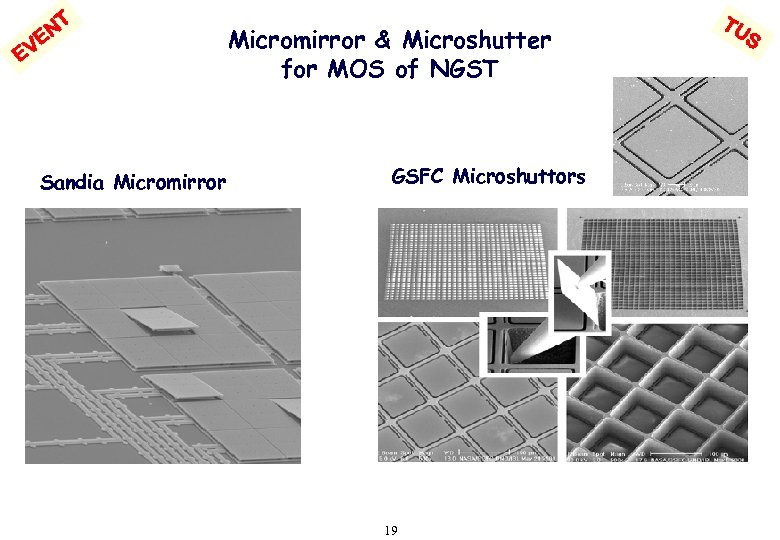 NT VE E Sandia Micromirror & Microshutter for MOS of NGST GSFC Microshuttors 19 TU S
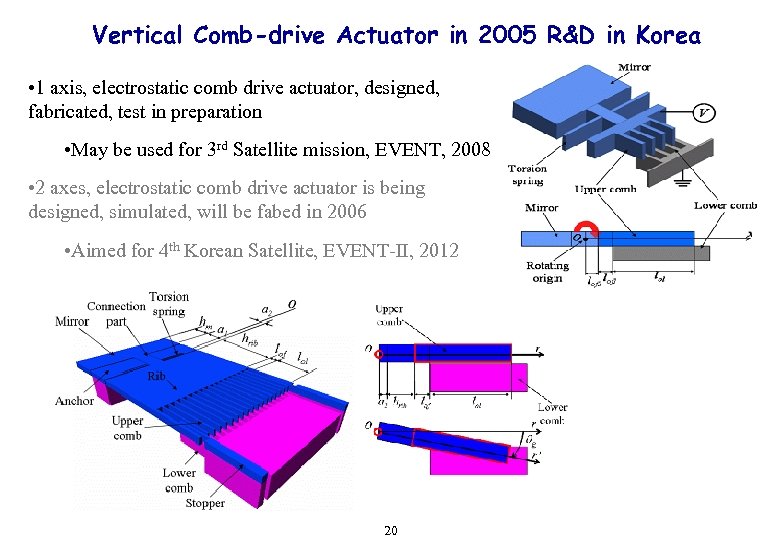 Vertical Comb-drive Actuator in 2005 R&D in Korea • 1 axis, electrostatic comb drive actuator, designed, fabricated, test in preparation • May be used for 3 rd Satellite mission, EVENT, 2008 • 2 axes, electrostatic comb drive actuator is being designed, simulated, will be fabed in 2006 • Aimed for 4 th Korean Satellite, EVENT-II, 2012 20
 TU NT Remarks and Plan for MOS for SPICA S VE E • Remarks – Needs comprehensive study to find the best solution for MOS • Comparisons between DMD, shutter, “our own design” – Our design is under way with a help of KIST – Multi-spectrum measurements with micromirror being tried • Plan – Study of micromirror and microshutter (-2005. 8) – Design of our micromirror prototype (-2005. 5) • How to actuate ? - Actuation material study – Completion of the process flowchart (-2005. 6) – Fabrication of 1 -axis micromirror prototype (-2005. 10) • Fab at KIST, ETRI, or/and SNU-ISRC – Test bench setup (optics, table, etc. ) and Test of the prototype – Feedback to the next prototype design (-2006. 1) 21
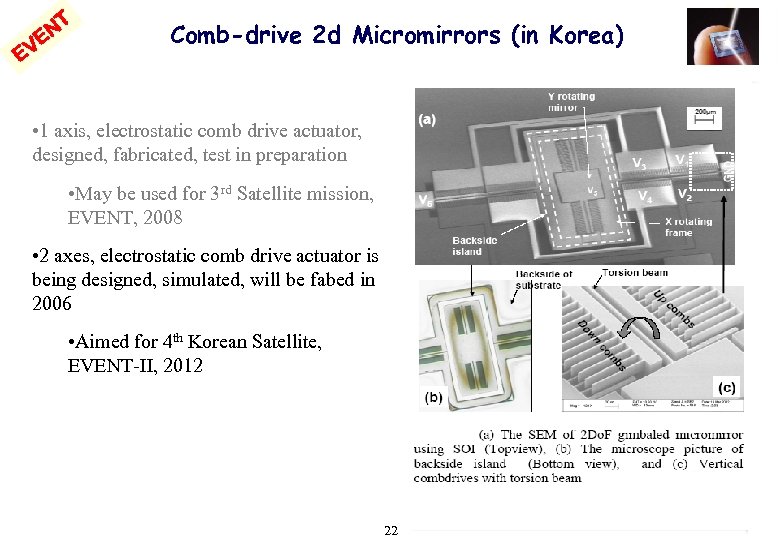 NT VE E Comb-drive 2 d Micromirrors (in Korea) • 1 axis, electrostatic comb drive actuator, designed, fabricated, test in preparation • May be used for 3 rd Satellite mission, EVENT, 2008 • 2 axes, electrostatic comb drive actuator is being designed, simulated, will be fabed in 2006 • Aimed for 4 th Korean Satellite, EVENT-II, 2012 22 TU S
 NT VE E Proposal to 3 rd Korean Science Payload EVENT • Science – 1 st goal: UHECR, dust grain, meteor – 2 nd goal: Atmospheric science: ionosphere related, solar activity related science (solar max in 2008), Blue Jets, Aurora, Thunderstorm discharge, earthquake related, … • Technology – Public attention like “ARTIFICIAL MOON” • Turning mirror • Folding segments – Digital MEMS application in space • Try of multi-detector (multi-frequency) system: UV & IR measurement in one platform – Try of ground supervision like mountain fire, large scale explosion, etc. 23 TU S
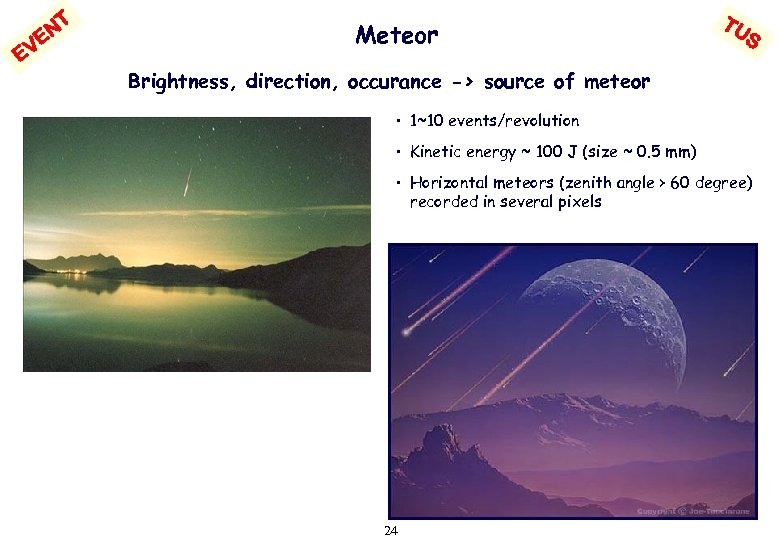 NT VE E Meteor TU S Brightness, direction, occurance -> source of meteor • 1~10 events/revolution • Kinetic energy ~ 100 J (size ~ 0. 5 mm) • Horizontal meteors (zenith angle > 60 degree) recorded in several pixels 24
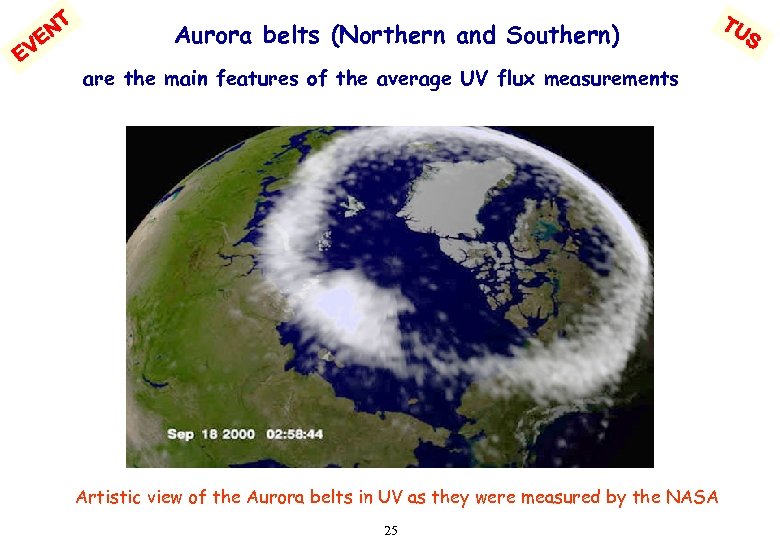 NT VE E Aurora belts (Northern and Southern) are the main features of the average UV flux measurements Artistic view of the Aurora belts in UV as they were measured by the NASA 25 TU S
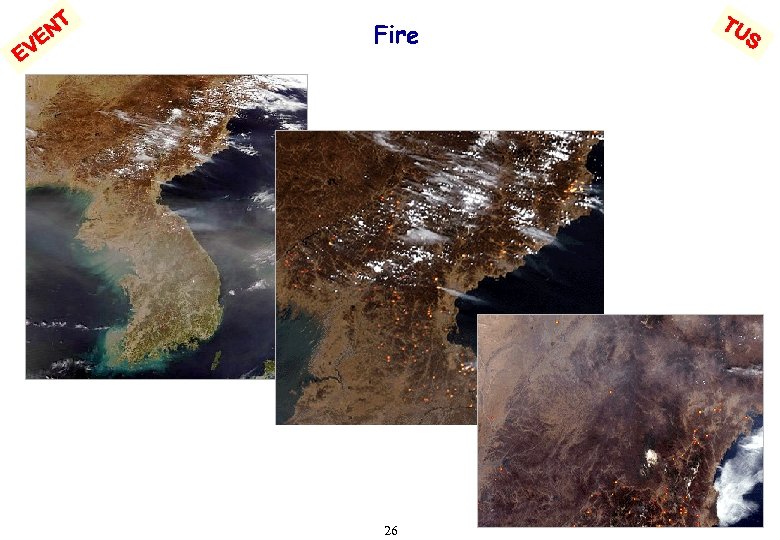 NT VE E Fire 26 TU S
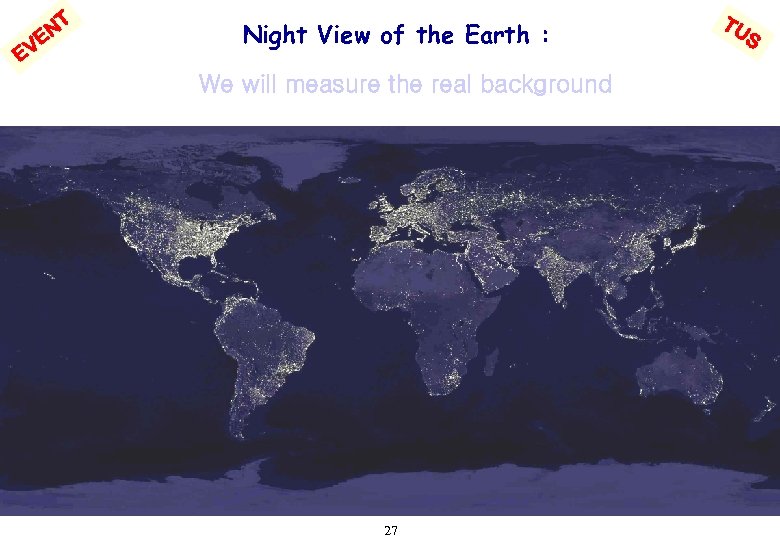 NT VE E Night View of the Earth : We will measure the real background 27 TU S
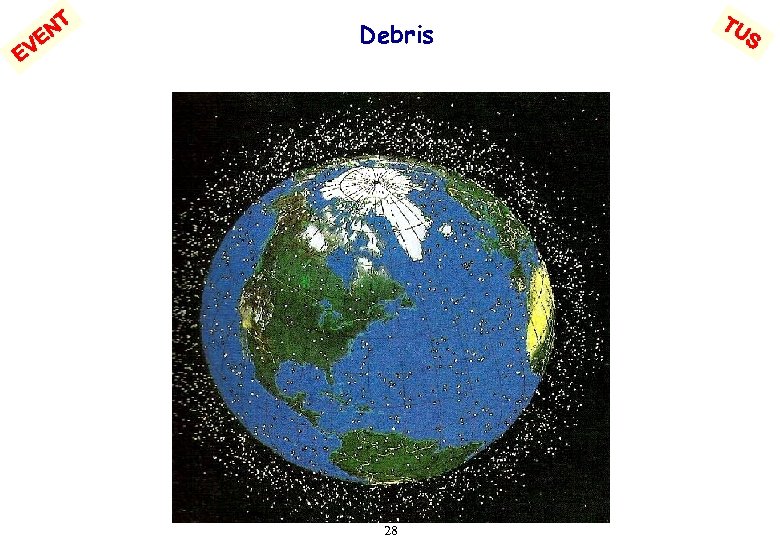 NT VE E Debris 28 TU S
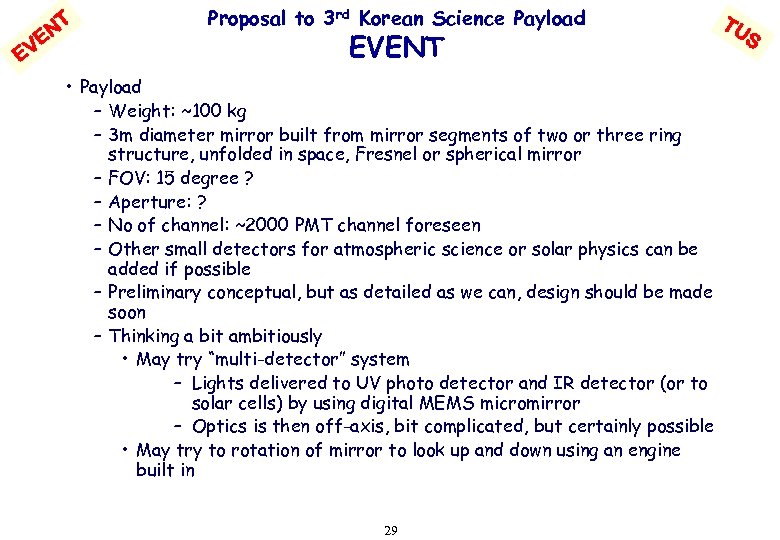 NT VE E Proposal to 3 rd Korean Science Payload EVENT • Payload – Weight: ~100 kg – 3 m diameter mirror built from mirror segments of two or three ring structure, unfolded in space, Fresnel or spherical mirror – FOV: 15 degree ? – Aperture: ? – No of channel: ~2000 PMT channel foreseen – Other small detectors for atmospheric science or solar physics can be added if possible – Preliminary conceptual, but as detailed as we can, design should be made soon – Thinking a bit ambitiously • May try “multi-detector” system – Lights delivered to UV photo detector and IR detector (or to solar cells) by using digital MEMS micromirror – Optics is then off-axis, bit complicated, but certainly possible • May try to rotation of mirror to look up and down using an engine built in 29 TU S
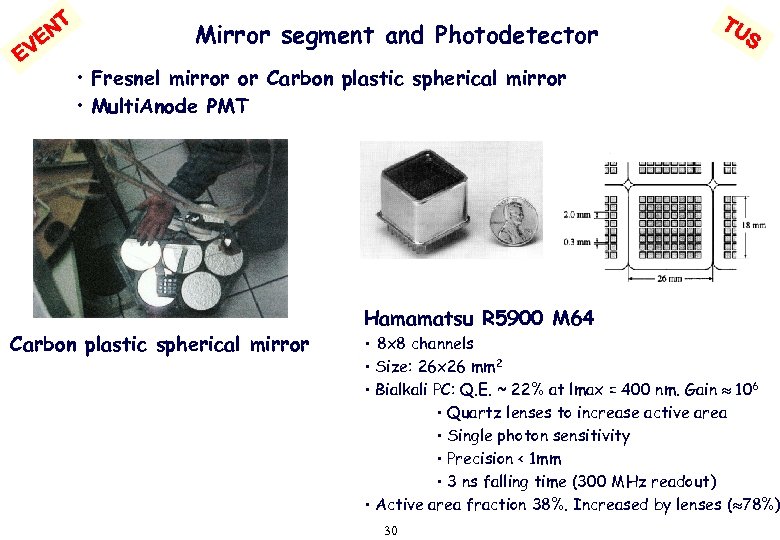 NT VE E Mirror segment and Photodetector TU S • Fresnel mirror or Carbon plastic spherical mirror • Multi. Anode PMT Carbon plastic spherical mirror Hamamatsu R 5900 M 64 • 8 x 8 channels • Size: 26 x 26 mm 2 • Bialkali PC: Q. E. ~ 22% at lmax = 400 nm. Gain 106 • Quartz lenses to increase active area • Single photon sensitivity • Precision < 1 mm • 3 ns falling time (300 MHz readout) • Active area fraction 38%. Increased by lenses ( 78%) 30
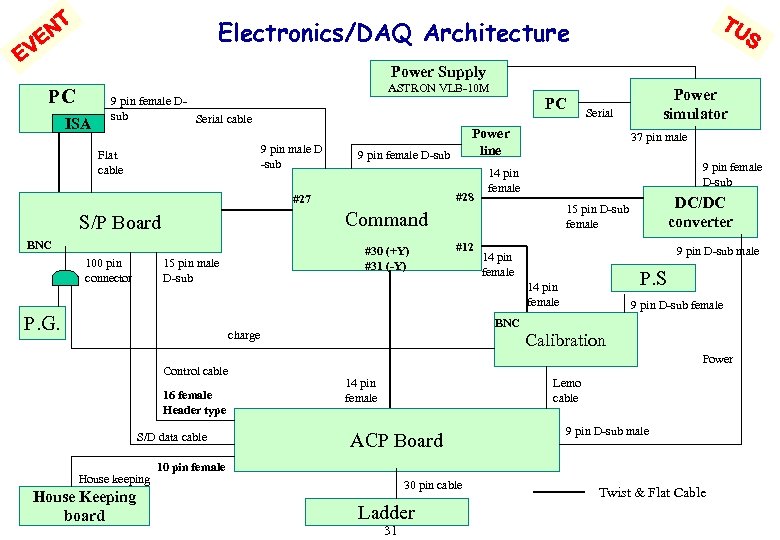 NT VE E TU S Electronics/DAQ Architecture Power Supply PC ISA ASTRON VLB-10 M 9 pin female Dsub Serial cable PC 9 pin male D -sub Flat cable #28 #27 BNC 100 pin connector #30 (+Y) #31 (-Y) 15 pin male D-sub P. G. #12 Control cable 16 female Header type S/D data cable House Keeping board 9 pin female D-sub 14 pin female DC/DC converter 15 pin D-sub female 9 pin D-sub male 14 pin female P. S 14 pin female BNC charge House keeping 37 pin male Command S/P Board Serial Power line 9 pin female D-sub Power simulator 9 pin D-sub female Calibration Power 14 pin female Lemo cable ACP Board 9 pin D-sub male 10 pin female 30 pin cable Ladder 31 Twist & Flat Cable
 NT VE E Proposal to 3 rd Korean Science Payload EVENT • Launch – Using same as MSU-Tatiana, using Military satellite – Energia and Samara using PROGRESS – Submarine launching • Ground control – 3 years of mission –? 32 TU S
 NT VE E Proposal To be clearly stated with concrete plan • Payload name • Mission – minimal: – Maximal: – If we are lucky: • Results and spinoff • Risks • Platform • Launch • Organization and Collaboration (? ) – Korea: [Ewha, KAIST, Yonsei, KAO], [KARI, Satrek] – Russia: [MSU, DUBNA, …], [Energia, …], […] • MOU or agreement letters, etc 33 TU S
 NT VE E Discussion in this “CR in Space” community • EVENT can be considered as a “pilot experiment” for future EUSO or KLYPVE • You can try to test any what we have on mind with EVENT • Our CR community is quite small, so I need your support and collaboration to win the AO this year 34 TU S