


 Скачать презентацию Event-Driven Architectures A Devil s Advocate s View K Mani
5fc1a2bfeb9f76295d1c646253a45053.ppt
- Количество слайдов: 33
 Event-Driven Architectures: A Devil’s Advocate’s View K. Mani Chandy Computer Science Department and Information Science and Technology Institute California Institute of Technology mani@cs. caltech. edu Event-Processing Symposium 14 March 2006, IBM Research, Hawthorne, NY Each slide has attached notes. Please read the notes to understand the slides 1
 My role today (and only today!) 2
 Is EDA an area of IT? n n What is the repeatable asset? Is it unique to EDA? 3
 Uniqueness of EDA on enterprise stack? n n n n DB: real-time DB Dashboard – BAM Messaging - ESB Rules Engines – real-time rules engines Business Intelligence – real-time BI Web Services …. . Buy another tool, concept? Or reuse? 4
 What is EDA? System that executes rules: WHEN reality deviates significantly from expectations THEN respond n 5
 What is EDA? System that executes rules: WHEN reality deviates significantly from expectations n n Control systems have two roles: n n Continuous operational control Mode change 6
 What is EDA? System that executes rules: WHEN reality deviates significantly from expectations n n Control systems have two roles: n n Continuous operational control – is being handled well Mode change – is a new opportunity 7
 Aspects of EDA n BI Truly loose-coupling EAI Better continuous operation --- handling usual sequences of business activity better. Timely response to exceptional situations n Keeping these aspects separate helps. n n n 8
 Architecture: Some thoughts 9
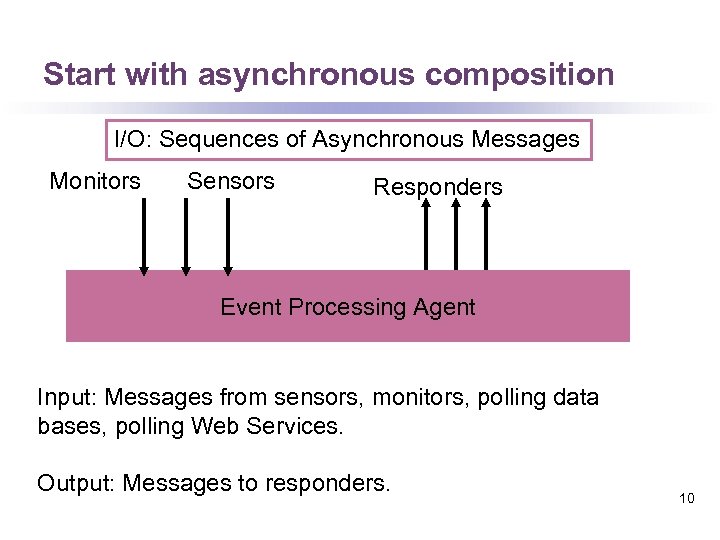 Start with asynchronous composition I/O: Sequences of Asynchronous Messages Monitors Sensors Responders Event Processing Agent Input: Messages from sensors, monitors, polling data bases, polling Web Services. Output: Messages to responders. 10
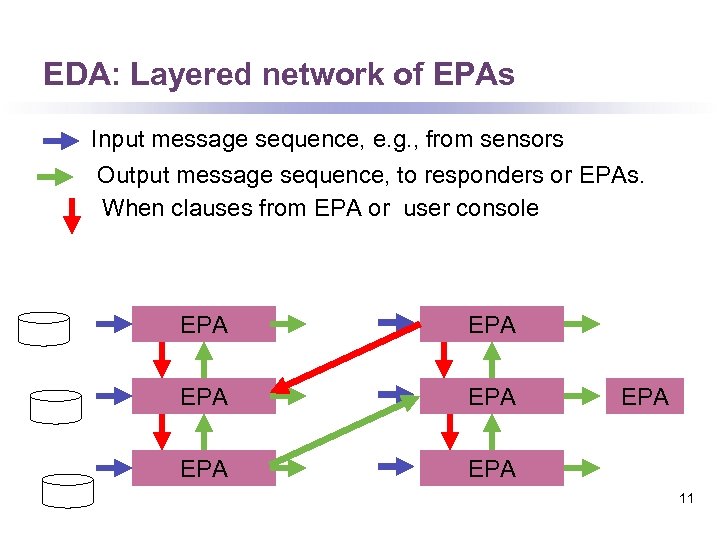 EDA: Layered network of EPAs Input message sequence, e. g. , from sensors Output message sequence, to responders or EPAs. When clauses from EPA or user console EPA EPA 11
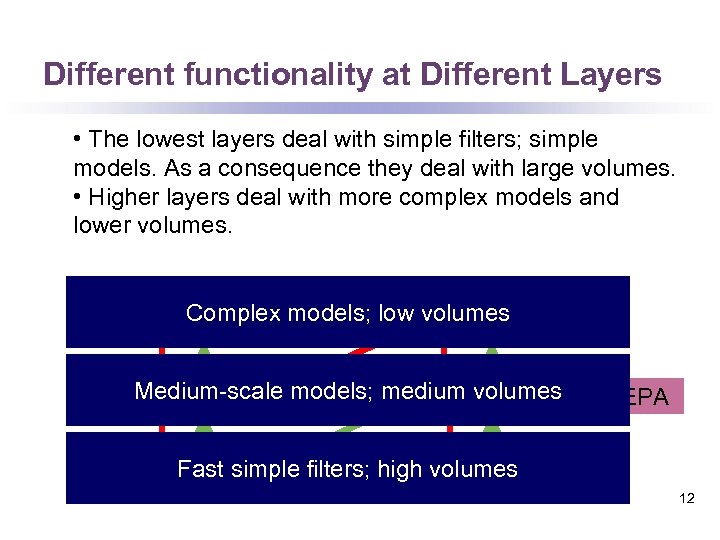 Different functionality at Different Layers • The lowest layers deal with simple filters; simple models. As a consequence they deal with large volumes. • Higher layers deal with more complex models and lower volumes. Complex models; low volumes EPA Medium-scale models; medium EPA volumes EPA EPA Fast simple filters; high volumes 12
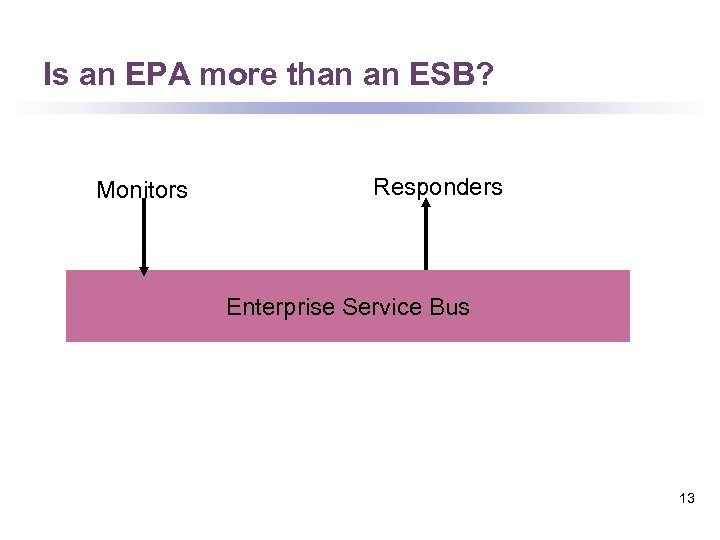 Is an EPA more than an ESB? Monitors Responders Enterprise Service Bus 13
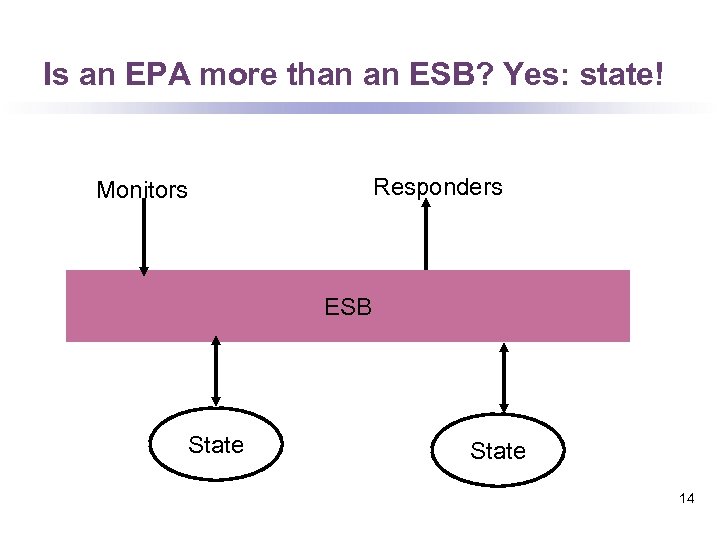 Is an EPA more than an ESB? Yes: state! Responders Monitors ESB State 14
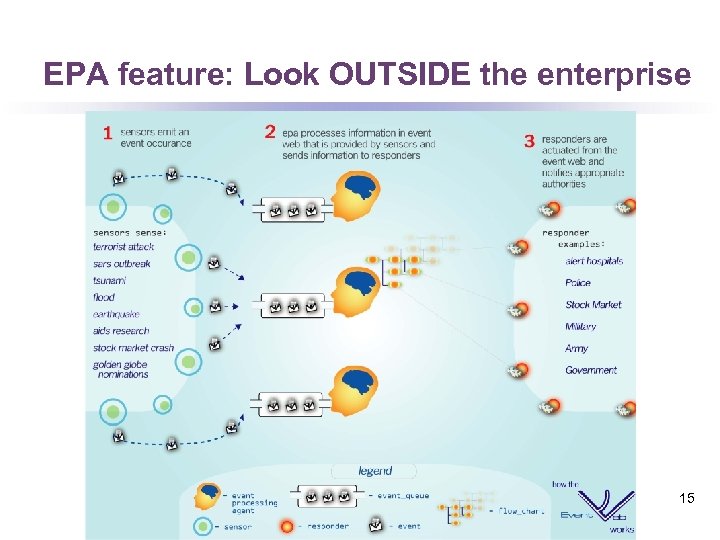 EPA feature: Look OUTSIDE the enterprise 15
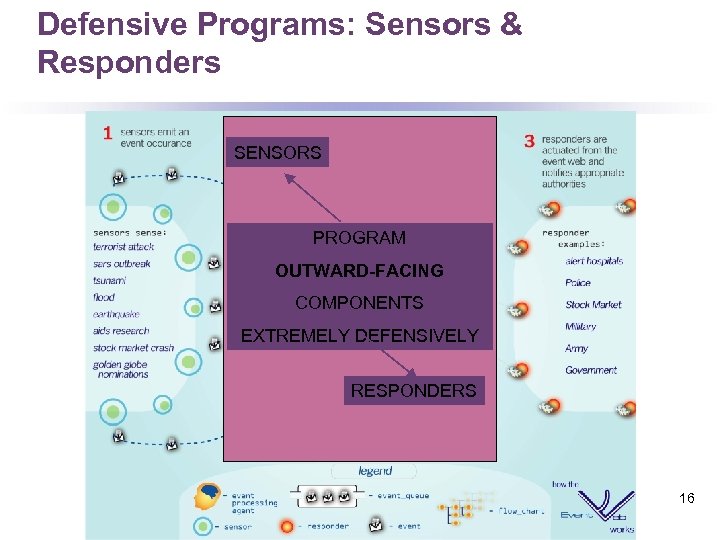 Defensive Programs: Sensors & Responders SENSORS PROGRAM OUTWARD-FACING COMPONENTS EXTREMELY DEFENSIVELY RESPONDERS 16
 EDA n n n When reality deviates from expectation then respond Implemented as a layered network of EPA servers. Each EPA manages sets of triples [f, g, h]: state = f(oldstate, input_msg) ESB functionality: If g(state, oldstate) then h(state, oldstate). 17
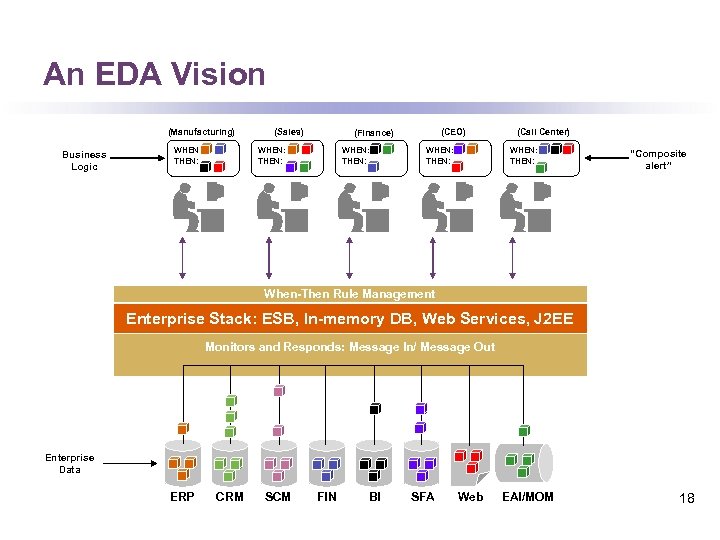 An EDA Vision (Manufacturing) Business Logic WHEN THEN: (Sales) (CEO) (Finance) WHEN: THEN: (Call Center) WHEN: THEN: “Composite alert” When-Then Rule Management Enterprise Stack: ESB, In-memory DB, Web Services, J 2 EE Monitors and Responds: Message In/ Message Out Enterprise Data ERP CRM SCM FIN BI SFA Web EAI/MOM 18
 Application Space n 1. 2. Application space categories determined by: Complexity and uniqueness of app. Development methods: 1. 2. 3. 4. 5. Professional services use library of components. End-user tailors plumbing using WYSIWYG. Notation for functions f, g, h Costs of false positives and false negatives Performance requirements 19
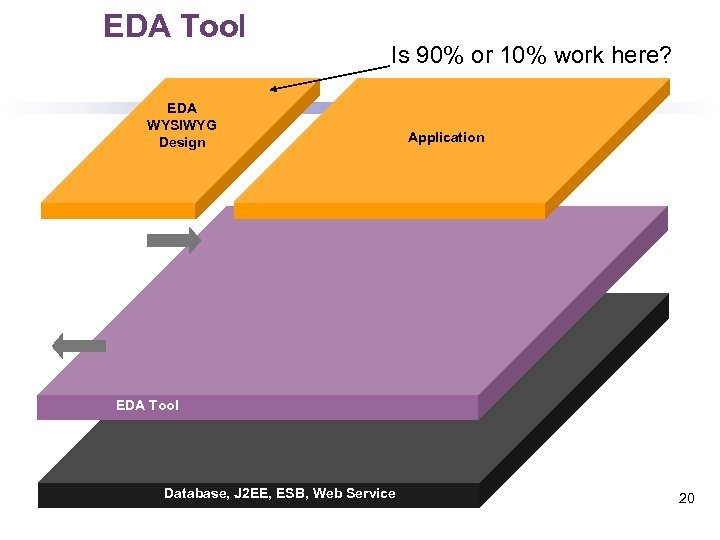 EDA Tool Is 90% or 10% work here? EDA WYSIWYG Design Application EDA Tool Database, J 2 EE, ESB, Web Service 20
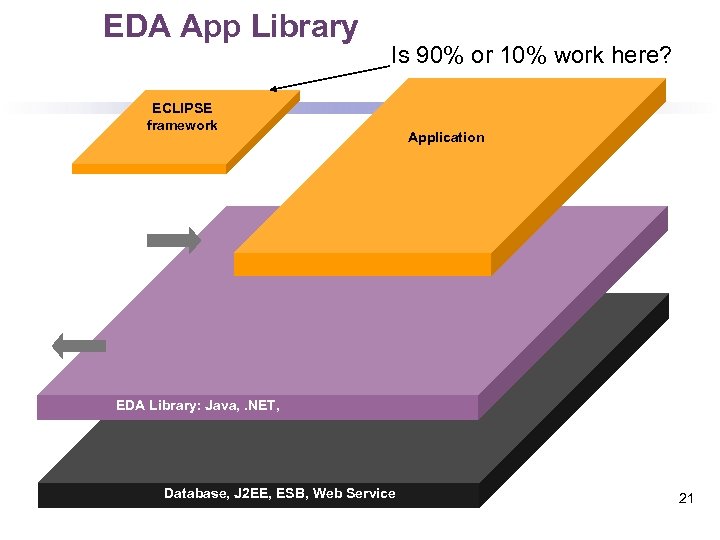 EDA App Library Is 90% or 10% work here? ECLIPSE framework Application EDA Library: Java, . NET, Database, J 2 EE, ESB, Web Service 21
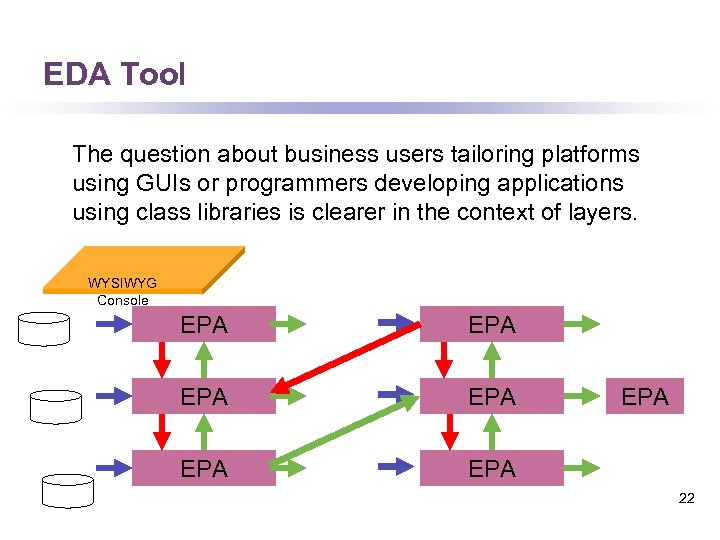 EDA Tool The question about business users tailoring platforms using GUIs or programmers developing applications using class libraries is clearer in the context of layers. WYSIWYG Console EPA EPA 22
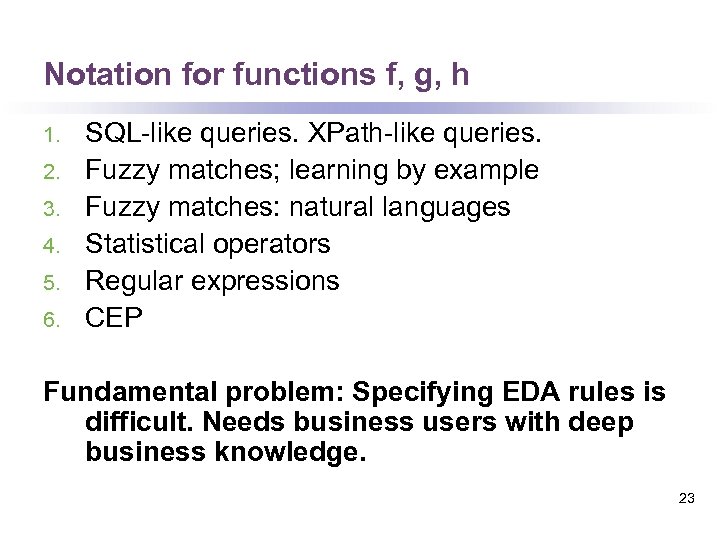 Notation for functions f, g, h 1. 2. 3. 4. 5. 6. SQL-like queries. XPath-like queries. Fuzzy matches; learning by example Fuzzy matches: natural languages Statistical operators Regular expressions CEP Fundamental problem: Specifying EDA rules is difficult. Needs business users with deep business knowledge. 23
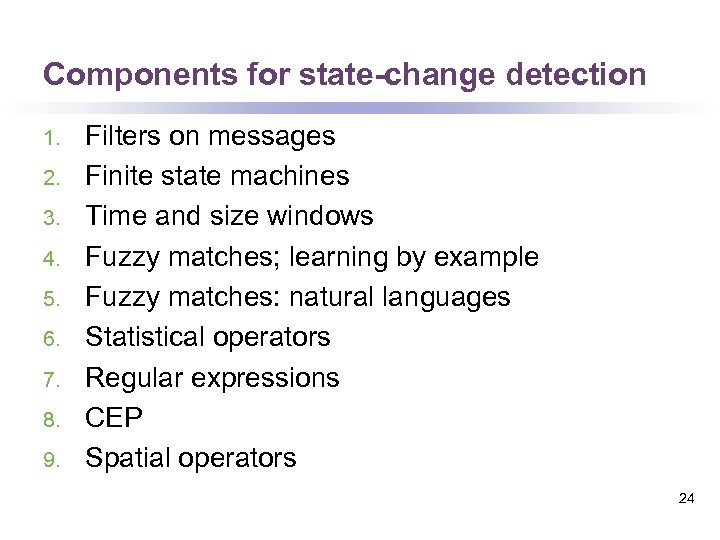 Components for state-change detection 1. 2. 3. 4. 5. 6. 7. 8. 9. Filters on messages Finite state machines Time and size windows Fuzzy matches; learning by example Fuzzy matches: natural languages Statistical operators Regular expressions CEP Spatial operators 24
 EDA Performance Requirements n 1. 2. 3. 4. n n Performance requirements for each EPA? Delay: Minutes? Sub-seconds? Incoming message rate: 1/sec, or 10, 000/sec? Numbers of rule templates: 10 or 1000? Numbers of rules: 100 or 100, 000? Are most apps at the low end of performance? Do low-end apps need tools unique to EDA? 25
 Costs of False Positives & Negatives n n n If actual expenditure deviates from plans then alert appropriate account executive. If arbitrage opportunity then pop-up trading window If radiation material within perimeter then send DHS vehicle to check. KEY Question: Cost of false positives? (Costs of false negatives almost always high. ) 26
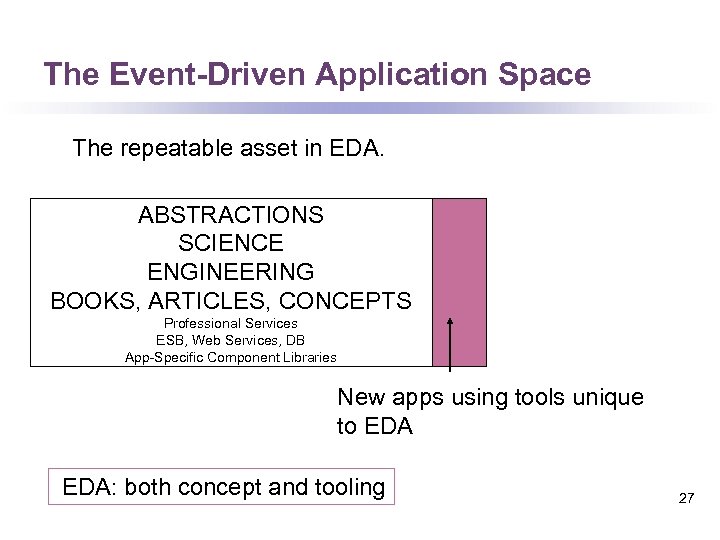 The Event-Driven Application Space The repeatable asset in EDA. ABSTRACTIONS SCIENCE ENGINEERING BOOKS, ARTICLES, CONCEPTS Professional Services ESB, Web Services, DB App-Specific Component Libraries New apps using tools unique to EDA: both concept and tooling 27
 Predictions for 2009? 1. 2. 3. 4. 5. 6. EDA – the concept – will get increasing press: books, conferences, workshops, blogs. EDA – professional services best practices will become common. EDA seminar courses will begin to appear. ECLIPSE plug-ins for EDA components. Niche applications in RFID, program trading, C 4 I exist, and will become more common. Nascent horizontal EDA platform development. 28
 My Research n n Primary focus: “event: reality deviates from expectation. ” Concepts: n n n Component libraries Rule creation and management Concepts n n Not horizontal EDA tool Not event programming language 29
 Challenges n n EDA, as an organizing principle will happen. EDA libraries for different app spaces will happen more rapidly with JEVS, Java Event Service. n (See what Java Message Service did for Message Queues. ) 30
 THE CRITICAL CHALLENGES n n Partition the many different things EDA does into categories. Identify the layers of an EDA architecture Identify the unique value proposition that EDA brings to each layer. Define concepts. Develop the science. Write books (thanks David). Define best practices. Tools and performance will follow. 31
 It’s All About Total Cost of Ownership n n Time, effort to build useful query templates Costs of false positives --- data inundation n Mindshare for new event-driven architecture. We already own so many components in the enterprise stack; don’t they do this already? Costs of application development. n Cost of new products. n n 32
 I’m done with being a devil’s advocate! 33