 Скачать презентацию Event-by-Event Fluctuations in 40 80 and 158 AGe
3b6691e8a3ac81c043b23cd724091c7e.ppt
- Количество слайдов: 46



Event-by-Event Fluctuations in 40, 80, and 158 AGe. V/c Pb+Au Collisions Hiroyuki Sako and H. Appelshäuser for the CERES/NA 45 Collaboration Quark Matter 2004 Oakland, Jan 11 -17, 2004 Goals Mean p. T fluctuations Net-charge fluctuations Conclusions
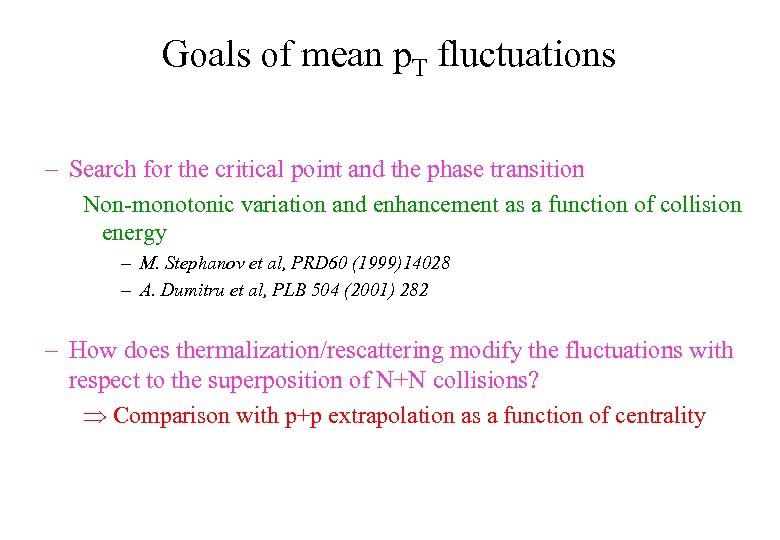
Goals of mean p. T fluctuations – Search for the critical point and the phase transition Non-monotonic variation and enhancement as a function of collision energy – M. Stephanov et al, PRD 60 (1999)14028 – A. Dumitru et al, PLB 504 (2001) 282 – How does thermalization/rescattering modify the fluctuations with respect to the superposition of N+N collisions? Þ Comparison with p+p extrapolation as a function of centrality
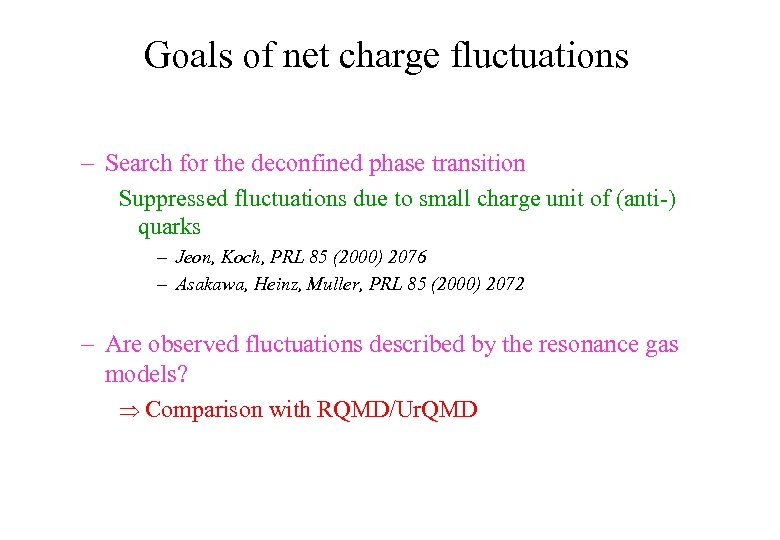
Goals of net charge fluctuations – Search for the deconfined phase transition Suppressed fluctuations due to small charge unit of (anti-) quarks – Jeon, Koch, PRL 85 (2000) 2076 – Asakawa, Heinz, Muller, PRL 85 (2000) 2072 – Are observed fluctuations described by the resonance gas models? Þ Comparison with RQMD/Ur. QMD
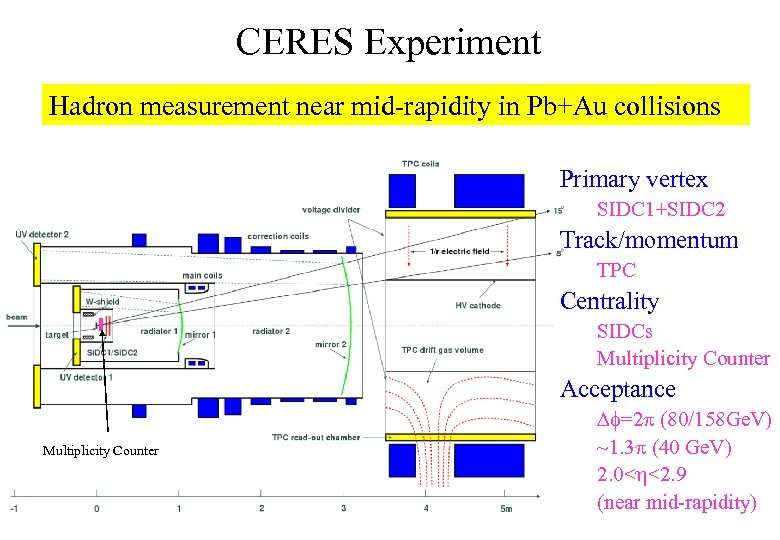
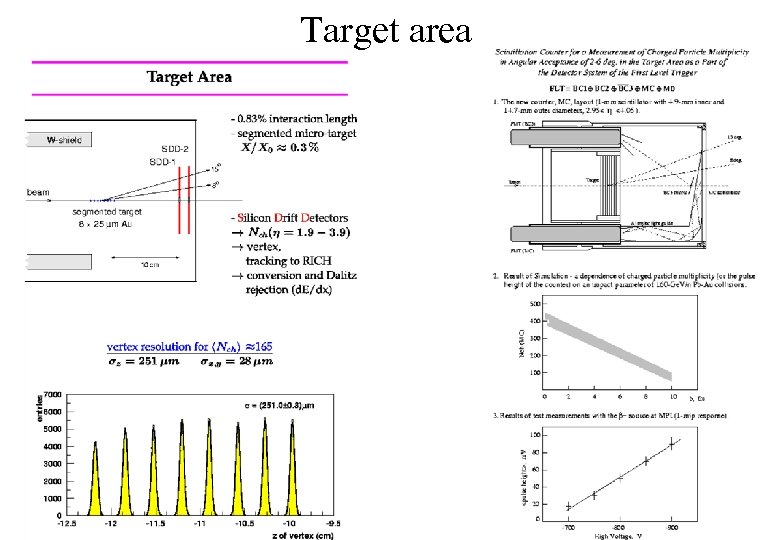
CERES Experiment Hadron measurement near mid-rapidity in Pb+Au collisions Primary vertex SIDC 1+SIDC 2 Track/momentum TPC Centrality SIDCs Multiplicity Counter Acceptance Multiplicity Counter Df=2 p (80/158 Ge. V) ~1. 3 p (40 Ge. V) 2. 0<h<2. 9 (near mid-rapidity)
Mean p. T Fluctuations (D. Adamova, et al, CERES collaboration, Nucl. Phys. A 727(2003)97 -119)
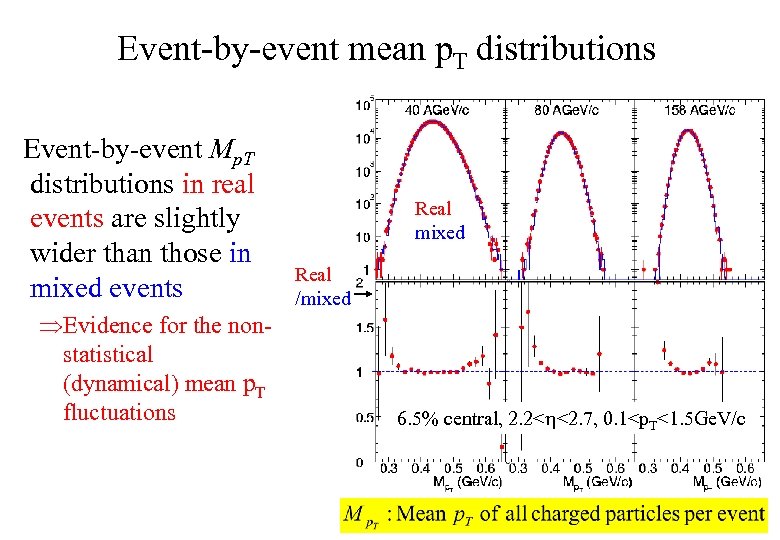
Event-by-event mean p. T distributions Event-by-event Mp. T distributions in real events are slightly wider than those in mixed events ÞEvidence for the nonstatistical (dynamical) mean p. T fluctuations Real mixed Real /mixed 6. 5% central, 2. 2<h<2. 7, 0. 1<p. T<1. 5 Ge. V/c
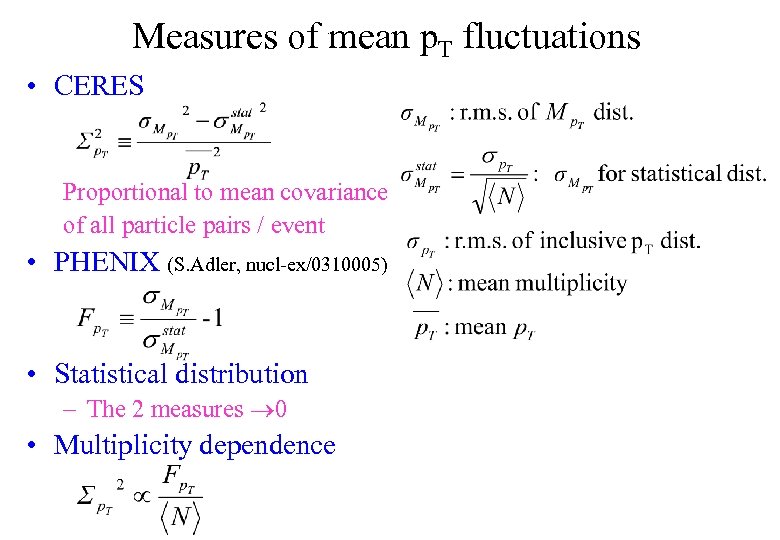
Measures of mean p. T fluctuations • CERES Proportional to mean covariance of all particle pairs / event • PHENIX (S. Adler, nucl-ex/0310005) • Statistical distribution – The 2 measures 0 • Multiplicity dependence
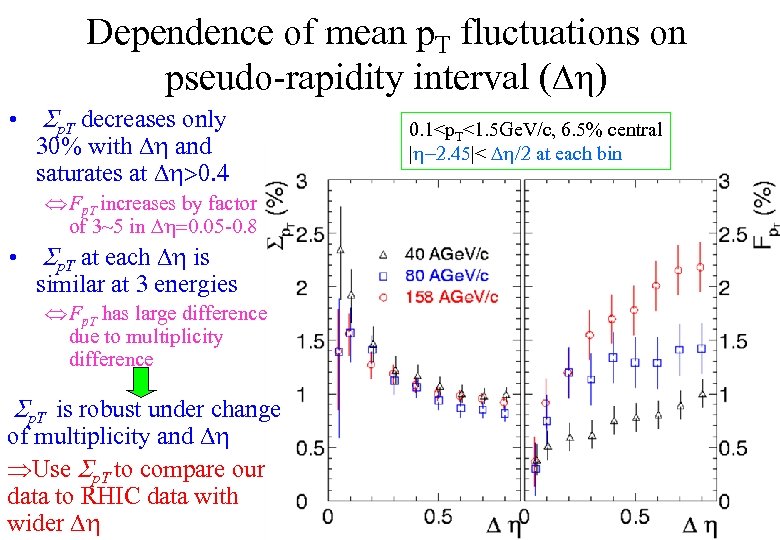
Dependence of mean p. T fluctuations on pseudo-rapidity interval (Dh) • Sp. T decreases only 30% with Dh and saturates at Dh>0. 4 Û Fp. T increases by factor of 3~5 in Dh=0. 05 -0. 8 • Sp. T at each Dh is similar at 3 energies Û Fp. T has large difference due to multiplicity difference Sp. T is robust under change of multiplicity and Dh ÞUse Sp. T to compare our data to RHIC data with wider Dh 0. 1<p. T<1. 5 Ge. V/c, 6. 5% central |h-2. 45|< Dh/2 at each bin
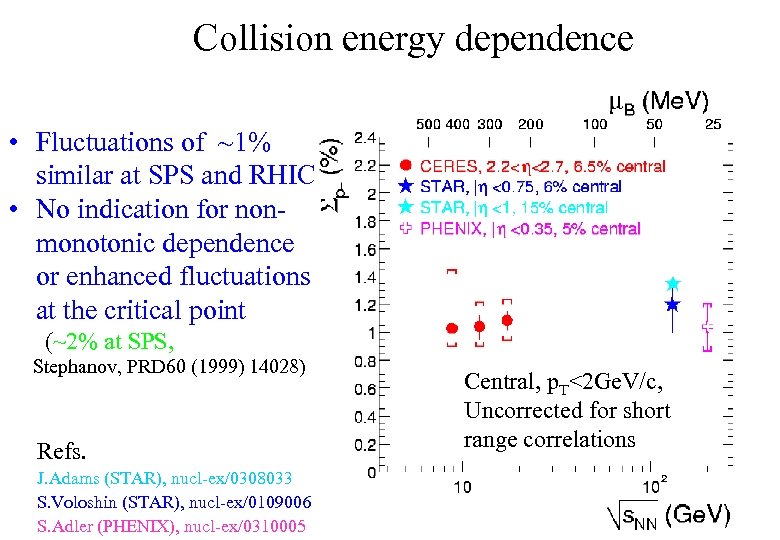
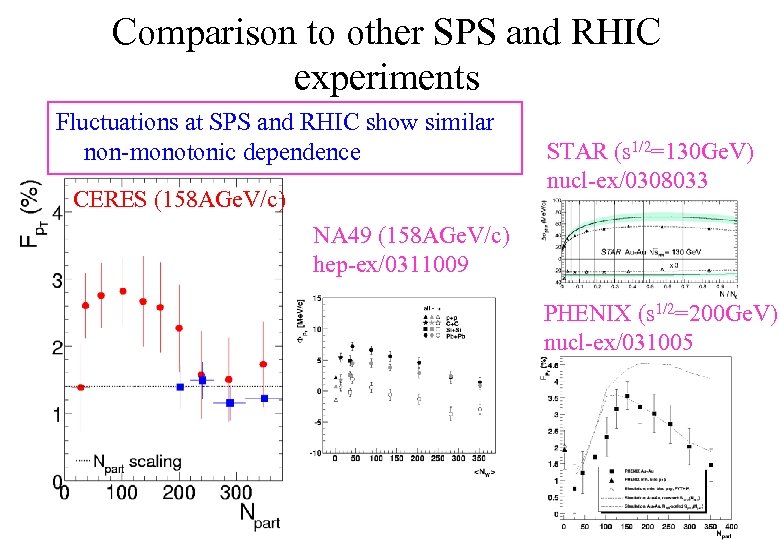
Collision energy dependence • Fluctuations of ~1% similar at SPS and RHIC • No indication for nonmonotonic dependence or enhanced fluctuations at the critical point (~2% at SPS, Stephanov, PRD 60 (1999) 14028) Refs. J. Adams (STAR), nucl-ex/0308033 S. Voloshin (STAR), nucl-ex/0109006 S. Adler (PHENIX), nucl-ex/0310005 Central, p. T<2 Ge. V/c, Uncorrected for short range correlations
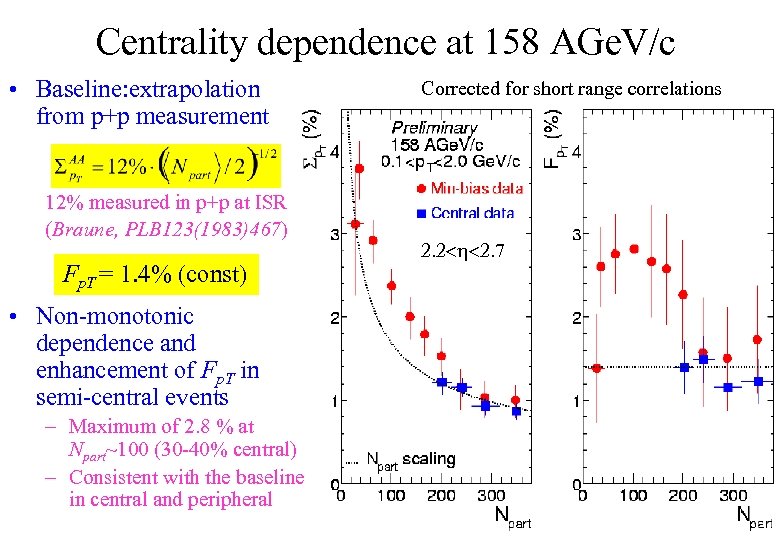
Centrality dependence at 158 AGe. V/c • Baseline: extrapolation from p+p measurement 12% measured in p+p at ISR (Braune, PLB 123(1983)467) Fp. T = 1. 4% (const) • Non-monotonic dependence and enhancement of Fp. T in semi-central events – Maximum of 2. 8 % at Npart~100 (30 -40% central) – Consistent with the baseline in central and peripheral Corrected for short range correlations 2. 2<h<2. 7
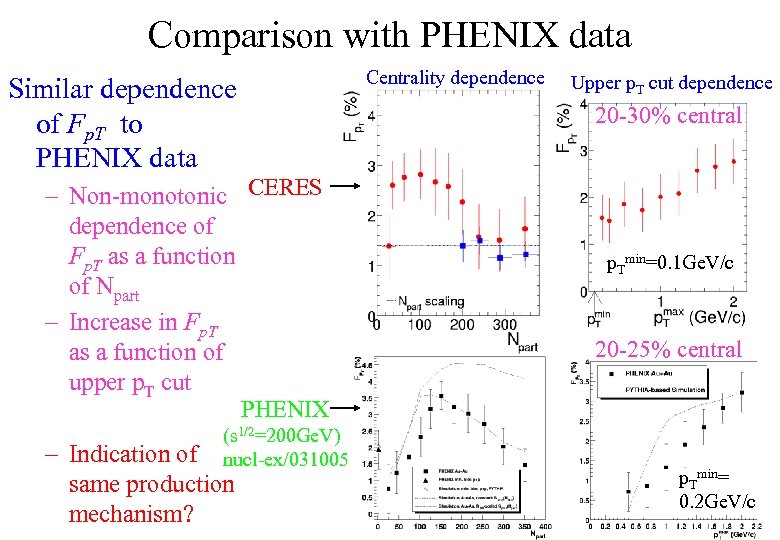
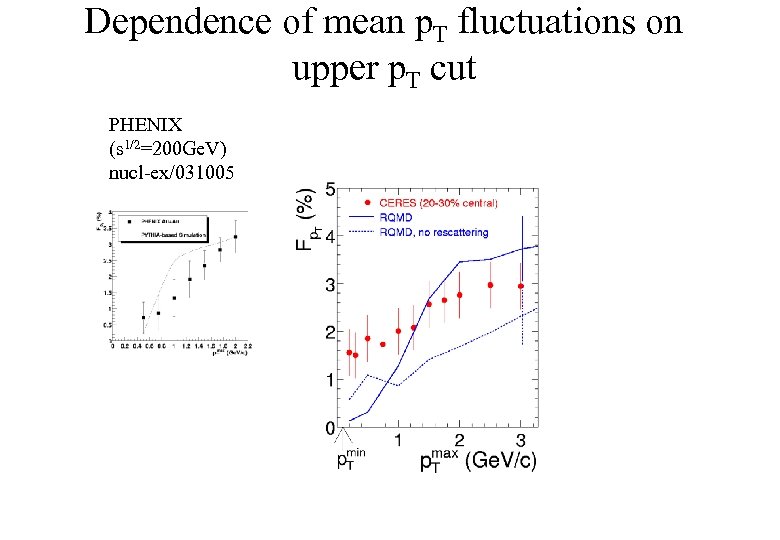
Comparison with PHENIX data Centrality dependence Similar dependence of Fp. T to PHENIX data Upper p. T cut dependence 20 -30% central – Non-monotonic CERES dependence of Fp. T as a function of Npart – Increase in Fp. T as a function of upper p. T cut p. Tmin=0. 1 Ge. V/c 20 -25% central PHENIX (s 1/2=200 Ge. V) nucl-ex/031005 – Indication of same production mechanism? p. Tmin= 0. 2 Ge. V/c
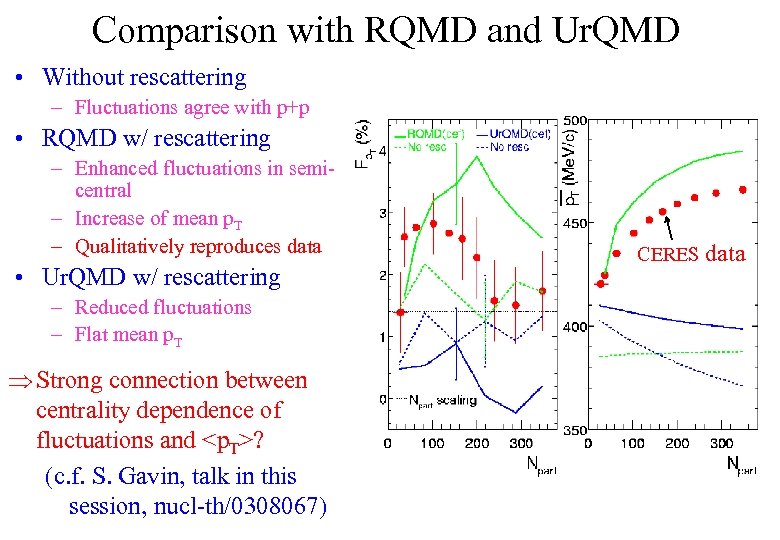
Comparison with RQMD and Ur. QMD • Without rescattering – Fluctuations agree with p+p • RQMD w/ rescattering – Enhanced fluctuations in semicentral – Increase of mean p. T – Qualitatively reproduces data • Ur. QMD w/ rescattering – Reduced fluctuations – Flat mean p. T Þ Strong connection between centrality dependence of fluctuations and <p. T>? (c. f. S. Gavin, talk in this session, nucl-th/0308067) CERES data

Net Charge Fluctuations
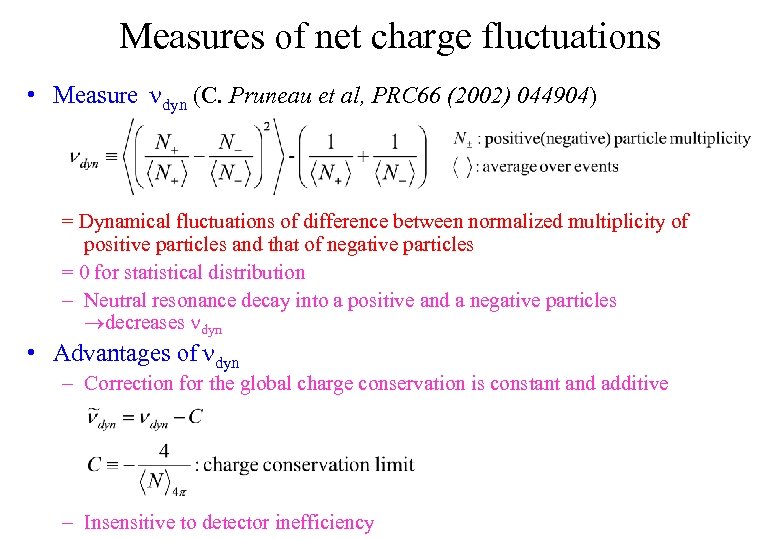
Measures of net charge fluctuations • Measure ndyn (C. Pruneau et al, PRC 66 (2002) 044904) = Dynamical fluctuations of difference between normalized multiplicity of positive particles and that of negative particles = 0 for statistical distribution – Neutral resonance decay into a positive and a negative particles decreases ndyn • Advantages of ndyn – Correction for the global charge conservation is constant and additive – Insensitive to detector inefficiency
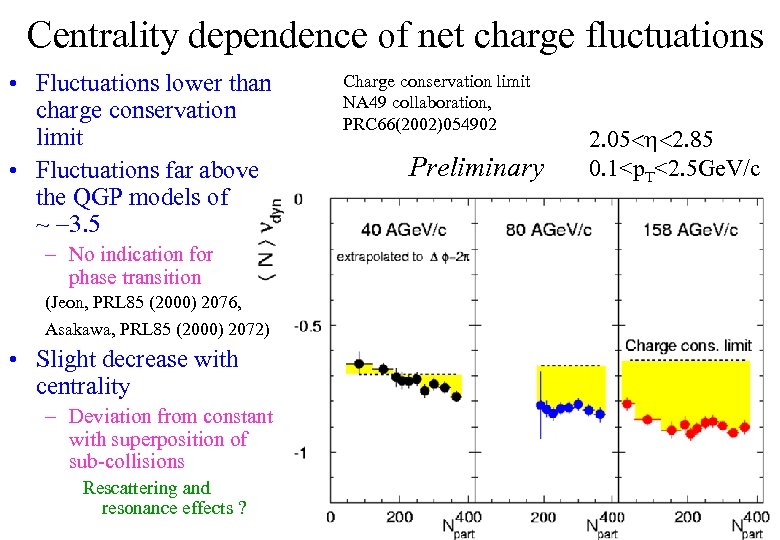
Centrality dependence of net charge fluctuations • Fluctuations lower than charge conservation limit • Fluctuations far above the QGP models of ~ -3. 5 – No indication for phase transition (Jeon, PRL 85 (2000) 2076, Asakawa, PRL 85 (2000) 2072) • Slight decrease with centrality – Deviation from constant with superposition of sub-collisions Rescattering and resonance effects ? Charge conservation limit NA 49 collaboration, PRC 66(2002)054902 Preliminary 2. 05<h<2. 85 0. 1<p. T<2. 5 Ge. V/c
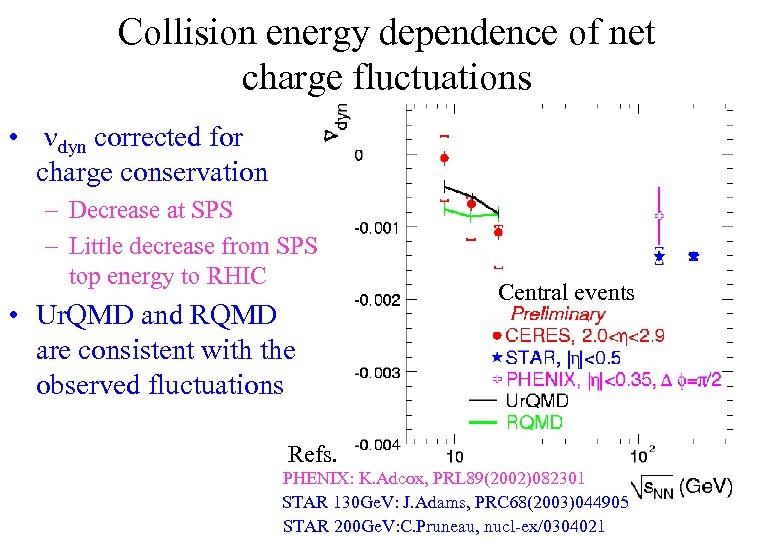
Collision energy dependence of net charge fluctuations • ndyn corrected for charge conservation – Decrease at SPS – Little decrease from SPS top energy to RHIC • Ur. QMD and RQMD are consistent with the observed fluctuations Central events Refs. PHENIX: K. Adcox, PRL 89(2002)082301 STAR 130 Ge. V: J. Adams, PRC 68(2003)044905 STAR 200 Ge. V: C. Pruneau, nucl-ex/0304021
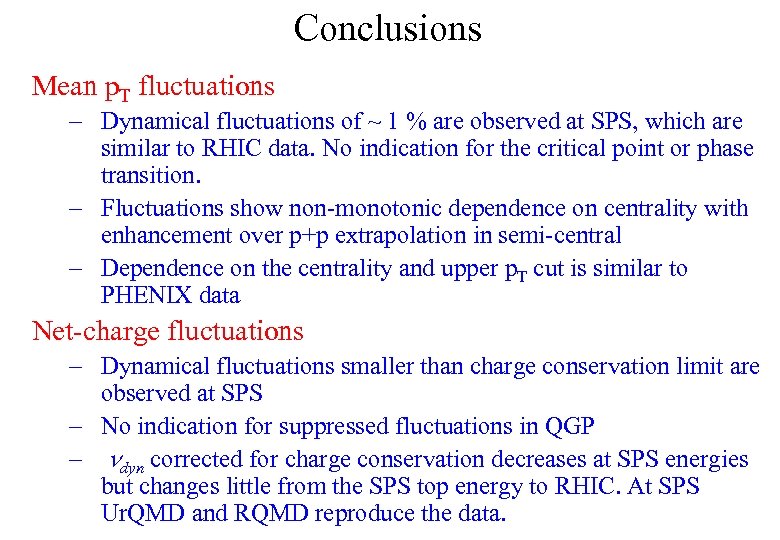
Conclusions Mean p. T fluctuations – Dynamical fluctuations of ~ 1 % are observed at SPS, which are similar to RHIC data. No indication for the critical point or phase transition. – Fluctuations show non-monotonic dependence on centrality with enhancement over p+p extrapolation in semi-central – Dependence on the centrality and upper p. T cut is similar to PHENIX data Net-charge fluctuations – Dynamical fluctuations smaller than charge conservation limit are observed at SPS – No indication for suppressed fluctuations in QGP – ndyn corrected for charge conservation decreases at SPS energies but changes little from the SPS top energy to RHIC. At SPS Ur. QMD and RQMD reproduce the data.
CERES/NA 45 Collaboration D. Adamova 1, G. Agakichiev 2, H. Appelshaeuser 3, V. Belaga 4, P. Braun-Munzinger 2, R. Campagnolo 3, A. Castillo 2, A. Cherlin 5, S. Damjanovic 3, T. Dietel 3, L. Dietrich 3, A. Drees 6, S. I. Esumi 3, K. Filimonov 3, K. Fomenko 4, Z. Fraenkel 5, C. Garabatos 2, P. Glaessel 3, G. Hering 2, J. Holeczek 2, V. Kushpil 1, B. Lenkeit 7, W. Ludolphs 3, A. Maas 2, A. Marin 2, J. Milosevic 3, A. Milov 5, D. Miskowiec 2, L. Musa 7, Yu. Panebrattsev 4, O. Petchenova 4, V. Petracek 3, A. Pfeiffer 7, J. Rak 8, I. Ravinovich 5, P. Rehak 8, M. Richter 3, H. Sako 2, W. Schmitz 3, J. Schukraft 7, S. Sedykh 2, W. Seipp 3, A. Sharma 2, S. Shimansky 4, J. Slivova 3, H. J. Specht 3, J. Stachel 3, M. Sumbera 1, H. Tilsner 3, I. Tserruya 5, J. P. Wessels 2, T. Wienold 3, B. Windelband 3, J. P. Wurm 8, W. Xie 5, S. Yurevich 3, V. Yurevich 4 (1) NPI ASCR, Rez, Czech Republic (2) GSI Darmstadt, Germany (3) Heidelberg University, Germany (4) JINR Dubna, Russia (5) Weizmann Institute, Rehovot, Israel (6) SUNY at Stony Brook, U. S. A. (7) CERN, Geneva, Switzerland (8) BNL, Upton, U. S. A. (9) MPI, Heidelberg, Germany
Comparison to other SPS and RHIC experiments Fluctuations at SPS and RHIC show similar non-monotonic dependence CERES (158 AGe. V/c) STAR (s 1/2=130 Ge. V) nucl-ex/0308033 NA 49 (158 AGe. V/c) hep-ex/0311009 PHENIX (s 1/2=200 Ge. V) nucl-ex/031005
Dependence of mean p. T fluctuations on upper p. T cut PHENIX (s 1/2=200 Ge. V) nucl-ex/031005
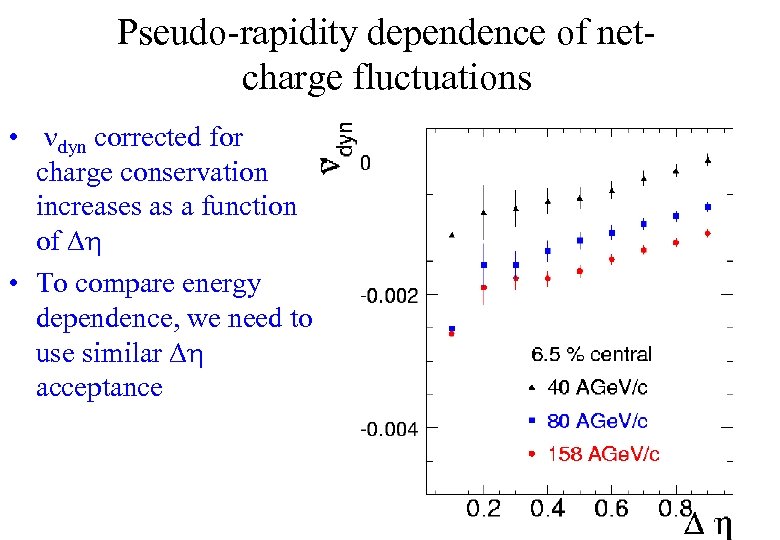
Pseudo-rapidity dependence of netcharge fluctuations • ndyn corrected for charge conservation increases as a function of Dh • To compare energy dependence, we need to use similar Dh acceptance
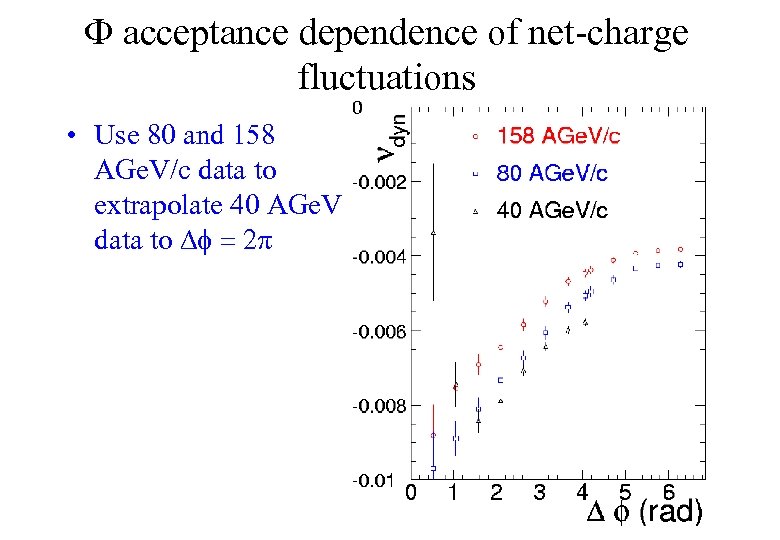
F acceptance dependence of net-charge fluctuations • Use 80 and 158 AGe. V/c data to extrapolate 40 AGe. V data to Df = 2 p
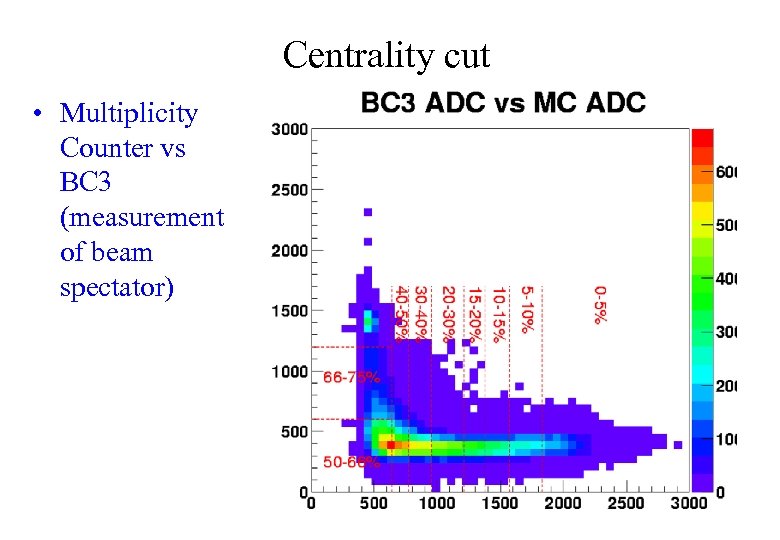
Centrality cut • Multiplicity Counter vs BC 3 (measurement of beam spectator)
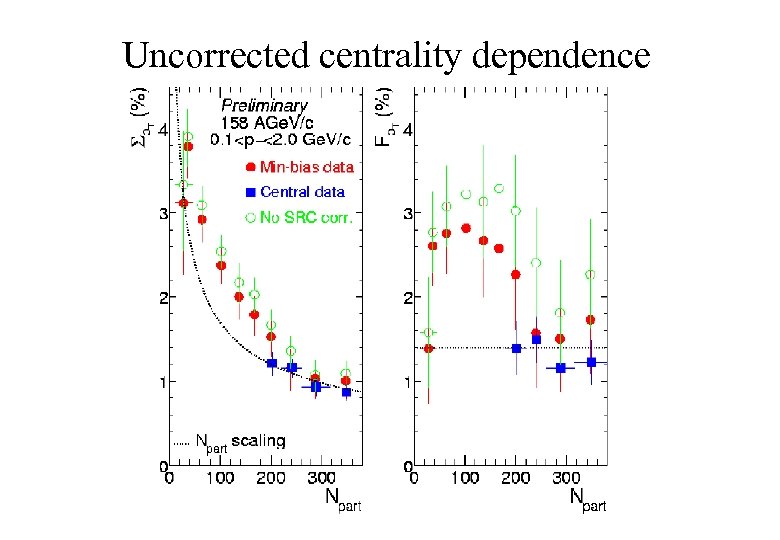
Uncorrected centrality dependence
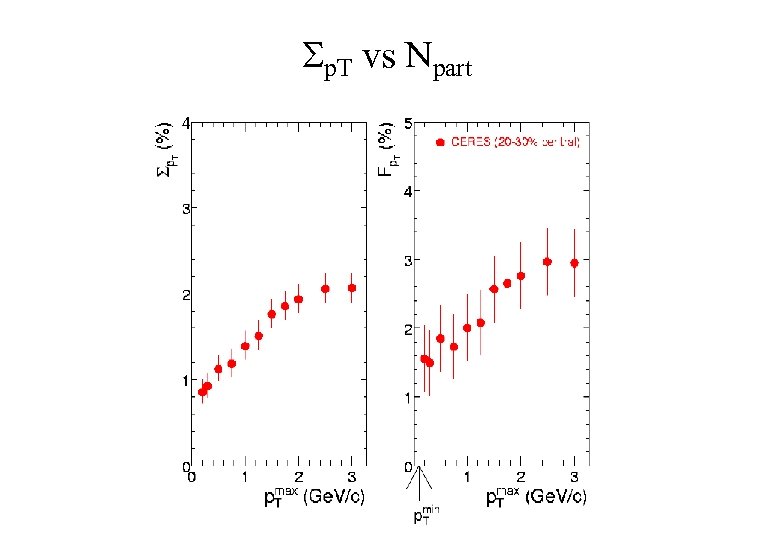
Sp. T vs Npart
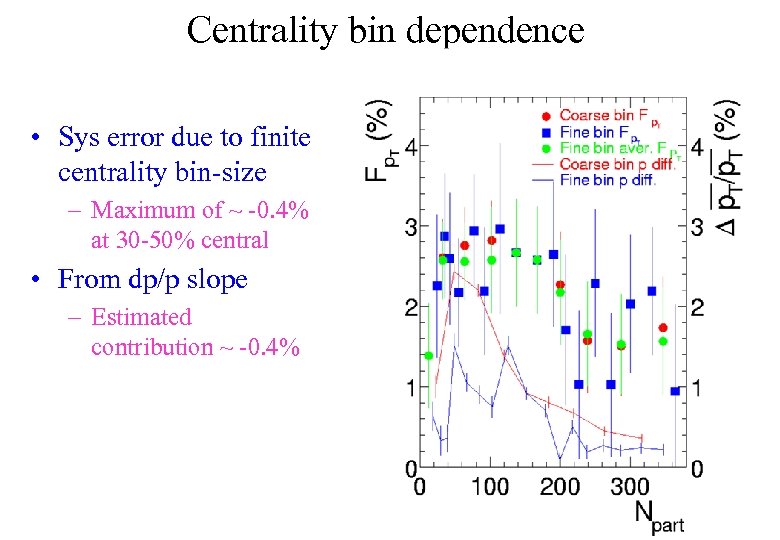
Centrality bin dependence • Sys error due to finite centrality bin-size – Maximum of ~ -0. 4% at 30 -50% central • From dp/p slope – Estimated contribution ~ -0. 4%
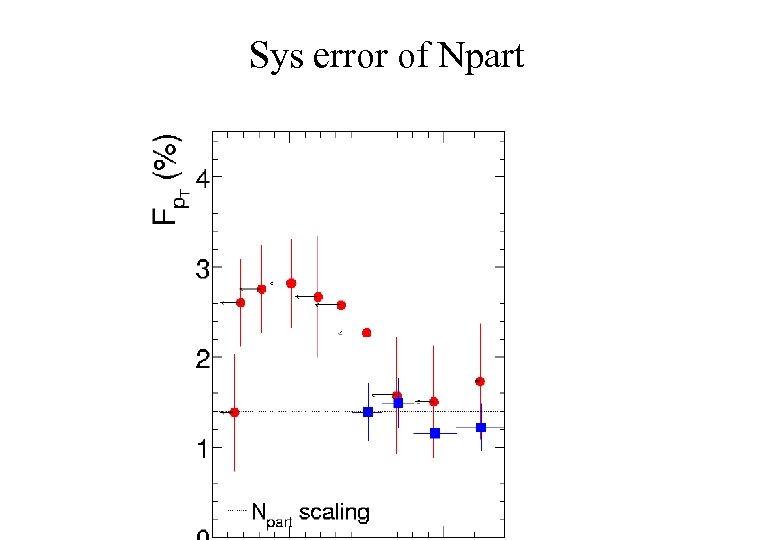
Sys error of Npart
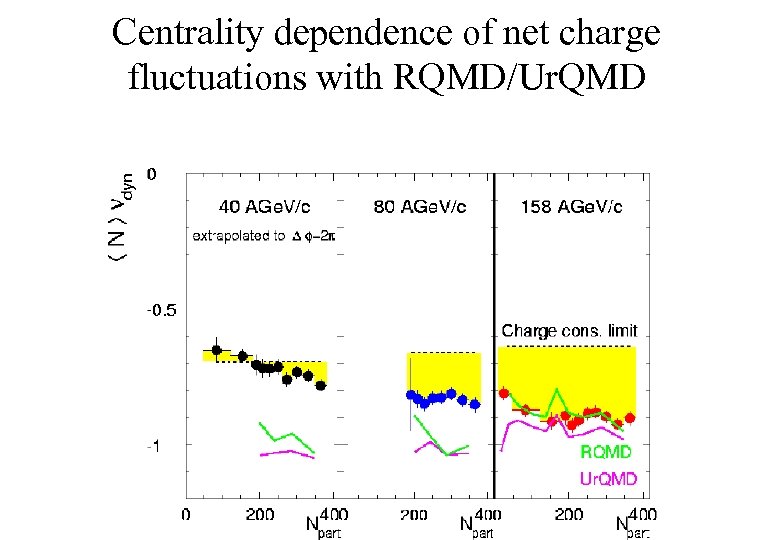
Centrality dependence of net charge fluctuations with RQMD/Ur. QMD
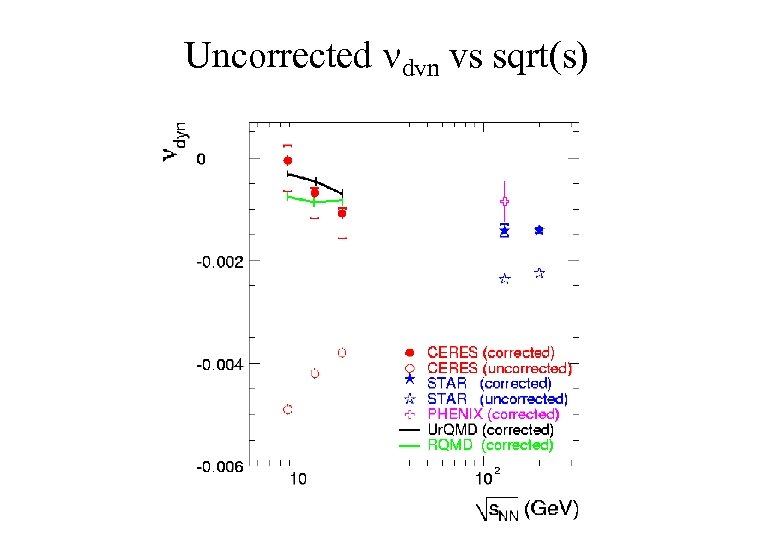
Uncorrected ndyn vs sqrt(s)
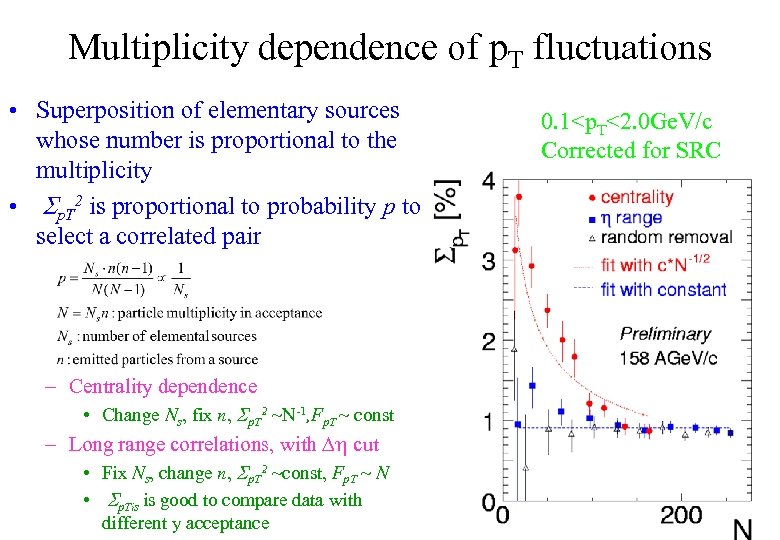
Multiplicity dependence of p. T fluctuations • Superposition of elementary sources whose number is proportional to the multiplicity • Sp. T 2 is proportional to probability p to select a correlated pair – Centrality dependence • Change Ns, fix n, Sp. T 2 ~N-1, Fp. T ~ const – Long range correlations, with Dh cut • Fix Ns, change n, Sp. T 2 ~const, Fp. T ~ N • Sp. Tis is good to compare data with different y acceptance 0. 1<p. T<2. 0 Ge. V/c Corrected for SRC
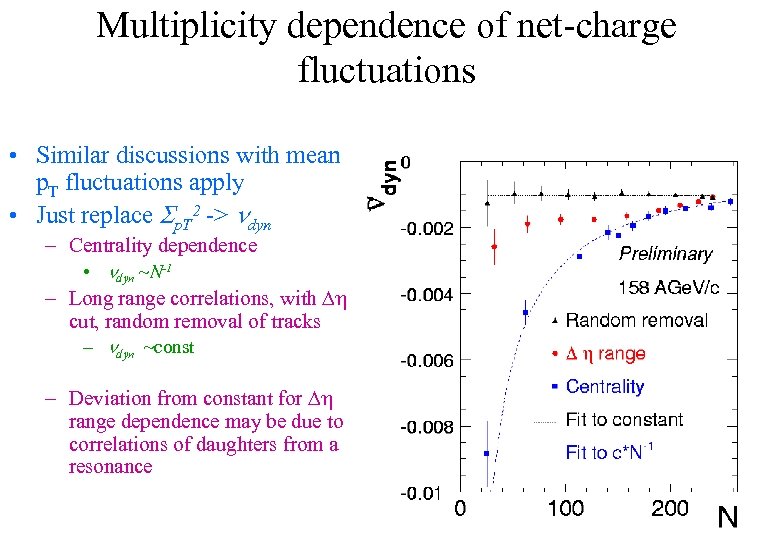
Multiplicity dependence of net-charge fluctuations • Similar discussions with mean p. T fluctuations apply • Just replace Sp. T 2 -> ndyn – Centrality dependence • ndyn ~N-1 – Long range correlations, with Dh cut, random removal of tracks – ndyn ~const – Deviation from constant for Dh range dependence may be due to correlations of daughters from a resonance
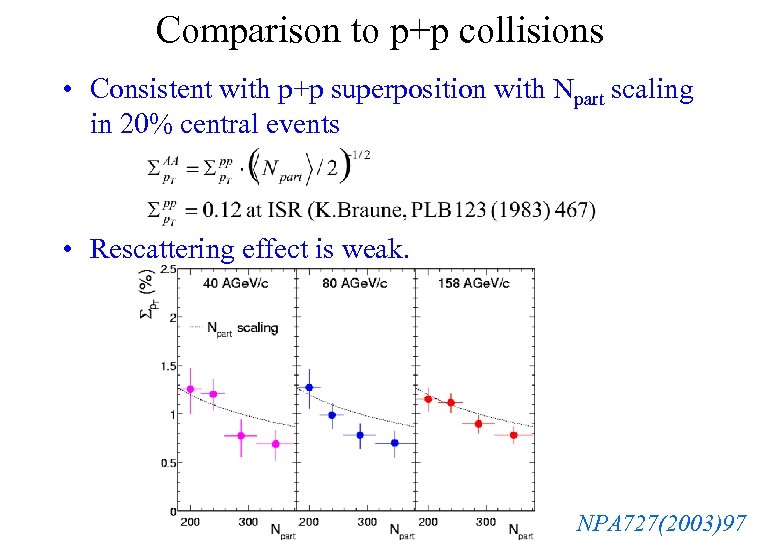
Comparison to p+p collisions • Consistent with p+p superposition with Npart scaling in 20% central events • Rescattering effect is weak. NPA 727(2003)97
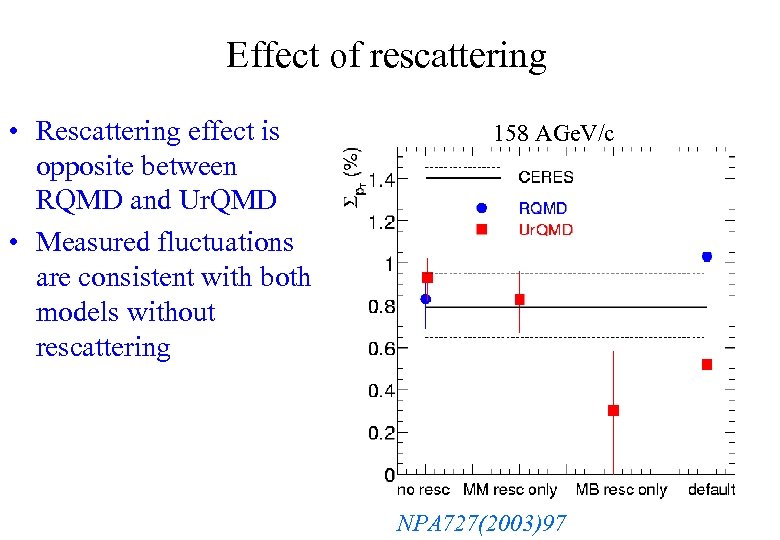
Effect of rescattering • Rescattering effect is opposite between RQMD and Ur. QMD • Measured fluctuations are consistent with both models without rescattering 158 AGe. V/c NPA 727(2003)97
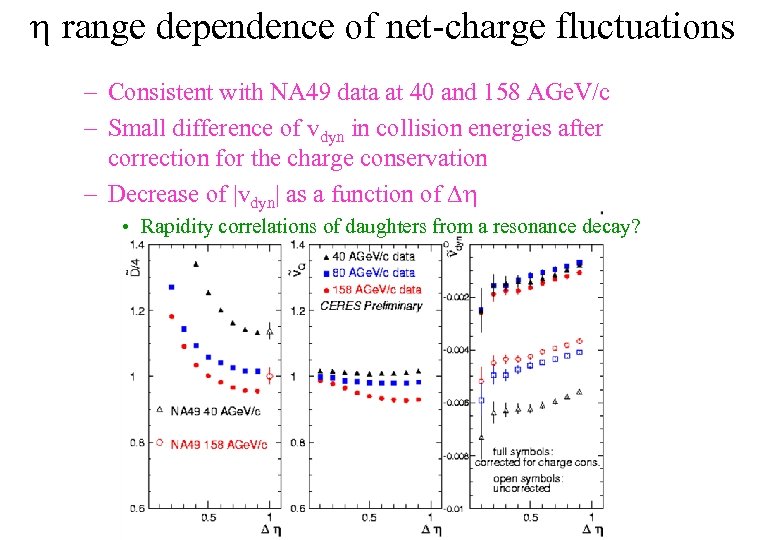
h range dependence of net-charge fluctuations – Consistent with NA 49 data at 40 and 158 AGe. V/c – Small difference of vdyn in collision energies after correction for the charge conservation – Decrease of |vdyn| as a function of Dh • Rapidity correlations of daughters from a resonance decay?
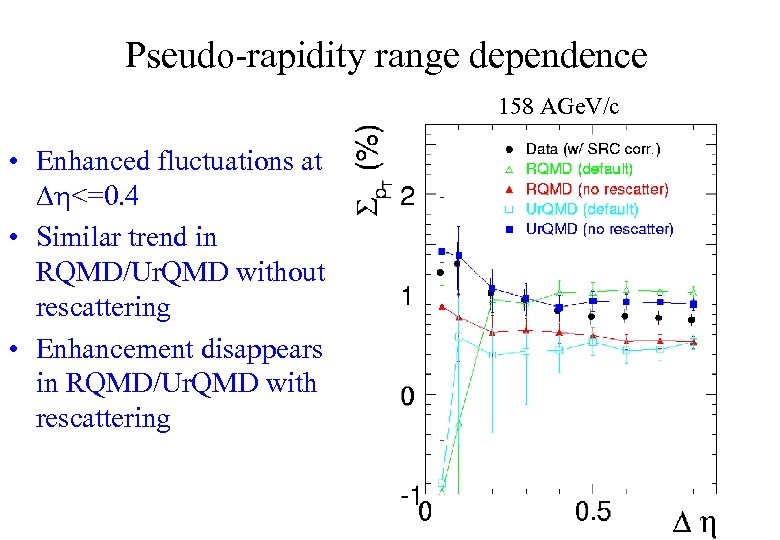
Pseudo-rapidity range dependence 158 AGe. V/c • Enhanced fluctuations at Dh<=0. 4 • Similar trend in RQMD/Ur. QMD without rescattering • Enhancement disappears in RQMD/Ur. QMD with rescattering
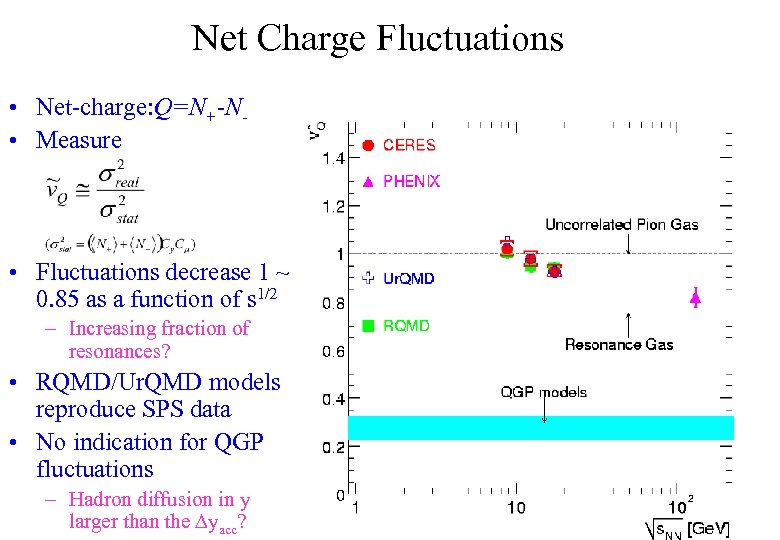
Net Charge Fluctuations • Net-charge: Q=N+-N • Measure • Fluctuations decrease 1 ~ 0. 85 as a function of s 1/2 – Increasing fraction of resonances? • RQMD/Ur. QMD models reproduce SPS data • No indication for QGP fluctuations – Hadron diffusion in y larger than the Dyacc?
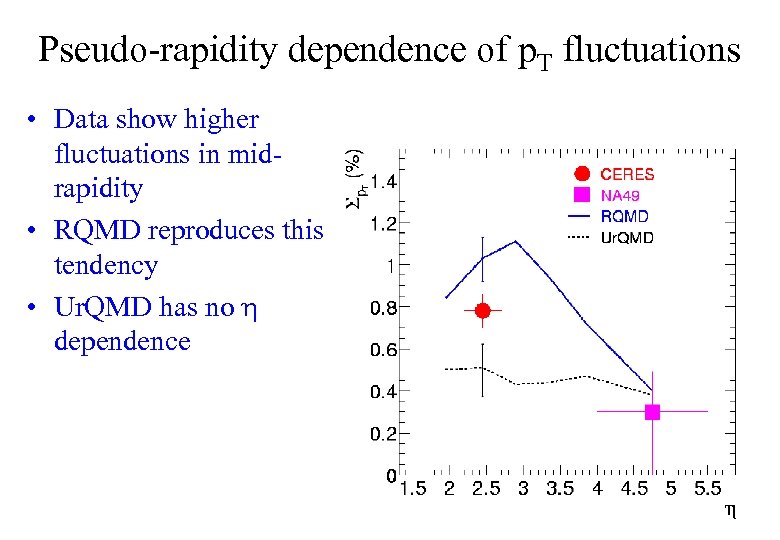
Pseudo-rapidity dependence of p. T fluctuations • Data show higher fluctuations in midrapidity • RQMD reproduces this tendency • Ur. QMD has no h dependence
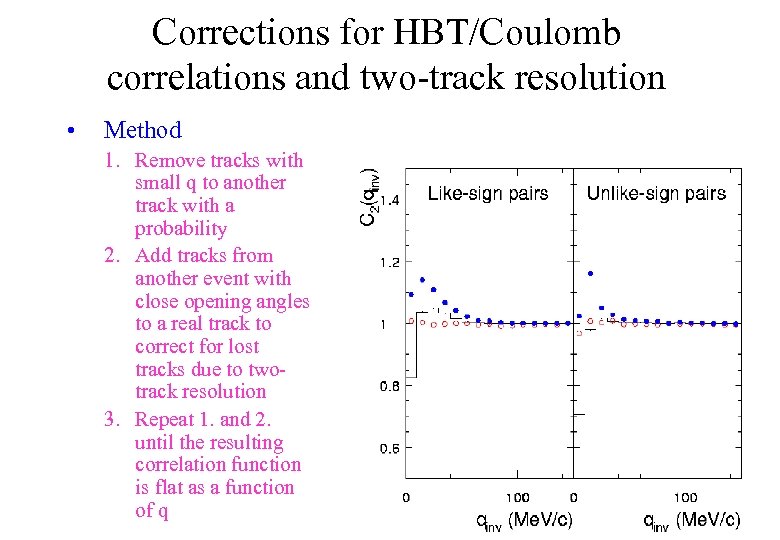
Corrections for HBT/Coulomb correlations and two-track resolution • Method 1. Remove tracks with small q to another track with a probability 2. Add tracks from another event with close opening angles to a real track to correct for lost tracks due to twotrack resolution 3. Repeat 1. and 2. until the resulting correlation function is flat as a function of q
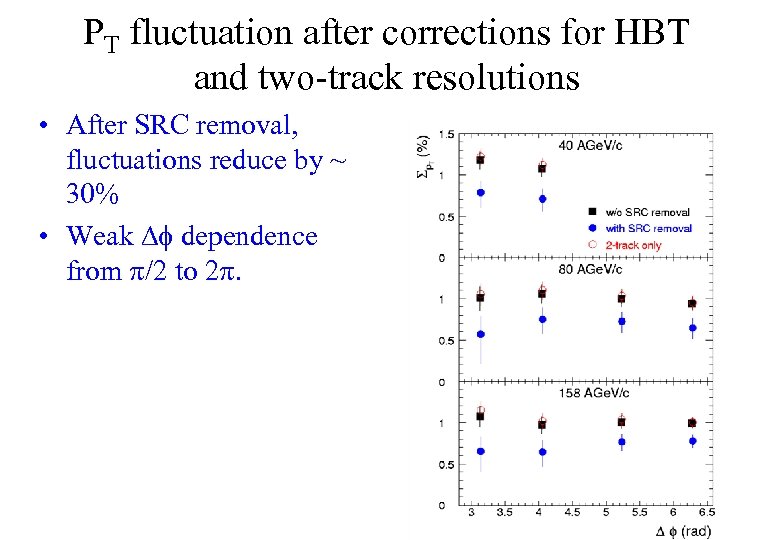
PT fluctuation after corrections for HBT and two-track resolutions • After SRC removal, fluctuations reduce by ~ 30% • Weak Df dependence from p/2 to 2 p.
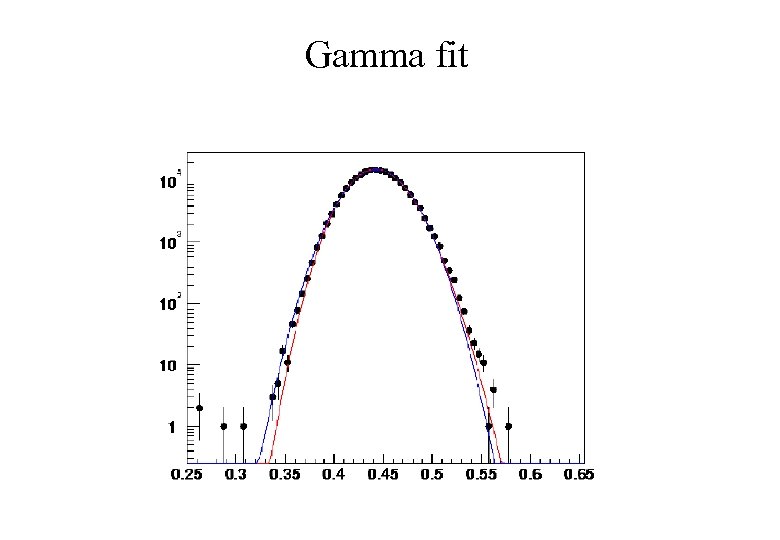
Gamma fit
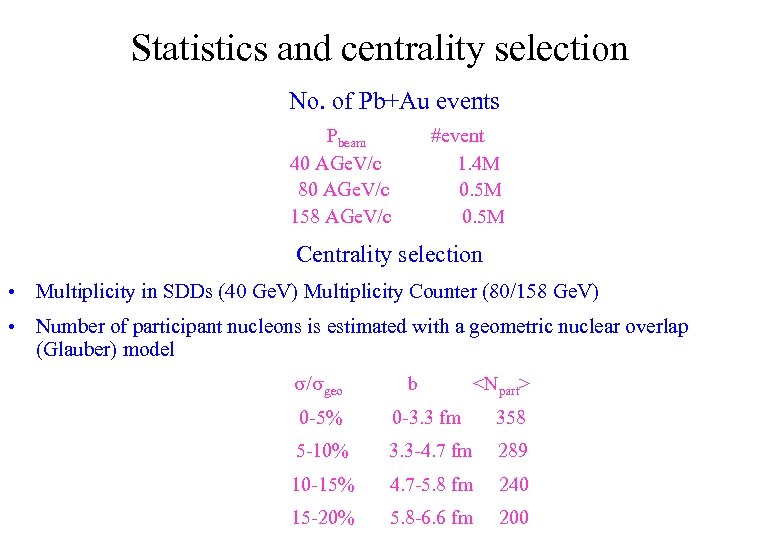
Statistics and centrality selection No. of Pb+Au events Pbeam 40 AGe. V/c 80 AGe. V/c 158 AGe. V/c #event 1. 4 M 0. 5 M Centrality selection • Multiplicity in SDDs (40 Ge. V) Multiplicity Counter (80/158 Ge. V) • Number of participant nucleons is estimated with a geometric nuclear overlap (Glauber) model s/sgeo b <Npart> 0 -5% 0 -3. 3 fm 358 5 -10% 3. 3 -4. 7 fm 289 10 -15% 4. 7 -5. 8 fm 240 15 -20% 5. 8 -6. 6 fm 200
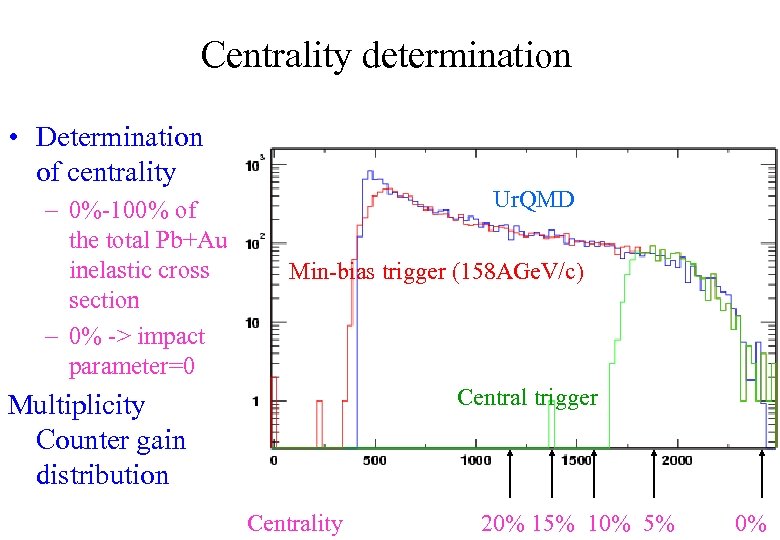
Centrality determination • Determination of centrality – 0%-100% of the total Pb+Au inelastic cross section – 0% -> impact parameter=0 Ur. QMD Min-bias trigger (158 AGe. V/c) Central trigger Ur. QMD Multiplicity Counter gain distribution Centrality 20% 15% 10% 5% 0%
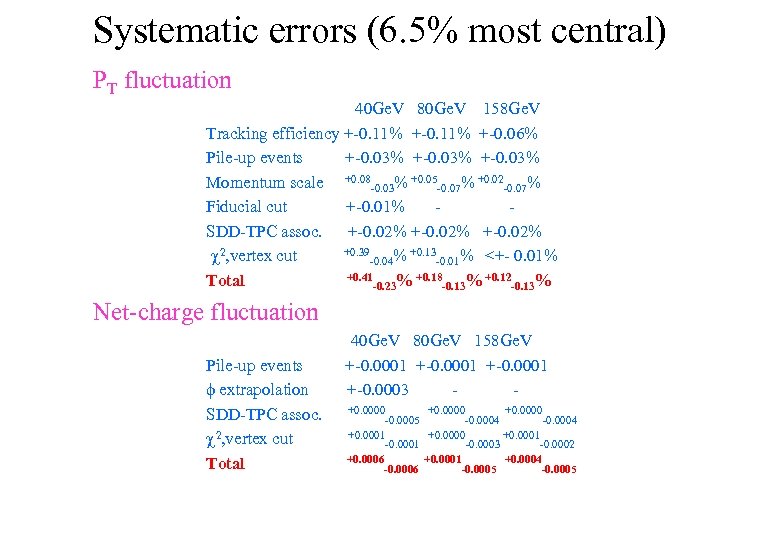
Systematic errors (6. 5% most central) PT fluctuation 40 Ge. V 80 Ge. V 158 Ge. V Tracking efficiency +-0. 11% +-0. 06% Pile-up events +-0. 03% Momentum scale +0. 08 -0. 03% +0. 05 -0. 07% +0. 02 -0. 07% Fiducial cut +-0. 01% SDD-TPC assoc. +-0. 02% +0. 39 +0. 13 c 2, vertex cut -0. 04% -0. 01% <+- 0. 01% +0. 41 +0. 18 +0. 12 Total -0. 23% -0. 13% Net-charge fluctuation Pile-up events f extrapolation SDD-TPC assoc. c 2, vertex cut Total 40 Ge. V 80 Ge. V 158 Ge. V +-0. 0001 +-0. 0003 +0. 0000 -0. 0005 -0. 0004 +0. 0001 +0. 0000 +0. 0001 -0. 0003 -0. 0002 +0. 0006 +0. 0001 +0. 0004 -0. 0006 -0. 0005
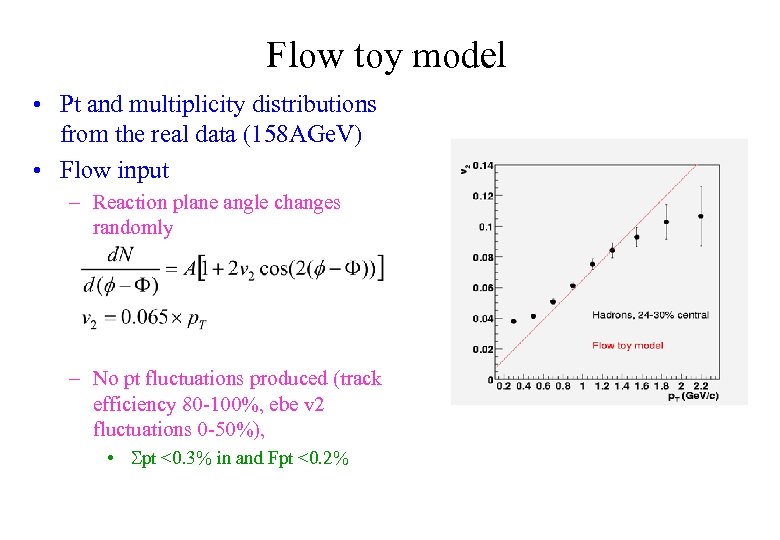
Flow toy model • Pt and multiplicity distributions from the real data (158 AGe. V) • Flow input – Reaction plane angle changes randomly – No pt fluctuations produced (track efficiency 80 -100%, ebe v 2 fluctuations 0 -50%), • Spt <0. 3% in and Fpt <0. 2%
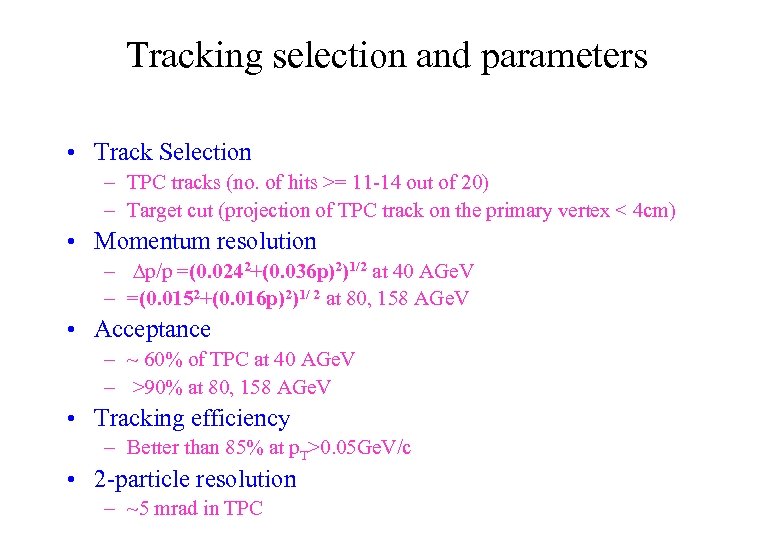
Tracking selection and parameters • Track Selection – TPC tracks (no. of hits >= 11 -14 out of 20) – Target cut (projection of TPC track on the primary vertex < 4 cm) • Momentum resolution – Dp/p =(0. 0242+(0. 036 p)2)1/2 at 40 AGe. V – =(0. 0152+(0. 016 p)2)1/ 2 at 80, 158 AGe. V • Acceptance – ~ 60% of TPC at 40 AGe. V – >90% at 80, 158 AGe. V • Tracking efficiency – Better than 85% at p. T>0. 05 Ge. V/c • 2 -particle resolution – ~5 mrad in TPC
Target area
Скачать презентацию Event-by-Event Fluctuations in 40 80 and 158 AGe
3b6691e8a3ac81c043b23cd724091c7e.ppt