


 Скачать презентацию Evaluation of the Implementation of The Primary Health
83fbdb626f560bdd020845eef42ebe74.ppt
- Количество слайдов: 58
 Evaluation of the Implementation of The Primary Health Care Strategy
 2. Presentation Outline n Introduction to the project n Dr Antony Raymont n Quantitative Findings n Dr Barry Gribben n Qualitative Findings n Dr Antony Raymont n Nursing Issues n Prof. Margaret Horsburgh n Discussion n Jon Foley on continuity of care
 3. PHCSE: The Project Antony Raymont / Jackie Cumming Health Services Research Centre Victoria University of Wellington
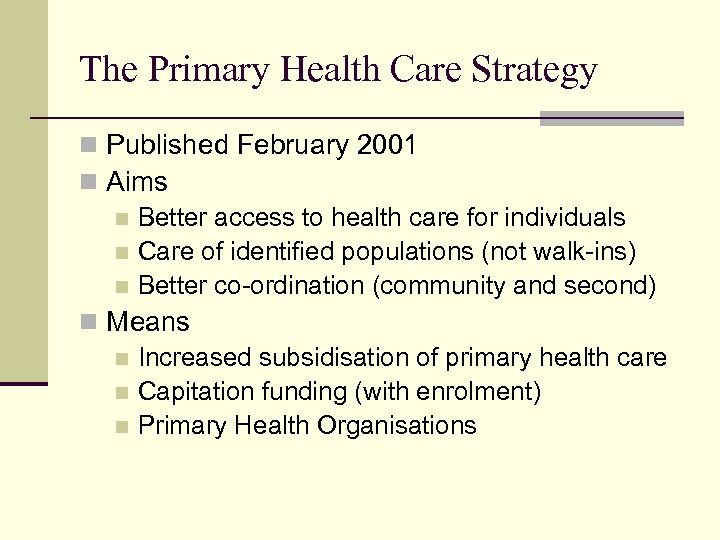 The Primary Health Care Strategy n Published February 2001 n Aims n Better access to health care for individuals n Care of identified populations (not walk-ins) n Better co-ordination (community and second) n Means n Increased subsidisation of primary health care n Capitation funding (with enrolment) n Primary Health Organisations
![5. Set-up of Evaluation n “The Strategy [] will be supported by ongoing research](https://present5.com/presentation/83fbdb626f560bdd020845eef42ebe74/image-5.jpg "5. Set-up of Evaluation n “The Strategy [] will be supported by ongoing research") 5. Set-up of Evaluation n “The Strategy [] will be supported by ongoing research during its implementation” (p. 26) n Funded by Mo. H, ACC & HRCNZ (2003) n Health Research Council of New Zealand called for proposals n Selection followed the usual HRC process
5. Set-up of Evaluation n “The Strategy [] will be supported by ongoing research during its implementation” (p. 26) n Funded by Mo. H, ACC & HRCNZ (2003) n Health Research Council of New Zealand called for proposals n Selection followed the usual HRC process
 6. Research Team n Host organisation – Victoria University of Wellington n Health Service Research Centre (VUW) Jackie Cumming and Antony Raymont n Anne Goodhead, Mariana Churchward, Janet Mc. Donald, Mahi Paurini n n CBG Health Research Ltd (Auckland) n Barry Gribben and Carol Boustead n Nikki Coupe and Fiva Fa’alau
 7. Research Team n Auckland (Nursing) n Margaret Horsburgh and Bridie Kent n Wellington Medical School (GP) n Tony Dowell and Roshan Perera n Canterbury (PH and GP) n Pauline Barnett n Ministry and Treasury n Bronwyn Croxson, Durga Rauyinar n International n Nick Mays and Judith Smith
 8. Governance - Steering Group n Constitution n Four research managers, Four funder representatives (1 ACC), and HRC as chair n Function (serially) n Discuss and comment on the project plan and research instruments n Monitor progress and review and approve any variations in the project plan n Review reports and publications
 9. Research Themes I n The relationship between the Ministry, DHBs, PHOs and PCOs. n Governance and internal financial arrangements of PHOs. n Changes in the role of consumers and local communities in the development and management of primary health care services. n Enrolment processes and efforts to address population care.
 10. Research Themes II n Efforts to identify and correct inequities in access to health services. n The development of new services, other changes in service provision and the achievement of comprehensiveness in primary care. n Efforts to improve service quality. n Developments in information collection and quality.
 11. Research Themes III n The impact on primary health care services for n n Māori. The impact on primary health care services for Pacific peoples. Changes in the primary health care workforce. The development of multidisciplinary teams within PHOs particularly the role of nurses. Moves to coordinate services between PHOs and other organizations
 12. Research Themes IV n How the PHCS has increased access, and reduced inequalities in access, to services. n The impact of the PHCS on health status and in reducing health inequalities. n The impact of the implementation of the PHCS on injury care provision. n Changes in the quality of primary care services (including use of drugs, laboratory tests and referrals).
 13. Structure of the Research n Key Informant Interviews n A Postal Survey n Quantitative assessment n Economic analysis n Time line (three years) n Phase I to June ’ 05; Phase II to Dec ‘ 06
 14. Key Informant Interviews n Purpose Understand the experience and activities of Primary Health Organisations and their member practices in responding to the Strategy n Time line n Interview 1 – Mid 2004 (Report April ’ 05) n Interview 2 – Jan – June 2006
 15. Postal Survey n Purpose To investigate the issues raised during the key informant interviews so that their extent and distribution can be specified. n Timeline To follow each phase of the informant interviews
 16. Quantitative Assessment n In summary Will use data from administrative data sets and from practice PMS to assess patient costs rates of consultation use of nurses changes in ACC claiming n Results will be presented by Barry Gribben
 17. Economic analysis n Will use national and practice level data n Assess net cost of the Strategy n Evaluate distribution of expenditure by Population group (pop. vs govt. ; low/high SES) n Service type (primary vs secondary) n
 18. Quantitative Assessment Analysis plan Barry Gribben CBG Health Research Ltd
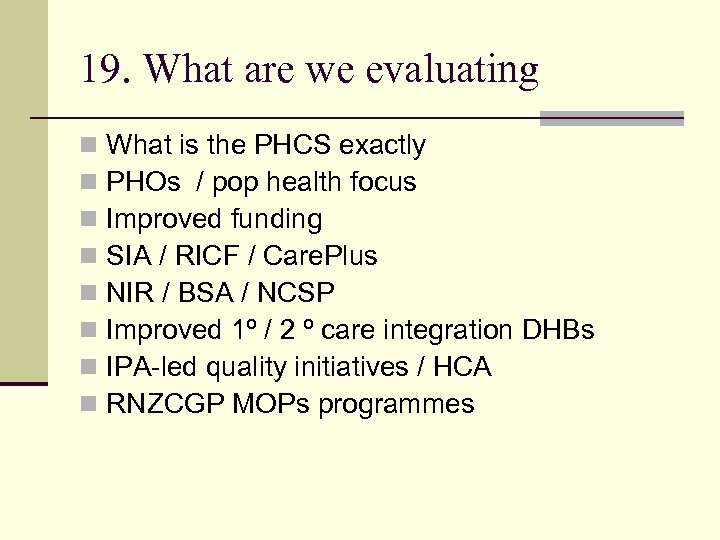 19. What are we evaluating n n n n What is the PHCS exactly PHOs / pop health focus Improved funding SIA / RICF / Care. Plus NIR / BSA / NCSP Improved 1º / 2 º care integration DHBs IPA-led quality initiatives / HCA RNZCGP MOPs programmes
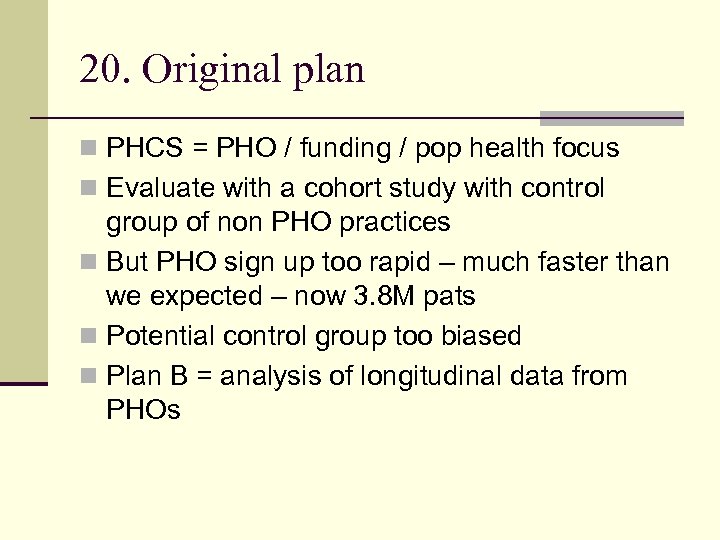 20. Original plan n PHCS = PHO / funding / pop health focus n Evaluate with a cohort study with control group of non PHO practices n But PHO sign up too rapid – much faster than we expected – now 3. 8 M pats n Potential control group too biased n Plan B = analysis of longitudinal data from PHOs
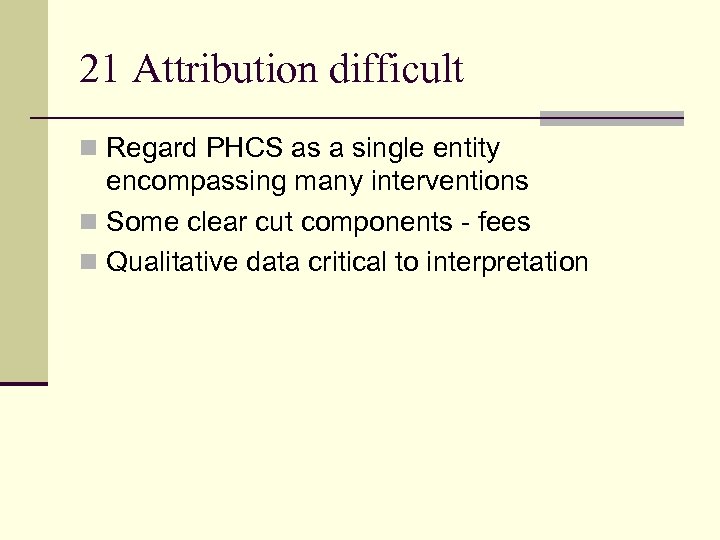 21 Attribution difficult n Regard PHCS as a single entity encompassing many interventions n Some clear cut components - fees n Qualitative data critical to interpretation
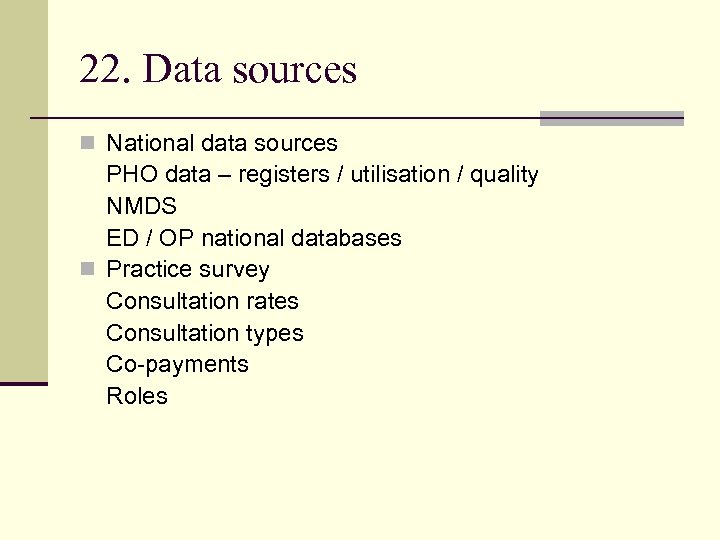 22. Data sources n National data sources PHO data – registers / utilisation / quality NMDS ED / OP national databases n Practice survey Consultation rates Consultation types Co-payments Roles
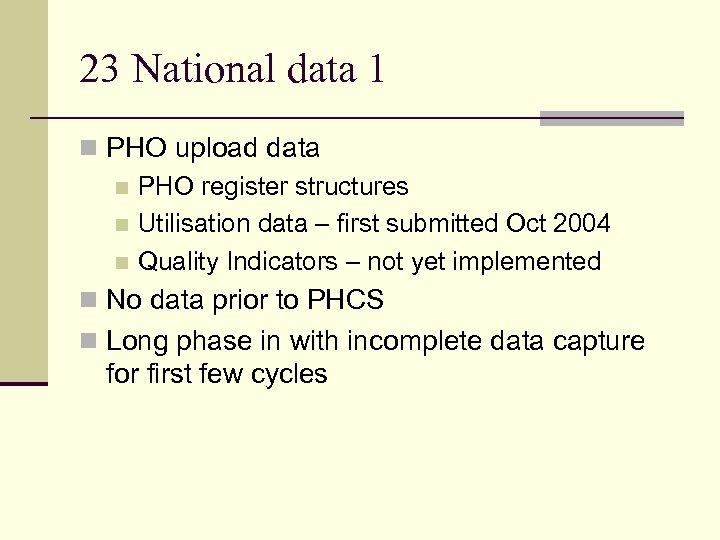 23 National data 1 n PHO upload data n PHO register structures n Utilisation data – first submitted Oct 2004 n Quality Indicators – not yet implemented n No data prior to PHCS n Long phase in with incomplete data capture for first few cycles
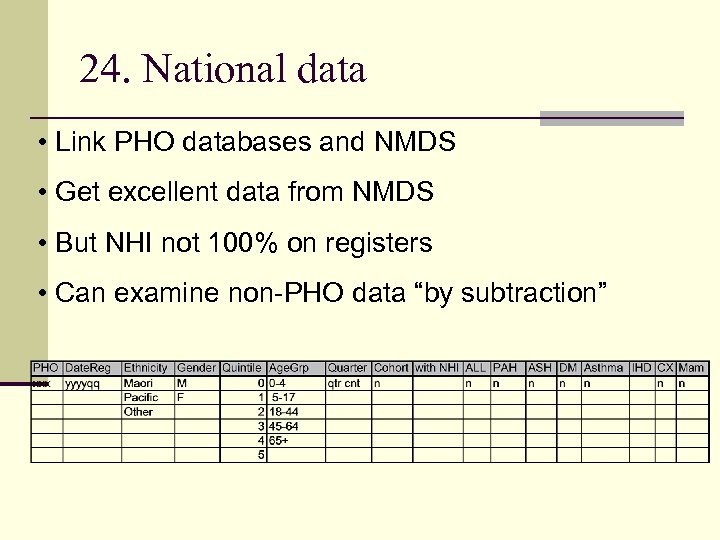 24. National data • Link PHO databases and NMDS • Get excellent data from NMDS • But NHI not 100% on registers • Can examine non-PHO data “by subtraction”
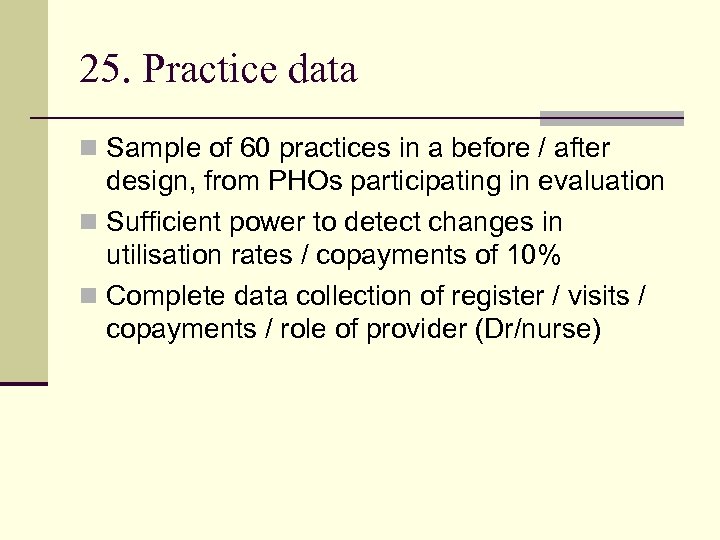 25. Practice data n Sample of 60 practices in a before / after design, from PHOs participating in evaluation n Sufficient power to detect changes in utilisation rates / copayments of 10% n Complete data collection of register / visits / copayments / role of provider (Dr/nurse)
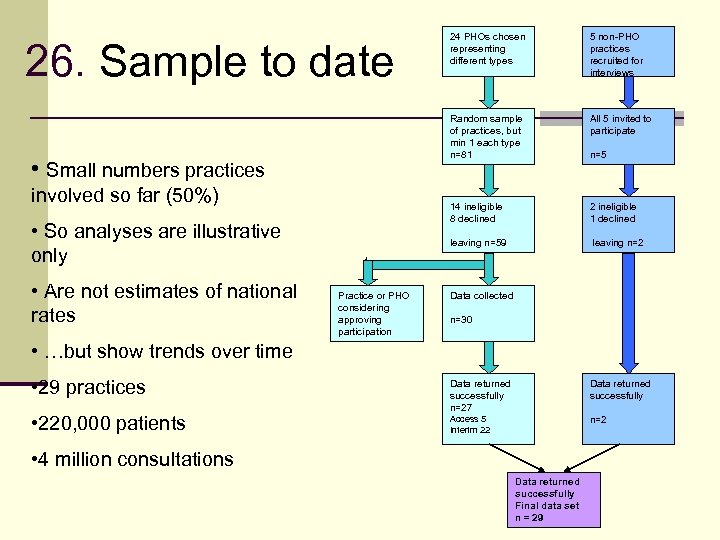 • So analyses are illustrative only • Are not estimates of national rates Practice or PHO considering approving participation 2 ineligible 1 declined leaving n=59 involved so far (50%) All 5 invited to participate 14 ineligible 8 declined • Small numbers practices 5 non-PHO practices recruited for interviews Random sample of practices, but min 1 each type n=81 26. Sample to date 24 PHOs chosen representing different types leaving n=2 n=5 Data collected n=30 • …but show trends over time • 29 practices • 220, 000 patients Data returned successfully n=27 Data returned successfully Access 5 Interim 22 n=2 • 4 million consultations Data returned successfully Final data set n = 29
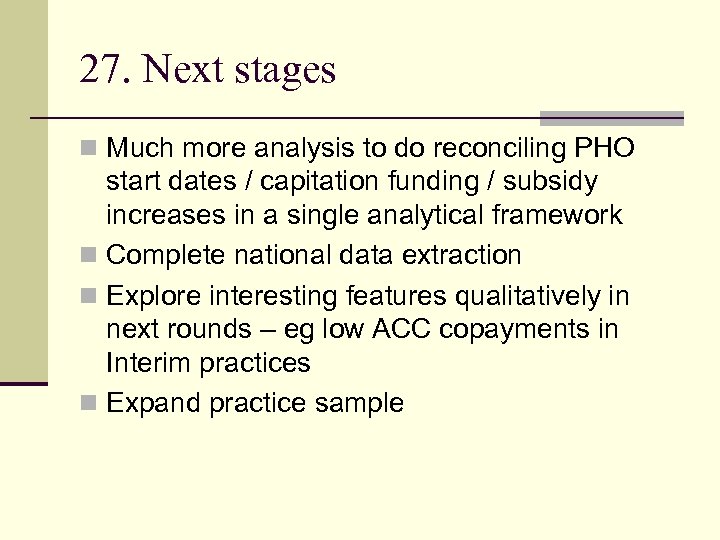 27. Next stages n Much more analysis to do reconciling PHO start dates / capitation funding / subsidy increases in a single analytical framework n Complete national data extraction n Explore interesting features qualitatively in next rounds – eg low ACC copayments in Interim practices n Expand practice sample
 28. Key Informant Interviews Phase One (formative) Antony Raymont
 29. Appreciation n Thanks to all those in sector who have been badgered for information, interviewed and asked to reveal their experiences with the implementation of the Strategy. Practice Nurses n Medical Practitioners n Community Representatives n Managers and CEOs n Bureaucrats from IPAC to Mo. H n
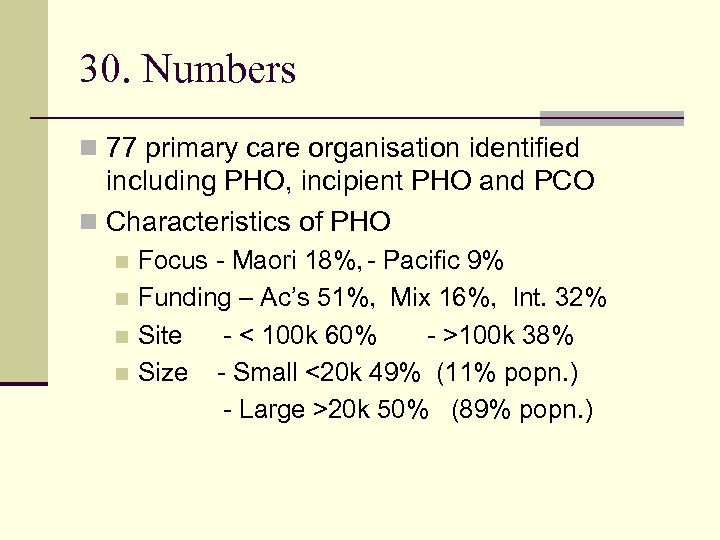 30. Numbers n 77 primary care organisation identified including PHO, incipient PHO and PCO n Characteristics of PHO Focus - Maori 18%, - Pacific 9% n Funding – Ac’s 51%, Mix 16%, Int. 32% n Site - < 100 k 60% - >100 k 38% n Size - Small <20 k 49% (11% popn. ) - Large >20 k 50% (89% popn. ) n
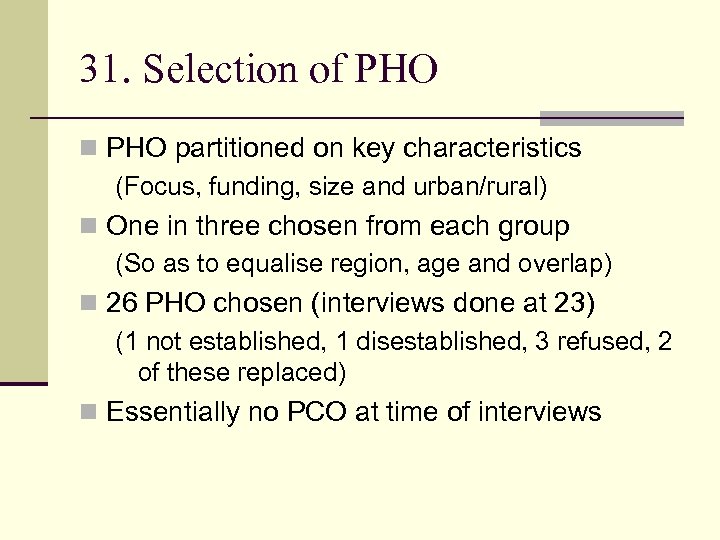 31. Selection of PHO n PHO partitioned on key characteristics (Focus, funding, size and urban/rural) n One in three chosen from each group (So as to equalise region, age and overlap) n 26 PHO chosen (interviews done at 23) (1 not established, 1 disestablished, 3 refused, 2 of these replaced) n Essentially no PCO at time of interviews
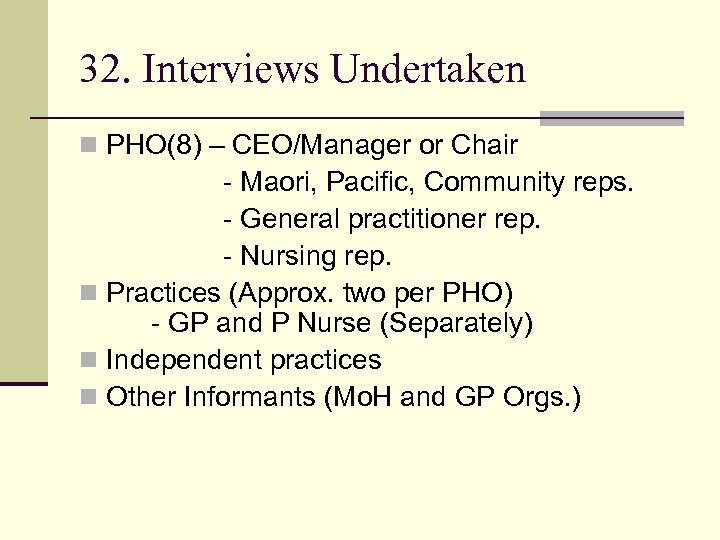 32. Interviews Undertaken n PHO(8) – CEO/Manager or Chair - Maori, Pacific, Community reps. - General practitioner rep. - Nursing rep. n Practices (Approx. two per PHO) - GP and P Nurse (Separately) n Independent practices n Other Informants (Mo. H and GP Orgs. )
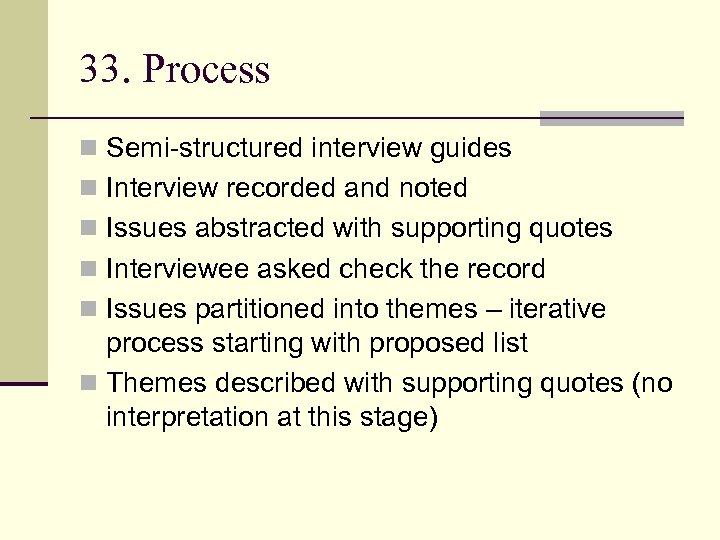 33. Process n Semi-structured interview guides n Interview recorded and noted n Issues abstracted with supporting quotes n Interviewee asked check the record n Issues partitioned into themes – iterative process starting with proposed list n Themes described with supporting quotes (no interpretation at this stage)
 34. Qualitative results
 35. Positive Response n Better access with reduced fees n More flexibility with capitation funding n Nurse visits, phone FU, proactive care n Ability to identify and care for population n Small Ethnic PHO to City PHO n Rejuvenation of General Practice n Higher income
 36. Wariness GPs noted n Threats to viability of practices n Compliance, bureaucratic, cost increase without clinical benefit n Devaluation of medical role Others mentioned n Failure to realise full benefits Gradual increase in trust
 37. Implementation I Problems n Payment processes Data errors n Detection of duplicates n Treatment of casual visits n Context n Rapid uptake; three levels of data
 38. Implementation II Problems n Targeting of subsidy n Well off in Access practices or 65+ Context n Multiple targeting are in use on the way to universal coverage n Access (geographical); Age groups; Care. Plus (health need)
 39. PHO Governance n Boards included representation of: n Community including Maori and Pacific people n Medical and Nursing professionals n Community reps - shoulder tapped, nominated or elected by community groups n Problems Comm’ity development vs Medical/Corporate n Community uninterested (Size related) n
 40. PHO Management n Focus on setting-up n Now moving to new initiatives n Small PHO capacity issues n Management fee n Efficiencies of Scale n Larger (ex IPA) PHO n Benefit of changes (esp. population approach, community involvement) less obvious
 41. Other Organisations n Co-operation between PHO (Large interim PHO and small access one) n Difficulties in case of overlap (Patient and practitioner poaching) n Various moves towards combined work with eg WINZ, Schools, Police etc.
 42. Primary Care Workforce n Fears of inadequate capacity n Issues and solutions n Address income disparity (docs and nurses) n Ensure adequate training (Spaces in FMTP; financial support PNs) n Changing expectations – eg benefits of n n n Team work (vs being in charge) Salaried employment (vs business worries) Independent practice (vs handmaiden role)
 43. PHCS: Nursing Margaret Horsburgh School of Nursing University of Auckland
 44. PHCS : Nursing n Expanded role for nursing n Strengthen and enhance phc team n Teamwork and collaboration n Aligning nursing practice with community need and service delivery n Population and personal health strategies
 45. Nursing perspective: Implementation n Uneven development n Development depends largely on preferences of general practitioners n Focus on primary medical care versus primary health care
 46. Challenges n Dominant private business model n Employer/employee relationships n Differentiating nursing role n Leadership
 47. Way forward n Articulating primary health care nurse role n Career pathway n Recruitment and orientation to primary health care n n including mentoring Nationally recognized standards of practice Financial recognition for skill level Increasing training opportunities Reducing barriers to education
 n I think there is the potential to achieve an expanded role, and it is happening particularly in rural areas where there are not enough GPs to provide services n Nurses are really struggling at the moment to see how they fit into the whole structure. Some of them have embraced the idea then been knocked back by the PHOs who are really GP dominated n It depends on the attitude of the GPs, and the nursedoctor employment arrangement is often a barrier
 49. New Services n Great variability by PHO and Practice
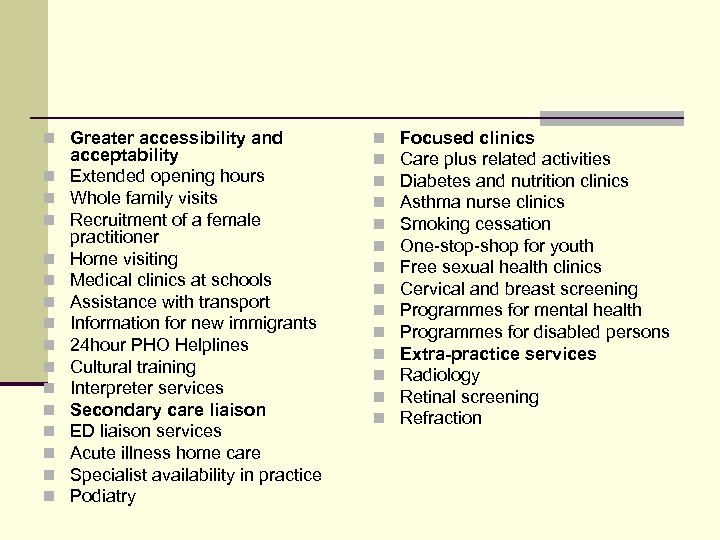 n Greater accessibility and n n n n acceptability Extended opening hours Whole family visits Recruitment of a female practitioner Home visiting Medical clinics at schools Assistance with transport Information for new immigrants 24 hour PHO Helplines Cultural training Interpreter services Secondary care liaison ED liaison services Acute illness home care Specialist availability in practice Podiatry n n n n Focused clinics Care plus related activities Diabetes and nutrition clinics Asthma nurse clinics Smoking cessation One-stop-shop for youth Free sexual health clinics Cervical and breast screening Programmes for mental health Programmes for disabled persons Extra-practice services Radiology Retinal screening Refraction
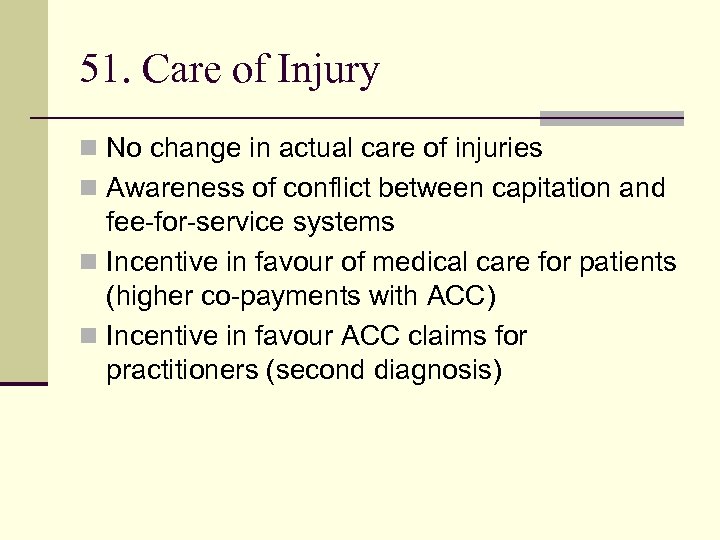 51. Care of Injury n No change in actual care of injuries n Awareness of conflict between capitation and fee-for-service systems n Incentive in favour of medical care for patients (higher co-payments with ACC) n Incentive in favour ACC claims for practitioners (second diagnosis)
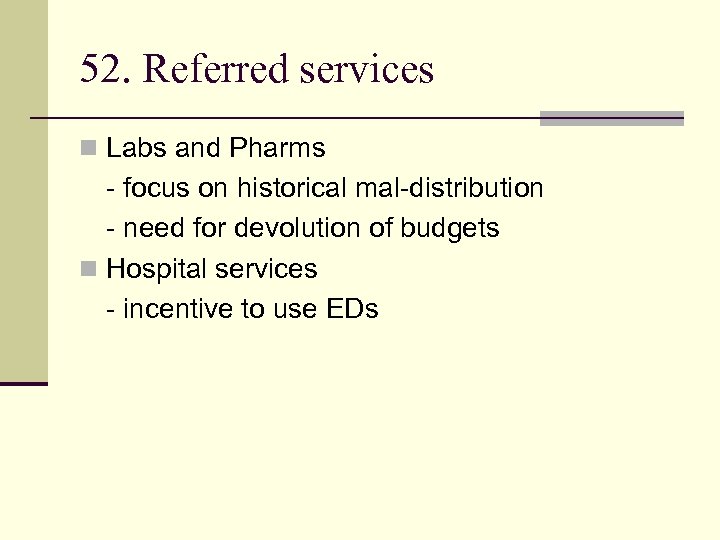 52. Referred services n Labs and Pharms - focus on historical mal-distribution - need for devolution of budgets n Hospital services - incentive to use EDs
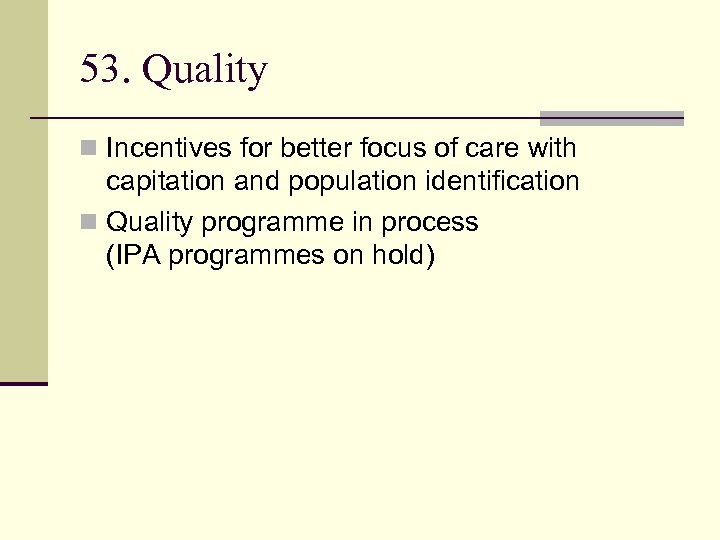 53. Quality n Incentives for better focus of care with capitation and population identification n Quality programme in process (IPA programmes on hold)
 54. Information n Population data much improved (Reporting more complete but individual visit data not required)
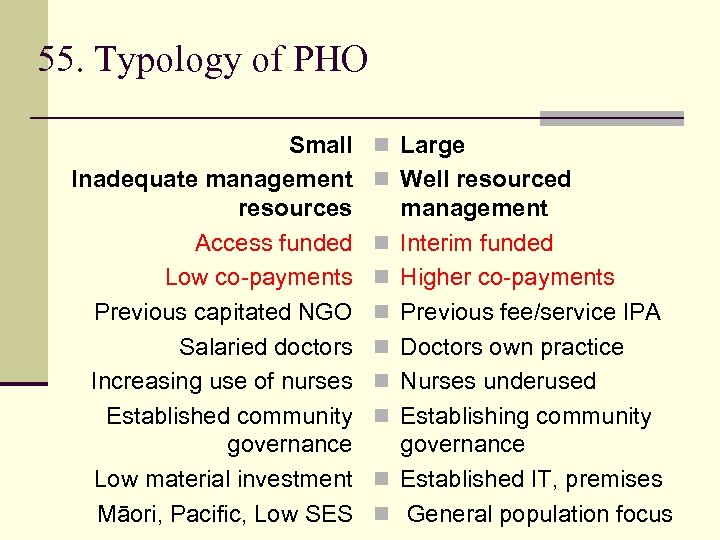 55. Typology of PHO Small Inadequate management resources Access funded Low co-payments Previous capitated NGO Salaried doctors Increasing use of nurses Established community governance Low material investment Māori, Pacific, Low SES n Large n Well resourced n n n n management Interim funded Higher co-payments Previous fee/service IPA Doctors own practice Nurses underused Establishing community governance Established IT, premises General population focus
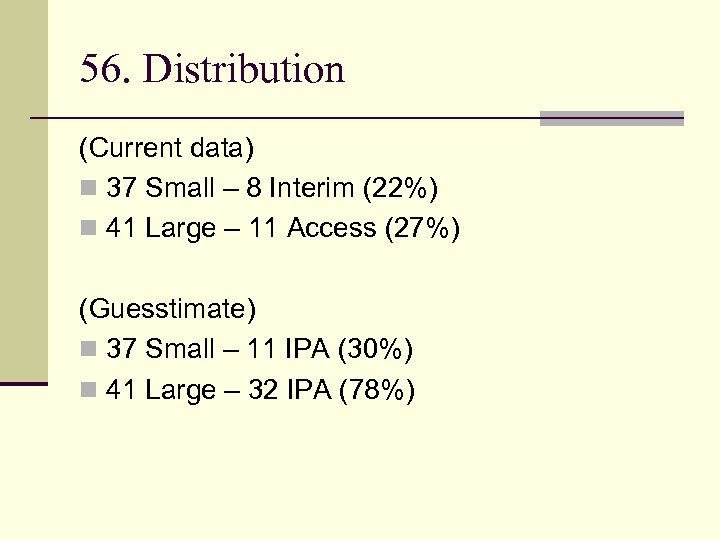 56. Distribution (Current data) n 37 Small – 8 Interim (22%) n 41 Large – 11 Access (27%) (Guesstimate) n 37 Small – 11 IPA (30%) n 41 Large – 32 IPA (78%)
 57. The Future n Need to ensure that the goals of Strategy are reached: n Inexpensive care n Expansion of primary health care team n Population focus n Inclusion of the community n Co-operation with other services n Monitoring outcomes
![n We [said] that if you are just doing this to reconfigure general practice](https://present5.com/presentation/83fbdb626f560bdd020845eef42ebe74/image-58.jpg "n We [said] that if you are just doing this to reconfigure general practice") n We [said] that if you are just doing this to reconfigure general practice you are wasting your time and money, it needs to be a bigger more audacious goal than that and that is about bringing in other services [and functions]. ” (DHB)
n We [said] that if you are just doing this to reconfigure general practice you are wasting your time and money, it needs to be a bigger more audacious goal than that and that is about bringing in other services [and functions]. ” (DHB)