


 Скачать презентацию Evaluation of the 2006 Air Quality Forecasting Operation
d496501e3afe490f93667991a92108e1.ppt
- Количество слайдов: 25
 Evaluation of the 2006 Air Quality Forecasting Operation in Georgia Talat Odman , Yongtao Hu, Ted Russell School of Civil & Environmental Engineering Michael Chang, Carlos Cardelino School of Earth and Atmospheric Sciences Georgia Institute of Technology 5 th Annual CMAS Conference October 17, 2006 Georgia Institute of Technology
 Air Quality Forecasting • There is an increasing interest in day-to-day variation of air quality – Public becoming more health conscious – Local authorities looking for short-term management strategies • Forecasts are produced using various techniques – – – Persistence Climatology Statistical Regression Close Neighbor Decision Tree 3 -D Air Quality Models Georgia Institute of Technology
 Air Quality Forecasting in Atlanta • Ozone forecasting since 1996 Olympic Games • Panel of experts gets together and issues a forecast for next day – Ozone Alerts • One of the methods used is 3 -D AQM – – Urban Airshed Model (UAM) Diagnostic Meteorology Constant Emissions Arguably first in the U. S. but now mostly outdated • Last year, PM 2. 5 forecasting started • Forecasts being extended to other cities in Georgia – Macon (~135 km South-Southeast of Atlanta) Georgia Institute of Technology
 Goal of our Operation • To provide accurate, “fine-scale”, local forecasts sufficiently in advance that – Local controls can be triggered to avoid bad episodes – Personal exposure can be minimized • NOAA/EPA’s national forecast currently provides 12 -km resolution over the Southeast • We are currently at 4 -km resolution aiming at 1 -km or “finer” resolution locally. • Our goal is to forecast not just air quality but effectiveness of predetermined local control strategies Georgia Institute of Technology
 Our Modeling System • WRF for meteorology – Driven by NAM (formerly Eta) – 3 ½ -day NAM forecasts available every 6 hours (00, 06, 12, 18 Z) • SMOKE for emissions – Forecasting of EGU, mobile, biogenic emissions • CMAQ for chemistry and transport – Currently using standard version 4. 5 – Will start using our contributions soon: • Direct Decoupled Method (DDM-3 D) for emission sensitivities • Variable Time Step Algorithm (VARTSTEP) for speed • Dynamic Solution Adaptive Grid Algorithm (DSAGA) for high resolution Georgia Institute of Technology
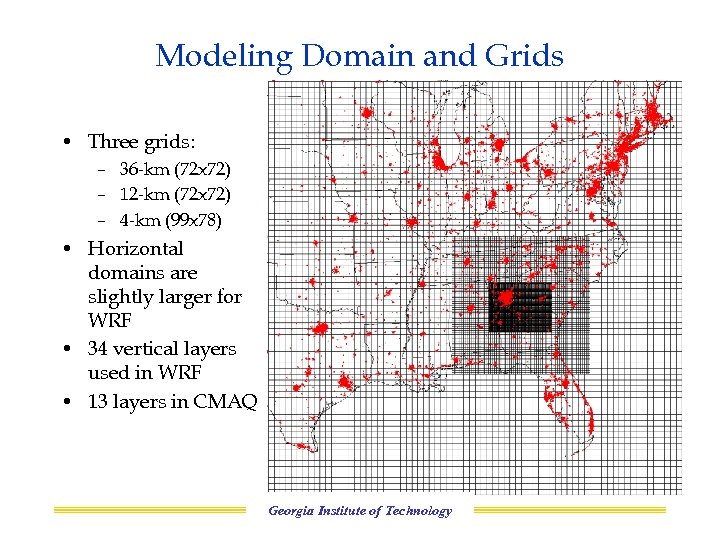 Modeling Domain and Grids • Three grids: – 36 -km (72 x 72) – 12 -km (72 x 72) – 4 -km (99 x 78) • Horizontal domains are slightly larger for WRF • 34 vertical layers used in WRF • 13 layers in CMAQ Georgia Institute of Technology
 Our 2006 Operation • Started May 1, 2006 (through September 30 th) • Tomorrow’s forecast is due by 10 a. m. today – Processing takes 1 ½ days – Wednesday’s forecasting starts by Sunday night • We simulate: – 3 days over the 36 -km grid using 00 Z NAM, IC from previous cycle (warm start) and “clean” BC – 2 ½ days over the 12 -km grid using 12 Z NAM and IC/BC from 36 km – 24 hours over the 4 -km using 12 Z NAM and IC/BC from 12 -km • Mostly automated – 1 hr/day of human interaction – 6 CPUs • The product is a 24 -hr ozone and PM 2. 5 forecast once per day Georgia Institute of Technology
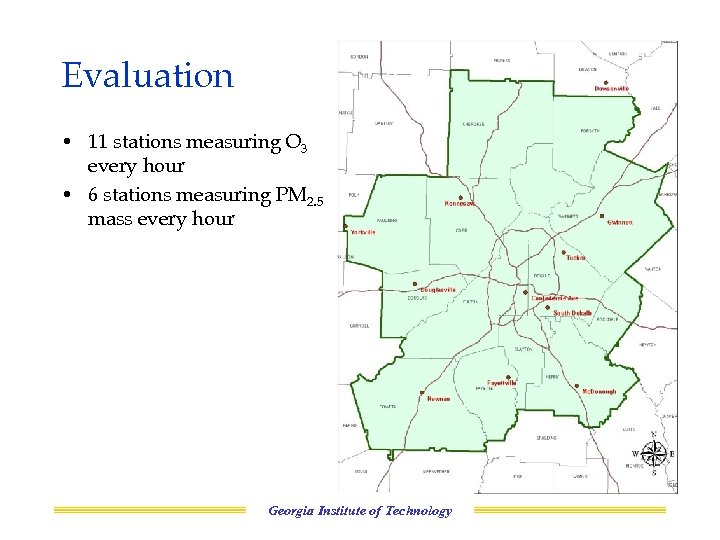 Evaluation • 11 stations measuring O 3 every hour • 6 stations measuring PM 2. 5 mass every hour Georgia Institute of Technology
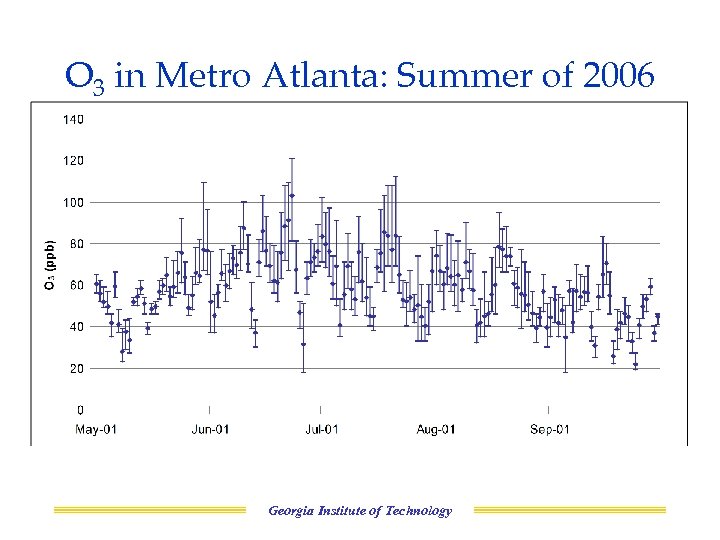 O 3 in Metro Atlanta: Summer of 2006 Georgia Institute of Technology
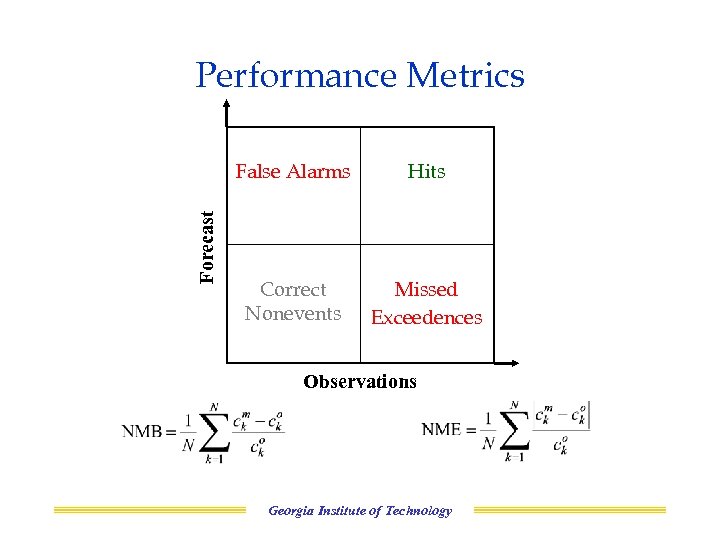 Performance Metrics Forecast False Alarms Hits Correct Nonevents Missed Exceedences Observations Georgia Institute of Technology
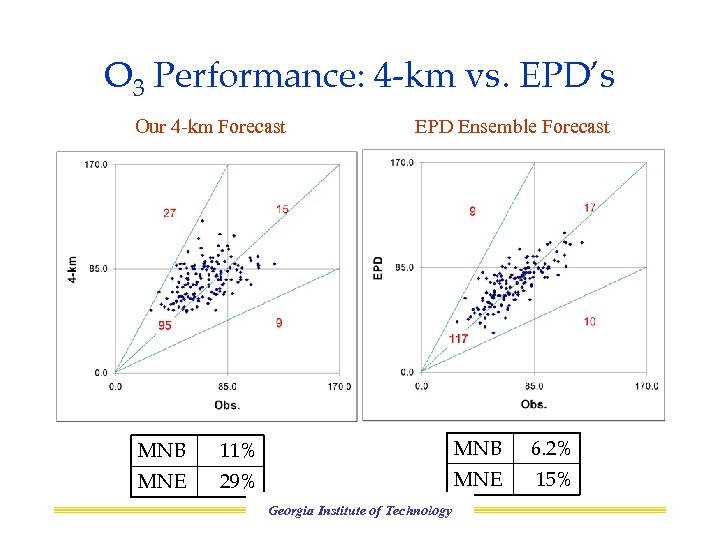 O 3 Performance: 4 -km vs. EPD’s Our 4 -km Forecast EPD Ensemble Forecast MNB 11% MNB 6. 2% MNE 29% MNE 15% Georgia Institute of Technology
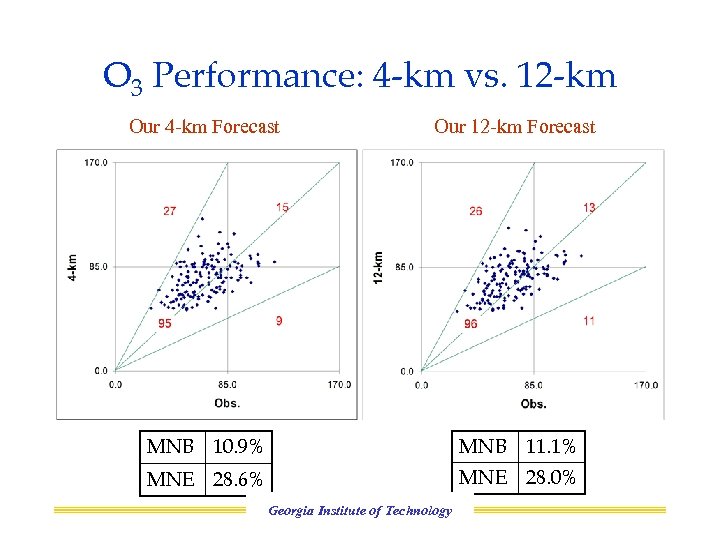 O 3 Performance: 4 -km vs. 12 -km Our 4 -km Forecast Our 12 -km Forecast MNB 10. 9% MNB 11. 1% MNE 28. 6% MNE 28. 0% Georgia Institute of Technology
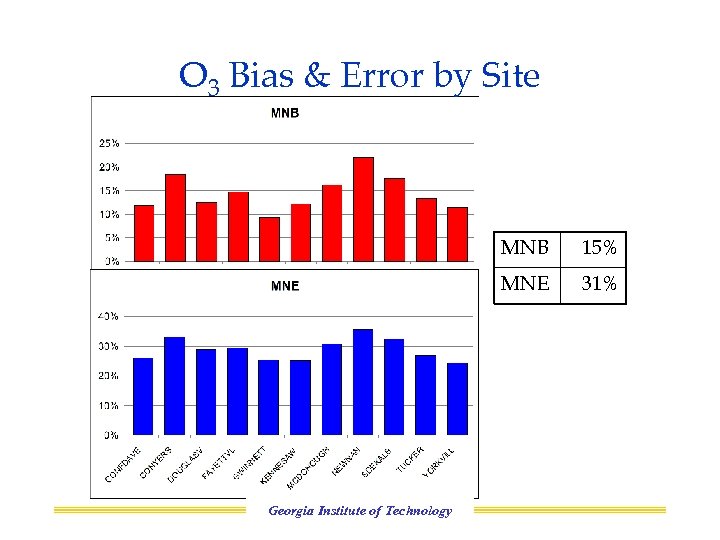 O 3 Bias & Error by Site MNB MNE Georgia Institute of Technology 15% 31%
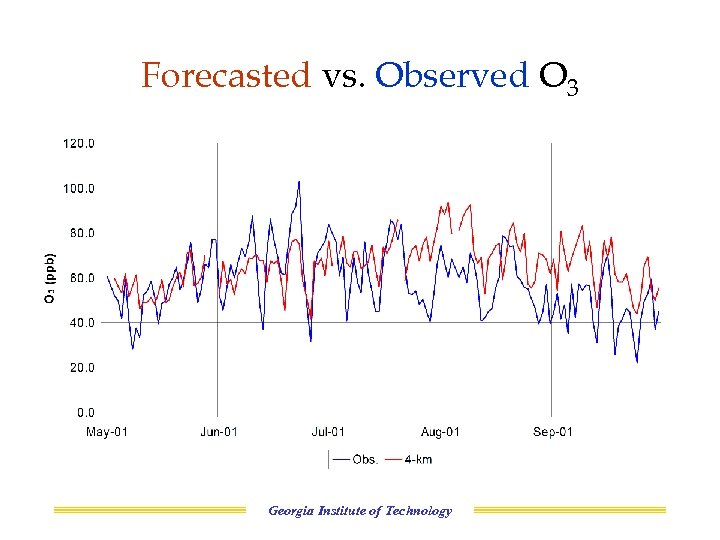 Forecasted vs. Observed O 3 Georgia Institute of Technology
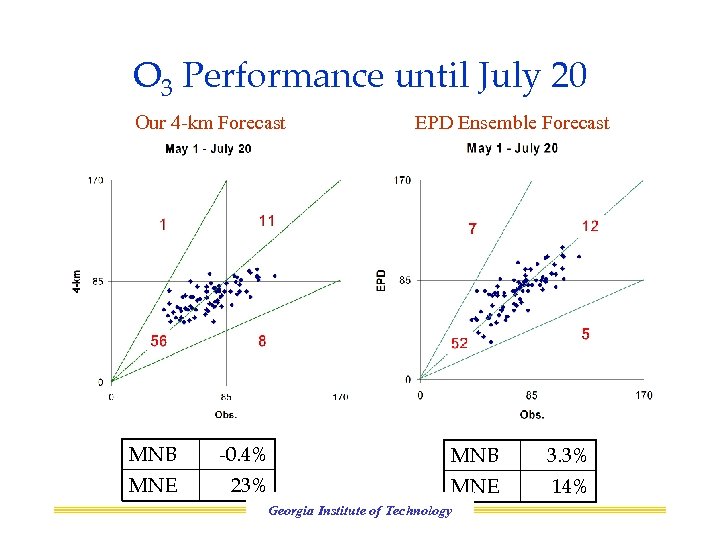 O 3 Performance until July 20 Our 4 -km Forecast EPD Ensemble Forecast MNB -0. 4% MNB 3. 3% MNE 23% MNE 14% Georgia Institute of Technology
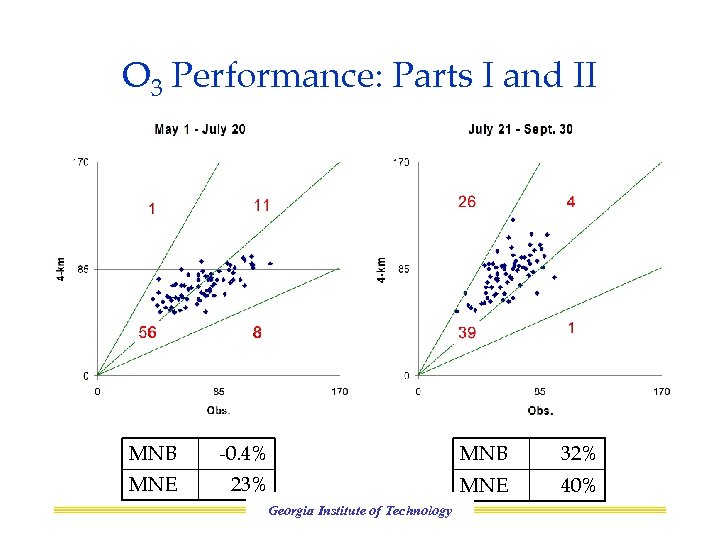 O 3 Performance: Parts I and II MNB -0. 4% MNB 32% MNE 23% MNE 40% Georgia Institute of Technology
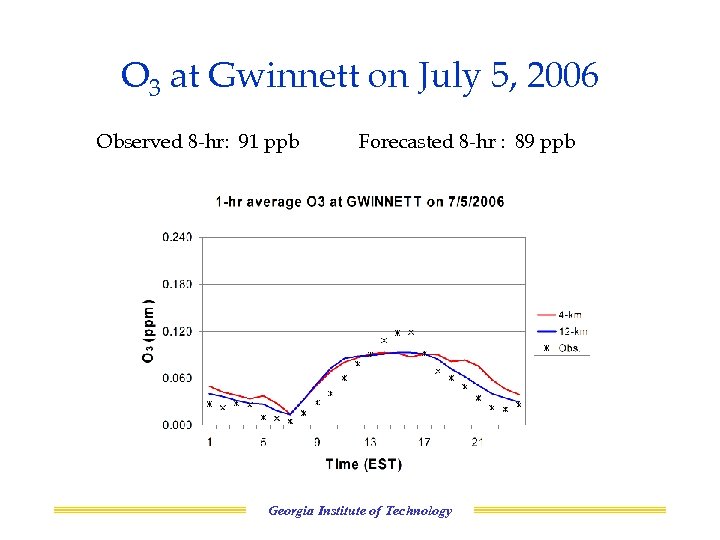 O 3 at Gwinnett on July 5, 2006 Observed 8 -hr: 91 ppb Forecasted 8 -hr : 89 ppb Georgia Institute of Technology
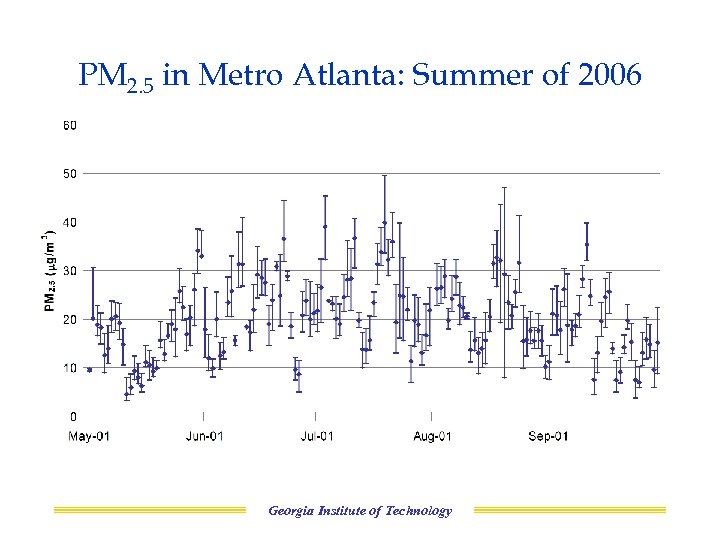 PM 2. 5 in Metro Atlanta: Summer of 2006 Georgia Institute of Technology
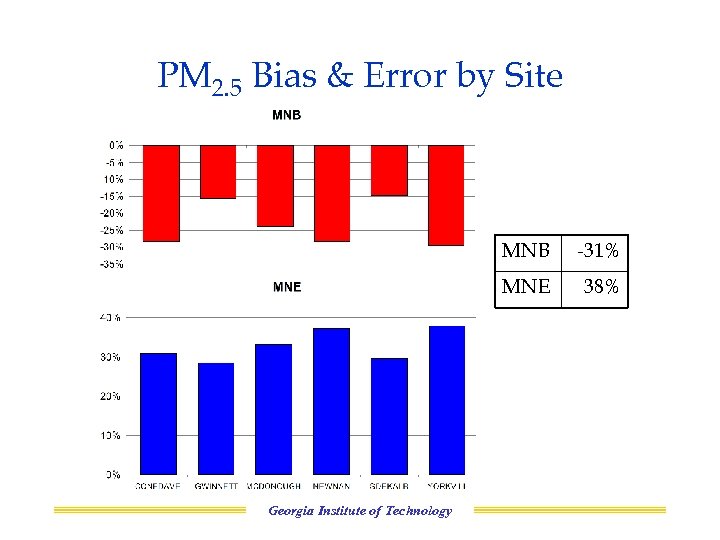 PM 2. 5 Bias & Error by Site MNB MNE Georgia Institute of Technology -31% 38%
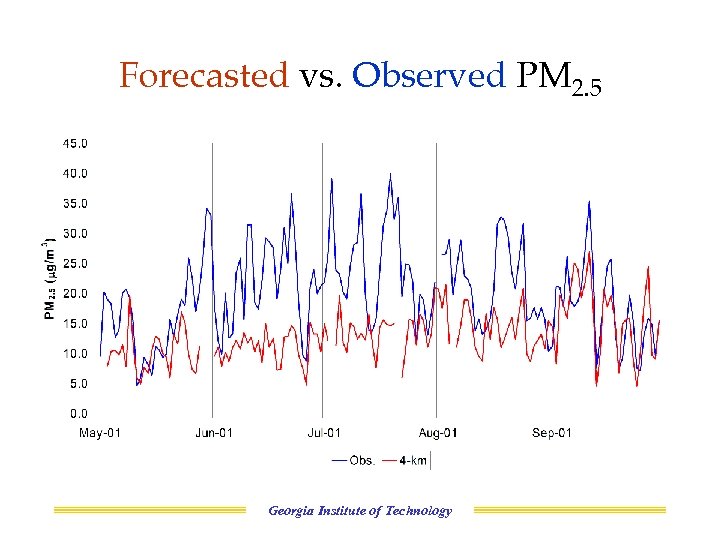 Forecasted vs. Observed PM 2. 5 Georgia Institute of Technology
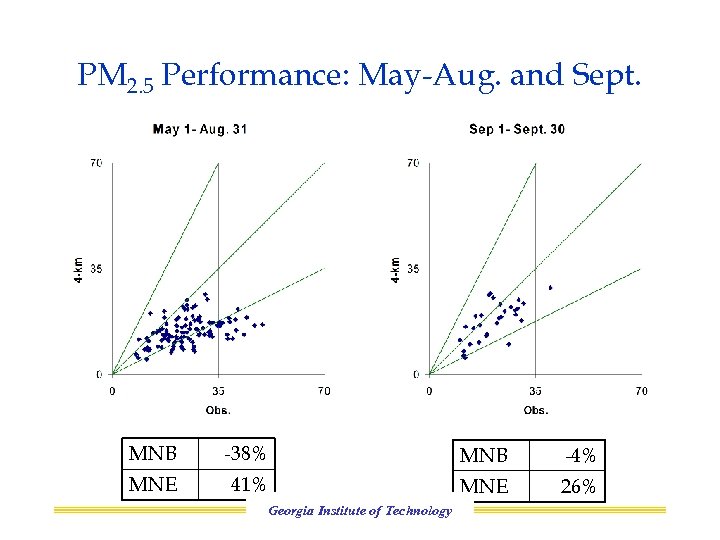 PM 2. 5 Performance: May-Aug. and Sept. MNB -38% MNB -4% MNE 41% MNE 26% Georgia Institute of Technology
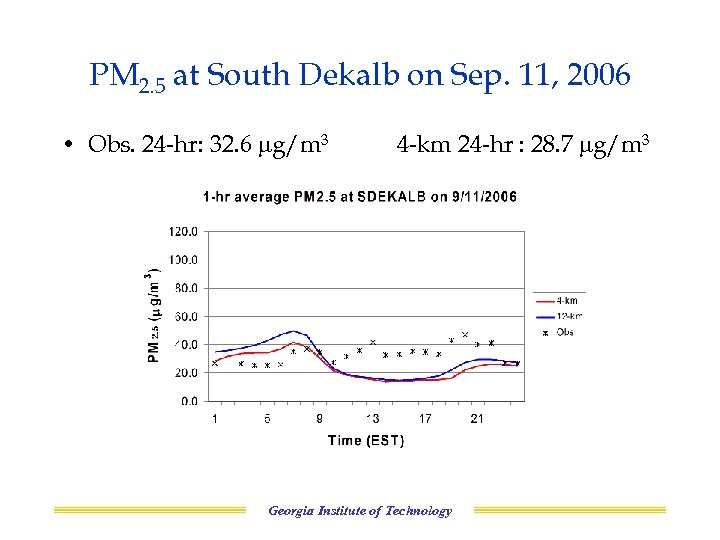 PM 2. 5 at South Dekalb on Sep. 11, 2006 • Obs. 24 -hr: 32. 6 mg/m 3 4 -km 24 -hr : 28. 7 mg/m 3 Georgia Institute of Technology
 Conclusion • • • We started a “fine-scale” forecasting operation in GA using 3 -D models Spatial variability of O 3 and PM 2. 5 indicates the need for finer scales The 4 -km forecast is slightly more accurate than the 12 -km forecast Predictions at some sites are better than others, especially for PM 2. 5 Ozone forecasts were generally accurate until mid-July (no bias, 20% error) but overestimations dominated afterwards (30% bias, 40% error) – Diurnal changes are somewhat captured; daily peaks are generally underestimated • PM 2. 5 was generally underestimated May-August (40% bias, 40% error) but more accurate in September (-5% bias, 25% error) – Afternoon peaks were generally missed • Spatial variability was underestimated both for O 3 and PM 2. 5 Georgia Institute of Technology
 Next Steps • Continue the operation in 2007 – – – Improve accuracy Extend the domain of coverage Increase the resolution Elongate the forecasting period Issue daily updates • Link the forecast to health-effects studies: – Study the impacts on asthmatic children – Build a data archive for long-term exposure studies • Forecast the effectiveness of short-term, local control strategies – Predict the impacts of predetermined strategies Georgia Institute of Technology
 Acknowledgement This research is supported by: • Georgia Department of Natural Resources • Air Resources Engineering Center at Georgia Tech Georgia Institute of Technology