 Скачать презентацию Evaluation of Standards data collected from probabilistic sampling
fdce92a357ebe5a6d237343b5486c349.ppt
- Количество слайдов: 33



Evaluation of Standards data collected from probabilistic sampling programs Eric P. Smith Y. Duan, Z. Li, K. Ye Statistics Dept. , Virginia Tech Presented at the Monitoring Science and Technology Symposium, Denver, CO Sept 20 -24. 1

Outline o Background n o o Single site analysis Regional analysis n n o Standards assessments Mixed model approach Bayesian approach Upshot: need models that allow for additional information to be used in assessments 2
320 3
Standards assessment – 303 d o o o Clean Water Act section 303 d mandates states in US to monitor and assess condition of streams Site impaired – list site, start TMDL process (Total Max Daily Loading) Impaired means site does not meet usability criteria 4
![Linkages in 303(d) Set goals and WQS Implement strategies [NPDES, 319, SRF, etc] standards](https://present5.com/presentation/fdce92a357ebe5a6d237343b5486c349/image-5.jpg "Linkages in 303(d) Set goals and WQS Implement strategies [NPDES, 319, SRF, etc] standards")
Linkages in 303(d) Set goals and WQS Implement strategies [NPDES, 319, SRF, etc] standards Conduct monitoring Local to regional 303(d) List Sampling plan No Meeting WQS? tests Yes Apply Antidegradation Develop strategies [TMDLs] 5
Impaired sites o o Site impaired if standards not met Standards – defined through numerical criteria n o Involve frequency, duration, magnitude –Old method n n Site impaired if >10% of samples exceed criteria Implicit statistical decision process- error rates 6
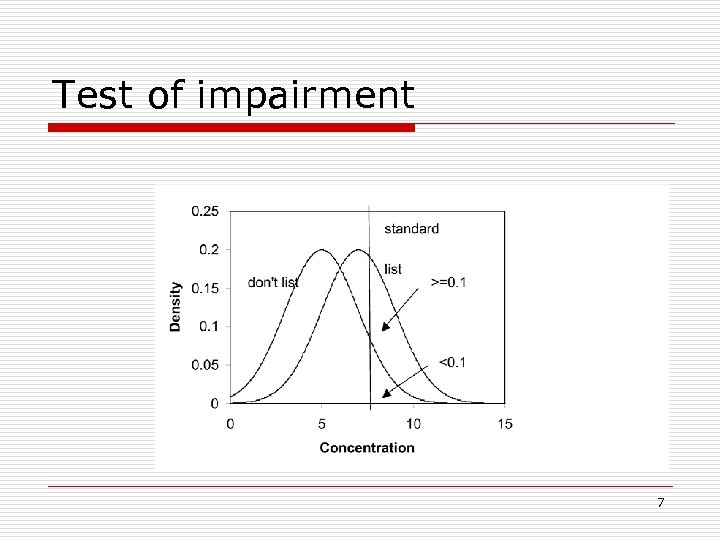
Test of impairment 7
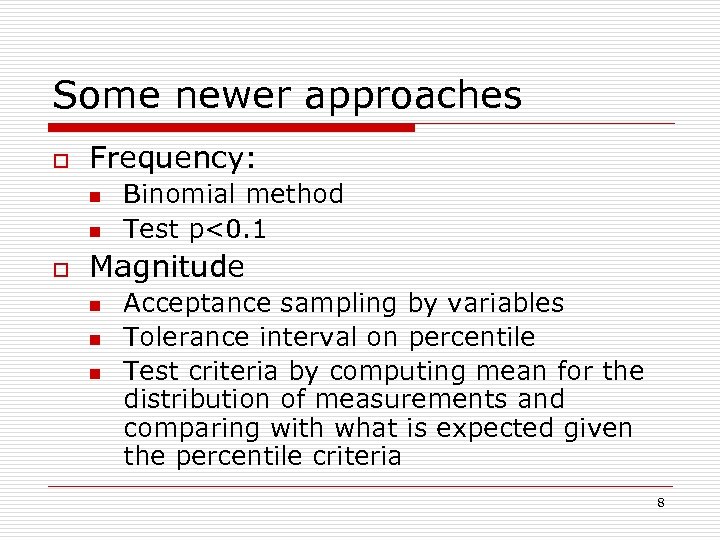
Some newer approaches o Frequency: n n o Binomial method Test p<0. 1 Magnitude n n n Acceptance sampling by variables Tolerance interval on percentile Test criteria by computing mean for the distribution of measurements and comparing with what is expected given the percentile criteria 8
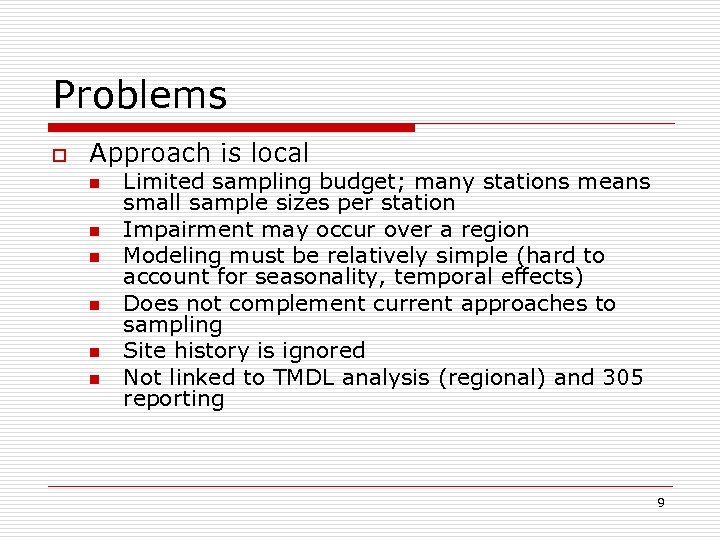
Problems o Approach is local n n n Limited sampling budget; many stations means small sample sizes per station Impairment may occur over a region Modeling must be relatively simple (hard to account for seasonality, temporal effects) Does not complement current approaches to sampling Site history is ignored Not linked to TMDL analysis (regional) and 305 reporting 9
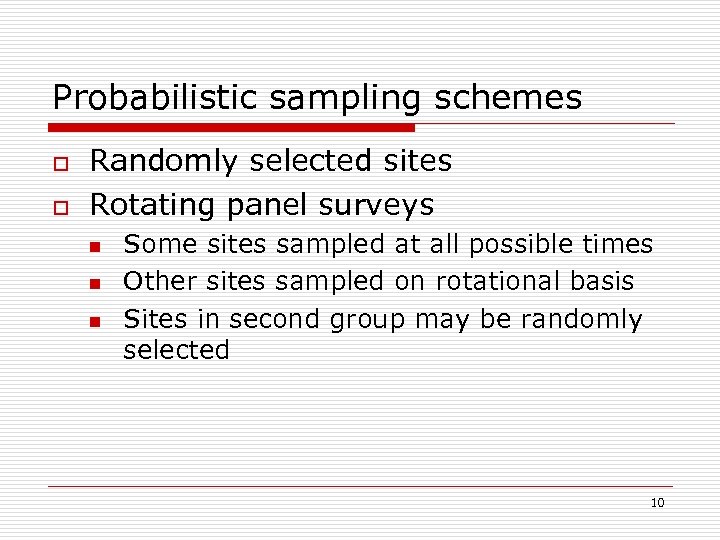
Probabilistic sampling schemes o o Randomly selected sites Rotating panel surveys n n n Some sites sampled at all possible times Other sites sampled on rotational basis Sites in second group may be randomly selected 10
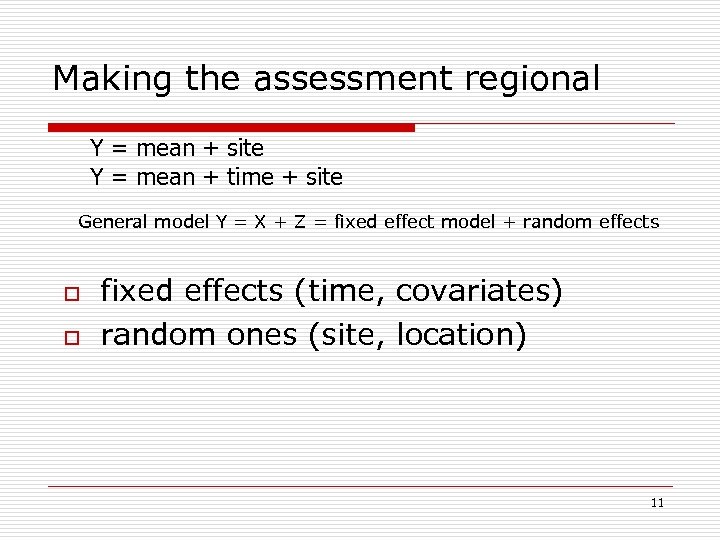
Making the assessment regional Y = mean + site Y = mean + time + site General model Y = X + Z = fixed effect model + random effects o o fixed effects (time, covariates) random ones (site, location) 11
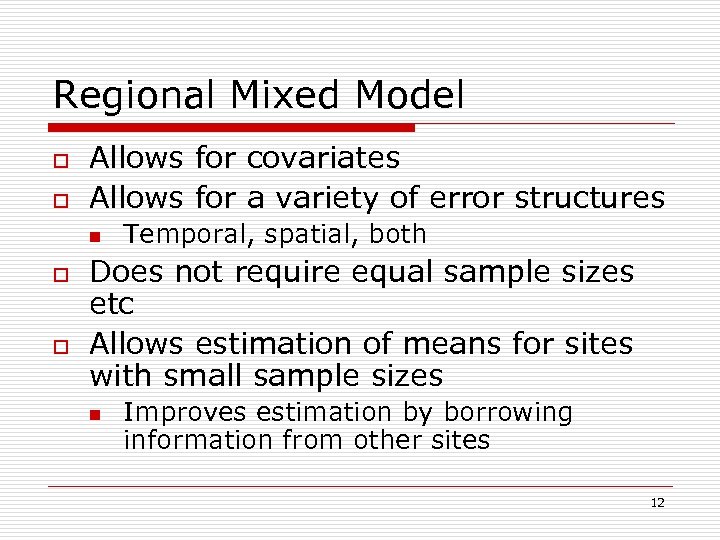
Regional Mixed Model o o Allows for covariates Allows for a variety of error structures n o o Temporal, spatial, both Does not require equal sample sizes etc Allows estimation of means for sites with small sample sizes n Improves estimation by borrowing information from other sites 12
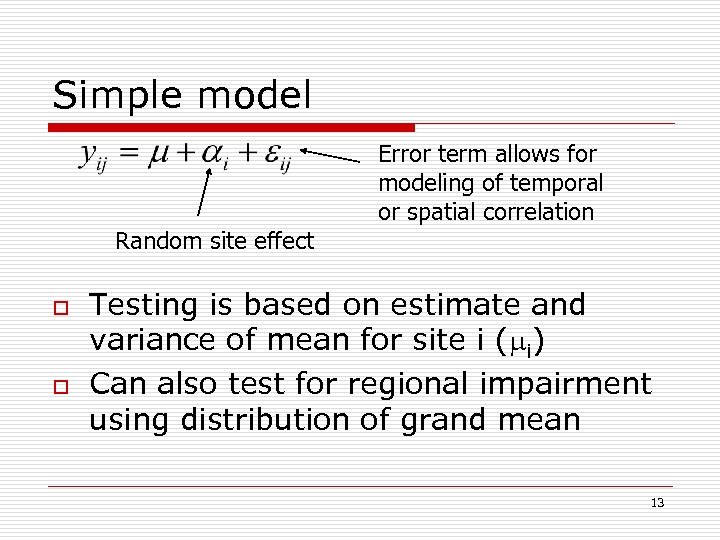
Simple model Error term allows for modeling of temporal or spatial correlation Random site effect o o Testing is based on estimate and variance of mean for site i (mi) Can also test for regional impairment using distribution of grand mean 13
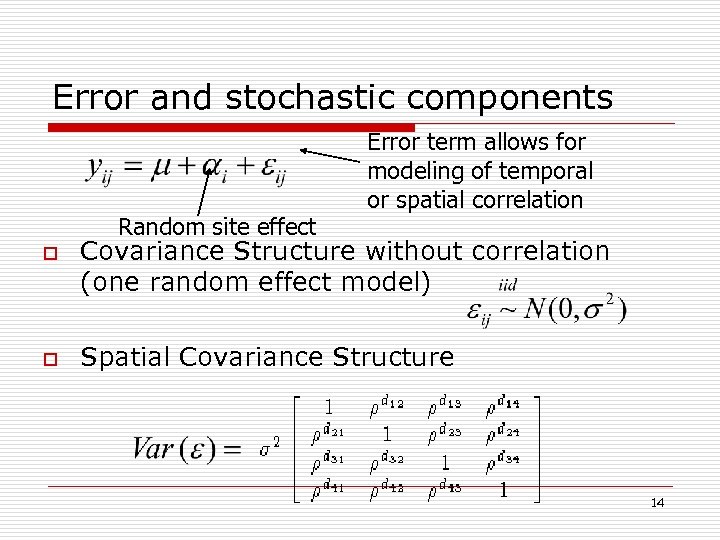
Error and stochastic components Random site effect o o Error term allows for modeling of temporal or spatial correlation Covariance Structure without correlation (one random effect model) Spatial Covariance Structure 14
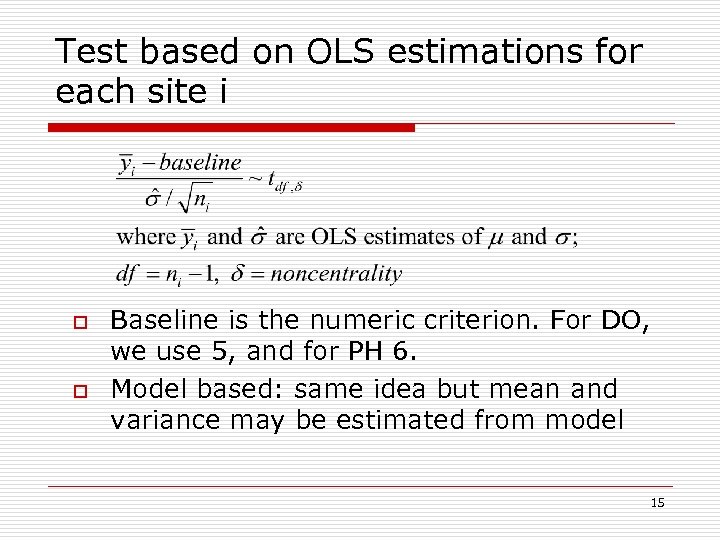
Test based on OLS estimations for each site i o o Baseline is the numeric criterion. For DO, we use 5, and for PH 6. Model based: same idea but mean and variance may be estimated from model 15
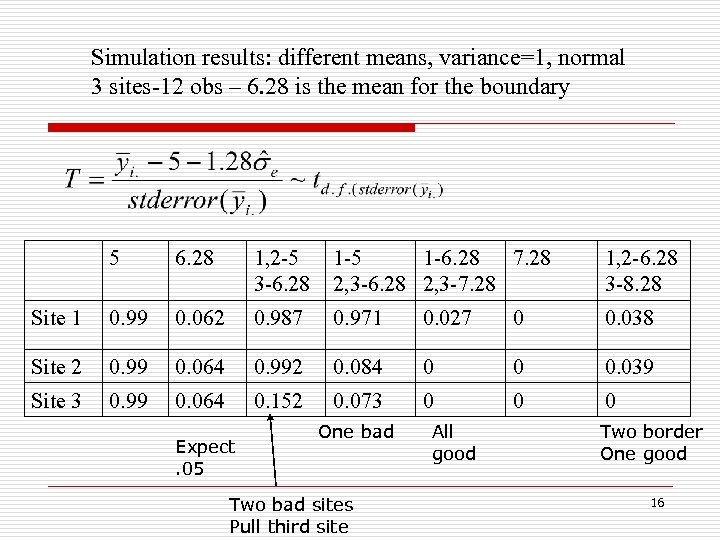
Simulation results: different means, variance=1, normal 3 sites-12 obs – 6. 28 is the mean for the boundary 5 6. 28 1, 2 -5 3 -6. 28 1 -5 1 -6. 28 7. 28 2, 3 -6. 28 2, 3 -7. 28 1, 2 -6. 28 3 -8. 28 Site 1 0. 99 0. 062 0. 987 0. 971 0. 027 0 0. 038 Site 2 0. 99 0. 064 0. 992 0. 084 0 0 0. 039 Site 3 0. 99 0. 064 0. 152 0. 073 0 0 0 Expect. 05 One bad Two bad sites Pull third site All good Two border One good 16

Located in SW Virginia Good bass fishing 17
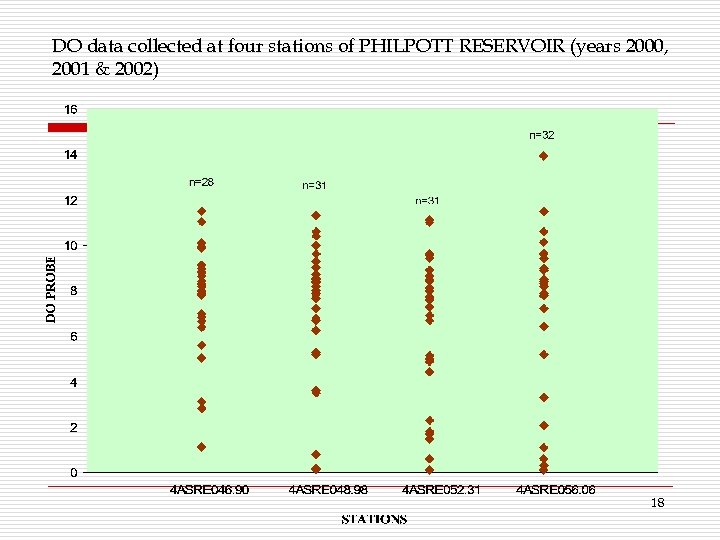
DO data collected at four stations of PHILPOTT RESERVOIR (years 2000, 2001 & 2002) 18
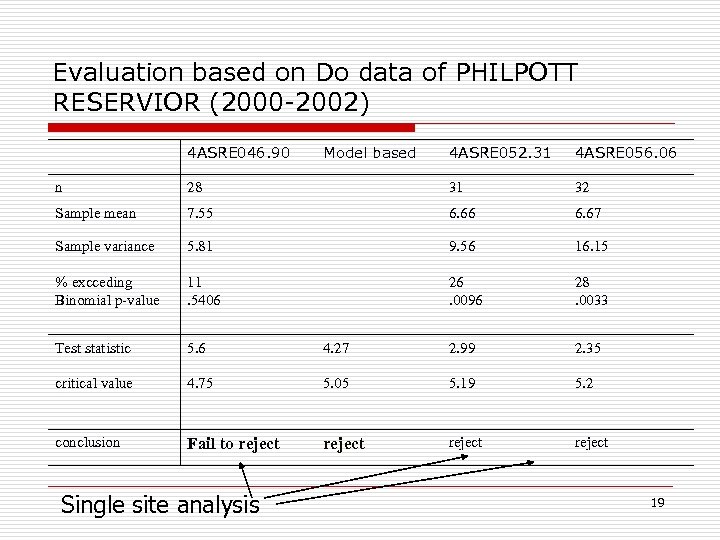
Evaluation based on Do data of PHILPOTT RESERVIOR (2000 -2002) 4 ASRE 046. 90 Model based 4 ASRE 052. 31 4 ASRE 056. 06 n 28 31 32 Sample mean 7. 55 6. 66 6. 67 Sample variance 5. 81 9. 56 16. 15 % excceding Binomial p-value 11. 5406 26. 0096 28. 0033 Test statistic 5. 6 4. 27 2. 99 2. 35 critical value 4. 75 5. 05 5. 19 5. 2 conclusion Fail to reject Single site analysis 19
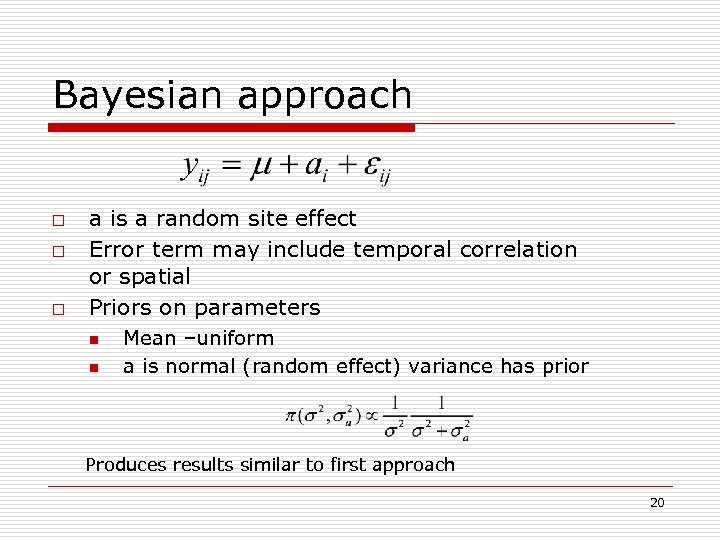
Bayesian approach o o o a is a random site effect Error term may include temporal correlation or spatial Priors on parameters n n Mean –uniform a is normal (random effect) variance has prior Produces results similar to first approach 20
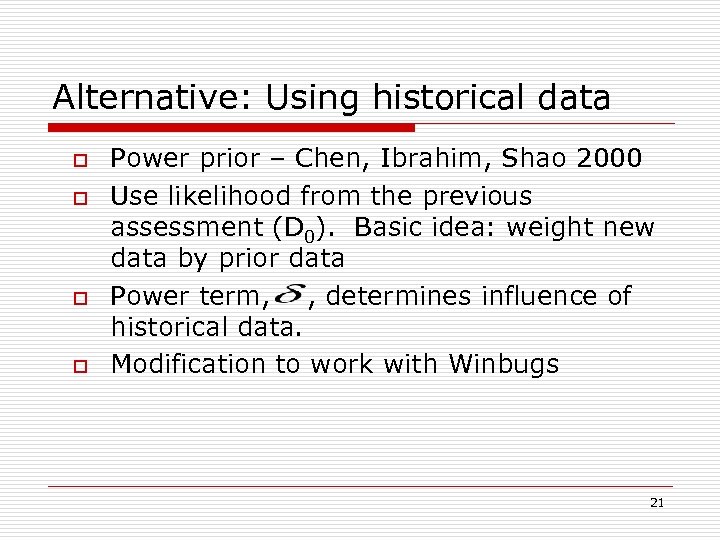
Alternative: Using historical data o o Power prior – Chen, Ibrahim, Shao 2000 Use likelihood from the previous assessment (D 0). Basic idea: weight new data by prior data Power term, , determines influence of historical data. Modification to work with Winbugs 21
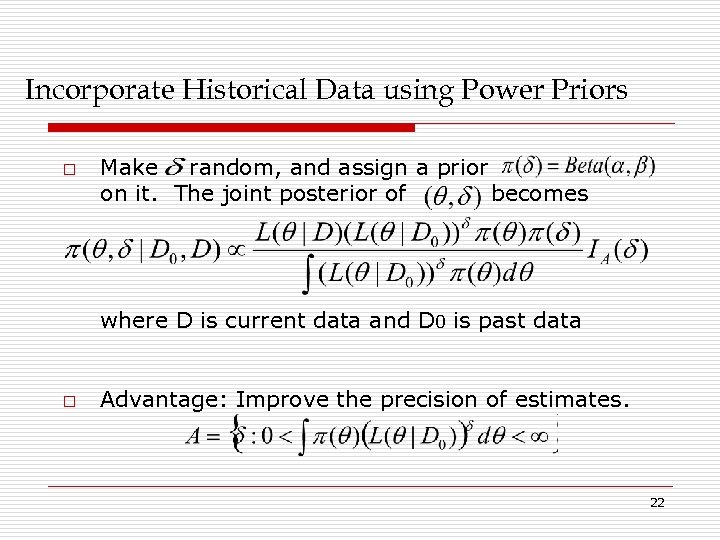
Incorporate Historical Data using Power Priors o Make random, and assign a prior on it. The joint posterior of becomes where D is current data and D 0 is past data o Advantage: Improve the precision of estimates. 22
23
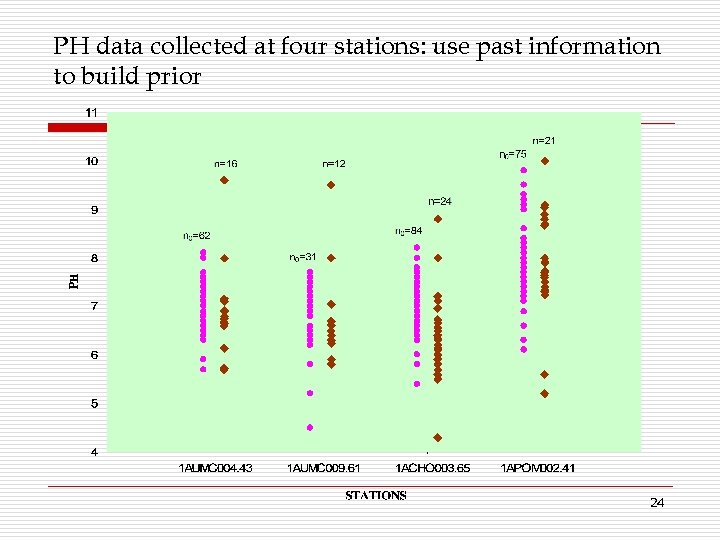
PH data collected at four stations: use past information to build prior 24
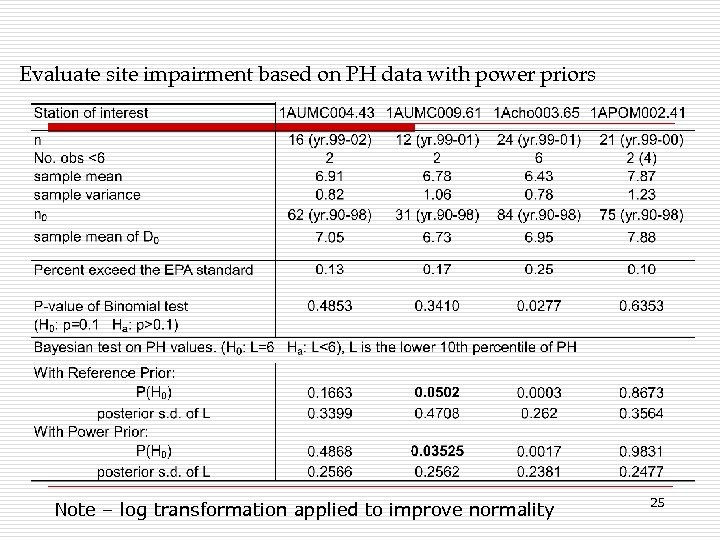
Evaluate site impairment based on PH data with power priors Note – log transformation applied to improve normality 25
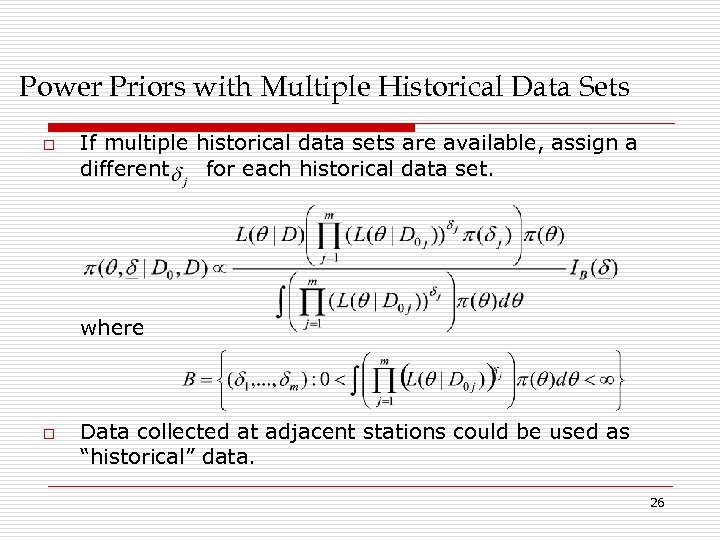
Power Priors with Multiple Historical Data Sets o If multiple historical data sets are available, assign a different for each historical data set. where o Data collected at adjacent stations could be used as “historical” data. 26
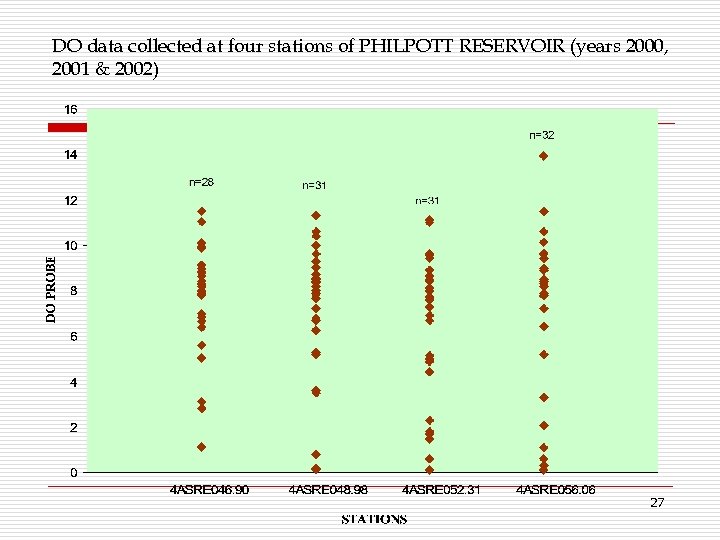
DO data collected at four stations of PHILPOTT RESERVOIR (years 2000, 2001 & 2002) 27
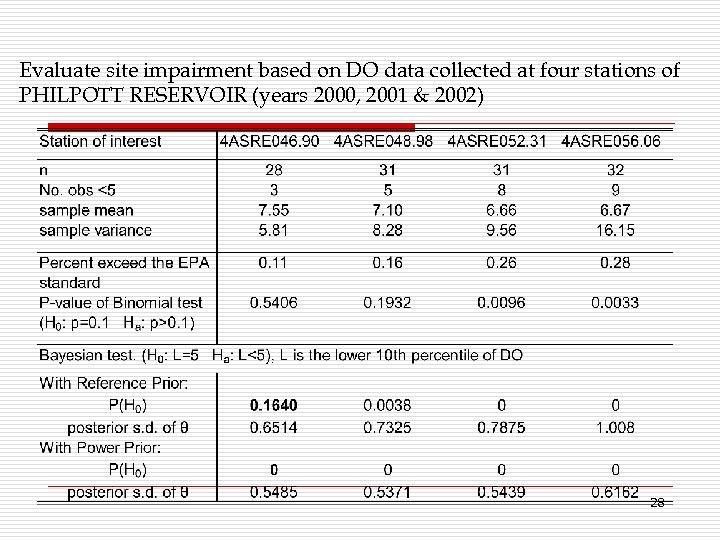
Evaluate site impairment based on DO data collected at four stations of PHILPOTT RESERVOIR (years 2000, 2001 & 2002) 28
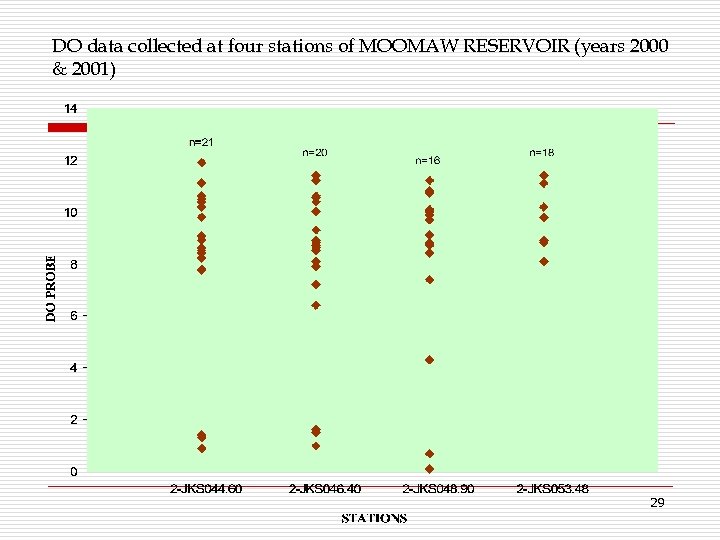
DO data collected at four stations of MOOMAW RESERVOIR (years 2000 & 2001) 29
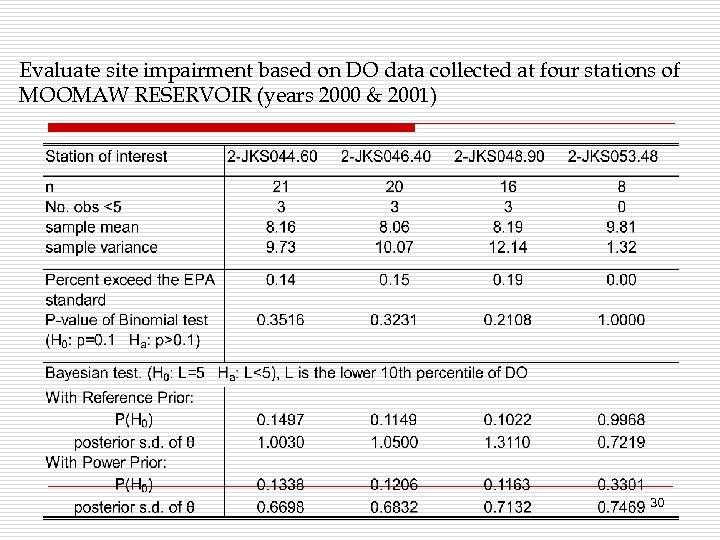
Evaluate site impairment based on DO data collected at four stations of MOOMAW RESERVOIR (years 2000 & 2001) 30
Comments o Advantages n n o Disadvantage n n o Greater flexibility in modeling Allows for site history to be included Can include spatial and temporal components Can better connect to TMDL analysis and probabilistic sampling Requires more commitment to the modeling process Greater emphasis on the distributional assumptions http: //www. stat. vt. edu/facstaff/epsmith. h tml 31
Needs o o More applications to evaluate Temporal/spatial modeling Evaluation of error rates Bayesian modeling and null and alternative hypotheses 32

Sponsor RD-83136801 -0 This talk was not subjected to USEPA review. The conclusion and opinions are soley those of the authors and not the views of the Agency. 33
Скачать презентацию Evaluation of Standards data collected from probabilistic sampling
fdce92a357ebe5a6d237343b5486c349.ppt