 Скачать презентацию Evaluation of Broadcast Media 電視產業現況 l l
8bf4175e09f628f57dfb9f93979177e2.ppt
- Количество слайдов: 49



Evaluation of Broadcast Media

電視產業現況 l l l 目前無線頻道業者家數 目前有線電視普及率
Advantages of Television l Creativity and impact l l l The interaction of sight and sound offers tremendous creative flexibility and makes possible dramatic, lifelike representations of products and services. TV commercials can be used to convey a mood or image for a brand as well as to develop emotional or entertaining appeals that help make a dull product appear interesting, e. g. Thai Airways. TV is also an excellent medium for demonstrating a product or service, e. g. SUZUKI_晶鑽 125.
Advantages of Television l Coverage and cost effectiveness l l l Nearly, regardless of age, sex, income, or education level, watched at least some TV. In 2005, the average CPM homes reached was nearly $20 for network evening shows and $4. 59 for day time weekly shows. TV is a popular medium among companies selling mass-consumption products, e. g. General Motors & Ford (nearly 2/3), Pepsi. Co & Coca-Cola (more than 80%).
Advantages of Television l Captivity and attention l l l The low involvement nature of consumer learning and response processes may mean TV ads have an effect on consumers simply through heavy repetition and exposure to catchy slogans and jingles. As much as 1/3 of program audiences may be lost during commercial time. Selectivity and flexibility l l Program content, broadcast time, and geographic coverage The growth of cable TV → sports, news, history, the arts, or music
Limitations of Television l Costs l l The expense of buying airtime + the costs of producing a quality commercial Production costs for a national brand 30 -sec spot average nearly $400, 000 and can reach over a million for more elaborate commercials. Segment marketing & media-driven creative strategies Lack of selectivity l Improvement: the type of program or day and/or time
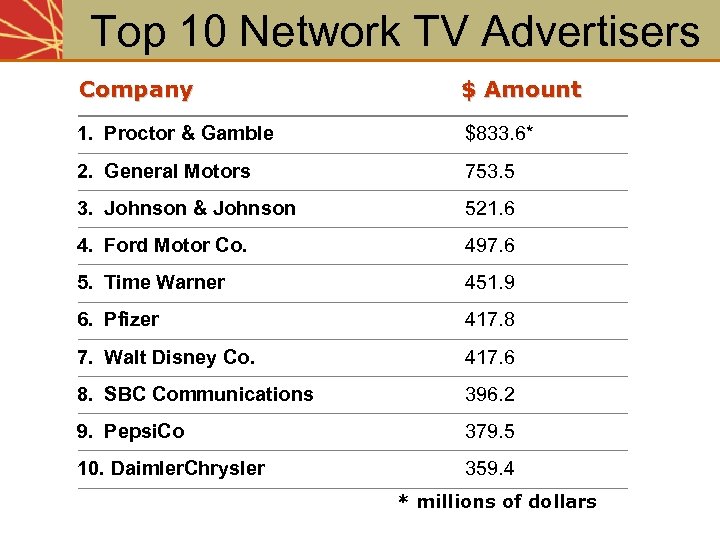
Top 10 Network TV Advertisers Company $ Amount 1. Proctor & Gamble $833. 6* 2. General Motors 753. 5 3. Johnson & Johnson 521. 6 4. Ford Motor Co. 497. 6 5. Time Warner 451. 9 6. Pfizer 417. 8 7. Walt Disney Co. 417. 6 8. SBC Communications 396. 2 9. Pepsi. Co 379. 5 10. Daimler. Chrysler 359. 4 * millions of dollars
Limitations of Television l Fleeting message l l l The spiraling inflation in media costs over the past decade 30 -second commercials became the norm in the mid 1970 s, and September 1986, the three major networks began accepting 15 -second spots across their full schedules. The growth in the use of 15 -second commercials peaked at 38% in 1989 and has declined slightly since then. 30 -second: network (~ 60%) & nonnetwork (~ 80%) 15 -second spot: network (~ 33%) & nonnetwork (~ 10%) Why is 15 -second ad less popular? l Creative considerations, lower price for network time, and a desire by the networks to restrict clutter.
Limitations of Television l Clutter l l Limited viewer attention l l Fleeting messages and shorter commercials Zipping (快轉 ) & Zapping (轉台 ) Distrust and negative evaluation l l The pervasiveness and the intrusive nature Studies have shown that of the various forms of advertising, distrust is generally the highest for TV commercials.
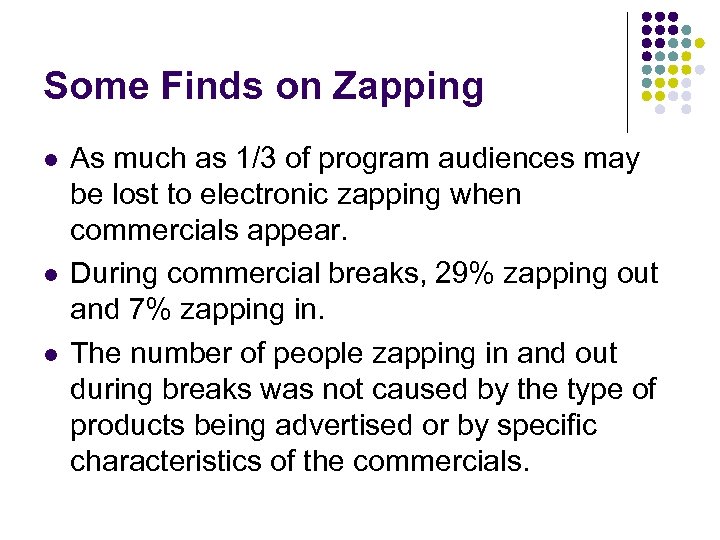
Some Finds on Zapping l l l As much as 1/3 of program audiences may be lost to electronic zapping when commercials appear. During commercial breaks, 29% zapping out and 7% zapping in. The number of people zapping in and out during breaks was not caused by the type of products being advertised or by specific characteristics of the commercials.
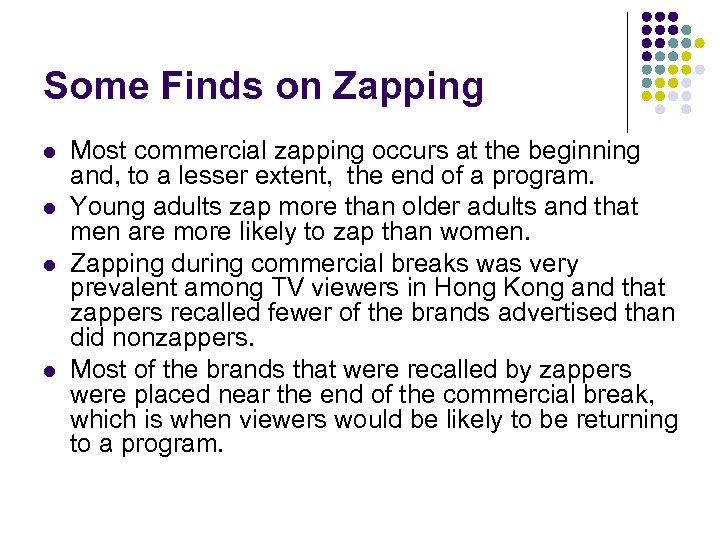
Some Finds on Zapping l l Most commercial zapping occurs at the beginning and, to a lesser extent, the end of a program. Young adults zap more than older adults and that men are more likely to zap than women. Zapping during commercial breaks was very prevalent among TV viewers in Hong Kong and that zappers recalled fewer of the brands advertised than did nonzappers. Most of the brands that were recalled by zappers were placed near the end of the commercial break, which is when viewers would be likely to be returning to a program.
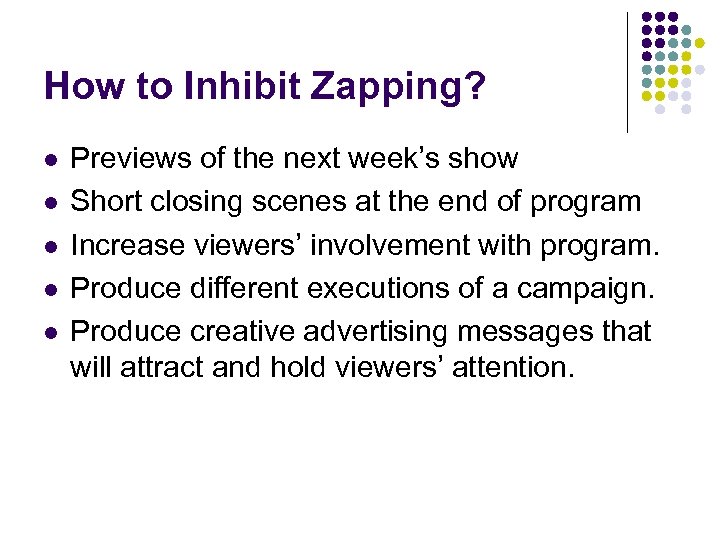
How to Inhibit Zapping? l l l Previews of the next week’s show Short closing scenes at the end of program Increase viewers’ involvement with program. Produce different executions of a campaign. Produce creative advertising messages that will attract and hold viewers’ attention.
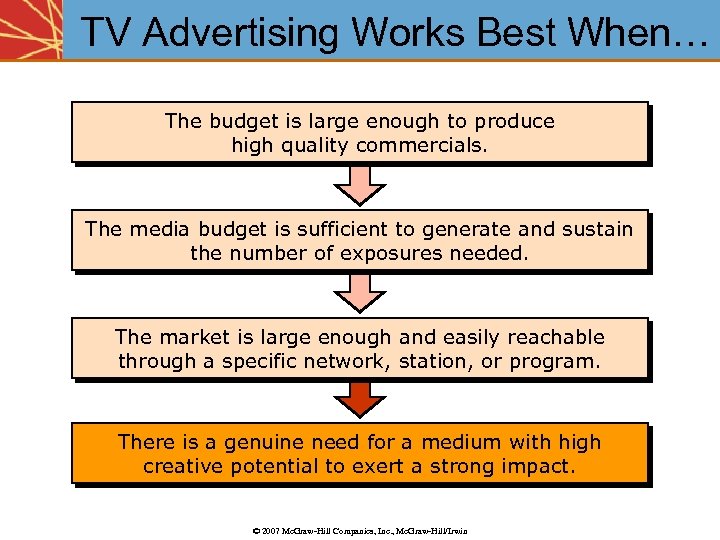
TV Advertising Works Best When… The budget is large enough to produce high quality commercials. The media budget is sufficient to generate and sustain the number of exposures needed. The market is large enough and easily reachable through a specific network, station, or program. There is a genuine need for a medium with high creative potential to exert a strong impact. © 2007 Mc. Graw-Hill Companies, Inc. , Mc. Graw-Hill/Irwin
電視廣告片製作 1. 2. 3. 4. 比價 – 尋找合適的製片公司 召開製前會議 (PPM, pre-production meeting) 拍片 交片: A拷、B拷 & 播出帶
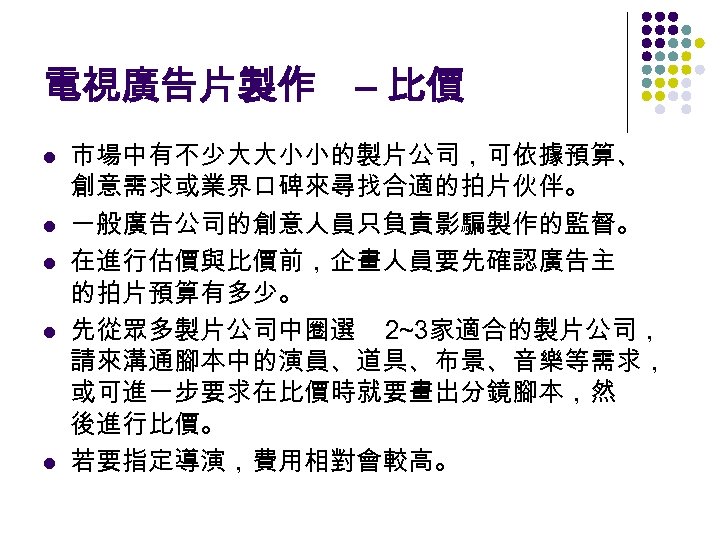
電視廣告片製作 – 比價 l l l 市場中有不少大大小小的製片公司,可依據預算、 創意需求或業界口碑來尋找合適的拍片伙伴。 一般廣告公司的創意人員只負責影騙製作的監督。 在進行估價與比價前,企畫人員要先確認廣告主 的拍片預算有多少。 先從眾多製片公司中圈選 2~3家適合的製片公司, 請來溝通腳本中的演員、道具、布景、音樂等需求, 或可進一步要求在比價時就要畫出分鏡腳本,然 後進行比價。 若要指定導演,費用相對會較高。
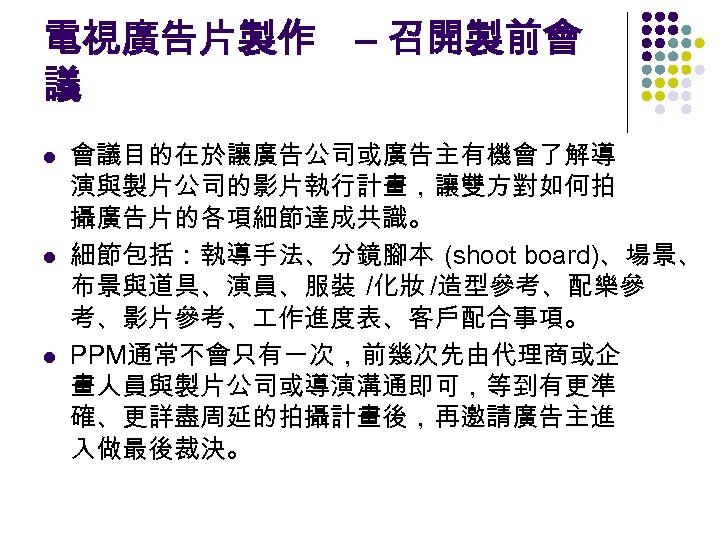
電視廣告片製作 – 召開製前會 議 l l l 會議目的在於讓廣告公司或廣告主有機會了解導 演與製片公司的影片執行計畫,讓雙方對如何拍 攝廣告片的各項細節達成共識。 細節包括:執導手法、分鏡腳本 (shoot board)、場景、 布景與道具、演員、服裝 /化妝 /造型參考、配樂參 考、影片參考、 作進度表、客戶配合事項。 PPM通常不會只有一次,前幾次先由代理商或企 畫人員與製片公司或導演溝通即可,等到有更準 確、更詳盡周延的拍攝計畫後,再邀請廣告主進 入做最後裁決。
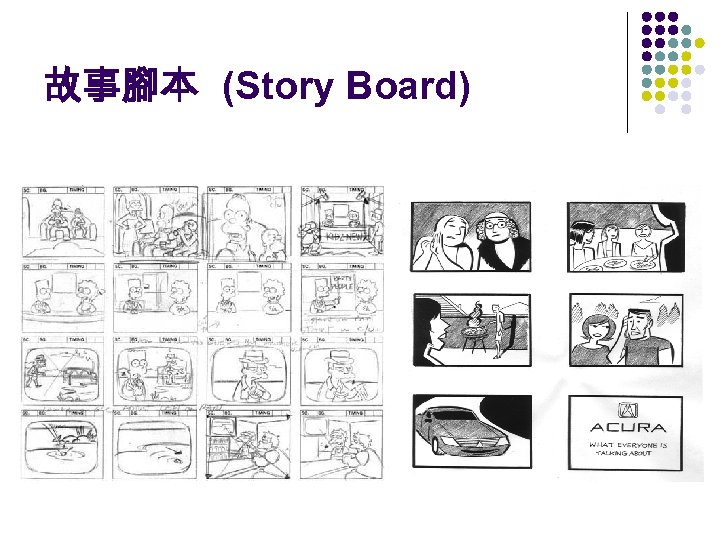
故事腳本 (Story Board)
電視廣告片製作 – 拍片 l l l 拍攝流程計畫 (shooting rundown):除拍片 流程外,還包括相關備註事項、 作人員名 單及聯絡電話、到達各場景或攝影棚之交 通路線圖。 考量時間效率與經濟效益,拍攝流程計畫 通常並不會依照腳本的敘事分鏡順序依序 拍攝。 在現場監拍的創意人員或企畫人員若有任 何覺得不妥之處,要及時提出與導演討論。 拍完收 就幾乎沒有補救的機會,因為再 補拍都是要花錢的。
電視廣告片製作 – 交片 l l l A拷 (A copy):將拍攝影片沖洗並過成數為訊號, 然後將影片粗剪所成的版本。約需 3~7個 作天。 A拷主要是看整支片子的調性與節奏是否符合原 創的要求、是否能把產品訊息呈現出來。 B拷 (B copy):將廣告主同意後的 A拷進行後期製 作並錄音所成的版本。約需 3~7個 作天。 B拷主要評估音效與旁白部分的製作是否令人滿 意。 播出帶 (station copy):將 B拷以最嚴謹的方式轉錄 所成的版本。
Buying Television Time l l l Network versus spot Methods of buying time Selecting time periods and programs Cable television Measuring the TV audience
Network Versus Spot l Network advertising l l l A network assembles a series of affiliated local TV stations, or affiliates, to which it supplies programming and services, e. g. NBC, ABC, CBS, and FOX. Advantage: the simplification of the purchase process. Disadvantages : the high cost of network time (Figure 112), availability of time. l up-front market: a buying period that occurs before the TV season begins. l scatter market: a buying period that runs through the TV season. l Incentives for up-front market: prime-time, cancellation options, and lower prices.
Network Versus Spot l Spot and local advertising l l l Spot advertising: commercials shown on local TV stations, with time negotiated and purchased directly from the individual stations. National spot advertising: all nonnetwork advertising done by a national advertiser. Local advertising: airtime sold to local firms such as retailers, restaurants, banks, and auto dealers. Advantages: flexibility, test marketing, or introducing a product in limited market areas. Disadvantages : clutter, more difficult to acquire → station reps.
Network Versus Spot l Syndication l l l Syndicated programs: shows that are sold or distributed on a station-by-station, market-by-market basis. First-run syndication: shows produced specifically for the syndication market. Advertiser-supported or barter syndication: the practice of selling shows to stations in return for a portion of the commercial time in the show, rather than (or in addition to) cash. Advantages: broaden reach, save money, and target certain audiences. Disadvantages: audience type, research information, undesirable market or time period.
Methods of Buying Time l Participations l l l Advertisers buy commercial time or spots on a particular program. Nearly 90% of network advertising time is sold as participations. The advertiser has no long-term commitment to a program, and expenditures can be adjusted to buy whatever number of participation spots fits within the budget. TV budget can be spread over a number of programs, thereby providing for greater reach in the media schedule. Disadvantages: the advertiser has little control over the placement of ads, problems with availability.
Methods of Buying Time l Sponsorship l l Under a sponsorship arrangement, an advertiser assumes responsibility for the production and usually the content of the program as well as the advertising that appears within it. Advertisers introducing new products or brands sometimes sponsor a program and run commercials that are several minutes long to launch them. Sponsorship allows the firm to capitalize on the prestige of a high-quality program, enhancing the image of the company and its product. Recently, a number of companies have paid for shows to run commercial free as part of a larger package involving placements of their products in the program.
Methods of Buying Time l Spot announcements l l Bought from the local stations and generally appear during time periods adjacent to network programs (hence the term adjacencies), rather than within them. Most often used by purely local advertisers
Selecting Time Periods and Programs l l l The time of day & the particular program → audience size → the cost of TV Dayparts – specific segments of a broadcast day (Figure 11 -4) The various dayparts are important to advertisers since they attract different demographic groups.
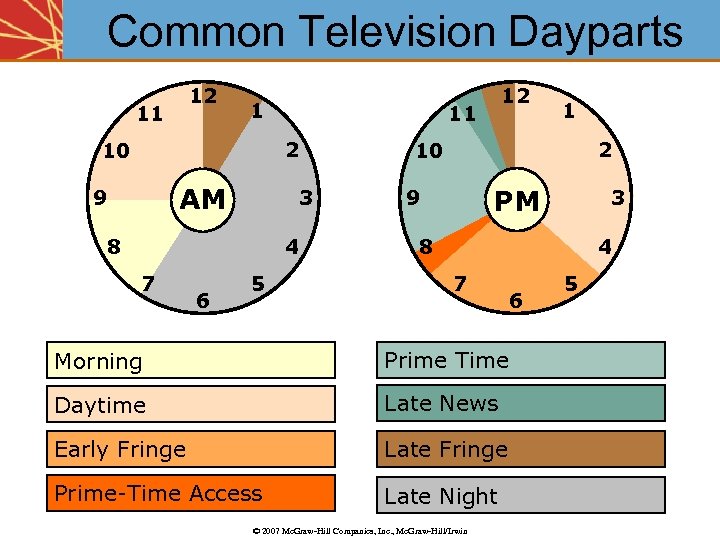
Common Television Dayparts 12 11 1 11 2 10 AM 9 3 8 4 7 6 5 12 1 2 10 PM 9 3 8 4 7 6 Morning Prime Time Daytime Late News Early Fringe Late Fringe Prime-Time Access Late Night © 2007 Mc. Graw-Hill Companies, Inc. , Mc. Graw-Hill/Irwin 5
Cable Television l The growth of cable l l 13% (1975) → 84% (2005) Superstation: independent local stations that send their signals nationally via satellite to cable operators to make their programs available to subscribers. The expanded viewing options have led to considerable audience fragmentation. Cable channels now have more of the prime-time viewing audience than the major networks.
Cable Television l Advertising on cable l l l Cable advertising revenues have increased steadily since the mid-1980 s and exceeded $21 billion in 2005. Over the past four years, spot cable revenues have averaged 20% annual growth, reaching nearly $6 billion in 2005 Interconnect: a number of cable systems and networks in a geographic area are joined for advertising purposes.
Cable Television l Advantages of cable l l Selectivity → narrowcasting (i. e. reaching very specialized markets) Low cost l l Advertising time on network shows can cost 2 to 3 times as much on a CPM basis. Flexibility l Cable advertisers generally do not have to make the large up-front commitments, which may be as much as a year in advance, the network require.
Cable Television l Limitations of cable l l Cable generally has less desirable programming than broadcast TV. Audience fragmentation → buying procedure more difficult. The quality and availability of local ratings for cable stations as well as research on audience characteristics. Cable lacks total penetration, e. g. 82% in LA, 77% in Houston, and 78% in Dallas.
Cable Television l The future of cable l l l Increases in the number of channels → fragmentation of the audience Changes in government regulations Competing in the programming distribution business from other telecommunications companies and direct broadcast satellite services.
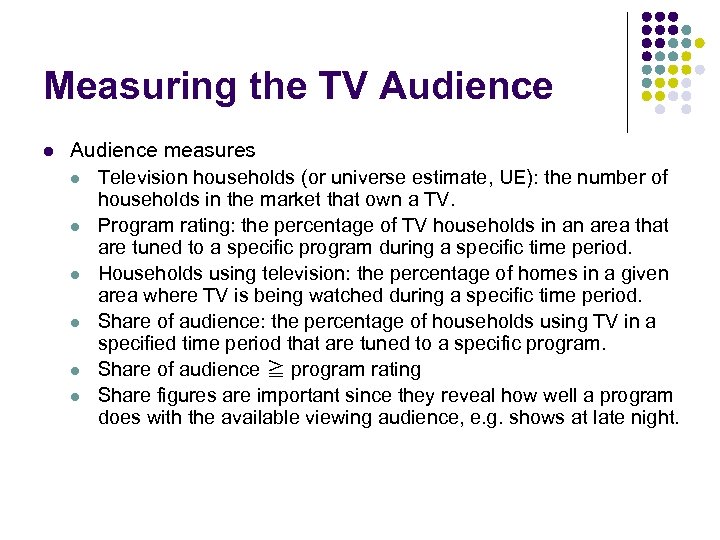
Measuring the TV Audience l Audience measures l Television households (or universe estimate, UE): the number of households in the market that own a TV. l Program rating: the percentage of TV households in an area that are tuned to a specific program during a specific time period. l Households using television: the percentage of homes in a given area where TV is being watched during a specific time period. l Share of audience: the percentage of households using TV in a specified time period that are tuned to a specific program. l Share of audience ≧ program rating l Share figures are important since they reveal how well a program does with the available viewing audience, e. g. shows at late night.
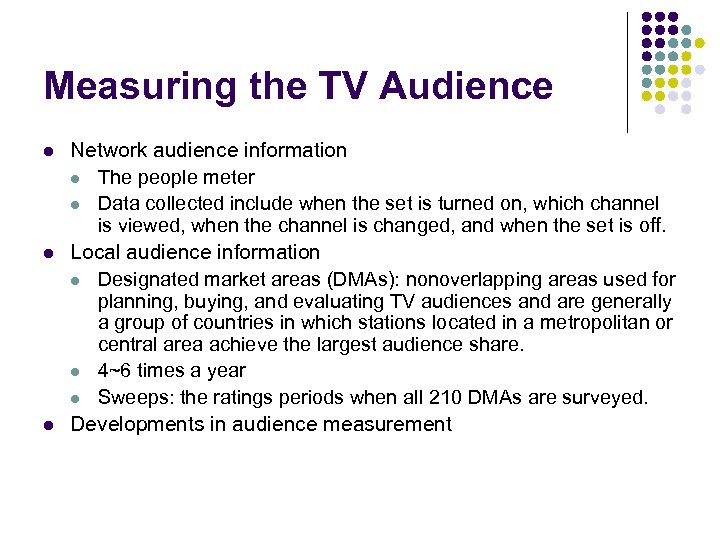
Measuring the TV Audience l l l Network audience information l The people meter l Data collected include when the set is turned on, which channel is viewed, when the channel is changed, and when the set is off. Local audience information l Designated market areas (DMAs): nonoverlapping areas used for planning, buying, and evaluating TV audiences and are generally a group of countries in which stations located in a metropolitan or central area achieve the largest audience share. l 4~6 times a year l Sweeps: the ratings periods when all 210 DMAs are surveyed. Developments in audience measurement
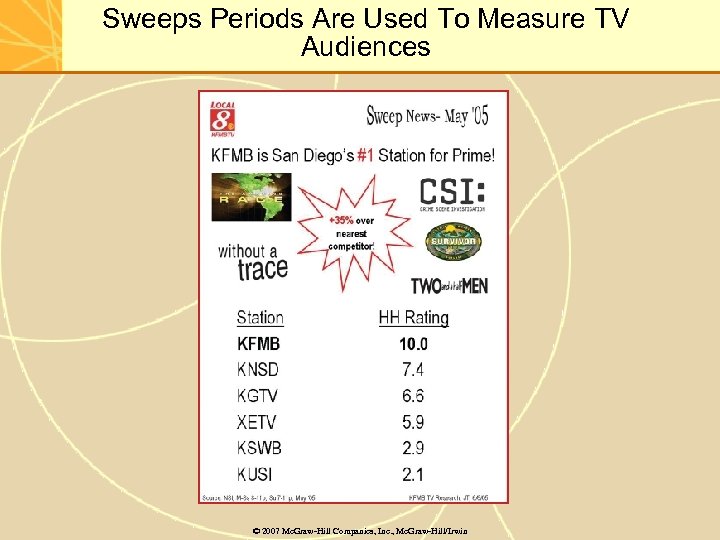
Sweeps Periods Are Used To Measure TV Audiences © 2007 Mc. Graw-Hill Companies, Inc. , Mc. Graw-Hill/Irwin
Radio l l 目前廣播業者家數 廣播調查報告 – 1, 2 廣播廣告成長原因 : 分眾明顯,廣告主 (1) 容易選擇;(2) 置入性行銷及活動舉辦。 廣播通路化應該會成為未來趨勢,如台北 愛樂、ICRT、 NEWS 98及全國廣播的廣播購 物,都有不錯的收益。
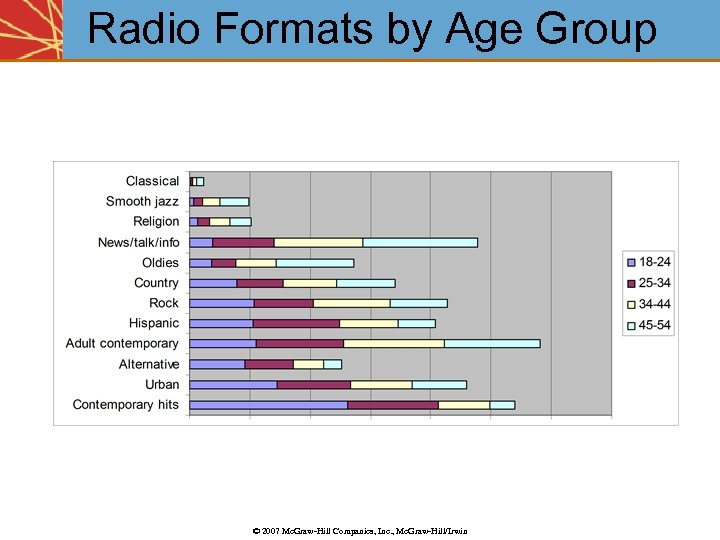
Radio Formats by Age Group © 2007 Mc. Graw-Hill Companies, Inc. , Mc. Graw-Hill/Irwin
Advantages of Radio l Cost and efficiency l l A minute on network radio may cost only $5, 000 ≒ $3~$4 CPM. Local advertising on radio stations costs about $6 per thousand households, compared to more than $20 for local TV advertising. Low cost → high reach and frequency Selectivity l l Figure 11 -6 Radio has become a popular war to reach specific non. English-speaking ethnic markets.
Advantages of Radio l Flexibility l l Mental imagery l l l Very short closing period → advertisers can change their message almost up to the time it goes on the air. Many advertisers take advantage of the absence of a visual element to let consumers create their own picture of what is happening in a radio message. Image transfer – TV + Radio Integrated marketing opportunities l The synergistic use of radio with TV and newspapers had a positive impact on brand awareness and brand selection.
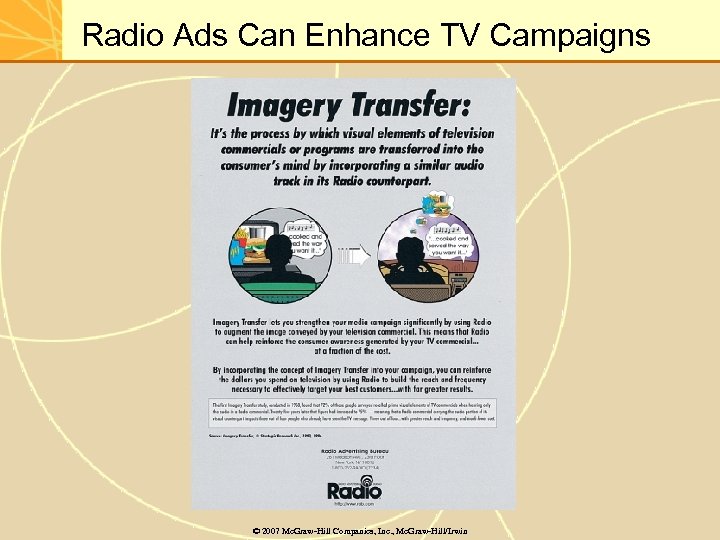
Radio Ads Can Enhance TV Campaigns © 2007 Mc. Graw-Hill Companies, Inc. , Mc. Graw-Hill/Irwin
Limitations of Radio l l Creative limitations Fragmentation l l The large number of stations → the high level of audience fragmentation The percentage of the market tuned to any particular station is used very small (< 10%).
Limitations of Radio l Chaotic buying procedures l l l Acquiring information and evaluating and contracting for time with even a fraction of the 10, 500 commercial stations that operate across the country can be very difficult and time-consuming. This problem has diminished somewhat in recent years as the number of radio networks and of syndicated programs offering a package of several hundred stations increases. Limited research data l l Most radio stations are small operations and lack the revenue to support detailed studies of their audiences. Most users of radio are local companies that cannot support research on radio listenership in their market.
Limitations of Radio l l Limited listener attention l Radio programming, particularly music, is often the background to some other activity and may not receive the listeners’ full attention. l Listeners in car were exposed to only half of the advertising broadcast and changed stations frequently to avoid commercials. l The emergence of several digital-based technologies, e. g. cellular phones, MP 3 players, and satellite radio. Clutter l Most radio stations carry an average of nearly 10 minutes of commercials every hour. l “commercial-free” blocks of music l Perceptions of increased ad clutter were cited by consumers as a reason for spending less time listening to radio.
廣播廣告製作 l l 「簡單」是廣播廣告奉為第一的製作守則 – 用語簡 單、訊息單純,要讓聽眾在「三心兩意」的狀況下 還能接受到訊息。 廣播廣告的表現元素: 1. 內容(文案或旁白)、 聲 2. 音表情(音質、節奏、感情)、 音樂或音效。 3. 內容有趣、聲音創意呈現,是廣播廣告吸引人的兩 大魅力因素。 表現方式: 1. 以音樂或廣告歌為主的表現手法 ; 2. 口白播報式廣告 ; 對話式廣告 ; 劇情式廣告 。 3. 4.
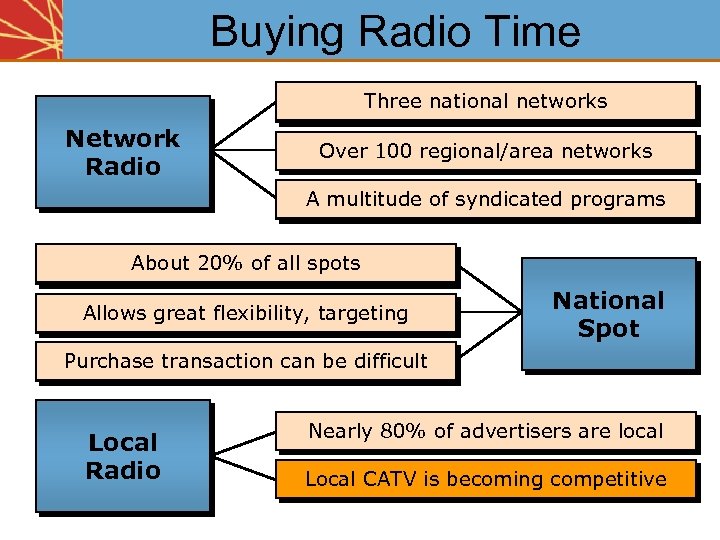
Buying Radio Time Three national networks Network Radio Over 100 regional/area networks A multitude of syndicated programs About 20% of all spots Allows great flexibility, targeting National Spot Purchase transaction can be difficult Local Radio Nearly 80% of advertisers are local Local CATV is becoming competitive
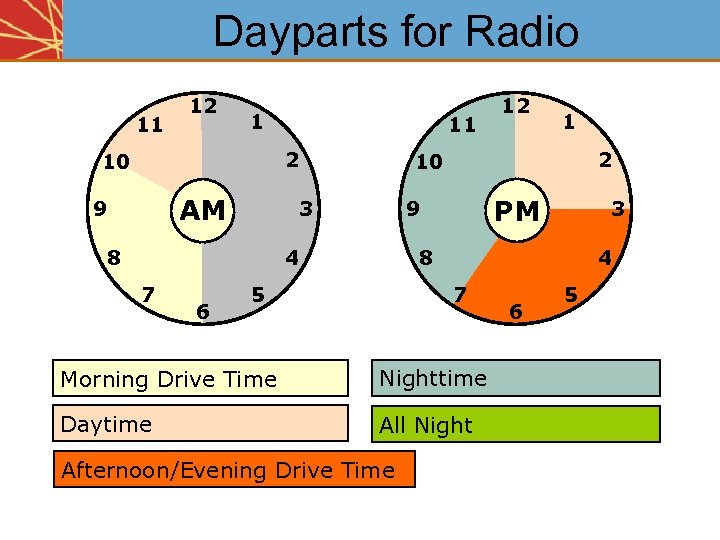
Dayparts for Radio 11 12 1 11 2 10 AM 9 6 2 PM 9 4 7 1 10 3 8 12 3 8 5 4 7 Morning Drive Time Nighttime Daytime All Night Afternoon/Evening Drive Time 6 5
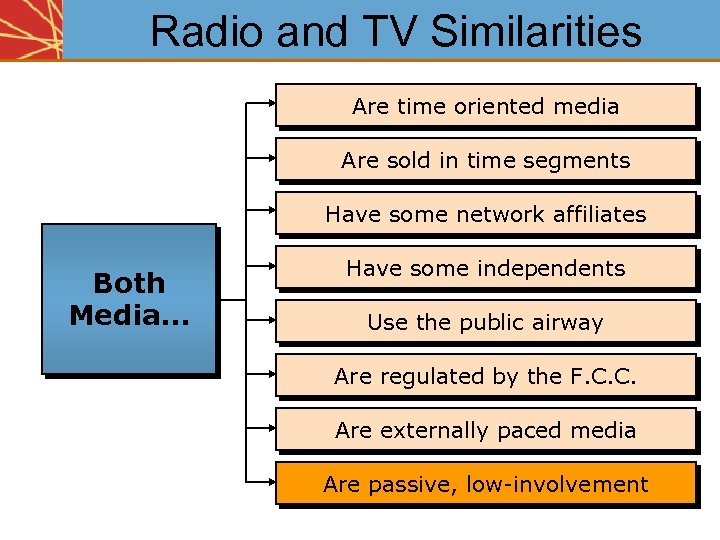
Radio and TV Similarities Are time oriented media Are sold in time segments Have some network affiliates Both Media… Have some independents Use the public airway Are regulated by the F. C. C. Are externally paced media Are passive, low-involvement
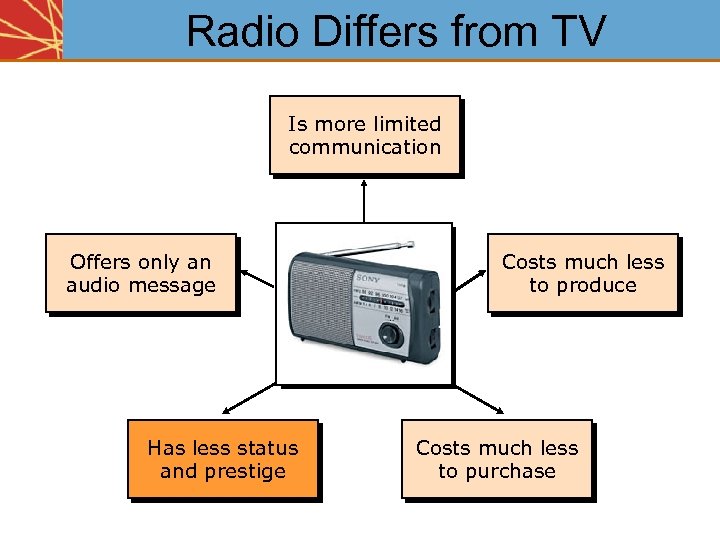
Radio Differs from TV Is more limited communication Offers only an audio message Has less status and prestige Costs much less to produce Costs much less to purchase
Скачать презентацию Evaluation of Broadcast Media 電視產業現況 l l
8bf4175e09f628f57dfb9f93979177e2.ppt