 Скачать презентацию Evaluation of a Global Health Residency Track Therese
c02affa424fa145812a1583132abdceb.ppt
- Количество слайдов: 33



Evaluation of a Global Health Residency Track Therese Zink, MD, MPH Erik Solberg, MA, MEd Global Family Medicine Pathway Department of Family Medicine and Community Health University of Minnesota
Disclosures • Dr. Zink and Mr. Solberg declare no relevant financial affiliations nor conflicts of interest. • Neither Zink nor Solberg plan to discuss an off-label use of any prescription medication during this presentation.
Session Objectives By the conclusion of this session, attendees will be able to: 1. List the steps involved in creating an overarching consent to use de-identified residents' responses for evaluation. 2. Describe opportunities for testing and capturing the knowledge gained through participation in international experiences. 3. Explain the value of international experiences in addressing the six ACGME competencies during residency training T
Session Agenda/Overview • Overview of DFMCH and Pathway • Consent to use Resident Data • ACGME General Competencies – International Elective Goals and Objectives • Curriculum – Pre and Post Knowledge Assessments – Reflective Writing and Qualitative Assessment • Questions and Discussion T
UMN DFMCH Global Health Pathway • 8 residencies (5 Twin Cities + 3 greater MN) • Residency autonomy • On-line curriculum, in-person experiences, international partner sites • Partners: Departments of Internal Medicine and Pediatrics (residencies) • Enrolled residents 2011 -12 • Improve international knowledge of all residents: – Community Health – Cultural Competence T
Communication • • • Moodle site Google Calendar: UMN Global Health E-newsletter and updates Facebook Blogging – considerations E
CONSENT TO USE RESIDENTS’ DATA T
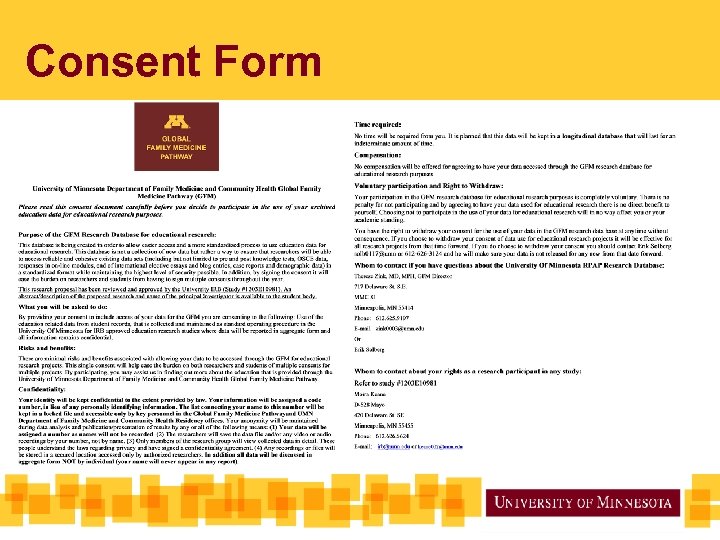
Consent • IRB exemptions – #1 Educational curriculum evaluation – #4 Existing de-identified data • Residents sign when enroll in pathway • Consent to use de-identified data for evaluation • May need additional IRB approval for specific study. T
Consent Form
Reflective Writing Article: International Electives for Global Pediatric Residents at the University of Minnesota: Opportunities for Education in all Accreditation Council Graduate Medical Education Competencies (Academic Pediatrics, 2012: 245– 250) 32 pediatric and peds/IM GH residents’ essays Prompt: write a one-page (or longer) summary of your international elective experience • Rich learning for “hard to teach competencies” • Reflection on personal and professional development T
ACGME General Competencies 1. 2. 3. 4. 5. 6. T Patient Care Medical Knowledge Practice Based Learning Interpersonal and Communication Skills Professionalism System Based Practice
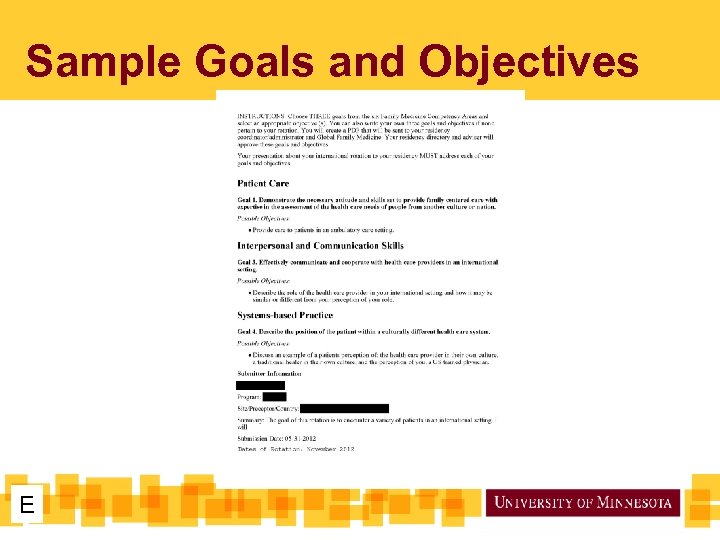
GOALS AND OBJECTIVES MENU FOR INTERNATIONAL ELECTIVES E
Sample Goals and Objectives E
Sample Goal 1 Inter Com Skills Goal 1. Understand the role of gender, power differentials, uncertainty avoidance across intercultural patient-physician interactions. Possible Objectives: • Articulate gender roles within the family and society in ____(country)____. • Articulate the significance of gender in the care patients in ____(country)____. • Evaluate inter and intra power differentials on physicianpatient interaction in __(country)__. E
Sample Goal 2 Prof Goal 4. Demonstrate personal and professional responsibility in a global setting. Possible Objectives: • Describe an experience where this was evident (managed cultural misperception, safety challenge, culture shock, etc. ) E
Sample Goal 3 PBL Goal 2. Utilizing local resources available in international settings, be able to triage and manage patient care. Possible objectives: • Explain how to identify and access local resources in __(city, country)___. • Explain how local diagnostic and treatment resources impact your work-up and how this may be different from what you would do in the US. • Describe how non-traditional resources in __(country)___shape health care delivery. E
Sample Goal 4 SBP Goal 6. Recognize the importance of population-based health (i. e. community and public health). Possible Objectives: • Identify an example of a population-based health activity in __(name of community/community)__and discuss its success, challenges or deficiencies. E
PRE AND POST KNOWLEDGE ASSESSMENT E
Knowledge Assessment • Developed by pediatrics – Sample Question: True/False (Select one): “All immigrant children, including refugees and international adoptees, are screened for tuberculosis prior to entering the U. S. , as part of a medical examination required by the U. S. Department of Homeland Security” E
Knowledge Assessment • Illustrates knowledge change across the domains of medical knowledge, patient care. – In lights of the diversity of the patient panels at UMN residency clinics, some questions are relevant to all residents, even those NOT doing international rotations. E
ONLINE CURRICULUM AND KNOWLEDGE ASSESSMENT T
On-line curriculum CONTENT • Videotaped lectures • GHEC modules • Ted lectures • Open Sight • OTHERS? ? T
KNOWLEDGE ASSESSMENT • Knowledge questions (True/False, multiple choice w/ correct answer and citation) • Short answer reflection

REFLECTIVE ESSAYS AND OTHER QUALITATIVE OPPORTUNITIES T
Examples: • End of international rotation essay • Short reflections after movie night and book club • Resident project T
Prompts: Global Peds Essay • Where did you work? – Describe daily responsibilities, clinical and teaching environment, expound on interesting clinical cases and patient/family interactions. – Would you recommend this site to future residents, and why? Significant non-medical experiences? • Discuss how you feel your own culture and nationality played a part • Describe and discuss a situation in which your openness and curiosity fostered a learning situation T
Experiential prompts • What will you take away from this evening’s discussion? – Sample response: PGY 2, Female • It’s okay to make cultural “mistakes”—everyone does—as long as you approach the situation with openness and curiosity • My favorite part of these book/movie club nights is the networking & hearing other providers stories & adventures abroad. I learn so much more when what we read/watched is then discussed in an new context with someone with a real life experience. T
MAINTAIN DATABASE T
Resident Database • UMN Alumni data • Every 5 year (33% response rate) • Dedicate staff to search internet (state license, professional organization lists) – Goal: Meets RRC requirement to survey program graduates and provides capability to do longitudinal research on pathway graduates T
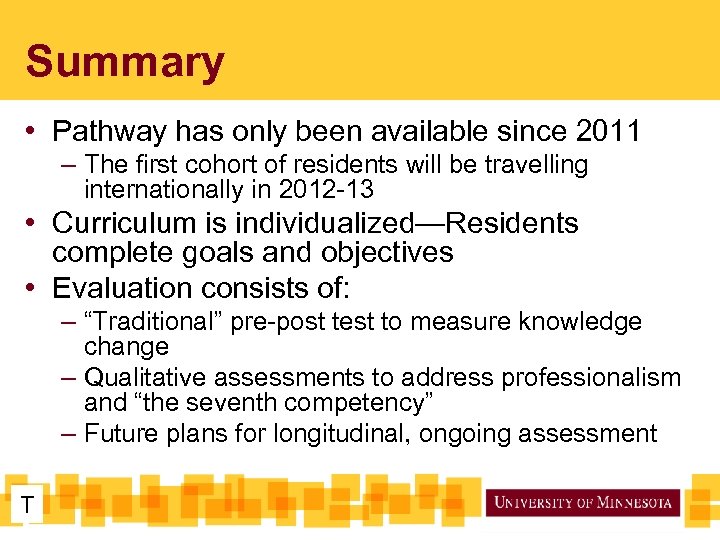
Summary • Pathway has only been available since 2011 – The first cohort of residents will be travelling internationally in 2012 -13 • Curriculum is individualized—Residents complete goals and objectives • Evaluation consists of: – “Traditional” pre-post test to measure knowledge change – Qualitative assessments to address professionalism and “the seventh competency” – Future plans for longitudinal, ongoing assessment T
Questions & Comments

 Скачать презентацию Evaluation of a Global Health Residency Track Therese
c02affa424fa145812a1583132abdceb.ppt