


 Скачать презентацию Evaluation and Improvements of Cloud Model Dynamics and
c840fd0050ac9580899f0c54168bf78a.ppt
- Количество слайдов: 1
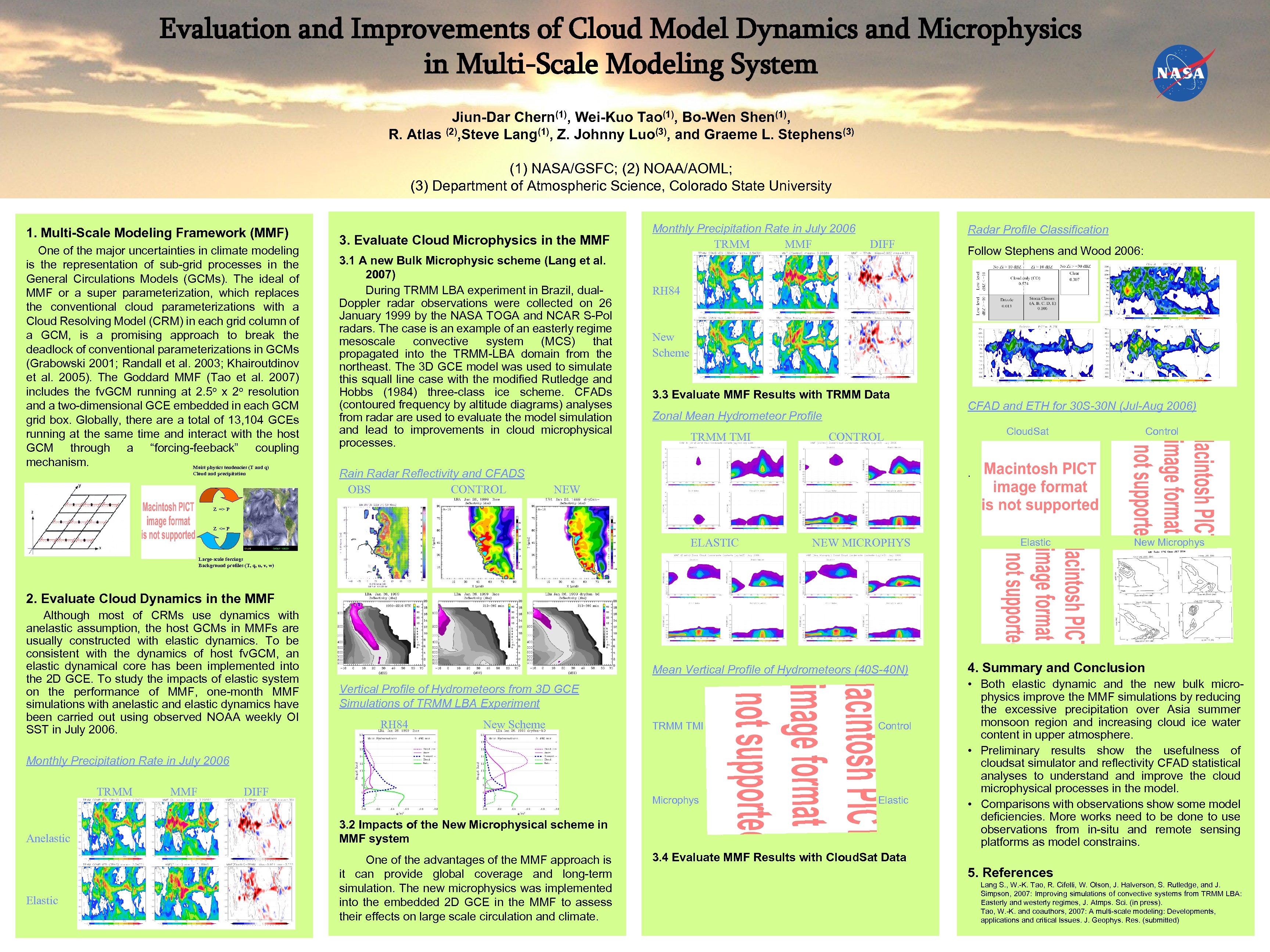 Evaluation and Improvements of Cloud Model Dynamics and Microphysics in Multi-Scale Modeling System Jiun-Dar Chern(1), Wei-Kuo Tao(1), Bo-Wen Shen(1), R. Atlas (2), Steve Lang(1), Z. Johnny Luo(3), and Graeme L. Stephens(3) (1) NASA/GSFC; (2) NOAA/AOML; (3) Department of Atmospheric Science, Colorado State University 1. Multi-Scale Modeling Framework (MMF) One of the major uncertainties in climate modeling is the representation of sub-grid processes in the General Circulations Models (GCMs). The ideal of MMF or a super parameterization, which replaces the conventional cloud parameterizations with a Cloud Resolving Model (CRM) in each grid column of a GCM, is a promising approach to break the deadlock of conventional parameterizations in GCMs (Grabowski 2001; Randall et al. 2003; Khairoutdinov et al. 2005). The Goddard MMF (Tao et al. 2007) includes the fv. GCM running at 2. 5 o x 2 o resolution and a two-dimensional GCE embedded in each GCM grid box. Globally, there a total of 13, 104 GCEs running at the same time and interact with the host GCM through a “forcing-feeback” coupling mechanism. Moist physics tendencies (T and q) Cloud and precipitation 3. Evaluate Cloud Microphysics in the MMF 3. 1 A new Bulk Microphysic scheme (Lang et al. 2007) During TRMM LBA experiment in Brazil, dual. Doppler radar observations were collected on 26 January 1999 by the NASA TOGA and NCAR S-Pol radars. The case is an example of an easterly regime mesoscale convective system (MCS) that propagated into the TRMM-LBA domain from the northeast. The 3 D GCE model was used to simulate this squall line case with the modified Rutledge and Hobbs (1984) three-class ice scheme. CFADs (contoured frequency by altitude diagrams) analyses from radar are used to evaluate the model simulation and lead to improvements in cloud microphysical processes. Rain Radar Reflectivity and CFADS OBS CONTROL Monthly Precipitation Rate in July 2006 TRMM MMF Radar Profile Classification DIFF Follow Stephens and Wood 2006: RH 84 New Scheme 3. 3 Evaluate MMF Results with TRMM Data Zonal Mean Hydrometeor Profile TRMM TMI CFAD and ETH for 30 S-30 N (Jul-Aug 2006) Cloud. Sat CONTROL Control . NEW Z => P Z <= P ELASTIC NEW MICROPHYS Elastic New Microphys Large-scale forcings Background profiles (T, q, u, v, w) 2. Evaluate Cloud Dynamics in the MMF Although most of CRMs use dynamics with anelastic assumption, the host GCMs in MMFs are usually constructed with elastic dynamics. To be consistent with the dynamics of host fv. GCM, an elastic dynamical core has been implemented into the 2 D GCE. To study the impacts of elastic system on the performance of MMF, one-month MMF simulations with anelastic and elastic dynamics have been carried out using observed NOAA weekly OI SST in July 2006. Mean Vertical Profile of Hydrometeors (40 S-40 N) Vertical Profile of Hydrometeors from 3 D GCE Simulations of TRMM LBA Experiment RH 84 New Scheme TRMM TMI Control Microphys Elastic Monthly Precipitation Rate in July 2006 TRMM Anelastic Elastic MMF DIFF 3. 2 Impacts of the New Microphysical scheme in MMF system One of the advantages of the MMF approach is it can provide global coverage and long-term simulation. The new microphysics was implemented into the embedded 2 D GCE in the MMF to assess their effects on large scale circulation and climate. 4. Summary and Conclusion • Both elastic dynamic and the new bulk microphysics improve the MMF simulations by reducing the excessive precipitation over Asia summer monsoon region and increasing cloud ice water content in upper atmosphere. • Preliminary results show the usefulness of cloudsat simulator and reflectivity CFAD statistical analyses to understand improve the cloud microphysical processes in the model. • Comparisons with observations show some model deficiencies. More works need to be done to use observations from in-situ and remote sensing platforms as model constrains. 3. 4 Evaluate MMF Results with Cloud. Sat Data 5. References Lang S. , W. -K. Tao, R. Cifelli, W. Olson, J. Halverson, S. Rutledge, and J. Simpson, 2007: Improving simulations of convective systems from TRMM LBA: Easterly and westerly regimes, J. Atmps. Sci. (in press). Tao, W. -K. and coauthors, 2007: A multi-scale modeling: Developments, applications and critical Issues. J. Geophys. Res. (submitted)