 Скачать презентацию Evaluating the Effectiveness and Implementation of New Labour
983306d1c825b8ef38c0ae3f7bc40a1b.ppt
- Количество слайдов: 1



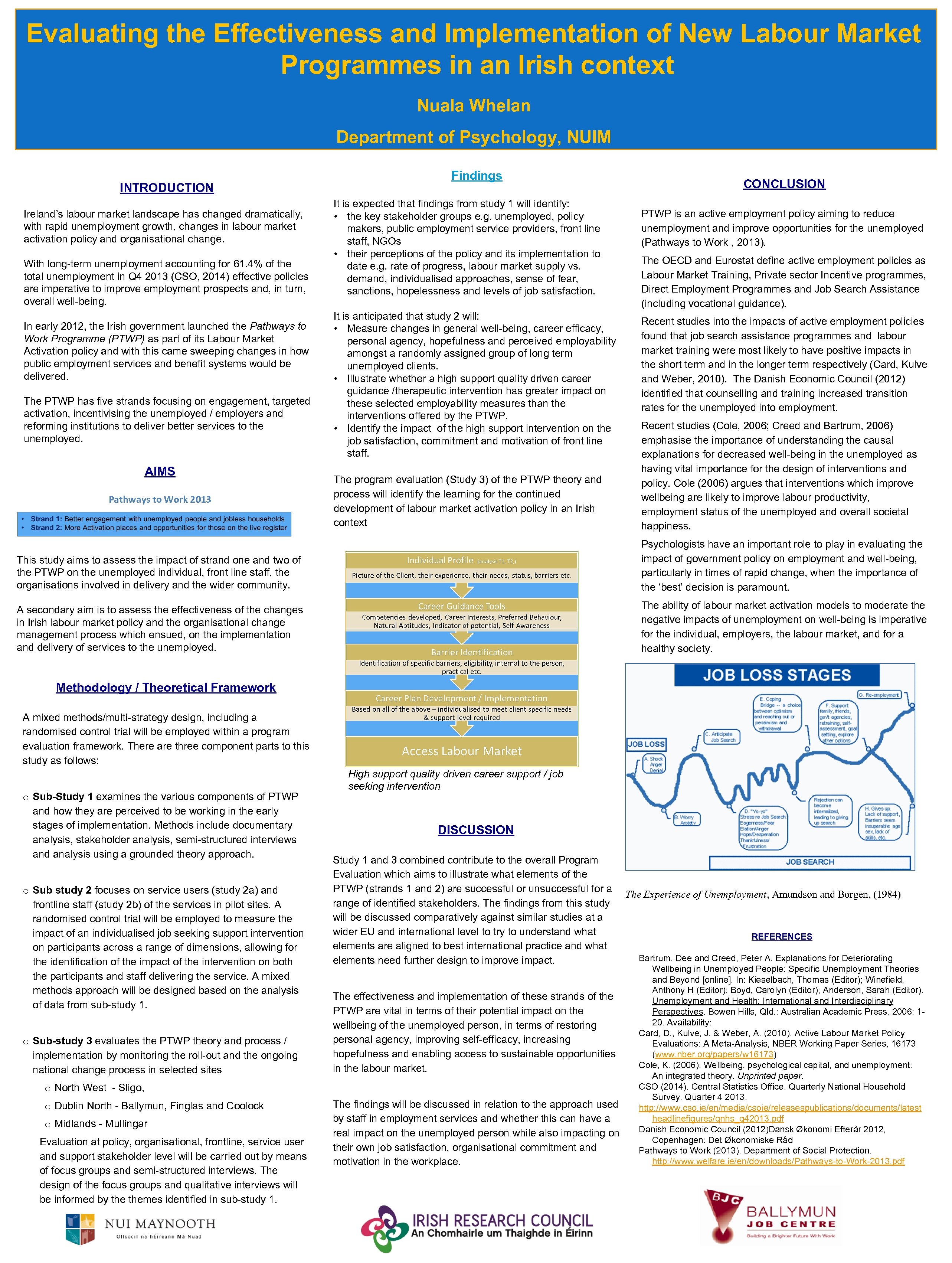
Evaluating the Effectiveness and Implementation of New Labour Market Programmes in an Irish context Nuala Whelan Department of Psychology, NUIM INTRODUCTION Ireland’s labour market landscape has changed dramatically, with rapid unemployment growth, changes in labour market activation policy and organisational change. With long-term unemployment accounting for 61. 4% of the total unemployment in Q 4 2013 (CSO, 2014) effective policies are imperative to improve employment prospects and, in turn, overall well-being. In early 2012, the Irish government launched the Pathways to Work Programme (PTWP) as part of its Labour Market Activation policy and with this came sweeping changes in how public employment services and benefit systems would be delivered. The PTWP has five strands focusing on engagement, targeted activation, incentivising the unemployed / employers and reforming institutions to deliver better services to the unemployed. AIMS Pathways to Work 2013 Findings It is expected that findings from study 1 will identify: • the key stakeholder groups e. g. unemployed, policy makers, public employment service providers, front line staff, NGOs • their perceptions of the policy and its implementation to date e. g. rate of progress, labour market supply vs. demand, individualised approaches, sense of fear, sanctions, hopelessness and levels of job satisfaction. It is anticipated that study 2 will: • Measure changes in general well-being, career efficacy, personal agency, hopefulness and perceived employability amongst a randomly assigned group of long term unemployed clients. • Illustrate whether a high support quality driven career guidance /therapeutic intervention has greater impact on these selected employability measures than the interventions offered by the PTWP. • Identify the impact of the high support intervention on the job satisfaction, commitment and motivation of front line staff. The program evaluation (Study 3) of the PTWP theory and process will identify the learning for the continued development of labour market activation policy in an Irish context CONCLUSION PTWP is an active employment policy aiming to reduce unemployment and improve opportunities for the unemployed (Pathways to Work , 2013). The OECD and Eurostat define active employment policies as Labour Market Training, Private sector Incentive programmes, Direct Employment Programmes and Job Search Assistance (including vocational guidance). Recent studies into the impacts of active employment policies found that job search assistance programmes and labour market training were most likely to have positive impacts in the short term and in the longer term respectively (Card, Kulve and Weber, 2010). The Danish Economic Council (2012) identified that counselling and training increased transition rates for the unemployed into employment. Recent studies (Cole, 2006; Creed and Bartrum, 2006) emphasise the importance of understanding the causal explanations for decreased well-being in the unemployed as having vital importance for the design of interventions and policy. Cole (2006) argues that interventions which improve wellbeing are likely to improve labour productivity, employment status of the unemployed and overall societal happiness. This study aims to assess the impact of strand one and two of the PTWP on the unemployed individual, front line staff, the organisations involved in delivery and the wider community. Psychologists have an important role to play in evaluating the impact of government policy on employment and well-being, particularly in times of rapid change, when the importance of the ‘best’ decision is paramount. A secondary aim is to assess the effectiveness of the changes in Irish labour market policy and the organisational change management process which ensued, on the implementation and delivery of services to the unemployed. The ability of labour market activation models to moderate the negative impacts of unemployment on well-being is imperative for the individual, employers, the labour market, and for a healthy society. Methodology / Theoretical Framework A mixed methods/multi-strategy design, including a randomised control trial will be employed within a program evaluation framework. There are three component parts to this study as follows: o Sub-Study 1 examines the various components of PTWP and how they are perceived to be working in the early stages of implementation. Methods include documentary analysis, stakeholder analysis, semi-structured interviews and analysis using a grounded theory approach. o Sub study 2 focuses on service users (study 2 a) and frontline staff (study 2 b) of the services in pilot sites. A randomised control trial will be employed to measure the impact of an individualised job seeking support intervention on participants across a range of dimensions, allowing for the identification of the impact of the intervention on both the participants and staff delivering the service. A mixed methods approach will be designed based on the analysis of data from sub-study 1. o Sub-study 3 evaluates the PTWP theory and process / implementation by monitoring the roll-out and the ongoing national change process in selected sites High support quality driven career support / job seeking intervention DISCUSSION Study 1 and 3 combined contribute to the overall Program Evaluation which aims to illustrate what elements of the PTWP (strands 1 and 2) are successful or unsuccessful for a range of identified stakeholders. The findings from this study will be discussed comparatively against similar studies at a wider EU and international level to try to understand what elements are aligned to best international practice and what elements need further design to improve impact. The effectiveness and implementation of these strands of the PTWP are vital in terms of their potential impact on the wellbeing of the unemployed person, in terms of restoring personal agency, improving self-efficacy, increasing hopefulness and enabling access to sustainable opportunities in the labour market. o North West - Sligo, o Dublin North - Ballymun, Finglas and Coolock o Midlands - Mullingar Evaluation at policy, organisational, frontline, service user and support stakeholder level will be carried out by means of focus groups and semi-structured interviews. The design of the focus groups and qualitative interviews will be informed by themes identified in sub-study 1. The findings will be discussed in relation to the approach used by staff in employment services and whether this can have a real impact on the unemployed person while also impacting on their own job satisfaction, organisational commitment and motivation in the workplace. The Experience of Unemployment, Amundson and Borgen, (1984) REFERENCES Bartrum, Dee and Creed, Peter A. Explanations for Deteriorating Wellbeing in Unemployed People: Specific Unemployment Theories and Beyond [online]. In: Kieselbach, Thomas (Editor); Winefield, Anthony H (Editor); Boyd, Carolyn (Editor); Anderson, Sarah (Editor). Unemployment and Health: International and Interdisciplinary Perspectives. Bowen Hills, Qld. : Australian Academic Press, 2006: 120. Availability: Card, D. , Kulve, J. & Weber, A. (2010). Active Labour Market Policy Evaluations: A Meta-Analysis, NBER Working Paper Series, 16173 (www. nber. org/papers/w 16173) Cole, K. (2006). Wellbeing, psychological capital, and unemployment: An integrated theory. Unprinted paper. CSO (2014). Central Statistics Office. Quarterly National Household Survey. Quarter 4 2013. http: //www. cso. ie/en/media/csoie/releasespublications/documents/latest headlinefigures/qnhs_q 42013. pdf Danish Economic Council (2012)Dansk Økonomi Efterår 2012, Copenhagen: Det Økonomiske Råd Pathways to Work (2013). Department of Social Protection. http: //www. welfare. ie/en/downloads/Pathways-to-Work-2013. pdf
Скачать презентацию Evaluating the Effectiveness and Implementation of New Labour
983306d1c825b8ef38c0ae3f7bc40a1b.ppt