


 Скачать презентацию Evaluating Role Mining Algorithms Ian Molloy Ninghui Li
608cdb0a18f0b9948c40b2761b44fd4f.ppt
- Количество слайдов: 11
 Evaluating Role Mining Algorithms Ian Molloy, Ninghui Li, Tiancheng Li, Ziqing Mao, Qihua Wang, Jorge Lobo
 Role Mining Overview • Data mining techniques to discover roles from existing system configuration data. • Uses automated techniques. • Can accelerate the role engineering process
 Role Mining Algorithms • Algorithms have only been evaluated when they were proposed • No standardized method of evaluating algorithms • Some framework should exist to be able to compare role mining algorithms performance
 Evaluating Role Mining Algorithms • Three questions must be answered 1. What does a role mining algorithm output? 2. What criteria should be used to compare the outputs from different role mining algorithms? 3. What input datasets should be used?
 Evaluating Role Mining Algorithms • Categorized algorithms into two classes based on output • Class 1 algorithms output a sequence of prioritized roles • Class 2 algorithms output complete RBAC states • Class 1 algorithms can be converted into Class 2 algorithms and vice versa
 Class 1 Algorithms • Prioritized list of candidate roles, each of which is a set of permissions • Two phases: (a) identify a set of candidate roles from data (b) assign a priority value to each candidate role (a higher priority is more important and useful)
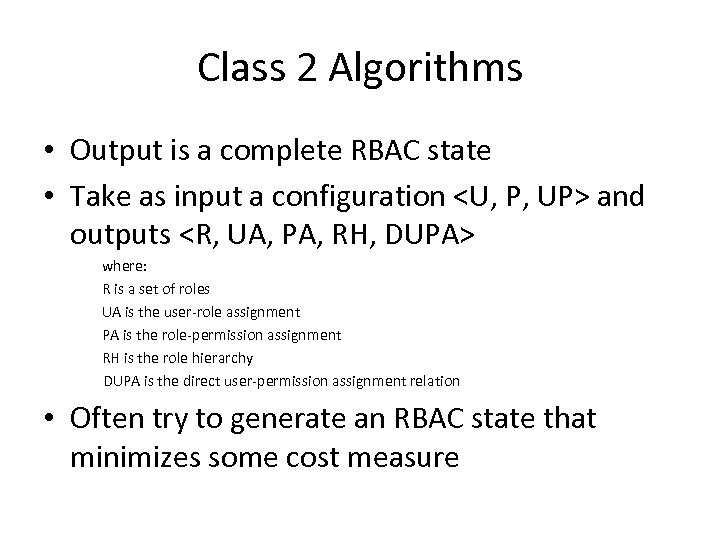 Class 2 Algorithms • Output is a complete RBAC state • Take as input a configuration
 Metrics for Comparing Algorithms • Quality of RBAC states • Prioritized Role Quality
 Input Datasets • Real-world Data • Synthetic Data – Random – Tree-based data generation – ERBAC data generation
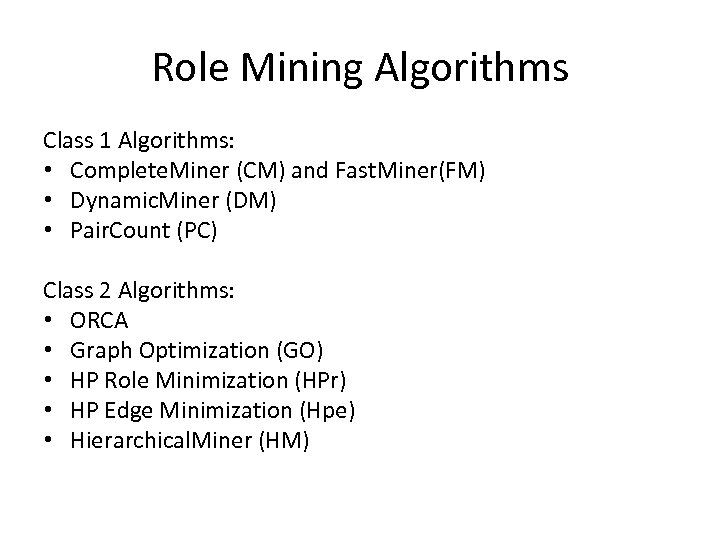 Role Mining Algorithms Class 1 Algorithms: • Complete. Miner (CM) and Fast. Miner(FM) • Dynamic. Miner (DM) • Pair. Count (PC) Class 2 Algorithms: • ORCA • Graph Optimization (GO) • HP Role Minimization (HPr) • HP Edge Minimization (Hpe) • Hierarchical. Miner (HM)
 Algorithm Evaluation Results • HM tended to do the best except in minimizing the number of roles • Synthetic data results largely echoed realworld data • Results indicate that algorithms which strive to minimize the number of roles often generate RBAC states with a larger number of edges.