


 Скачать презентацию Evaluating Primary Sources Javier Ergueta August 2013
10e8d8d8953a56af1bf431f1b30086e3.ppt
- Количество слайдов: 19
 Evaluating Primary Sources Javier Ergueta August, 2013
 Primary evidence • Information related to an event, provided by a contemporary observer – Directly or in recorded form • Contemporary material evidence related to an event – A setting where the event took place – A object present or produced at the event ©J. Ergueta, 2013
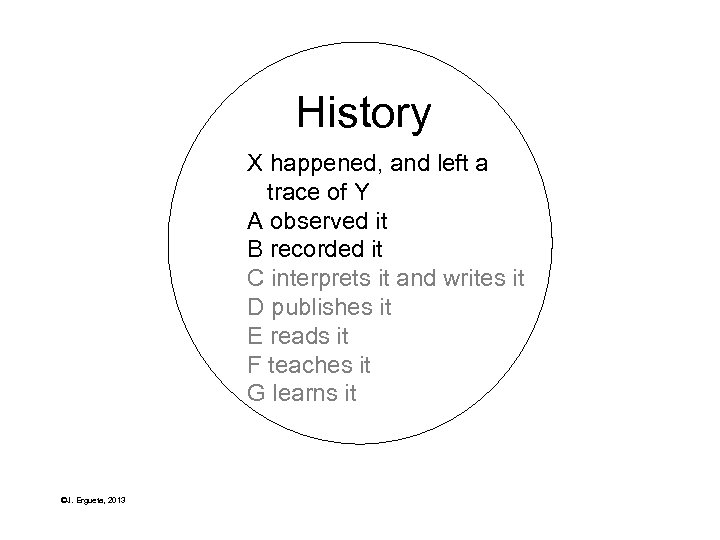 History X happened, and left a trace of Y A observed it B recorded it C interprets it and writes it D publishes it E reads it F teaches it G learns it ©J. Ergueta, 2013
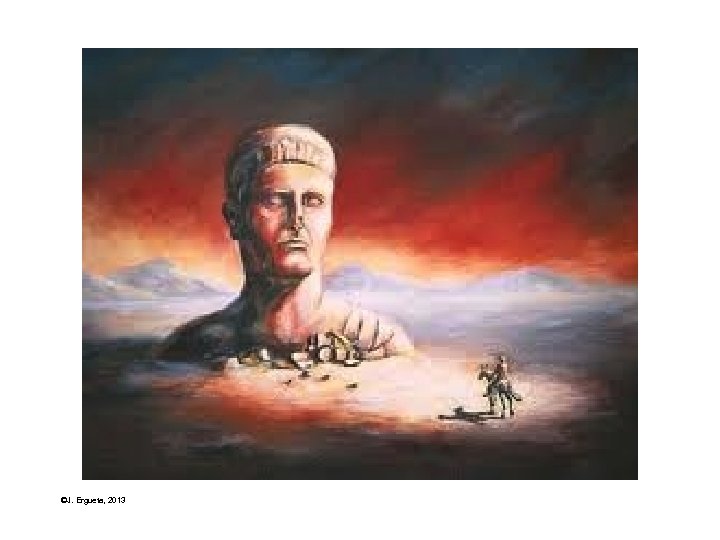
 “Ozymandias” by Percy B. Shelley I met a traveller from an antique land Who said: "Two vast and trunkless legs of stone Stand in the desert. Near them on the sand, Half sunk, a shattered visage lies, whose frown And wrinkled lip and sneer of cold command Tell that its sculptor well those passions read Which yet survive, stamped on these lifeless things, The hand that mocked them and the heart that fed. And on the pedestal these words appear: `My name is Ozymandias, King of Kings: Look on my works, ye mighty, and despair!' Nothing beside remains. Round the decay Of that colossal wreck, boundless and bare, The lone and level sands stretch far away". ©J. Ergueta, 2013
 ©J. Ergueta, 2013
 Types of primary evidence • • • Geographical features Archaelogical remains Biological traces Linguistic patterns Artistic and textual records Oral traditions ©J. Ergueta, 2013
 Evaluating primary sources • They seem to offer evidence that is as close as possible to the event • But one needs to question: – Authenticity: Is the source what it seems to be? – Reliability: Does the source provide solid grounding for one’s area of research? ©J. Ergueta, 2013
 “No opinion can be trusted; even the facts may be nothing but a printer's error. ” – W. C. Williams ©J. Ergueta, 2013
 Authenticity: Is it what it seems? • Internal evidence: – Consistent with known methods & materials of the period? • External evidence: – Probability of its being produced? – Is its production consistent with other events? With known facts? ©J. Ergueta, 2013
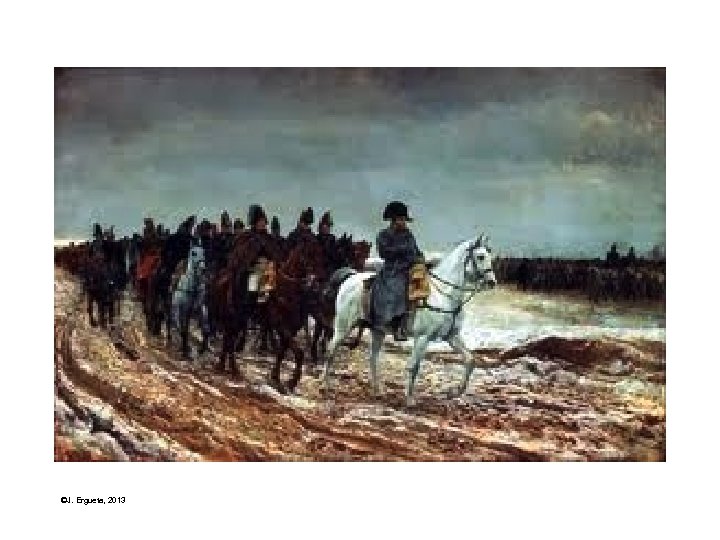
 Metternich’s account of a meeting with Emperor Napoleon, 1813: “Such a man as I does not care a snap of the fingers for the lives of a million men…France has no reason to complain. To spare France, I have sacrificed Germans and Poles. In Russia I lost three hundred thousand men, but only a tenth of them were Frenchmen. ” – Napoleon ©J. Ergueta, 2013
 ©J. Ergueta, 2013
 Notable Historic Frauds • • • The Donation of Constantine Ossian’s poems The Protocols of the Elders of Zion Piltdown Man Hitler’s Diaries ©J. Ergueta, 2013
 Reliability: Does it reflect the truth? • Who produced it? • What role did he play? In a position to know? To care? • What POV or bias is evident? • Is it internally consistent? • Consistent with other documents from period? ©J. Ergueta, 2013
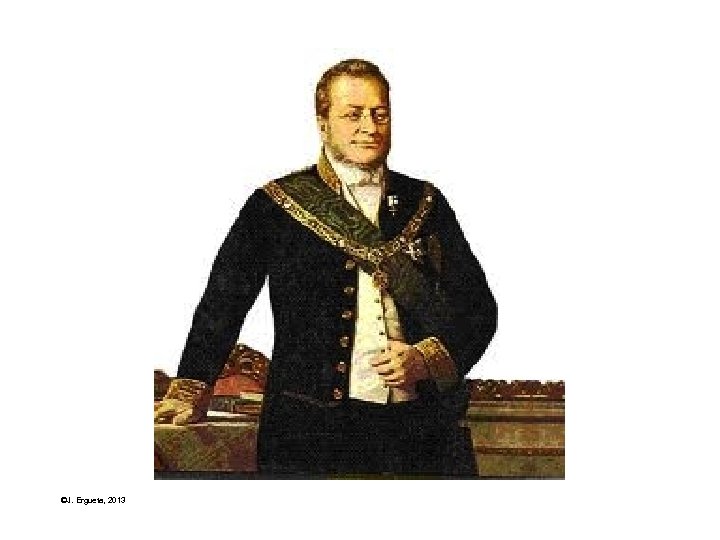
 From a book review by Camillo di Cavour, May, 1846: “A democratic revolution has no chance of success in Italy. Active power resides almost exclusively in the middle class and part of the upper class, both of which groups have ultra-conservative interests to defend. All true friends of the country must therefore reject such means as useless. They must recognize that they cannot truly help their fatherland except by gathering in support of legitimate monarchs who have their roots deep in the national soil. ” ©J. Ergueta, 2013
 ©J. Ergueta, 2013
 ary m Pri rces sou Typical limitations • Takes one perspective, limited by POV • Emotionally involved • Self-interest involved • Caught up in biases of own time ©J. Ergueta, 2013
 Primary sources are by definition close to the event examined and are likely to be very biased. Yet all secondary sources ultimately rely on primary ones, so the proper response to much bias is not to dismiss the source entirely, but rather to treat it appropriately: One needs to corroborate possibly biased information, confirm its accuracy by comparison with other sources. ©J. Ergueta, 2013
 ary m Pri rces sou Typical kinds of value • Contemporary evidence of “who-whatwhere” • Contemporary interpretation of significance and meaning of events • Unique insight into the mind of the observer/recorder ©J. Ergueta, 2013
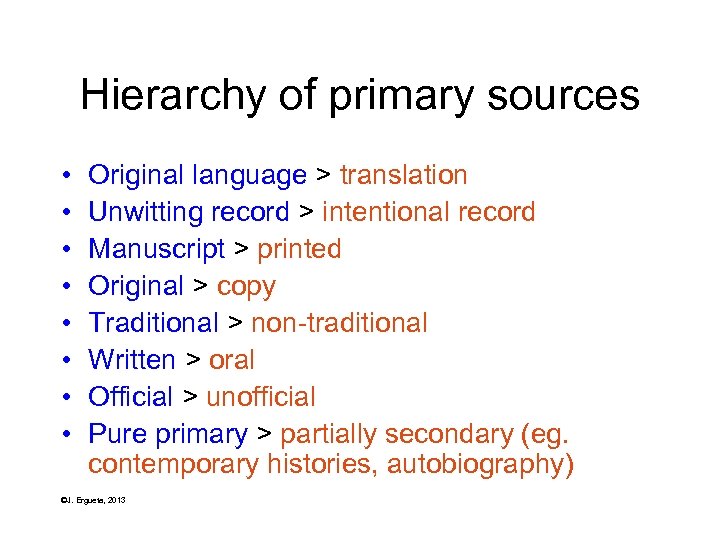 Hierarchy of primary sources • • Original language > translation Unwitting record > intentional record Manuscript > printed Original > copy Traditional > non-traditional Written > oral Official > unofficial Pure primary > partially secondary (eg. contemporary histories, autobiography) ©J. Ergueta, 2013