


 Скачать презентацию Evaluating HRD Programs Effectiveness The degree
1e263cd5aa4906d5a43d29cb587be1a9.ppt
- Количество слайдов: 53
 Evaluating HRD Programs
 Effectiveness • The degree to which a training (or other HRD program) achieves its intended purpose • Measures are relative to some starting point • Measures how well the desired goal is achieved
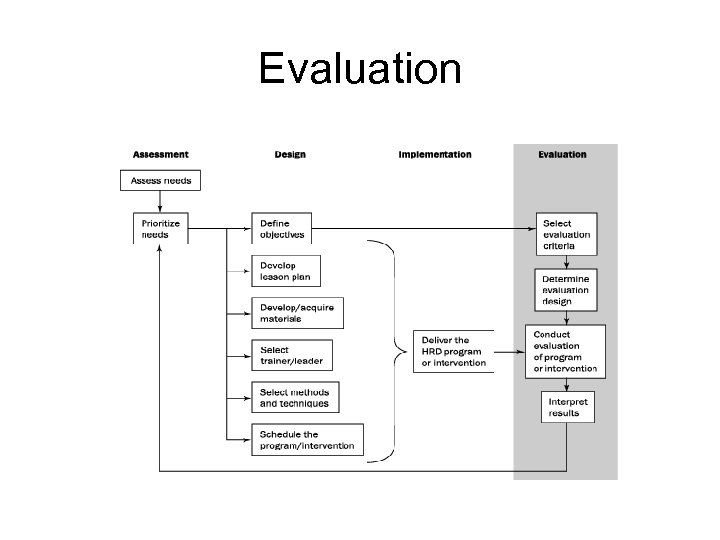 Evaluation
 HRD Evaluation Textbook definition: “The systematic collection of descriptive and judgmental information necessary to make effective training decisions related to the selection, adoption, value, and modification of various instructional activities. ”
 In Other Words… Are we training: • the right people • the right “stuff” • the right way • with the right materials • at the right time?
 Evaluation Needs • Descriptive and judgmental information needed – Objective and subjective data • Information gathered according to a plan and in a desired format • Gathered to provide decision making information
 Purposes of Evaluation • Determine whether the program is meeting the intended objectives • Identify strengths and weaknesses • Determine cost-benefit ratio • Identify who benefited most or least • Determine future participants • Provide information for improving HRD programs
 Purposes of Evaluation – 2 • Reinforce major points to be made • Gather marketing information • Determine if training program is appropriate • Establish management database
 Evaluation Bottom Line • Is HRD a revenue contributor or a revenue user? • Is HRD credible to line and upper-level managers? • Are benefits of HRD readily evident to all?
 How Often are HRD Evaluations Conducted? • Not often enough!!! • Frequently, only end-of-course participant reactions are collected • Transfer to the workplace is evaluated less frequently
 Why HRD Evaluations are Rare • Reluctance to having HRD programs evaluated • Evaluation needs expertise and resources • Factors other than HRD cause performance improvements – e. g. , – Economy – Equipment – Policies, etc.
 Need for HRD Evaluation • Shows the value of HRD • Provides metrics for HRD efficiency • Demonstrates value-added approach for HRD • Demonstrates accountability for HRD activities • Everyone else has it… why not HRD?
 Make or Buy Evaluation • “I bought it, therefore it is good. ” • “Since it’s good, I don’t need to post-test. ” • Who says it’s: – Appropriate? – Effective? – Timely? – Transferable to the workplace?
 Evolution of Evaluation Efforts 1. Anecdotal approach – talk to other users 2. Try before buy – borrow and use samples 3. Analytical approach – match research data to training needs 4. Holistic approach – look at overall HRD process, as well as individual training
 Models and Frameworks of Evaluation • Table 7 -1 lists six frameworks for evaluation • The most popular is that of D. Kirkpatrick: – Reaction – Learning – Job Behavior – Results
 Kirkpatrick’s Four Levels • Reaction – Focus on trainee’s reactions • Learning – Did they learn what they were supposed to? • Job Behavior – Was it used on job? • Results – Did it improve the organization’s effectiveness?
 Issues Concerning Kirkpatrick’s Framework • Most organizations don’t evaluate at all four levels • Focuses only on post-training • Doesn’t treat inter-stage improvements • WHAT ARE YOUR THOUGHTS?
 A Suggested Framework – 1 • Reaction – Did trainees like the training? – Did the training seem useful? • Learning – How much did they learn? • Behavior – What behavior change occurred?
 Suggested Framework – 2 • Results – What were the tangible outcomes? – What was the return on investment (ROI)? – What was the contribution to the organization?
 Data Collection for HRD Evaluation Possible methods: • Interviews • Questionnaires • Direct observation • Written tests • Simulation/Performance tests • Archival performance information
 Interviews Advantages: • Flexible • Opportunity for clarification • Depth possible • Personal contact Limitations: • High reactive effects • High cost • Face-to-face threat potential • Labor intensive • Trained observers needed
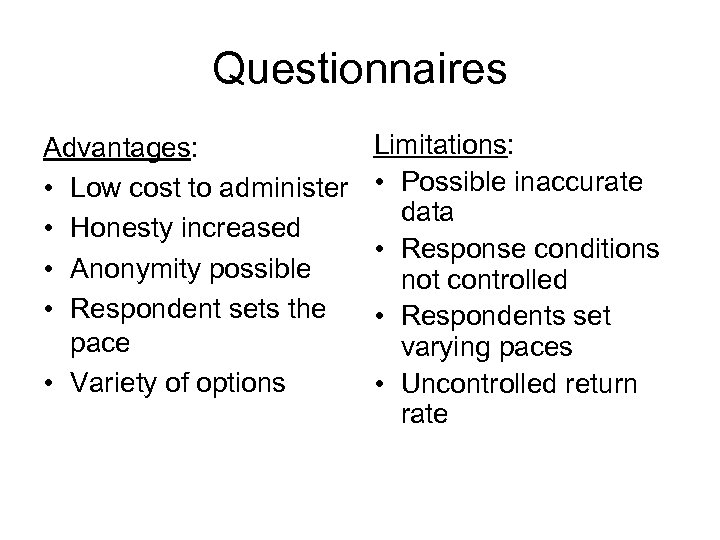 Questionnaires Advantages: • Low cost to administer • Honesty increased • Anonymity possible • Respondent sets the pace • Variety of options Limitations: • Possible inaccurate data • Response conditions not controlled • Respondents set varying paces • Uncontrolled return rate
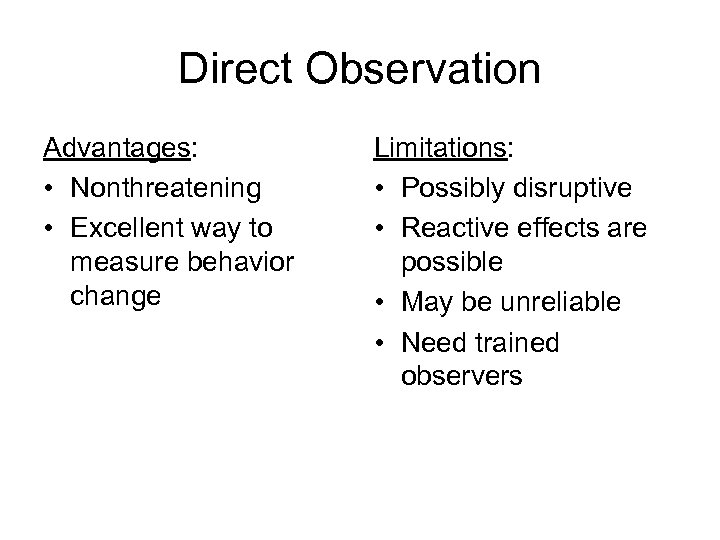 Direct Observation Advantages: • Nonthreatening • Excellent way to measure behavior change Limitations: • Possibly disruptive • Reactive effects are possible • May be unreliable • Need trained observers
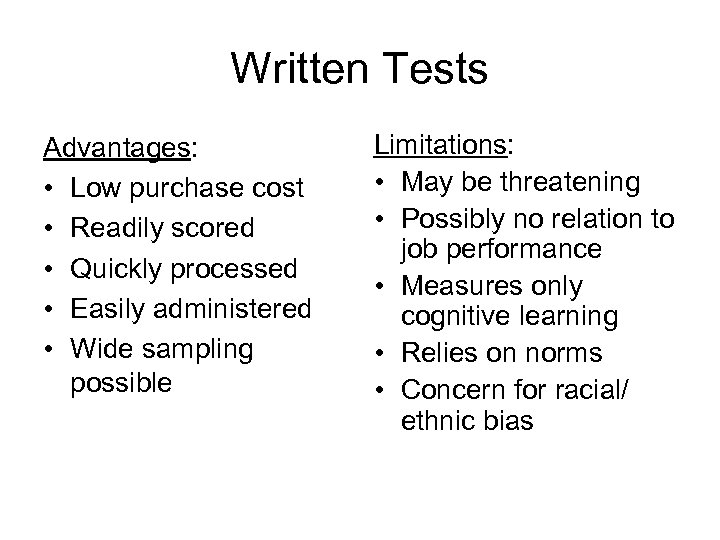 Written Tests Advantages: • Low purchase cost • Readily scored • Quickly processed • Easily administered • Wide sampling possible Limitations: • May be threatening • Possibly no relation to job performance • Measures only cognitive learning • Relies on norms • Concern for racial/ ethnic bias
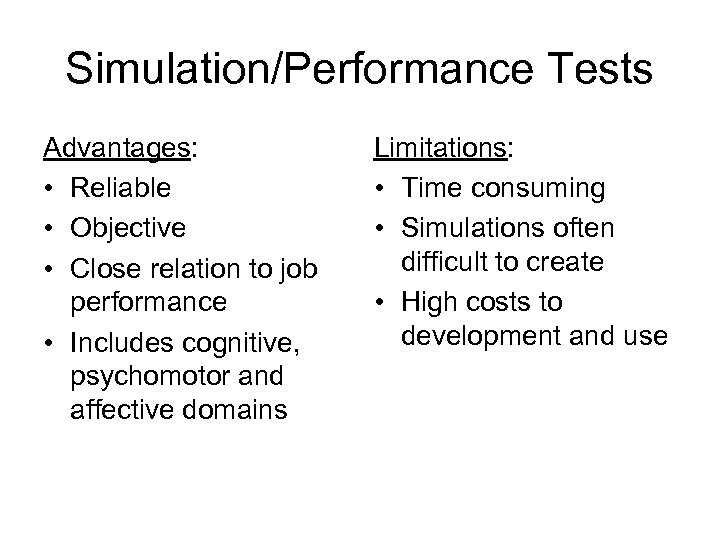 Simulation/Performance Tests Advantages: • Reliable • Objective • Close relation to job performance • Includes cognitive, psychomotor and affective domains Limitations: • Time consuming • Simulations often difficult to create • High costs to development and use
 Archival Performance Data Advantages: • Reliable • Objective • Job-based • Easy to review • Minimal reactive effects Limitations: • Criteria for keeping/ discarding records • Information system discrepancies • Indirect • Not always usable • Records prepared for other purposes
 Choosing Data Collection Methods • Reliability – Consistency of results, and freedom from collection method bias and error • Validity – Does the device measure what we want to measure? • Practicality – Does it make sense in terms of the resources used to get the data?
 Type of Data Used/Needed • Individual performance • Systemwide performance • Economic
 Individual Performance Data • Individual knowledge • Individual behaviors • Examples: – Test scores – Performance quantity, quality, and timeliness – Attendance records – Attitudes
 Systemwide Performance Data • • • Productivity Scrap/rework rates Customer satisfaction levels On-time performance levels Quality rates and improvement rates
 Economic Data • • Profits Product liability claims Avoidance of penalties Market share Competitive position Return on investment (ROI) Financial utility calculations
 Use of Self-Report Data • Most common method • Pre-training and post-training data • Problems: – Mono-method bias • Desire to be consistent between tests – Socially desirable responses – Response Shift Bias: • Trainees adjust expectations to training
 Research Design Specifies in advance: • the expected results of the study • the methods of data collection to be used • how the data will be analyzed
 Research Design Issues • Pretest and Posttest – Shows trainee what training has accomplished – Helps eliminate pretest knowledge bias • Control Group – Compares performance of group with training against the performance of a similar group without training
 Recommended Research Design • Pretest and posttest with control group • Whenever possible: – Randomly assign individuals to the test group and the control group to minimize bias – Use “time-series” approach to data collection to verify performance improvement is due to training
 Ethical Issues Concerning Evaluation Research • • • Confidentiality Informed consent Withholding training from control groups Use of deception Pressure to produce positive results
 Assessing the Impact of HRD • Money is the language of business. • You MUST talk dollars, not HRD jargon. • No one (except maybe you) cares about “the effectiveness of training interventions as measured by and analysis of formal pretest, posttest control group data. ”
 HRD Program Assessment • HRD programs and training are investments • Line managers often see HR and HRD as costs – i. e. , revenue users, not revenue producers • You must prove your worth to the organization – Or you’ll have to find another organization…
 Evaluation of Training Costs • Cost-benefit analysis – Compares cost of training to benefits gained such as attitudes, reduction in accidents, reduction in employee sick-days, etc. • Cost-effectiveness analysis – Focuses on increases in quality, reduction in scrap/rework, productivity, etc.
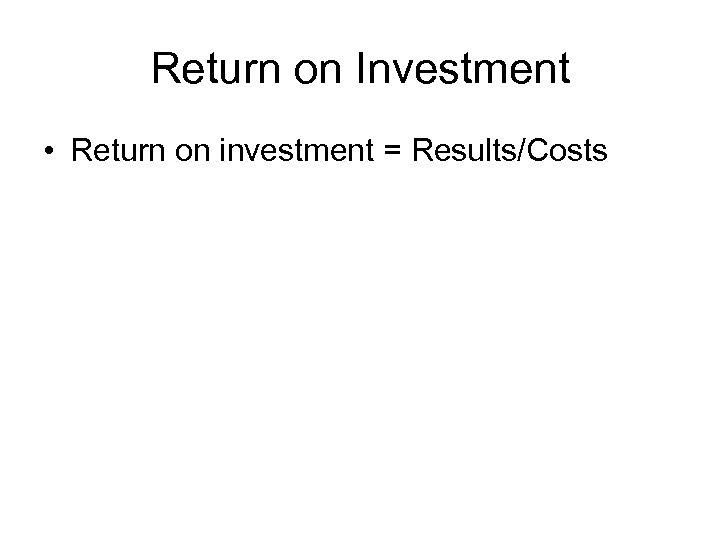 Return on Investment • Return on investment = Results/Costs
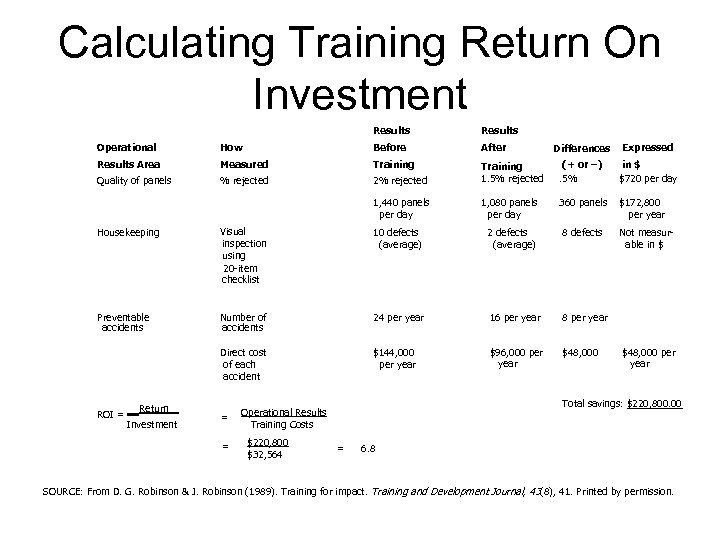 Calculating Training Return On Investment Results Operational How Before After Results Area Measured Training Quality of panels % rejected Housekeeping Visual inspection using 20 -item checklist Differences Expressed 2% rejected Training 1. 5% rejected (+ or –). 5% in $ $720 per day 1, 440 panels per day 1, 080 panels per day 360 panels $172, 800 per year 2 defects (average) 8 defects 10 defects (average) Not measur able in $ Preventable accidents Number of accidents 24 per year 16 per year 8 per year Direct cost of each accident $144, 000 per year $96, 000 per year $48, 000 per year Total savings: $220, 800. 00 ROI = Return Investment = = Operational Results Training Costs $220, 800 $32, 564 = 6. 8 SOURCE: From D. G. Robinson & J. Robinson (1989). Training for impact. Training and Development Journal, 43(8), 41. Printed by permission.
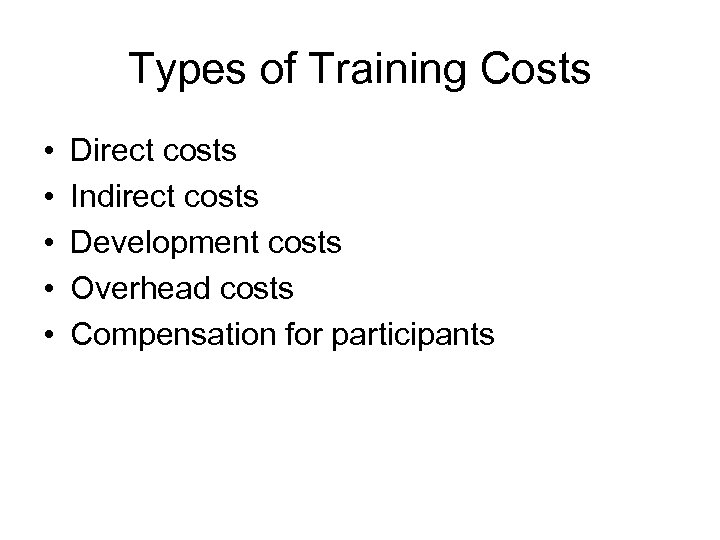 Types of Training Costs • • • Direct costs Indirect costs Development costs Overhead costs Compensation for participants
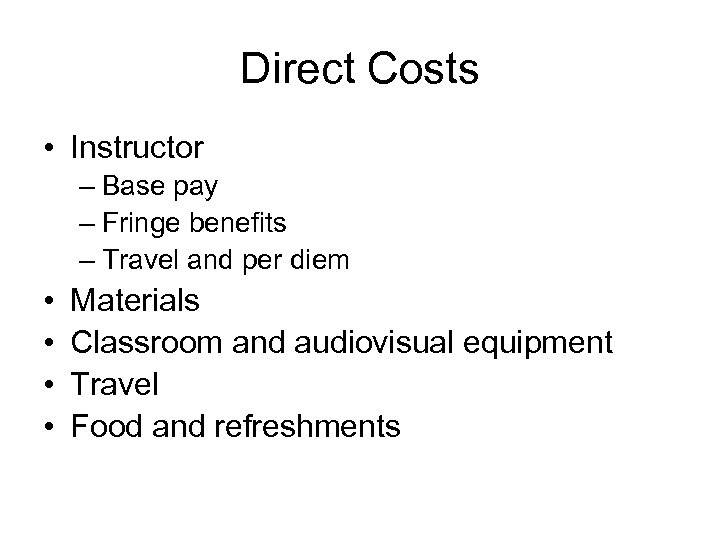 Direct Costs • Instructor – Base pay – Fringe benefits – Travel and per diem • • Materials Classroom and audiovisual equipment Travel Food and refreshments
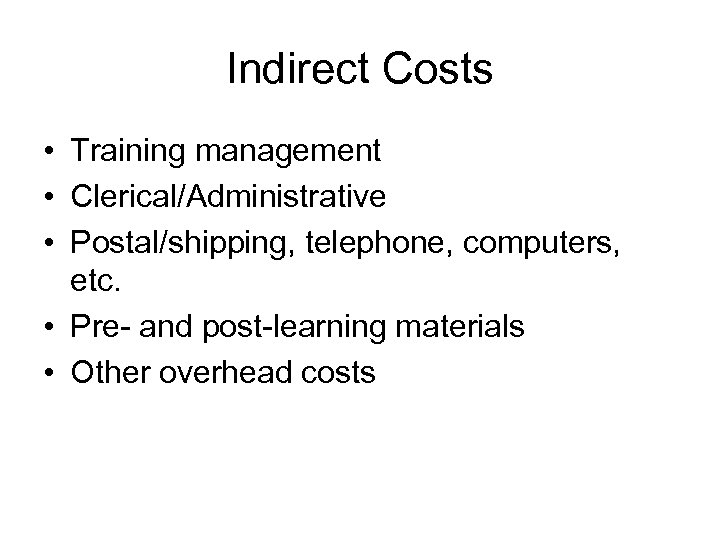 Indirect Costs • Training management • Clerical/Administrative • Postal/shipping, telephone, computers, etc. • Pre- and post-learning materials • Other overhead costs
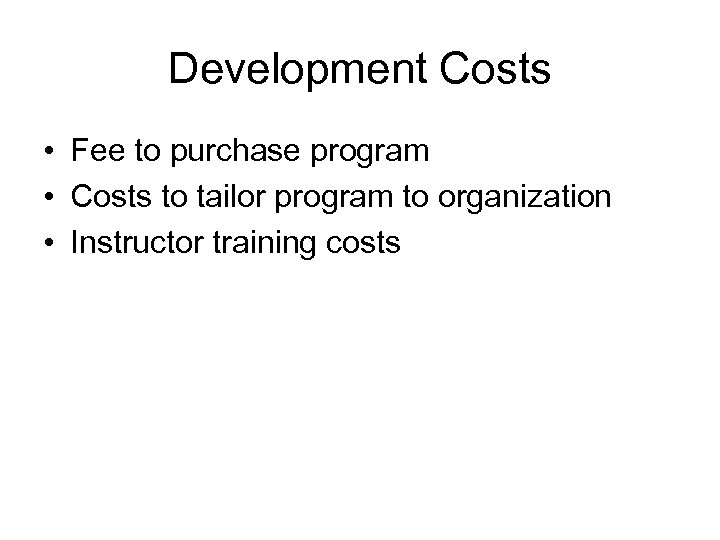 Development Costs • Fee to purchase program • Costs to tailor program to organization • Instructor training costs
 Overhead Costs • • General organization support Top management participation Utilities, facilities General and administrative costs, such as HRM
 Compensation for Participants • Participants’ salary and benefits for time away from job • Travel, lodging, and per-diem costs
 Measuring Benefits – Change in quality per unit measured in dollars – Reduction in scrap/rework measured in dollar cost of labor and materials – Reduction in preventable accidents measured in dollars – ROI = Benefits/Training costs
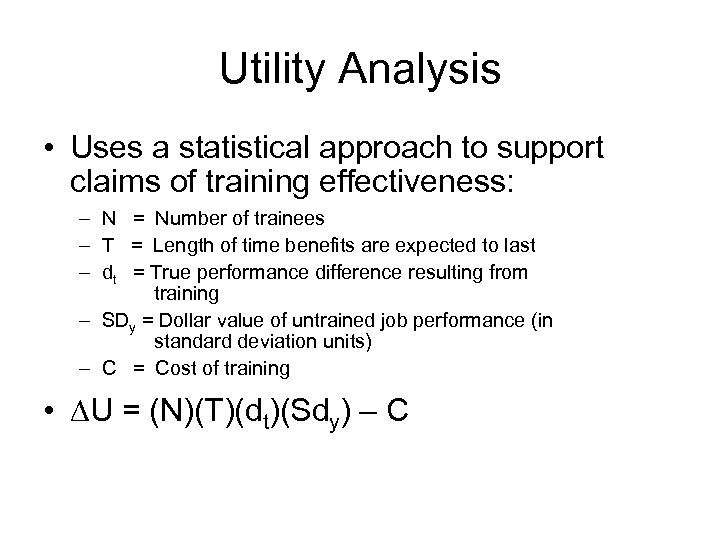 Utility Analysis • Uses a statistical approach to support claims of training effectiveness: – N = Number of trainees – T = Length of time benefits are expected to last – dt = True performance difference resulting from training – SDy = Dollar value of untrained job performance (in standard deviation units) – C = Cost of training • U = (N)(T)(dt)(Sdy) – C
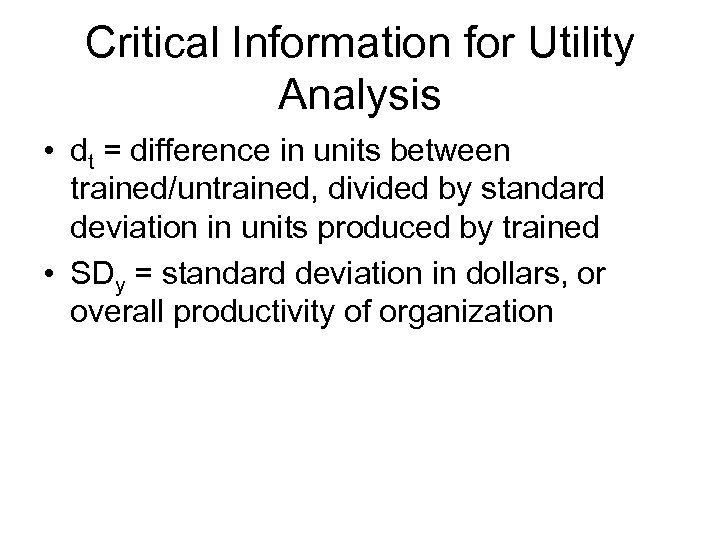 Critical Information for Utility Analysis • dt = difference in units between trained/untrained, divided by standard deviation in units produced by trained • SDy = standard deviation in dollars, or overall productivity of organization
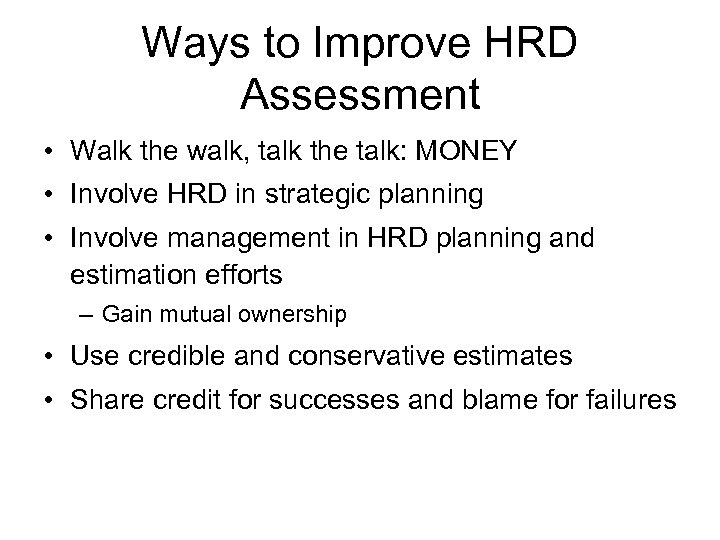 Ways to Improve HRD Assessment • Walk the walk, talk the talk: MONEY • Involve HRD in strategic planning • Involve management in HRD planning and estimation efforts – Gain mutual ownership • Use credible and conservative estimates • Share credit for successes and blame for failures
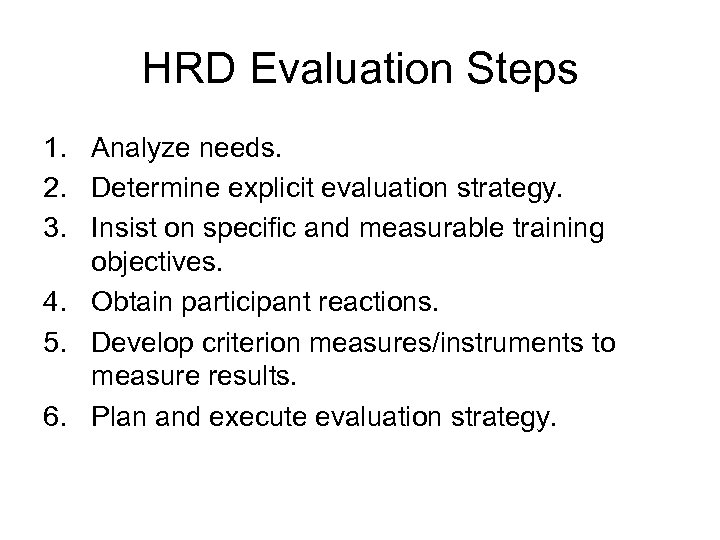 HRD Evaluation Steps 1. Analyze needs. 2. Determine explicit evaluation strategy. 3. Insist on specific and measurable training objectives. 4. Obtain participant reactions. 5. Develop criterion measures/instruments to measure results. 6. Plan and execute evaluation strategy.
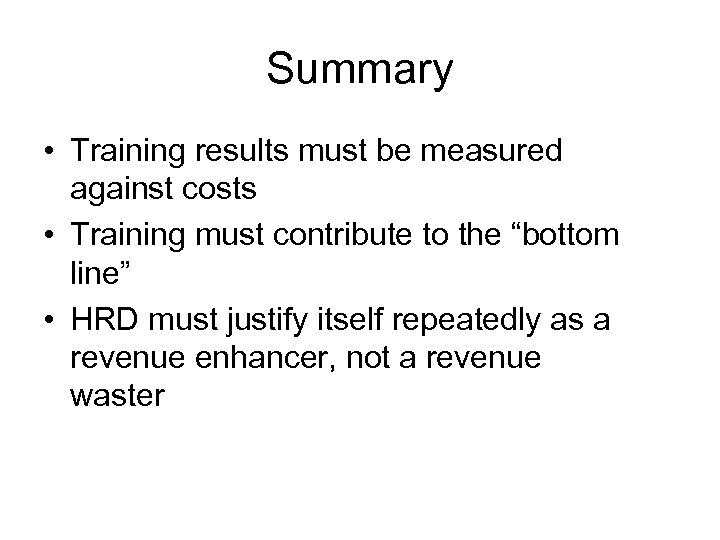 Summary • Training results must be measured against costs • Training must contribute to the “bottom line” • HRD must justify itself repeatedly as a revenue enhancer, not a revenue waster