 Скачать презентацию EUTROPHICATION FUELFIED MINBAY R CHECKED NOVOZHILOVA M
Eutrophication Ринат.pptx
- Количество слайдов: 12



EUTROPHICATION FUELFIED MINBAY R CHECKED NOVOZHILOVA M
PLAN • Introduction • 1. Mechanism of eutrofication • 1. 1 Cultural eutrophication • 1. 2 Lakes and rivers • 1. 3 Natural eutrophication • 1. 4 Ocean waters • 2. Ecological effects
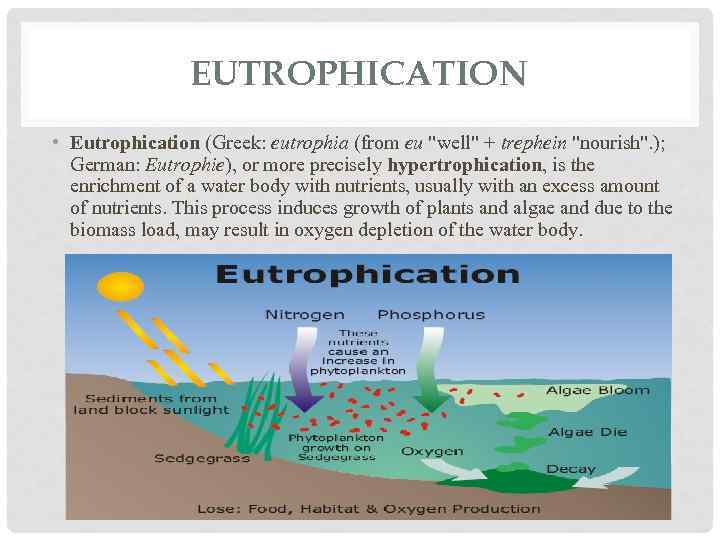
EUTROPHICATION • Eutrophication (Greek: eutrophia (from eu "well" + trephein "nourish". ); German: Eutrophie), or more precisely hypertrophication, is the enrichment of a water body with nutrients, usually with an excess amount of nutrients. This process induces growth of plants and algae and due to the biomass load, may result in oxygen depletion of the water body.
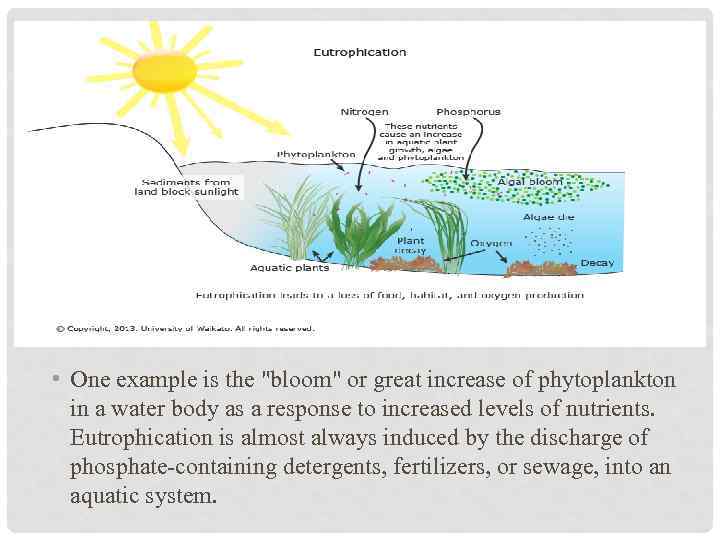
• One example is the "bloom" or great increase of phytoplankton in a water body as a response to increased levels of nutrients. Eutrophication is almost always induced by the discharge of phosphate-containing detergents, fertilizers, or sewage, into an aquatic system.
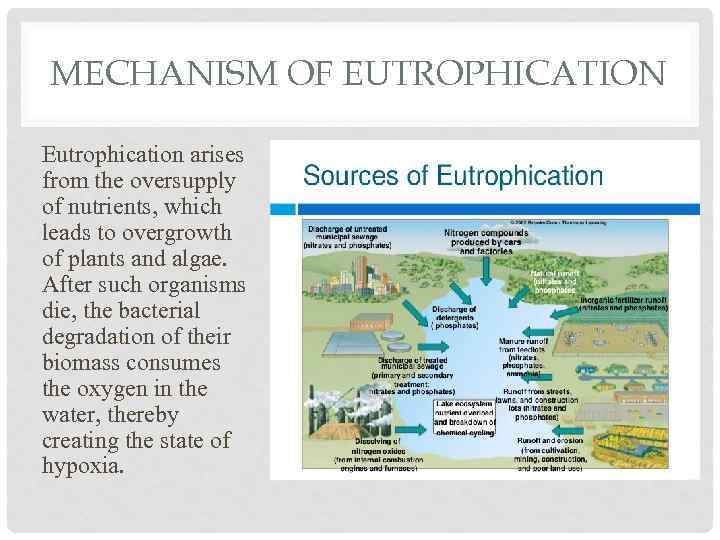
MECHANISM OF EUTROPHICATION Eutrophication arises from the oversupply of nutrients, which leads to overgrowth of plants and algae. After such organisms die, the bacterial degradation of their biomass consumes the oxygen in the water, thereby creating the state of hypoxia.
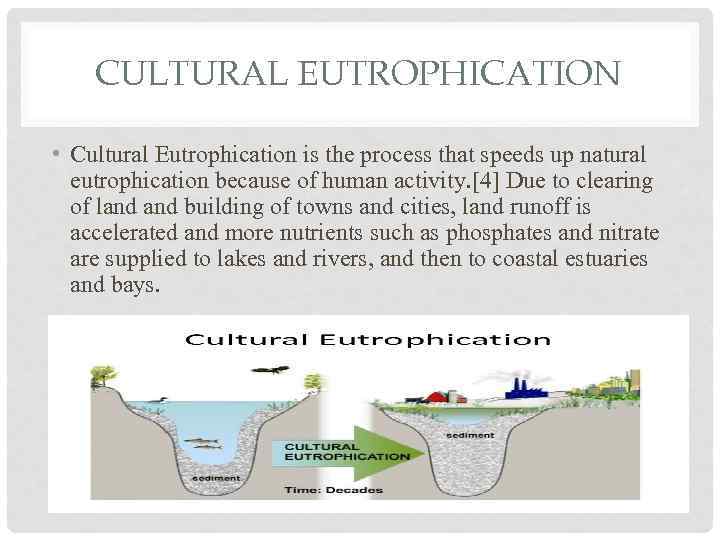
CULTURAL EUTROPHICATION • Cultural Eutrophication is the process that speeds up natural eutrophication because of human activity. [4] Due to clearing of land building of towns and cities, land runoff is accelerated and more nutrients such as phosphates and nitrate are supplied to lakes and rivers, and then to coastal estuaries and bays.
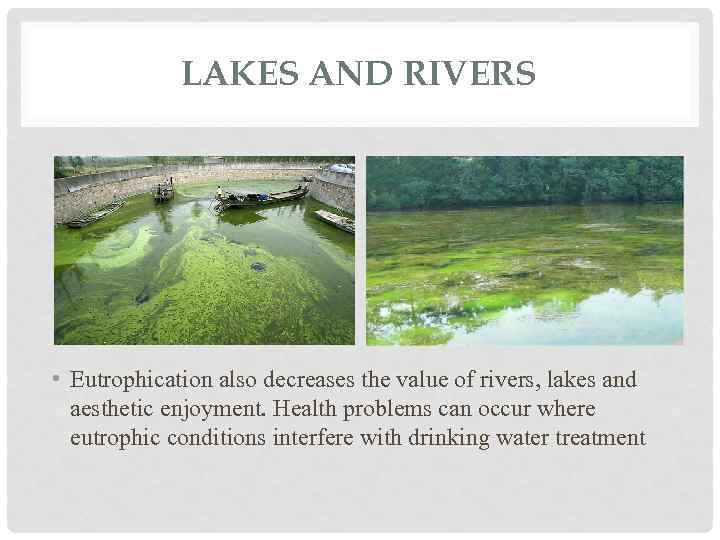
LAKES AND RIVERS • Eutrophication also decreases the value of rivers, lakes and aesthetic enjoyment. Health problems can occur where eutrophic conditions interfere with drinking water treatment
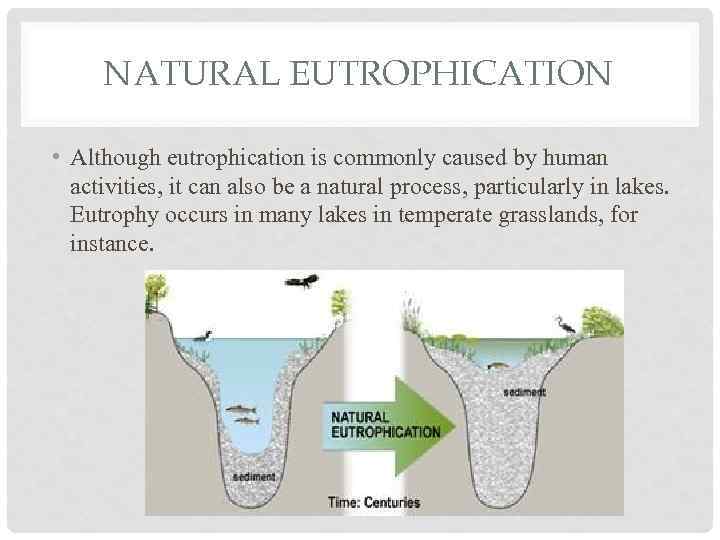
NATURAL EUTROPHICATION • Although eutrophication is commonly caused by human activities, it can also be a natural process, particularly in lakes. Eutrophy occurs in many lakes in temperate grasslands, for instance.
• Some lakes also demonstrate the reverse process (meiotrophication), becoming less nutrient rich with time.
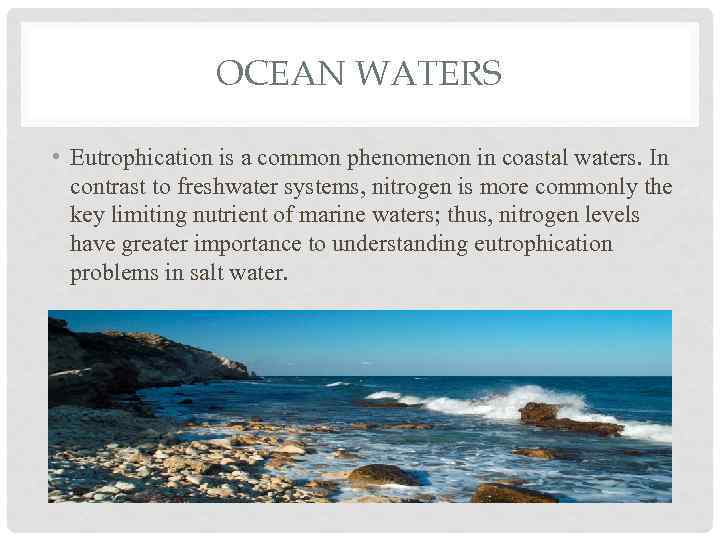
OCEAN WATERS • Eutrophication is a common phenomenon in coastal waters. In contrast to freshwater systems, nitrogen is more commonly the key limiting nutrient of marine waters; thus, nitrogen levels have greater importance to understanding eutrophication problems in salt water.
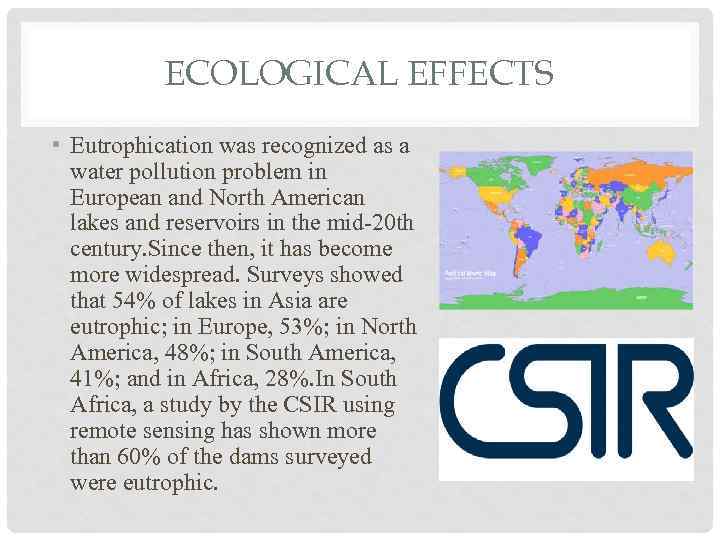
ECOLOGICAL EFFECTS • Eutrophication was recognized as a water pollution problem in European and North American lakes and reservoirs in the mid-20 th century. Since then, it has become more widespread. Surveys showed that 54% of lakes in Asia are eutrophic; in Europe, 53%; in North America, 48%; in South America, 41%; and in Africa, 28%. In South Africa, a study by the CSIR using remote sensing has shown more than 60% of the dams surveyed were eutrophic.
CONCLUSION • New species invasion • Eutrophication may cause competitive release by making abundant a normally limiting nutrient. This process causes shifts in the species composition of ecosystems. For instance, an increase in nitrogen might allow new, competitive species to invade and out-compete original inhabitant species. This has been shown to occur in New England salt marshes. In Europe and Asia, the common carp frequently lives in naturally Eutrophic or Hypereutrophic areas, and is adapted to living in such conditions. The eutrophication of areas outside its natural range partially explain the fish's success in colonising these areas after being introduced.
Скачать презентацию EUTROPHICATION FUELFIED MINBAY R CHECKED NOVOZHILOVA M
Eutrophication Ринат.pptx