


EUROPIAN UNION Kolbas Dmitriy
The EU is a unique economic and political partnership between 27 European countries that together cover much of the continent. It was created in the aftermath of the Second World War. The first steps were to foster economic cooperation: the idea being that countries who trade with one another become economically interdependent and so more likely to avoid conflict. The result was the European Economic Community (EEC), created in 1958, and initially increasing economic cooperation between six countries: Belgium, Germany, France, Italy, Luxembourg and the Netherlands. Since then, a huge single market has been created and continues to develop towards its full potential.
The EU has delivered half a century of peace, stability, and prosperity, helped raise living standards, and launched a single European currency. Thanks to the abolition of border controls between EU countries, people can travel freely throughout most of the continent. And it's also become much easier to live and work abroad in Europe. The EU is based on the rule of law. This means that everything that it does is founded on treaties, voluntarily and democratically agreed by all member countries. These binding agreements set out the EU's goals in its many areas of activity.
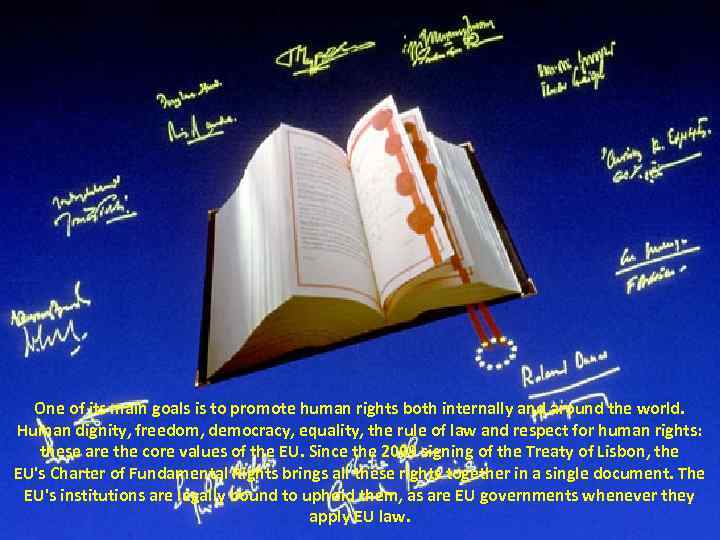
One of its main goals is to promote human rights both internally and around the world. Human dignity, freedom, democracy, equality, the rule of law and respect for human rights: these are the core values of the EU. Since the 2009 signing of the Treaty of Lisbon, the EU's Charter of Fundamental Rights brings all these rights together in a single document. The EU's institutions are legally bound to uphold them, as are EU governments whenever they apply EU law.
The single market is the EU's main economic engine, enabling most goods, services, money and people to move freely. Another key objective is to develop this huge resource to ensure that Europeans can draw the maximum benefit. As it continues to grow, the EU remains focused on making its governing institutions more transparent and democratic. More powers are being given to the directly elected European Parliament, while national parliaments are being given a greater role, working alongside the European institutions. In turn, European citizens have an ever-increasing number of channels for taking part in the political process.
Since 1991, when Ukraine gained independence, the European Union and Ukraine have developed an increasingly dynamic relationship. Ukraine is a priority partner country within the European Neighbourhood Policy (ENP) and the Eastern Partnership. The current legal framework for EU-Ukraine relations is provided by the Partnership and Co-operation Agreement (PCA). The ambitions of both the EU and Ukraine to enhance their relationship created an opportunity to move beyond cooperation towards gradual economic integration and deepening political association.
Univers ity No automatic recognition. There is no automatic EU-wide recognition of academic diplomas. You may therefore need to go through a national procedure to get your academic degree or diploma recognised in another EU country, if you seek admission to a further course of study there. If you already know that you will eventually want to pursue further studies in a different country, check before you start whether your diploma will be recognised there.
Tra ine If you are in vocational education or training, or have just finished your training, and want to develop your job skills and employability through a traineeship abroad, the EU's 'Leonardo da Vinci' programme may provide financial support. esh ips
? es the EU do What do The European Union acts in a wide range of policy areas where its action is beneficial to the member states. These include: • innovation policies, which bring state-oftheart technologies to fields such as environmental protection, research and development (R & D) and energy; • solidarity policies (also known as cohesion policies) in regional, agricultural and social affairs. The Union funds these policies through an annual budget which enables it to complement and add value to action taken by national governments. The EU budget is small by comparison with the collective wealth of its member states: it represents no more than 1. 23 % of their combined gross national income.
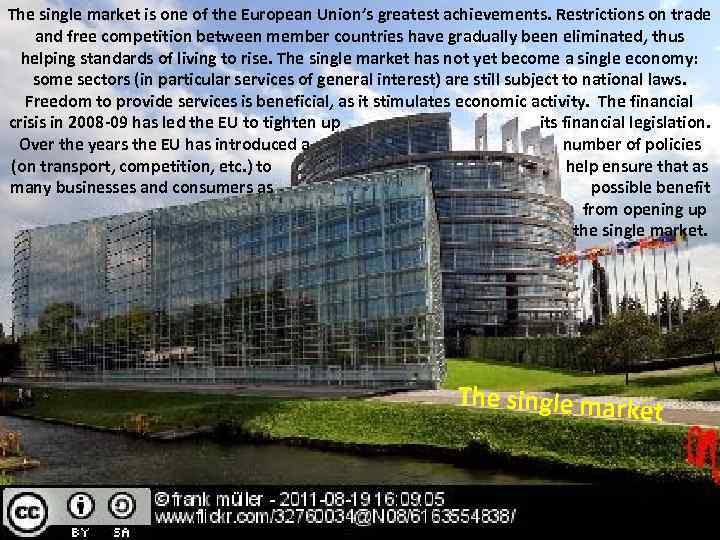
The single market is one of the European Union’s greatest achievements. Restrictions on trade and free competition between member countries have gradually been eliminated, thus helping standards of living to rise. The single market has not yet become a single economy: some sectors (in particular services of general interest) are still subject to national laws. Freedom to provide services is beneficial, as it stimulates economic activity. The financial crisis in 2008 -09 has led the EU to tighten up its financial legislation. Over the years the EU has introduced a number of policies (on transport, competition, etc. ) to help ensure that as many businesses and consumers as possible benefit from opening up the single market. The single mark et
