


 Скачать презентацию European Union has legal personality Art 47 TEU
EU Presentation 2011 english.pptx
- Количество слайдов: 79
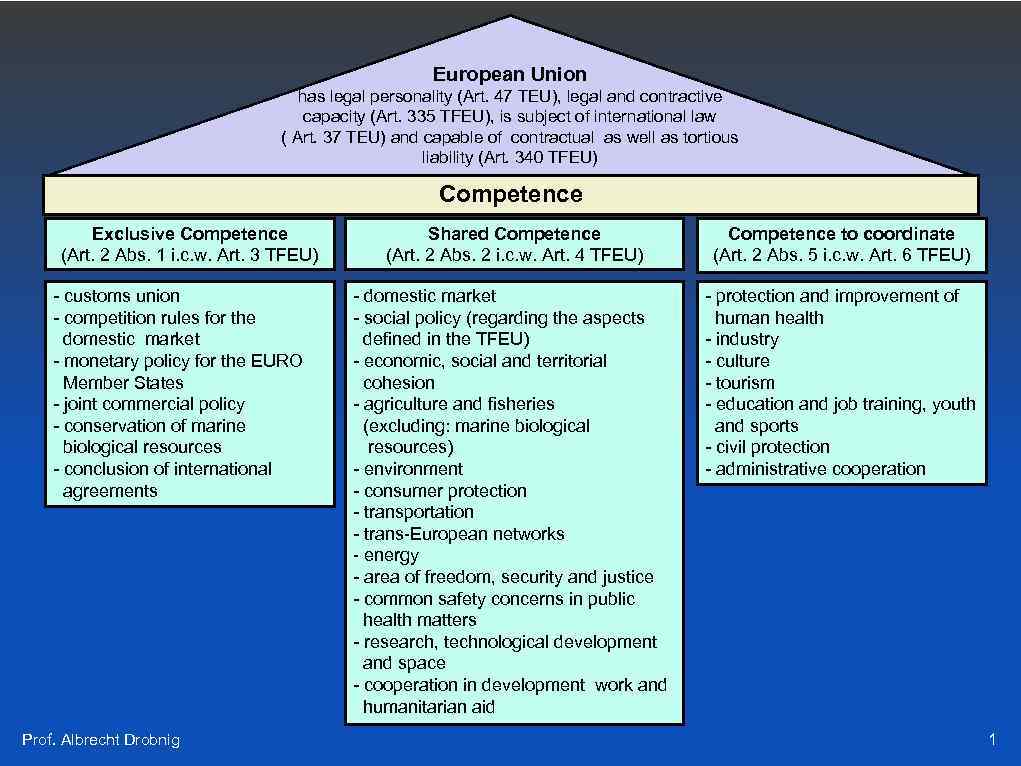 European Union has legal personality (Art. 47 TEU), legal and contractive capacity (Art. 335 TFEU), is subject of international law ( Art. 37 TEU) and capable of contractual as well as tortious liability (Art. 340 TFEU) Competence Exclusive Competence (Art. 2 Abs. 1 i. c. w. Art. 3 TFEU) - customs union - competition rules for the domestic market - monetary policy for the EURO Member States - joint commercial policy - conservation of marine biological resources - conclusion of international agreements Prof. Albrecht Drobnig Shared Competence (Art. 2 Abs. 2 i. c. w. Art. 4 TFEU) Competence to coordinate (Art. 2 Abs. 5 i. c. w. Art. 6 TFEU) - domestic market - social policy (regarding the aspects defined in the TFEU) - economic, social and territorial cohesion - agriculture and fisheries (excluding: marine biological resources) - environment - consumer protection - transportation - trans-European networks - energy - area of freedom, security and justice - common safety concerns in public health matters - research, technological development and space - cooperation in development work and humanitarian aid - protection and improvement of human health - industry - culture - tourism - education and job training, youth and sports - civil protection - administrative cooperation 1
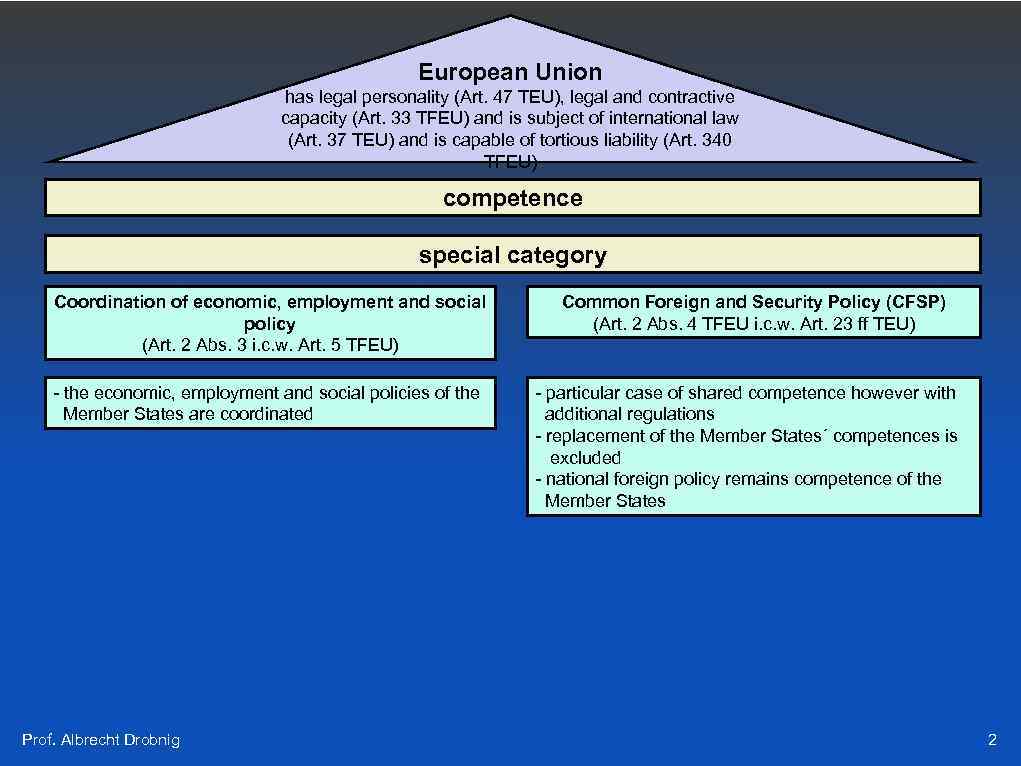 European Union has legal personality (Art. 47 TEU), legal and contractive capacity (Art. 33 TFEU) and is subject of international law (Art. 37 TEU) and is capable of tortious liability (Art. 340 TFEU) competence special category Coordination of economic, employment and social policy (Art. 2 Abs. 3 i. c. w. Art. 5 TFEU) - the economic, employment and social policies of the Member States are coordinated Prof. Albrecht Drobnig Common Foreign and Security Policy (CFSP) (Art. 2 Abs. 4 TFEU i. c. w. Art. 23 ff TEU) - particular case of shared competence however with additional regulations - replacement of the Member States´ competences is excluded - national foreign policy remains competence of the Member States 2
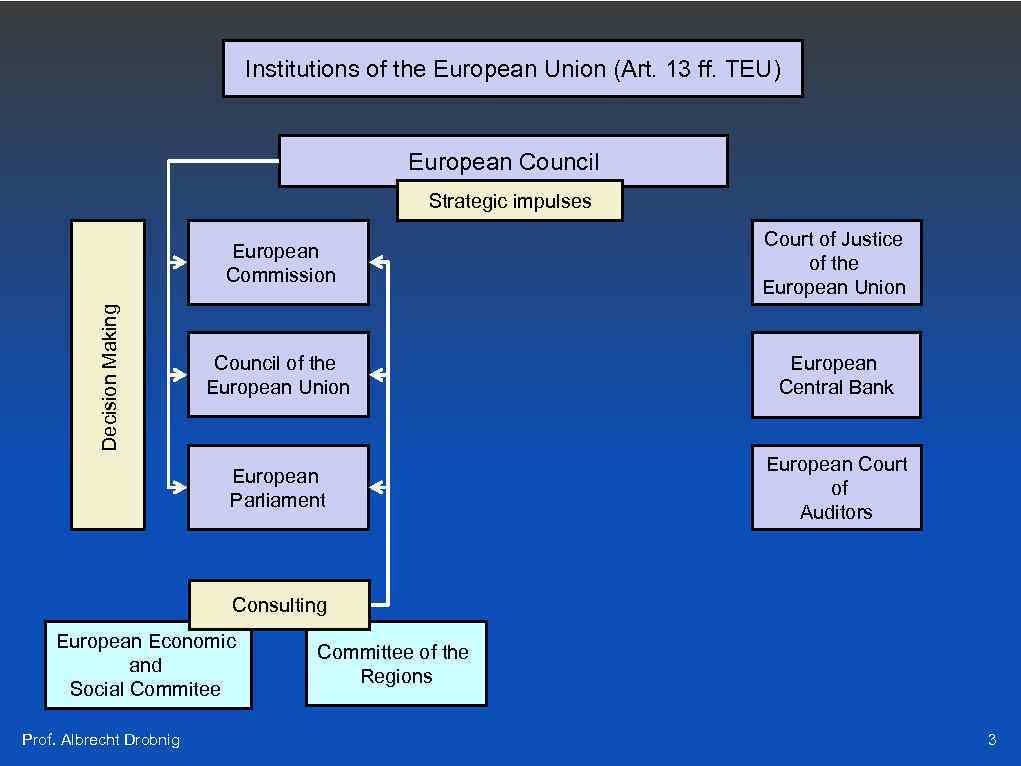 Institutions of the European Union (Art. 13 ff. TEU) European Council Strategic impulses Court of Justice of the European Union Council of the European Union European Central Bank European Parliament Decision Making European Commission European Court of Auditors Consulting European Economic and Social Commitee Prof. Albrecht Drobnig Committee of the Regions 3
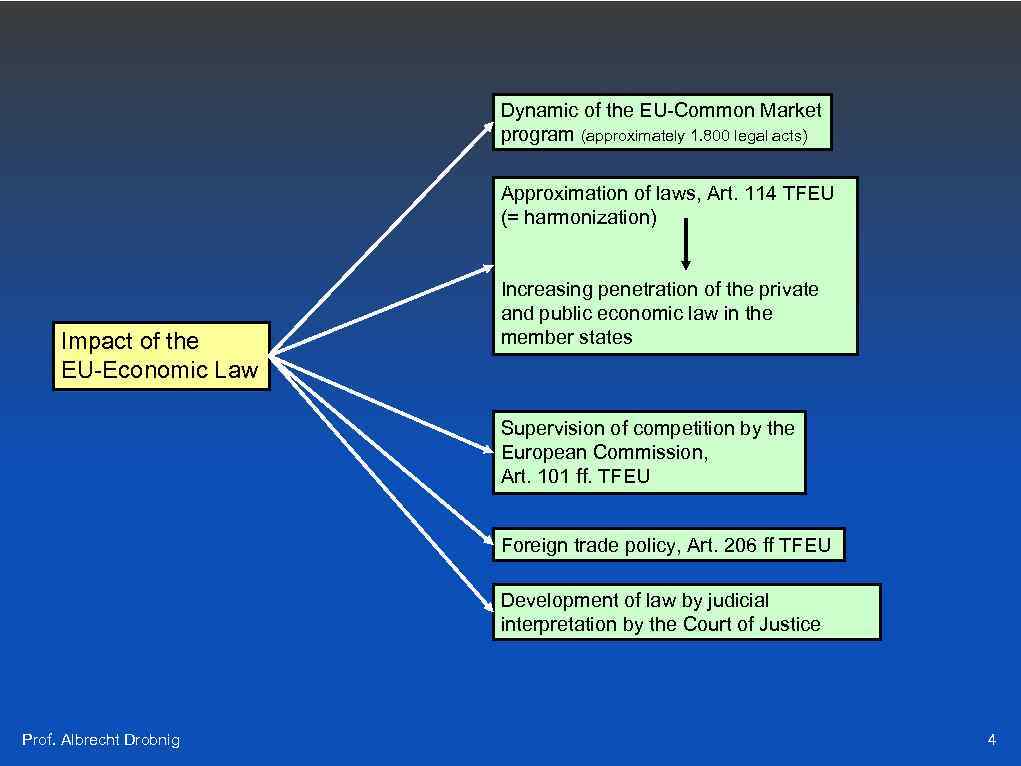 Dynamic of the EU-Common Market program (approximately 1. 800 legal acts) Approximation of laws, Art. 114 TFEU (= harmonization) Impact of the EU-Economic Law Increasing penetration of the private and public economic law in the member states Supervision of competition by the European Commission, Art. 101 ff. TFEU Foreign trade policy, Art. 206 ff TFEU Development of law by judicial interpretation by the Court of Justice Prof. Albrecht Drobnig 4
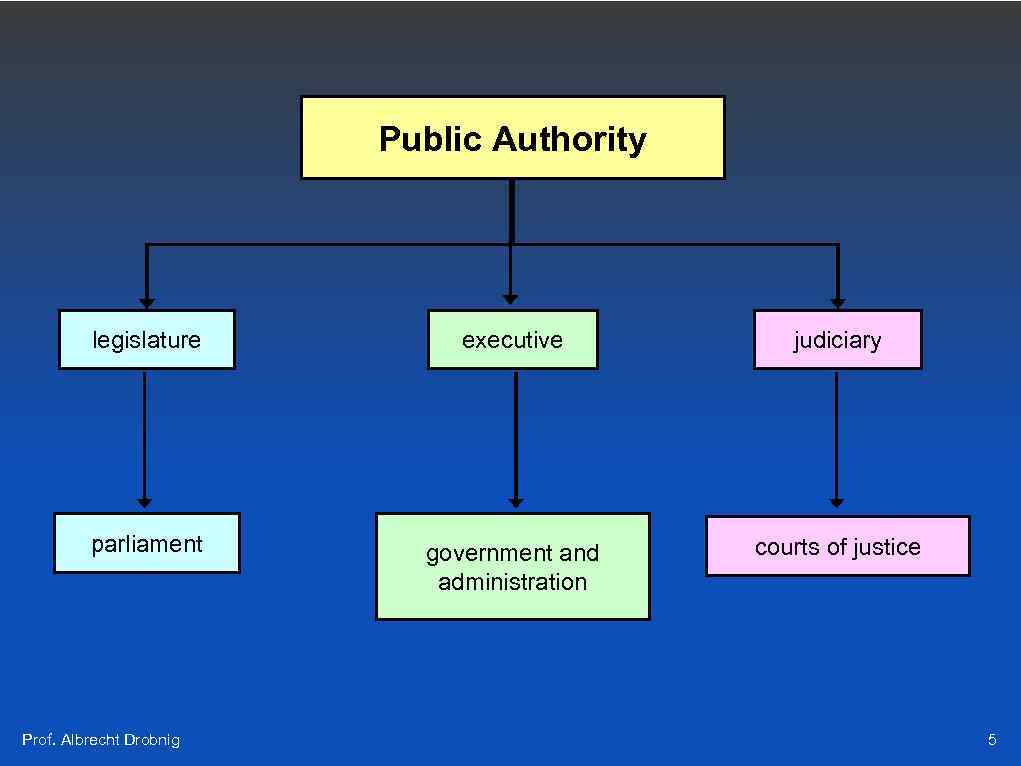 Public Authority legislature executive judiciary parliament government and administration courts of justice Prof. Albrecht Drobnig 5
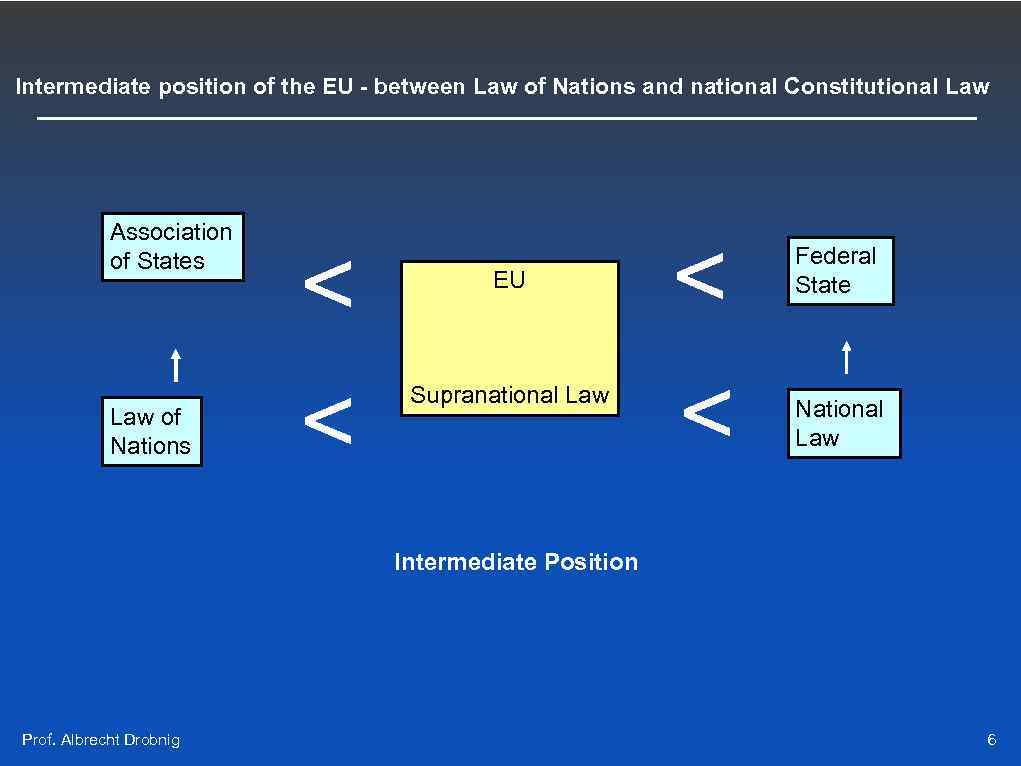 Intermediate position of the EU - between Law of Nations and national Constitutional Law Association of States Law of Nations < < EU Supranational Law < < Federal State National Law Intermediate Position Prof. Albrecht Drobnig 6
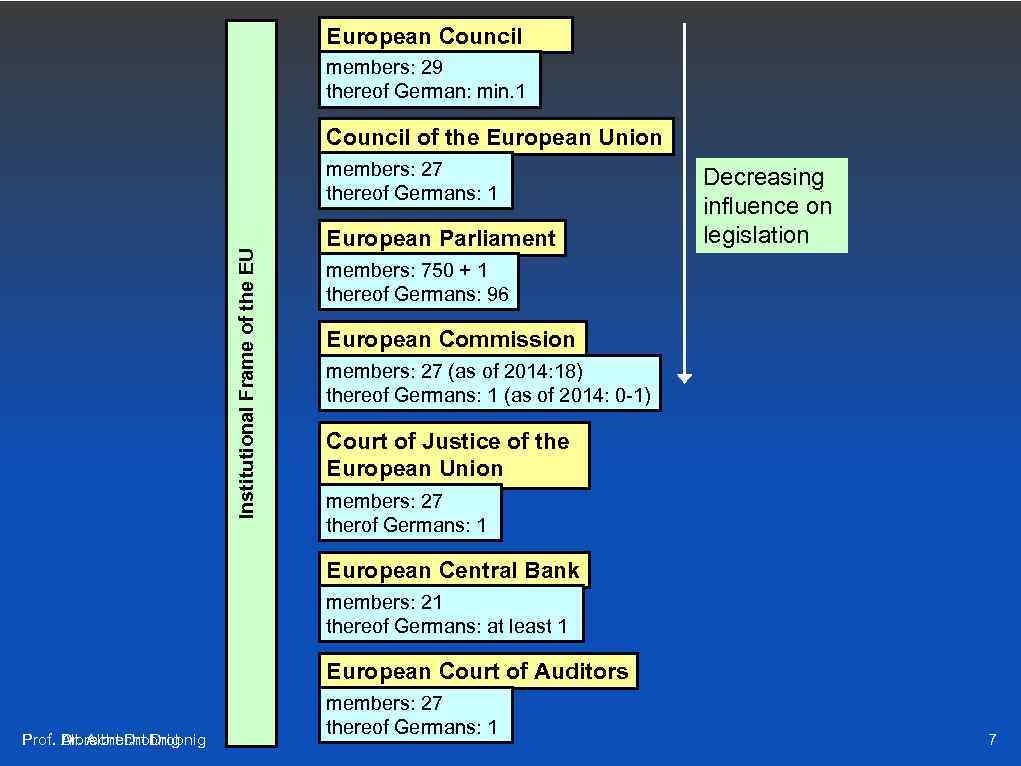 European Council members: 29 thereof German: min. 1 Council of the European Union Institutional Frame of the EU members: 27 thereof Germans: 1 European Parliament Decreasing influence on legislation members: 750 + 1 thereof Germans: 96 European Commission members: 27 (as of 2014: 18) thereof Germans: 1 (as of 2014: 0 -1) Court of Justice of the European Union members: 27 therof Germans: 1 European Central Bank members: 21 thereof Germans: at least 1 European Court of Auditors Prof. Albrecht Drobnig Prof. Dr. Albrecht Drobnig members: 27 thereof Germans: 1 7
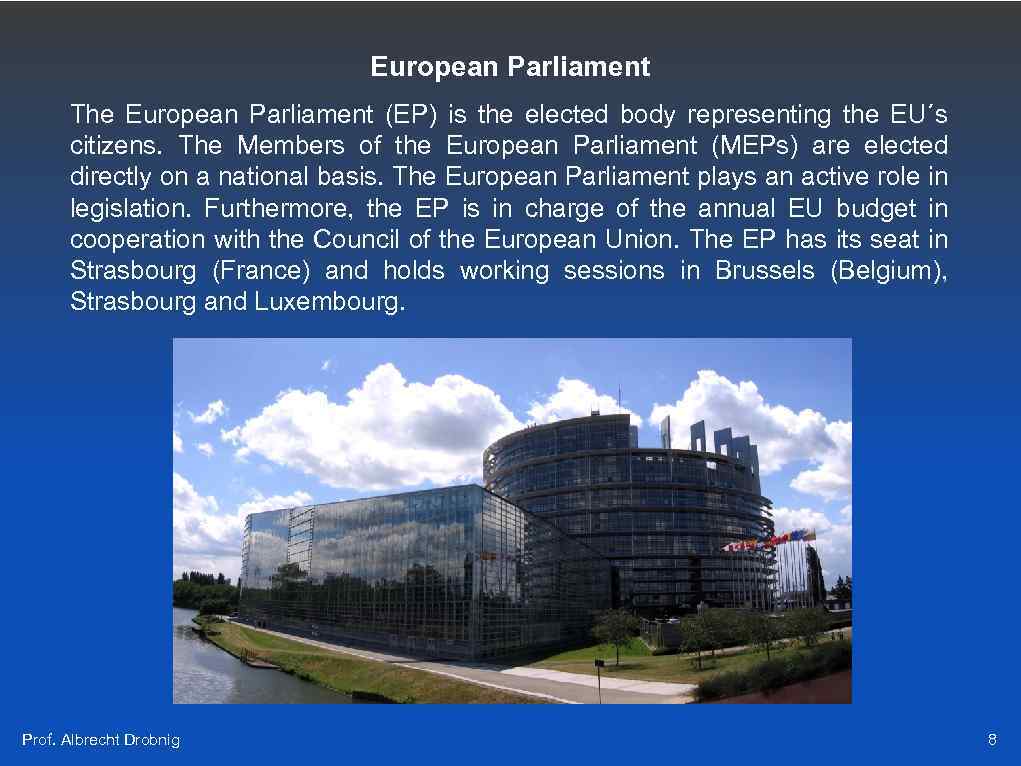 European Parliament The European Parliament (EP) is the elected body representing the EU´s citizens. The Members of the European Parliament (MEPs) are elected directly on a national basis. The European Parliament plays an active role in legislation. Furthermore, the EP is in charge of the annual EU budget in cooperation with the Council of the European Union. The EP has its seat in Strasbourg (France) and holds working sessions in Brussels (Belgium), Strasbourg and Luxembourg. Prof. Albrecht Drobnig 8
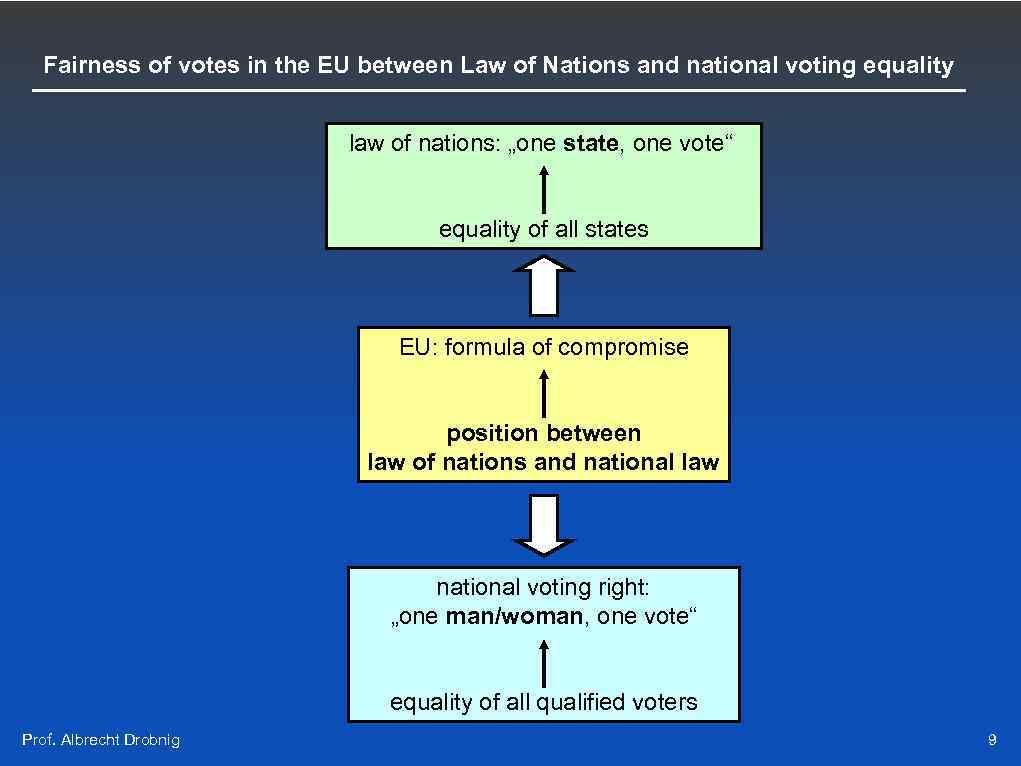 Fairness of votes in the EU between Law of Nations and national voting equality law of nations: „one state, one vote“ equality of all states EU: formula of compromise position between law of nations and national law national voting right: „one man/woman, one vote“ equality of all qualified voters Prof. Albrecht Drobnig 9
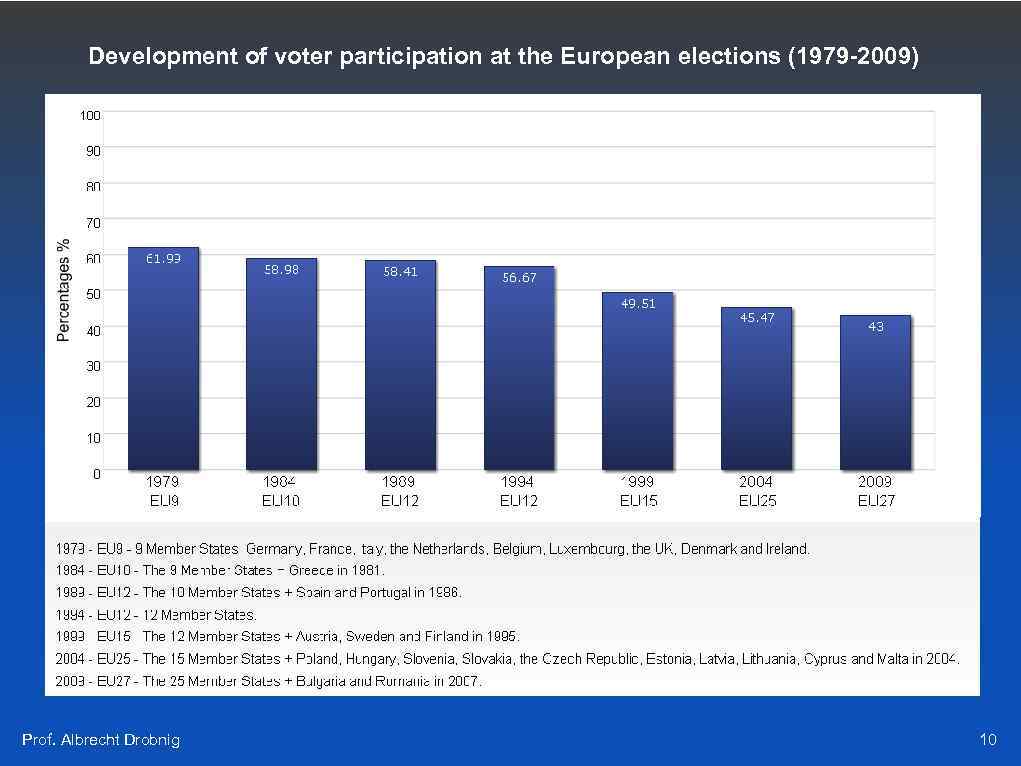 Development of voter participation at the European elections (1979 -2009) Prof. Albrecht Drobnig 10
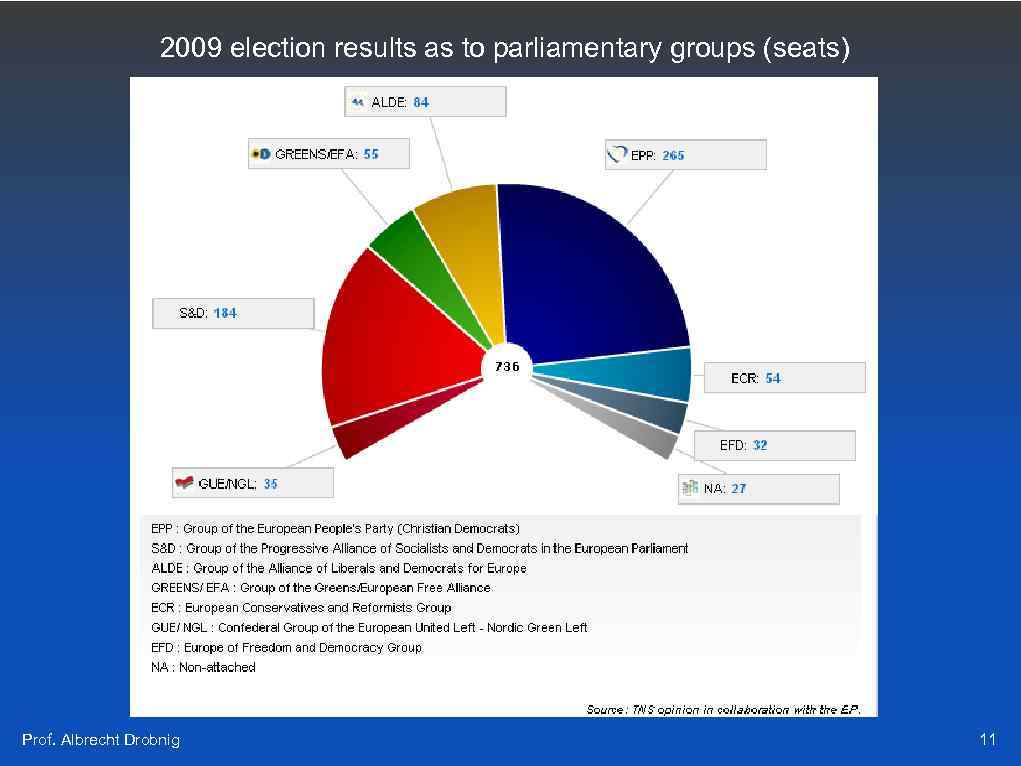 2009 election results as to parliamentary groups (seats) Prof. Albrecht Drobnig 11
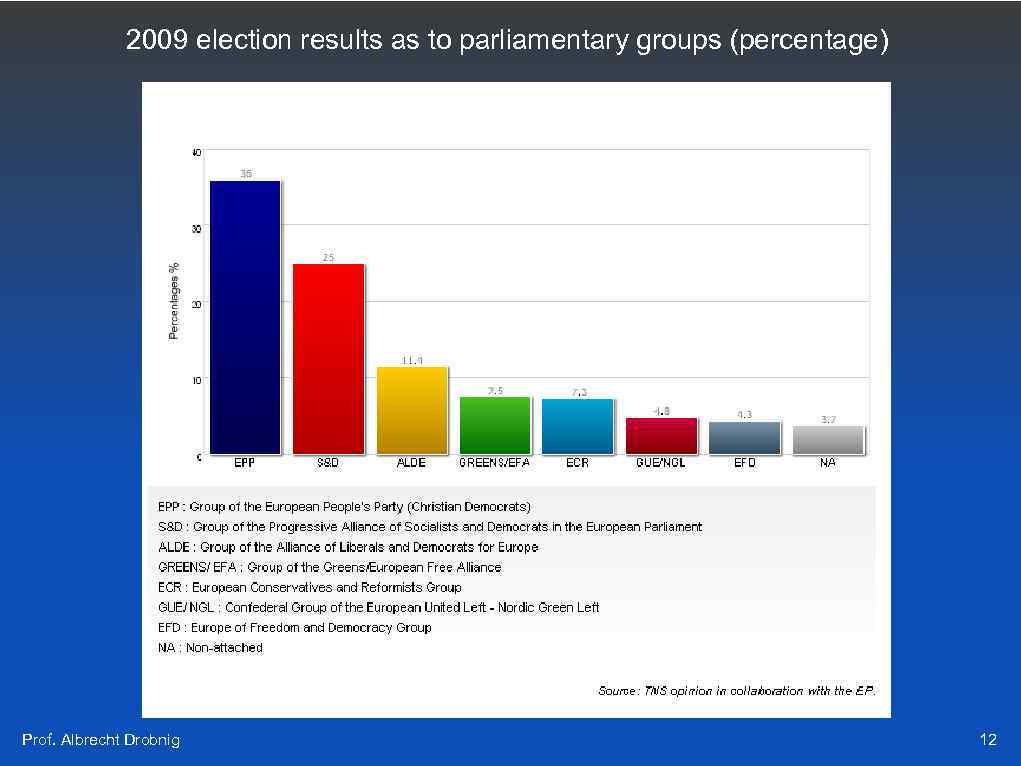 2009 election results as to parliamentary groups (percentage) Prof. Albrecht Drobnig 12
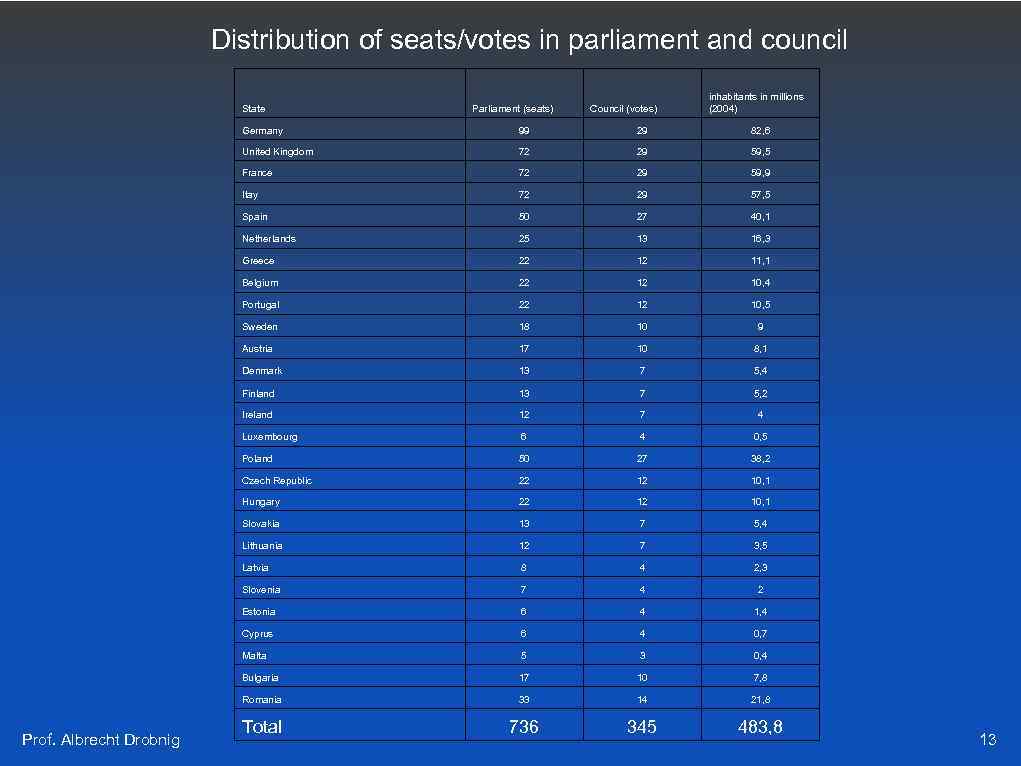 Distribution of seats/votes in parliament and council State Parliament (seats) Council (votes) inhabitants in millions (2004) Germany 29 82, 6 United Kingdom 72 29 59, 5 France 72 29 59, 9 Itay 72 29 57, 5 Spain 50 27 40, 1 Netherlands 25 13 16, 3 Greece 22 12 11, 1 Belgium 22 12 10, 4 Portugal 22 12 10, 5 Sweden 18 10 9 Austria 17 10 8, 1 Denmark 13 7 5, 4 Finland 13 7 5, 2 Ireland 12 7 4 Luxembourg 6 4 0, 5 Poland 50 27 38, 2 Czech Republic 22 12 10, 1 Hungary 22 12 10, 1 Slovakia 13 7 5, 4 Lithuania 12 7 3, 5 Latvia 8 4 2, 3 Slovenia 7 4 2 Estonia 6 4 1, 4 Cyprus 6 4 0, 7 Malta 5 3 0, 4 Bulgaria 17 10 7, 8 Romania Prof. Albrecht Drobnig 99 33 14 21, 8 Total 736 345 483, 8 13
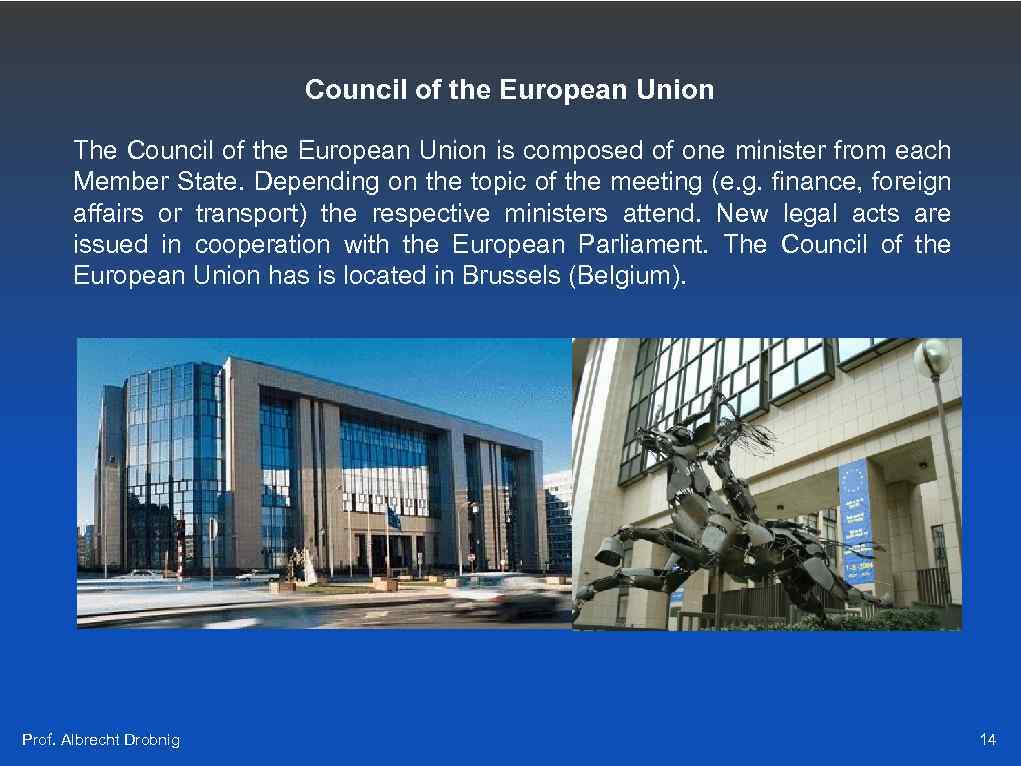 Council of the European Union The Council of the European Union is composed of one minister from each Member State. Depending on the topic of the meeting (e. g. finance, foreign affairs or transport) the respective ministers attend. New legal acts are issued in cooperation with the European Parliament. The Council of the European Union has is located in Brussels (Belgium). Prof. Albrecht Drobnig 14
 Council (votes) Prof. Albrecht Drobnig 15
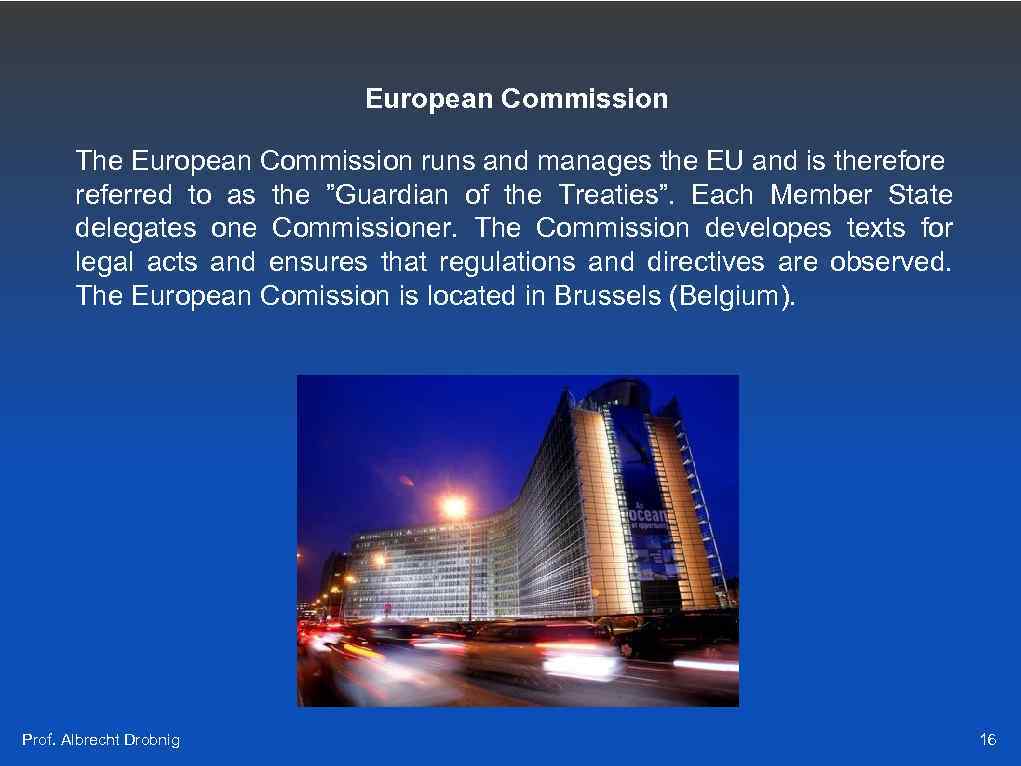 European Commission The European Commission runs and manages the EU and is therefore referred to as the ”Guardian of the Treaties”. Each Member State delegates one Commissioner. The Commission developes texts for legal acts and ensures that regulations and directives are observed. The European Comission is located in Brussels (Belgium). Prof. Albrecht Drobnig 16
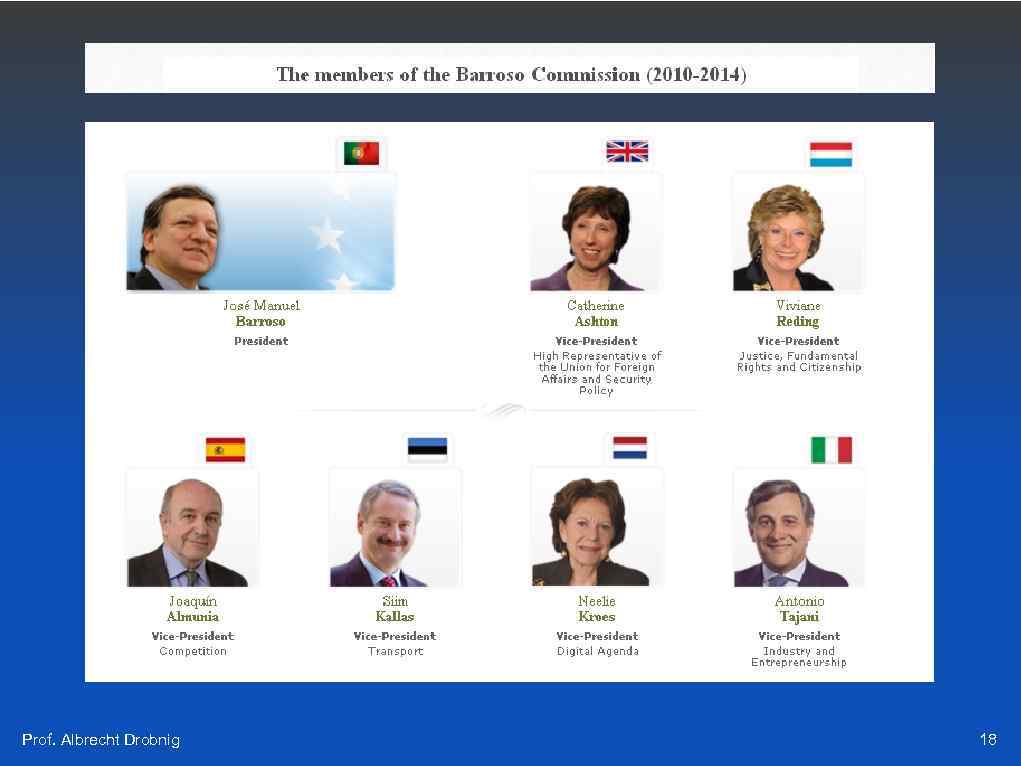
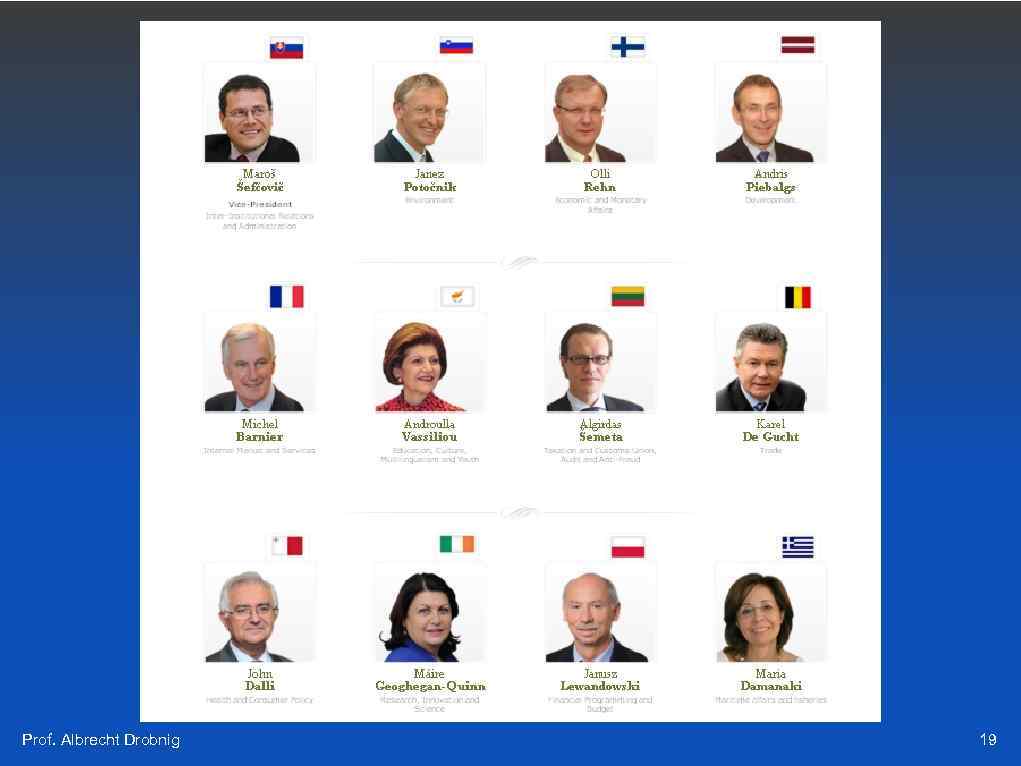
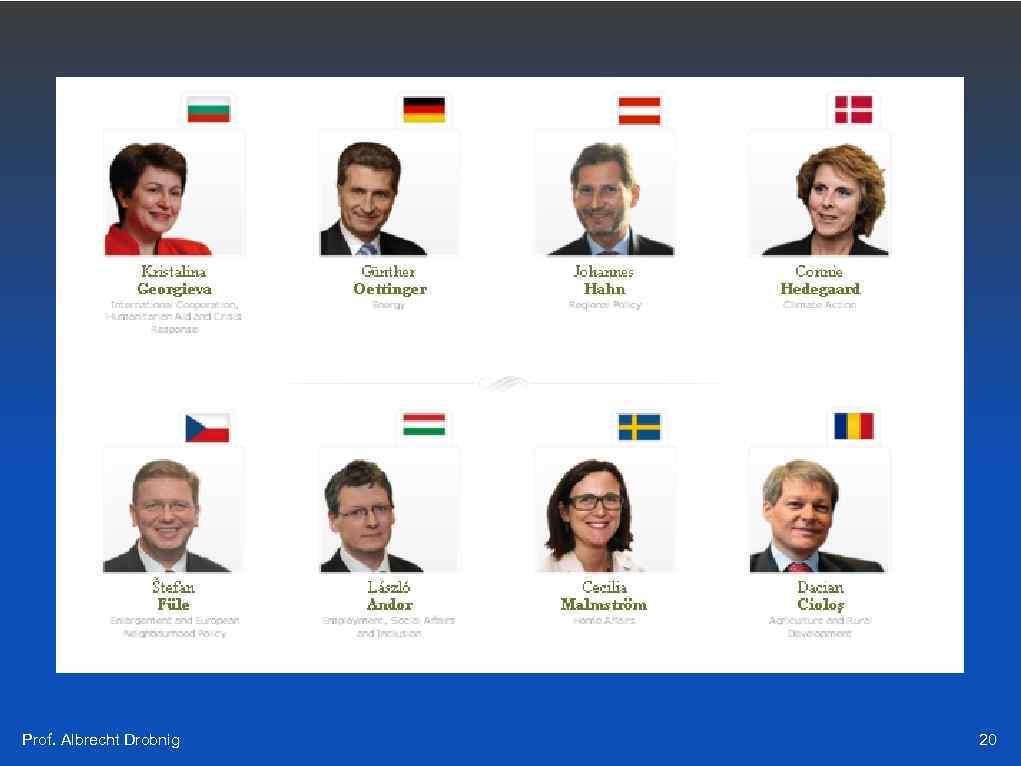
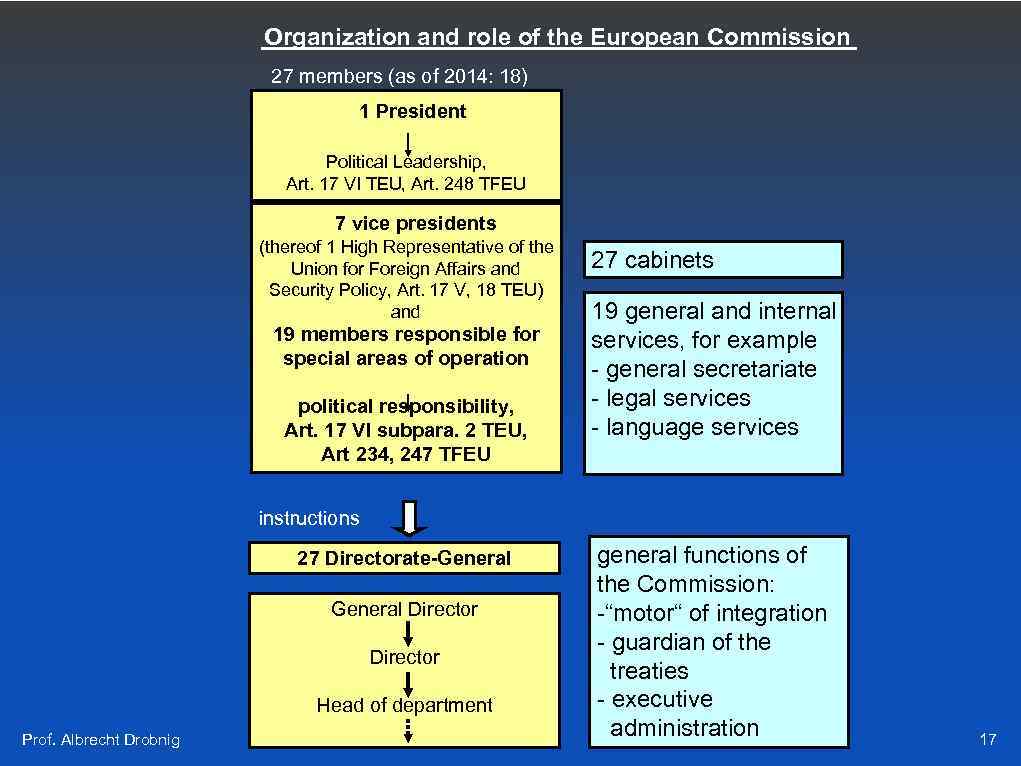 Organization and role of the European Commission 27 members (as of 2014: 18) 1 President Political Leadership, Art. 17 VI TEU, Art. 248 TFEU 7 vice presidents (thereof 1 High Representative of the Union for Foreign Affairs and Security Policy, Art. 17 V, 18 TEU) and 19 members responsible for special areas of operation political responsibility, Art. 17 VI subpara. 2 TEU, Art 234, 247 TFEU 27 cabinets 19 general and internal services, for example - general secretariate - legal services - language services instructions 27 Directorate-General Director Head of department Prof. Albrecht Drobnig general functions of the Commission: -“motor“ of integration - guardian of the treaties - executive administration 17
 Prof. Albrecht Drobnig 18
 Prof. Albrecht Drobnig 19
 Prof. Albrecht Drobnig 20
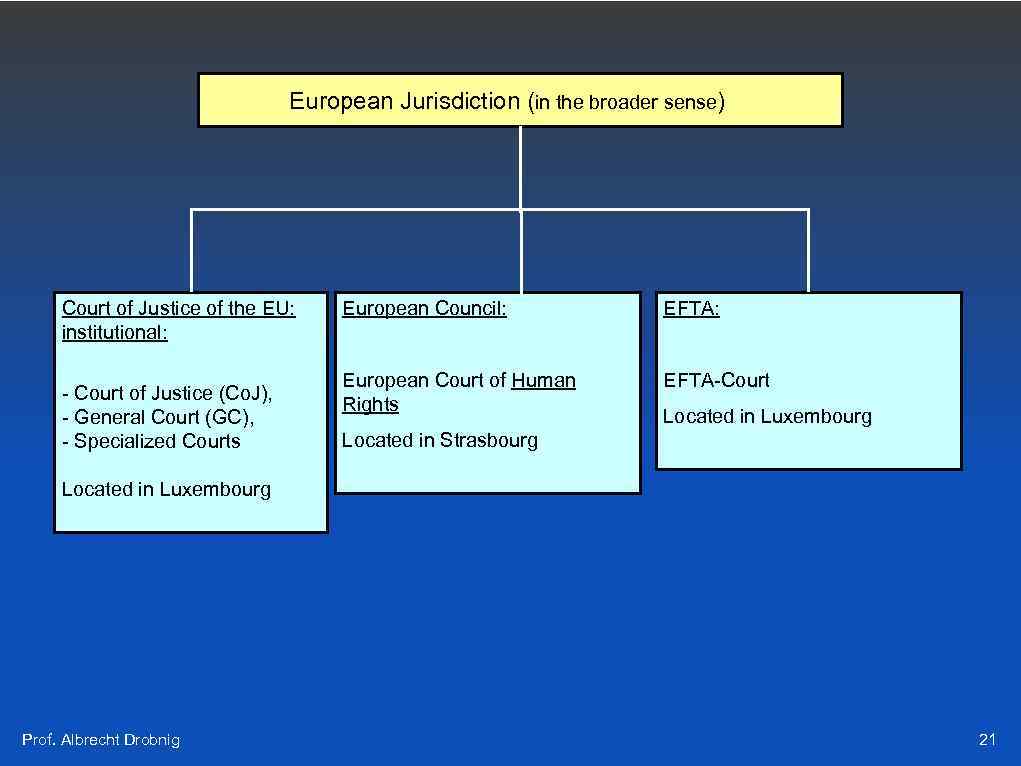 European Jurisdiction (in the broader sense) Court of Justice of the EU: institutional: - Court of Justice (Co. J), - General Court (GC), - Specialized Courts Located in Luxembourg Prof. Albrecht Drobnig European Council: EFTA: European Court of Human Rights EFTA-Court Located in Luxembourg Located in Strasbourg 21
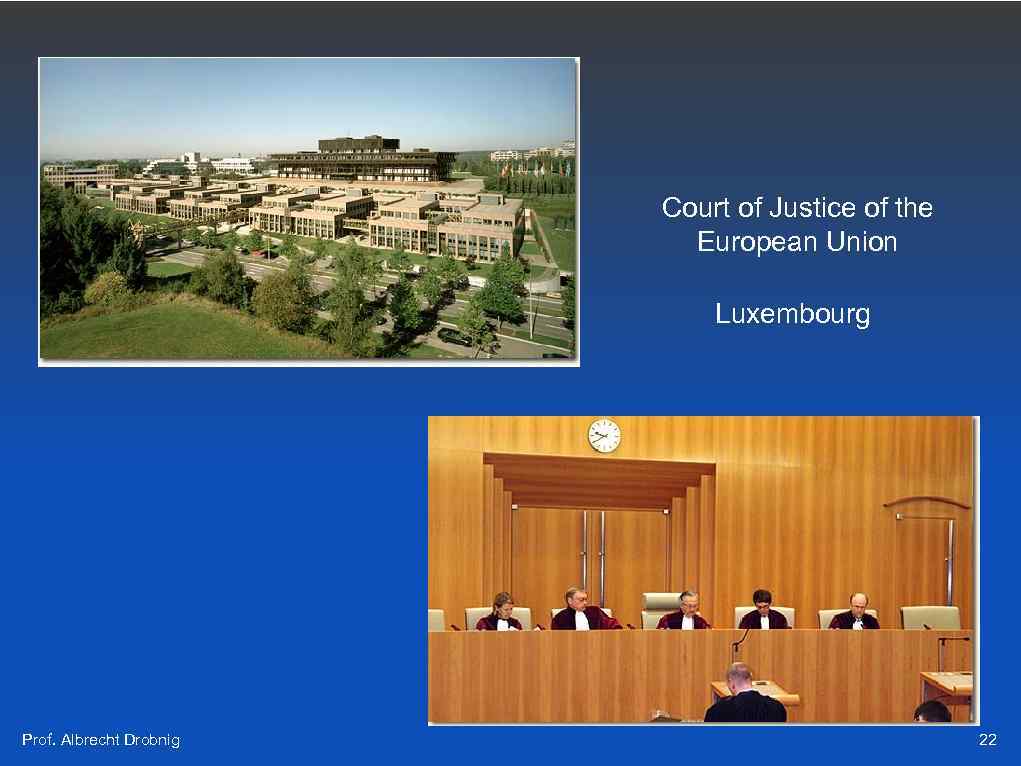 Court of Justice of the European Union Luxembourg Prof. Albrecht Drobnig 22
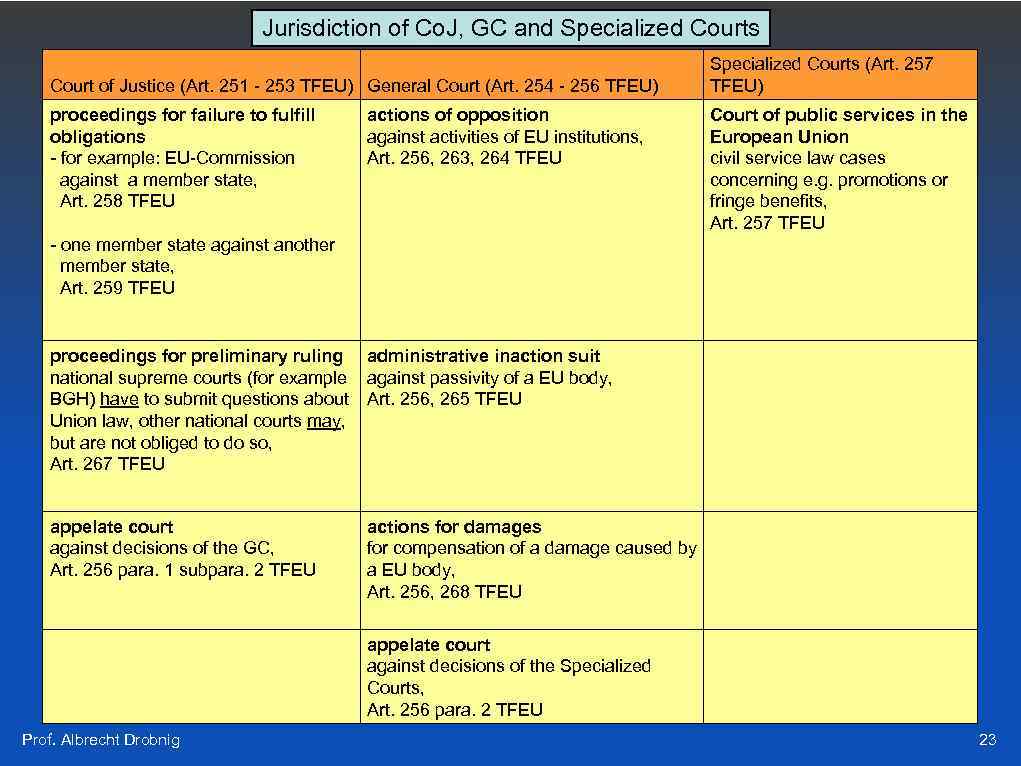 Jurisdiction of Co. J, GC and Specialized Courts Court of Justice (Art. 251 - 253 TFEU) General Court (Art. 254 - 256 TFEU) proceedings for failure to fulfill obligations - for example: EU-Commission against a member state, Art. 258 TFEU actions of opposition against activities of EU institutions, Art. 256, 263, 264 TFEU Specialized Courts (Art. 257 TFEU) Court of public services in the European Union civil service law cases concerning e. g. promotions or fringe benefits, Art. 257 TFEU - one member state against another member state, Art. 259 TFEU proceedings for preliminary ruling national supreme courts (for example BGH) have to submit questions about Union law, other national courts may, but are not obliged to do so, Art. 267 TFEU administrative inaction suit against passivity of a EU body, Art. 256, 265 TFEU appelate court against decisions of the GC, Art. 256 para. 1 subpara. 2 TFEU Prof. Albrecht Drobnig actions for damages for compensation of a damage caused by a EU body, Art. 256, 268 TFEU appelate court against decisions of the Specialized Courts, Art. 256 para. 2 TFEU 23
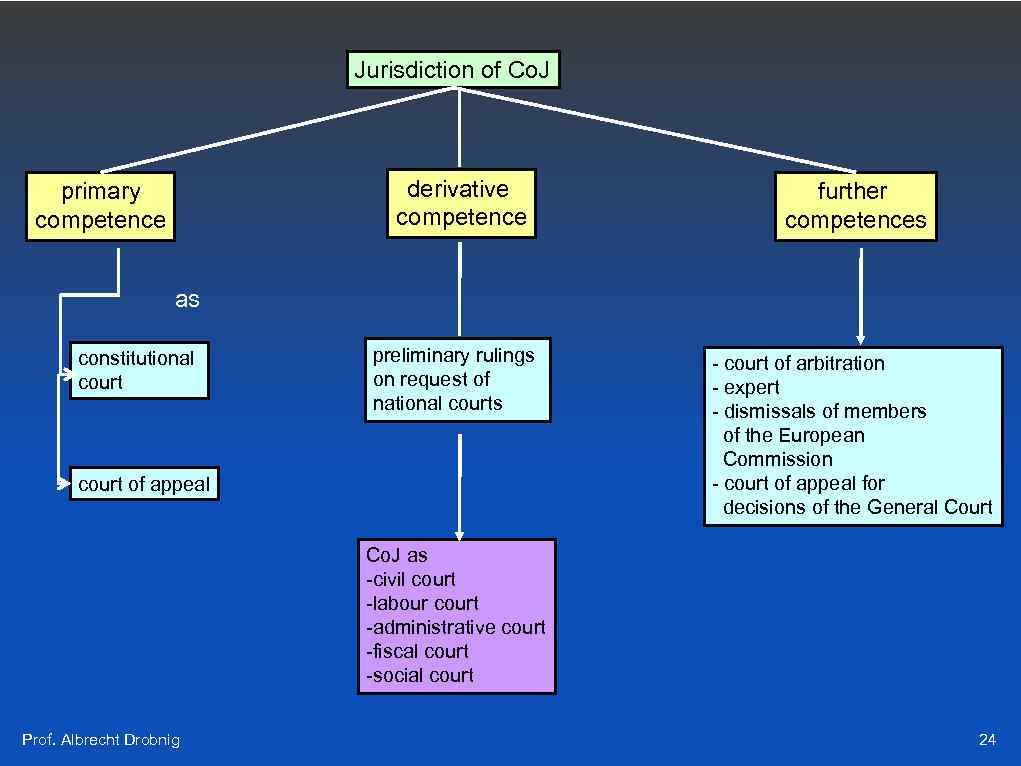 Jurisdiction of Co. J derivative competence primary competence further competences preliminary rulings on request of national courts - court of arbitration - expert - dismissals of members of the European Commission - court of appeal for decisions of the General Court as constitutional court of appeal Co. J as -civil court -labour court -administrative court -fiscal court -social court Prof. Albrecht Drobnig 24
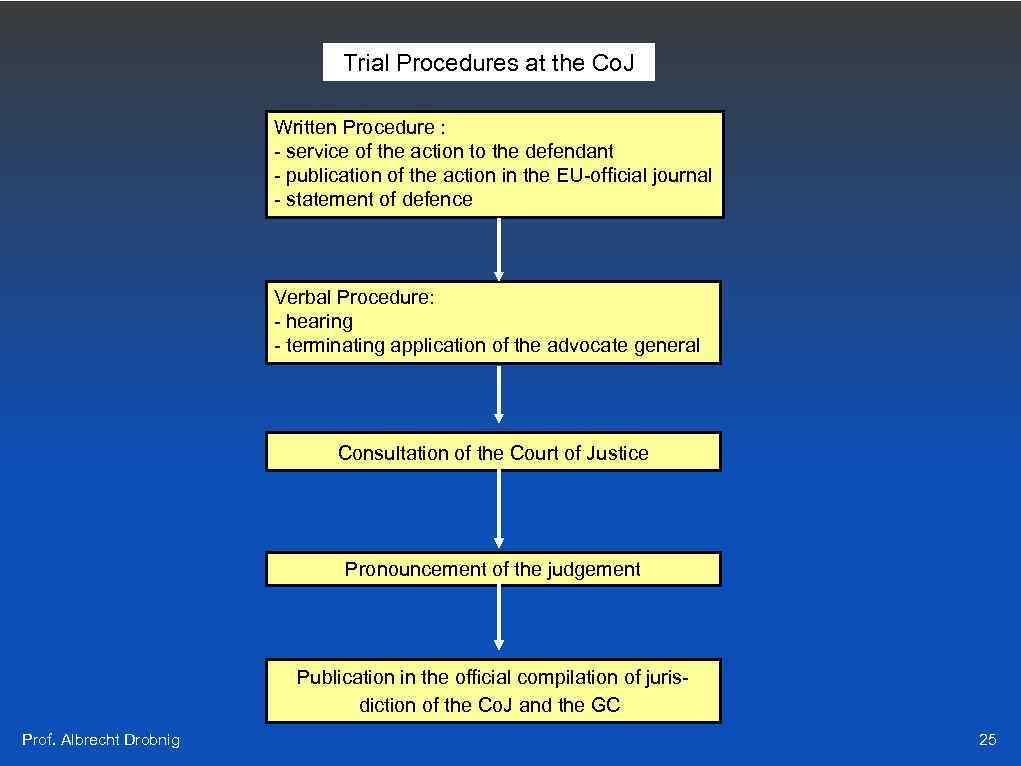 Trial Procedures at the Co. J Written Procedure : - service of the action to the defendant - publication of the action in the EU-official journal - statement of defence Verbal Procedure: - hearing - terminating application of the advocate general Consultation of the Court of Justice Pronouncement of the judgement Publication in the official compilation of jurisdiction of the Co. J and the GC Prof. Albrecht Drobnig 25
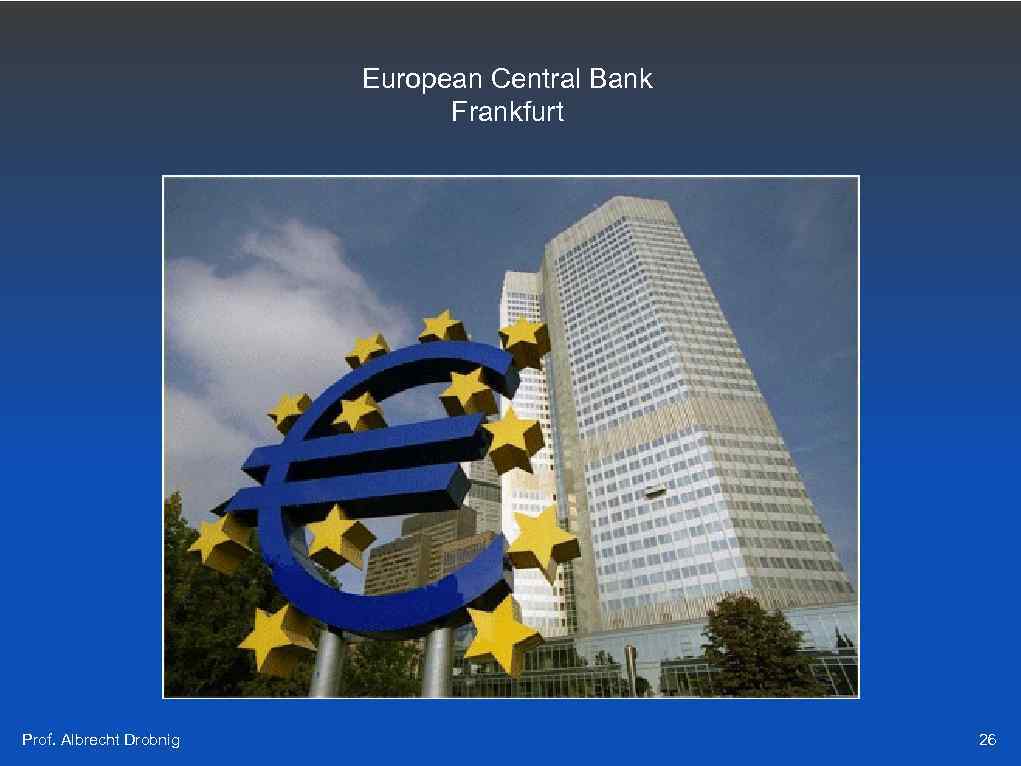 European Central Bank Frankfurt Prof. Albrecht Drobnig 26
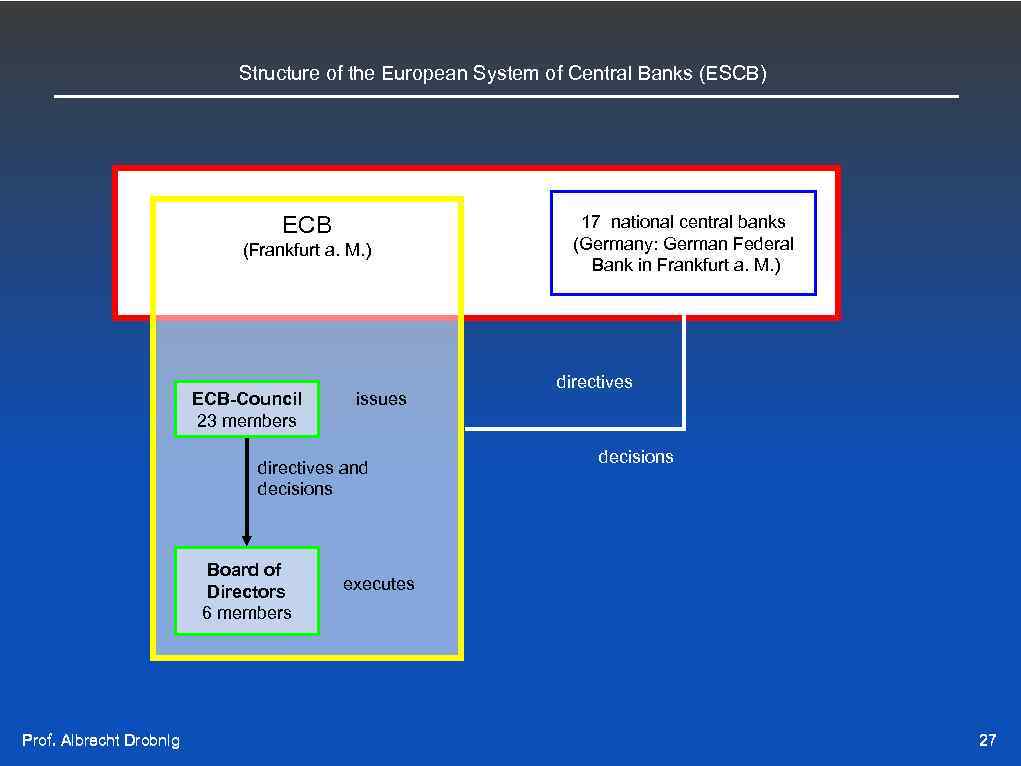 Structure of the European System of Central Banks (ESCB) ECB (Frankfurt a. M. ) ECB-Council 23 members issues directives and decisions Board of Directors 6 members Prof. Albrecht Drobnig 17 national central banks (Germany: German Federal Bank in Frankfurt a. M. ) directives decisions executes 27
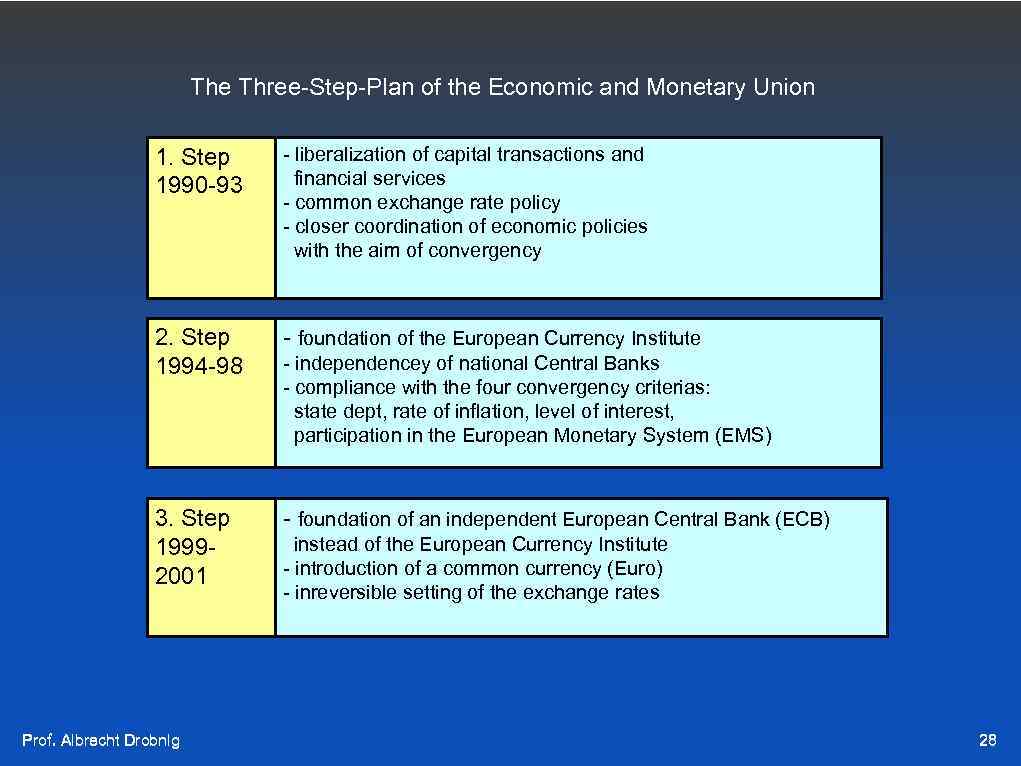 The Three-Step-Plan of the Economic and Monetary Union 1. Step 1990 -93 - liberalization of capital transactions and financial services - common exchange rate policy - closer coordination of economic policies with the aim of convergency 2. Step 1994 -98 - foundation of the European Currency Institute 3. Step 19992001 - foundation of an independent European Central Bank (ECB) Prof. Albrecht Drobnig - independencey of national Central Banks - compliance with the four convergency criterias: state dept, rate of inflation, level of interest, participation in the European Monetary System (EMS) instead of the European Currency Institute - introduction of a common currency (Euro) - inreversible setting of the exchange rates 28
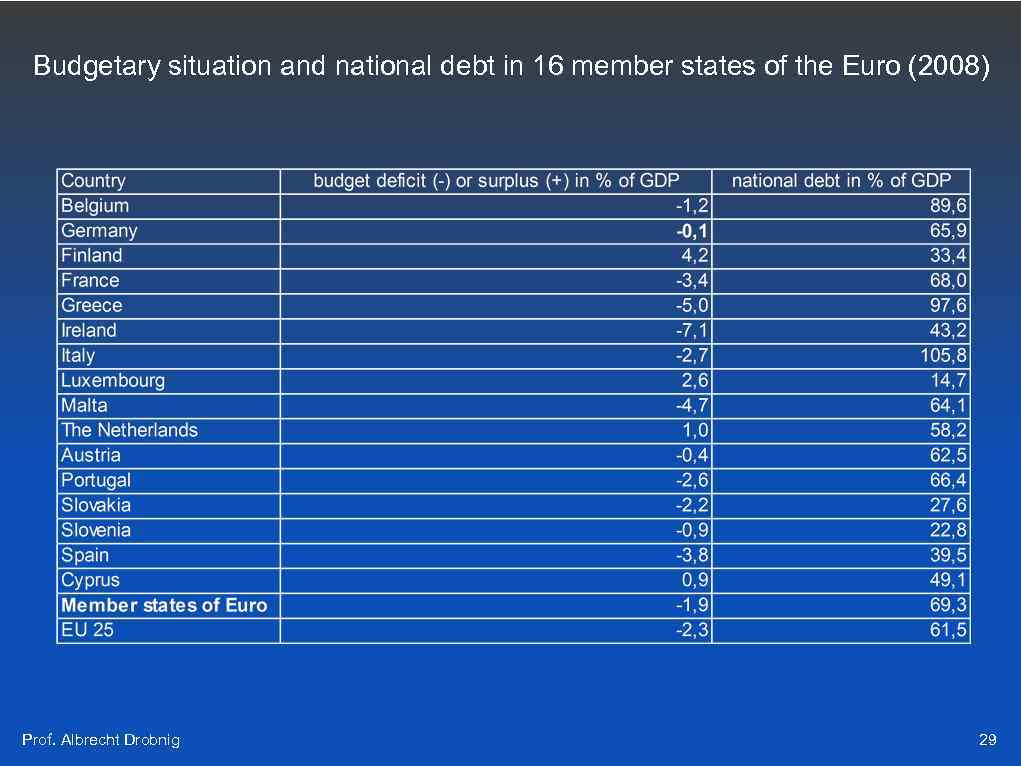 Budgetary situation and national debt in 16 member states of the Euro (2008) Prof. Albrecht Drobnig 29
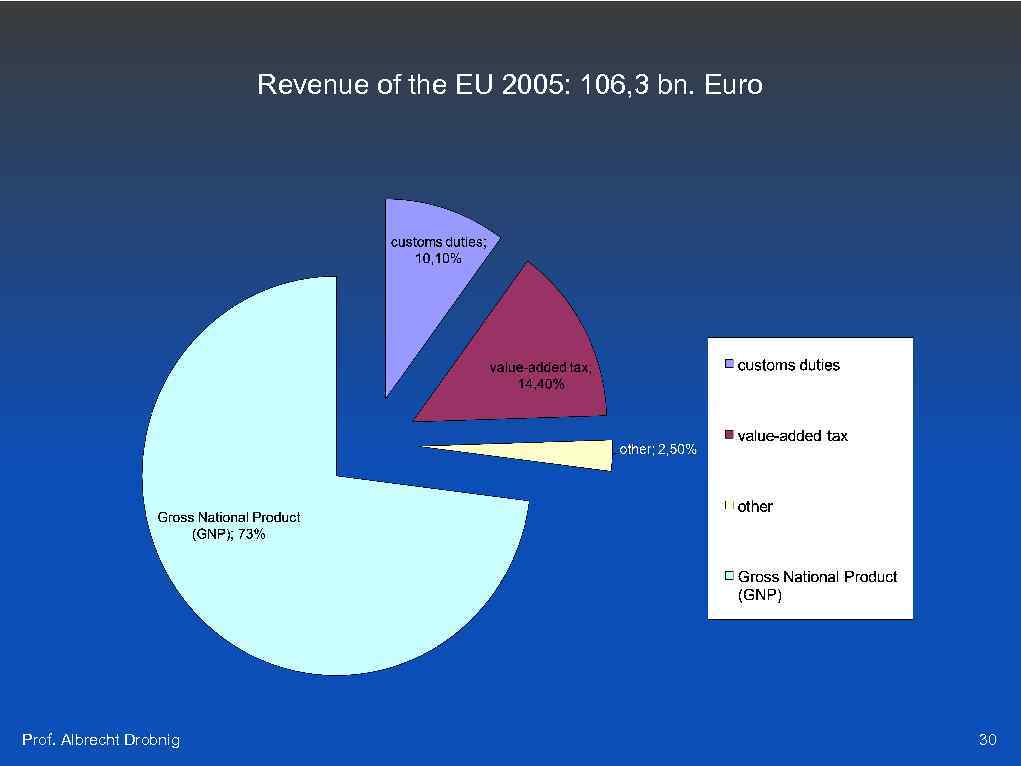 Revenue of the EU 2005: 106, 3 bn. Euro Prof. Albrecht Drobnig 30
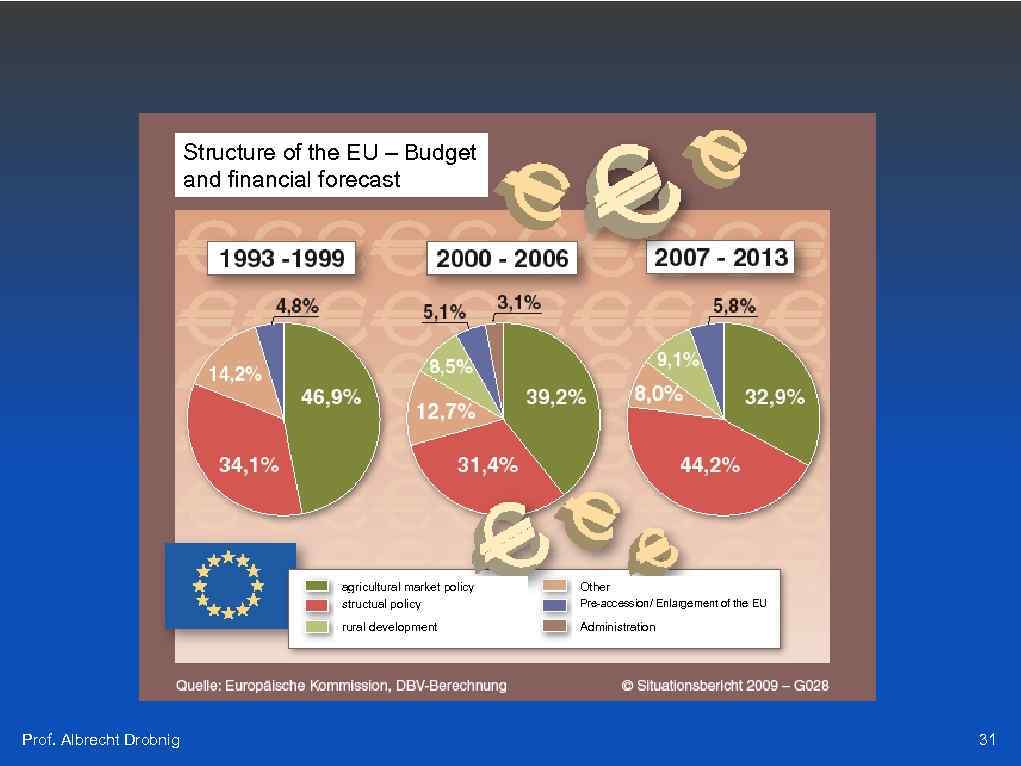 Structure of the EU – Budget and financial forecast agricultural market policy structual policy rural development Prof. Albrecht Drobnig Other Administration Pre-accession/ Enlargement of the EU 31
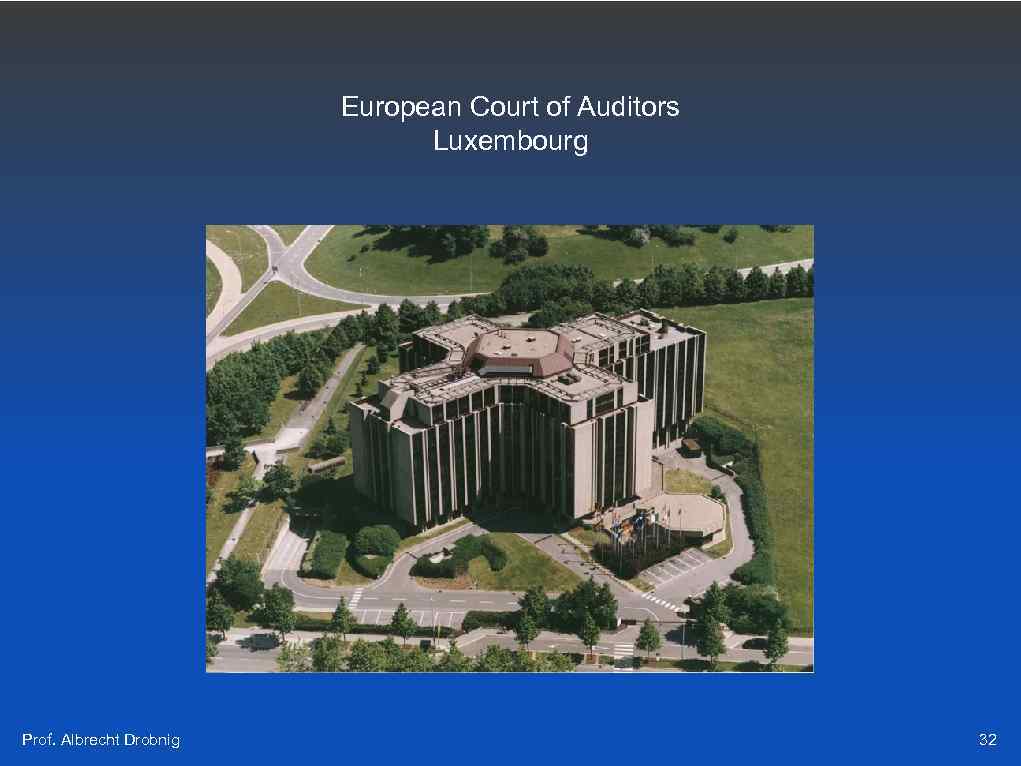 European Court of Auditors Luxembourg Prof. Albrecht Drobnig 32
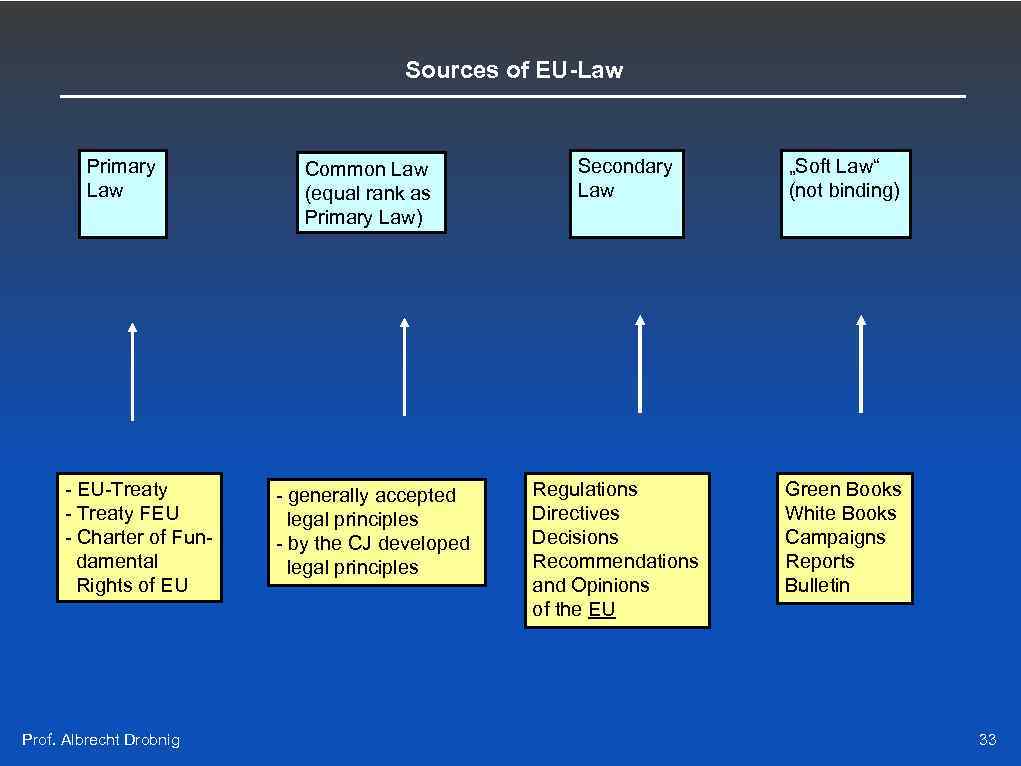 Sources of EU-Law Primary Law - EU-Treaty - Treaty FEU - Charter of Fun damental Rights of EU Prof. Albrecht Drobnig Common Law (equal rank as Primary Law) - generally accepted legal principles - by the CJ developed legal principles Secondary Law Regulations Directives Decisions Recommendations and Opinions of the EU „Soft Law“ (not binding) Green Books White Books Campaigns Reports Bulletin 33
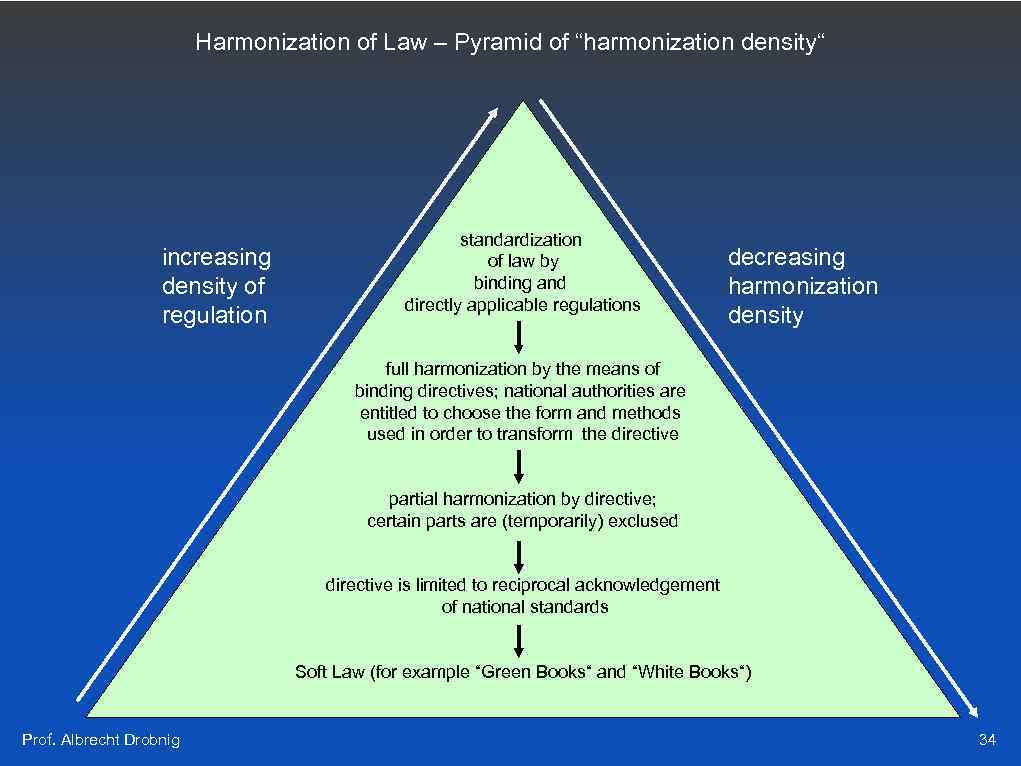 Harmonization of Law – Pyramid of “harmonization density“ increasing density of regulation standardization of law by binding and directly applicable regulations decreasing harmonization density full harmonization by the means of binding directives; national authorities are entitled to choose the form and methods used in order to transform the directive partial harmonization by directive; certain parts are (temporarily) exclused directive is limited to reciprocal acknowledgement of national standards Soft Law (for example “Green Books“ and “White Books“) Prof. Albrecht Drobnig 34
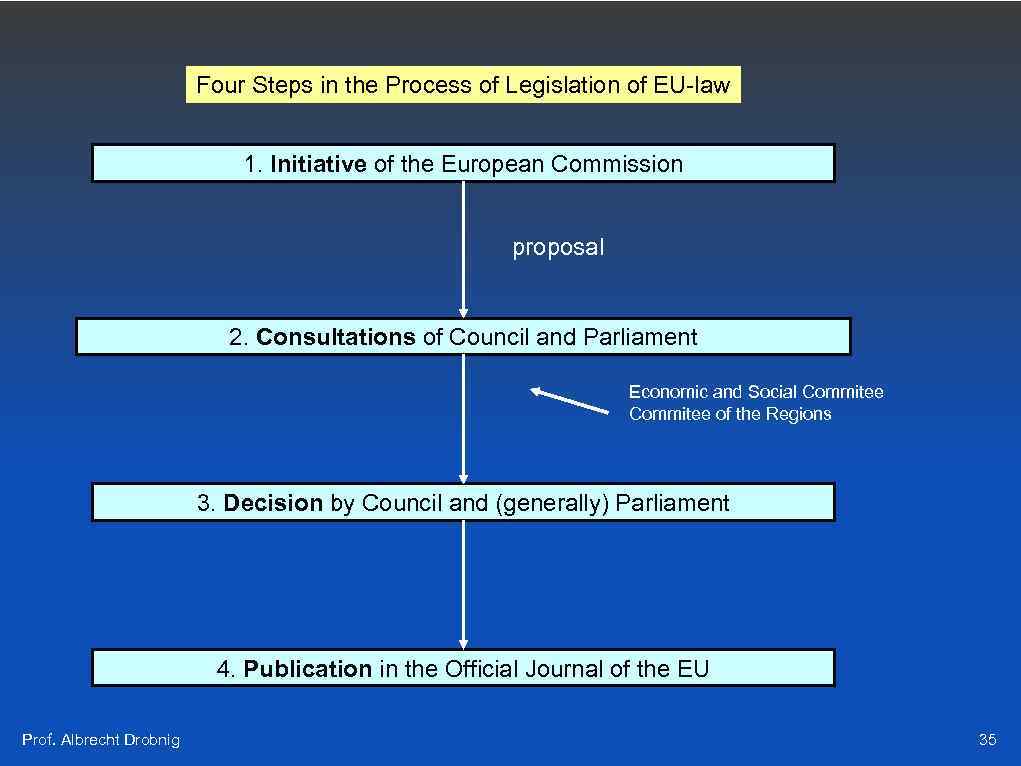 Four Steps in the Process of Legislation of EU-law 1. Initiative of the European Commission proposal 2. Consultations of Council and Parliament Economic and Social Commitee of the Regions 3. Decision by Council and (generally) Parliament 4. Publication in the Official Journal of the EU Prof. Albrecht Drobnig 35
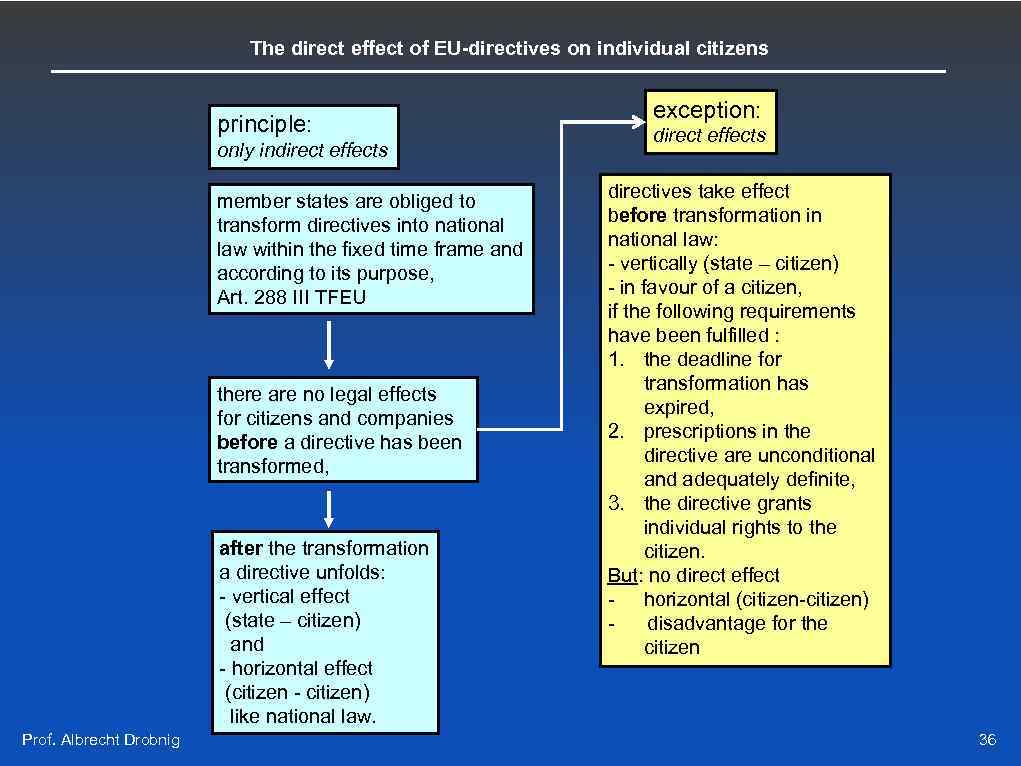 The direct effect of EU-directives on individual citizens principle: only indirect effects member states are obliged to transform directives into national law within the fixed time frame and according to its purpose, Art. 288 III TFEU there are no legal effects for citizens and companies before a directive has been transformed, after the transformation a directive unfolds: - vertical effect (state – citizen) and - horizontal effect (citizen - citizen) like national law. Prof. Albrecht Drobnig exception: direct effects directives take effect before transformation in national law: - vertically (state – citizen) - in favour of a citizen, if the following requirements have been fulfilled : 1. the deadline for transformation has expired, 2. prescriptions in the directive are unconditional and adequately definite, 3. the directive grants individual rights to the citizen. But: no direct effect - horizontal (citizen-citizen) - disadvantage for the citizen 36
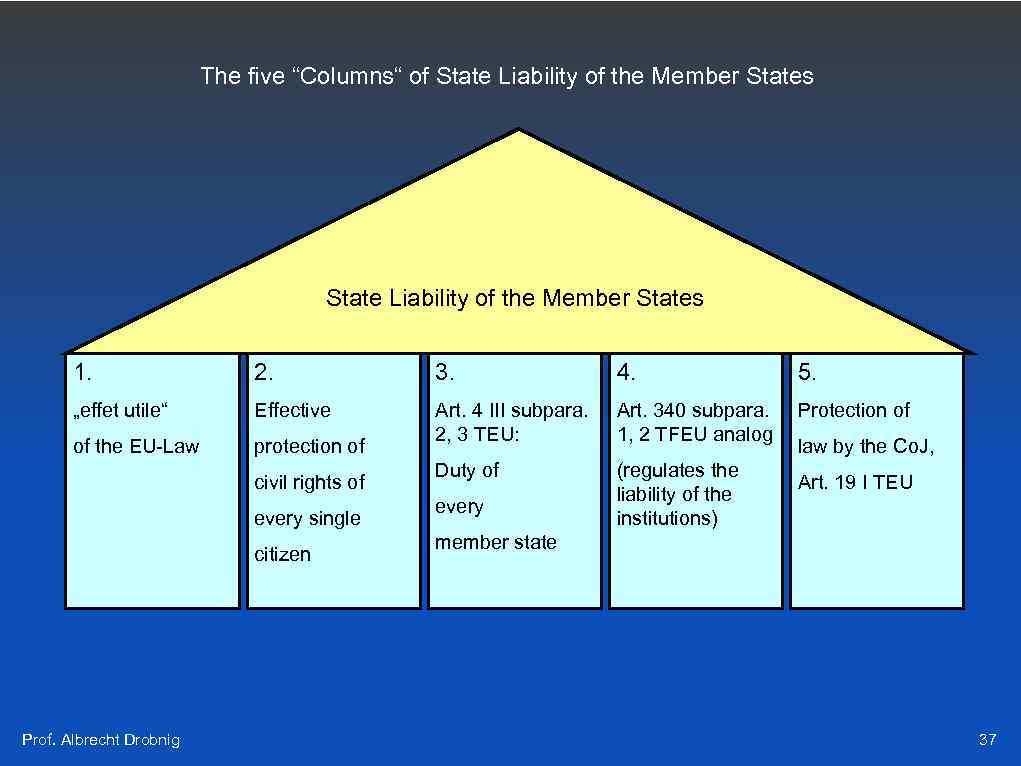 The five “Columns“ of State Liability of the Member States 1. 2. 3. 4. 5. „effet utile“ Effective protection of Art. 340 subpara. 1, 2 TFEU analog Protection of of the EU-Law Art. 4 III subpara. 2, 3 TEU: Duty of (regulates the liability of the institutions) civil rights of every single citizen Prof. Albrecht Drobnig every law by the Co. J, Art. 19 I TEU member state 37
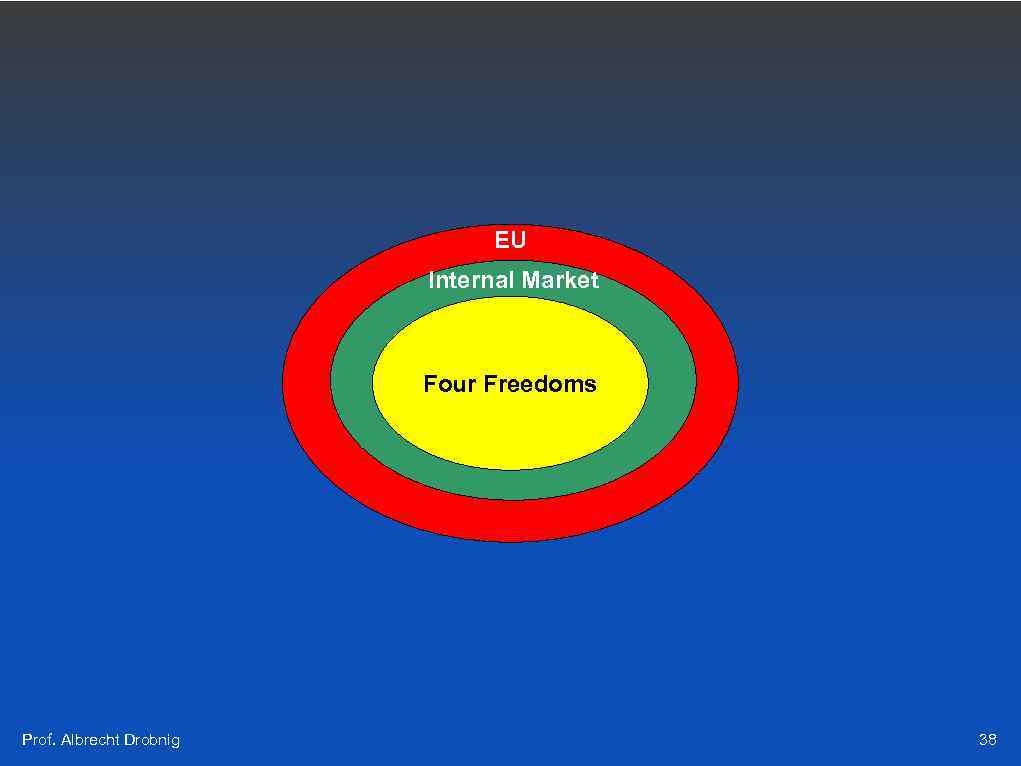 EU Internal Market Four Freedoms Prof. Albrecht Drobnig 38
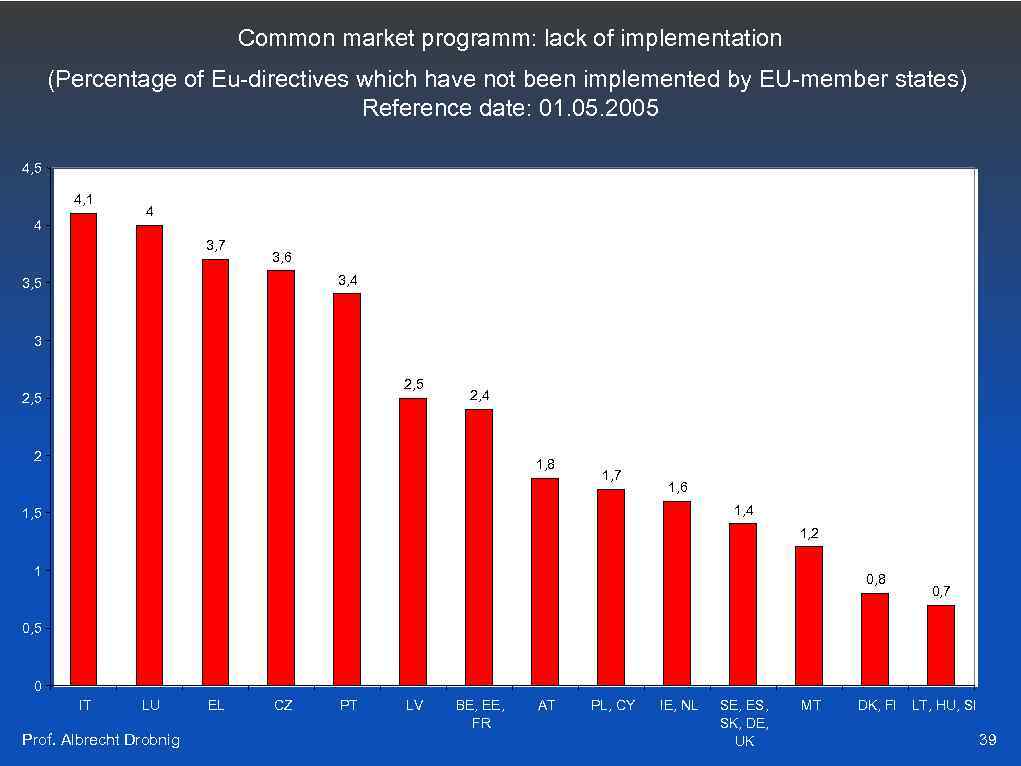 Common market programm: lack of implementation (Percentage of Eu-directives which have not been implemented by EU-member states) Reference date: 01. 05. 2005 4, 1 4 4 3, 7 3, 6 3, 4 3, 5 3 2, 5 2, 4 2 1, 8 1, 7 1, 6 1, 4 1, 5 1, 2 1 0, 8 0, 7 0, 5 0 IT LU Prof. Albrecht Drobnig EL CZ PT LV BE, EE, FR AT PL, CY IE, NL SE, ES, SK, DE, UK MT DK, FI LT, HU, SI 39
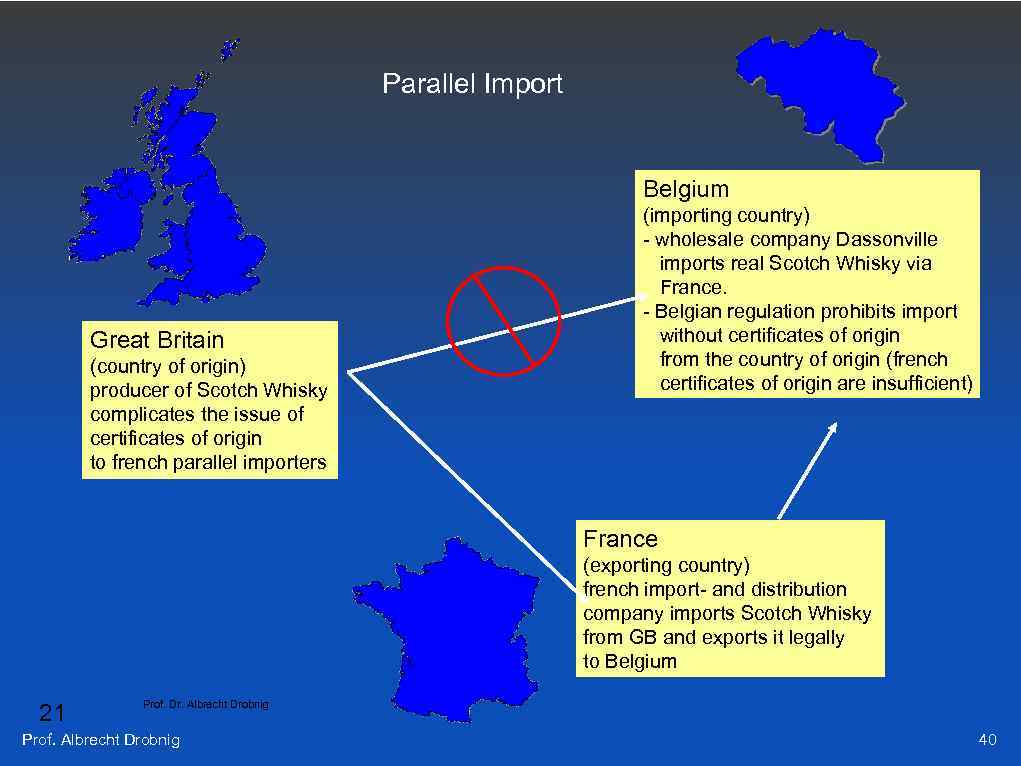 Parallel Import Belgium Great Britain (country of origin) producer of Scotch Whisky complicates the issue of certificates of origin to french parallel importers (importing country) - wholesale company Dassonville imports real Scotch Whisky via France. - Belgian regulation prohibits import without certificates of origin from the country of origin (french certificates of origin are insufficient) France (exporting country) french import- and distribution company imports Scotch Whisky from GB and exports it legally to Belgium 21 Prof. Dr. Albrecht Drobnig Prof. Albrecht Drobnig 40
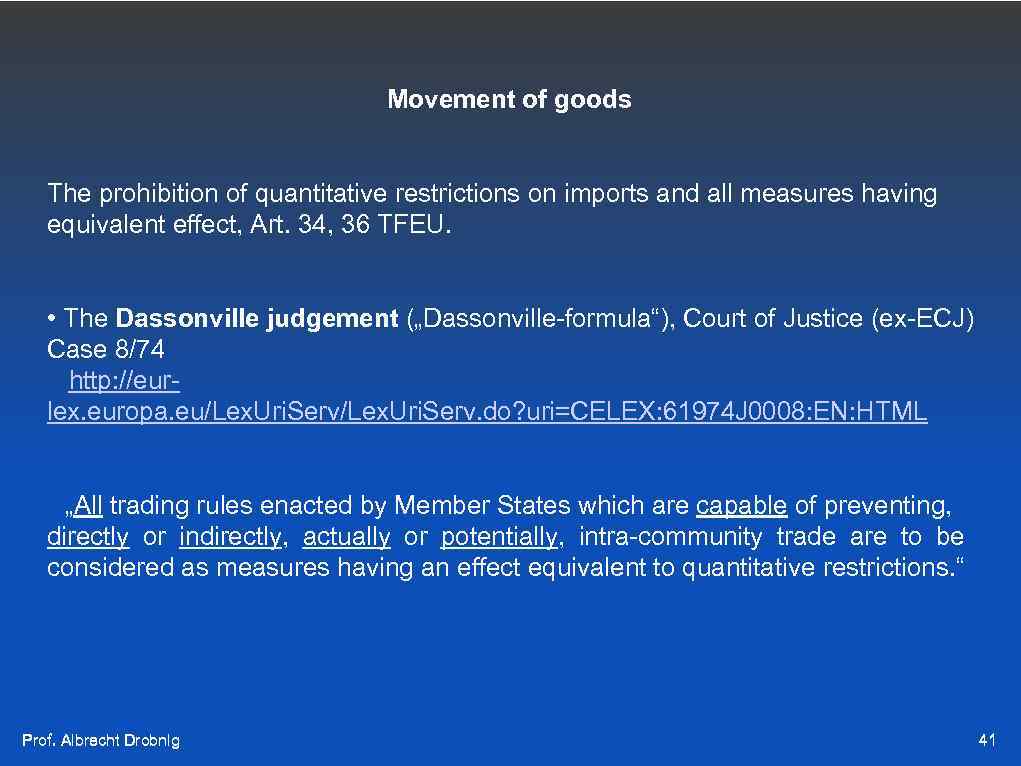 Movement of goods The prohibition of quantitative restrictions on imports and all measures having equivalent effect, Art. 34, 36 TFEU. • The Dassonville judgement („Dassonville-formula“), Court of Justice (ex-ECJ) Case 8/74 http: //eurlex. europa. eu/Lex. Uri. Serv. do? uri=CELEX: 61974 J 0008: EN: HTML „All trading rules enacted by Member States which are capable of preventing, directly or indirectly, actually or potentially, intra-community trade are to be considered as measures having an effect equivalent to quantitative restrictions. “ Prof. Albrecht Drobnig 41
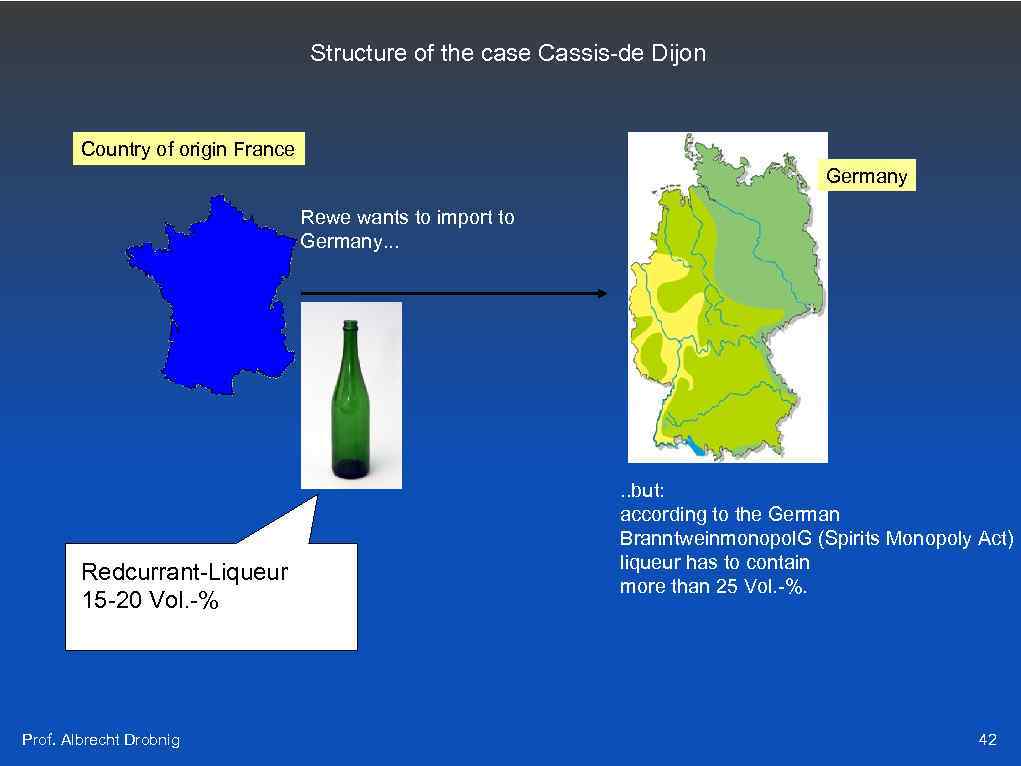 Structure of the case Cassis-de Dijon Country of origin France Germany Rewe wants to import to Germany. . . Redcurrant-Liqueur 15 -20 Vol. -% Prof. Albrecht Drobnig . . but: according to the German Branntweinmonopol. G (Spirits Monopoly Act) liqueur has to contain more than 25 Vol. -%. 42
 • The Cassis de Dijon judgement (Cassis-de-Dijon-Formula), Co. J (ex-ECJ) Case 120/78, judgement as of February 20, 1979 : http: //eur-lex. europa. eu/Lex. Uri. Serv. do? uri=CELEX: 61978 J 0120: EN: HTML “If the movement of goods within the community is restricted due to disparities between the national laws regarding the marketing of products this restriction must be accepted if those provisions are necessary in order to fulfill mandatory requirements relating to - the effectiveness of fiscal supervision - the protection of public health - the fairness of commercial transaction and - the defence of the consumer. ” Keep in mind: If something is free once, it is always free. country-of-origin principle • The judgment concerning „Reinheitsgebot (beer purity law) for German Beer“ The Co. J reaffirmed the Cassis-de-Dijon-doctrine. Prof. Albrecht Drobnig 43
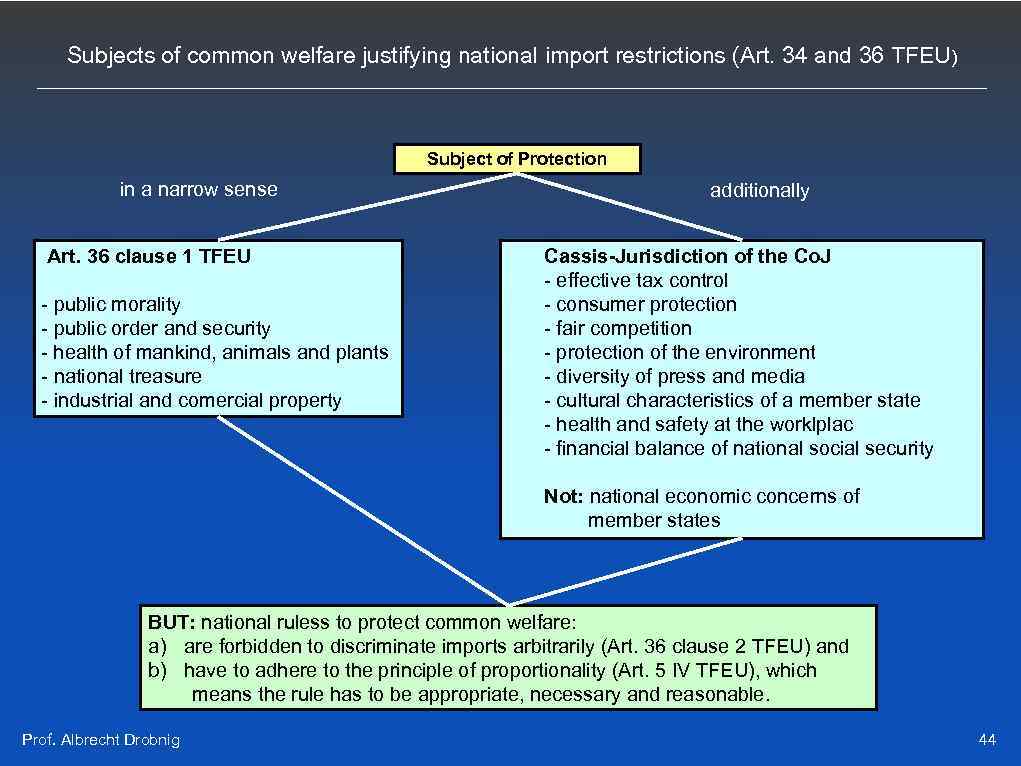 Subjects of common welfare justifying national import restrictions (Art. 34 and 36 TFEU ) Subject of Protection in a narrow sense Art. 36 clause 1 TFEU - public morality - public order and security - health of mankind, animals and plants - national treasure - industrial and comercial property additionally Cassis-Jurisdiction of the Co. J - effective tax control - consumer protection - fair competition - protection of the environment - diversity of press and media - cultural characteristics of a member state - health and safety at the worklplac - financial balance of national social security Not: national economic concerns of member states BUT: national ruless to protect common welfare: a) are forbidden to discriminate imports arbitrarily (Art. 36 clause 2 TFEU) and b) have to adhere to the principle of proportionality (Art. 5 IV TFEU), which means the rule has to be appropriate, necessary and reasonable. Prof. Albrecht Drobnig 44
 • The Keck judgement (Keck-Formula), Co. J (ex-ECJ) Case C-267/91 and C-268/91, judgement as of November 24, 1993: http: //eur-lex. europa. eu/Lex. Uri. Serv. do? uri=CELEX: 61991 J 0267: EN: HTML „ Any measure which is capable of directly or indirectly, actually or potentially, hindering intra-Community trade constitutes a measure having equivalent effect to a quantitative restriction, prohibited between Member States by Article 30 of the Treaty. That definition covers obstacles to the free movement of goods which, in the absence of harmonization of legislation, are the consequence of applying to goods coming from other Member States where they are lawfully manufactured and marketed, rules that lay down requirements to be met by such goods (such as those relating to designation, form, size, weight, composition, presentation, labeling, packaging). This is so even if those rules apply without distinction to all products unless their application can be justified by a public-interest objective taking precedence over the free movement of goods. ” Prof. Albrecht Drobnig 45
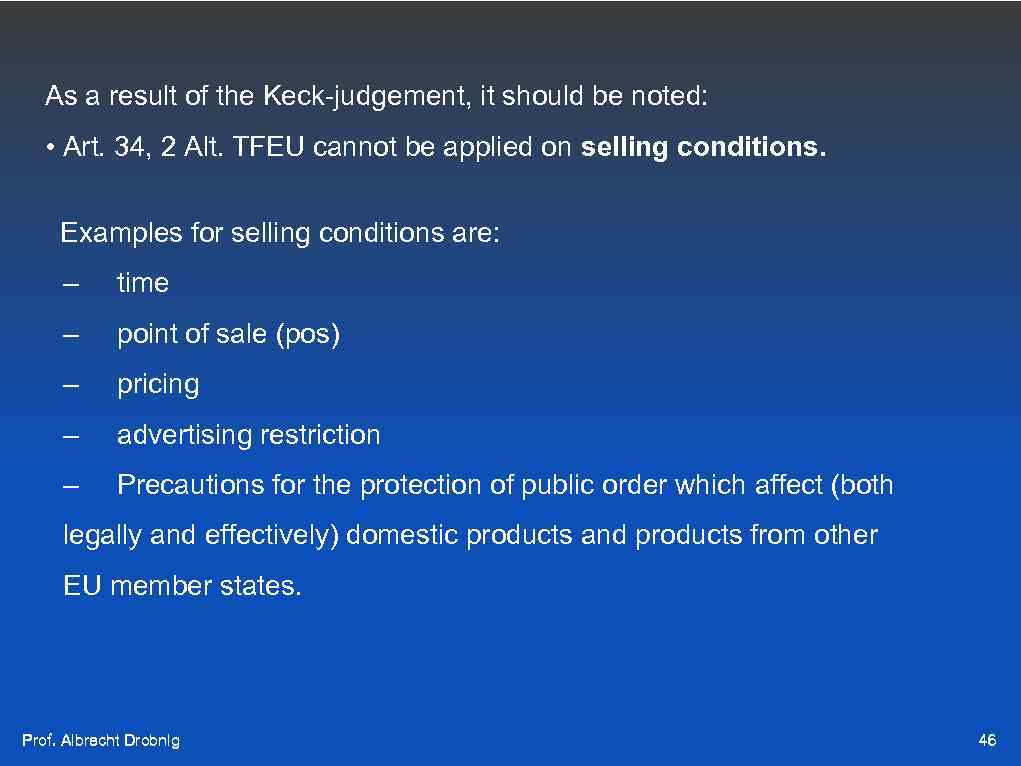 As a result of the Keck-judgement, it should be noted: • Art. 34, 2 Alt. TFEU cannot be applied on selling conditions. Examples for selling conditions are: – time – point of sale (pos) – pricing – advertising restriction – Precautions for the protection of public order which affect (both legally and effectively) domestic products and products from other EU member states. Prof. Albrecht Drobnig 46
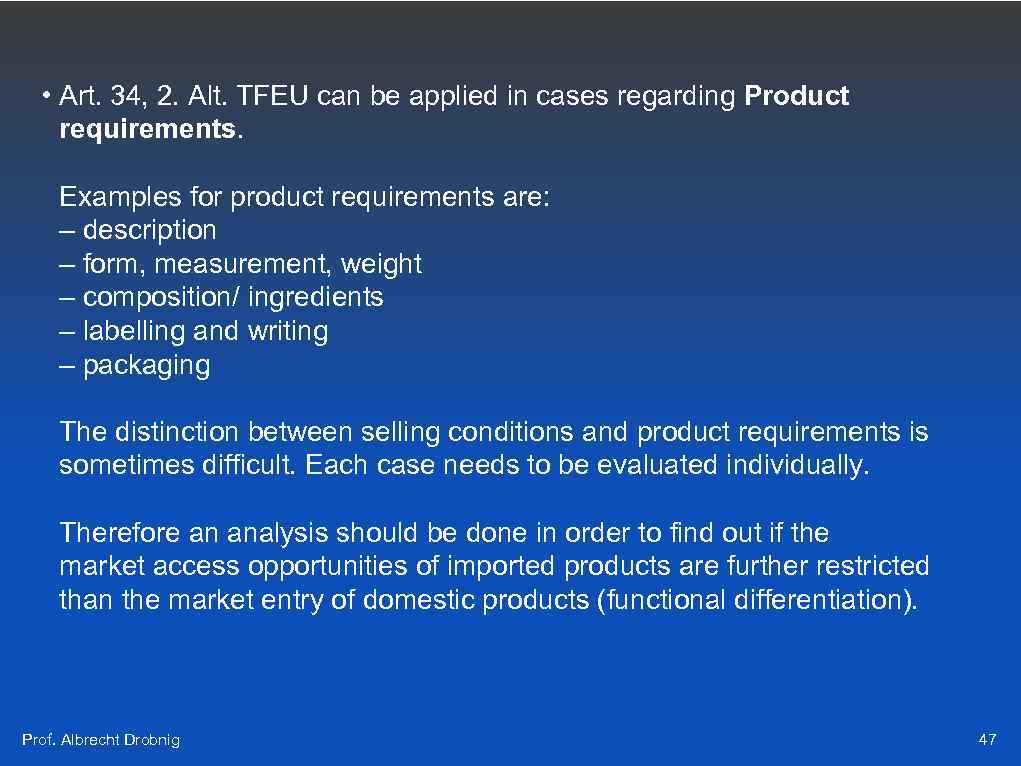 • Art. 34, 2. Alt. TFEU can be applied in cases regarding Product requirements. Examples for product requirements are: – description – form, measurement, weight – composition/ ingredients – labelling and writing – packaging The distinction between selling conditions and product requirements is sometimes difficult. Each case needs to be evaluated individually. Therefore an analysis should be done in order to find out if the market access opportunities of imported products are further restricted than the market entry of domestic products (functional differentiation). Prof. Albrecht Drobnig 47
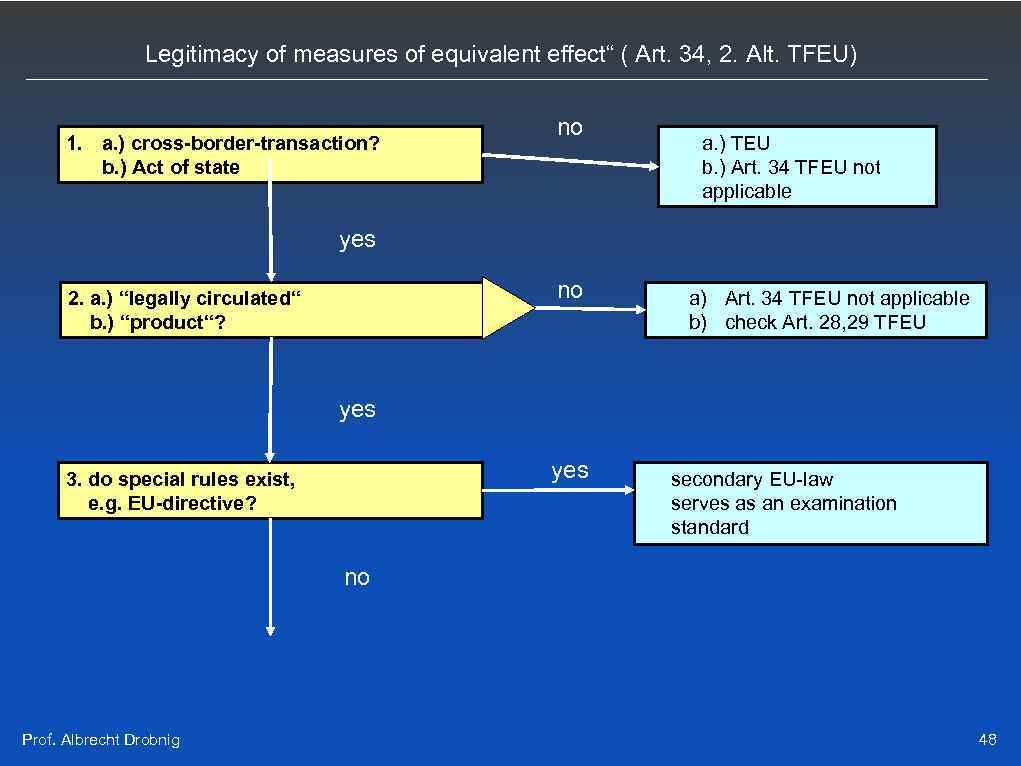 Legitimacy of measures of equivalent effect“ ( Art. 34, 2. Alt. TFEU) 1. a. ) cross-border-transaction? b. ) Act of state no a. ) TEU b. ) Art. 34 TFEU not applicable yes no 2. a. ) “legally circulated“ b. ) “product“? a) Art. 34 TFEU not applicable b) check Art. 28, 29 TFEU yes 3. do special rules exist, e. g. EU-directive? secondary EU-law serves as an examination standard no Prof. Albrecht Drobnig 48
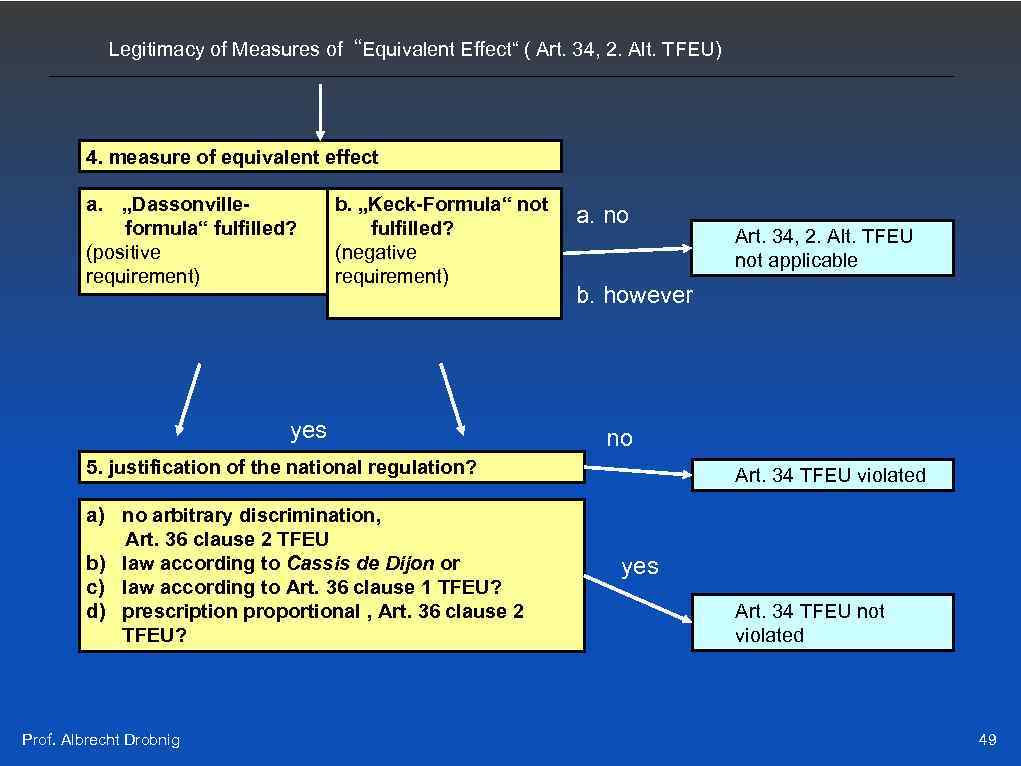 Legitimacy of Measures of “Equivalent Effect“ ( Art. 34, 2. Alt. TFEU) 4. measure of equivalent effect a. „Dassonvilleformula“ fulfilled? (positive requirement) b. „Keck-Formula“ not fulfilled? (negative requirement) yes a. no b. however no 5. justification of the national regulation? a) no arbitrary discrimination, Art. 36 clause 2 TFEU b) law according to Cassis de Dijon or c) law according to Art. 36 clause 1 TFEU? d) prescription proportional , Art. 36 clause 2 TFEU? Prof. Albrecht Drobnig Art. 34, 2. Alt. TFEU not applicable Art. 34 TFEU violated yes Art. 34 TFEU not violated 49
 Free movement of persons, Art. 45 – 55 TFEU I. Free movement of workers (Art. 45 -48 TFEU) • Casagrande judgement, Co. J Case 9/74, judgement as of July 3 1974 (regarding a BAFöG = government financial aid for academic studies of a migrant worker´s son) The BAFöG-claim (financial state aid for students) of a migrant worker´s son is not directly connected to the employment of the migrant worker. Nevertheless it is mandatory to treat migrant workers and there relatives the same way as domestic employees. Therefore migrant workers and their relatives are equally entitled to social benefits (e. g. financial aid for students) of the state where they live. Prof. Albrecht Drobnig 50
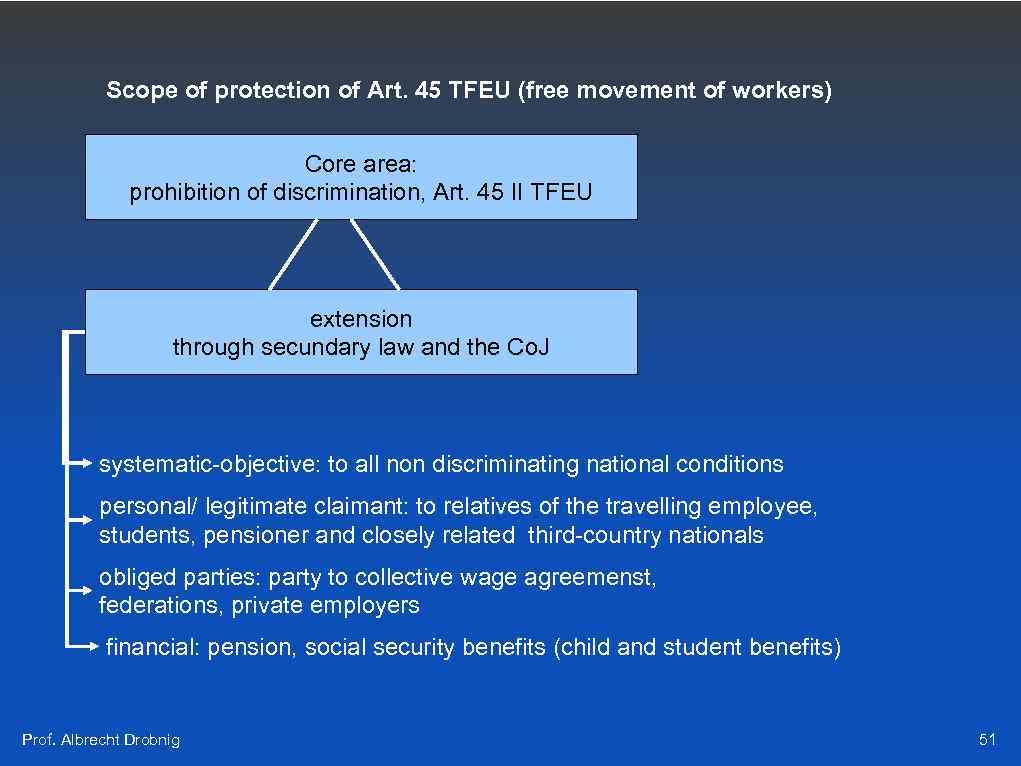 Scope of protection of Art. 45 TFEU (free movement of workers) Core area: prohibition of discrimination, Art. 45 II TFEU extension through secundary law and the Co. J systematic-objective: to all non discriminating national conditions personal/ legitimate claimant: to relatives of the travelling employee, students, pensioner and closely related third-country nationals obliged parties: party to collective wage agreemenst, federations, private employers financial: pension, social security benefits (child and student benefits) Prof. Albrecht Drobnig 51
 • The Di Leo judgement, Co. J-(ex-ECJ) Case 3/90 as of February 26, 1992 http: //lexetius. com/1992, 371 (concerning a BAföG-claim for an academic study in ones homecountry) Ms. Di Leo, daughter of an Italian migrant worker in Germany, is entitled to BAföG (financial state aid for students), even if she wants to study in her parents´ home country. The right to BAFöG of migrant workers´children can not be declined because such a child studies in her parents´ home country. Prof. Albrecht Drobnig 52
 • Court decision Angonese (Rs. C-281/98) 06. 2000 http: //eur-lex. europa. eu/Lex. Uri. Serv. do? uri=CELEX: 61998 J 0281: EN: HTML Case: Mr. Angonese is an Italian citizen and lives in South Tyrol. His native language is German. After finishing his studies in Austria he applied for a job in a private bank in Bozen (South Tyrol). His application was declined since he did not present the „patentino“, a certificate confirming bilinguality (German, Italian). The „patentino“ is issued exclusively in Bozen, South Tyrol. Other certificates proving bilinguality were not accepted. Mr. Angonese felt discriminated by the South Tyrolian bank and sued it for compensation. Decision: The court agreed with Mr. Angonese. The requirement to bring forward a „patentino“ in connection with job applications means a discrimination of nonresident candidates. As the patentino is only issued in Bozen, South Tyrol, nonresidents need greater effort to gain it and are thereby discriminated. Both, public and private employers have to observe the non-discrimination rule (Art. 45 II TFEU). Prof. Albrecht Drobnig 53
 • Important exceptions from the right of free movement of workers: - The right of free movement of workers can be limited for reasons of public policy, public security and public health, Art. 45 III TFEU. E. g. vis-à-vis members of Scientology, criminal workers, workers with epidemic infection. - Freedom of movement of workers is not applicable to employment in public service, Art. 45 IV TFEU. - Court of Justice: exceptions of the right of free movement of workers have to be interpreted in a narrow sense. The term „public service“ covers only sovereign acts of state like defence, police force, customs and justice. Jobs in public institutions offering public services (education, transport, energy supply, telecommunications) cannot be limited. Prof. Albrecht Drobnig 54
 • to fulfill the principle of proportionality (Art. 5 para. 4 TEU), i. e. they have to be - appropriate, - necessary and - reasonable. • Prof. Albrecht Drobnig 55
 II. Freedom of Establishment, Art. 49 - 55 TFEU The right of self-employed persons to perform self-employment permanently as a single person or as a company in another Member State is covered by Art. 49, 54 TFEU (freedom to provide services: temporary employment, Art. 56, 57 para. 3 TFEU). • Gebhard judgement, Co. J (ex-ECJ) Case 55/94 as of November 30, 1995 http: //eur-lex. europa. eu/Lex. Uri. Serv. do? uri=CELEX: 61994 J 0055: EN: HTML The freedom of establishment (Art. 49 TFEU) takes precedence over the freedom to provide services (Art. 56 ff. TFEU). The distinction between permanent (freedom of establishment) and temporary (freedom to provide services) employment in other Member States is based on - duration, - frequency and - recurrence of the services provided. Prof. Albrecht Drobnig 56
 Art. 49 TFEU (freedom of establishment) grants the right of treatment equal to residents. This means that the set up and pursuit of activities of selfemployed persons as well as the establishment and managing of companies underlie the rules of the country where the business is carried out, Art. 49 II TFEU. It is not allowed to demand higher standards from EU-citizens than from residents of the respective Member State. Same applies for the acceptance of foreign certificates and qualifications, Art. 53 TFEU. Prof. Albrecht Drobnig 57
 It is only tolerable to insist on special requirements (certificate, reference or qualification) for citizens of other Member States pursuing self-employment and/or using a job title (e. g. avvocato) for reasons of public policy, public security or public health, Art. 52 Abs. 1 TFEU. To prevent national restricting rules from violating Art. 49 TFEU, these rules have - to be justified by urgent reasons of public interest, Art 52 TFEU, - to be applied non-discriminatory and - to fulfill the principle of proportionality, Art. 5 Abs. 4 TEU; National requirements are proportional if they are appropriate, necessary and reasonable in order to achieve the respective objective. Consequence: Example for attorneys from other Member States working in Italy: Italy may require an additional exam in Italian law. However, an Italian rule has to consider legal knowledge already acquired in other Member States. Prof. Albrecht Drobnig 58
 Limitations of the freedom of establishment • Art. 51 TFEU: According to Art. 51 TFEU the freedom of establishment shall not apply to activities with the exercise of official authority. As it is a restriction of one of the freedoms, the restriction is narrowly interpreted by the Co. J. - The Co. J approved exercise of official authority for notaries certifying documents. - The Co. J declined exercise of official authority for lawyers and auditors in Belgium as well as for experts of car accidents in Greece. • Art. 52 TFEU: Restricting provisions for EU-citizens of other Member States may be justified only on reasons of public policy, public security or public health. As restriction it has to be interpreted narrowly. Examples for restrictions: - serious previous conviction of the applicant, - reasonable suspicion of industrial espionage, - danger of introducing an epidemic. Principle of proportionality, Art. 5 Abs. 4 TEU: Only the mildest means necessary to achieve the objective is justified. Prof. Albrecht Drobnig 59
 Freedom of establishment case law: please differentiate between companies moving to or moving out of a Member State. 1. Co. J-(ex-ECJ) Daily Mail judgement (Case 81/87) as of September 27, 1988 http: //eur-lex. europa. eu/Lex. Uri. Serv. do? uri=CELEX: 61987 J 0081: EN: HTML Facts of the case (moving out of a Member State): The Daily Mail and General Trust plc (incorporated in Great Britain) wanted to transfer its seat to the Netherlands in order to benefit from tax advantages in connection with a planned restructuring of the company. However, the British Ministry of Finance denied its legally necessary consent for the seat transfer. Thus the British tax law forbids companies to move the fiscal place of business abroad without an approval of the Ministry. The approval was denied as the Ministry at least asked for a partial taxation in Great Britain. Prof. Albrecht Drobnig 60
 Decision: The right of free establishment is a basic rule of EU-law (Art. 49 ff. TFEU). It prevents Member States from constraining the relocation of citizens or companies to other Member States. This freedom is ensured by granting the possibility to found subsidiaries or affiliates in other Member States. But Art. 49 and 54 TFEU cannot be interpreted in that way that companies may move their executive board into another Member State while keeping their legal personality. Prof. Albrecht Drobnig 61
 Moving to another Member State of the EU: 2. Court decision Centros (C-212/97) 9. 3. 1999 http: //curia. europa. eu/jurisp/cgi-bin/form. pl? lang=en Facts of the case: The Danish Trade and Companies Board rejected to register a permanent establishment of Centros Ltd. , a British registered "private limited company by shares”, in Denmark. Centros Ltd. had been founded in Great Britain by a Danish couple and maintained a registered office at the residence of a friend of the Danish couple. However Centros Ltd. never carried out any business in Great Britain. It managed business in Denmark only. Even though the Danish law grants the right to install a permanent establishment in Denmark, the request had been denied. The authorities argued that Centros Ltd. in fact did not want to maintain a permanent establishment but a headquaters avoiding national requirements connected with the establishment of a headquaters. Prof. Albrecht Drobnig 62
 Decision: The registration of a permanent establishment should not be rejected, if the company has been effectively constituted in another Member State. It is irrelevant wether the company carries out any business in its country of origin. The intention of Art. 49, 54 TFEU is that companies which have been founded within the EU are empowered to start business in any other Member State by building up permanent establishments. It is no misuse of the freedom of establishment if a EU-citizen founds a company in the Member State which offers the most favorable legal framework. Furthermore it is irrelevant if permanent establishments in other Member States are set up afterwards. Prof. Albrecht Drobnig 63
 3. Court Decision Überseering (C-208/00) 5. 11. 2002 http: //curia. europa. eu/jurisp/cgibin/gettext. pl? lang=en&num=79978894 C 19000208&doc=T&ouvert=T&seance=ARRET Facts of the case: The Nederland Besloten Vennootschap (BV) „Überseering“, a Dutch corporation, owned property in Düsseldorf, Germany, including a garage which needed renovation and a motel. In 1992 Überseering authorized a German building company to carry out the necessary renovations. The building company did not carry out the renovation properly. Therefore Überseering sued the building company for damages of one million DM. In the meantime the executive board and the representation of Überseering BV had been moved to Germany. Due to this German courts presumed that Überseering BV moved its headquarter to Germany and denied Überseering BV´s legal personality and legal capacity. Prof. Albrecht Drobnig 64
 Decision: The Court of Justice decided it as violation of EU-law if legal personality and legal capacity of a company founded according to the laws of a EUMember State are denied. In this case the Court of Justice only had to decide about the question of legal personality and legal capacity of a company moving its headquarters to another member state (Preliminary ruling, Art. 267 TFEU). It did not have to decide about the legal form of the company. The (German) Federal Court of Justice decided, that a company that moved its headquarters to Germany is treated as a BGB-company (private partnership under German civil code). This means, that the company has another legal form in Germany than in its country of origin. (BGH, 13. 03. 2003, VII ZR 370/98, http: //juris. bundesgerichtshof. de/cgibin/rechtsprechung/document. py? Gericht=bgh&Art=en&sid=ad 97614620 ba 3 aff 7 f 3 c 561 a 2 cc 9 e 7 ec&nr=25771&pos=23&anz=31) Prof. Albrecht Drobnig 65
 4. Court decision Inspire Arts (C-167/01) 30. 09. 2003 http: //curia. europa. eu/jurisp/cgibin/gettext. pl? lang=en&num=79969069 C 19010167&doc=T&ouvert=T&seance=ARRET&where Case: Inspire Art Ltd. has been established on July 28, 2000 as a „private company limited by shares" according to British law. The headquarters were located in Folkestone (Great Britain). Its sole director lived in Den Haag (Netherlands) and had individual power of representation. Inspire Art Ltd. maintained a permanent establishment in Amsterdam where it carried out its business exclusively. An additional specification identifying Inspire Art Ltd. as foreign company had not been registered in the Amsterdam trade register. The Amsterdam chamber of commerce held the opinion that such additional specification is mandatory and filed a claim at the district court in Amsterdam. The status as foreign company would have entailed additional legal obligations, e. g. personal liability of its directors). However, Inspire Art Ltd. esteemed a mandatory registration as foreign company as violation of Art. 49, 54 TFEU. Prof. Albrecht Drobnig 66
 Decision: The rules regarding the freedom of establishment (Art. 49 ff. , 54 TFEU) intend to grant companies being incorporated in line with the law of a Member State the right to conduct their business in any other Member State by opening up agencies, subsidiaries or any other form of permanent establishments. It is in line with the guaranteed freedom of establishment (Art. 49, 54 TFEU) if a company is founded according to the most favorable legal framework of a Member State and opens permanent establishments in other Member States afterwards. It is neither misuse nor deception if a company does not conduct any or only small business in the country where it had been founded but mainly carries out its business in a permanent establishment in another Member State. The Member State where the company was incorporated is not entitled to exclude the company from application of EU-law due to this. Prof. Albrecht Drobnig 67
 5. Court Case Sevic (C-411/03) 13. 12. 2005 http: //lexetius. com/2005, 2856 Case: In 2002 the German SEVIC System AG and the Luxembourgian Security Vision Concept SA signed a merger agreement. The merger agreement determined that Security Vision Concept SA would be merged in SEVIC SYTEM AG (transfer of its assets to SEVIC System AG without being dissolved and without amortization of undisclosed reserves). The local court of Neuwied declined the request to register the merger in the local trade register. It was of the opinion the German Mergers Act (Umwandlungsgesetz = Umw. G) is – due to its wording - only applicable on mergers of legal entities maintaining their headquarters in Germany (§ 1 (1) No. 1 Umw. G). Prof. Albrecht Drobnig 68
 Decision: It is a violation of the freedom of establishment (Art. 49, 54 TFEU) if the merger of a German company and a company from another Member State cannot be registered in a German trade register. Purely domestic mergers and mergers of companies based in different EU Member States (cross-border-merger) should not be treated differently under the rule of the freedom of establishment (Art. 49, 54 TFEU). Adverse treatment of EU-cross border mergers is not justified by protection of public policy, Art. 52 TFEU. Prof. Albrecht Drobnig 69
 Moving out of a Member State: 6. Cartesio judgement, Co. J (ex-ECJ) (C-210/06) of 16. December 2008 http: //curia. europa. eu/jurisp/cgi-bin/form. pl? lang=EN&Submit=recher&numaff=C-210/06 Facts of the case: Cartesio was established on 20. May 2004 as a „betéti társaság“ (limited partnership) according to Hungarian law. The company´s seat was located in Baja (Hungary). It was registered on 11. June 2004. The company had a limited an unlimited partner both being inhabitants and citizens of Hungary. Cartesio mainly operated its business in the field of human resources, translation, teaching and education. After having decided to transfer its company seat from Baja (Hungary) to Gallarate (Italy) Cartesio applied on 11. November 2005 to the competent Hungarian commercial court (trade register) to register to new company seat. Prof. Albrecht Drobnig 70
 The registration of Gallarate (Italy) as new company seat was declined by the Hungarian trade court arguing a company incorporated according to and ruled by Hungarian law may not transfer its seat to another Member State whilst retaining its status as company governed by Hungarian law. Decision: The refusal of the Hungarian commercial court to register the transfer of the seat does not violate the freedom of establishment, Art. 49, 54 TFEU. Art. 49, 54 TFEU do not exclude national legislation of a Member State forbidding companies incorporated under the law of that Member State to transfer their seats to another Member State whilst retaining their status as companies governed by the law of the Member State of incorporation. Prof. Albrecht Drobnig 71
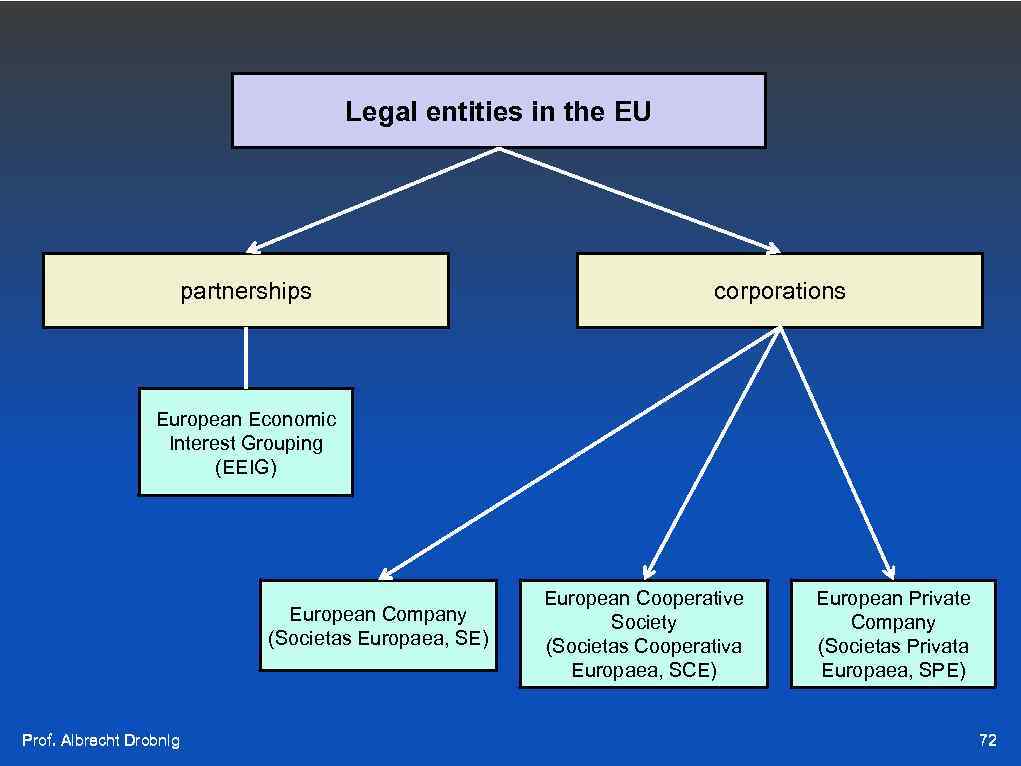 Legal entities in the EU partnerships corporations European Economic Interest Grouping (EEIG) European Company (Societas Europaea, SE) Prof. Albrecht Drobnig European Cooperative Society (Societas Cooperativa Europaea, SCE) European Private Company (Societas Privata Europaea, SPE) 72
 Freedom to provide services, Art. 56 -62 TFEU Art. 56 TFEU: The freedom to provide services extends the freedom of establishment on temporary occupations in other Member State. Services may be offered and rendered in other Member States without maintaining permanent establishments in these Member States. The freedom to provide services includes the right to reside temporarily in other Member States in order to provide the offered services. Prof. Albrecht Drobnig 73
 Content of Art. 57 TFEU: • definition of the term “service” • the freedom to provide service is subsidiary to the other freedoms granted according to EU-law • Art. 57 is only applicable, if: - the provider of services - the recipient or - the service itself crosses the border of a Member State, see Art. 56 para. 1 TFEU. The freedom to provide services comprises the right of a self employed person to sustain a minimum of infrastructure in the host country, e. g. office to collect orders or to distribute advertising material. Restrictions: Art. 62 TFEU (with reference to Art. 51, 52 TFEU - exercise of official authority, public policy, public security, public health). Principle of proportionality It is only allowed to use the mildest means necessary to achieve the objective. Prof. Albrecht Drobnig 74
 Art. 62 i. c. w. Art. 53 TFEU: National regulations that determine the conduct of business in service industries can be harmonized. This has already been done in the area of banking and insurance, see Art. 58 para. 2. Banks and insurance companies may offer financial services throughout the EU since 1994, provided they: • are registered in one Member State (principle of single registration) and • are controlled by the supervisory body in their home country, ome-country-control „country-of-origin principle“, the derived from principle“. Prof. Albrecht Drobnig 75
 Directive concerning the delegation of workers within the framework of the provision of services (Directive 96/71/EG as of December 16, 1996) http: //eur-lex. europa. eu/Lex. Uri. Serv. do? uri=CELEX: 31996 L 0071: DE: HTML • the directive is applicable if companies delegate employees to another Member State keeping up the employment contract. • Member States shall ensure that companies guarantee their delegated workers the terms and conditions of employment which are laid down by law, regulation or administrative provision and/or by collective agreements or arbitration awards in the country of destination. • “country-of-destination principle” Prof. Albrecht Drobnig 76
 • Working and employment conditions according to laws and rules of the country of destination: maximum work periods and minimum rest periods; minimum period of paid annual holiday minimum wages including overtime payment conditions for temporary employments health, safety and sanitary conditions at work safety measures in respect of employed pregnant women or women who have recently given birth, of children and of youths; equal treatment of men and women and other provisions guaranteeing non-discrimination. Prof. Albrecht Drobnig 77
 Exemptions The directive entered into force at the date of its issue. However Member States may deviate from the principle of immediate application of the directive (96/71/EG) in respect of: and if the worker is not employed by a temporary-employment agency; carried out is marginal and if the worker is not employed by a temporary-employment agency; Prof. Albrecht Drobnig 78
 Free movement of capital and payments, Art. 63 -66 TFEU Art. 63 TFEU is applicable on movements of capital and on payments between Member States and third countries. There is no need for the owner of capital respectively the payee of payments to be a national of an Member State. Consequence: Even an US-American, Russian or Japanese shareholder may rely on the free movement of capital and payments granted according to Art. 63 TFEU if he is involved in financial transactions in a Member State. Restrictions: Art. 65 TFEU: restrictions due to national fiscal reasons are allowed. Art. 64, 66 TFEU: restrictions in relation to non-Member States are acceptable for a limited period if strictly necessary. Prof. Albrecht Drobnig 79